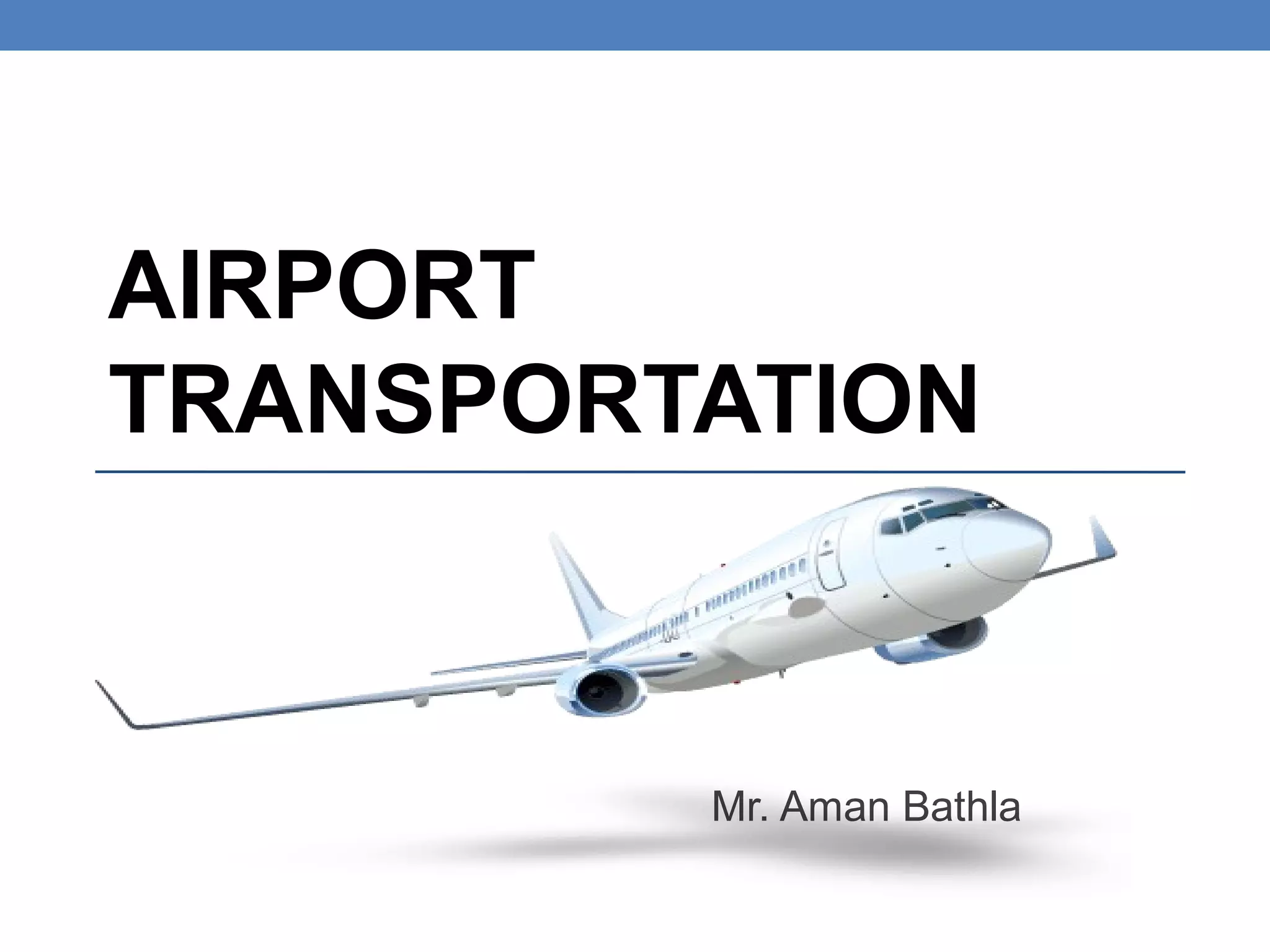

AIRPORT
TRANSPORTATION
Mr. Aman Bathla
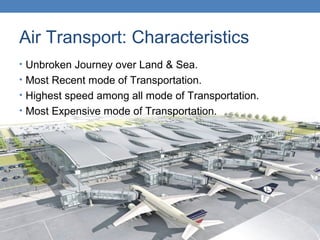
Air Transport: Characteristics
• Unbroken Journey over Land & Sea.
• Most Recent mode of Transportation.
• Highest speed among all mode of Transportation.
• Most Expensive mode of Transportation.
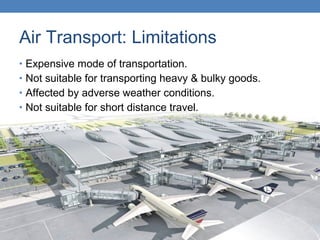
Air Transport: Limitations
• Expensive mode of transportation.
• Not suitable for transporting heavy & bulky goods.
• Affected by adverse weather conditions.
• Not suitable for short distance travel.
Air Transport: Importance
• Economical for long distances transportation of costly &
light-weight consignments.
• Ideal transportation in emergency & calamities.
• Connects countries of different continents.
Air Transport: Status in India
• Air transport in India started between Allahabad & Naini in
1911.
• Airport Authority of India was established on April 1st
,
1985.
• The Air India, has become the 16th
largest airline in Asia.
Presently, operate at the fleet of 159 crafts & serves 50
domestic & 39 International routes.
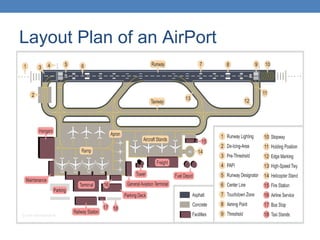
Layout Plan of an AirPort
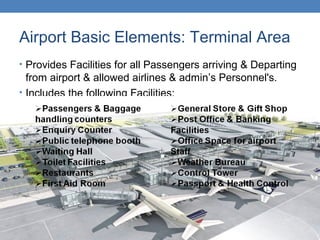
Airport Basic Elements: Terminal Area
• Provides Facilities for all Passengers arriving & Departing
from airport & allowed airlines & admin’s Personnel's.
• Includes the following Facilities:
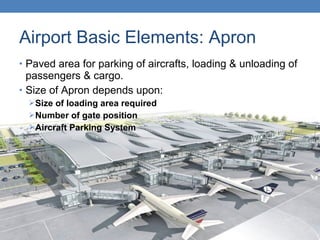
Airport Basic Elements: Apron
• Paved area for parking of aircrafts, loading & unloading of
passengers & cargo.
• Size of Apron depends upon:
Size of loading area required
Number of gate position
Aircraft Parking System
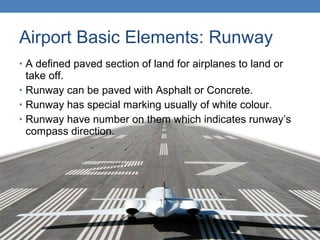
Airport Basic Elements: Runway
• A defined paved section of land for airplanes to land or
take off.
• Runway can be paved with Asphalt or Concrete.
• Runway has special marking usually of white colour.
• Runway have number on them which indicates runway’s
compass direction.
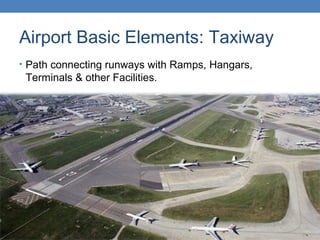
Airport Basic Elements: Taxiway
• Path connecting runways with Ramps, Hangars,
Terminals & other Facilities.
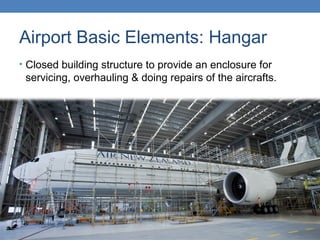
Airport Basic Elements: Hangar
• Closed building structure to provide an enclosure for
servicing, overhauling & doing repairs of the aircrafts.
ANY QUESTION?

Air Transportation Basic Elements

  • 1.
  • 2.
    Air Transport: Characteristics •Unbroken Journey over Land & Sea. • Most Recent mode of Transportation. • Highest speed among all mode of Transportation. • Most Expensive mode of Transportation.
  • 3.
    Air Transport: Limitations •Expensive mode of transportation. • Not suitable for transporting heavy & bulky goods. • Affected by adverse weather conditions. • Not suitable for short distance travel.
  • 4.
    Air Transport: Importance •Economical for long distances transportation of costly & light-weight consignments. • Ideal transportation in emergency & calamities. • Connects countries of different continents.
  • 5.
    Air Transport: Statusin India • Air transport in India started between Allahabad & Naini in 1911. • Airport Authority of India was established on April 1st , 1985. • The Air India, has become the 16th largest airline in Asia. Presently, operate at the fleet of 159 crafts & serves 50 domestic & 39 International routes.
  • 6.
    Layout Plan ofan AirPort
  • 7.
    Airport Basic Elements:Terminal Area • Provides Facilities for all Passengers arriving & Departing from airport & allowed airlines & admin’s Personnel's. • Includes the following Facilities:
  • 8.
    Airport Basic Elements:Apron • Paved area for parking of aircrafts, loading & unloading of passengers & cargo. • Size of Apron depends upon: Size of loading area required Number of gate position Aircraft Parking System
  • 9.
    Airport Basic Elements:Runway • A defined paved section of land for airplanes to land or take off. • Runway can be paved with Asphalt or Concrete. • Runway has special marking usually of white colour. • Runway have number on them which indicates runway’s compass direction.
  • 10.
    Airport Basic Elements:Taxiway • Path connecting runways with Ramps, Hangars, Terminals & other Facilities.
  • 11.
    Airport Basic Elements:Hangar • Closed building structure to provide an enclosure for servicing, overhauling & doing repairs of the aircrafts.
  • 12.