GEOMETRIC DESIGN OF TRACK
BY-ER. MOHIT DUREJA
NECESSITY OF GEOMETRIC DESIGN OF TRACK
• TO PREVENT TRAIN DERAILMENTS
Most of the derailments occur due to following reason
– Track defect : Civil engineer is mainly concern with
track defects. He should be aware of the track defects
and how to remove these defects so that no
derailment takes place.
– Vehicular defect
– Operational defect
• To suiting load of the train,
• speed of the train and
• meeting the safety and economic requirements
BY-ER. MOHIT DUREJA
• On straight track derailment occur due to
 Defective cross level
 Defective alignment
• On curved track derailment occur due to
 Improper superelivatioon
 Improper radius of curve
 Improper speed
 Unequal distributution of loads on two rail
• On turouts and crossinng derailment occur due to
 Gaping
 Lifting of toe of switch due to inadequate fittings
 Improper assembly of crossing
 Excessive wear in switches
 Defective check clearance at the nose of crossing
Defective gauge
Low joints
BY-ER. MOHIT DUREJA
1) Gradient
• Any departure of the track from the level is
known as grade or gradient.
• Up or rising gradient is one when the track rises in the
direction of movement
• Down or falling gradient is one when the track falls in the
direction
Gradient is measured by two method
 Rise/Fall in 100 units (eg 4 in 100)
 Horizontal distance traveled in 1 unit (eg 1 in 25)
BY-ER. MOHIT DUREJA
Why Gradient provided ?
• To provide a uniform rate of rise or fall
• To reach the various station located at
different elevation
• To reduce the cost of earth work
BY-ER. MOHIT DUREJA
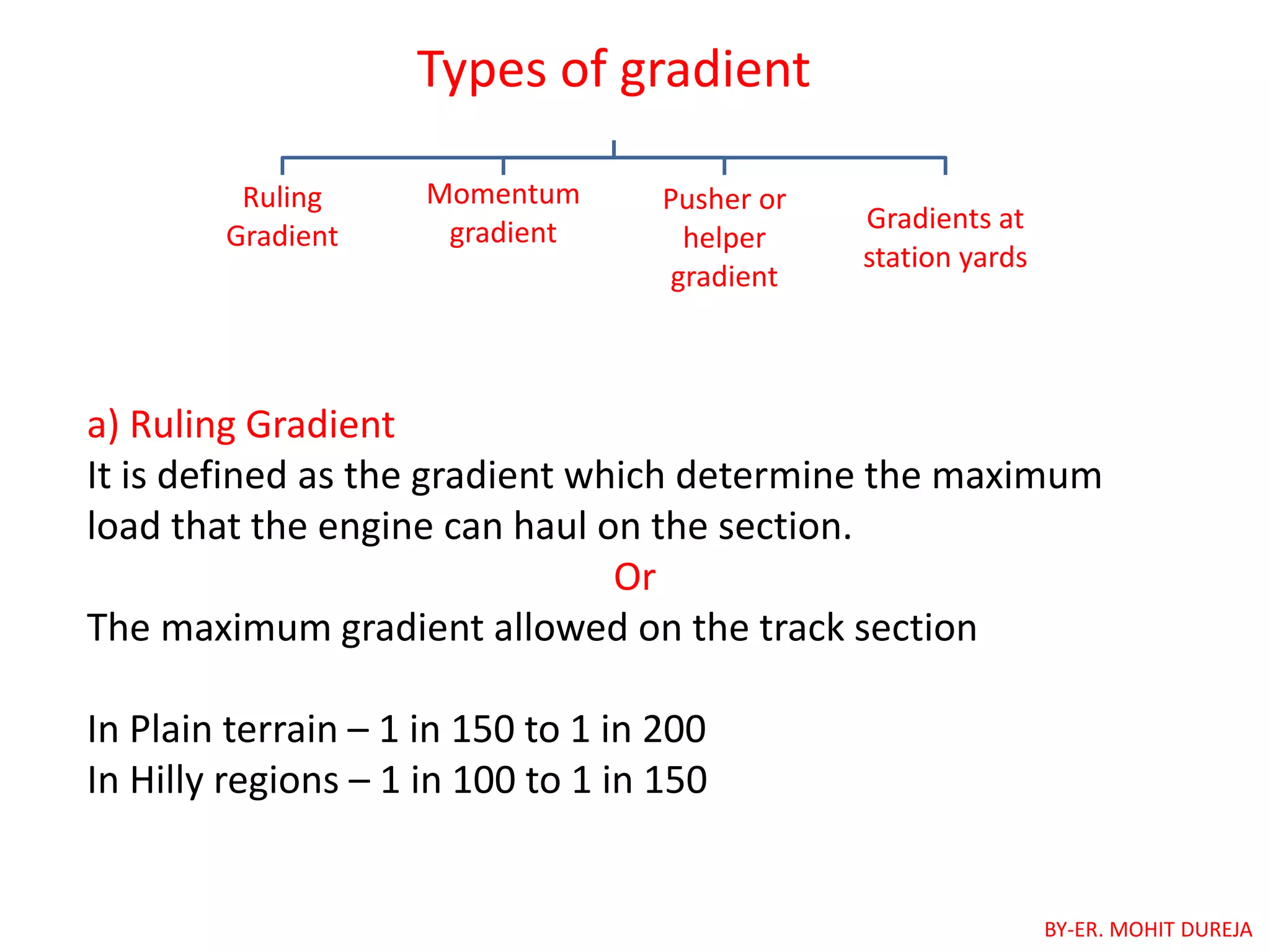
Types of gradient
Ruling
Gradient
Momentum
gradient
Pusher or
helper
gradient
Gradients at
station yards
a) Ruling Gradient
It is defined as the gradient which determine the maximum
load that the engine can haul on the section.
Or
The maximum gradient allowed on the track section
In Plain terrain – 1 in 150 to 1 in 200
In Hilly regions – 1 in 100 to 1 in 150
BY-ER. MOHIT DUREJA
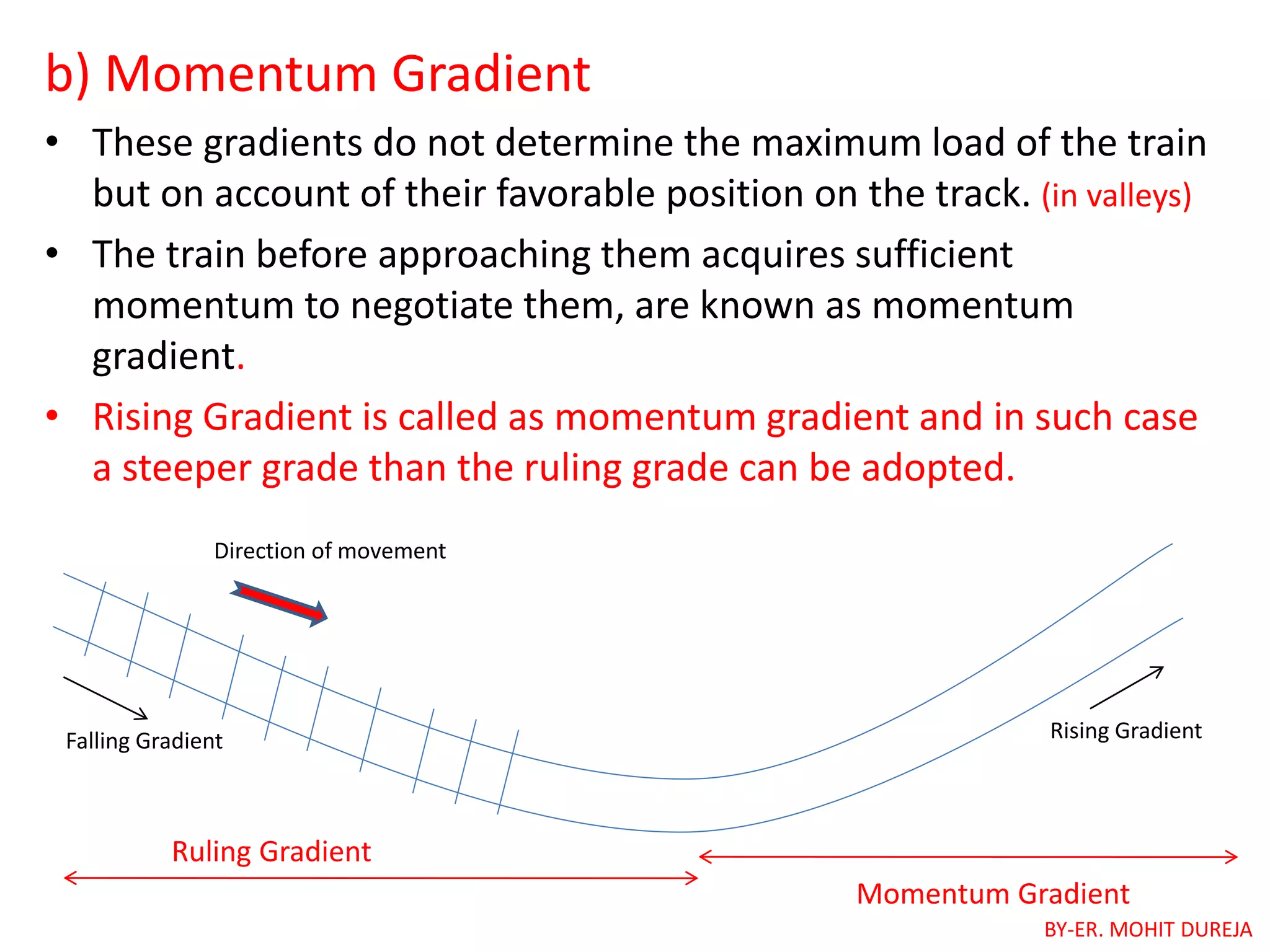
b) Momentum Gradient
• These gradients do not determine the maximum load of the train
but on account of their favorable position on the track. (in valleys)
• The train before approaching them acquires sufficient
momentum to negotiate them, are known as momentum
gradient.
• Rising Gradient is called as momentum gradient and in such case
a steeper grade than the ruling grade can be adopted.
Momentum Gradient
Ruling Gradient
Falling Gradient Rising Gradient
Direction of movement
BY-ER. MOHIT DUREJA
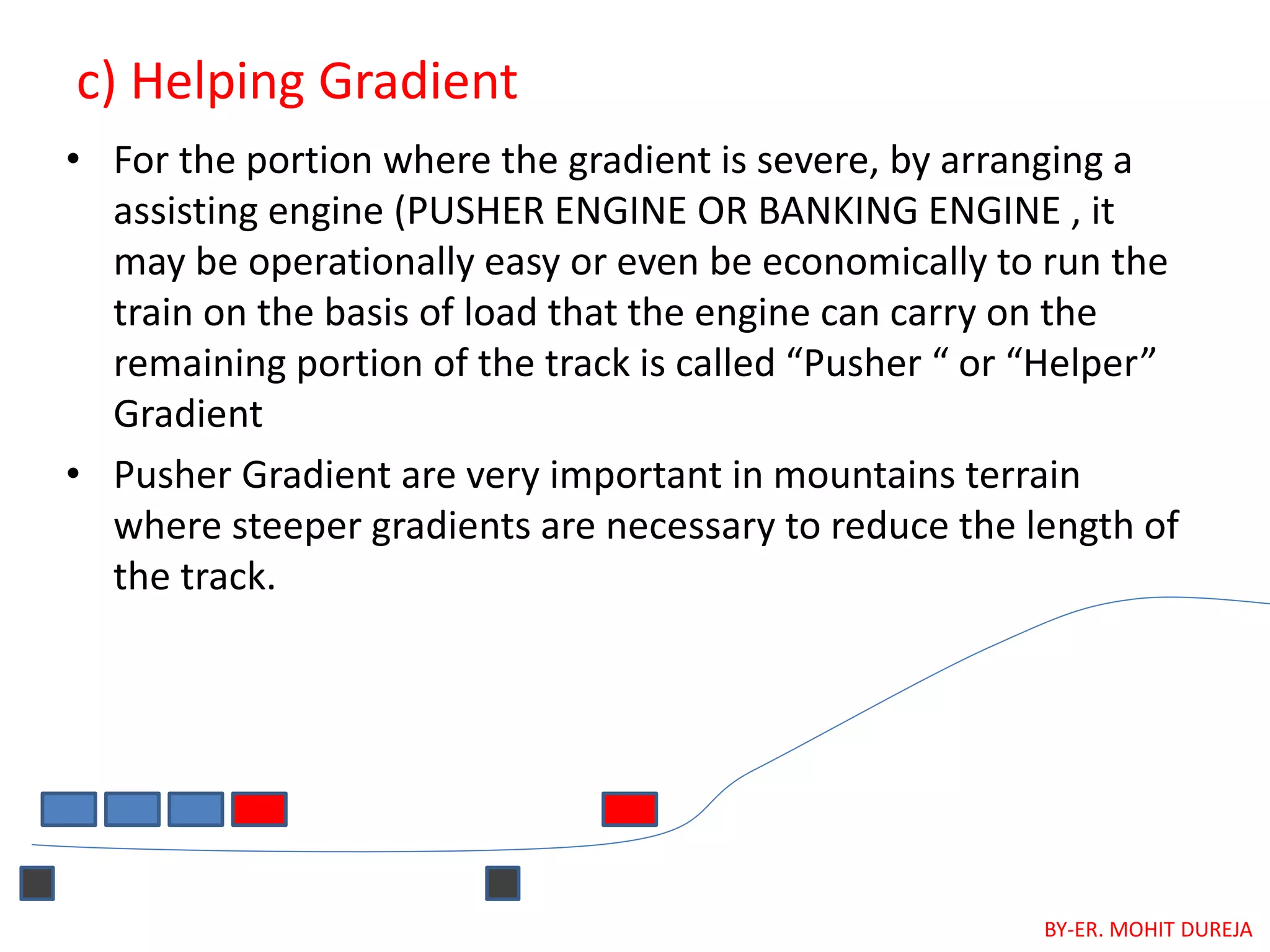
c) Helping Gradient
• For the portion where the gradient is severe, by arranging a
assisting engine (PUSHER ENGINE OR BANKING ENGINE , it
may be operationally easy or even be economically to run the
train on the basis of load that the engine can carry on the
remaining portion of the track is called “Pusher “ or “Helper”
Gradient
• Pusher Gradient are very important in mountains terrain
where steeper gradients are necessary to reduce the length of
the track.
BY-ER. MOHIT DUREJA
d) Gradients in station yards
• Gradietns in station yards are generally low:
– To prevent the movement of standing vehicle on
the track due to the effect of gravity
– In India permitted gradients in station yard
– Max- 1 in 400
– Min 1 in 1000 is recommended from drainage point of view
BY-ER. MOHIT DUREJA
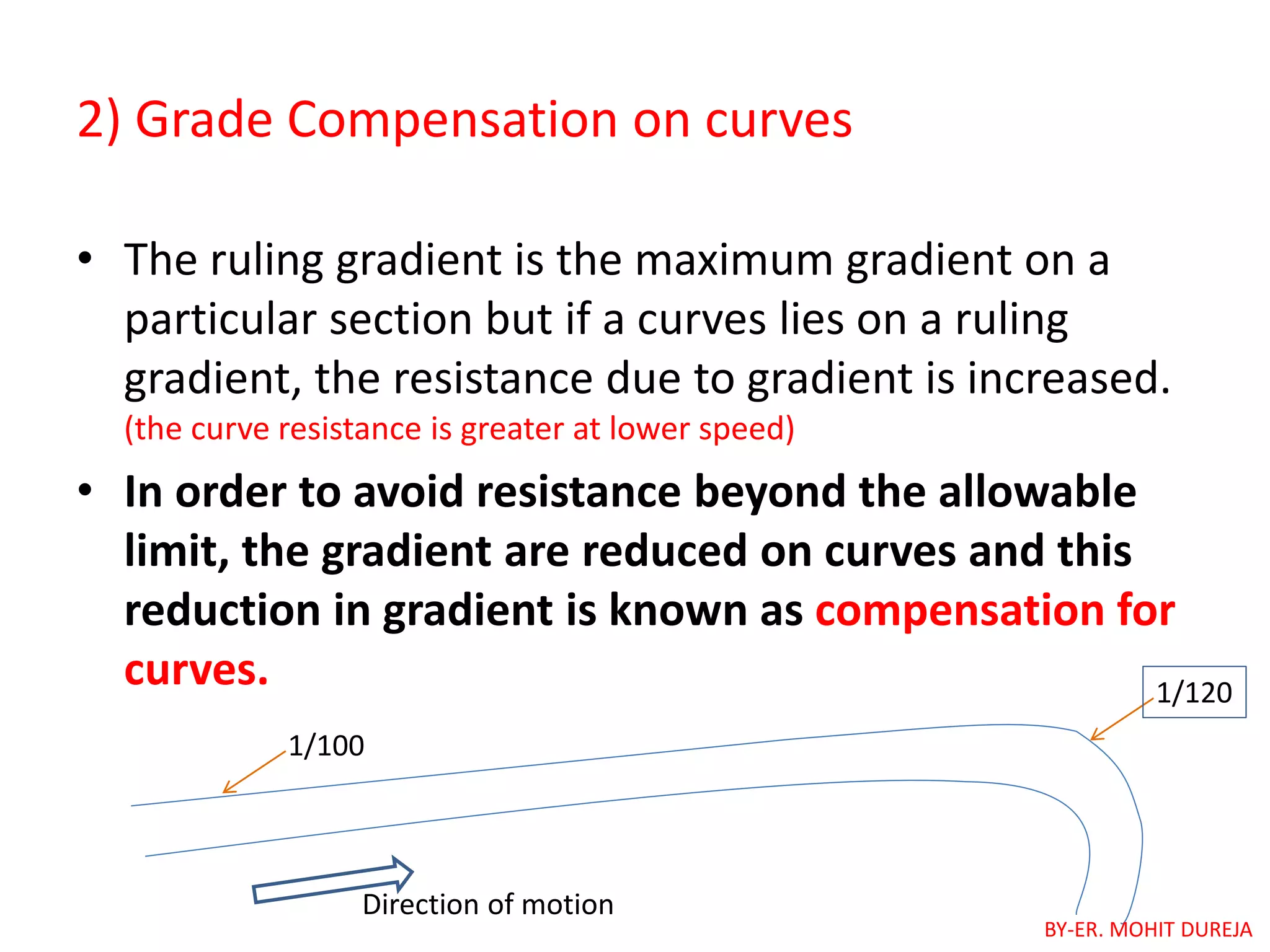
2) Grade Compensation on curves
• The ruling gradient is the maximum gradient on a
particular section but if a curves lies on a ruling
gradient, the resistance due to gradient is increased.
(the curve resistance is greater at lower speed)
• In order to avoid resistance beyond the allowable
limit, the gradient are reduced on curves and this
reduction in gradient is known as compensation for
curves.
1/100
1/120
Direction of motion
BY-ER. MOHIT DUREJA
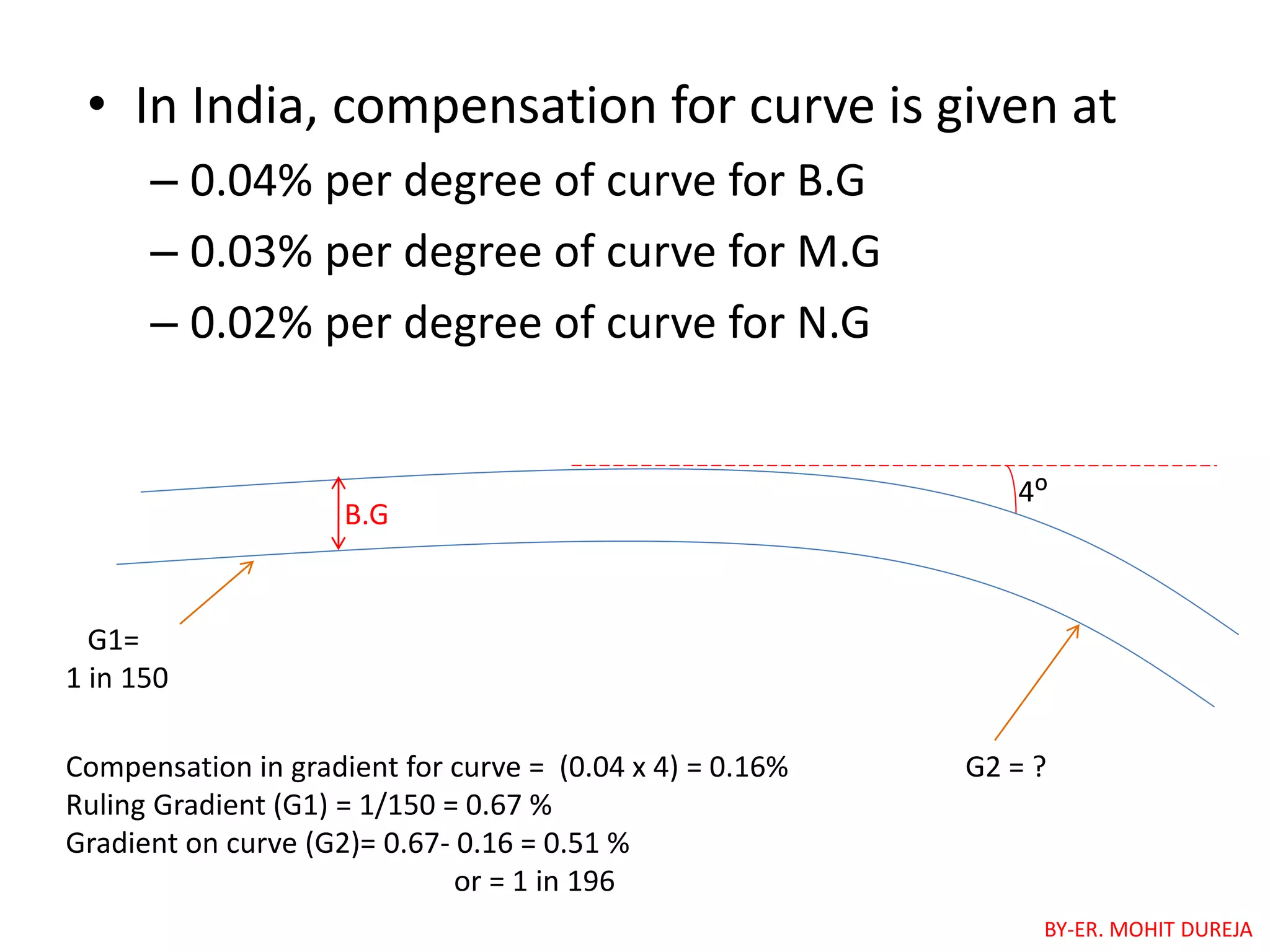
• In India, compensation for curve is given at
– 0.04% per degree of curve for B.G
– 0.03% per degree of curve for M.G
– 0.02% per degree of curve for N.G
4ᴼ
G1=
1 in 150
G2 = ?
B.G
Compensation in gradient for curve = (0.04 x 4) = 0.16%
Ruling Gradient (G1) = 1/150 = 0.67 %
Gradient on curve (G2)= 0.67- 0.16 = 0.51 %
or = 1 in 196
BY-ER. MOHIT DUREJA
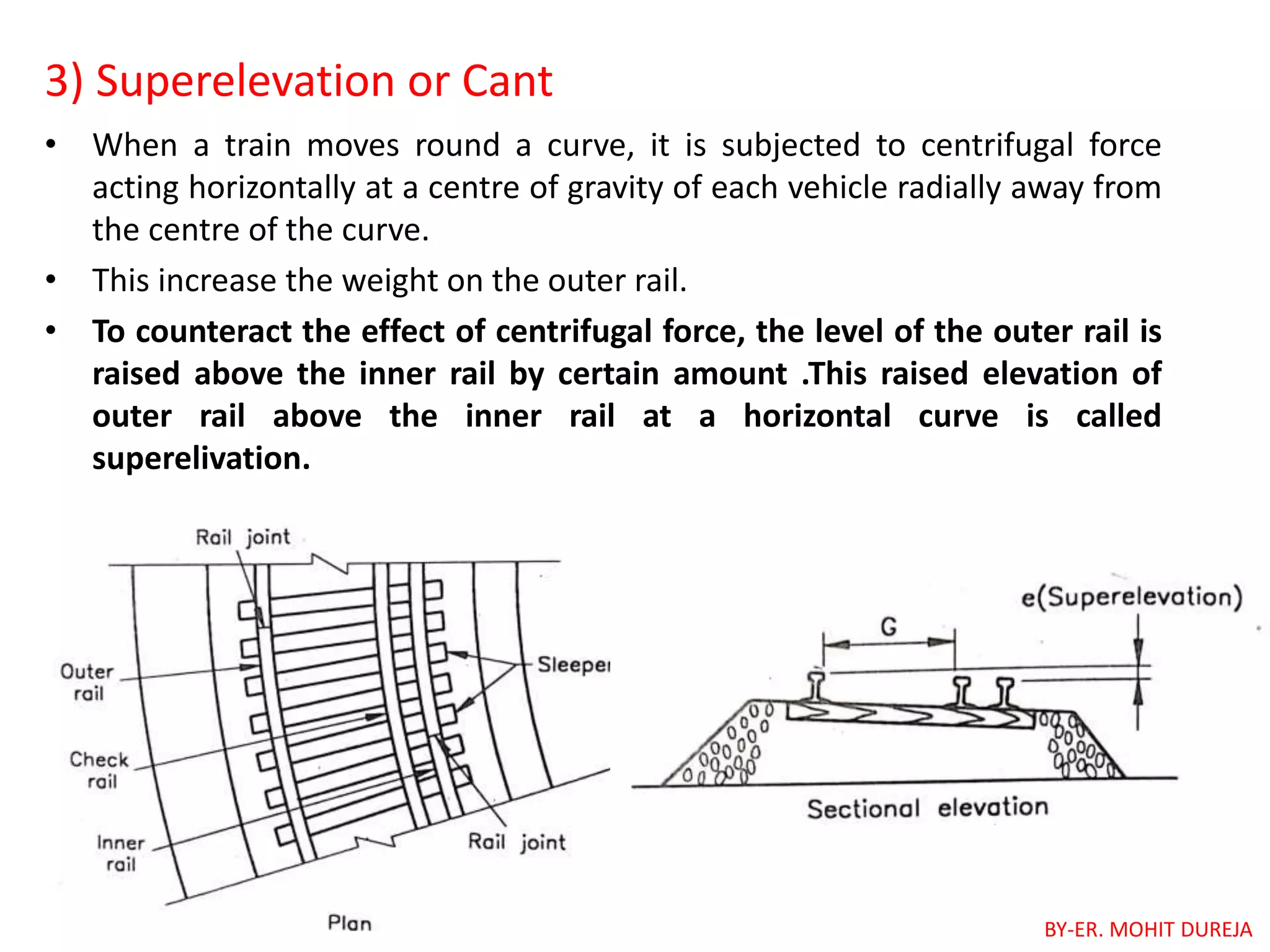
3) Superelevation or Cant
• When a train moves round a curve, it is subjected to centrifugal force
acting horizontally at a centre of gravity of each vehicle radially away from
the centre of the curve.
• This increase the weight on the outer rail.
• To counteract the effect of centrifugal force, the level of the outer rail is
raised above the inner rail by certain amount .This raised elevation of
outer rail above the inner rail at a horizontal curve is called
superelivation.
BY-ER. MOHIT DUREJA
Objective of providing Superelivation
• To introduce the centripetal force for counteracting the
effect of centrifugal force.
• Provide faster movement of train on the curve
• Prevent derailment
• Reduce the side wear and creep of rail leads reduce in
maintenance cost
• Provide equal distribution of wheel loads on two rails
• To provide an even and smooth running track to ensure
comfortable ride to passengers and safe movement of
goods.
BY-ER. MOHIT DUREJA
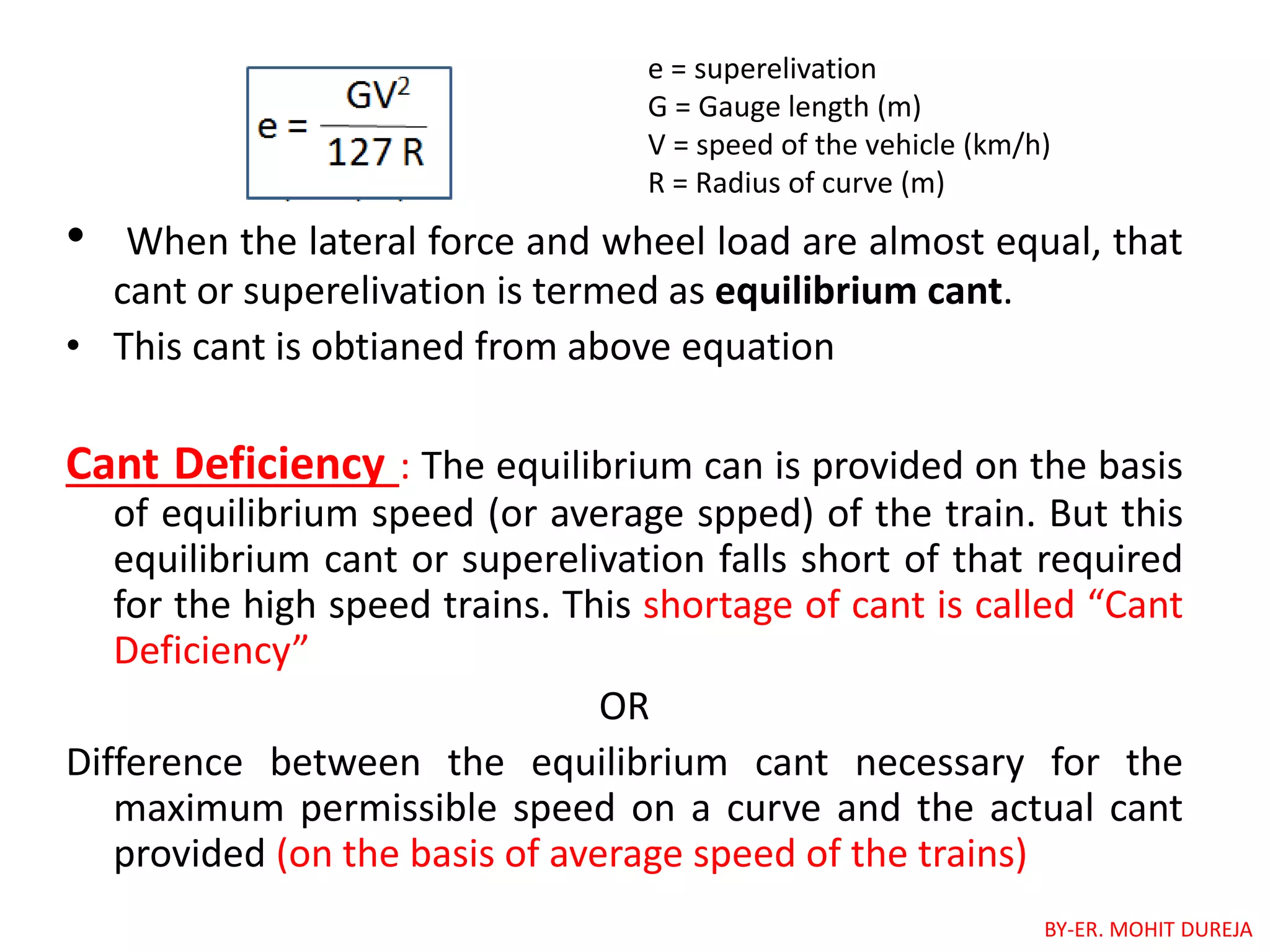
• When the lateral force and wheel load are almost equal, that
cant or superelivation is termed as equilibrium cant.
• This cant is obtianed from above equation
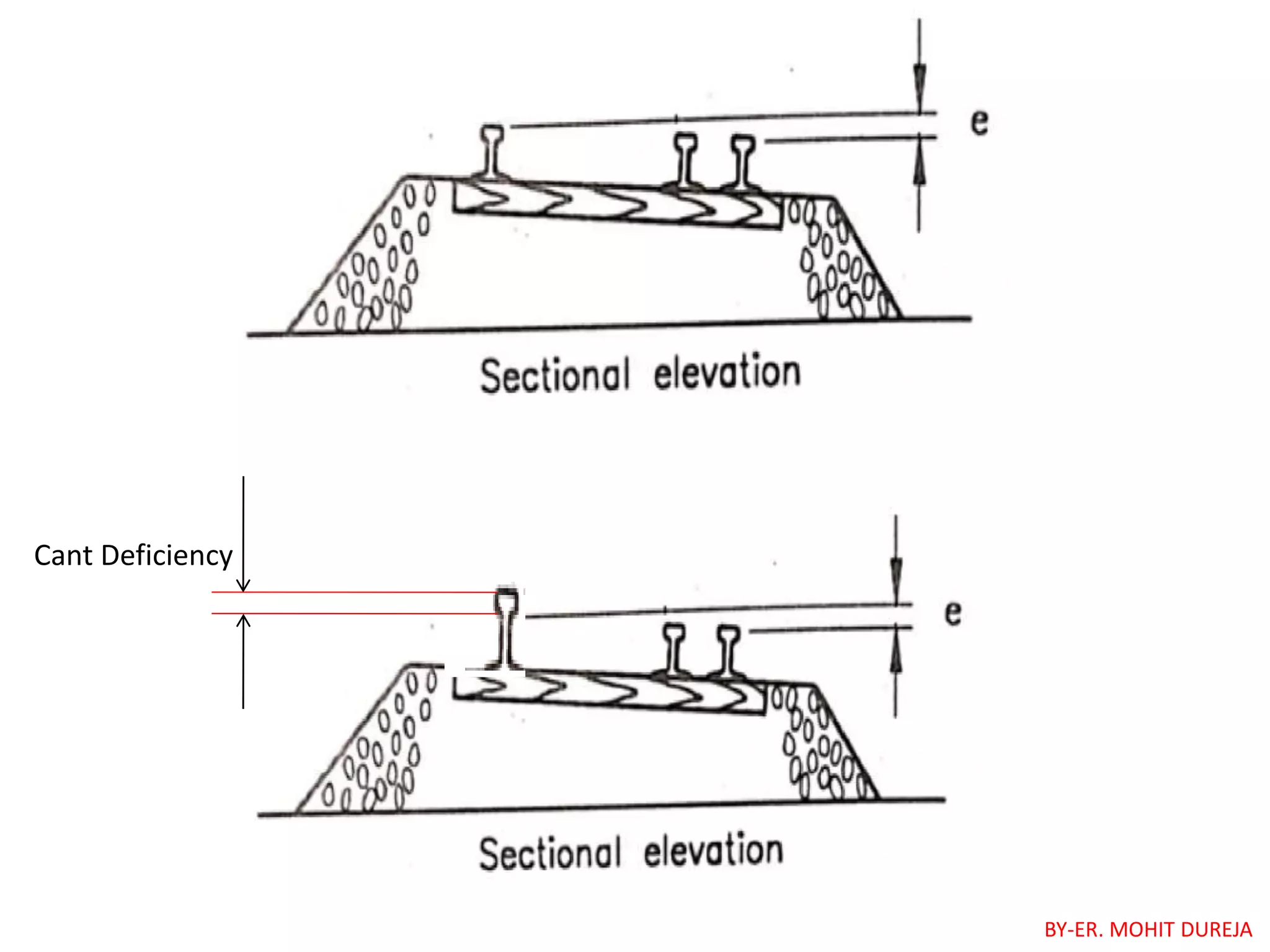
Cant Deficiency : The equilibrium can is provided on the basis
of equilibrium speed (or average spped) of the train. But this
equilibrium cant or superelivation falls short of that required
for the high speed trains. This shortage of cant is called “Cant
Deficiency”
OR
Difference between the equilibrium cant necessary for the
maximum permissible speed on a curve and the actual cant
provided (on the basis of average speed of the trains)
e = superelivation
G = Gauge length (m)
V = speed of the vehicle (km/h)
R = Radius of curve (m)
BY-ER. MOHIT DUREJA
Cant Deficiency
BY-ER. MOHIT DUREJA
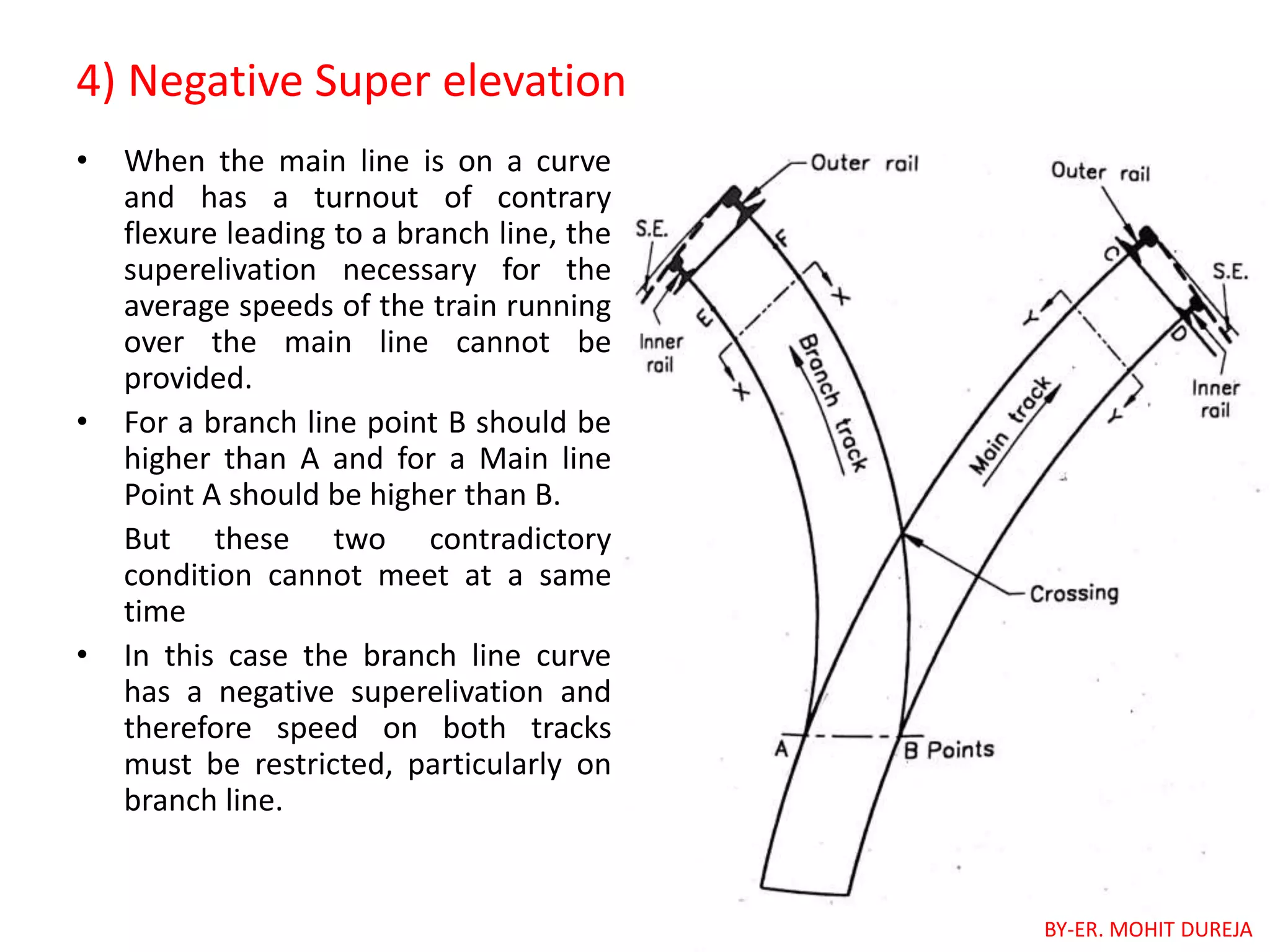
4) Negative Super elevation
• When the main line is on a curve
and has a turnout of contrary
flexure leading to a branch line, the
superelivation necessary for the
average speeds of the train running
over the main line cannot be
provided.
• For a branch line point B should be
higher than A and for a Main line
Point A should be higher than B.
But these two contradictory
condition cannot meet at a same
time
• In this case the branch line curve
has a negative superelivation and
therefore speed on both tracks
must be restricted, particularly on
branch line.
BY-ER. MOHIT DUREJA
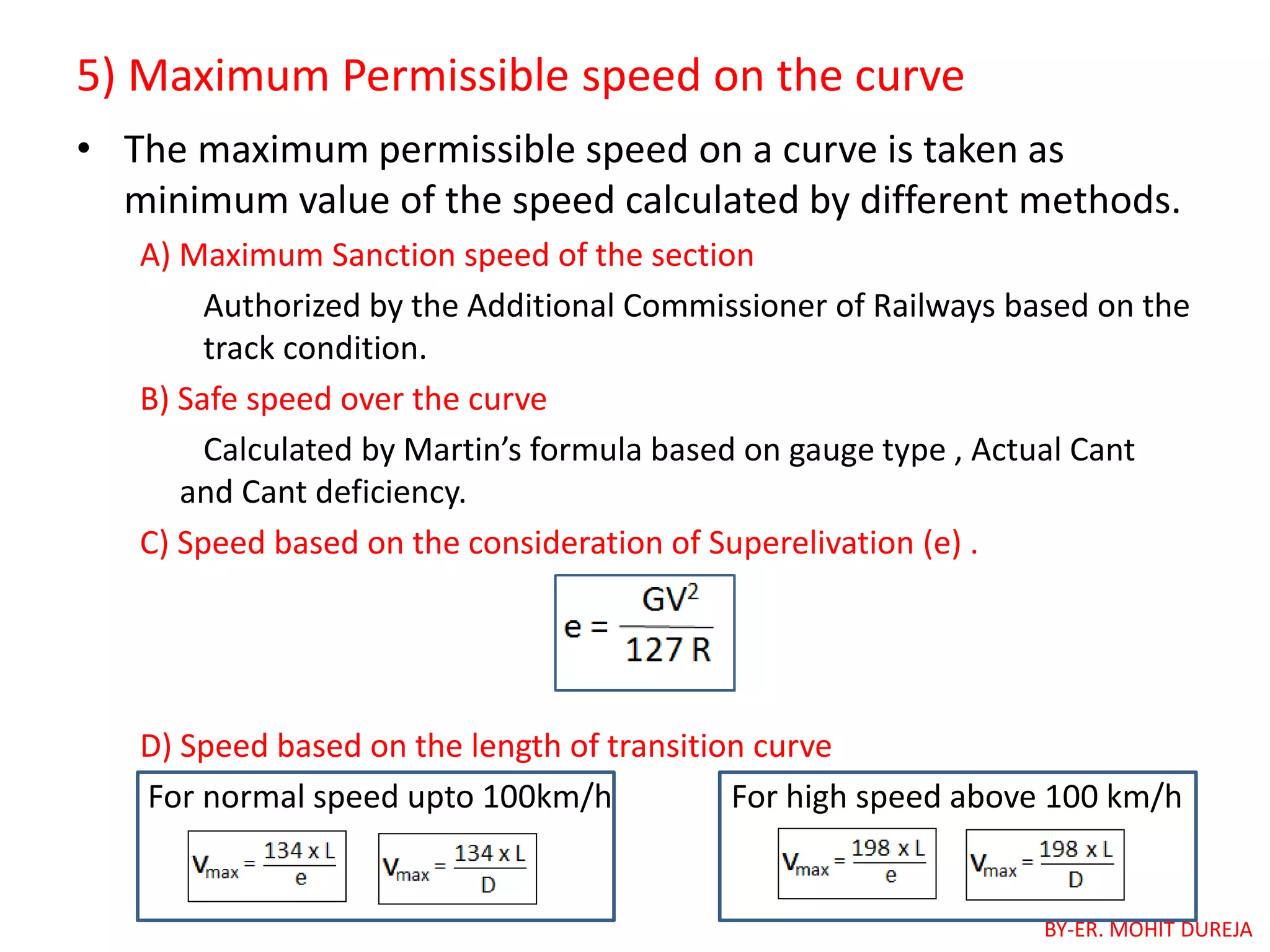
5) Maximum Permissible speed on the curve
• The maximum permissible speed on a curve is taken as
minimum value of the speed calculated by different methods.
A) Maximum Sanction speed of the section
Authorized by the Additional Commissioner of Railways based on the
track condition.
B) Safe speed over the curve
Calculated by Martin’s formula based on gauge type , Actual Cant
and Cant deficiency.
C) Speed based on the consideration of Superelivation (e) .
D) Speed based on the length of transition curve
For normal speed upto 100km/h For high speed above 100 km/h
BY-ER. MOHIT DUREJA
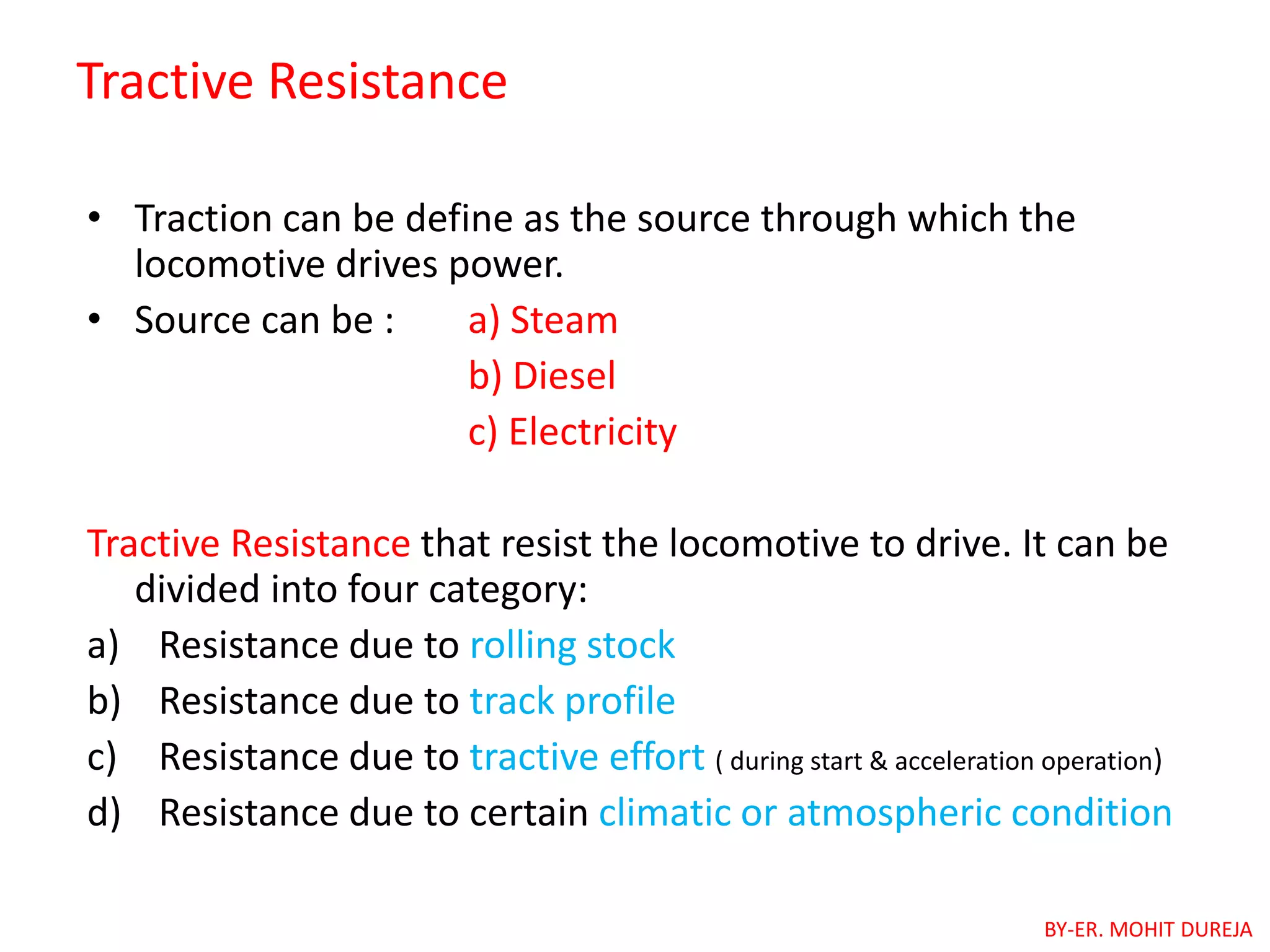
Tractive Resistance
• Traction can be define as the source through which the
locomotive drives power.
• Source can be : a) Steam
b) Diesel
c) Electricity
Tractive Resistance that resist the locomotive to drive. It can be
divided into four category:
a) Resistance due to rolling stock
b) Resistance due to track profile
c) Resistance due to tractive effort ( during start & acceleration operation)
d) Resistance due to certain climatic or atmospheric condition
BY-ER. MOHIT DUREJA
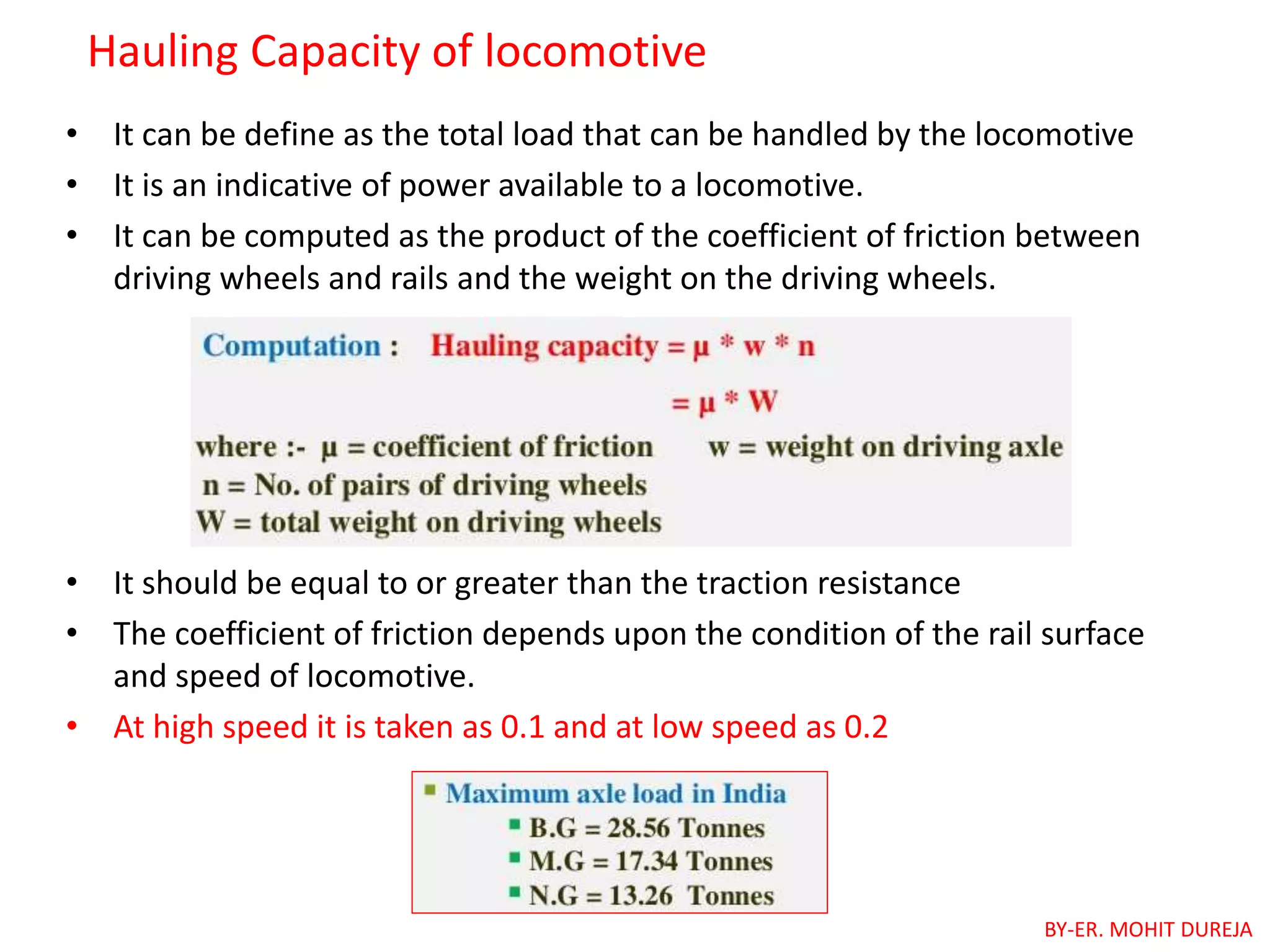
Hauling Capacity of locomotive
• It can be define as the total load that can be handled by the locomotive
• It is an indicative of power available to a locomotive.
• It can be computed as the product of the coefficient of friction between
driving wheels and rails and the weight on the driving wheels.
• It should be equal to or greater than the traction resistance
• The coefficient of friction depends upon the condition of the rail surface
and speed of locomotive.
• At high speed it is taken as 0.1 and at low speed as 0.2
BY-ER. MOHIT DUREJA

Geometric design of railway track

  • 1.
    GEOMETRIC DESIGN OFTRACK BY-ER. MOHIT DUREJA
  • 2.
    NECESSITY OF GEOMETRICDESIGN OF TRACK • TO PREVENT TRAIN DERAILMENTS Most of the derailments occur due to following reason – Track defect : Civil engineer is mainly concern with track defects. He should be aware of the track defects and how to remove these defects so that no derailment takes place. – Vehicular defect – Operational defect • To suiting load of the train, • speed of the train and • meeting the safety and economic requirements BY-ER. MOHIT DUREJA
  • 3.
    • On straighttrack derailment occur due to  Defective cross level  Defective alignment • On curved track derailment occur due to  Improper superelivatioon  Improper radius of curve  Improper speed  Unequal distributution of loads on two rail • On turouts and crossinng derailment occur due to  Gaping  Lifting of toe of switch due to inadequate fittings  Improper assembly of crossing  Excessive wear in switches  Defective check clearance at the nose of crossing Defective gauge Low joints BY-ER. MOHIT DUREJA
  • 4.
    1) Gradient • Anydeparture of the track from the level is known as grade or gradient. • Up or rising gradient is one when the track rises in the direction of movement • Down or falling gradient is one when the track falls in the direction Gradient is measured by two method  Rise/Fall in 100 units (eg 4 in 100)  Horizontal distance traveled in 1 unit (eg 1 in 25) BY-ER. MOHIT DUREJA
  • 5.
    Why Gradient provided? • To provide a uniform rate of rise or fall • To reach the various station located at different elevation • To reduce the cost of earth work BY-ER. MOHIT DUREJA
  • 6.
    Types of gradient Ruling Gradient Momentum gradient Pusheror helper gradient Gradients at station yards a) Ruling Gradient It is defined as the gradient which determine the maximum load that the engine can haul on the section. Or The maximum gradient allowed on the track section In Plain terrain – 1 in 150 to 1 in 200 In Hilly regions – 1 in 100 to 1 in 150 BY-ER. MOHIT DUREJA
  • 7.
    b) Momentum Gradient •These gradients do not determine the maximum load of the train but on account of their favorable position on the track. (in valleys) • The train before approaching them acquires sufficient momentum to negotiate them, are known as momentum gradient. • Rising Gradient is called as momentum gradient and in such case a steeper grade than the ruling grade can be adopted. Momentum Gradient Ruling Gradient Falling Gradient Rising Gradient Direction of movement BY-ER. MOHIT DUREJA
  • 8.
    c) Helping Gradient •For the portion where the gradient is severe, by arranging a assisting engine (PUSHER ENGINE OR BANKING ENGINE , it may be operationally easy or even be economically to run the train on the basis of load that the engine can carry on the remaining portion of the track is called “Pusher “ or “Helper” Gradient • Pusher Gradient are very important in mountains terrain where steeper gradients are necessary to reduce the length of the track. BY-ER. MOHIT DUREJA
  • 9.
    d) Gradients instation yards • Gradietns in station yards are generally low: – To prevent the movement of standing vehicle on the track due to the effect of gravity – In India permitted gradients in station yard – Max- 1 in 400 – Min 1 in 1000 is recommended from drainage point of view BY-ER. MOHIT DUREJA
  • 10.
    2) Grade Compensationon curves • The ruling gradient is the maximum gradient on a particular section but if a curves lies on a ruling gradient, the resistance due to gradient is increased. (the curve resistance is greater at lower speed) • In order to avoid resistance beyond the allowable limit, the gradient are reduced on curves and this reduction in gradient is known as compensation for curves. 1/100 1/120 Direction of motion BY-ER. MOHIT DUREJA
  • 11.
    • In India,compensation for curve is given at – 0.04% per degree of curve for B.G – 0.03% per degree of curve for M.G – 0.02% per degree of curve for N.G 4ᴼ G1= 1 in 150 G2 = ? B.G Compensation in gradient for curve = (0.04 x 4) = 0.16% Ruling Gradient (G1) = 1/150 = 0.67 % Gradient on curve (G2)= 0.67- 0.16 = 0.51 % or = 1 in 196 BY-ER. MOHIT DUREJA
  • 12.
    3) Superelevation orCant • When a train moves round a curve, it is subjected to centrifugal force acting horizontally at a centre of gravity of each vehicle radially away from the centre of the curve. • This increase the weight on the outer rail. • To counteract the effect of centrifugal force, the level of the outer rail is raised above the inner rail by certain amount .This raised elevation of outer rail above the inner rail at a horizontal curve is called superelivation. BY-ER. MOHIT DUREJA
  • 13.
    Objective of providingSuperelivation • To introduce the centripetal force for counteracting the effect of centrifugal force. • Provide faster movement of train on the curve • Prevent derailment • Reduce the side wear and creep of rail leads reduce in maintenance cost • Provide equal distribution of wheel loads on two rails • To provide an even and smooth running track to ensure comfortable ride to passengers and safe movement of goods. BY-ER. MOHIT DUREJA
  • 14.
    • When thelateral force and wheel load are almost equal, that cant or superelivation is termed as equilibrium cant. • This cant is obtianed from above equation Cant Deficiency : The equilibrium can is provided on the basis of equilibrium speed (or average spped) of the train. But this equilibrium cant or superelivation falls short of that required for the high speed trains. This shortage of cant is called “Cant Deficiency” OR Difference between the equilibrium cant necessary for the maximum permissible speed on a curve and the actual cant provided (on the basis of average speed of the trains) e = superelivation G = Gauge length (m) V = speed of the vehicle (km/h) R = Radius of curve (m) BY-ER. MOHIT DUREJA
  • 15.
  • 16.
    4) Negative Superelevation • When the main line is on a curve and has a turnout of contrary flexure leading to a branch line, the superelivation necessary for the average speeds of the train running over the main line cannot be provided. • For a branch line point B should be higher than A and for a Main line Point A should be higher than B. But these two contradictory condition cannot meet at a same time • In this case the branch line curve has a negative superelivation and therefore speed on both tracks must be restricted, particularly on branch line. BY-ER. MOHIT DUREJA
  • 17.
    5) Maximum Permissiblespeed on the curve • The maximum permissible speed on a curve is taken as minimum value of the speed calculated by different methods. A) Maximum Sanction speed of the section Authorized by the Additional Commissioner of Railways based on the track condition. B) Safe speed over the curve Calculated by Martin’s formula based on gauge type , Actual Cant and Cant deficiency. C) Speed based on the consideration of Superelivation (e) . D) Speed based on the length of transition curve For normal speed upto 100km/h For high speed above 100 km/h BY-ER. MOHIT DUREJA
  • 18.
    Tractive Resistance • Tractioncan be define as the source through which the locomotive drives power. • Source can be : a) Steam b) Diesel c) Electricity Tractive Resistance that resist the locomotive to drive. It can be divided into four category: a) Resistance due to rolling stock b) Resistance due to track profile c) Resistance due to tractive effort ( during start & acceleration operation) d) Resistance due to certain climatic or atmospheric condition BY-ER. MOHIT DUREJA
  • 19.
    Hauling Capacity oflocomotive • It can be define as the total load that can be handled by the locomotive • It is an indicative of power available to a locomotive. • It can be computed as the product of the coefficient of friction between driving wheels and rails and the weight on the driving wheels. • It should be equal to or greater than the traction resistance • The coefficient of friction depends upon the condition of the rail surface and speed of locomotive. • At high speed it is taken as 0.1 and at low speed as 0.2 BY-ER. MOHIT DUREJA