GEOMETRIC DESIGN OF
TRACK
BY J O Y C H E N K E N G L A N G
( C E / 1 6 / 2 5 )
CONTENTS
TOPIC PAGE NO.
• INTRODUCTION 3
• NEED 4
• GRADIENTS 5
• NEED OF GRADIENTS 6
• TYPES OF GRADIENTS 7-11
• GRADE COMPENSATION 12
• CURVATURE OF TRACK 13-14
• DEGREE OF CURVATURE 15
• TRACK ALLIGNMENT 16-20
• REFERENCES 21
Geometric design of a railway track includes all those
paramaters affecting the geometry of the track.
It includes:
1.Gradients – grade compensation, rising gradient, falling
gradient etc.
2.Curvature of the track – horizontal and vertical curves,
transition curves, sharpness of the curve, superelevation
etc.
3.Allignment of the track
Need
• to ensure safe and smooth running of trains
• To achieve maximum speeds
• To carry heavy axle loads
• To avoid accidents and derailments due to defective permanent way
• To ensure the track requires least maintenance
• Good aesthetics
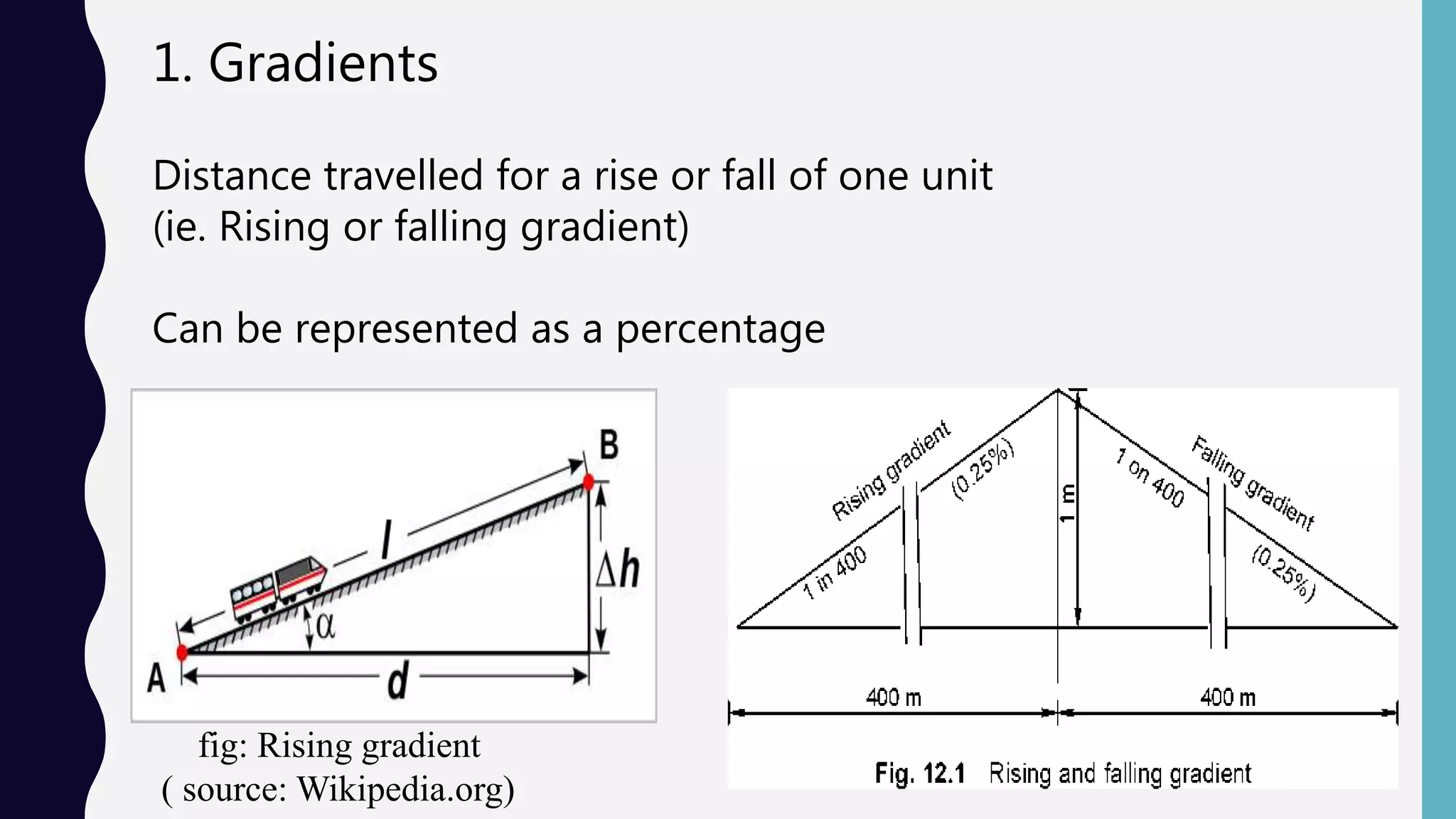
1. Gradients
Distance travelled for a rise or fall of one unit
(ie. Rising or falling gradient)
Can be represented as a percentage
fig: Rising gradient
( source: Wikipedia.org)
Need of gradients
1. To reach stations of different elevations
2. To follow natural contours of the ground to the extent possible
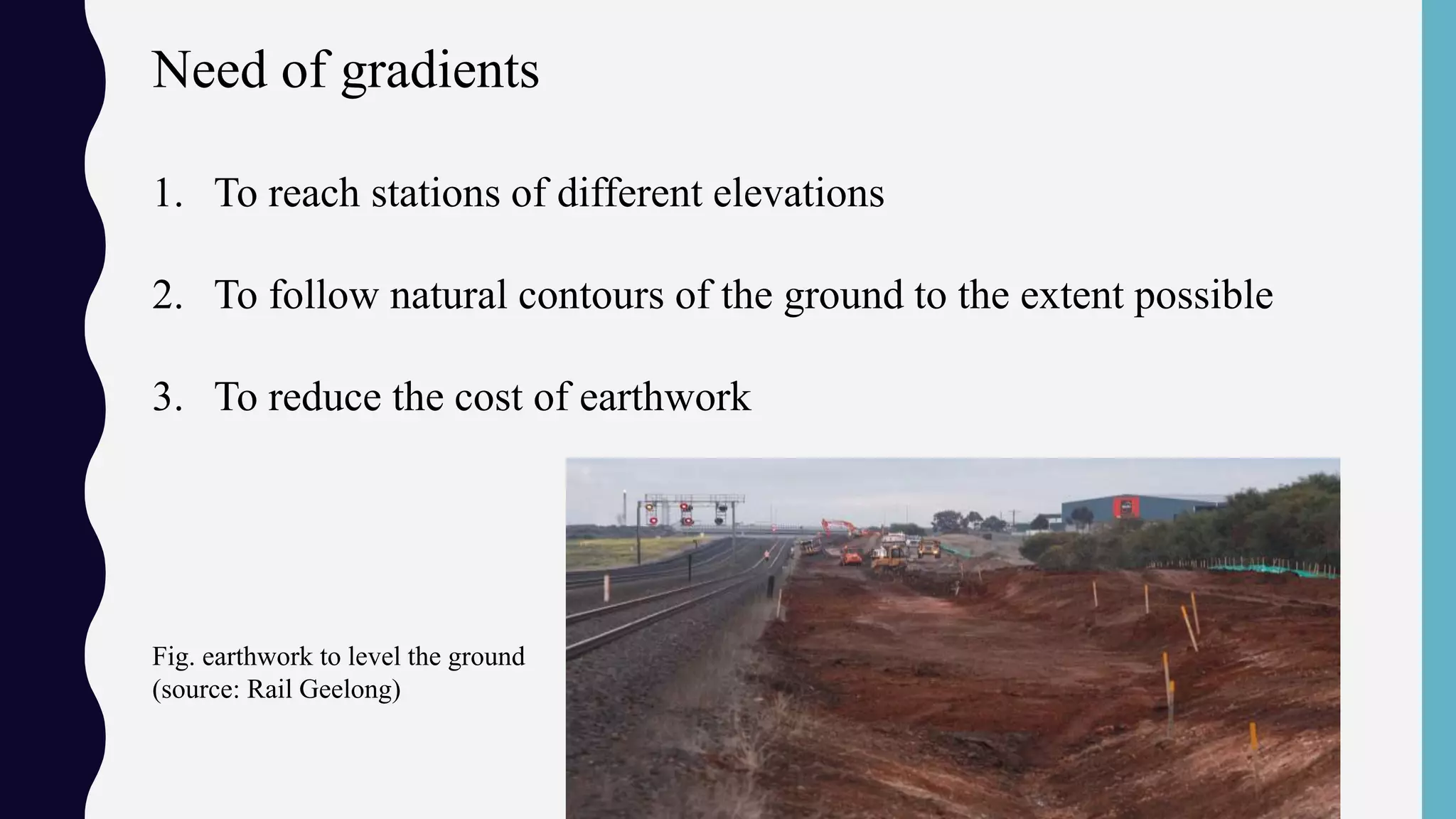
3. To reduce the cost of earthwork
Fig. earthwork to level the ground
(source: Rail Geelong)
Types of gradients
1. Ruling Gradient
2. Pusher or Helper Gradient
3. Momentum Gradient
4. Gradients in station yards
Ruling Gradient
• It is maximum gradient to which a track can be laid
• It depends on the load and additional power of the locomotive
• Extra force P required to pull train of W weight at inclination x is
P=Wsinx = Wtanx( since x is very small)
=W X Gradient
• In plain terrain: 1 in 150 to 1 in 200
• In hilly terrain: 1 in 100 to 1 in 150
Pusher or Helper Gradient
• A gradient where an extra engine is required to push the train
• Steeper than ruling gradient and provided in hills
• Avoids heavy cutting and reduces length of track
• Eg; Western Ghats with B.G track- 1 in 37
• Darjeeling railway with N.G. track- 1in 25
fig. Western Ghats Railway section fig. Darjeeling Himalayan Railway section
(source:youtube.com) ( source: Deccan Herald)
Momentum Gradient
• It uses the momentum gained in fall to rise higher gradients
• Fall creates additional kinetic energy to rise steeper gradients than
Ruling Gradient
fig: momentum gradient depiction
(source: cnl.salk.edu)
Station Yard Gradient
Fig:station yard gradient
(source: Wikimedia)
It is the minimum gradient provided in station yard for easy drainage of
rainwater
• Maximum possible gradient is fixed as 1 in 400 with recommended
value as 1 in 1000 for easy drainage
• It is to be reduced or avoided due to:
• bogies standing o gradients may start moving due to gravity and wind
• Locomotives require extra power to start if it is on a rising gradient
Grade Compensation
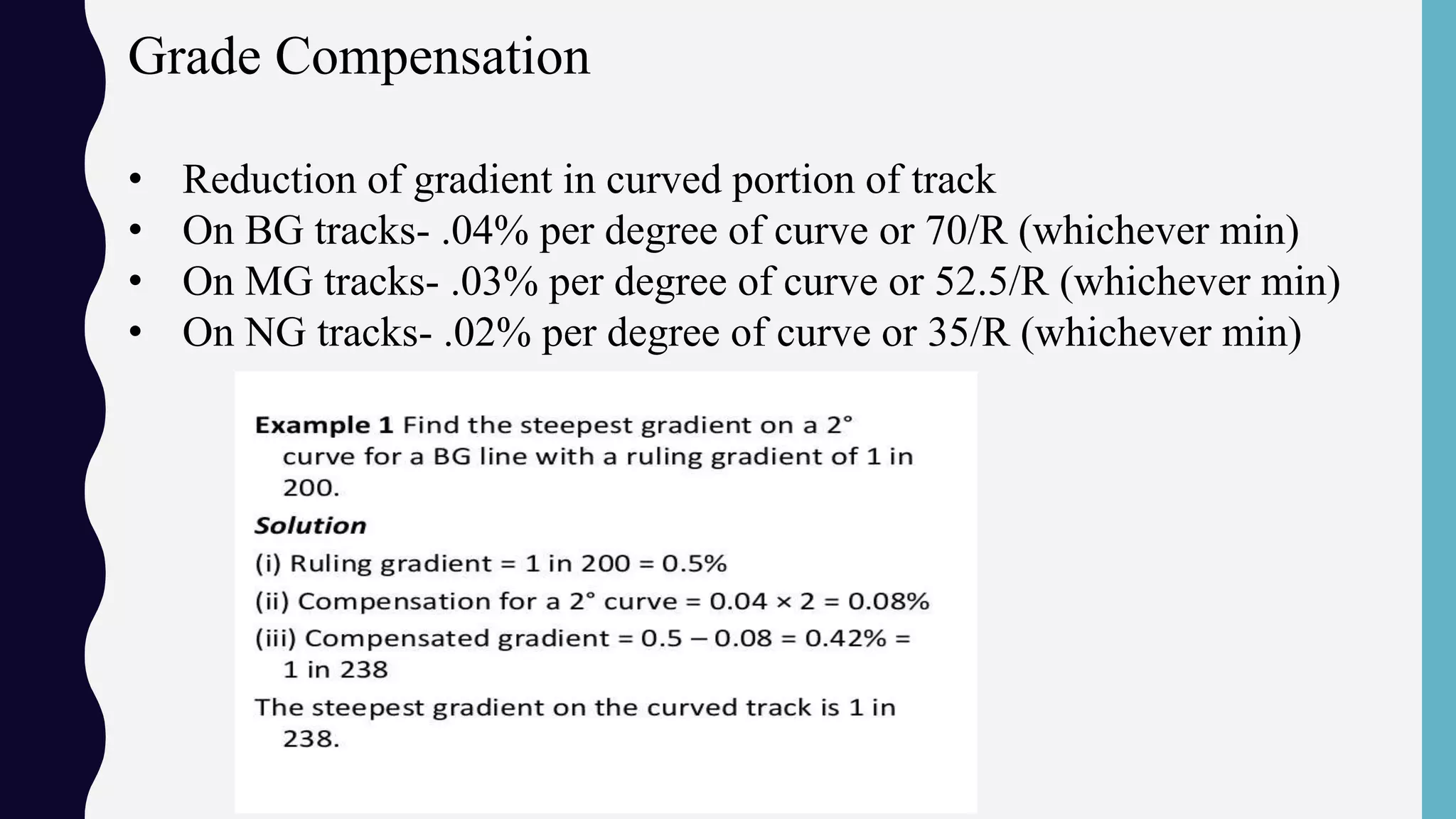
• Reduction of gradient in curved portion of track
• On BG tracks- .04% per degree of curve or 70/R (whichever min)
• On MG tracks- .03% per degree of curve or 52.5/R (whichever min)
• On NG tracks- .02% per degree of curve or 35/R (whichever min)
2. Curvature of track
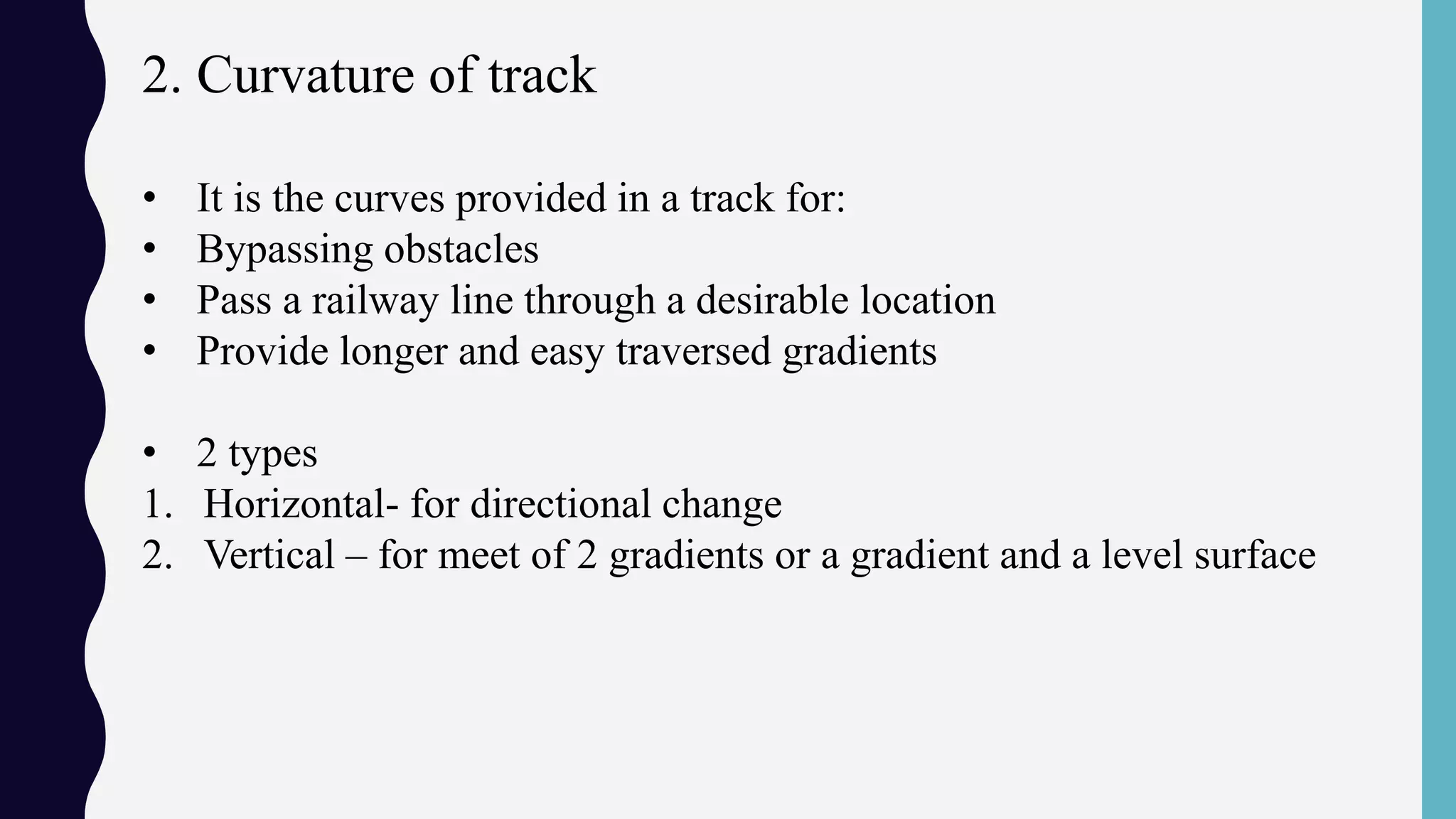
• It is the curves provided in a track for:
• Bypassing obstacles
• Pass a railway line through a desirable location
• Provide longer and easy traversed gradients
• 2 types
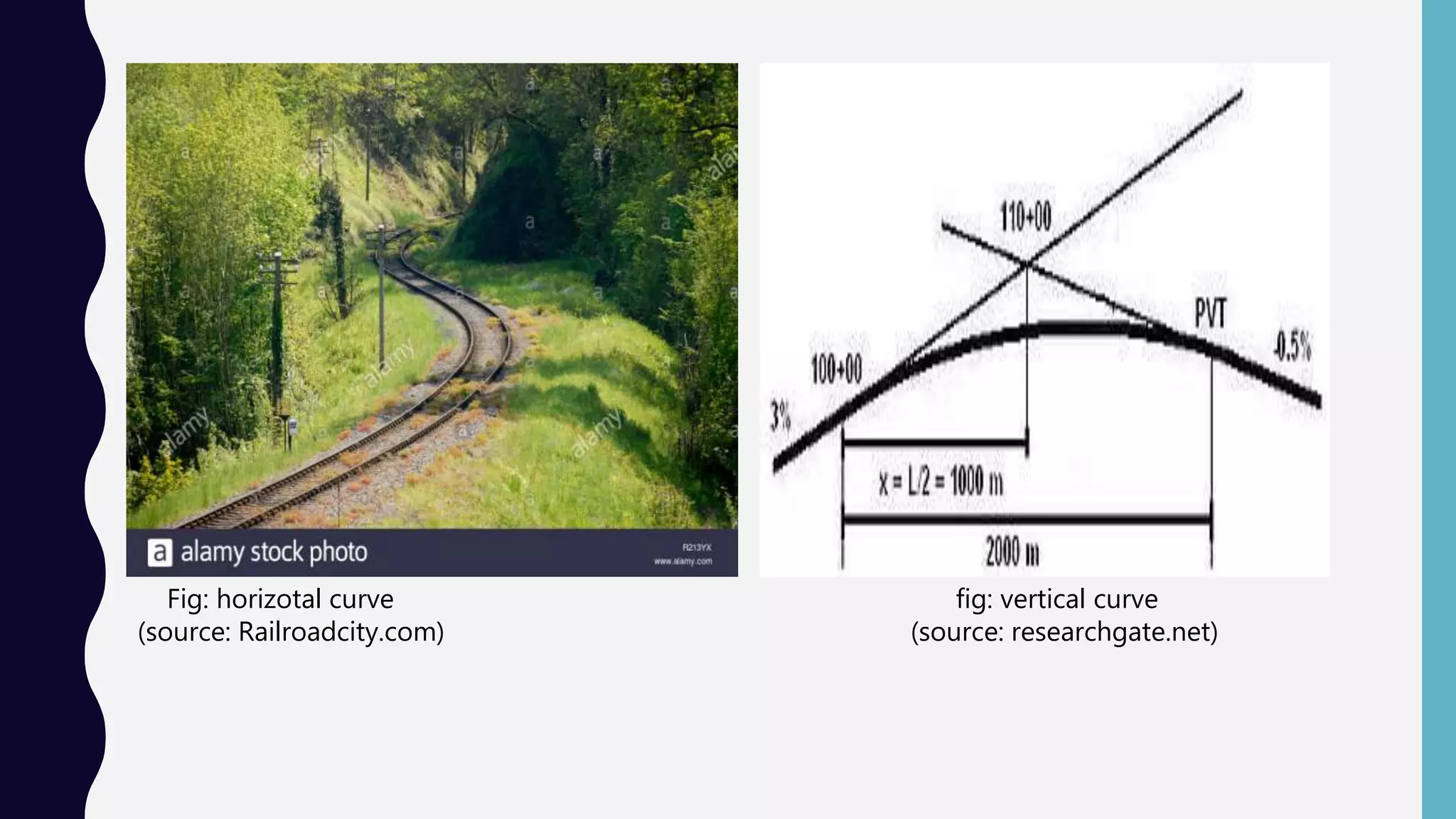
1. Horizontal- for directional change
2. Vertical – for meet of 2 gradients or a gradient and a level surface
Fig: horizotal curve fig: vertical curve
(source: Railroadcity.com) (source: researchgate.net)
Degree of Curvature
• The angle subtended at the center of the curve by a chord of radius
100 feet / 30.48 m
fig: curved path
(source: trains magazine)
3. Track Allignment
• Direction and position of the central line of the railway track in the
horizontal and vertical planes
fig: track alignment
( source: researchgate.net)
Basic requirements of an ideal alignment
• Purpose of new railway line
• Strategic or political eg; Kashmir Rail link
• Development of backward areas
• Shortening existing ones( Konkan rail link)
• Connectting trade centres
•
• fig: Konkan Rail Link
(source: Konkanrail.com)
Fig: Kashmr Rail Link
(source: telegraph India)
• Integrated development
• Economic considerations
• Shortest route
• Construction and maintenance cost
• Minimum operational expences
• Maximum safety and comfort
• Aesthetic considerations
Fig:Accident due to excessive curve
( source: New Yorker)
Selection of a Good Allignment
• Obligatory or controlling points
• Eg; important cities, towns
• Major bridge sites and river crossing
• Tunnels
• Topography
• Plain
• Valley
• Mountaineous
• Geometric standards
• Effect of Flood and Climate
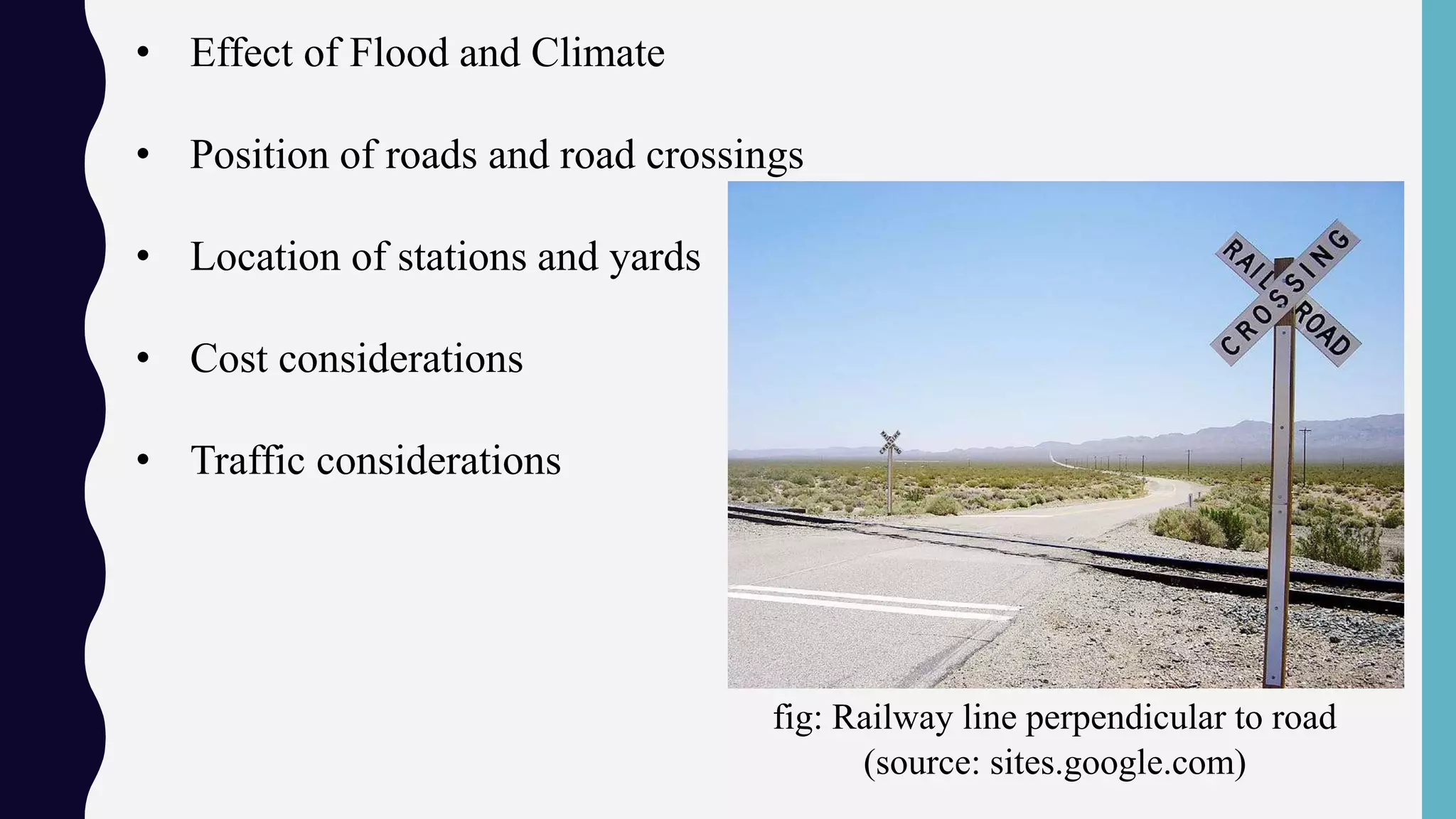
• Position of roads and road crossings
• Location of stations and yards
• Cost considerations
• Traffic considerations
fig: Railway line perpendicular to road
(source: sites.google.com)
References
• Railway engineering(2nd edition)- Satish Chandra, M.M. Agarwal
• http://nptel.ac.in/courses/105107123/
• https://en.m.Wikipedia.org/wiki/Railway_engineering
• http://whatisengineering.com/topic/what-is-railway-engineering/
• http://trainguard.in
• https://ircep.gov.in
THANK YOU

Geometric design of track

  • 1.
    GEOMETRIC DESIGN OF TRACK BYJ O Y C H E N K E N G L A N G ( C E / 1 6 / 2 5 )
  • 2.
    CONTENTS TOPIC PAGE NO. •INTRODUCTION 3 • NEED 4 • GRADIENTS 5 • NEED OF GRADIENTS 6 • TYPES OF GRADIENTS 7-11 • GRADE COMPENSATION 12 • CURVATURE OF TRACK 13-14 • DEGREE OF CURVATURE 15 • TRACK ALLIGNMENT 16-20 • REFERENCES 21
  • 3.
    Geometric design ofa railway track includes all those paramaters affecting the geometry of the track. It includes: 1.Gradients – grade compensation, rising gradient, falling gradient etc. 2.Curvature of the track – horizontal and vertical curves, transition curves, sharpness of the curve, superelevation etc. 3.Allignment of the track
  • 4.
    Need • to ensuresafe and smooth running of trains • To achieve maximum speeds • To carry heavy axle loads • To avoid accidents and derailments due to defective permanent way • To ensure the track requires least maintenance • Good aesthetics
  • 5.
    1. Gradients Distance travelledfor a rise or fall of one unit (ie. Rising or falling gradient) Can be represented as a percentage fig: Rising gradient ( source: Wikipedia.org)
  • 6.
    Need of gradients 1.To reach stations of different elevations 2. To follow natural contours of the ground to the extent possible 3. To reduce the cost of earthwork Fig. earthwork to level the ground (source: Rail Geelong)
  • 7.
    Types of gradients 1.Ruling Gradient 2. Pusher or Helper Gradient 3. Momentum Gradient 4. Gradients in station yards Ruling Gradient • It is maximum gradient to which a track can be laid • It depends on the load and additional power of the locomotive • Extra force P required to pull train of W weight at inclination x is P=Wsinx = Wtanx( since x is very small) =W X Gradient
  • 8.
    • In plainterrain: 1 in 150 to 1 in 200 • In hilly terrain: 1 in 100 to 1 in 150 Pusher or Helper Gradient • A gradient where an extra engine is required to push the train • Steeper than ruling gradient and provided in hills • Avoids heavy cutting and reduces length of track • Eg; Western Ghats with B.G track- 1 in 37 • Darjeeling railway with N.G. track- 1in 25
  • 9.
    fig. Western GhatsRailway section fig. Darjeeling Himalayan Railway section (source:youtube.com) ( source: Deccan Herald)
  • 10.
    Momentum Gradient • Ituses the momentum gained in fall to rise higher gradients • Fall creates additional kinetic energy to rise steeper gradients than Ruling Gradient fig: momentum gradient depiction (source: cnl.salk.edu)
  • 11.
    Station Yard Gradient Fig:stationyard gradient (source: Wikimedia) It is the minimum gradient provided in station yard for easy drainage of rainwater • Maximum possible gradient is fixed as 1 in 400 with recommended value as 1 in 1000 for easy drainage • It is to be reduced or avoided due to: • bogies standing o gradients may start moving due to gravity and wind • Locomotives require extra power to start if it is on a rising gradient
  • 12.
    Grade Compensation • Reductionof gradient in curved portion of track • On BG tracks- .04% per degree of curve or 70/R (whichever min) • On MG tracks- .03% per degree of curve or 52.5/R (whichever min) • On NG tracks- .02% per degree of curve or 35/R (whichever min)
  • 13.
    2. Curvature oftrack • It is the curves provided in a track for: • Bypassing obstacles • Pass a railway line through a desirable location • Provide longer and easy traversed gradients • 2 types 1. Horizontal- for directional change 2. Vertical – for meet of 2 gradients or a gradient and a level surface
  • 14.
    Fig: horizotal curvefig: vertical curve (source: Railroadcity.com) (source: researchgate.net)
  • 15.
    Degree of Curvature •The angle subtended at the center of the curve by a chord of radius 100 feet / 30.48 m fig: curved path (source: trains magazine)
  • 16.
    3. Track Allignment •Direction and position of the central line of the railway track in the horizontal and vertical planes fig: track alignment ( source: researchgate.net)
  • 17.
    Basic requirements ofan ideal alignment • Purpose of new railway line • Strategic or political eg; Kashmir Rail link • Development of backward areas • Shortening existing ones( Konkan rail link) • Connectting trade centres • • fig: Konkan Rail Link (source: Konkanrail.com) Fig: Kashmr Rail Link (source: telegraph India)
  • 18.
    • Integrated development •Economic considerations • Shortest route • Construction and maintenance cost • Minimum operational expences • Maximum safety and comfort • Aesthetic considerations Fig:Accident due to excessive curve ( source: New Yorker)
  • 19.
    Selection of aGood Allignment • Obligatory or controlling points • Eg; important cities, towns • Major bridge sites and river crossing • Tunnels • Topography • Plain • Valley • Mountaineous • Geometric standards
  • 20.
    • Effect ofFlood and Climate • Position of roads and road crossings • Location of stations and yards • Cost considerations • Traffic considerations fig: Railway line perpendicular to road (source: sites.google.com)
  • 21.
    References • Railway engineering(2ndedition)- Satish Chandra, M.M. Agarwal • http://nptel.ac.in/courses/105107123/ • https://en.m.Wikipedia.org/wiki/Railway_engineering • http://whatisengineering.com/topic/what-is-railway-engineering/ • http://trainguard.in • https://ircep.gov.in
  • 22.