Presentation on Rapid transit sysytem 
In India 
Submited by:- 
Prakhar srivastava 
Civil 4th year
 Rapid transit in India consists 
of bus, metro, monorail and light rail systems 
 It is a type of high-capacity public 
transport generally found in urban areas. 
 transit systems operate on an exclusive right-of- 
way which is usually grade separated 
in tunnels or elevated railways.
 Civil engineers handle the design, construction, 
and operation of railroads and mass transit 
systems that use a fixed guideway. 
 To determining horizontal and vertical 
alignment design, station location and design, 
and construction cost estimating
Rapid transit system history 
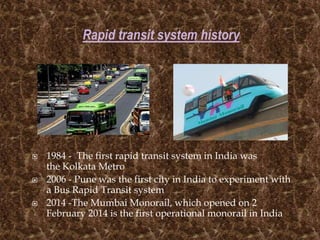
 1984 - The first rapid transit system in India was 
the Kolkata Metro 
 2006 - Pune was the first city in India to experiment with 
a Bus Rapid Transit system 
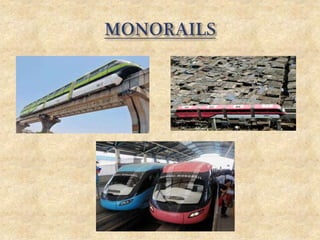
 2014 -The Mumbai Monorail, which opened on 2 
February 2014 is the first operational monorail in India
 Growing cities, growing population and growing traffic has 
invariably called for a shift from private modes of conveyance to 
public transport. 
 The only metro service in the country functioning directly under the 
Indian Railways, the foundation for this was laid as early as 1972. 
 Metro rail lines in India are composed of both standard 
gauge and broad gauge. 
 One exception is the Ahmedabad Metro, which will use Broad 
gauge
• There are currently 6 cities in india having metro facilities i,e.. 
Kolkatta,Delhi,Gurgaon,Chennai,Banglore 
& mumbai, 
• 7 cities having metro under construction i,e.. Jaipur,Navi 
mumbai,hyderabad,kochi,lucknow,ahemdabad & chennai 
• 17 cities metro facilities are under planning i,e 
Bhopal,indore,kanpur etc
 Delhi metro was formed by Delhi metro rail corporation 
Whose construction was started in 1998 and commenced 
his service on 24 dec 2002 
 Today, Delhi metro is a major business with 2.4 million passenger 
journeys made a day 
 It serving 140 stations with a total length of 193 kilomteres
Before:- 
.Traffic had been an utter koas in Delhi before the start of the Metro rail. 
• Delhi was a very bad city indeed. Its state-run and private buses were 
overcrowded, ill-kept and uncomfortable, Women suffered the most,Fisticuffs 
inside buses were common. 
After:- 
•The Metro railway has resulted in reduced consumption of fuel containing 
hydrocarbons, the study claims this has resulted in emission savings of 2,275 
tonnes. These saving are likely to go up to 3,968 tonnes by the end of this year. 
•People in the city save 66 minutes every day on an average by 
travelling to and fro by the Metro rail, which has resulted in a saving of 
Rs. 415 crore up to 2006 as their earning capacity time increases.
 TBM tunnel construction is now well accepted in indian metro rail 
construction since it inception from phase 1 delhi metro,different 
type of TBM are used against different soil condition. 
 Different type for various soil conditions :- Earth pressure 
machine,slurry machine,hard rock machine,mix shield & road 
header.
 SINGLE U-GIRDER 
 First time in Delhi Metro 
Advantages as compared to segmental box section 
 – Cost effective as the weight 11t/m where as it is 16t/m in segmental box, 
overall savings is about 10% . 
 – Fast un erection it takes less than one day cycle in erection of one span 
compared to 5-6 days required of conventionalsegmental span. 
 – Aesthetically better looking as no joints. 
 – No site parapets required.
Bearing 
 -Elastomeric bear ing are placed underneath U- girder for transfer 
 of vertical forces 
 -Concrete shear keys are provided at top of pier cap which restrain 
 the movement of deck in transverse direction and acts as topper in 
 longitudinal direction. 
 A gap of 25mm between deck and shear key each side of the deck 
 is maintained to allow thermal expansion of the deck. 
Drainage of deck/ solid pier 
 Drain pipe is located with in solid pier to avoid aesthetics 
 problems. 
 The top of deck soffit slab is profiled so as to collect run off water 
 at middle of slab by providing a cross slop of 1%. Two no of 
 drainage pipes at each end of U girder span have been provided on 
 top of the pier cap which will connect to the drainage pipe in pier.
 A metro is a fully automated rail based public transportation 
system 
 It consist of automated electical driven cars with capacity of 1000 
passengers on a network of guide ways. 
 Trains operate at a frequency of 2 minutes 40 seconds to 5–10 
minutes between 6:00 and 23:00 depending peak and off-peak 
time. 
 Trains operating within the network typically travel at speed up to 
40 km/h (25 mph), and stop for about 20 seconds at each station. 
 The power output is supplied by 25-kilovolt, 50-hertz alternating 
current through overhead catenary 
 Station located on the sidings with merge/diverging points,This 
approaches allowed for non stops,point to point travel,by passing 
all intermediate station
• For the convenience of customers, Metro commuters have three choices 
for ticket purchase 
•The RFID tokens are valid only for a single journey on the day of 
purchase and the value depends on the distance travelled 
•Travel cards are available for longer durations and are most convenient 
for frequent commuters,A 10% discount is given on all travel made on it. 
•A ticket machine, also known as a Ticket Vending Machine (TVM), is 
a vending machine that produces tickets.
• Cheap. – Money saving because the cost of ticket 
for riding the metro is definitely lower compared to 
gas, car maintenance and amortization/ insurance 
of your car. 
• Environment-Friendly. – Less traffic on the streets 
and your share in saving the earth from pollution 
emitted from your car. 
• Convenience – You can reach your destination on 
time and without any problems with traffic which 
makes riding the metro a good thing to do.
Some people ride BART (Bay Area Rapid Transit, a 
commuter rail system), for example, so that they 
can use their commute time to do work, read for 
pleasure, take a nap, or simply relax and enjoy the 
scenery rather than concentrating on driving. 
Cost comparison often shows that BART fare is lower 
than the combined costs of bridge tolls and 
maintaining and fueling a vehicle.
United States Environmental Protection Agency: 
wrote a paper in July 1998 titled, 
“Transportation Control Measures: Improved Public Transit.” 
3 major ways of increasing ridership on public transit – and thus decreasing energy costs 
associated with transportation within a population 
• system and service expansion 
• operational improvements to the system 
• incentives to commuters to use public transit more frequently
System and Service Expansion 
• provide entirely new systems – new subways, light rail, etc. 
• provide new services – express buses, HOV lanes, lanes exclusively for buses 
Operational Improvements 
• broader geographic coverage 
• reliable schedules and improved maintenance of transit vehicles 
Incentives 
• discounts on monthly or weekly passes 
• employers can buy bulk numbers of passes for employees and perhaps receive 
government incentives 
• if mass transit system becomes efficient, riders will benefit by saving time and money
Goals 
• save commuters’ time and money 
• improve the city’s traffic and pollution problems without embarking on massive 
construction of an expensive transit system 
A Solution!!! 
• use existing infrastructure – with a few modifications – and incentives to increase 
ridership on mass transit 
• public buses (hybrid or perhaps fully electric-powered) – with expanded geographic 
coverage, exclusive bus lanes (to make commuting faster and more prompt), better 
maintenance and cleanliness, and incentives
 Bus Rapid Transit" takes its name from 
rail rapid transit, which describes a high-capacity 
urban public-transit system with its 
own right of way. 
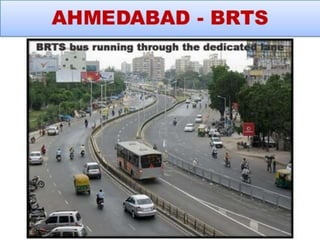
 BRT uses buses on a wide variety of rights-of-way, 
including mixed traffic, dedicated lanes 
on surface streets, and busways separated from 
traffic.
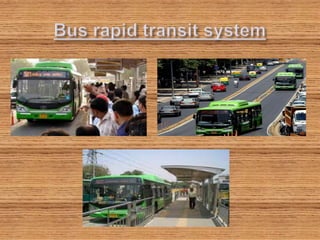
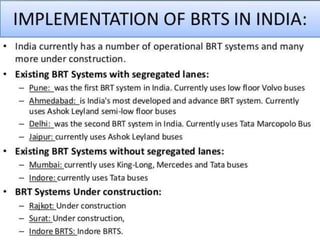
 Pune was the first city in India to experiment 
with a Bus Rapid Transit system. 
 The project consists of 16.5 kilometres (10.3 mi) 
of bus lanes along the Pune Satara Road using 
airconditioned, low-floor more than 500 Volvo 
B7RLE buses.
 The Delhi BRT system was inspired by a similar 
systems in Curitiba, Brazil which had been introduced 
a system in 1975,with similar systems being introduced 
in , Colombia , Guayaquil, Ecuador and the Eugene, 
Oregon
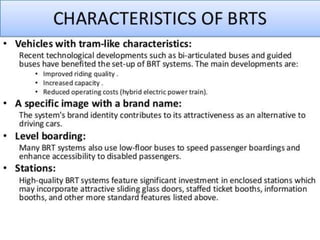
 Bus only right of way. 
 Level boarding. 
 Saves times & energy. 
 Environmental quality. 
 Operation cost efficiency. 
 Reduction in accident rate. 
 Urban rejuvenation. 
 Capital cost effectivness.
THANK YOU

Rapid transit system

  • 1.
    Presentation on Rapidtransit sysytem In India Submited by:- Prakhar srivastava Civil 4th year
  • 3.
     Rapid transitin India consists of bus, metro, monorail and light rail systems  It is a type of high-capacity public transport generally found in urban areas.  transit systems operate on an exclusive right-of- way which is usually grade separated in tunnels or elevated railways.
  • 4.
     Civil engineershandle the design, construction, and operation of railroads and mass transit systems that use a fixed guideway.  To determining horizontal and vertical alignment design, station location and design, and construction cost estimating
  • 5.
    Rapid transit systemhistory  1984 - The first rapid transit system in India was the Kolkata Metro  2006 - Pune was the first city in India to experiment with a Bus Rapid Transit system  2014 -The Mumbai Monorail, which opened on 2 February 2014 is the first operational monorail in India
  • 7.
     Growing cities,growing population and growing traffic has invariably called for a shift from private modes of conveyance to public transport.  The only metro service in the country functioning directly under the Indian Railways, the foundation for this was laid as early as 1972.  Metro rail lines in India are composed of both standard gauge and broad gauge.  One exception is the Ahmedabad Metro, which will use Broad gauge
  • 8.
    • There arecurrently 6 cities in india having metro facilities i,e.. Kolkatta,Delhi,Gurgaon,Chennai,Banglore & mumbai, • 7 cities having metro under construction i,e.. Jaipur,Navi mumbai,hyderabad,kochi,lucknow,ahemdabad & chennai • 17 cities metro facilities are under planning i,e Bhopal,indore,kanpur etc
  • 9.
     Delhi metrowas formed by Delhi metro rail corporation Whose construction was started in 1998 and commenced his service on 24 dec 2002  Today, Delhi metro is a major business with 2.4 million passenger journeys made a day  It serving 140 stations with a total length of 193 kilomteres
  • 10.
    Before:- .Traffic hadbeen an utter koas in Delhi before the start of the Metro rail. • Delhi was a very bad city indeed. Its state-run and private buses were overcrowded, ill-kept and uncomfortable, Women suffered the most,Fisticuffs inside buses were common. After:- •The Metro railway has resulted in reduced consumption of fuel containing hydrocarbons, the study claims this has resulted in emission savings of 2,275 tonnes. These saving are likely to go up to 3,968 tonnes by the end of this year. •People in the city save 66 minutes every day on an average by travelling to and fro by the Metro rail, which has resulted in a saving of Rs. 415 crore up to 2006 as their earning capacity time increases.
  • 12.
     TBM tunnelconstruction is now well accepted in indian metro rail construction since it inception from phase 1 delhi metro,different type of TBM are used against different soil condition.  Different type for various soil conditions :- Earth pressure machine,slurry machine,hard rock machine,mix shield & road header.
  • 14.
     SINGLE U-GIRDER  First time in Delhi Metro Advantages as compared to segmental box section  – Cost effective as the weight 11t/m where as it is 16t/m in segmental box, overall savings is about 10% .  – Fast un erection it takes less than one day cycle in erection of one span compared to 5-6 days required of conventionalsegmental span.  – Aesthetically better looking as no joints.  – No site parapets required.
  • 15.
    Bearing  -Elastomericbear ing are placed underneath U- girder for transfer  of vertical forces  -Concrete shear keys are provided at top of pier cap which restrain  the movement of deck in transverse direction and acts as topper in  longitudinal direction.  A gap of 25mm between deck and shear key each side of the deck  is maintained to allow thermal expansion of the deck. Drainage of deck/ solid pier  Drain pipe is located with in solid pier to avoid aesthetics  problems.  The top of deck soffit slab is profiled so as to collect run off water  at middle of slab by providing a cross slop of 1%. Two no of  drainage pipes at each end of U girder span have been provided on  top of the pier cap which will connect to the drainage pipe in pier.
  • 16.
     A metrois a fully automated rail based public transportation system  It consist of automated electical driven cars with capacity of 1000 passengers on a network of guide ways.  Trains operate at a frequency of 2 minutes 40 seconds to 5–10 minutes between 6:00 and 23:00 depending peak and off-peak time.  Trains operating within the network typically travel at speed up to 40 km/h (25 mph), and stop for about 20 seconds at each station.  The power output is supplied by 25-kilovolt, 50-hertz alternating current through overhead catenary  Station located on the sidings with merge/diverging points,This approaches allowed for non stops,point to point travel,by passing all intermediate station
  • 17.
    • For theconvenience of customers, Metro commuters have three choices for ticket purchase •The RFID tokens are valid only for a single journey on the day of purchase and the value depends on the distance travelled •Travel cards are available for longer durations and are most convenient for frequent commuters,A 10% discount is given on all travel made on it. •A ticket machine, also known as a Ticket Vending Machine (TVM), is a vending machine that produces tickets.
  • 18.
    • Cheap. –Money saving because the cost of ticket for riding the metro is definitely lower compared to gas, car maintenance and amortization/ insurance of your car. • Environment-Friendly. – Less traffic on the streets and your share in saving the earth from pollution emitted from your car. • Convenience – You can reach your destination on time and without any problems with traffic which makes riding the metro a good thing to do.
  • 20.
    Some people rideBART (Bay Area Rapid Transit, a commuter rail system), for example, so that they can use their commute time to do work, read for pleasure, take a nap, or simply relax and enjoy the scenery rather than concentrating on driving. Cost comparison often shows that BART fare is lower than the combined costs of bridge tolls and maintaining and fueling a vehicle.
  • 21.
    United States EnvironmentalProtection Agency: wrote a paper in July 1998 titled, “Transportation Control Measures: Improved Public Transit.” 3 major ways of increasing ridership on public transit – and thus decreasing energy costs associated with transportation within a population • system and service expansion • operational improvements to the system • incentives to commuters to use public transit more frequently
  • 22.
    System and ServiceExpansion • provide entirely new systems – new subways, light rail, etc. • provide new services – express buses, HOV lanes, lanes exclusively for buses Operational Improvements • broader geographic coverage • reliable schedules and improved maintenance of transit vehicles Incentives • discounts on monthly or weekly passes • employers can buy bulk numbers of passes for employees and perhaps receive government incentives • if mass transit system becomes efficient, riders will benefit by saving time and money
  • 23.
    Goals • savecommuters’ time and money • improve the city’s traffic and pollution problems without embarking on massive construction of an expensive transit system A Solution!!! • use existing infrastructure – with a few modifications – and incentives to increase ridership on mass transit • public buses (hybrid or perhaps fully electric-powered) – with expanded geographic coverage, exclusive bus lanes (to make commuting faster and more prompt), better maintenance and cleanliness, and incentives
  • 27.
     Bus RapidTransit" takes its name from rail rapid transit, which describes a high-capacity urban public-transit system with its own right of way.  BRT uses buses on a wide variety of rights-of-way, including mixed traffic, dedicated lanes on surface streets, and busways separated from traffic.
  • 28.
     Pune wasthe first city in India to experiment with a Bus Rapid Transit system.  The project consists of 16.5 kilometres (10.3 mi) of bus lanes along the Pune Satara Road using airconditioned, low-floor more than 500 Volvo B7RLE buses.
  • 29.
     The DelhiBRT system was inspired by a similar systems in Curitiba, Brazil which had been introduced a system in 1975,with similar systems being introduced in , Colombia , Guayaquil, Ecuador and the Eugene, Oregon
  • 33.
     Bus onlyright of way.  Level boarding.  Saves times & energy.  Environmental quality.  Operation cost efficiency.  Reduction in accident rate.  Urban rejuvenation.  Capital cost effectivness.
  • 34.