FORMULATION APPROACHES AND
DEVELOPMENT OF NANOSTRUCTURED
LIPID CARRIER
Presented By
Mr. Rahul S. Dalvi
M. Pharm. (SEM – II)
Dept. of Pharmaceutics
Guided By
Dr. A. J. Shinde
Asso. Professor
Dept. of Pharmaceutics
BHARATI VIDYAPEETH
COLLEGE OF PHARMACY, KOLHAPUR
2015-2016
Date:12/03/2016
1
 Contents
 Introduction
 Types of NLC
 Composition
 Method of preparation
 Characterization methods
 Marketed products
 Conclusion
 References
2
 Introduction
 Lipid nanoparticles.
 Second generation lipid nanoparticles.
 Produced from blends of solid lipids and liquid lipids.
 The blends obtained are also solid at room temperature and body
temperature.
 Solid lipids are mixed with liquid lipids preferably in the ratio of
70:30 up to a ratio of 99.9:0.1.
 Has lipid matrix with a special nanostructure which improve drug
loading and firmly incorporate the drug during storage.
 Can be administered via oral, ocular, topical and intravenous
route.
Nanostructured Lipid Carrier ( NLC )
3
 Limitations
 Poor drug loading capacity.
 Drug expulsion after polymeric transition during storage.
 Relatively high water content of the dispersions (70-99.9%)
 The low capacity to load water soluble drugs due to
partitioning effects during the production process.
NLC overcome these limitations
4
 Advantages
 Better physical stability.
 Ease of preparation and scale-up.
 Increased dispersability in an aqueous medium.
 High entrapment of lipophilic drugs and hydrophilic drugs.
 Controlled particle size.
 An advanced and efficient carrier system in particular for
substances.
 Increase of skin occlusion.
 Extended release of the drug.
5
 Types of NLC
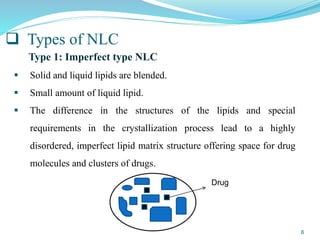
Type 1: Imperfect type NLC
 Solid and liquid lipids are blended.
 Small amount of liquid lipid.
 The difference in the structures of the lipids and special
requirements in the crystallization process lead to a highly
disordered, imperfect lipid matrix structure offering space for drug
molecules and clusters of drugs.
Drug
6
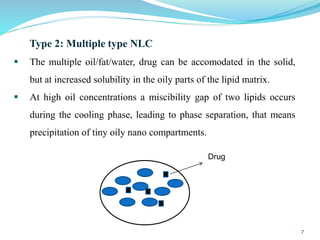
Type 2: Multiple type NLC
 The multiple oil/fat/water, drug can be accomodated in the solid,
but at increased solubility in the oily parts of the lipid matrix.
 At high oil concentrations a miscibility gap of two lipids occurs
during the cooling phase, leading to phase separation, that means
precipitation of tiny oily nano compartments.
Drug
7
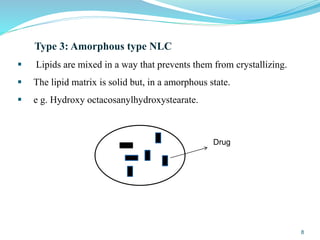
Type 3: Amorphous type NLC
 Lipids are mixed in a way that prevents them from crystallizing.
 The lipid matrix is solid but, in a amorphous state.
 e g. Hydroxy octacosanylhydroxystearate.
Drug
8
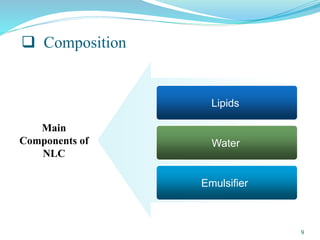
 Composition
Lipids
Water
Emulsifier
Main
Components of
NLC
9
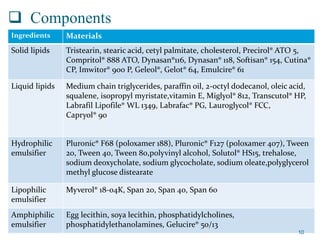
 Components
Ingredients Materials
Solid lipids Tristearin, stearic acid, cetyl palmitate, cholesterol, Precirol® ATO 5,
Compritol® 888 ATO, Dynasan®116, Dynasan® 118, Softisan® 154, Cutina®
CP, Imwitor® 900 P, Geleol®, Gelot® 64, Emulcire® 61
Liquid lipids Medium chain triglycerides, paraffin oil, 2-octyl dodecanol, oleic acid,
squalene, isopropyl myristate,vitamin E, Miglyol® 812, Transcutol® HP,
Labrafil Lipofile® WL 1349, Labrafac® PG, Lauroglycol® FCC,
Capryol® 90
Hydrophilic
emulsifier
Pluronic® F68 (poloxamer 188), Pluronic® F127 (poloxamer 407), Tween
20, Tween 40, Tween 80,polyvinyl alcohol, Solutol® HS15, trehalose,
sodium deoxycholate, sodium glycocholate, sodium oleate,polyglycerol
methyl glucose distearate
Lipophilic
emulsifier
Myverol® 18-04K, Span 20, Span 40, Span 60
Amphiphilic
emulsifier
Egg lecithin, soya lecithin, phosphatidylcholines,
phosphatidylethanolamines, Gelucire® 50/13
10
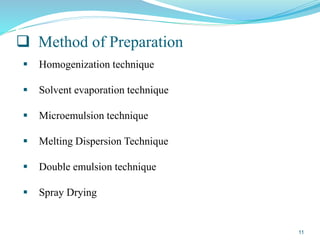
 Method of Preparation
 Homogenization technique
 Solvent evaporation technique
 Microemulsion technique
 Melting Dispersion Technique
 Double emulsion technique
 Spray Drying
11
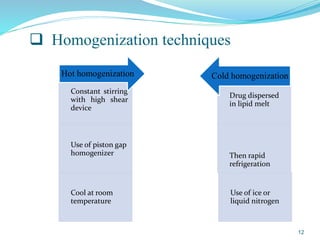
 Homogenization techniques
Constant stirring
with high shear
device
Cool at room
temperature
Use of piston gap
homogenizer
Hot homogenization
Drug dispersed
in lipid melt
Then rapid
refrigeration
Use of ice or
liquid nitrogen
Cold homogenization
12
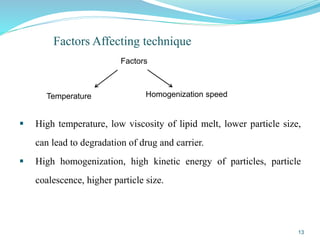
Factors Affecting technique
 High temperature, low viscosity of lipid melt, lower particle size,
can lead to degradation of drug and carrier.
 High homogenization, high kinetic energy of particles, particle
coalescence, higher particle size.
Factors
Temperature Homogenization speed
13
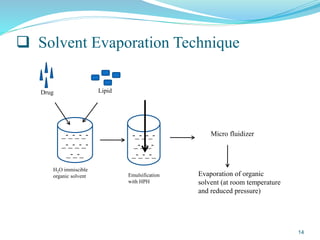
 Solvent Evaporation Technique
Drug Lipid
_-_-_-_-
_-_-_-_-
_-_-_
H2O immiscible
organic solvent
-_-_-_-
_-_-_-
_-_-_-_
Emulsification
with HPH
Micro fluidizer
Evaporation of organic
solvent (at room temperature
and reduced pressure)
14
 Concentration of lipid in organic solvent dictates particle size
 Low lipid load, small particle size
 Incorporation of thermolabile drugs
 Disadvantages: use of organic solvent may interact with drug,
limited solubility of lipid in organic solvent.
15
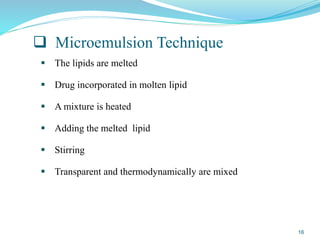
 Microemulsion Technique
 The lipids are melted
 Drug incorporated in molten lipid
 A mixture is heated
 Adding the melted lipid
 Stirring
 Transparent and thermodynamically are mixed
16
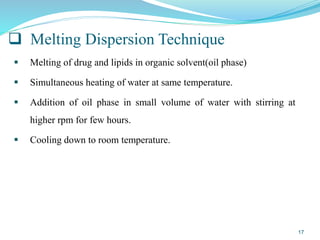
 Melting Dispersion Technique
 Melting of drug and lipids in organic solvent(oil phase)
 Simultaneous heating of water at same temperature.
 Addition of oil phase in small volume of water with stirring at
higher rpm for few hours.
 Cooling down to room temperature.
17
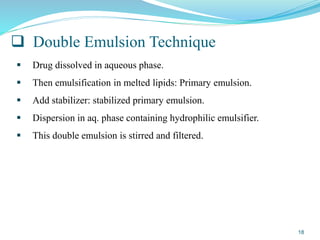
 Double Emulsion Technique
 Drug dissolved in aqueous phase.
 Then emulsification in melted lipids: Primary emulsion.
 Add stabilizer: stabilized primary emulsion.
 Dispersion in aq. phase containing hydrophilic emulsifier.
 This double emulsion is stirred and filtered.
18
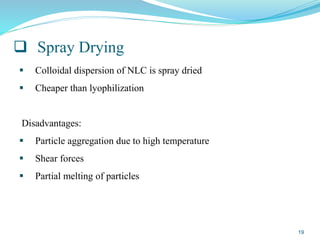
 Spray Drying
 Colloidal dispersion of NLC is spray dried
 Cheaper than lyophilization
Disadvantages:
 Particle aggregation due to high temperature
 Shear forces
 Partial melting of particles
19
 Characterization
 Particle Size: Photon Correlation Spectroscopy
 Zeta potential
 Electron microscopy: SEM, TEM, AFM
 Surface tension: Wilhemy plate method
 DSC: Crystallinity
 X-Ray Diffraction: Crystallinity
 NMR: Mobility of materials in inner core of NLC
20
 Drug entrapment efficiency: Ultrafiltration, ultracentrifugation,
filtration by sephadex and dialysis
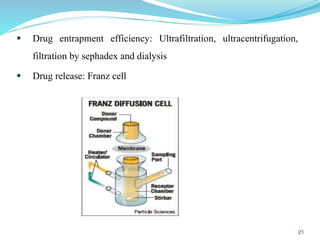
 Drug release: Franz cell
21
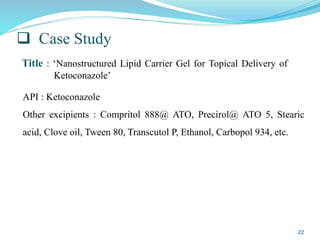
 Case Study
Title : ‘Nanostructured Lipid Carrier Gel for Topical Delivery of
Ketoconazole’
API : Ketoconazole
Other excipients : Compritol 888@ ATO, Precirol@ ATO 5, Stearic
acid, Clove oil, Tween 80, Transcutol P, Ethanol, Carbopol 934, etc.
22
Experimental and Evaluation Parameters
 Preformulation study
 Screening of surfactuctant and co-surfactuctant system
 Preparation of NLC
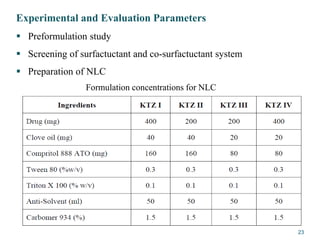
Formulation concentrations for NLC
23
 Factorial design
 Formulation development
Preparation of KNLC
KNLC were prepared by using mechanical agitation method. Method uses
ketoconazole in 200 mg and 400 mg concentration, 40 mg/ml and 20 mg/ml of
clove oil and 160 mg/ml and 80 mg/ml of solid lipid compritol 888 ATO.
Surfactant, co-surfactant system included tween 80 (0.3% w/v) and triton X-
100 (0.1% w/v) were used for KNLC. Antisolvent volume was 50 ml.
Preparation of KNLC Gel
KNLC gel was prepared by using mechanical agitation method. Method uses
KNLC system of volume 50 ml and carbomer 934 was used as gelling agent at
concentration 1.5%.
24
 Evaluation and optimization of Ketoconazole NLC
 Crystallographic investigations
 Evaluation of Ketoconazole NLC Gel
 Accelerated stability studies
Accelerated stability study carried out for three months period at 250C ±
2˚c/ 75 % ±5% RH. Sampling has been done after three months period.
These gels were evaluated for in vitro drug release study (ICH Q1A (R2) .
25
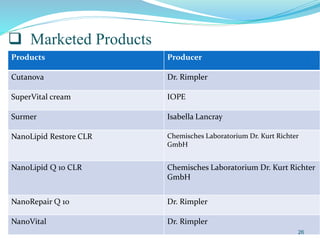
 Marketed Products
Products Producer
Cutanova Dr. Rimpler
SuperVital cream IOPE
Surmer Isabella Lancray
NanoLipid Restore CLR Chemisches Laboratorium Dr. Kurt Richter
GmbH
NanoLipid Q 10 CLR Chemisches Laboratorium Dr. Kurt Richter
GmbH
NanoRepair Q 10 Dr. Rimpler
NanoVital Dr. Rimpler
26
 Conclusion
 The lipid nanoparticles – NLC are carrier systems with good
perspectives to be marketed very successfully.
 The reason for this is that they were developed considering
industrial needs e.g. scale up, qualification and validation,
simple technology, low cost, tolerability
 NLCs can generally be applied where solid nanoparticles
possess advantages for the delivery of drugs.
 NLCs are used in topical drug delivery, oral and parenteral
administration. They also have used in cosmetics, food and
agricultural products.
27
 References
 Mishra B, Patel BB, Tiwari S, Colloidal nanocarriers: a
review on formulation technology, types and applications
toward targeted drug delivery, Nanomedicine. 2010; 6: 9– 24.
 Muller, R. H. et al., Solid lipid nanoparticles (SLN) for
controlled drug delivery – a review of the state of the art, Eur.
J. Pharm. Biopharm. 50, 161-177, 2000.
 Carli, F., Physical Chemistry and Oral Absorption of the
Nanoparticulate Systems, 1999,158-160.
 Joshi, M., Patravale, V., Nanostructured lipid carrier (NLC)
based gel of celecoxib, Int J Pharm, 2008, 346(1-2):124-32.
28
29

Nanostructure lipid carrier rahul dalvi

  • 1.
    FORMULATION APPROACHES AND DEVELOPMENTOF NANOSTRUCTURED LIPID CARRIER Presented By Mr. Rahul S. Dalvi M. Pharm. (SEM – II) Dept. of Pharmaceutics Guided By Dr. A. J. Shinde Asso. Professor Dept. of Pharmaceutics BHARATI VIDYAPEETH COLLEGE OF PHARMACY, KOLHAPUR 2015-2016 Date:12/03/2016 1
  • 2.
     Contents  Introduction Types of NLC  Composition  Method of preparation  Characterization methods  Marketed products  Conclusion  References 2
  • 3.
     Introduction  Lipidnanoparticles.  Second generation lipid nanoparticles.  Produced from blends of solid lipids and liquid lipids.  The blends obtained are also solid at room temperature and body temperature.  Solid lipids are mixed with liquid lipids preferably in the ratio of 70:30 up to a ratio of 99.9:0.1.  Has lipid matrix with a special nanostructure which improve drug loading and firmly incorporate the drug during storage.  Can be administered via oral, ocular, topical and intravenous route. Nanostructured Lipid Carrier ( NLC ) 3
  • 4.
     Limitations  Poordrug loading capacity.  Drug expulsion after polymeric transition during storage.  Relatively high water content of the dispersions (70-99.9%)  The low capacity to load water soluble drugs due to partitioning effects during the production process. NLC overcome these limitations 4
  • 5.
     Advantages  Betterphysical stability.  Ease of preparation and scale-up.  Increased dispersability in an aqueous medium.  High entrapment of lipophilic drugs and hydrophilic drugs.  Controlled particle size.  An advanced and efficient carrier system in particular for substances.  Increase of skin occlusion.  Extended release of the drug. 5
  • 6.
     Types ofNLC Type 1: Imperfect type NLC  Solid and liquid lipids are blended.  Small amount of liquid lipid.  The difference in the structures of the lipids and special requirements in the crystallization process lead to a highly disordered, imperfect lipid matrix structure offering space for drug molecules and clusters of drugs. Drug 6
  • 7.
    Type 2: Multipletype NLC  The multiple oil/fat/water, drug can be accomodated in the solid, but at increased solubility in the oily parts of the lipid matrix.  At high oil concentrations a miscibility gap of two lipids occurs during the cooling phase, leading to phase separation, that means precipitation of tiny oily nano compartments. Drug 7
  • 8.
    Type 3: Amorphoustype NLC  Lipids are mixed in a way that prevents them from crystallizing.  The lipid matrix is solid but, in a amorphous state.  e g. Hydroxy octacosanylhydroxystearate. Drug 8
  • 9.
  • 10.
     Components Ingredients Materials Solidlipids Tristearin, stearic acid, cetyl palmitate, cholesterol, Precirol® ATO 5, Compritol® 888 ATO, Dynasan®116, Dynasan® 118, Softisan® 154, Cutina® CP, Imwitor® 900 P, Geleol®, Gelot® 64, Emulcire® 61 Liquid lipids Medium chain triglycerides, paraffin oil, 2-octyl dodecanol, oleic acid, squalene, isopropyl myristate,vitamin E, Miglyol® 812, Transcutol® HP, Labrafil Lipofile® WL 1349, Labrafac® PG, Lauroglycol® FCC, Capryol® 90 Hydrophilic emulsifier Pluronic® F68 (poloxamer 188), Pluronic® F127 (poloxamer 407), Tween 20, Tween 40, Tween 80,polyvinyl alcohol, Solutol® HS15, trehalose, sodium deoxycholate, sodium glycocholate, sodium oleate,polyglycerol methyl glucose distearate Lipophilic emulsifier Myverol® 18-04K, Span 20, Span 40, Span 60 Amphiphilic emulsifier Egg lecithin, soya lecithin, phosphatidylcholines, phosphatidylethanolamines, Gelucire® 50/13 10
  • 11.
     Method ofPreparation  Homogenization technique  Solvent evaporation technique  Microemulsion technique  Melting Dispersion Technique  Double emulsion technique  Spray Drying 11
  • 12.
     Homogenization techniques Constantstirring with high shear device Cool at room temperature Use of piston gap homogenizer Hot homogenization Drug dispersed in lipid melt Then rapid refrigeration Use of ice or liquid nitrogen Cold homogenization 12
  • 13.
    Factors Affecting technique High temperature, low viscosity of lipid melt, lower particle size, can lead to degradation of drug and carrier.  High homogenization, high kinetic energy of particles, particle coalescence, higher particle size. Factors Temperature Homogenization speed 13
  • 14.
     Solvent EvaporationTechnique Drug Lipid _-_-_-_- _-_-_-_- _-_-_ H2O immiscible organic solvent -_-_-_- _-_-_- _-_-_-_ Emulsification with HPH Micro fluidizer Evaporation of organic solvent (at room temperature and reduced pressure) 14
  • 15.
     Concentration oflipid in organic solvent dictates particle size  Low lipid load, small particle size  Incorporation of thermolabile drugs  Disadvantages: use of organic solvent may interact with drug, limited solubility of lipid in organic solvent. 15
  • 16.
     Microemulsion Technique The lipids are melted  Drug incorporated in molten lipid  A mixture is heated  Adding the melted lipid  Stirring  Transparent and thermodynamically are mixed 16
  • 17.
     Melting DispersionTechnique  Melting of drug and lipids in organic solvent(oil phase)  Simultaneous heating of water at same temperature.  Addition of oil phase in small volume of water with stirring at higher rpm for few hours.  Cooling down to room temperature. 17
  • 18.
     Double EmulsionTechnique  Drug dissolved in aqueous phase.  Then emulsification in melted lipids: Primary emulsion.  Add stabilizer: stabilized primary emulsion.  Dispersion in aq. phase containing hydrophilic emulsifier.  This double emulsion is stirred and filtered. 18
  • 19.
     Spray Drying Colloidal dispersion of NLC is spray dried  Cheaper than lyophilization Disadvantages:  Particle aggregation due to high temperature  Shear forces  Partial melting of particles 19
  • 20.
     Characterization  ParticleSize: Photon Correlation Spectroscopy  Zeta potential  Electron microscopy: SEM, TEM, AFM  Surface tension: Wilhemy plate method  DSC: Crystallinity  X-Ray Diffraction: Crystallinity  NMR: Mobility of materials in inner core of NLC 20
  • 21.
     Drug entrapmentefficiency: Ultrafiltration, ultracentrifugation, filtration by sephadex and dialysis  Drug release: Franz cell 21
  • 22.
     Case Study Title: ‘Nanostructured Lipid Carrier Gel for Topical Delivery of Ketoconazole’ API : Ketoconazole Other excipients : Compritol 888@ ATO, Precirol@ ATO 5, Stearic acid, Clove oil, Tween 80, Transcutol P, Ethanol, Carbopol 934, etc. 22
  • 23.
    Experimental and EvaluationParameters  Preformulation study  Screening of surfactuctant and co-surfactuctant system  Preparation of NLC Formulation concentrations for NLC 23
  • 24.
     Factorial design Formulation development Preparation of KNLC KNLC were prepared by using mechanical agitation method. Method uses ketoconazole in 200 mg and 400 mg concentration, 40 mg/ml and 20 mg/ml of clove oil and 160 mg/ml and 80 mg/ml of solid lipid compritol 888 ATO. Surfactant, co-surfactant system included tween 80 (0.3% w/v) and triton X- 100 (0.1% w/v) were used for KNLC. Antisolvent volume was 50 ml. Preparation of KNLC Gel KNLC gel was prepared by using mechanical agitation method. Method uses KNLC system of volume 50 ml and carbomer 934 was used as gelling agent at concentration 1.5%. 24
  • 25.
     Evaluation andoptimization of Ketoconazole NLC  Crystallographic investigations  Evaluation of Ketoconazole NLC Gel  Accelerated stability studies Accelerated stability study carried out for three months period at 250C ± 2˚c/ 75 % ±5% RH. Sampling has been done after three months period. These gels were evaluated for in vitro drug release study (ICH Q1A (R2) . 25
  • 26.
     Marketed Products ProductsProducer Cutanova Dr. Rimpler SuperVital cream IOPE Surmer Isabella Lancray NanoLipid Restore CLR Chemisches Laboratorium Dr. Kurt Richter GmbH NanoLipid Q 10 CLR Chemisches Laboratorium Dr. Kurt Richter GmbH NanoRepair Q 10 Dr. Rimpler NanoVital Dr. Rimpler 26
  • 27.
     Conclusion  Thelipid nanoparticles – NLC are carrier systems with good perspectives to be marketed very successfully.  The reason for this is that they were developed considering industrial needs e.g. scale up, qualification and validation, simple technology, low cost, tolerability  NLCs can generally be applied where solid nanoparticles possess advantages for the delivery of drugs.  NLCs are used in topical drug delivery, oral and parenteral administration. They also have used in cosmetics, food and agricultural products. 27
  • 28.
     References  MishraB, Patel BB, Tiwari S, Colloidal nanocarriers: a review on formulation technology, types and applications toward targeted drug delivery, Nanomedicine. 2010; 6: 9– 24.  Muller, R. H. et al., Solid lipid nanoparticles (SLN) for controlled drug delivery – a review of the state of the art, Eur. J. Pharm. Biopharm. 50, 161-177, 2000.  Carli, F., Physical Chemistry and Oral Absorption of the Nanoparticulate Systems, 1999,158-160.  Joshi, M., Patravale, V., Nanostructured lipid carrier (NLC) based gel of celecoxib, Int J Pharm, 2008, 346(1-2):124-32. 28
  • 29.