DEVELOPMENT OF LACIDIPINE LOADED
NANOSTRUCTURED LIPID CARRIERS (NLCs)
FOR BIOAVAILABILITY ENHANCEMENT
By:
Anuradha Kush, Associate Professor
R.K.S.D. College of pharmacy,
Kaithal, Haryana
CONTENT
INTRODUCTION
LITERATURE REVIEW
RESEARCH ENVISAGED
PLAN OF WORK
PREFORMULATION STUDIES
PREPARATION, EFFECT OF PROCESS VARIABLES AND
CHARACTERIZATION
IN VITRO AND IN VIVO STUDIES
STABILITY STUDIES
REFERENCES
Oral Route
• Most preferred route for administration of drugs
• Offers greatest degree of patient compliance
• Very effective for drugs with high solubility and gastrointestinal
permeability
INTRODUCTION
El-Kattan. et al.2012
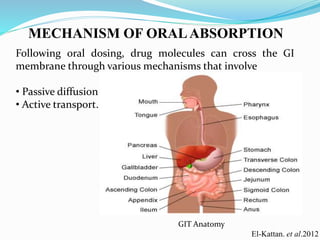
MECHANISM OF ORALABSORPTION
GIT Anatomy
Following oral dosing, drug molecules can cross the GI
membrane through various mechanisms that involve
• Passive diffusion
• Active transport.
El-Kattan. et al.2012
BIOAVAILABILITY
Bioavailability is the rate and extent (fraction or the
percentage of the dose) to which the active drug ingredient
delivered is absorbed from a drug product into the general
circulation.
Poor bioavailability by the oral route can be due to :
 Poor solubility
 Degradation in GI lumen
 Poor membrane permeation
 Pre-systemic elimination
Liang Shen. et al.2008
FACTORS AFFECTING BIOAVAILABILITY
Particle size
pKa
Partition coefficient
Stability
Liang Shen. et al.2008
BIOAVAILABILITY ENHANCEMENT OF
POORLY WATER SOLUBLE DRUGS
Prodrug approach
Microemulsion formulations
Particle Size Reduction (Micronization, Nanotechnology)
Gupta. et al.2011
NANOSTRUCTURED LIPID CARRIERS
Radtke. et al. 2011
Nanostructured lipid carriers (NLCs) are a type of submicron
particulate drug delivery system based on mixture of solid lipids
with liquid lipids.
 The nanostructure lipid carriers (NLCs) are regarded as the
second-generation of lipid nanoparticles.
 Solid lipids and liquid lipids are considerably different in
chemical structure.
 The usual particle diameters of the NLCs are in the range
of approximately 10–1000 nm.
 Molecules of NLCs improve mucosal adhesion due to
small particle size and increases their GIT residence time.
 Accommodate more drug and reduce the drug leakage
during storage.
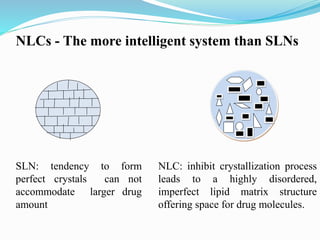
NLCs - The more intelligent system than SLNs
SLN: tendency to form
perfect crystals can not
accommodate larger drug
amount
NLC: inhibit crystallization process
leads to a highly disordered,
imperfect lipid matrix structure
offering space for drug molecules.
ADVANTAGES OF CARRIER SYSTEM
Reginald. et al. 2012
 Increases drug loading
 Controlled drug release
 The possibility of production on large industrial scale
 Possess negligible toxicity
 Bioavailability of highly lipophilic molecules can be increased
 Minimum drug leakage during storage
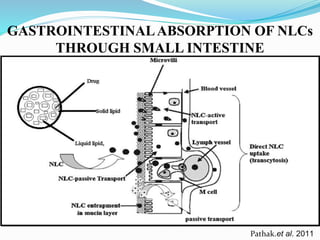
GASTROINTESTINALABSORPTION OF NLCs
THROUGH SMALL INTESTINE
Pathak.et al. 2011
Solid lipid (Glyceryl monostearate)
 Lipophillic in nature.
 Responsible for more sustained release of the drug.
Liqid lipids (Oleic acid, Linoleic acid)
 Enhances the entrapment efficiency.
 Entropy of the lipid provides space for entrapment of drug
molecules.
Surfactant (Poloxamer 407 )
Supports the absorption of NLCs, due to their effect on intestinal
epithelial permeability.
FORMULATION OF NLCs
B.P 2007, page-1205
IUPAC Name Diethyl 4-{2-[(tert butoxycarbonyl)vinyl]phenyl}- 1,4
dihydropyridine -3,5dicarboxylate
Category Antihypertensive(Calcium channel blocker)
Appearance It's a white to pale yellow colored crystalline powder
Molecular Formula C26H33NO6
Molecular Weight 455.54 g/mol
Melting point 183.5-184.5°C
Partition Coefficient 5.49
Dose 2-6mg
Bioavailabity 10%
Solubility Practically insoluble in water, springly soluble in alcohol,
soluble in dichloromethane, freely soluble in acetonitrile
and acetone.
LACIDIPINE PROFILE
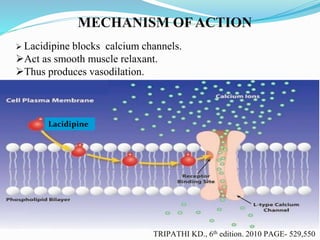
MECHANISM OF ACTION
TRIPATHI KD., 6th edition. 2010 PAGE- 529,550
 Lacidipine blocks calcium channels.
Act as smooth muscle relaxant.
Thus produces vasodilation.
Lacidipine
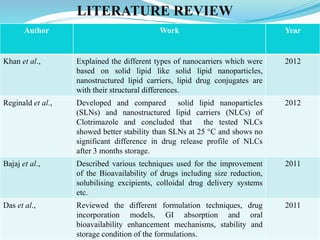
LITERATURE REVIEW
Author Work Year
Khan et al., Explained the different types of nanocarriers which were
based on solid lipid like solid lipid nanoparticles,
nanostructured lipid carriers, lipid drug conjugates are
with their structural differences.
2012
Reginald et al., Developed and compared solid lipid nanoparticles
(SLNs) and nanostructured lipid carriers (NLCs) of
Clotrimazole and concluded that the tested NLCs
showed better stability than SLNs at 25 °C and shows no
significant difference in drug release profile of NLCs
after 3 months storage.
2012
Bajaj et al., Described various techniques used for the improvement
of the Bioavailability of drugs including size reduction,
solubilising excipients, colloidal drug delivery systems
etc.
2011
Das et al., Reviewed the different formulation techniques, drug
incorporation models, GI absorption and oral
bioavailability enhancement mechanisms, stability and
storage condition of the formulations.
2011
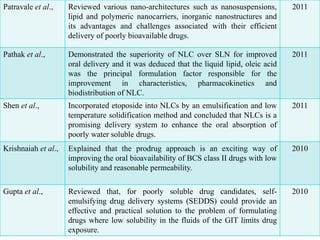
Patravale et al., Reviewed various nano-architectures such as nanosuspensions,
lipid and polymeric nanocarriers, inorganic nanostructures and
its advantages and challenges associated with their efficient
delivery of poorly bioavailable drugs.
2011
Pathak et al., Demonstrated the superiority of NLC over SLN for improved
oral delivery and it was deduced that the liquid lipid, oleic acid
was the principal formulation factor responsible for the
improvement in characteristics, pharmacokinetics and
biodistribution of NLC.
2011
Shen et al., Incorporated etoposide into NLCs by an emulsification and low
temperature solidification method and concluded that NLCs is a
promising delivery system to enhance the oral absorption of
poorly water soluble drugs.
2011
Krishnaiah et al., Explained that the prodrug approach is an exciting way of
improving the oral bioavailability of BCS class II drugs with low
solubility and reasonable permeability.
2010
Gupta et al., Reviewed that, for poorly soluble drug candidates, self-
emulsifying drug delivery systems (SEDDS) could provide an
effective and practical solution to the problem of formulating
drugs where low solubility in the fluids of the GIT limits drug
exposure.
2010
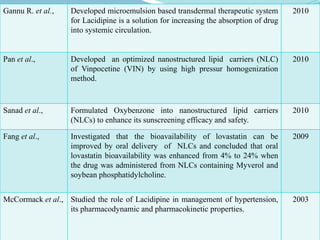
Gannu R. et al., Developed microemulsion based transdermal therapeutic system
for Lacidipine is a solution for increasing the absorption of drug
into systemic circulation.
2010
Pan et al., Developed an optimized nanostructured lipid carriers (NLC)
of Vinpocetine (VIN) by using high pressur homogenization
method.
2010
Sanad et al., Formulated Oxybenzone into nanostructured lipid carriers
(NLCs) to enhance its sunscreening efficacy and safety.
2010
Fang et al., Investigated that the bioavailability of lovastatin can be
improved by oral delivery of NLCs and concluded that oral
lovastatin bioavailability was enhanced from 4% to 24% when
the drug was administered from NLCs containing Myverol and
soybean phosphatidylcholine.
2009
McCormack et al., Studied the role of Lacidipine in management of hypertension,
its pharmacodynamic and pharmacokinetic properties.
2003
Antihypertensive drug Lacidipine is having only 10%
bioavailability so NLC’s are selected to enhance the
bioavailability.
Lipid-based drug delivery systems are expected as promising
oral carriers because of their potential to increase the solubility
and improve oral bioavailability of lipophilic drugs.
The objective of the present study is to prepare and
characterize Nanostructured lipid carriers (NLCs) for delivering
orally the hypertensive drug Lacidipine for enhancement of
bioavailability.
RESEARCH ENVISAGED
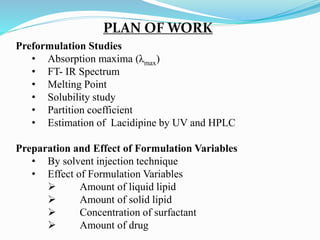
PLAN OF WORK
Preformulation Studies
• Absorption maxima (λmax)
• FT- IR Spectrum
• Melting Point
• Solubility study
• Partition coefficient
• Estimation of Lacidipine by UV and HPLC
Preparation and Effect of Formulation Variables
• By solvent injection technique
• Effect of Formulation Variables
 Amount of liquid lipid
 Amount of solid lipid
 Concentration of surfactant
 Amount of drug
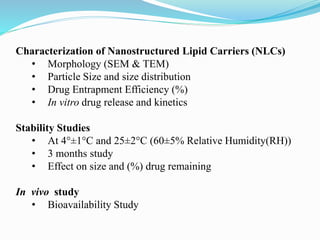
Characterization of Nanostructured Lipid Carriers (NLCs)
• Morphology (SEM & TEM)
• Particle Size and size distribution
• Drug Entrapment Efficiency (%)
• In vitro drug release and kinetics
Stability Studies
• At 4°±1°C and 25±2°C (60±5% Relative Humidity(RH))
• 3 months study
• Effect on size and (%) drug remaining
In vivo study
• Bioavailability Study
PREFORMULATION
STUDIES
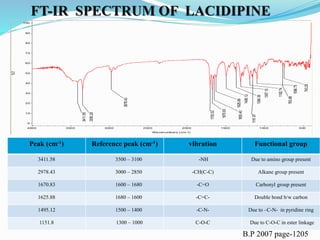
FT-IR SPECTRUM OF LACIDIPINE
743.25
763.68
1098.75
1151.87
1192.74
1307.15
1364.36
1495.12
1625.88
1650.40
1670.83
1703.52
2978.43
3350.28
3411.58
0
10
20
30
40
50
60
70
80
90
100
%T
500
1000
1500
2000
2500
3000
3500
4000
Wavenumbers (cm-1)
Peak (cm-1) Reference peak (cm-1) vibration Functional group
3411.58 3500 – 3100 -NH Due to amino group present
2978.43 3000 – 2850 -CH(C-C) Alkane group present
1670.83 1600 – 1680 -C=O Carbonyl group present
1625.88 1680 – 1600 -C=C- Double bond b/w carbon
1495.12 1500 – 1400 -C-N- Due to –C-N- in pyridine ring
1151.8 1300 – 1000 C-O-C Due to C-O-C in ester linkage
B.P 2007 page-1205
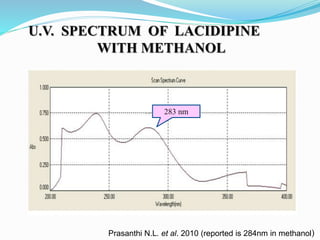
U.V. SPECTRUM OF LACIDIPINE
WITH METHANOL
283 nm
Prasanthi N.L. et al. 2010 (reported is 284nm in methanol)
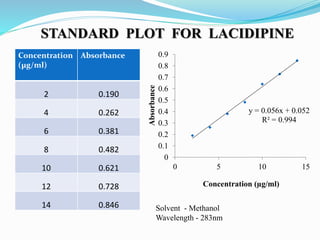
STANDARD PLOT FOR LACIDIPINE
Solvent - Methanol
Wavelength - 283nm
Concentration
(µg/ml)
Absorbance
2 0.190
4 0.262
6 0.381
8 0.482
10 0.621
12 0.728
14 0.846
y = 0.056x + 0.052
R² = 0.994
0
0.1
0.2
0.3
0.4
0.5
0.6
0.7
0.8
0.9
0 5 10 15
Absorbance
Concentration (µg/ml)
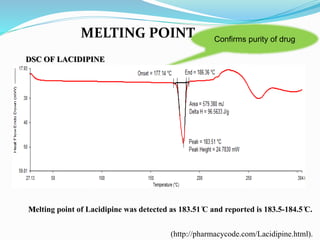
MELTING POINT Confirms purity of drug
DSC OF LACIDIPINE
Melting point of Lacidipine was detected as 183.51 ̊C and reported is 183.5-184.5 ̊C.
(http://pharmacycode.com/Lacidipine.html).
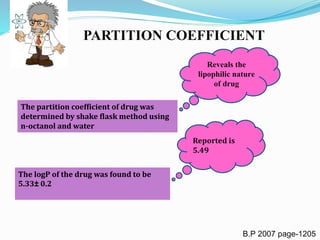
PARTITION COEFFICIENT
The partition coefficient of drug was
determined by shake flask method using
n-octanol and water
The logP of the drug was found to be
5.33± 0.2
Reveals the
lipophilic nature
of drug
Reported is
5.49
B.P 2007 page-1205
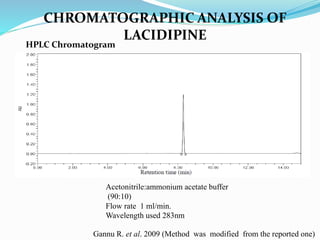
CHROMATOGRAPHIC ANALYSIS OF
LACIDIPINE
Acetonitrile:ammonium acetate buffer
(90:10)
Flow rate 1 ml/min.
Wavelength used 283nm
HPLC Chromatogram
Gannu R. et al. 2009 (Method was modified from the reported one)
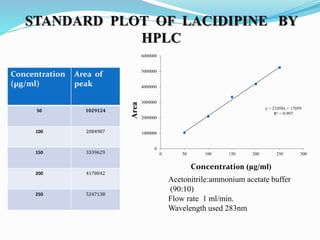
STANDARD PLOT OF LACIDIPINE BY
HPLC
Acetonitrile:ammonium acetate buffer
(90:10)
Flow rate 1 ml/min.
Wavelength used 283nm
Concentration
(µg/ml)
Area of
peak
50 1029124
100 2084987
150 3339629
200 4178042
250 5247138
y = 21058x + 17059
R² = 0.997
0
1000000
2000000
3000000
4000000
5000000
6000000
0 50 100 150 200 250 300
Concentration (µg/ml)
Area
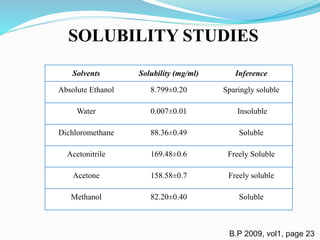
SOLUBILITY STUDIES
B.P 2009, vol1, page 23
Solvents Solubility (mg/ml) Inference
Absolute Ethanol 8.799±0.20 Sparingly soluble
Water 0.007±0.01 Insoluble
Dichloromethane 88.36±0.49 Soluble
Acetonitrile 169.48±0.6 Freely Soluble
Acetone 158.58±0.7 Freely soluble
Methanol 82.20±0.40 Soluble
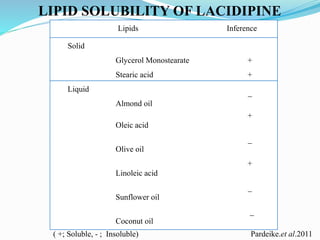
Lipids Inference
Solid
Glycerol Monostearate
Stearic acid
+
+
Liquid
Almond oil
Oleic acid
Olive oil
Linoleic acid
Sunflower oil
Coconut oil
_
+
_
+
_
_
LIPID SOLUBILITY OF LACIDIPINE
( +; Soluble, - ; Insoluble) Pardeike.et al.2011
PREPARATION, EFFECT OF VARIABLES
AND CHARACTERIZATION OF
NANOSTRUCTURED LIPID CARRIERS
FORMULATION
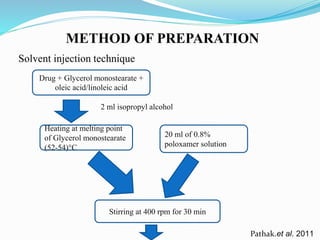
METHOD OF PREPARATION
Solvent injection technique
Pathak.et al. 2011
2 ml isopropyl alcohol
Stirring at 400 rpm for 30 min
Drug + Glycerol monostearate +
oleic acid/linoleic acid
Heating at melting point
of Glycerol monostearate
(52-54)°C
20 ml of 0.8%
poloxamer solution
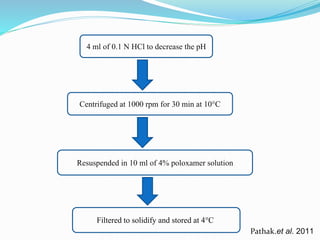
4 ml of 0.1 N HCl to decrease the pH
Centrifuged at 1000 rpm for 30 min at 10°C
Resuspended in 10 ml of 4% poloxamer solution
Pathak.et al. 2011
Filtered to solidify and stored at 4°C.
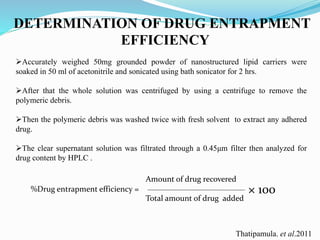
DETERMINATION OF DRUG ENTRAPMENT
EFFICIENCY
Accurately weighed 50mg grounded powder of nanostructured lipid carriers were
soaked in 50 ml of acetonitrile and sonicated using bath sonicator for 2 hrs.
After that the whole solution was centrifuged by using a centrifuge to remove the
polymeric debris.
Then the polymeric debris was washed twice with fresh solvent to extract any adhered
drug.
The clear supernatant solution was filtrated through a 0.45μm filter then analyzed for
drug content by HPLC .
%Drug entrapment efficiency =
Amount of drug recovered
Total amount of drug added
× 100
Thatipamula. et al.2011
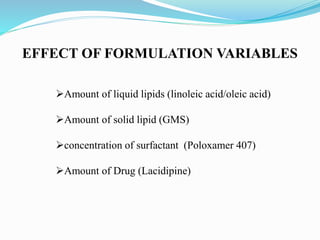
EFFECT OF FORMULATION VARIABLES
Amount of liquid lipids (linoleic acid/oleic acid)
Amount of solid lipid (GMS)
concentration of surfactant (Poloxamer 407)
Amount of Drug (Lacidipine)
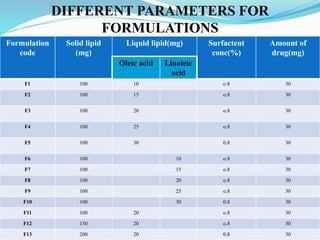
Formulation
code
Solid lipid
(mg)
Liquid lipid(mg) Surfactent
conc(%)
Amount of
drug(mg)
Oleic acid Linoleic
acid
F1 100 10 o.8 30
F2 100 15 o.8 30
F3 100 20 o.8 30
F4 100 25 o.8 30
F5 100 30 0.8 30
F6 100 10 o.8 30
F7 100 15 o.8 30
F8 100 20 o.8 30
F9 100 25 o.8 30
F10 100 30 0.8 30
F11 100 20 o.8 30
F12 150 20 o.8 30
F13 200 20 0.8 30
DIFFERENT PARAMETERS FOR
FORMULATIONS
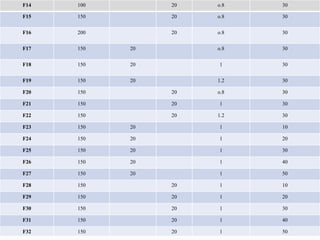
F14 100 20 o.8 30
F15 150 20 o.8 30
F16 200 20 o.8 30
F17 150 20 o.8 30
F18 150 20 1 30
F19 150 20 1.2 30
F20 150 20 o.8 30
F21 150 20 1 30
F22 150 20 1.2 30
F23 150 20 1 10
F24 150 20 1 20
F25 150 20 1 30
F26 150 20 1 40
F27 150 20 1 50
F28 150 20 1 10
F29 150 20 1 20
F30 150 20 1 30
F31 150 20 1 40
F32 150 20 1 50
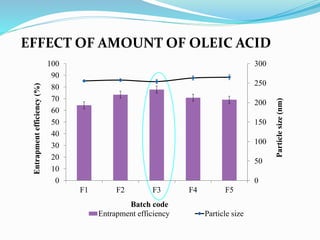
EFFECT OF AMOUNT OF OLEIC ACID
0
50
100
150
200
250
300
0
10
20
30
40
50
60
70
80
90
100
F1 F2 F3 F4 F5
Entrapment efficiency Particle size
Entrapment
efficiency
(%)
Batch code
Particle
size
(nm)
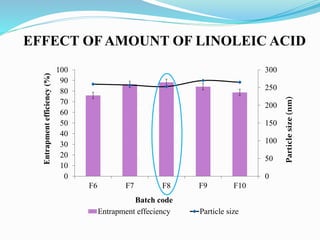
EFFECT OFAMOUNT OF LINOLEIC ACID
0
50
100
150
200
250
300
0
10
20
30
40
50
60
70
80
90
100
F6 F7 F8 F9 F10
Entrapment effeciency Particle size
Entrapment
efficiency
(%)
Particle
size
(nm)
Batch code
0
50
100
150
200
250
300
0
10
20
30
40
50
60
70
80
90
100
F11 F12 F13
Entrapment efficiency (%) Particle size
Particle
size
(nm)
Batch code
Entrapment
efficiency
(%)
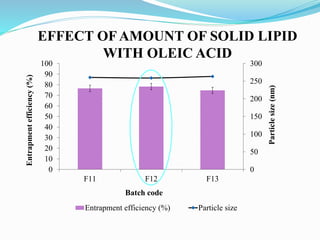
EFFECT OF AMOUNT OF SOLID LIPID
WITH OLEIC ACID
0
50
100
150
200
250
300
0
10
20
30
40
50
60
70
80
90
100
F14 F15 F16
Entrapment efficiency (%) Particle size
Entrapment
efficiency
(%)
Batch code
Particle
size
(nm)
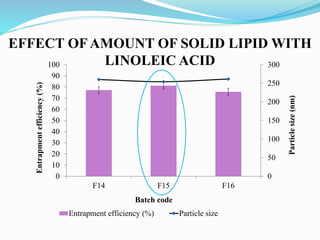
EFFECT OF AMOUNT OF SOLID LIPID WITH
LINOLEIC ACID
0
50
100
150
200
250
300
0
10
20
30
40
50
60
70
80
90
100
F17 F18 F19
Entrapment efficiency (%) Particle size (nm)
Entrapment
efficiency
(%)
Particle
size
(nm)
Batch code
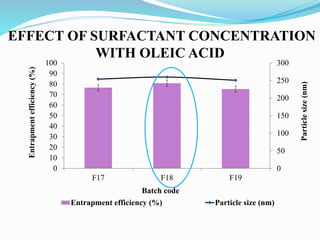
EFFECT OF SURFACTANT CONCENTRATION
WITH OLEIC ACID
0
50
100
150
200
250
300
0
10
20
30
40
50
60
70
80
90
100
F20 F21 F22
Entrapment efficiency (%) Particle size (nm)
Entrapment
efficiency
(%)
Batch code
Particle
size
(nm)
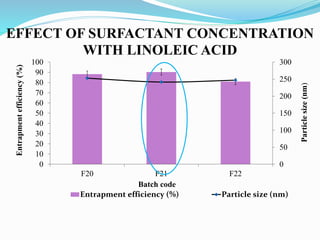
EFFECT OF SURFACTANT CONCENTRATION
WITH LINOLEIC ACID
0
50
100
150
200
250
300
0
10
20
30
40
50
60
70
80
90
100
F23 F24 F25 F26 F27
Entrapment efficiency (%) Particle size (nm)
Entrapment
efficiency
(%)
Particle
size
(nm)
Batch code
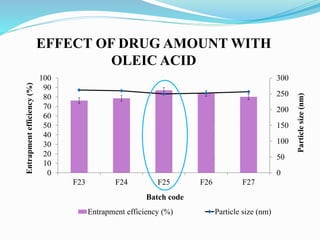
EFFECT OF DRUG AMOUNT WITH
OLEIC ACID
0
50
100
150
200
250
300
0
10
20
30
40
50
60
70
80
90
100
F28 F29 F30 F31 F32
Entrapment efficiency (%) Particle size (nm)
Entrapment
efficiency
(%)
Particle
size
(nm)
Batch code
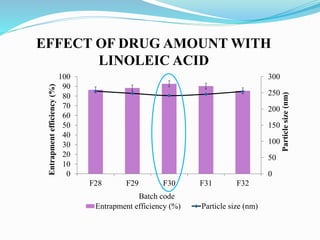
EFFECT OF DRUG AMOUNT WITH
LINOLEIC ACID
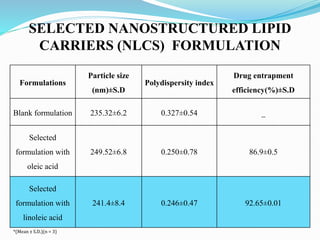
Formulations
Particle size
(nm)±S.D
Polydispersity index
Drug entrapment
efficiency(%)±S.D
Blank formulation 235.32±6.2 0.327±0.54 _
Selected
formulation with
oleic acid
249.52±6.8 0.250±0.78 86.9±0.5
Selected
formulation with
linoleic acid
241.4±8.4 0.246±0.47 92.65±0.01
*(Mean ± S.D.)(n = 3)
SELECTED NANOSTRUCTURED LIPID
CARRIERS (NLCS) FORMULATION
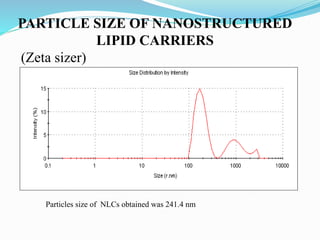
PARTICLE SIZE OF NANOSTRUCTURED
LIPID CARRIERS
(Zeta sizer)
Particles size of NLCs obtained was 241.4 nm
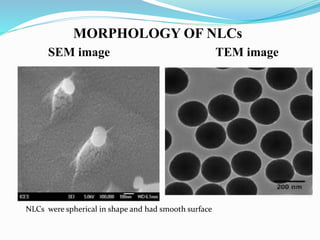
MORPHOLOGY OF NLCs
NLCs were spherical in shape and had smooth surface
SEM image TEM image
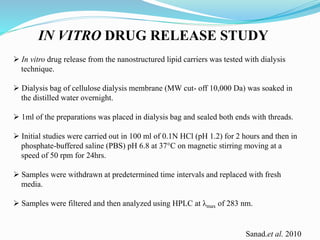
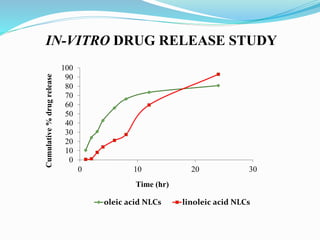
IN VITRO DRUG RELEASE STUDY
 In vitro drug release from the nanostructured lipid carriers was tested with dialysis
technique.
 Dialysis bag of cellulose dialysis membrane (MW cut- off 10,000 Da) was soaked in
the distilled water overnight.
 1ml of the preparations was placed in dialysis bag and sealed both ends with threads.
 Initial studies were carried out in 100 ml of 0.1N HCl (pH 1.2) for 2 hours and then in
phosphate-buffered saline (PBS) pH 6.8 at 37°C on magnetic stirring moving at a
speed of 50 rpm for 24hrs.
 Samples were withdrawn at predetermined time intervals and replaced with fresh
media.
 Samples were filtered and then analyzed using HPLC at λmax of 283 nm.
Sanad.et al. 2010
IN-VITRO DRUG RELEASE STUDY
0
10
20
30
40
50
60
70
80
90
100
0 10 20 30
oleic acid NLCs linoleic acid NLCs
Time (hr)
Cumulative
%
drug
release
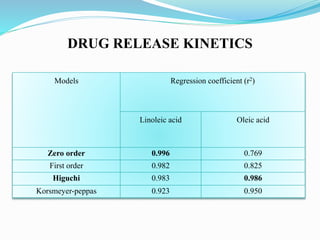
DRUG RELEASE KINETICS
Models Regression coefficient (r2)
Linoleic acid Oleic acid
Zero order 0.996 0.769
First order 0.982 0.825
Higuchi 0.983 0.986
Korsmeyer-peppas 0.923 0.950
BIOAVAILABILITY STUDY
All the in vivo studies were carried out under the guidelines compiled by
CPCSEA (Committee for the Purpose of Control and Supervision of
Experiments on Animal, Ministry of Culture, Government of India)
Approval No. RITS/IAEC/2012/05/26
All the study protocols were approved by the local institutional Animal Ethics
Committee.
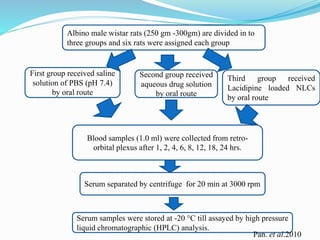
Albino male wistar rats (250 gm -300gm) are divided in to
three groups and six rats were assigned each group
First group received saline
solution of PBS (pH 7.4)
by oral route
Second group received
aqueous drug solution
by oral route
Third group received
Lacidipine loaded NLCs
by oral route
Blood samples (1.0 ml) were collected from retro-
orbital plexus after 1, 2, 4, 6, 8, 12, 18, 24 hrs.
Serum separated by centrifuge for 20 min at 3000 rpm
Serum samples were stored at -20 °C till assayed by high pressure
liquid chromatographic (HPLC) analysis.
Pan. et al.2010
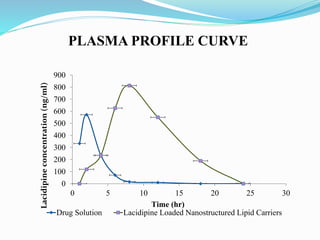
PLASMA PROFILE CURVE
0
100
200
300
400
500
600
700
800
900
0 5 10 15 20 25 30
Drug Solution Lacidipine Loaded Nanostructured Lipid Carriers
Time (hr)
Lacidipine
concentration
(ng/ml)
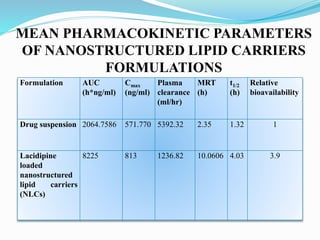
Formulation AUC
(h*ng/ml)
Cmax
(ng/ml)
Plasma
clearance
(ml/hr)
MRT
(h)
t1/2
(h)
Relative
bioavailability
Drug suspension 2064.7586 571.770 5392.32 2.35 1.32 1
Lacidipine
loaded
nanostructured
lipid carriers
(NLCs)
8225 813 1236.82 10.0606 4.03 3.9
MEAN PHARMACOKINETIC PARAMETERS
OF NANOSTRUCTURED LIPID CARRIERS
FORMULATIONS
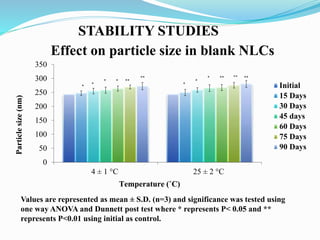
Effect on particle size in blank NLCs
0
50
100
150
200
250
300
350
4 ± 1 °C 25 ± 2 °C
Initial
15 Days
30 Days
45 days
60 Days
75 Days
90 Days
Temperature (˚C)
Particle
size
(nm)
*
*
*
*
*
**
**
*
**
*
**
Temperature (˚C)
Particle
size
(nm)
*
*
*
*
*
**
**
*
** **
*
**
Values are represented as mean ± S.D. (n=3) and significance was tested using
one way ANOVA and Dunnett post test where * represents P< 0.05 and **
represents P<0.01 using initial as control.
STABILITY STUDIES
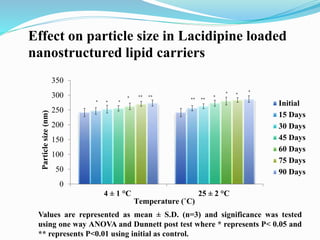
Effect on particle size in Lacidipine loaded
nanostructured lipid carriers
Values are represented as mean ± S.D. (n=3) and significance was tested
using one way ANOVA and Dunnett post test where * represents P< 0.05 and
** represents P<0.01 using initial as control.
0
50
100
150
200
250
300
350
4 ± 1 °C 25 ± 2 °C
Initial
15 Days
30 Days
45 Days
60 Days
75 Days
90 Days
Temperature (˚C)
Particle
size
(nm)
*
*
*
*
*
**
**
*
*
*
**
**
80
82
84
86
88
90
92
94
96
98
100
102
4 ± 1 °C 25 ± 2 °C
Initial
15 Days
30 Days
45 Days
60 Days
75 Days
90 Days
*
*
**
**
*
*
*
*
*
**
%
Drug
remaining
Temperature (˚C)
**
**
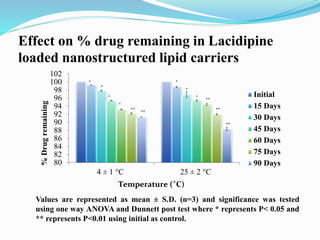
Effect on % drug remaining in Lacidipine
loaded nanostructured lipid carriers
Values are represented as mean ± S.D. (n=3) and significance was tested
using one way ANOVA and Dunnett post test where * represents P< 0.05 and
** represents P<0.01 using initial as control.
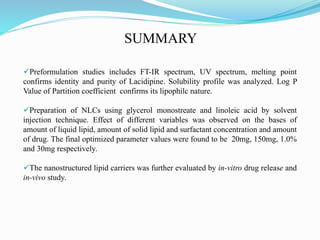
Preformulation studies includes FT-IR spectrum, UV spectrum, melting point
confirms identity and purity of Lacidipine. Solubility profile was analyzed. Log P
Value of Partition coefficient confirms its lipophilc nature.
Preparation of NLCs using glycerol monostreate and linoleic acid by solvent
injection technique. Effect of different variables was observed on the bases of
amount of liquid lipid, amount of solid lipid and surfactant concentration and amount
of drug. The final optimized parameter values were found to be 20mg, 150mg, 1.0%
and 30mg respectively.
The nanostructured lipid carriers was further evaluated by in-vitro drug release and
in-vivo study.
SUMMARY
 NLCs formulated with oleic acid and linoleic acid were studied for in vitro
release study, results obtained from the dissolution profile of NLCs was fitted
into various mathematical models and the data was found to fit best into the
zero release model, which suggests that the mechanism of drug release was
constant or independent on concentration.
Stability studies were performed at 4±1°C and 25±2°C (60±5%RH) for 3
months to access the stability of the NLCs. Results of stability studies have
shown that no significant changes were observed in %drug remaining and
particle size.
In vivo bioavailability study was performed in albino rats. The result
showed that the Lacidipine loaded NLCs formulation shows more than thrice
the relative bioavailability of drug solution.
CONCLUSIONS
Results from preformulation studies proved the purity of the drug and
compatibility with the excepients.
 Lacidipine loaded NLCs developed for oral delivery of Lacidipine possessed site
specific targeting ability, better stability and higher entrapment efficiency, easy to
scale up.
Linoleic acid caused numerous crystal defects in solid lipid and provided
imperfections in highly ordered crystal. In this space more drug molecules get
entrapped due to which the increase in entrapment efficiency and reduction in
particle size takes place.
REFERENCES
 Thomas, V. H., Bhattachar, S., Hitchingham, L., Zocharski, P., Naath, M., Surendran,
N. Stoner, C. L. & El-Kattan. The road map to oral bioavailability: an industrial
perspective. Expert Opin Drug Metab Toxicol 2006, 2(4): 591-608.
 Hurst, S., Loi, C. M., Brodfuehrer, J. & El-Kattan, A. Impact of physiological,
physicochemical and biopharmaceutical factors in absorption and metabolis mechanisms
on the drug oral bioavailability of rats and humans. Expert Opin Drug Metab Toxicol
2007; 3(4): 469-489.
 Varma, M. V., Ambler, C. M., Ullah, M., Rotter, C. J., Sun, H., Litchfield, J., Fenner,
K. S. & El-Kattan, A. F. Targeting intestinal transporters for optimizing oral drug
absorption. Curr Drug Metab 2013; 11(9): 730-742.
 Varma, M. V., Obach, R..S., Rotter, C., Miller, H. R., Chang, G., Steyn, S. J., El-
Kattan, A. & Troutman, M. D. Physicochemical space for optimum oral bioavailability:
contribution of human intestinal absorption and first-pass elimination. J Med Chem
2010; 53(3): 1108-1098.
 Karlsson, J., Ungell, A., Grasjo, J. & Artursson, P. Paracellular drug transport across
intestinal epithelia: influence of charge and induced water flux. Eur. J. Pharm. 1999;
9(1): 47-56.
 Lipinski, C. A. Computational alerts for potential absorption problems: profiles of
clinically tested drugs. J. Pharmacol. Tox. Methods 1995; 44(1): 235-249.
GIT Anatomy(www.edoctoronline.com), accessed on April 27, 2013.
 Lennernas, H. Does fluid flow across the intestinal mucosa affect quantitative oral
drug absorption? Is it time for a reevaluation?, Pharm. Res.1995; 12(11): 1573-1582.
Avdeef, A. Physicochemical profiling (solubility, permeability and charge state). Curr.
Top. Med. Chem. 2001; 1(4): 277-351.
 Gursoy, R.N. and Benita, S. Self-emulsifying drug delivery systems (SEDDS) for
improved oral delivery of lipophilic drugs. Biomed. Pharmacother. 2004; 58: 173-182.
 Amidon, G.L. A theoretical basis for a biopharmaceutic drug classification: the
correlation of in vitro drug product dissolution and in vivo bioavailability. Pharm. Res.
1995; 12: 413–420.
 Date, A.A. Self-nanoemulsifying drug delivery systems: formulation insights,
applications and advances. Nanomedicine 2010; 5: 1595-1616.
http://en.wikipedia.org/wiki/Bioavailability accessed on April 29, 2013.
 Lappin, Graham; Rowland, Malcolm; Garner, R Colin. The use of isotopes in the
determination of absolute bioavailability of drugs in humans. Expert Opinion on Drug
Metabolism & Toxicology. 2006; 2 (3): 27-419.
 Lappin, Graham; Stevens, Lloyd. Biomedical accelerator mass spectrometry: Recent
applications in metabolism and pharmacokinetics. Expert Opinion on Drug Metabolism &
Toxicology. 2008; 4(8): 33-1021.
 Hoag, Stephen W.; Hussain, Ajaz S. The Impact of Formulation on Bioavailability:
Summary of Workshop Discussion. The Journal of Nutrition. 2001; 131(4): 1389S–91S.
Rita Wegmuller, Michael B. Zimmermann, Diego Moretti, Myrtha Arnold, Wolfgang
Langhans and Richard F. Hurrell. Particle size reduction and encapsulation affect the
bioavailability of ferric pyrophosphate in rats. Amer Soci Nutri Sci J. Nutr. 2004; 134:
3301-3304.
Shargel, L.; Yu, A.B. Applied biopharmaceutics & pharmacokinetics (4th edition)1999;
453-430.
 EI-Laithy HM. Self-nanoemulsifying drug delivery system for enhanced bioavailability
and improved hepatoprotective activity of biphenyl dimethyl dicarboxylate. Curr Drug
Deliv. 2008; 5(3): 6-170.
 Wu JZ, Ho PC. Evaluation of the in vitro activity and in vivo bioavailability of realgar
nanoparticles prepared by cryo-grinding. Eur J Pharm Sci. 2006; 29(1): 44-35.
 Kotyla T, Kuo F, Moolchandani V, Wilson T, Nicolosi R. Increased bioavailability of a
transdermal application of a nano-sized emulsion preparation. Int J Pharm. 2008; 22: 8-
144.
 Hecq J, Deleers M, Fanara D, Vranckx H, Boulanger P, Le Lamer S, Amighi K.
Preparation and in vitro/in vivo evaluation of nano-sized crystals for dissolution rate
enhancement of ucb-35440-3, a highly dosed poorly water-soluble weak base. Eur J Pharm
Biopharm. 2006; 64(3): 8-360.
 Lohitnavy, M., Lohitnavy, O., Thangkeattiyanon, O., Srichai, W. Reduced oral
itraconazole bioavailability by antacid suspension. J. of Clin Pharm. 2005; 30(3): 6-201.
Magdalene Radtke, Eliana B. Souto, Rainer H. Muller. Nanostructured Lipid Carriers: A Novel
Generation of Solid Lipid Drug Carriers. Pharmaceutical Technology Europe. 2005; 17(4):45–50.
Gupta MM, Saini TR. Preformulation Parameters Characterization to Design, Development and
Formulation of Vancomycin Hydrochloride Tablets for Psudomembranous Colitis. Int J Pharm
Res Dev. 2009; 1(9):1-7.
Prasanthi NL, Rama Rao N. Formulation evaluation of lacidipine tablets employing lacidipine-
starch phosphate binary systems. Research j. Pharm. and Tech. 2010; 3(2): 458-460.
Pathak kamla, Tiwari Radheshyam, Nanostructured lipid carrier versus solid lipid nanoparticles
of simvastatin: Comparative analysis of characteristics, pharmacokinetics and tissue uptake,
International Journal of Pharmaceutics. 2011; 415: 232– 243.
Tiecheng Zhang, Jianian Chen, Yi Zhang, Qi Shen,Weisan Pan. Characterization and evaluation
of nanostructured lipid carrier as a vehicle for oral delivery of etoposide. European Journal of
Pharmaceutical Sciences. 2011; 43:174–179.
Chun-Yang Zhuang, Ning Li, Mi Wang, Xiao-Ning Zhang, Wei-San Pana, Jun-Jie Penga, Yu-
Sheng Pana, Xin Tang. Preparation and characterization of vinpocetine loaded nanostructured
lipid carriers (NLC) for improved oral bioavailability. International Journal of Pharmaceutics.
2010; 394 : 179–185.
ACKNOWLEDGMENT
I wish to express my gratitude to my respected guide Dr. Senthil Kumar M., Professor and
Head Department of Pharmaceutics, Rajendra Institute of Technology and Sciences,Sirsa.
I am profoundly grateful to Dr. Rajendar Singh sra, Chairman, and Mr. Omprakash,
Secretary of Rajendra Institutes, Sirsa, for providing me all necessary facilities required for
completion of my project.
My sincere thanks to Dr. Vikramdeep Monga, Dr. Anupama Setia, Mr. Ashwani Sharma,
Mr. Rampal, Mr. Shammi, Miss Madhu, Mrs. Suman.
I express my thanks to SAIF staff of AIIMS, Delhi, for carrying out SEM and TEM of my
sample. I also would like to thanks staff of Nanotechnology GJUS&T, Hisar for carrying out
Zeta sizer and zeta potential of my sample.
PUBLICATIONS
Research Paper
Entitled “Development of Lacidipine Loaded Nanostructured Lipid Carriers
(NLCs) for Bioavailability Enhancement”
Communicated to Journal of Drug Targeting
POSTERS PRESENTATIONS
Title: Nanoparticulate Delivery System for Tuberculosis Treatment
Conference: National seminar on Importance of Cell Lines in Pharmaceutical
Research in India. Held at School of Pharmaceutical Sciences, Shoolini
University, Solan, 14-15 Nov, 2011
Title: Nanostructured Lipid Carriers (NLCs)- A Review
Conference: Pharmaceutical Drug Discovery & Development- Future
Perspectives. Rajendra Institute of Technology and Sciences, Sirsa, 28-29 July,
2012
SLN -.pptx

SLN -.pptx

  • 1.
    DEVELOPMENT OF LACIDIPINELOADED NANOSTRUCTURED LIPID CARRIERS (NLCs) FOR BIOAVAILABILITY ENHANCEMENT By: Anuradha Kush, Associate Professor R.K.S.D. College of pharmacy, Kaithal, Haryana
  • 2.
    CONTENT INTRODUCTION LITERATURE REVIEW RESEARCH ENVISAGED PLANOF WORK PREFORMULATION STUDIES PREPARATION, EFFECT OF PROCESS VARIABLES AND CHARACTERIZATION IN VITRO AND IN VIVO STUDIES STABILITY STUDIES REFERENCES
  • 3.
    Oral Route • Mostpreferred route for administration of drugs • Offers greatest degree of patient compliance • Very effective for drugs with high solubility and gastrointestinal permeability INTRODUCTION El-Kattan. et al.2012
  • 4.
    MECHANISM OF ORALABSORPTION GITAnatomy Following oral dosing, drug molecules can cross the GI membrane through various mechanisms that involve • Passive diffusion • Active transport. El-Kattan. et al.2012
  • 5.
    BIOAVAILABILITY Bioavailability is therate and extent (fraction or the percentage of the dose) to which the active drug ingredient delivered is absorbed from a drug product into the general circulation. Poor bioavailability by the oral route can be due to :  Poor solubility  Degradation in GI lumen  Poor membrane permeation  Pre-systemic elimination Liang Shen. et al.2008
  • 6.
    FACTORS AFFECTING BIOAVAILABILITY Particlesize pKa Partition coefficient Stability Liang Shen. et al.2008
  • 7.
    BIOAVAILABILITY ENHANCEMENT OF POORLYWATER SOLUBLE DRUGS Prodrug approach Microemulsion formulations Particle Size Reduction (Micronization, Nanotechnology) Gupta. et al.2011
  • 8.
    NANOSTRUCTURED LIPID CARRIERS Radtke.et al. 2011 Nanostructured lipid carriers (NLCs) are a type of submicron particulate drug delivery system based on mixture of solid lipids with liquid lipids.  The nanostructure lipid carriers (NLCs) are regarded as the second-generation of lipid nanoparticles.  Solid lipids and liquid lipids are considerably different in chemical structure.  The usual particle diameters of the NLCs are in the range of approximately 10–1000 nm.  Molecules of NLCs improve mucosal adhesion due to small particle size and increases their GIT residence time.  Accommodate more drug and reduce the drug leakage during storage.
  • 9.
    NLCs - Themore intelligent system than SLNs SLN: tendency to form perfect crystals can not accommodate larger drug amount NLC: inhibit crystallization process leads to a highly disordered, imperfect lipid matrix structure offering space for drug molecules.
  • 10.
    ADVANTAGES OF CARRIERSYSTEM Reginald. et al. 2012  Increases drug loading  Controlled drug release  The possibility of production on large industrial scale  Possess negligible toxicity  Bioavailability of highly lipophilic molecules can be increased  Minimum drug leakage during storage
  • 11.
    GASTROINTESTINALABSORPTION OF NLCs THROUGHSMALL INTESTINE Pathak.et al. 2011
  • 12.
    Solid lipid (Glycerylmonostearate)  Lipophillic in nature.  Responsible for more sustained release of the drug. Liqid lipids (Oleic acid, Linoleic acid)  Enhances the entrapment efficiency.  Entropy of the lipid provides space for entrapment of drug molecules. Surfactant (Poloxamer 407 ) Supports the absorption of NLCs, due to their effect on intestinal epithelial permeability. FORMULATION OF NLCs
  • 13.
    B.P 2007, page-1205 IUPACName Diethyl 4-{2-[(tert butoxycarbonyl)vinyl]phenyl}- 1,4 dihydropyridine -3,5dicarboxylate Category Antihypertensive(Calcium channel blocker) Appearance It's a white to pale yellow colored crystalline powder Molecular Formula C26H33NO6 Molecular Weight 455.54 g/mol Melting point 183.5-184.5°C Partition Coefficient 5.49 Dose 2-6mg Bioavailabity 10% Solubility Practically insoluble in water, springly soluble in alcohol, soluble in dichloromethane, freely soluble in acetonitrile and acetone. LACIDIPINE PROFILE
  • 14.
    MECHANISM OF ACTION TRIPATHIKD., 6th edition. 2010 PAGE- 529,550  Lacidipine blocks calcium channels. Act as smooth muscle relaxant. Thus produces vasodilation. Lacidipine
  • 15.
    LITERATURE REVIEW Author WorkYear Khan et al., Explained the different types of nanocarriers which were based on solid lipid like solid lipid nanoparticles, nanostructured lipid carriers, lipid drug conjugates are with their structural differences. 2012 Reginald et al., Developed and compared solid lipid nanoparticles (SLNs) and nanostructured lipid carriers (NLCs) of Clotrimazole and concluded that the tested NLCs showed better stability than SLNs at 25 °C and shows no significant difference in drug release profile of NLCs after 3 months storage. 2012 Bajaj et al., Described various techniques used for the improvement of the Bioavailability of drugs including size reduction, solubilising excipients, colloidal drug delivery systems etc. 2011 Das et al., Reviewed the different formulation techniques, drug incorporation models, GI absorption and oral bioavailability enhancement mechanisms, stability and storage condition of the formulations. 2011
  • 16.
    Patravale et al.,Reviewed various nano-architectures such as nanosuspensions, lipid and polymeric nanocarriers, inorganic nanostructures and its advantages and challenges associated with their efficient delivery of poorly bioavailable drugs. 2011 Pathak et al., Demonstrated the superiority of NLC over SLN for improved oral delivery and it was deduced that the liquid lipid, oleic acid was the principal formulation factor responsible for the improvement in characteristics, pharmacokinetics and biodistribution of NLC. 2011 Shen et al., Incorporated etoposide into NLCs by an emulsification and low temperature solidification method and concluded that NLCs is a promising delivery system to enhance the oral absorption of poorly water soluble drugs. 2011 Krishnaiah et al., Explained that the prodrug approach is an exciting way of improving the oral bioavailability of BCS class II drugs with low solubility and reasonable permeability. 2010 Gupta et al., Reviewed that, for poorly soluble drug candidates, self- emulsifying drug delivery systems (SEDDS) could provide an effective and practical solution to the problem of formulating drugs where low solubility in the fluids of the GIT limits drug exposure. 2010
  • 17.
    Gannu R. etal., Developed microemulsion based transdermal therapeutic system for Lacidipine is a solution for increasing the absorption of drug into systemic circulation. 2010 Pan et al., Developed an optimized nanostructured lipid carriers (NLC) of Vinpocetine (VIN) by using high pressur homogenization method. 2010 Sanad et al., Formulated Oxybenzone into nanostructured lipid carriers (NLCs) to enhance its sunscreening efficacy and safety. 2010 Fang et al., Investigated that the bioavailability of lovastatin can be improved by oral delivery of NLCs and concluded that oral lovastatin bioavailability was enhanced from 4% to 24% when the drug was administered from NLCs containing Myverol and soybean phosphatidylcholine. 2009 McCormack et al., Studied the role of Lacidipine in management of hypertension, its pharmacodynamic and pharmacokinetic properties. 2003
  • 18.
    Antihypertensive drug Lacidipineis having only 10% bioavailability so NLC’s are selected to enhance the bioavailability. Lipid-based drug delivery systems are expected as promising oral carriers because of their potential to increase the solubility and improve oral bioavailability of lipophilic drugs. The objective of the present study is to prepare and characterize Nanostructured lipid carriers (NLCs) for delivering orally the hypertensive drug Lacidipine for enhancement of bioavailability. RESEARCH ENVISAGED
  • 19.
    PLAN OF WORK PreformulationStudies • Absorption maxima (λmax) • FT- IR Spectrum • Melting Point • Solubility study • Partition coefficient • Estimation of Lacidipine by UV and HPLC Preparation and Effect of Formulation Variables • By solvent injection technique • Effect of Formulation Variables  Amount of liquid lipid  Amount of solid lipid  Concentration of surfactant  Amount of drug
  • 20.
    Characterization of NanostructuredLipid Carriers (NLCs) • Morphology (SEM & TEM) • Particle Size and size distribution • Drug Entrapment Efficiency (%) • In vitro drug release and kinetics Stability Studies • At 4°±1°C and 25±2°C (60±5% Relative Humidity(RH)) • 3 months study • Effect on size and (%) drug remaining In vivo study • Bioavailability Study
  • 21.
  • 22.
    FT-IR SPECTRUM OFLACIDIPINE 743.25 763.68 1098.75 1151.87 1192.74 1307.15 1364.36 1495.12 1625.88 1650.40 1670.83 1703.52 2978.43 3350.28 3411.58 0 10 20 30 40 50 60 70 80 90 100 %T 500 1000 1500 2000 2500 3000 3500 4000 Wavenumbers (cm-1) Peak (cm-1) Reference peak (cm-1) vibration Functional group 3411.58 3500 – 3100 -NH Due to amino group present 2978.43 3000 – 2850 -CH(C-C) Alkane group present 1670.83 1600 – 1680 -C=O Carbonyl group present 1625.88 1680 – 1600 -C=C- Double bond b/w carbon 1495.12 1500 – 1400 -C-N- Due to –C-N- in pyridine ring 1151.8 1300 – 1000 C-O-C Due to C-O-C in ester linkage B.P 2007 page-1205
  • 23.
    U.V. SPECTRUM OFLACIDIPINE WITH METHANOL 283 nm Prasanthi N.L. et al. 2010 (reported is 284nm in methanol)
  • 24.
    STANDARD PLOT FORLACIDIPINE Solvent - Methanol Wavelength - 283nm Concentration (µg/ml) Absorbance 2 0.190 4 0.262 6 0.381 8 0.482 10 0.621 12 0.728 14 0.846 y = 0.056x + 0.052 R² = 0.994 0 0.1 0.2 0.3 0.4 0.5 0.6 0.7 0.8 0.9 0 5 10 15 Absorbance Concentration (µg/ml)
  • 25.
    MELTING POINT Confirmspurity of drug DSC OF LACIDIPINE Melting point of Lacidipine was detected as 183.51 ̊C and reported is 183.5-184.5 ̊C. (http://pharmacycode.com/Lacidipine.html).
  • 26.
    PARTITION COEFFICIENT The partitioncoefficient of drug was determined by shake flask method using n-octanol and water The logP of the drug was found to be 5.33± 0.2 Reveals the lipophilic nature of drug Reported is 5.49 B.P 2007 page-1205
  • 27.
    CHROMATOGRAPHIC ANALYSIS OF LACIDIPINE Acetonitrile:ammoniumacetate buffer (90:10) Flow rate 1 ml/min. Wavelength used 283nm HPLC Chromatogram Gannu R. et al. 2009 (Method was modified from the reported one)
  • 28.
    STANDARD PLOT OFLACIDIPINE BY HPLC Acetonitrile:ammonium acetate buffer (90:10) Flow rate 1 ml/min. Wavelength used 283nm Concentration (µg/ml) Area of peak 50 1029124 100 2084987 150 3339629 200 4178042 250 5247138 y = 21058x + 17059 R² = 0.997 0 1000000 2000000 3000000 4000000 5000000 6000000 0 50 100 150 200 250 300 Concentration (µg/ml) Area
  • 29.
    SOLUBILITY STUDIES B.P 2009,vol1, page 23 Solvents Solubility (mg/ml) Inference Absolute Ethanol 8.799±0.20 Sparingly soluble Water 0.007±0.01 Insoluble Dichloromethane 88.36±0.49 Soluble Acetonitrile 169.48±0.6 Freely Soluble Acetone 158.58±0.7 Freely soluble Methanol 82.20±0.40 Soluble
  • 30.
    Lipids Inference Solid Glycerol Monostearate Stearicacid + + Liquid Almond oil Oleic acid Olive oil Linoleic acid Sunflower oil Coconut oil _ + _ + _ _ LIPID SOLUBILITY OF LACIDIPINE ( +; Soluble, - ; Insoluble) Pardeike.et al.2011
  • 31.
    PREPARATION, EFFECT OFVARIABLES AND CHARACTERIZATION OF NANOSTRUCTURED LIPID CARRIERS FORMULATION
  • 32.
    METHOD OF PREPARATION Solventinjection technique Pathak.et al. 2011 2 ml isopropyl alcohol Stirring at 400 rpm for 30 min Drug + Glycerol monostearate + oleic acid/linoleic acid Heating at melting point of Glycerol monostearate (52-54)°C 20 ml of 0.8% poloxamer solution
  • 33.
    4 ml of0.1 N HCl to decrease the pH Centrifuged at 1000 rpm for 30 min at 10°C Resuspended in 10 ml of 4% poloxamer solution Pathak.et al. 2011 Filtered to solidify and stored at 4°C.
  • 34.
    DETERMINATION OF DRUGENTRAPMENT EFFICIENCY Accurately weighed 50mg grounded powder of nanostructured lipid carriers were soaked in 50 ml of acetonitrile and sonicated using bath sonicator for 2 hrs. After that the whole solution was centrifuged by using a centrifuge to remove the polymeric debris. Then the polymeric debris was washed twice with fresh solvent to extract any adhered drug. The clear supernatant solution was filtrated through a 0.45μm filter then analyzed for drug content by HPLC . %Drug entrapment efficiency = Amount of drug recovered Total amount of drug added × 100 Thatipamula. et al.2011
  • 35.
    EFFECT OF FORMULATIONVARIABLES Amount of liquid lipids (linoleic acid/oleic acid) Amount of solid lipid (GMS) concentration of surfactant (Poloxamer 407) Amount of Drug (Lacidipine)
  • 36.
    Formulation code Solid lipid (mg) Liquid lipid(mg)Surfactent conc(%) Amount of drug(mg) Oleic acid Linoleic acid F1 100 10 o.8 30 F2 100 15 o.8 30 F3 100 20 o.8 30 F4 100 25 o.8 30 F5 100 30 0.8 30 F6 100 10 o.8 30 F7 100 15 o.8 30 F8 100 20 o.8 30 F9 100 25 o.8 30 F10 100 30 0.8 30 F11 100 20 o.8 30 F12 150 20 o.8 30 F13 200 20 0.8 30 DIFFERENT PARAMETERS FOR FORMULATIONS
  • 37.
    F14 100 20o.8 30 F15 150 20 o.8 30 F16 200 20 o.8 30 F17 150 20 o.8 30 F18 150 20 1 30 F19 150 20 1.2 30 F20 150 20 o.8 30 F21 150 20 1 30 F22 150 20 1.2 30 F23 150 20 1 10 F24 150 20 1 20 F25 150 20 1 30 F26 150 20 1 40 F27 150 20 1 50 F28 150 20 1 10 F29 150 20 1 20 F30 150 20 1 30 F31 150 20 1 40 F32 150 20 1 50
  • 38.
    EFFECT OF AMOUNTOF OLEIC ACID 0 50 100 150 200 250 300 0 10 20 30 40 50 60 70 80 90 100 F1 F2 F3 F4 F5 Entrapment efficiency Particle size Entrapment efficiency (%) Batch code Particle size (nm)
  • 39.
    EFFECT OFAMOUNT OFLINOLEIC ACID 0 50 100 150 200 250 300 0 10 20 30 40 50 60 70 80 90 100 F6 F7 F8 F9 F10 Entrapment effeciency Particle size Entrapment efficiency (%) Particle size (nm) Batch code
  • 40.
    0 50 100 150 200 250 300 0 10 20 30 40 50 60 70 80 90 100 F11 F12 F13 Entrapmentefficiency (%) Particle size Particle size (nm) Batch code Entrapment efficiency (%) EFFECT OF AMOUNT OF SOLID LIPID WITH OLEIC ACID
  • 41.
    0 50 100 150 200 250 300 0 10 20 30 40 50 60 70 80 90 100 F14 F15 F16 Entrapmentefficiency (%) Particle size Entrapment efficiency (%) Batch code Particle size (nm) EFFECT OF AMOUNT OF SOLID LIPID WITH LINOLEIC ACID
  • 42.
    0 50 100 150 200 250 300 0 10 20 30 40 50 60 70 80 90 100 F17 F18 F19 Entrapmentefficiency (%) Particle size (nm) Entrapment efficiency (%) Particle size (nm) Batch code EFFECT OF SURFACTANT CONCENTRATION WITH OLEIC ACID
  • 43.
    0 50 100 150 200 250 300 0 10 20 30 40 50 60 70 80 90 100 F20 F21 F22 Entrapmentefficiency (%) Particle size (nm) Entrapment efficiency (%) Batch code Particle size (nm) EFFECT OF SURFACTANT CONCENTRATION WITH LINOLEIC ACID
  • 44.
    0 50 100 150 200 250 300 0 10 20 30 40 50 60 70 80 90 100 F23 F24 F25F26 F27 Entrapment efficiency (%) Particle size (nm) Entrapment efficiency (%) Particle size (nm) Batch code EFFECT OF DRUG AMOUNT WITH OLEIC ACID
  • 45.
    0 50 100 150 200 250 300 0 10 20 30 40 50 60 70 80 90 100 F28 F29 F30F31 F32 Entrapment efficiency (%) Particle size (nm) Entrapment efficiency (%) Particle size (nm) Batch code EFFECT OF DRUG AMOUNT WITH LINOLEIC ACID
  • 46.
    Formulations Particle size (nm)±S.D Polydispersity index Drugentrapment efficiency(%)±S.D Blank formulation 235.32±6.2 0.327±0.54 _ Selected formulation with oleic acid 249.52±6.8 0.250±0.78 86.9±0.5 Selected formulation with linoleic acid 241.4±8.4 0.246±0.47 92.65±0.01 *(Mean ± S.D.)(n = 3) SELECTED NANOSTRUCTURED LIPID CARRIERS (NLCS) FORMULATION
  • 47.
    PARTICLE SIZE OFNANOSTRUCTURED LIPID CARRIERS (Zeta sizer) Particles size of NLCs obtained was 241.4 nm
  • 48.
    MORPHOLOGY OF NLCs NLCswere spherical in shape and had smooth surface SEM image TEM image
  • 49.
    IN VITRO DRUGRELEASE STUDY  In vitro drug release from the nanostructured lipid carriers was tested with dialysis technique.  Dialysis bag of cellulose dialysis membrane (MW cut- off 10,000 Da) was soaked in the distilled water overnight.  1ml of the preparations was placed in dialysis bag and sealed both ends with threads.  Initial studies were carried out in 100 ml of 0.1N HCl (pH 1.2) for 2 hours and then in phosphate-buffered saline (PBS) pH 6.8 at 37°C on magnetic stirring moving at a speed of 50 rpm for 24hrs.  Samples were withdrawn at predetermined time intervals and replaced with fresh media.  Samples were filtered and then analyzed using HPLC at λmax of 283 nm. Sanad.et al. 2010
  • 50.
    IN-VITRO DRUG RELEASESTUDY 0 10 20 30 40 50 60 70 80 90 100 0 10 20 30 oleic acid NLCs linoleic acid NLCs Time (hr) Cumulative % drug release
  • 51.
    DRUG RELEASE KINETICS ModelsRegression coefficient (r2) Linoleic acid Oleic acid Zero order 0.996 0.769 First order 0.982 0.825 Higuchi 0.983 0.986 Korsmeyer-peppas 0.923 0.950
  • 52.
    BIOAVAILABILITY STUDY All thein vivo studies were carried out under the guidelines compiled by CPCSEA (Committee for the Purpose of Control and Supervision of Experiments on Animal, Ministry of Culture, Government of India) Approval No. RITS/IAEC/2012/05/26 All the study protocols were approved by the local institutional Animal Ethics Committee.
  • 53.
    Albino male wistarrats (250 gm -300gm) are divided in to three groups and six rats were assigned each group First group received saline solution of PBS (pH 7.4) by oral route Second group received aqueous drug solution by oral route Third group received Lacidipine loaded NLCs by oral route Blood samples (1.0 ml) were collected from retro- orbital plexus after 1, 2, 4, 6, 8, 12, 18, 24 hrs. Serum separated by centrifuge for 20 min at 3000 rpm Serum samples were stored at -20 °C till assayed by high pressure liquid chromatographic (HPLC) analysis. Pan. et al.2010
  • 54.
    PLASMA PROFILE CURVE 0 100 200 300 400 500 600 700 800 900 05 10 15 20 25 30 Drug Solution Lacidipine Loaded Nanostructured Lipid Carriers Time (hr) Lacidipine concentration (ng/ml)
  • 55.
    Formulation AUC (h*ng/ml) Cmax (ng/ml) Plasma clearance (ml/hr) MRT (h) t1/2 (h) Relative bioavailability Drug suspension2064.7586 571.770 5392.32 2.35 1.32 1 Lacidipine loaded nanostructured lipid carriers (NLCs) 8225 813 1236.82 10.0606 4.03 3.9 MEAN PHARMACOKINETIC PARAMETERS OF NANOSTRUCTURED LIPID CARRIERS FORMULATIONS
  • 56.
    Effect on particlesize in blank NLCs 0 50 100 150 200 250 300 350 4 ± 1 °C 25 ± 2 °C Initial 15 Days 30 Days 45 days 60 Days 75 Days 90 Days Temperature (˚C) Particle size (nm) * * * * * ** ** * ** * ** Temperature (˚C) Particle size (nm) * * * * * ** ** * ** ** * ** Values are represented as mean ± S.D. (n=3) and significance was tested using one way ANOVA and Dunnett post test where * represents P< 0.05 and ** represents P<0.01 using initial as control. STABILITY STUDIES
  • 57.
    Effect on particlesize in Lacidipine loaded nanostructured lipid carriers Values are represented as mean ± S.D. (n=3) and significance was tested using one way ANOVA and Dunnett post test where * represents P< 0.05 and ** represents P<0.01 using initial as control. 0 50 100 150 200 250 300 350 4 ± 1 °C 25 ± 2 °C Initial 15 Days 30 Days 45 Days 60 Days 75 Days 90 Days Temperature (˚C) Particle size (nm) * * * * * ** ** * * * ** **
  • 58.
    80 82 84 86 88 90 92 94 96 98 100 102 4 ± 1°C 25 ± 2 °C Initial 15 Days 30 Days 45 Days 60 Days 75 Days 90 Days * * ** ** * * * * * ** % Drug remaining Temperature (˚C) ** ** Effect on % drug remaining in Lacidipine loaded nanostructured lipid carriers Values are represented as mean ± S.D. (n=3) and significance was tested using one way ANOVA and Dunnett post test where * represents P< 0.05 and ** represents P<0.01 using initial as control.
  • 59.
    Preformulation studies includesFT-IR spectrum, UV spectrum, melting point confirms identity and purity of Lacidipine. Solubility profile was analyzed. Log P Value of Partition coefficient confirms its lipophilc nature. Preparation of NLCs using glycerol monostreate and linoleic acid by solvent injection technique. Effect of different variables was observed on the bases of amount of liquid lipid, amount of solid lipid and surfactant concentration and amount of drug. The final optimized parameter values were found to be 20mg, 150mg, 1.0% and 30mg respectively. The nanostructured lipid carriers was further evaluated by in-vitro drug release and in-vivo study. SUMMARY
  • 60.
     NLCs formulatedwith oleic acid and linoleic acid were studied for in vitro release study, results obtained from the dissolution profile of NLCs was fitted into various mathematical models and the data was found to fit best into the zero release model, which suggests that the mechanism of drug release was constant or independent on concentration. Stability studies were performed at 4±1°C and 25±2°C (60±5%RH) for 3 months to access the stability of the NLCs. Results of stability studies have shown that no significant changes were observed in %drug remaining and particle size. In vivo bioavailability study was performed in albino rats. The result showed that the Lacidipine loaded NLCs formulation shows more than thrice the relative bioavailability of drug solution.
  • 61.
    CONCLUSIONS Results from preformulationstudies proved the purity of the drug and compatibility with the excepients.  Lacidipine loaded NLCs developed for oral delivery of Lacidipine possessed site specific targeting ability, better stability and higher entrapment efficiency, easy to scale up. Linoleic acid caused numerous crystal defects in solid lipid and provided imperfections in highly ordered crystal. In this space more drug molecules get entrapped due to which the increase in entrapment efficiency and reduction in particle size takes place.
  • 62.
    REFERENCES  Thomas, V.H., Bhattachar, S., Hitchingham, L., Zocharski, P., Naath, M., Surendran, N. Stoner, C. L. & El-Kattan. The road map to oral bioavailability: an industrial perspective. Expert Opin Drug Metab Toxicol 2006, 2(4): 591-608.  Hurst, S., Loi, C. M., Brodfuehrer, J. & El-Kattan, A. Impact of physiological, physicochemical and biopharmaceutical factors in absorption and metabolis mechanisms on the drug oral bioavailability of rats and humans. Expert Opin Drug Metab Toxicol 2007; 3(4): 469-489.  Varma, M. V., Ambler, C. M., Ullah, M., Rotter, C. J., Sun, H., Litchfield, J., Fenner, K. S. & El-Kattan, A. F. Targeting intestinal transporters for optimizing oral drug absorption. Curr Drug Metab 2013; 11(9): 730-742.  Varma, M. V., Obach, R..S., Rotter, C., Miller, H. R., Chang, G., Steyn, S. J., El- Kattan, A. & Troutman, M. D. Physicochemical space for optimum oral bioavailability: contribution of human intestinal absorption and first-pass elimination. J Med Chem 2010; 53(3): 1108-1098.
  • 63.
     Karlsson, J.,Ungell, A., Grasjo, J. & Artursson, P. Paracellular drug transport across intestinal epithelia: influence of charge and induced water flux. Eur. J. Pharm. 1999; 9(1): 47-56.  Lipinski, C. A. Computational alerts for potential absorption problems: profiles of clinically tested drugs. J. Pharmacol. Tox. Methods 1995; 44(1): 235-249. GIT Anatomy(www.edoctoronline.com), accessed on April 27, 2013.  Lennernas, H. Does fluid flow across the intestinal mucosa affect quantitative oral drug absorption? Is it time for a reevaluation?, Pharm. Res.1995; 12(11): 1573-1582. Avdeef, A. Physicochemical profiling (solubility, permeability and charge state). Curr. Top. Med. Chem. 2001; 1(4): 277-351.  Gursoy, R.N. and Benita, S. Self-emulsifying drug delivery systems (SEDDS) for improved oral delivery of lipophilic drugs. Biomed. Pharmacother. 2004; 58: 173-182.  Amidon, G.L. A theoretical basis for a biopharmaceutic drug classification: the correlation of in vitro drug product dissolution and in vivo bioavailability. Pharm. Res. 1995; 12: 413–420.
  • 64.
     Date, A.A.Self-nanoemulsifying drug delivery systems: formulation insights, applications and advances. Nanomedicine 2010; 5: 1595-1616. http://en.wikipedia.org/wiki/Bioavailability accessed on April 29, 2013.  Lappin, Graham; Rowland, Malcolm; Garner, R Colin. The use of isotopes in the determination of absolute bioavailability of drugs in humans. Expert Opinion on Drug Metabolism & Toxicology. 2006; 2 (3): 27-419.  Lappin, Graham; Stevens, Lloyd. Biomedical accelerator mass spectrometry: Recent applications in metabolism and pharmacokinetics. Expert Opinion on Drug Metabolism & Toxicology. 2008; 4(8): 33-1021.  Hoag, Stephen W.; Hussain, Ajaz S. The Impact of Formulation on Bioavailability: Summary of Workshop Discussion. The Journal of Nutrition. 2001; 131(4): 1389S–91S. Rita Wegmuller, Michael B. Zimmermann, Diego Moretti, Myrtha Arnold, Wolfgang Langhans and Richard F. Hurrell. Particle size reduction and encapsulation affect the bioavailability of ferric pyrophosphate in rats. Amer Soci Nutri Sci J. Nutr. 2004; 134: 3301-3304.
  • 65.
    Shargel, L.; Yu,A.B. Applied biopharmaceutics & pharmacokinetics (4th edition)1999; 453-430.  EI-Laithy HM. Self-nanoemulsifying drug delivery system for enhanced bioavailability and improved hepatoprotective activity of biphenyl dimethyl dicarboxylate. Curr Drug Deliv. 2008; 5(3): 6-170.  Wu JZ, Ho PC. Evaluation of the in vitro activity and in vivo bioavailability of realgar nanoparticles prepared by cryo-grinding. Eur J Pharm Sci. 2006; 29(1): 44-35.  Kotyla T, Kuo F, Moolchandani V, Wilson T, Nicolosi R. Increased bioavailability of a transdermal application of a nano-sized emulsion preparation. Int J Pharm. 2008; 22: 8- 144.  Hecq J, Deleers M, Fanara D, Vranckx H, Boulanger P, Le Lamer S, Amighi K. Preparation and in vitro/in vivo evaluation of nano-sized crystals for dissolution rate enhancement of ucb-35440-3, a highly dosed poorly water-soluble weak base. Eur J Pharm Biopharm. 2006; 64(3): 8-360.  Lohitnavy, M., Lohitnavy, O., Thangkeattiyanon, O., Srichai, W. Reduced oral itraconazole bioavailability by antacid suspension. J. of Clin Pharm. 2005; 30(3): 6-201.
  • 66.
    Magdalene Radtke, ElianaB. Souto, Rainer H. Muller. Nanostructured Lipid Carriers: A Novel Generation of Solid Lipid Drug Carriers. Pharmaceutical Technology Europe. 2005; 17(4):45–50. Gupta MM, Saini TR. Preformulation Parameters Characterization to Design, Development and Formulation of Vancomycin Hydrochloride Tablets for Psudomembranous Colitis. Int J Pharm Res Dev. 2009; 1(9):1-7. Prasanthi NL, Rama Rao N. Formulation evaluation of lacidipine tablets employing lacidipine- starch phosphate binary systems. Research j. Pharm. and Tech. 2010; 3(2): 458-460. Pathak kamla, Tiwari Radheshyam, Nanostructured lipid carrier versus solid lipid nanoparticles of simvastatin: Comparative analysis of characteristics, pharmacokinetics and tissue uptake, International Journal of Pharmaceutics. 2011; 415: 232– 243. Tiecheng Zhang, Jianian Chen, Yi Zhang, Qi Shen,Weisan Pan. Characterization and evaluation of nanostructured lipid carrier as a vehicle for oral delivery of etoposide. European Journal of Pharmaceutical Sciences. 2011; 43:174–179. Chun-Yang Zhuang, Ning Li, Mi Wang, Xiao-Ning Zhang, Wei-San Pana, Jun-Jie Penga, Yu- Sheng Pana, Xin Tang. Preparation and characterization of vinpocetine loaded nanostructured lipid carriers (NLC) for improved oral bioavailability. International Journal of Pharmaceutics. 2010; 394 : 179–185.
  • 67.
    ACKNOWLEDGMENT I wish toexpress my gratitude to my respected guide Dr. Senthil Kumar M., Professor and Head Department of Pharmaceutics, Rajendra Institute of Technology and Sciences,Sirsa. I am profoundly grateful to Dr. Rajendar Singh sra, Chairman, and Mr. Omprakash, Secretary of Rajendra Institutes, Sirsa, for providing me all necessary facilities required for completion of my project. My sincere thanks to Dr. Vikramdeep Monga, Dr. Anupama Setia, Mr. Ashwani Sharma, Mr. Rampal, Mr. Shammi, Miss Madhu, Mrs. Suman. I express my thanks to SAIF staff of AIIMS, Delhi, for carrying out SEM and TEM of my sample. I also would like to thanks staff of Nanotechnology GJUS&T, Hisar for carrying out Zeta sizer and zeta potential of my sample.
  • 68.
    PUBLICATIONS Research Paper Entitled “Developmentof Lacidipine Loaded Nanostructured Lipid Carriers (NLCs) for Bioavailability Enhancement” Communicated to Journal of Drug Targeting POSTERS PRESENTATIONS Title: Nanoparticulate Delivery System for Tuberculosis Treatment Conference: National seminar on Importance of Cell Lines in Pharmaceutical Research in India. Held at School of Pharmaceutical Sciences, Shoolini University, Solan, 14-15 Nov, 2011 Title: Nanostructured Lipid Carriers (NLCs)- A Review Conference: Pharmaceutical Drug Discovery & Development- Future Perspectives. Rajendra Institute of Technology and Sciences, Sirsa, 28-29 July, 2012