NANOPARTICLES
NEENU ANNA THOMAS
SECOND SEMESTER MPHARM
DEPARTMENT OF PHARMACEUTICS
NANDHA COLLEGE OF PHARMACY
INTRODUCTION
 Targeted drug delivery implies for selective and effective localization of
pharmacologically active moiety at preidentified targets in therapeutic
concentration, while restricting its access to non-target normal cellular linings,
thus minimizing toxic effects and maximizing therapeutic index.
Eg: liposomes, nanoparticles and micro emulsion.
Nanoparticles is derived from the greek word nano meaning extremely small.
 Nano particles as a drug delivery vehicle were first developed by Spieser
and co-workers in the late 1960s.
DEFINITION:
“Nanoparticles are subionized colloidal structure composed of synthetic or
semisynthetic polymers”.
 It is also defined as solid colloidal particles ranging from 1 to 1000 nm in
size, they consist of macromolecular materials in which the active ingredients
is dissolved , entrapped, encapsulated or adsorbed.
 Size range: 10-1000 nm.
 The drug is dissolved, entrapped, encapsulated or attached to a nanoparticle
matrix.
INTRODUCTION
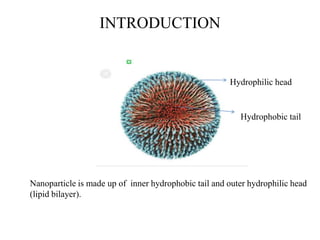
Nanoparticle is made up of inner hydrophobic tail and outer hydrophilic head
(lipid bilayer).
Hydrophilic head
Hydrophobic tail
TYPES OF NANOPARTICLES
 The materials which are used for the preparation of nanoparticles should be
non-toxic, biodegradable , sterilizable, etc.
 Based on the method of preparation, nanoparticles are classified into
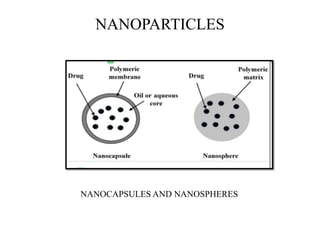
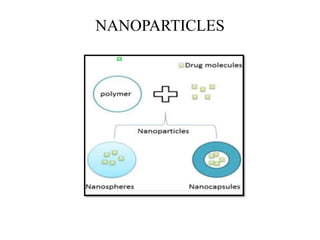
nanospheres or nanocapsules.
Nanoparticles
Nanoencapsules – membrane wall structure with an oil core containing
drug.
Nanospheres-matrix type structure in which a drug is dispersed.
NANOPARTICLES
NANOCAPSULES AND NANOSPHERES
NANOPARTICLES
BASIC CONCEPT OF NANOPARTICLES
 The basic concept involved is:
 Selective and effective localization of pharmacologically active moiety at
preselected target(s) in therapeutic concentration.
 Provided restriction of it’s access to non-target normal tissues and cells.
 Nanoparticles are mainly taken by reticulo endothelial system after the
administration.
 Hence are useful to carry drugs to the liver and to cells that are
phagocytically active.
 Distribution of the nanoparticles in the body may be achieved by coating
with certain serum components, attachment of antibodies or sulfoxide
groups and use of magnetic nanoparticles.
IDEAL CHARACTERISTICS OF
NANOPARTICLES
• It should be biochemical inert, non toxic and non-immunogenic.
• It should be stable both physically and chemically in invivo and invitro
conditions.
• Controllable and predicate rate of drug release.
• Restrict drug distribution to non-target cells and have uniform distribution.
• Drug release should not effect drug action.
• Specific therapeutic amount of drug release must be possessed.
• Carriers used must be biodegradable or readily eliminated from the body
without any problem and no carrier induced modulation in disease state.
• The preparation should be easy.
• Simple, reproducible and cost effective.
ADVANTAGES AND DISADVANTAGES OF
NANOPARTICLES
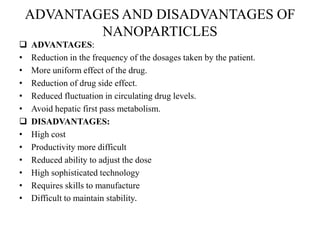
 ADVANTAGES:
• Reduction in the frequency of the dosages taken by the patient.
• More uniform effect of the drug.
• Reduction of drug side effect.
• Reduced fluctuation in circulating drug levels.
• Avoid hepatic first pass metabolism.
 DISADVANTAGES:
• High cost
• Productivity more difficult
• Reduced ability to adjust the dose
• High sophisticated technology
• Requires skills to manufacture
• Difficult to maintain stability.
FORMULATION OF NANOPARTICLES
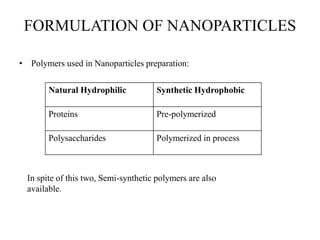
• Polymers used in Nanoparticles preparation:
Natural Hydrophilic Synthetic Hydrophobic
Proteins Pre-polymerized
Polysaccharides Polymerized in process
In spite of this two, Semi-synthetic polymers are also
available.
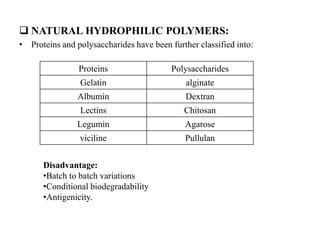
 NATURAL HYDROPHILIC POLYMERS:
• Proteins and polysaccharides have been further classified into:
Proteins Polysaccharides
Gelatin alginate
Albumin Dextran
Lectins Chitosan
Legumin Agarose
viciline Pullulan
Disadvantage:
•Batch to batch variations
•Conditional biodegradability
•Antigenicity.
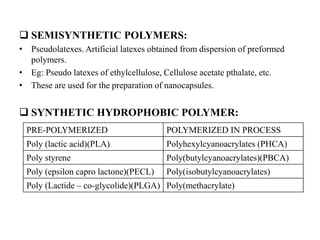
 SEMISYNTHETIC POLYMERS:
• Pseudolatexes. Artificial latexes obtained from dispersion of preformed
polymers.
• Eg: Pseudo latexes of ethylcellulose, Cellulose acetate pthalate, etc.
• These are used for the preparation of nanocapsules.
 SYNTHETIC HYDROPHOBIC POLYMER:
PRE-POLYMERIZED POLYMERIZED IN PROCESS
Poly (lactic acid)(PLA) Polyhexylcyanoacrylates (PHCA)
Poly styrene Poly(butylcyanoacrylates)(PBCA)
Poly (epsilon capro lactone)(PECL) Poly(isobutylcyanoacrylates)
Poly (Lactide – co-glycolide)(PLGA) Poly(methacrylate)
FACTORS DETERMINING THE MATRIX
COMPONENTS:
1. Size of the nanoparticles required
2. Inherent properties of the drug eg: aqueous solubility and stability
3. Surface characteristics such as charge and permeability
4. Degree of biodegradability, biocompatibility and toxicity
5. Drug release profile desired
6. Antigenicity of the final product.
METHOD OF PREPARATION
There are three techniques involved in the preparation of nanoparticles.
 Amphiphilic micromolecule cross linking
 Polymerization based method
 Polymer precipitation method
They are further subdivided into following classes:
 Amphiphilic micromolecule cross linking:
1. Heat cross linking
2. Chemical cross linking
 Polymerization based technique:
1. Polymerization of monomers in situ
2. Emulsion (micellar) polymerization
3. Dispersion polymerization
4. Interfacial condensation polymerization
5. Interfacial complexation
 Polymer precipitation methods (Preformed polymer)
1. Solvent evaporation method
2. Solvent displacement method
3. Salting out
4. Solvent diffusion method
5. Dialysis
 Super critical fluid technique
 AMPHIPHILIC MACROMOLECULE CROSSLINKING:
 Nanoparticles can be prepared from amphiphilic macromolecules, proteins
and polysaccharides.
 The process involved here is the aggregation of amphiphiles followed by
stabilization either by heat denaturation or chemical cross-linking
 Occurs both in biphasic O/W or W/O type of dispersed system.
METHOD OF PREPARATION
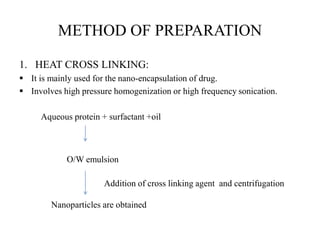
1. HEAT CROSS LINKING:
 It is mainly used for the nano-encapsulation of drug.
 Involves high pressure homogenization or high frequency sonication.
Aqueous protein + surfactant +oil
O/W emulsion
Addition of cross linking agent and centrifugation
Nanoparticles are obtained
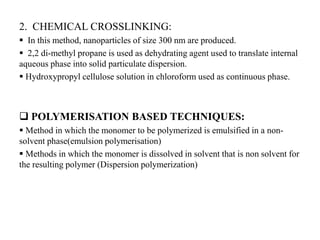
2. CHEMICAL CROSSLINKING:
 In this method, nanoparticles of size 300 nm are produced.
 2,2 di-methyl propane is used as dehydrating agent used to translate internal
aqueous phase into solid particulate dispersion.
 Hydroxypropyl cellulose solution in chloroform used as continuous phase.
 POLYMERISATION BASED TECHNIQUES:
 Method in which the monomer to be polymerized is emulsified in a non-
solvent phase(emulsion polymerisation)
 Methods in which the monomer is dissolved in solvent that is non solvent for
the resulting polymer (Dispersion polymerization)
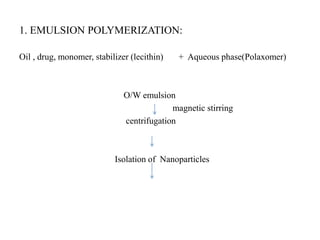
1. EMULSION POLYMERIZATION:
Oil , drug, monomer, stabilizer (lecithin) + Aqueous phase(Polaxomer)
O/W emulsion
magnetic stirring
centrifugation
Isolation of Nanoparticles
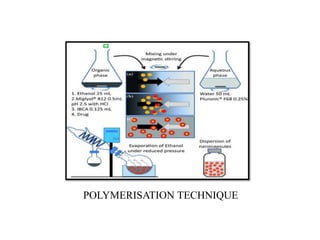
POLYMERISATION TECHNIQUE
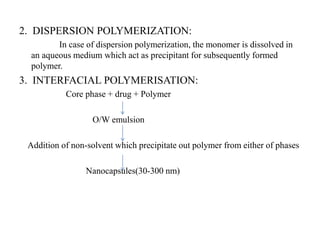
2. DISPERSION POLYMERIZATION:
In case of dispersion polymerization, the monomer is dissolved in
an aqueous medium which act as precipitant for subsequently formed
polymer.
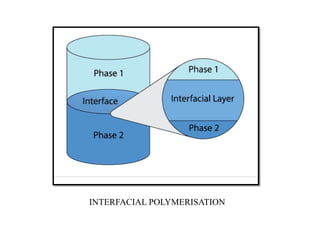
3. INTERFACIAL POLYMERISATION:
Core phase + drug + Polymer
O/W emulsion
Addition of non-solvent which precipitate out polymer from either of phases
Nanocapsules(30-300 nm)
INTERFACIAL POLYMERISATION
4. INTERFACIAL COMPLEXATION METHOD:
Water + Monomer A + Oil phase
high pressure homogenization
W/O emulsion
Monomer B
Nanocapsules
 POLYMER PRECIPITATION METHOD
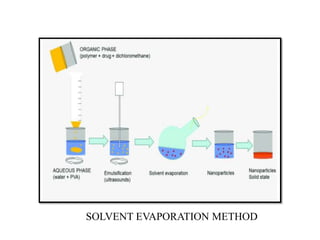
 SOLVENT EVAPORATION METHOD:
Polymer dissolved in organic solvent(DCM, Chloroform or ethyl acetate)
Drug is dispersed in this solution
Mixture emulsified in an aqueous phase containing surfactant (eg:
polysorbates, poloxamers)
Stirred by mechanical stirrer
Formation of emulsion by evaporation of organic solvent by increasing the
temperature.
SOLVENT EVAPORATION METHOD
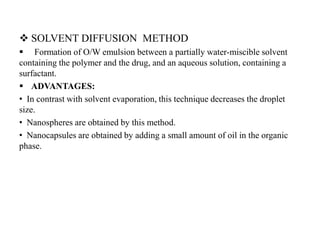
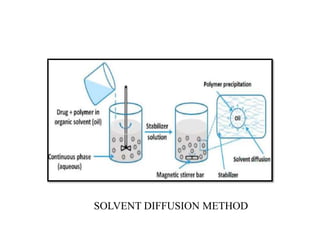
 SOLVENT DIFFUSION METHOD
 Formation of O/W emulsion between a partially water-miscible solvent
containing the polymer and the drug, and an aqueous solution, containing a
surfactant.
 ADVANTAGES:
• In contrast with solvent evaporation, this technique decreases the droplet
size.
• Nanospheres are obtained by this method.
• Nanocapsules are obtained by adding a small amount of oil in the organic
phase.
SOLVENT DIFFUSION METHOD
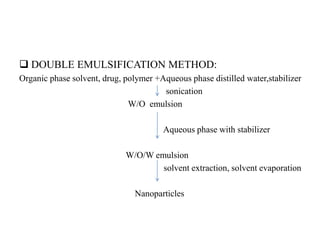
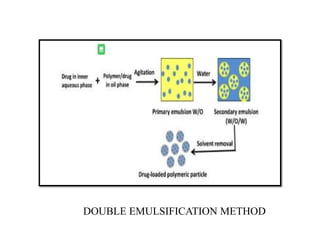
 DOUBLE EMULSIFICATION METHOD:
Organic phase solvent, drug, polymer +Aqueous phase distilled water,stabilizer
sonication
W/O emulsion
Aqueous phase with stabilizer
W/O/W emulsion
solvent extraction, solvent evaporation
Nanoparticles
DOUBLE EMULSIFICATION METHOD
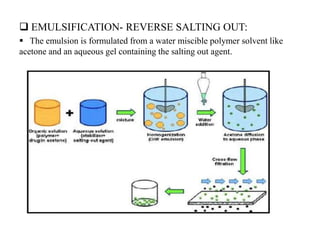
 EMULSIFICATION- REVERSE SALTING OUT:
 The emulsion is formulated from a water miscible polymer solvent like
acetone and an aqueous gel containing the salting out agent.
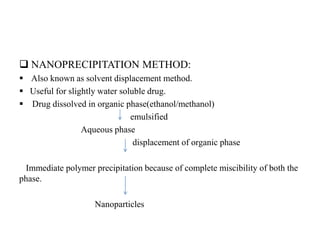
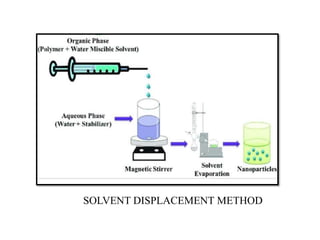
 NANOPRECIPITATION METHOD:
 Also known as solvent displacement method.
 Useful for slightly water soluble drug.
 Drug dissolved in organic phase(ethanol/methanol)
emulsified
Aqueous phase
displacement of organic phase
Immediate polymer precipitation because of complete miscibility of both the
phase.
Nanoparticles
SOLVENT DISPLACEMENT METHOD
 DIALYSIS:
 Polymer and the drug is dissolved in a organic solvent
 This solution is added to dialysis tube and dialysis performed against a non
solvent miscible with the former miscible.
 The displacement of the solvent inside the membrane is followed by the
progressive aggregation of polymer due to loss of solubility and formation
of homogenous suspension of nanoparticles.
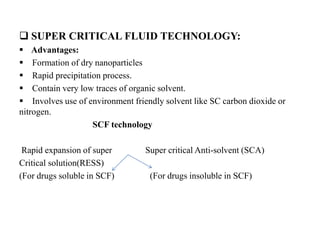
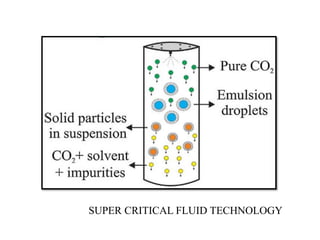
 SUPER CRITICAL FLUID TECHNOLOGY:
 Advantages:
 Formation of dry nanoparticles
 Rapid precipitation process.
 Contain very low traces of organic solvent.
 Involves use of environment friendly solvent like SC carbon dioxide or
nitrogen.
SCF technology
Rapid expansion of super Super critical Anti-solvent (SCA)
Critical solution(RESS)
(For drugs soluble in SCF) (For drugs insoluble in SCF)
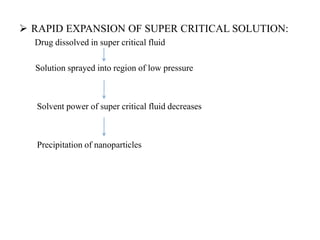
 RAPID EXPANSION OF SUPER CRITICAL SOLUTION:
Drug dissolved in super critical fluid
Solution sprayed into region of low pressure
Solvent power of super critical fluid decreases
Precipitation of nanoparticles
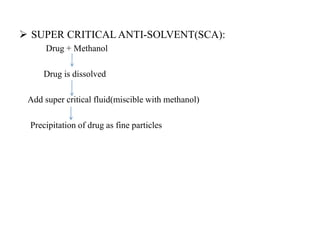
 SUPER CRITICAL ANTI-SOLVENT(SCA):
Drug + Methanol
Drug is dissolved
Add super critical fluid(miscible with methanol)
Precipitation of drug as fine particles
SUPER CRITICAL FLUID TECHNOLOGY
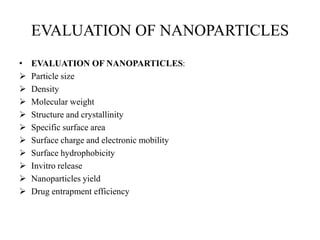
EVALUATION OF NANOPARTICLES
• EVALUATION OF NANOPARTICLES:
 Particle size
 Density
 Molecular weight
 Structure and crystallinity
 Specific surface area
 Surface charge and electronic mobility
 Surface hydrophobicity
 Invitro release
 Nanoparticles yield
 Drug entrapment efficiency
 PARTICLE SIZE:
• Photon correlation spectroscopy(For smaller particles)
• Laser diffractrometry(For larger particles)
• Electron microscopy(For coated materials and dry samples)
• Transmission electron microscopy
• Atomic force microscope, laser force microscope and scanning electron
microscope are used for evaluation of nanoparticles.
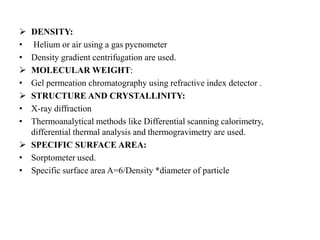
 DENSITY:
• Helium or air using a gas pycnometer
• Density gradient centrifugation are used.
 MOLECULAR WEIGHT:
• Gel permeation chromatography using refractive index detector .
 STRUCTURE AND CRYSTALLINITY:
• X-ray diffraction
• Thermoanalytical methods like Differential scanning calorimetry,
differential thermal analysis and thermogravimetry are used.
 SPECIFIC SURFACE AREA:
• Sorptometer used.
• Specific surface area A=6/Density *diameter of particle
 SURFACE CHARGE AND ELECTRONIC MOBILITY:
• By measuring particle velocity in electrical field.
• Laser Doppler Anemometry technique is used.
• Zeta potential can also be obtained by measuring the electronic mobility.
 SURFACE HYDROPHOBICITY:
• Hydrophobic interaction chromatography
• Two phase partition
• Contact angle measurement
 INVITRO RELEASE:
• Diffusion
• Ultra filtration
• Media used: phosphate buffer
 NANOPARTICLE YIELD:
• % Yield=actual weight of product/total weight of excipient and drug
 DRUG ENTRAPMENT EFFICIENCY:
• Drug entrapment % = mass of drug in nanoparticles /mass of drug used in
formulation *100
BENEFITS OF NANOPARTICLES
• BENEFITS OF NANOPARTICLES:
 Improved bioavailability by enhancing the aqueous solubility
 Increased resistance time in the body(increasing half life for clearance)
 Targeting drug to specific location in the body.
APPLICATION OF NANOPARTICLES
 APPLICATION OF NANOPARTICLES:
• Used in cancer therapy for enhance uptake of anti-tumor agents. Eg:
Polyalkylcyanoacrylate with anticancer agent.
• Used in extra cellular targeting for intracellular infections.
• Used as vaccine adjuvant for enhancing immune response
• Used in DNA delivery for significantly higher expression level.
• Used in ocular delivery.
• Used in gene therapy.
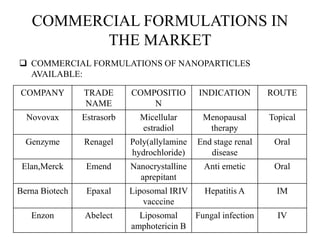
COMMERCIAL FORMULATIONS IN
THE MARKET
 COMMERCIAL FORMULATIONS OF NANOPARTICLES
AVAILABLE:
COMPANY TRADE
NAME
COMPOSITIO
N
INDICATION ROUTE
Novovax Estrasorb Micellular
estradiol
Menopausal
therapy
Topical
Genzyme Renagel Poly(allylamine
hydrochloride)
End stage renal
disease
Oral
Elan,Merck Emend Nanocrystalline
aprepitant
Anti emetic Oral
Berna Biotech Epaxal Liposomal IRIV
vacccine
Hepatitis A IM
Enzon Abelect Liposomal
amphotericin B
Fungal infection IV
REFERENCES
• REFERENCES:
• Mohanraj V.J, Chen Y, Nanoparticles- A Review. Tropical Journal of
Pharmaceutical Research, June 2006; 5(1): 561-573.
• Sovan Lal Pal. Utpal Jana, Mana P.K-Nanoparticle:An Overvview of
preparation and characterization. Journal of Applied Pharmaceutical -
Science 01(06);2011:228-234.
• Konwar Ranjit,Ahmed Abdul Baquee-Nanoparticle:An Overview of
preparation, characterization and application,Int.Res.J.Pharm.2013.
• Nanoparticles-wikipedia.
• Shantanu Tamuly and Aman Kumar-Preparation and Characterisation of
Nanoparticles. Research gate.net-273762796.

nano neenu.pptx

  • 1.
    NANOPARTICLES NEENU ANNA THOMAS SECONDSEMESTER MPHARM DEPARTMENT OF PHARMACEUTICS NANDHA COLLEGE OF PHARMACY
  • 2.
    INTRODUCTION  Targeted drugdelivery implies for selective and effective localization of pharmacologically active moiety at preidentified targets in therapeutic concentration, while restricting its access to non-target normal cellular linings, thus minimizing toxic effects and maximizing therapeutic index. Eg: liposomes, nanoparticles and micro emulsion. Nanoparticles is derived from the greek word nano meaning extremely small.  Nano particles as a drug delivery vehicle were first developed by Spieser and co-workers in the late 1960s. DEFINITION: “Nanoparticles are subionized colloidal structure composed of synthetic or semisynthetic polymers”.  It is also defined as solid colloidal particles ranging from 1 to 1000 nm in size, they consist of macromolecular materials in which the active ingredients is dissolved , entrapped, encapsulated or adsorbed.  Size range: 10-1000 nm.  The drug is dissolved, entrapped, encapsulated or attached to a nanoparticle matrix.
  • 3.
    INTRODUCTION Nanoparticle is madeup of inner hydrophobic tail and outer hydrophilic head (lipid bilayer). Hydrophilic head Hydrophobic tail
  • 4.
    TYPES OF NANOPARTICLES The materials which are used for the preparation of nanoparticles should be non-toxic, biodegradable , sterilizable, etc.  Based on the method of preparation, nanoparticles are classified into nanospheres or nanocapsules. Nanoparticles Nanoencapsules – membrane wall structure with an oil core containing drug. Nanospheres-matrix type structure in which a drug is dispersed.
  • 5.
  • 6.
  • 7.
    BASIC CONCEPT OFNANOPARTICLES  The basic concept involved is:  Selective and effective localization of pharmacologically active moiety at preselected target(s) in therapeutic concentration.  Provided restriction of it’s access to non-target normal tissues and cells.  Nanoparticles are mainly taken by reticulo endothelial system after the administration.  Hence are useful to carry drugs to the liver and to cells that are phagocytically active.  Distribution of the nanoparticles in the body may be achieved by coating with certain serum components, attachment of antibodies or sulfoxide groups and use of magnetic nanoparticles.
  • 8.
    IDEAL CHARACTERISTICS OF NANOPARTICLES •It should be biochemical inert, non toxic and non-immunogenic. • It should be stable both physically and chemically in invivo and invitro conditions. • Controllable and predicate rate of drug release. • Restrict drug distribution to non-target cells and have uniform distribution. • Drug release should not effect drug action. • Specific therapeutic amount of drug release must be possessed. • Carriers used must be biodegradable or readily eliminated from the body without any problem and no carrier induced modulation in disease state. • The preparation should be easy. • Simple, reproducible and cost effective.
  • 9.
    ADVANTAGES AND DISADVANTAGESOF NANOPARTICLES  ADVANTAGES: • Reduction in the frequency of the dosages taken by the patient. • More uniform effect of the drug. • Reduction of drug side effect. • Reduced fluctuation in circulating drug levels. • Avoid hepatic first pass metabolism.  DISADVANTAGES: • High cost • Productivity more difficult • Reduced ability to adjust the dose • High sophisticated technology • Requires skills to manufacture • Difficult to maintain stability.
  • 10.
    FORMULATION OF NANOPARTICLES •Polymers used in Nanoparticles preparation: Natural Hydrophilic Synthetic Hydrophobic Proteins Pre-polymerized Polysaccharides Polymerized in process In spite of this two, Semi-synthetic polymers are also available.
  • 11.
     NATURAL HYDROPHILICPOLYMERS: • Proteins and polysaccharides have been further classified into: Proteins Polysaccharides Gelatin alginate Albumin Dextran Lectins Chitosan Legumin Agarose viciline Pullulan Disadvantage: •Batch to batch variations •Conditional biodegradability •Antigenicity.
  • 12.
     SEMISYNTHETIC POLYMERS: •Pseudolatexes. Artificial latexes obtained from dispersion of preformed polymers. • Eg: Pseudo latexes of ethylcellulose, Cellulose acetate pthalate, etc. • These are used for the preparation of nanocapsules.  SYNTHETIC HYDROPHOBIC POLYMER: PRE-POLYMERIZED POLYMERIZED IN PROCESS Poly (lactic acid)(PLA) Polyhexylcyanoacrylates (PHCA) Poly styrene Poly(butylcyanoacrylates)(PBCA) Poly (epsilon capro lactone)(PECL) Poly(isobutylcyanoacrylates) Poly (Lactide – co-glycolide)(PLGA) Poly(methacrylate)
  • 13.
    FACTORS DETERMINING THEMATRIX COMPONENTS: 1. Size of the nanoparticles required 2. Inherent properties of the drug eg: aqueous solubility and stability 3. Surface characteristics such as charge and permeability 4. Degree of biodegradability, biocompatibility and toxicity 5. Drug release profile desired 6. Antigenicity of the final product.
  • 14.
    METHOD OF PREPARATION Thereare three techniques involved in the preparation of nanoparticles.  Amphiphilic micromolecule cross linking  Polymerization based method  Polymer precipitation method They are further subdivided into following classes:  Amphiphilic micromolecule cross linking: 1. Heat cross linking 2. Chemical cross linking  Polymerization based technique: 1. Polymerization of monomers in situ 2. Emulsion (micellar) polymerization 3. Dispersion polymerization 4. Interfacial condensation polymerization 5. Interfacial complexation
  • 15.
     Polymer precipitationmethods (Preformed polymer) 1. Solvent evaporation method 2. Solvent displacement method 3. Salting out 4. Solvent diffusion method 5. Dialysis  Super critical fluid technique  AMPHIPHILIC MACROMOLECULE CROSSLINKING:  Nanoparticles can be prepared from amphiphilic macromolecules, proteins and polysaccharides.  The process involved here is the aggregation of amphiphiles followed by stabilization either by heat denaturation or chemical cross-linking  Occurs both in biphasic O/W or W/O type of dispersed system.
  • 16.
    METHOD OF PREPARATION 1.HEAT CROSS LINKING:  It is mainly used for the nano-encapsulation of drug.  Involves high pressure homogenization or high frequency sonication. Aqueous protein + surfactant +oil O/W emulsion Addition of cross linking agent and centrifugation Nanoparticles are obtained
  • 17.
    2. CHEMICAL CROSSLINKING: In this method, nanoparticles of size 300 nm are produced.  2,2 di-methyl propane is used as dehydrating agent used to translate internal aqueous phase into solid particulate dispersion.  Hydroxypropyl cellulose solution in chloroform used as continuous phase.  POLYMERISATION BASED TECHNIQUES:  Method in which the monomer to be polymerized is emulsified in a non- solvent phase(emulsion polymerisation)  Methods in which the monomer is dissolved in solvent that is non solvent for the resulting polymer (Dispersion polymerization)
  • 18.
    1. EMULSION POLYMERIZATION: Oil, drug, monomer, stabilizer (lecithin) + Aqueous phase(Polaxomer) O/W emulsion magnetic stirring centrifugation Isolation of Nanoparticles
  • 19.
  • 20.
    2. DISPERSION POLYMERIZATION: Incase of dispersion polymerization, the monomer is dissolved in an aqueous medium which act as precipitant for subsequently formed polymer. 3. INTERFACIAL POLYMERISATION: Core phase + drug + Polymer O/W emulsion Addition of non-solvent which precipitate out polymer from either of phases Nanocapsules(30-300 nm)
  • 21.
  • 22.
    4. INTERFACIAL COMPLEXATIONMETHOD: Water + Monomer A + Oil phase high pressure homogenization W/O emulsion Monomer B Nanocapsules
  • 23.
     POLYMER PRECIPITATIONMETHOD  SOLVENT EVAPORATION METHOD: Polymer dissolved in organic solvent(DCM, Chloroform or ethyl acetate) Drug is dispersed in this solution Mixture emulsified in an aqueous phase containing surfactant (eg: polysorbates, poloxamers) Stirred by mechanical stirrer Formation of emulsion by evaporation of organic solvent by increasing the temperature.
  • 24.
  • 25.
     SOLVENT DIFFUSIONMETHOD  Formation of O/W emulsion between a partially water-miscible solvent containing the polymer and the drug, and an aqueous solution, containing a surfactant.  ADVANTAGES: • In contrast with solvent evaporation, this technique decreases the droplet size. • Nanospheres are obtained by this method. • Nanocapsules are obtained by adding a small amount of oil in the organic phase.
  • 26.
  • 27.
     DOUBLE EMULSIFICATIONMETHOD: Organic phase solvent, drug, polymer +Aqueous phase distilled water,stabilizer sonication W/O emulsion Aqueous phase with stabilizer W/O/W emulsion solvent extraction, solvent evaporation Nanoparticles
  • 28.
  • 29.
     EMULSIFICATION- REVERSESALTING OUT:  The emulsion is formulated from a water miscible polymer solvent like acetone and an aqueous gel containing the salting out agent.
  • 30.
     NANOPRECIPITATION METHOD: Also known as solvent displacement method.  Useful for slightly water soluble drug.  Drug dissolved in organic phase(ethanol/methanol) emulsified Aqueous phase displacement of organic phase Immediate polymer precipitation because of complete miscibility of both the phase. Nanoparticles
  • 31.
  • 32.
     DIALYSIS:  Polymerand the drug is dissolved in a organic solvent  This solution is added to dialysis tube and dialysis performed against a non solvent miscible with the former miscible.  The displacement of the solvent inside the membrane is followed by the progressive aggregation of polymer due to loss of solubility and formation of homogenous suspension of nanoparticles.
  • 33.
     SUPER CRITICALFLUID TECHNOLOGY:  Advantages:  Formation of dry nanoparticles  Rapid precipitation process.  Contain very low traces of organic solvent.  Involves use of environment friendly solvent like SC carbon dioxide or nitrogen. SCF technology Rapid expansion of super Super critical Anti-solvent (SCA) Critical solution(RESS) (For drugs soluble in SCF) (For drugs insoluble in SCF)
  • 34.
     RAPID EXPANSIONOF SUPER CRITICAL SOLUTION: Drug dissolved in super critical fluid Solution sprayed into region of low pressure Solvent power of super critical fluid decreases Precipitation of nanoparticles
  • 35.
     SUPER CRITICALANTI-SOLVENT(SCA): Drug + Methanol Drug is dissolved Add super critical fluid(miscible with methanol) Precipitation of drug as fine particles
  • 36.
  • 37.
    EVALUATION OF NANOPARTICLES •EVALUATION OF NANOPARTICLES:  Particle size  Density  Molecular weight  Structure and crystallinity  Specific surface area  Surface charge and electronic mobility  Surface hydrophobicity  Invitro release  Nanoparticles yield  Drug entrapment efficiency
  • 38.
     PARTICLE SIZE: •Photon correlation spectroscopy(For smaller particles) • Laser diffractrometry(For larger particles) • Electron microscopy(For coated materials and dry samples) • Transmission electron microscopy • Atomic force microscope, laser force microscope and scanning electron microscope are used for evaluation of nanoparticles.
  • 39.
     DENSITY: • Heliumor air using a gas pycnometer • Density gradient centrifugation are used.  MOLECULAR WEIGHT: • Gel permeation chromatography using refractive index detector .  STRUCTURE AND CRYSTALLINITY: • X-ray diffraction • Thermoanalytical methods like Differential scanning calorimetry, differential thermal analysis and thermogravimetry are used.  SPECIFIC SURFACE AREA: • Sorptometer used. • Specific surface area A=6/Density *diameter of particle
  • 40.
     SURFACE CHARGEAND ELECTRONIC MOBILITY: • By measuring particle velocity in electrical field. • Laser Doppler Anemometry technique is used. • Zeta potential can also be obtained by measuring the electronic mobility.  SURFACE HYDROPHOBICITY: • Hydrophobic interaction chromatography • Two phase partition • Contact angle measurement  INVITRO RELEASE: • Diffusion • Ultra filtration • Media used: phosphate buffer
  • 41.
     NANOPARTICLE YIELD: •% Yield=actual weight of product/total weight of excipient and drug  DRUG ENTRAPMENT EFFICIENCY: • Drug entrapment % = mass of drug in nanoparticles /mass of drug used in formulation *100
  • 42.
    BENEFITS OF NANOPARTICLES •BENEFITS OF NANOPARTICLES:  Improved bioavailability by enhancing the aqueous solubility  Increased resistance time in the body(increasing half life for clearance)  Targeting drug to specific location in the body.
  • 43.
    APPLICATION OF NANOPARTICLES APPLICATION OF NANOPARTICLES: • Used in cancer therapy for enhance uptake of anti-tumor agents. Eg: Polyalkylcyanoacrylate with anticancer agent. • Used in extra cellular targeting for intracellular infections. • Used as vaccine adjuvant for enhancing immune response • Used in DNA delivery for significantly higher expression level. • Used in ocular delivery. • Used in gene therapy.
  • 44.
    COMMERCIAL FORMULATIONS IN THEMARKET  COMMERCIAL FORMULATIONS OF NANOPARTICLES AVAILABLE: COMPANY TRADE NAME COMPOSITIO N INDICATION ROUTE Novovax Estrasorb Micellular estradiol Menopausal therapy Topical Genzyme Renagel Poly(allylamine hydrochloride) End stage renal disease Oral Elan,Merck Emend Nanocrystalline aprepitant Anti emetic Oral Berna Biotech Epaxal Liposomal IRIV vacccine Hepatitis A IM Enzon Abelect Liposomal amphotericin B Fungal infection IV
  • 45.
    REFERENCES • REFERENCES: • MohanrajV.J, Chen Y, Nanoparticles- A Review. Tropical Journal of Pharmaceutical Research, June 2006; 5(1): 561-573. • Sovan Lal Pal. Utpal Jana, Mana P.K-Nanoparticle:An Overvview of preparation and characterization. Journal of Applied Pharmaceutical - Science 01(06);2011:228-234. • Konwar Ranjit,Ahmed Abdul Baquee-Nanoparticle:An Overview of preparation, characterization and application,Int.Res.J.Pharm.2013. • Nanoparticles-wikipedia. • Shantanu Tamuly and Aman Kumar-Preparation and Characterisation of Nanoparticles. Research gate.net-273762796.