Liposomes
Presented by,
Pratiksha C
M pharma 2nd SEM
Dept. of pharmaceutics
HSK COP Bagalkot
Facilitated to,
Dr. Anita Desai
HOD and professor
Dept. of pharmaceutics
HSK COP Bagalkot
1
•Introduction
•Structure of liposomes
•Advantages& disadvantages
•Components of liposome
•Preparation methods of liposomes
•Characterization of liposomes
•Applications of liposomes
•References
2
Introduction:
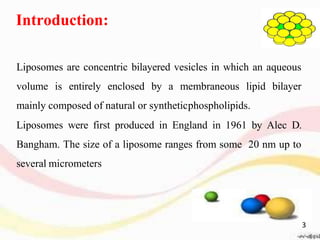
Liposomes are concentric bilayered vesicles in which an aqueous
volume is entirely enclosed by a membraneous lipid bilayer
mainly composed of natural or syntheticphospholipids.
Liposomes were first produced in England in 1961 by Alec D.
Bangham. The size of a liposome ranges from some 20 nm up to
several micrometers
3
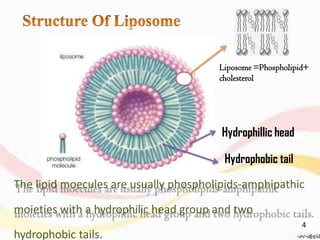
Hydrophillic head
Hydrophobic tail
The lipid moecules are usually phospholipids-amphipathic
moieties with a hydrophilic head group and two
hydrophobic tails.
Liposome =Phospholipid+
cholesterol
4
Advantages of liposomes
1. Provides selective passive targeting to tumor tissues.
(liposomal doxorubicin) .
2. Increased efficacy and therapeutic index.
3. Reduction in toxicity of the encapsulated agent.
4. Site avoidance effect (avoids non-target tissues).
5. Improved pharmacokinetic effects .
6. Flexibility to couple with site-specific ligands to achieve
active targeting.
5
Disadvantages of liposomes:
Production cost is high.
Leakage and fusion of encapsulated drug /
molecules.
Sometimes phospholipid undergoes oxidation
and hydrolysis like reaction.
Short half-life.
Low solubility.
6
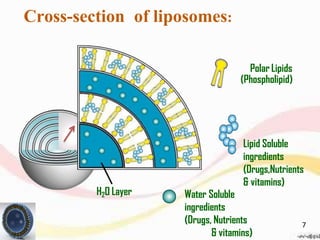
H2O Layer
Polar Lipids
(Phospholipid)
Water Soluble
ingredients
(Drugs, Nutrients
Lipid Soluble
ingredients
(Drugs,Nutrients
& vitamins)
Cross-section of liposomes:
& vitamins)
7
components of liposomes:
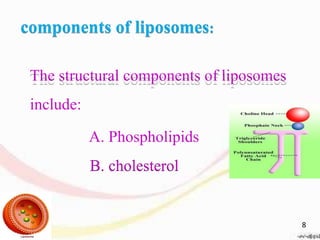
The structural components of liposomes
include:
A. Phospholipids
B. cholesterol
8
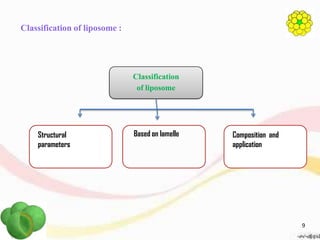
Classification of liposome :
Classification
of liposome
Structural
parameters
Based on lamelle Composition and
application
9
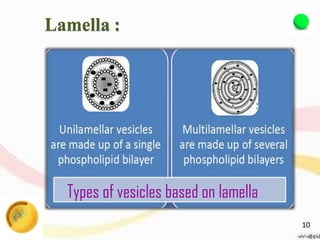
Types of vesicles based on lamella
Lamella :
10
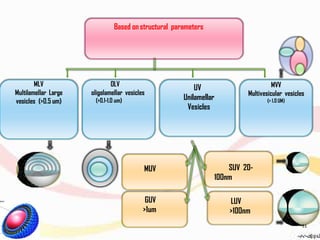
Based on structural parameters
MLV
Multilamellar Large
vesicles (>0.5 um)
OLV
oligolamellar vesicles
(>0.1-1.0 um)
UV
Unilamellar
Vesicles
MVV
Multivesicular vesicles
(> 1.0 UM)
MUV
GUV
>1um
SUV 20-
100nm
LUV
>100nm
11
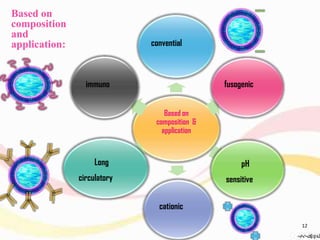
Based on
composition &
application
convential
fusogenic
pH
sensitive
cationic
Long
circulatory
immuno
Based on
composition
and
application:
12
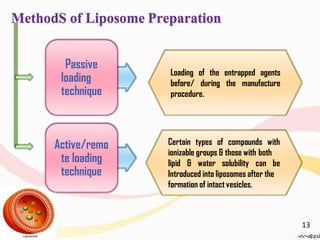
Passive
loading
technique
Active/remo
te loading
technique
Loading of the entrapped agents
before/ during the manufacture
procedure.
Certain types of compounds with
ionizable groups & those with both
lipid & water solubility can be
Introduced into liposomes after the
formation of intact vesicles.
MethodS of Liposome Preparation
13
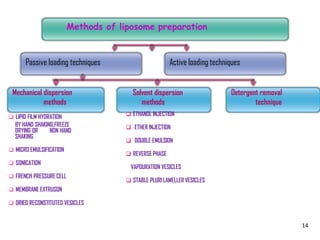
Methods of liposome preparation
Passive loading techniques Active loading techniques
Mechanical dispersion
methods
❑ LIPID FILM HYDRATION
BY HAND SHAKING,FREEZE
DRYING OR NON HAND
SHAKING
❑ MICRO EMULSIFICATION
❑ SONICATION
❑ FRENCH PRESSURE CELL
❑ MEMBRANE EXTRUSON
❑ DRIED RECONSTITUTED VESICLES
Solvent dispersion
methods
❑ ETHANOL INJECTION
❑ ETHER INJECTION
❑ DOUBLE EMULSION
❑ REVERSE PHASE
VAPOURATION VESICLES
❑ STABLE PLURI LAMELLER VESICLES
Detergent removal
technique
14
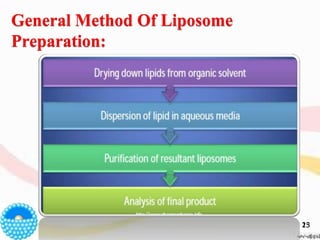
General Method Of Liposome
Preparation:
2315
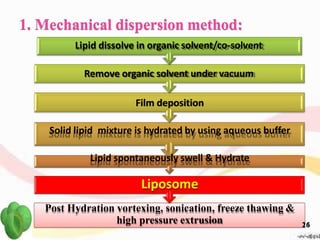
Liposome
Post Hydration vortexing, sonication, freeze thawing &
high pressure extrusion
Lipid dissolve in organic solvent/co-solvent
Remove organic solvent under vacuum
Film deposition
Solid lipid mixture is hydrated by using aqueous buffer
Lipid spontaneously swell & Hydrate
1. Mechanical dispersion method:
2416
There are four basic methods of physical/mechanical
dispersion :
Hand shaken method.
Non shaking method.
Pro – liposomes .
Freeze drying .
17
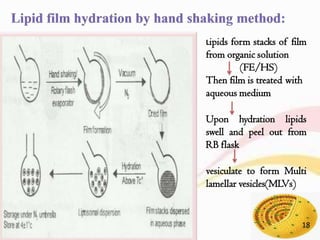
Lipids form stacks of film
from organic solution
(FE/HS)
Then film is treated with
aqueous medium
Upon hydration lipids
swell and peel out from
RB flask
vesiculate to form Multi
lamellar vesicles(MLVs)
18
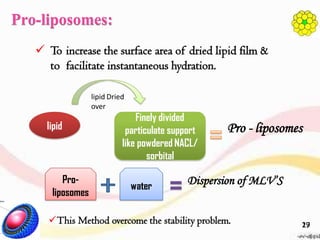
Pro-liposomes:
✓ To increase the surface area of dried lipid film &
to facilitate instantaneous hydration.
lipid Dried
over
lipid
Finely divided
particulate support
like powdered NACL/
sorbital
Pro - liposomes
Pro-
liposomes
water
Dispersion of MLV’S
✓This Method overcome the stability problem. 2719
Membrane extrusion Liposomes
Dried reconstituted vesicles(DRVs)
Freeze thaw sonification (FTS)
pH induced vesiculation
Cochleate method.
Processing of the lipids hydrated by physical means or the
mechanical treatments of MLVs :
Micro Emulsification liposomes (MEL)
Sonicated unilamellar vesicles (SUVs)
French Pressure Cell Liposomes .
2820
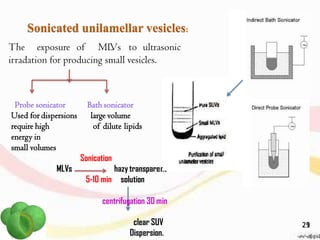
Sonicated unilamellar vesicles:
The exposure of MLVs to ultrasonic
irradation for producing small vesicles.
Bath sonicator
large volume
of dilute lipids
Probe sonicator
Used for dispersions
require high
energy in
small volumes
Sonication
MLVs hazy transparent
5-10 min solution
centrifugation 30 min
clear SUV
Dispersion.
2921
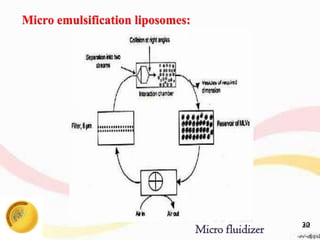
Micro emulsification liposomes:
Micro fluidizer 3022
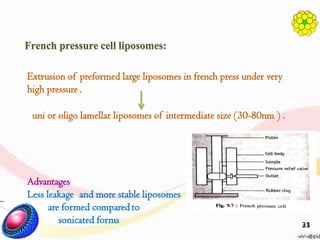
French pressure cell liposomes:
Extrusion of preformed large liposomes in french press under very
high pressure .
uni or oligo lamellar liposomes of intermediate size (30-80nm ) .
Advantages
Less leakage and more stable liposomes
are formed compared to
sonicated forms 3123
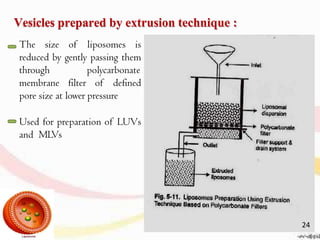
Vesicles prepared by extrusion technique :
The size of liposomes is
reduced by gently passing them
through polycarbonate
membrane filter of defined
pore size at lower pressure
Used for preparation of LUVs
and MLVs
24
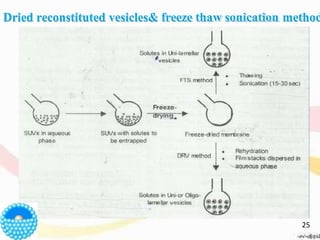
Dried reconstituted vesicles& freeze thaw sonication method
25
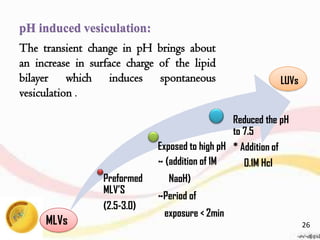
pH induced vesiculation:
Preformed
MLV’S
(2.5-3.0)
~ (addition of 1M
NaoH)
~Period of
exposure < 2min
Reduced the pH
to 7.5
Exposed to high pH * Addition of
0.1M Hcl
The transient change in pH brings about
an increase in surface charge of the lipid
bilayer which induces spontaneous
vesiculation .
MLVs
LUVs
26
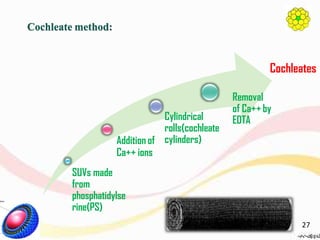
SUVs made
from
phosphatidylse
rine(PS)
Addition of
Ca++ ions
Cylindrical
rolls(cochleate
cylinders)
Removal
of Ca++by
EDTA
Cochleate method:
Cochleates
27
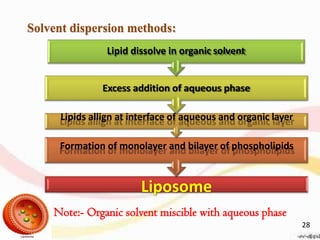
Lipid dissolve in organic solvent
Excess addition of aqueous phase
Lipids allign at interface of aqueous and organic layer
Formation of monolayer and bilayer of phospholipids
Liposome
Note:- Organic solvent miscible with aqueous phase
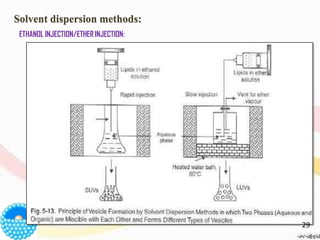
Solvent dispersion methods:
28
Solvent dispersion methods:
ETHANOL INJECTION/ETHERINJECTION:
29
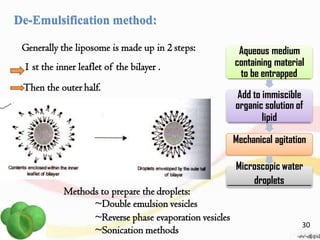
De-Emulsification method:
Generally the liposome is made up in 2 steps:
1 st the inner leaflet of the bilayer .
Then the outer half.
~Reverse phase evaporation vesicles
~Sonication methods
Aqueous medium
containing material
to be entrapped
Add to immiscible
organic solution of
lipid
Mechanical agitation
Microscopic water
droplets
Methods to prepare the droplets:
~Double emulsion vesicles
30
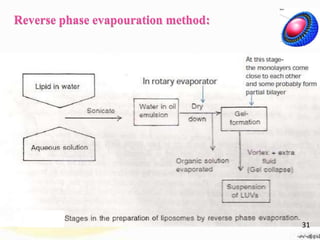
Reverse phase evapouration method:
31
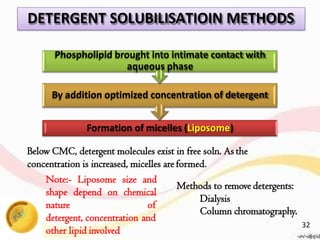
Phospholipid brought into intimate contact with
aqueous phase
By addition optimized concentration of detergent
Formation of micelles (Liposome)
shape depend on chemical
nature of
detergent, concentration and
other lipid involved
Below CMC, detergent molecules exist in free soln. As the
concentration is increased, micelles areformed.
Note:- Liposome size and
DETERGENT SOLUBILISATIOIN METHODS
Methods to remove detergents:
Dialysis
Column chromatography.
32
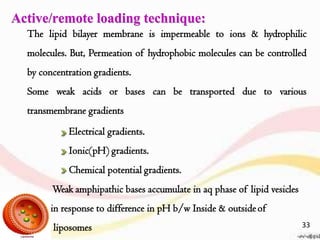
Active/remote loading technique:
The lipid bilayer membrane is impermeable to ions & hydrophilic
molecules. But, Permeation of hydrophobic molecules can be controlled
by concentration gradients.
Some weak acids or bases can be transported due to various
transmembrane gradients
Electrical gradients.
Ionic(pH) gradients.
Chemical potential gradients.
Weak amphipathic bases accumulate in aq phase of lipid vesicles
in response to difference in pH b/w Inside & outsideof
liposomes 33
pH gradient is created by preparingliposomes
with low internal pH.
Addtn of base to extraliposomal medium.
[Basic compds ( lipophilic (non ionic) athigh
pH & hydrophilic(ionic) at lowpH)]
Lipophilic (UNPROTONATED) drug diffuse through
thebilayer
At low pH side, the moleculesare
predominantly protonated .
Exchange of external medium by gelextrusion
chromatorapghy with neutralsolution.
Weak bases like doxorubicine,
adriamycin and vincristine are
encapsulated.
Solute bearing no
charge at neutral pH
Liposomes with low
internal pH
Neutral solute passes
easily through bilayer
membrane by diffusion
Charge aquired by solute
inside liposomes makes
them unable to exit
34
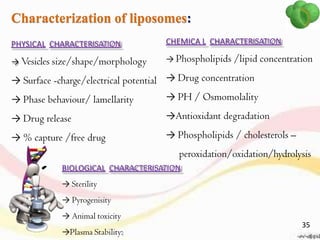
Characterization of liposomes:
PHYSICAL CHARACTERISATION
→ Vesicles size/shape/morphology
→ Surface -charge/electrical potential
→ Phase behaviour/ lamellarity
→ Drug release
→ % capture /free drug
CHEMICA L CHARACTERISATION
→ Phospholipids /lipid concentration
→ Drug concentration
→ PH / Osmomolality
→Antioxidant degradation
→ Phospholipids / cholesterols –
peroxidation/oxidation/hydrolysis
BIOLOGICAL CHARACTERISATION
→ Sterility
→ Pyrogenisity
→ Animal toxicity
→Plasma Stability:
35
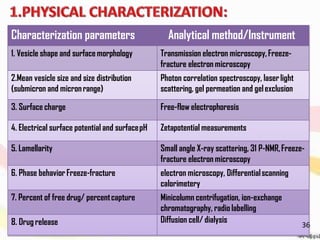
Characterization parameters Analytical method/Instrument
1. Vesicle shape and surface morphology Transmission electron microscopy,Freeze-
fracture electron microscopy
2.Mean vesicle size and size distribution
(submicron and micronrange)
Photon correlation spectroscopy, laserlight
scattering, gel permeation and gelexclusion
3. Surface charge Free-flow electrophoresis
4. Electrical surface potential and surfacepH Zetapotential measurements
5. Lamellarity Small angle X-ray scattering, 31 P-NMR,Freeze-
fracture electron microscopy
6. Phase behavior Freeze-fracture electron microscopy, Differentialscanning
calorimetery
7. Percent of free drug/ percentcapture Minicolumn centrifugation, ion-exchange
chromatography, radiolabelling
8. Drug release Diffusion cell/ dialysis
36
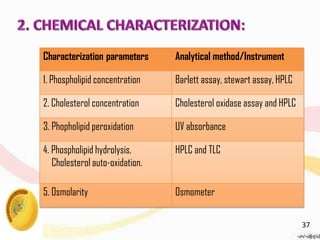
Characterization parameters Analytical method/Instrument
1. Phospholipid concentration Barlett assay, stewart assay, HPLC
2. Cholesterol concentration Cholesterol oxidase assay and HPLC
3. Phopholipid peroxidation UV absorbance
4. Phospholipid hydrolysis,
Cholesterol auto-oxidation.
HPLC and TLC
5. Osmolarity Osmometer
37
Characterization parameters Analytical method/Instrument
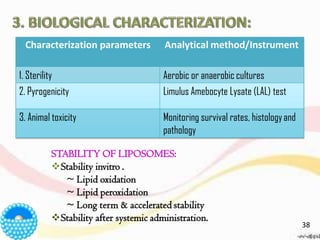
1. Sterility Aerobic or anaerobic cultures
2. Pyrogenicity Limulus Amebocyte Lysate (LAL) test
3. Animal toxicity Monitoring survival rates, histologyand
pathology
STABILITY OF LIPOSOMES:
❖Stability invitro .
~ Lipid oxidation
~ Lipid peroxidation
~ Long term & accelerated stability
❖Stability after systemic administration.
38
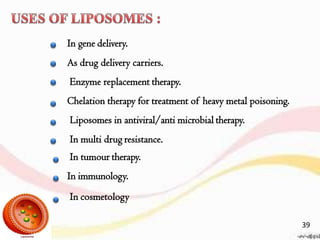
In gene delivery.
As drug delivery carriers.
Enzyme replacement therapy.
Chelation therapy for treatment of heavy metal poisoning.
Liposomes in antiviral/anti microbial therapy.
In multi drug resistance.
In tumour therapy.
In immunology.
In cosmetology
39
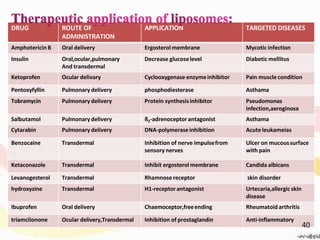
DRUG ROUTE OF
ADMINISTRATION
APPLICATION TARGETED DISEASES
Amphotericin B Oral delivery Ergosterol membrane Mycotic infection
Insulin Oral,ocular,pulmonary
And transdermal
Decrease glucoselevel Diabetic mellitus
Ketoprofen Ocular delivary Cyclooxygenase enzymeinhibitor Pain muscle condition
Pentoxyfyllin Pulmonary delivery phosphodiesterase Asthama
Tobramycin Pulmonary delivery Protein synthesisinhibitor Pseudomonas
infection,aeroginosa
Salbutamol Pulmonary delivery ß2-adrenoceptor antagonist Asthama
Cytarabin Pulmonary delivery DNA-polymeraseinhibition Acute leukameias
Benzocaine Transdermal Inhibition of nerve impulsefrom
sensory nerves
Ulcer on mucoussurface
with pain
Ketaconazole Transdermal Inhibit ergosterolmembrane Candida albicans
Levanogesterol Transdermal Rhamnosereceptor skin disorder
hydroxyzine Transdermal H1-receptorantagonist Urtecaria,allergic skin
disease
Ibuprofen Oral delivery Chaemoceptor,freeending Rheumatoidarthritis
triamcilonone Ocular delivery,Transdermal Inhibition of prostaglandin Anti-inflammatory
40
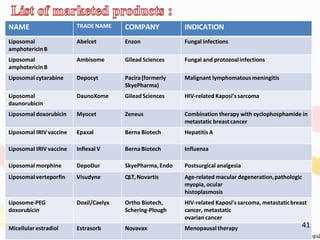
NAME TRADE NAME COMPANY INDICATION
Liposomal
amphotericinB
Abelcet Enzon Fungal infections
Liposomal
amphotericinB
Ambisome Gilead Sciences Fungal and protozoalinfections
Liposomal cytarabine Depocyt Pacira(formerly
SkyePharma)
Malignant lymphomatousmeningitis
Liposomal
daunorubicin
DaunoXome Gilead Sciences HIV-related Kaposi’s sarcoma
Liposomal doxorubicin Myocet Zeneus Combination therapy with cyclophosphamide in
metastatic breastcancer
Liposomal IRIV vaccine Epaxal Berna Biotech Hepatitis A
Liposomal IRIV vaccine Inflexal V Berna Biotech Influenza
Liposomal morphine DepoDur SkyePharma, Endo Postsurgical analgesia
Liposomal verteporfin Visudyne QLT,Novartis Age-related macular degeneration,pathologic
myopia, ocular
histoplasmosis
Liposome-PEG
doxorubicin
Doxil/Caelyx Ortho Biotech,
Schering-Plough
HIV-related Kaposi’s sarcoma, metastaticbreast
cancer, metastatic
ovarian cancer
Micellular estradiol Estrasorb Novavax Menopausal therapy 41
1. S.P. Vyas And R.K. Khar,targeted & Controlled Drug
Delivery,liposomes,173-279.
2. Mohammad Riaz, Liposomes :Preparation Methods, Pakistan
Journal Of Pharmaceutical Sciences, January 1996,Vol.19(1),65-
77.
3. Sharma Vijay K1*, Liposomes: Present Prospective and Future
Challenges,International Journal Of Current Pharmaceutical
ReviewAnd Research, oct 2010,vol1, issue 2,6-16
4. Himanshu Anwekar*, Liposome- as drug carriers,
International Journal Of Pharmacy & LifeSciences,Vol.2,
Issue 7: July: 2011, 945-951.
5. Jain NK. Introduction to novel drug delivery systems.1st
edition. Vallabh Prakashan publishers;2010.
6. Dr. Baviskar DT, Dr. Jain DK. Novel drug delivery systems.
2nd edition. Nirali Prakashan publishers;2015.
7. Images are from google.
42
43

Liposomes converted

  • 1.
    Liposomes Presented by, Pratiksha C Mpharma 2nd SEM Dept. of pharmaceutics HSK COP Bagalkot Facilitated to, Dr. Anita Desai HOD and professor Dept. of pharmaceutics HSK COP Bagalkot 1
  • 2.
    •Introduction •Structure of liposomes •Advantages&disadvantages •Components of liposome •Preparation methods of liposomes •Characterization of liposomes •Applications of liposomes •References 2
  • 3.
    Introduction: Liposomes are concentricbilayered vesicles in which an aqueous volume is entirely enclosed by a membraneous lipid bilayer mainly composed of natural or syntheticphospholipids. Liposomes were first produced in England in 1961 by Alec D. Bangham. The size of a liposome ranges from some 20 nm up to several micrometers 3
  • 4.
    Hydrophillic head Hydrophobic tail Thelipid moecules are usually phospholipids-amphipathic moieties with a hydrophilic head group and two hydrophobic tails. Liposome =Phospholipid+ cholesterol 4
  • 5.
    Advantages of liposomes 1.Provides selective passive targeting to tumor tissues. (liposomal doxorubicin) . 2. Increased efficacy and therapeutic index. 3. Reduction in toxicity of the encapsulated agent. 4. Site avoidance effect (avoids non-target tissues). 5. Improved pharmacokinetic effects . 6. Flexibility to couple with site-specific ligands to achieve active targeting. 5
  • 6.
    Disadvantages of liposomes: Productioncost is high. Leakage and fusion of encapsulated drug / molecules. Sometimes phospholipid undergoes oxidation and hydrolysis like reaction. Short half-life. Low solubility. 6
  • 7.
    H2O Layer Polar Lipids (Phospholipid) WaterSoluble ingredients (Drugs, Nutrients Lipid Soluble ingredients (Drugs,Nutrients & vitamins) Cross-section of liposomes: & vitamins) 7
  • 8.
    components of liposomes: Thestructural components of liposomes include: A. Phospholipids B. cholesterol 8
  • 9.
    Classification of liposome: Classification of liposome Structural parameters Based on lamelle Composition and application 9
  • 10.
    Types of vesiclesbased on lamella Lamella : 10
  • 11.
    Based on structuralparameters MLV Multilamellar Large vesicles (>0.5 um) OLV oligolamellar vesicles (>0.1-1.0 um) UV Unilamellar Vesicles MVV Multivesicular vesicles (> 1.0 UM) MUV GUV >1um SUV 20- 100nm LUV >100nm 11
  • 12.
  • 13.
    Passive loading technique Active/remo te loading technique Loading ofthe entrapped agents before/ during the manufacture procedure. Certain types of compounds with ionizable groups & those with both lipid & water solubility can be Introduced into liposomes after the formation of intact vesicles. MethodS of Liposome Preparation 13
  • 14.
    Methods of liposomepreparation Passive loading techniques Active loading techniques Mechanical dispersion methods ❑ LIPID FILM HYDRATION BY HAND SHAKING,FREEZE DRYING OR NON HAND SHAKING ❑ MICRO EMULSIFICATION ❑ SONICATION ❑ FRENCH PRESSURE CELL ❑ MEMBRANE EXTRUSON ❑ DRIED RECONSTITUTED VESICLES Solvent dispersion methods ❑ ETHANOL INJECTION ❑ ETHER INJECTION ❑ DOUBLE EMULSION ❑ REVERSE PHASE VAPOURATION VESICLES ❑ STABLE PLURI LAMELLER VESICLES Detergent removal technique 14
  • 15.
    General Method OfLiposome Preparation: 2315
  • 16.
    Liposome Post Hydration vortexing,sonication, freeze thawing & high pressure extrusion Lipid dissolve in organic solvent/co-solvent Remove organic solvent under vacuum Film deposition Solid lipid mixture is hydrated by using aqueous buffer Lipid spontaneously swell & Hydrate 1. Mechanical dispersion method: 2416
  • 17.
    There are fourbasic methods of physical/mechanical dispersion : Hand shaken method. Non shaking method. Pro – liposomes . Freeze drying . 17
  • 18.
    Lipids form stacksof film from organic solution (FE/HS) Then film is treated with aqueous medium Upon hydration lipids swell and peel out from RB flask vesiculate to form Multi lamellar vesicles(MLVs) 18
  • 19.
    Pro-liposomes: ✓ To increasethe surface area of dried lipid film & to facilitate instantaneous hydration. lipid Dried over lipid Finely divided particulate support like powdered NACL/ sorbital Pro - liposomes Pro- liposomes water Dispersion of MLV’S ✓This Method overcome the stability problem. 2719
  • 20.
    Membrane extrusion Liposomes Driedreconstituted vesicles(DRVs) Freeze thaw sonification (FTS) pH induced vesiculation Cochleate method. Processing of the lipids hydrated by physical means or the mechanical treatments of MLVs : Micro Emulsification liposomes (MEL) Sonicated unilamellar vesicles (SUVs) French Pressure Cell Liposomes . 2820
  • 21.
    Sonicated unilamellar vesicles: Theexposure of MLVs to ultrasonic irradation for producing small vesicles. Bath sonicator large volume of dilute lipids Probe sonicator Used for dispersions require high energy in small volumes Sonication MLVs hazy transparent 5-10 min solution centrifugation 30 min clear SUV Dispersion. 2921
  • 22.
  • 23.
    French pressure cellliposomes: Extrusion of preformed large liposomes in french press under very high pressure . uni or oligo lamellar liposomes of intermediate size (30-80nm ) . Advantages Less leakage and more stable liposomes are formed compared to sonicated forms 3123
  • 24.
    Vesicles prepared byextrusion technique : The size of liposomes is reduced by gently passing them through polycarbonate membrane filter of defined pore size at lower pressure Used for preparation of LUVs and MLVs 24
  • 25.
    Dried reconstituted vesicles&freeze thaw sonication method 25
  • 26.
    pH induced vesiculation: Preformed MLV’S (2.5-3.0) ~(addition of 1M NaoH) ~Period of exposure < 2min Reduced the pH to 7.5 Exposed to high pH * Addition of 0.1M Hcl The transient change in pH brings about an increase in surface charge of the lipid bilayer which induces spontaneous vesiculation . MLVs LUVs 26
  • 27.
    SUVs made from phosphatidylse rine(PS) Addition of Ca++ions Cylindrical rolls(cochleate cylinders) Removal of Ca++by EDTA Cochleate method: Cochleates 27
  • 28.
    Lipid dissolve inorganic solvent Excess addition of aqueous phase Lipids allign at interface of aqueous and organic layer Formation of monolayer and bilayer of phospholipids Liposome Note:- Organic solvent miscible with aqueous phase Solvent dispersion methods: 28
  • 29.
    Solvent dispersion methods: ETHANOLINJECTION/ETHERINJECTION: 29
  • 30.
    De-Emulsification method: Generally theliposome is made up in 2 steps: 1 st the inner leaflet of the bilayer . Then the outer half. ~Reverse phase evaporation vesicles ~Sonication methods Aqueous medium containing material to be entrapped Add to immiscible organic solution of lipid Mechanical agitation Microscopic water droplets Methods to prepare the droplets: ~Double emulsion vesicles 30
  • 31.
  • 32.
    Phospholipid brought intointimate contact with aqueous phase By addition optimized concentration of detergent Formation of micelles (Liposome) shape depend on chemical nature of detergent, concentration and other lipid involved Below CMC, detergent molecules exist in free soln. As the concentration is increased, micelles areformed. Note:- Liposome size and DETERGENT SOLUBILISATIOIN METHODS Methods to remove detergents: Dialysis Column chromatography. 32
  • 33.
    Active/remote loading technique: Thelipid bilayer membrane is impermeable to ions & hydrophilic molecules. But, Permeation of hydrophobic molecules can be controlled by concentration gradients. Some weak acids or bases can be transported due to various transmembrane gradients Electrical gradients. Ionic(pH) gradients. Chemical potential gradients. Weak amphipathic bases accumulate in aq phase of lipid vesicles in response to difference in pH b/w Inside & outsideof liposomes 33
  • 34.
    pH gradient iscreated by preparingliposomes with low internal pH. Addtn of base to extraliposomal medium. [Basic compds ( lipophilic (non ionic) athigh pH & hydrophilic(ionic) at lowpH)] Lipophilic (UNPROTONATED) drug diffuse through thebilayer At low pH side, the moleculesare predominantly protonated . Exchange of external medium by gelextrusion chromatorapghy with neutralsolution. Weak bases like doxorubicine, adriamycin and vincristine are encapsulated. Solute bearing no charge at neutral pH Liposomes with low internal pH Neutral solute passes easily through bilayer membrane by diffusion Charge aquired by solute inside liposomes makes them unable to exit 34
  • 35.
    Characterization of liposomes: PHYSICALCHARACTERISATION → Vesicles size/shape/morphology → Surface -charge/electrical potential → Phase behaviour/ lamellarity → Drug release → % capture /free drug CHEMICA L CHARACTERISATION → Phospholipids /lipid concentration → Drug concentration → PH / Osmomolality →Antioxidant degradation → Phospholipids / cholesterols – peroxidation/oxidation/hydrolysis BIOLOGICAL CHARACTERISATION → Sterility → Pyrogenisity → Animal toxicity →Plasma Stability: 35
  • 36.
    Characterization parameters Analyticalmethod/Instrument 1. Vesicle shape and surface morphology Transmission electron microscopy,Freeze- fracture electron microscopy 2.Mean vesicle size and size distribution (submicron and micronrange) Photon correlation spectroscopy, laserlight scattering, gel permeation and gelexclusion 3. Surface charge Free-flow electrophoresis 4. Electrical surface potential and surfacepH Zetapotential measurements 5. Lamellarity Small angle X-ray scattering, 31 P-NMR,Freeze- fracture electron microscopy 6. Phase behavior Freeze-fracture electron microscopy, Differentialscanning calorimetery 7. Percent of free drug/ percentcapture Minicolumn centrifugation, ion-exchange chromatography, radiolabelling 8. Drug release Diffusion cell/ dialysis 36
  • 37.
    Characterization parameters Analyticalmethod/Instrument 1. Phospholipid concentration Barlett assay, stewart assay, HPLC 2. Cholesterol concentration Cholesterol oxidase assay and HPLC 3. Phopholipid peroxidation UV absorbance 4. Phospholipid hydrolysis, Cholesterol auto-oxidation. HPLC and TLC 5. Osmolarity Osmometer 37
  • 38.
    Characterization parameters Analyticalmethod/Instrument 1. Sterility Aerobic or anaerobic cultures 2. Pyrogenicity Limulus Amebocyte Lysate (LAL) test 3. Animal toxicity Monitoring survival rates, histologyand pathology STABILITY OF LIPOSOMES: ❖Stability invitro . ~ Lipid oxidation ~ Lipid peroxidation ~ Long term & accelerated stability ❖Stability after systemic administration. 38
  • 39.
    In gene delivery. Asdrug delivery carriers. Enzyme replacement therapy. Chelation therapy for treatment of heavy metal poisoning. Liposomes in antiviral/anti microbial therapy. In multi drug resistance. In tumour therapy. In immunology. In cosmetology 39
  • 40.
    DRUG ROUTE OF ADMINISTRATION APPLICATIONTARGETED DISEASES Amphotericin B Oral delivery Ergosterol membrane Mycotic infection Insulin Oral,ocular,pulmonary And transdermal Decrease glucoselevel Diabetic mellitus Ketoprofen Ocular delivary Cyclooxygenase enzymeinhibitor Pain muscle condition Pentoxyfyllin Pulmonary delivery phosphodiesterase Asthama Tobramycin Pulmonary delivery Protein synthesisinhibitor Pseudomonas infection,aeroginosa Salbutamol Pulmonary delivery ß2-adrenoceptor antagonist Asthama Cytarabin Pulmonary delivery DNA-polymeraseinhibition Acute leukameias Benzocaine Transdermal Inhibition of nerve impulsefrom sensory nerves Ulcer on mucoussurface with pain Ketaconazole Transdermal Inhibit ergosterolmembrane Candida albicans Levanogesterol Transdermal Rhamnosereceptor skin disorder hydroxyzine Transdermal H1-receptorantagonist Urtecaria,allergic skin disease Ibuprofen Oral delivery Chaemoceptor,freeending Rheumatoidarthritis triamcilonone Ocular delivery,Transdermal Inhibition of prostaglandin Anti-inflammatory 40
  • 41.
    NAME TRADE NAMECOMPANY INDICATION Liposomal amphotericinB Abelcet Enzon Fungal infections Liposomal amphotericinB Ambisome Gilead Sciences Fungal and protozoalinfections Liposomal cytarabine Depocyt Pacira(formerly SkyePharma) Malignant lymphomatousmeningitis Liposomal daunorubicin DaunoXome Gilead Sciences HIV-related Kaposi’s sarcoma Liposomal doxorubicin Myocet Zeneus Combination therapy with cyclophosphamide in metastatic breastcancer Liposomal IRIV vaccine Epaxal Berna Biotech Hepatitis A Liposomal IRIV vaccine Inflexal V Berna Biotech Influenza Liposomal morphine DepoDur SkyePharma, Endo Postsurgical analgesia Liposomal verteporfin Visudyne QLT,Novartis Age-related macular degeneration,pathologic myopia, ocular histoplasmosis Liposome-PEG doxorubicin Doxil/Caelyx Ortho Biotech, Schering-Plough HIV-related Kaposi’s sarcoma, metastaticbreast cancer, metastatic ovarian cancer Micellular estradiol Estrasorb Novavax Menopausal therapy 41
  • 42.
    1. S.P. VyasAnd R.K. Khar,targeted & Controlled Drug Delivery,liposomes,173-279. 2. Mohammad Riaz, Liposomes :Preparation Methods, Pakistan Journal Of Pharmaceutical Sciences, January 1996,Vol.19(1),65- 77. 3. Sharma Vijay K1*, Liposomes: Present Prospective and Future Challenges,International Journal Of Current Pharmaceutical ReviewAnd Research, oct 2010,vol1, issue 2,6-16 4. Himanshu Anwekar*, Liposome- as drug carriers, International Journal Of Pharmacy & LifeSciences,Vol.2, Issue 7: July: 2011, 945-951. 5. Jain NK. Introduction to novel drug delivery systems.1st edition. Vallabh Prakashan publishers;2010. 6. Dr. Baviskar DT, Dr. Jain DK. Novel drug delivery systems. 2nd edition. Nirali Prakashan publishers;2015. 7. Images are from google. 42
  • 43.