CASSETTE &
RADIOGRAPHIC
INTENSIFYING
SCREEN
Prepared by:
Ayesha Shafqat |
Medical Imaging Technologist
Introduction
Intensifying Screens:
Radiographic intensifying screens
are specialized layers within a
cassette, coated with
phosphorescent materials. When
exposed to x-rays, these screens
emit visible light, which interacts
with the film to create an image.
Cassettes: Radiographic
cassettes are containers designed
to hold and protect the film and
intensifying screens during an x-
ray procedure.
Cont..
Intensifying screens were first developed to improve the sensitivity of screen film to x-rays,
initially using materials like calcium tungstate. Later rare-earth screens, like those using
gadolinium and lanthanum, were introduced.
Cassettes evolved alongside intensifying screens, becoming more efficient and durable,
designed to protect the film while optimizing image clarity.
Current Use in Radiography
• While digital detectors have largely replaced intensifying screens
and film cassettes in many modern radiography departments,
intensifying screens and cassettes are still used in some settings,
especially where digital systems may not be feasible due to cost or
infrastructure limitations.
Radiographic Intensifying Screen
• Use of screen film alone to detect x-rays and to image anatomical structures is inefficient.
• Fewer than 1% of the x-rays incident on radiographic film interact with the film and
contribute to the latent image.
• Most radiographs are made with the film in contact with a radiographic intensifying
screen because the use of film alone requires a high patient radiation dose.
• A radiographic intensifying screen is a device that converts the energy of the x-ray beam
into visible light. This visible light then interacts with the radiographic film, forming the
latent image.
Cont..
• The radiographic film is sandwiched between two screens. The film used is called double-
emulsion film.
• The radiographic intensifying screen amplifies the effect of image-forming x-rays that
reach the screen-film cassette.
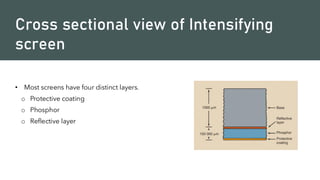
Cross sectional view of Intensifying
screen
• Most screens have four distinct layers.
o Protective coating
o Phosphor
o Reflective layer
Protective Coating
• The layer of the radiographic intensifying screen closest to the radiographic film is the
protective coating.
• It is 10 to 20 micro-meter thick and is applied to the face of the screen to make the screen
resistant to the abrasion and damage caused by handling.
• The protective layer is transparent to light.
Phosphor
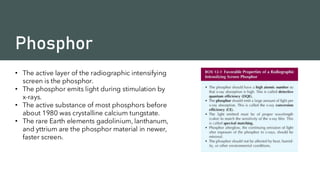
• The active layer of the radiographic intensifying
screen is the phosphor.
• The phosphor emits light during stimulation by
x-rays.
• The active substance of most phosphors before
about 1980 was crystalline calcium tungstate.
• The rare Earth elements gadolinium, lanthanum,
and yttrium are the phosphor material in newer,
faster screens.
Reflective layer
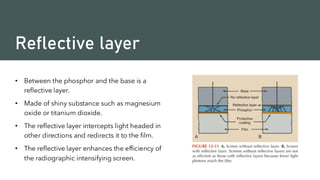
• Between the phosphor and the base is a
reflective layer.
• Made of shiny substance such as magnesium
oxide or titanium dioxide.
• The reflective layer intercepts light headed in
other directions and redirects it to the film.
• The reflective layer enhances the efficiency of
the radiographic intensifying screen.
Base
• The layer farthest from the radiographic film is the base.
• The base is approximately 1 mm thick and serves principally as a mechanical support for
the active phosphor layer.
• Polyester is the popular base material in radiographic intensifying screens, just as it is for
radiographic film.
Cassette
• The cassette is the rigid holder that
contains the film and radiographic
intensifying screens.
• The front cover, the side facing the x-
ray source, is made of material with a
low atomic number such as plastic,
designed for minimum attenuation of
the x-ray beam.
• Attached to the inside of the front
cover is the front screen, and attached
to the back cover is the back screen.
Cont..
• The radiographic film is sandwiched between the two screens.
• Between each screen and the cassette cover is some sort of compression device, which
maintains close screen-film contact when the cassette is closed and latched.
• The back cover is usually made of heavy metal to minimize backscatter.
Screen film
combinations
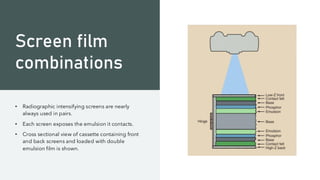
• Radiographic intensifying screens are nearly
always used in pairs.
• Each screen exposes the emulsion it contacts.
• Cross sectional view of cassette containing front
and back screens and loaded with double
emulsion film is shown.
THANK YOU!

Radiographic Intensifying screen and Cassette.pdf

  • 1.
  • 2.
    Introduction Intensifying Screens: Radiographic intensifyingscreens are specialized layers within a cassette, coated with phosphorescent materials. When exposed to x-rays, these screens emit visible light, which interacts with the film to create an image. Cassettes: Radiographic cassettes are containers designed to hold and protect the film and intensifying screens during an x- ray procedure.
  • 3.
    Cont.. Intensifying screens werefirst developed to improve the sensitivity of screen film to x-rays, initially using materials like calcium tungstate. Later rare-earth screens, like those using gadolinium and lanthanum, were introduced. Cassettes evolved alongside intensifying screens, becoming more efficient and durable, designed to protect the film while optimizing image clarity.
  • 4.
    Current Use inRadiography • While digital detectors have largely replaced intensifying screens and film cassettes in many modern radiography departments, intensifying screens and cassettes are still used in some settings, especially where digital systems may not be feasible due to cost or infrastructure limitations.
  • 5.
    Radiographic Intensifying Screen •Use of screen film alone to detect x-rays and to image anatomical structures is inefficient. • Fewer than 1% of the x-rays incident on radiographic film interact with the film and contribute to the latent image. • Most radiographs are made with the film in contact with a radiographic intensifying screen because the use of film alone requires a high patient radiation dose. • A radiographic intensifying screen is a device that converts the energy of the x-ray beam into visible light. This visible light then interacts with the radiographic film, forming the latent image.
  • 6.
    Cont.. • The radiographicfilm is sandwiched between two screens. The film used is called double- emulsion film. • The radiographic intensifying screen amplifies the effect of image-forming x-rays that reach the screen-film cassette.
  • 7.
    Cross sectional viewof Intensifying screen • Most screens have four distinct layers. o Protective coating o Phosphor o Reflective layer
  • 8.
    Protective Coating • Thelayer of the radiographic intensifying screen closest to the radiographic film is the protective coating. • It is 10 to 20 micro-meter thick and is applied to the face of the screen to make the screen resistant to the abrasion and damage caused by handling. • The protective layer is transparent to light.
  • 9.
    Phosphor • The activelayer of the radiographic intensifying screen is the phosphor. • The phosphor emits light during stimulation by x-rays. • The active substance of most phosphors before about 1980 was crystalline calcium tungstate. • The rare Earth elements gadolinium, lanthanum, and yttrium are the phosphor material in newer, faster screens.
  • 10.
    Reflective layer • Betweenthe phosphor and the base is a reflective layer. • Made of shiny substance such as magnesium oxide or titanium dioxide. • The reflective layer intercepts light headed in other directions and redirects it to the film. • The reflective layer enhances the efficiency of the radiographic intensifying screen.
  • 11.
    Base • The layerfarthest from the radiographic film is the base. • The base is approximately 1 mm thick and serves principally as a mechanical support for the active phosphor layer. • Polyester is the popular base material in radiographic intensifying screens, just as it is for radiographic film.
  • 12.
    Cassette • The cassetteis the rigid holder that contains the film and radiographic intensifying screens. • The front cover, the side facing the x- ray source, is made of material with a low atomic number such as plastic, designed for minimum attenuation of the x-ray beam. • Attached to the inside of the front cover is the front screen, and attached to the back cover is the back screen.
  • 13.
    Cont.. • The radiographicfilm is sandwiched between the two screens. • Between each screen and the cassette cover is some sort of compression device, which maintains close screen-film contact when the cassette is closed and latched. • The back cover is usually made of heavy metal to minimize backscatter.
  • 14.
    Screen film combinations • Radiographicintensifying screens are nearly always used in pairs. • Each screen exposes the emulsion it contacts. • Cross sectional view of cassette containing front and back screens and loaded with double emulsion film is shown.
  • 15.