X-Ray Film Construction
andEffects
This presentation provides an overview of the construction of X-ray films and examines
their cross-over effects. It covers essential sensitometry principles, film storage
requirements, and the roles of intensifying screens and cassettes. Additionally, it
explores luminescence phenomena such as fluorescence and phosphorescence,
highlighting various fluorescent materials used to enhance imaging effectiveness.
2.
X-Ray Film Construction
MaterialComposition
X-ray films consist of a polyester base and a silver halide emulsion layer, capturing images under X-
ray exposure.
Cross-Over Effect
Scattered X-rays can blur images, mitigated by films with antiscatter features, essential for image
quality.
Film Sensitivity
Sensitivity varies with silver halide crystal size; smaller crystals yield detail while larger offer
quicker exposure.
3.
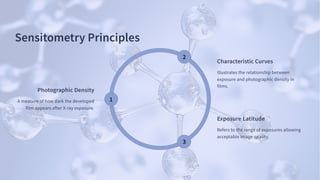
Sensitometry Principles
Photographic Density
Ameasure of how dark the developed
film appears after X-ray exposure.
Characteristic Curves
Illustrates the relationship between
exposure and photographic density in
films.
Exposure Latitude
Refers to the range of exposures allowing
acceptable image quality.
4.
Film Storage andHandling
Storage Environment
Films should be kept cool and dry to prevent degradation.
Shelf Life
Unexposed films can last months or years if stored correctly.
Handling Techniques
Use clean gloves to prevent scratches and contamination.
5.
Intensifying Screens in
Radiography
Functionality
EnhancesX-ray film sensitivity, decreases exposure time, and improves patient
safety.
Construction of Screens
Made of polyester base, luminescent materials, and anti-halo layer to reduce
scatter.
Types of Intensifying Screens
Includes calcium tungstate (blue light) and rare earth screens (green light).
6.
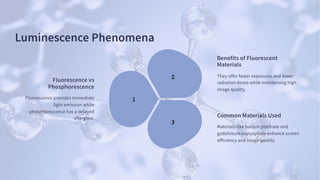
Luminescence Phenomena
Fluorescence vs
Phosphorescence
Fluorescenceprovides immediate
light emission while
phosphorescence has a delayed
afterglow.
Benefits of Fluorescent
Materials
They offer faster exposures and lower
radiation doses while maintaining high
image quality.
Common Materials Used
Materials like barium platinate and
gadolinium oxysulphide enhance screen
efficiency and image quality.
7.
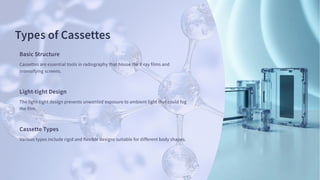
Types of Cassettes
BasicStructure
Cassettes are essential tools in radiography that house the X-ray films and
intensifying screens.
Light-tight Design
The light-tight design prevents unwanted exposure to ambient light that could fog
the film.
Cassette Types
Various types include rigid and flexible designs suitable for different body shapes.
8.
Summary and Conclusion
ImagingEvolution
Understanding the evolution of X-ray films and intensifying screens is critical for optimizing patient care.
Clinical Implications
Clinicians must understand the interplay of film construction and sensitometry to ensure effective
imaging processes.
Future Developments
Research in radiographic technology promises enhanced film and screen quality while minimizing
exposure risks.







![Getting Started with Apache Spark: Big Data Made Simple [Free Meetup]](https://cdn.slidesharecdn.com/ss_thumbnails/apachesparkgettingstarted-260203175547-8361bcc3-thumbnail.jpg?width=640&height=640&fit=bounds)


