THE
LINE FOCUS
PRINCIPLE
Mohammed Althaf
BSc MIT 2nd year
AJ Institute of Medical Science
Concept:
A large focal spot is therefor useful to protect the tungsten target as
the accumulates and dissipates within the area of focal spot.
However, a small focal spot is required to achieve a good
radiographic image quality.
The line focus principle helps resolve this issue by starting that an
angulation of the anode surface will result in an apparent decrease in
the focal spot size.
The apparent focal spot(projected focal spot) size can be determined
by the sine of the angle of the anode surface.
Apparent focal spot size = real focal spot size * sin anode angle
The angle varies as per tube design with a range value of 6 degrees
to about 20 degrees
Line - focus Principle
The target of an X-ray tube is mounted at very
steep angle 𝜗 w.r.t. motion of incident electron.
Hence, the X-ray will come from a smaller focal
area.
Whereas the electrons bombard relatively a large
focal area.
So, suddenly heat is removed and also picture
sharpness is improved.
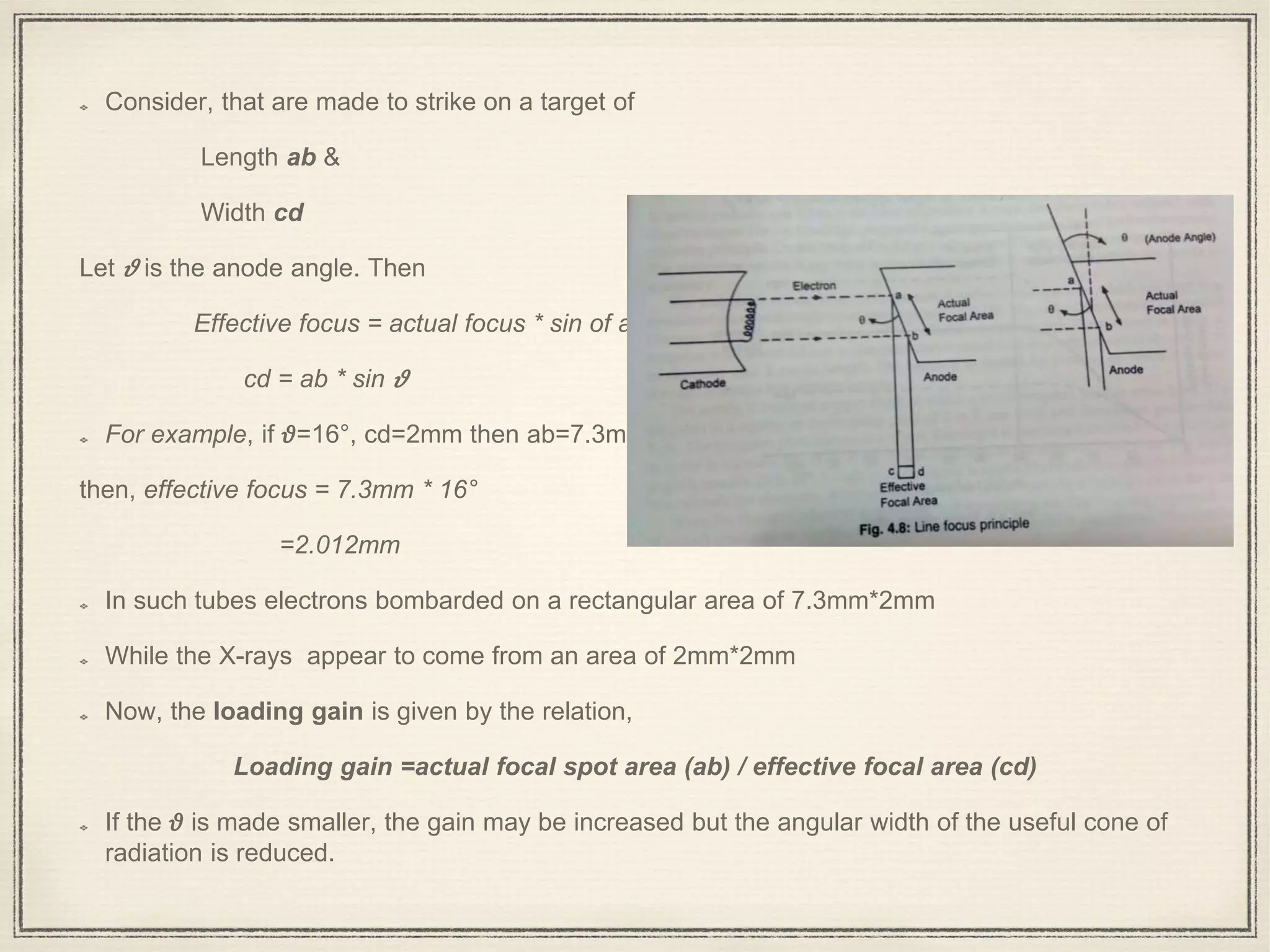
Consider, that are made to strike on a target of
Length ab &
Width cd
Let 𝜗 is the anode angle. Then
Effective focus = actual focus * sin of anode angle
cd = ab * sin 𝜗
For example, if 𝜗=16°, cd=2mm then ab=7.3mm
then, effective focus = 7.3mm * 16°
=2.012mm
In such tubes electrons bombarded on a rectangular area of 7.3mm*2mm
While the X-rays appear to come from an area of 2mm*2mm
Now, the loading gain is given by the relation,
Loading gain =actual focal spot area (ab) / effective focal area (cd)
If the 𝜗 is made smaller, the gain may be increased but the angular width of the useful cone of
radiation is reduced.
Line - focus principle
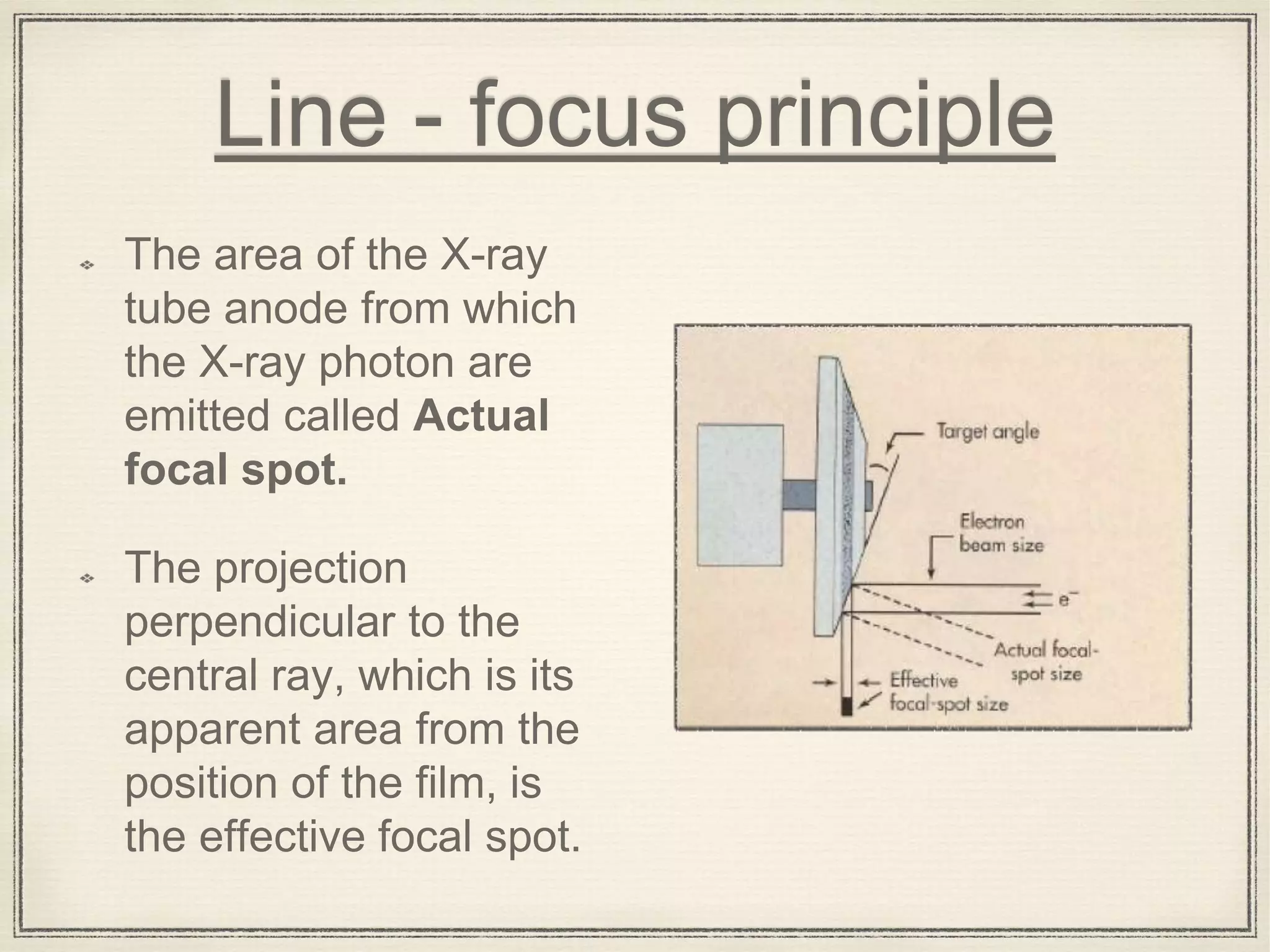
The area of the X-ray
tube anode from which
the X-ray photon are
emitted called Actual
focal spot.
The projection
perpendicular to the
central ray, which is its
apparent area from the
position of the film, is
the effective focal spot.
Line - focus principle
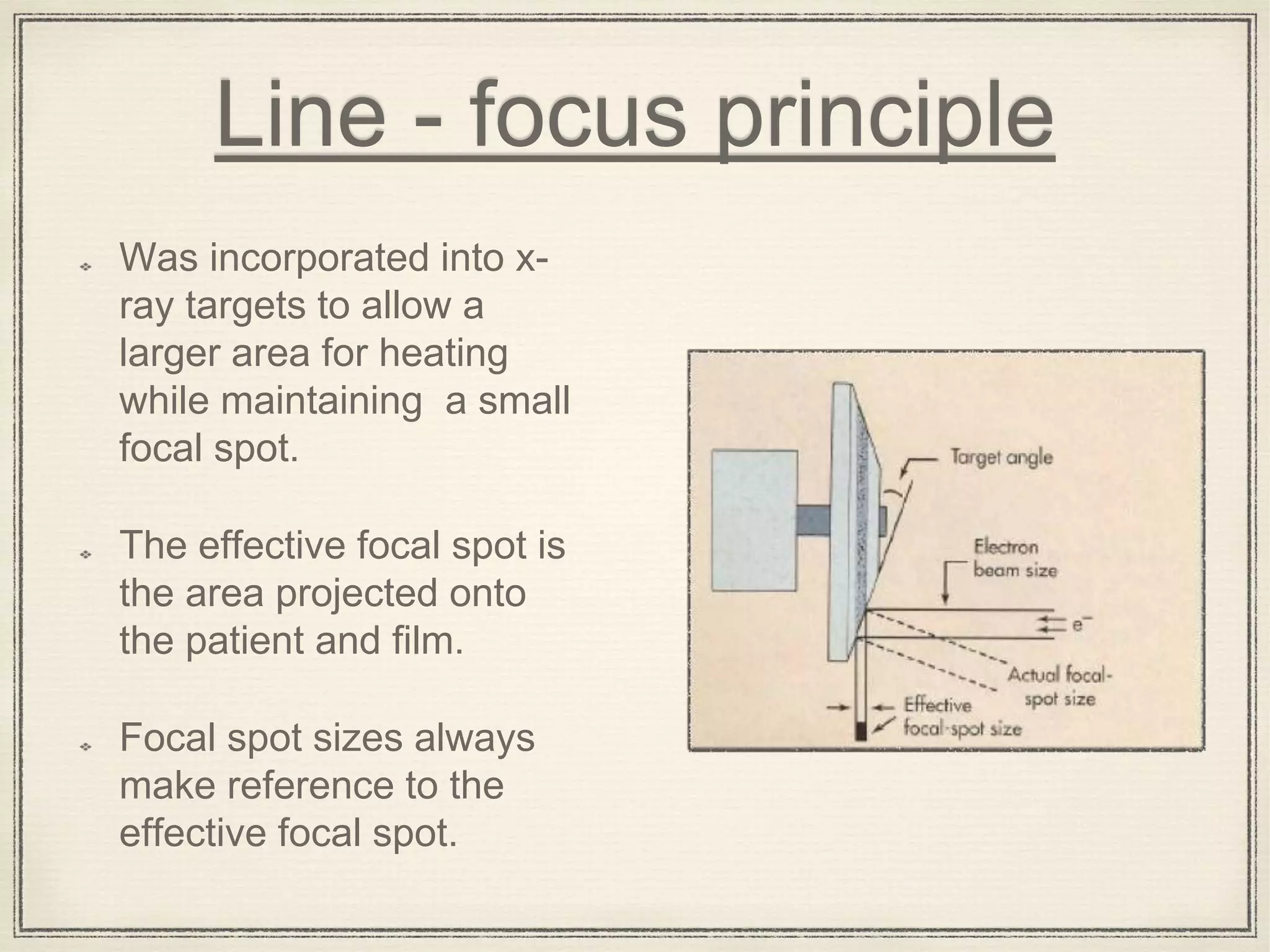
Was incorporated into x-
ray targets to allow a
larger area for heating
while maintaining a small
focal spot.
The effective focal spot is
the area projected onto
the patient and film.
Focal spot sizes always
make reference to the
effective focal spot.
Line - focus principle
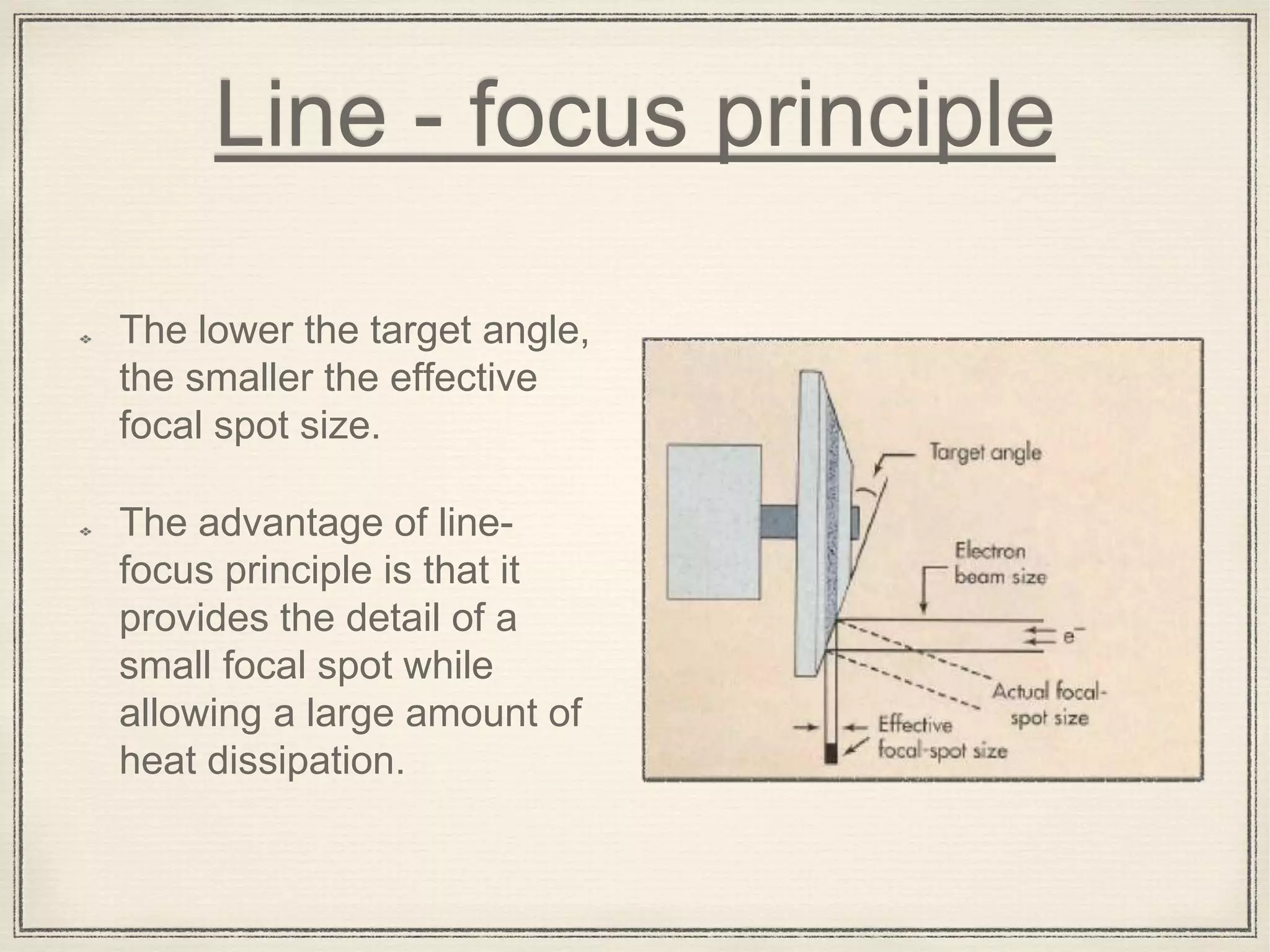
The lower the target angle,
the smaller the effective
focal spot size.
The advantage of line-
focus principle is that it
provides the detail of a
small focal spot while
allowing a large amount of
heat dissipation.
Line - focus principle
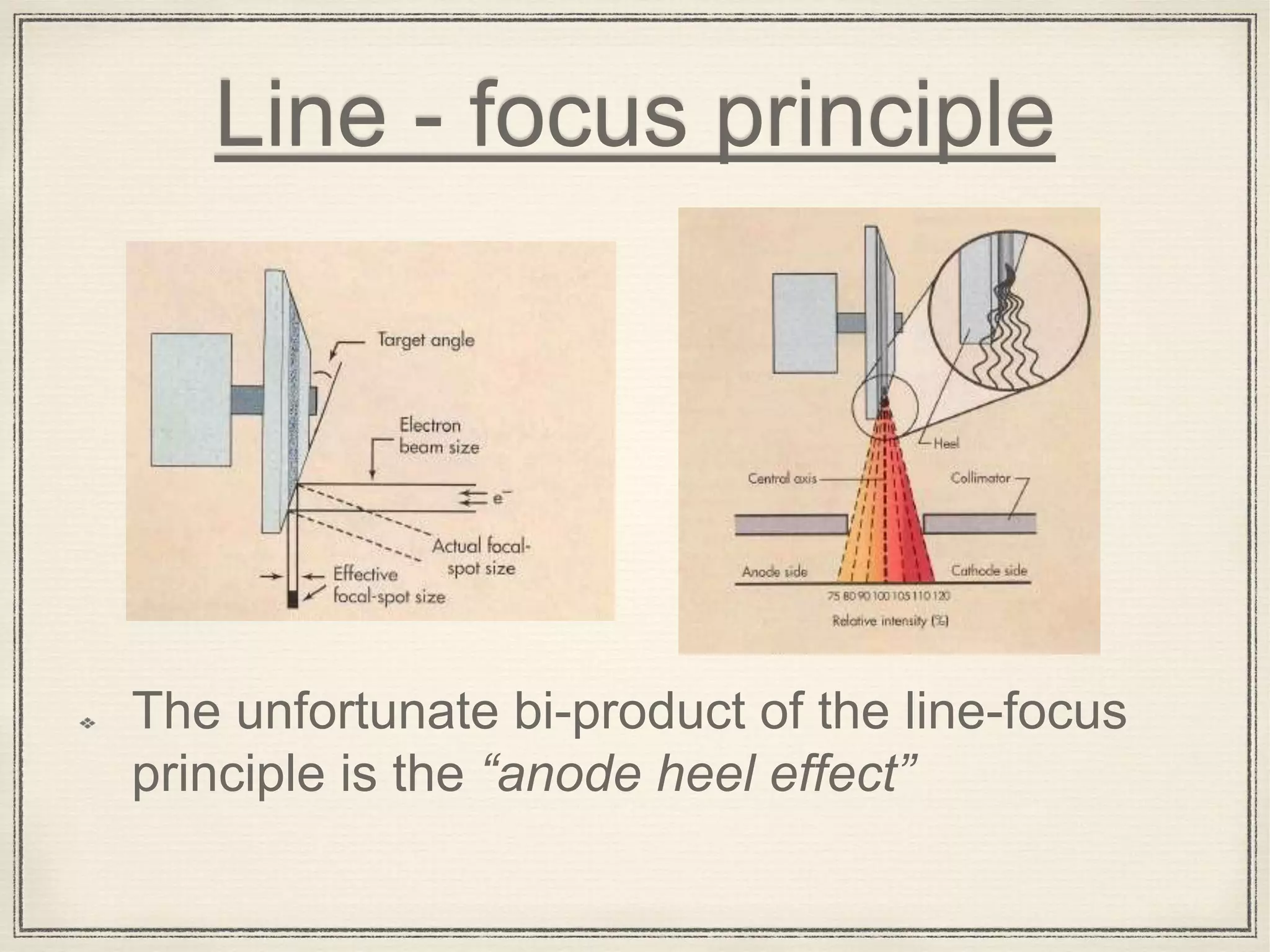
The unfortunate bi-product of the line-focus
principle is the “anode heel effect”
Limitations of the principle.
There are two important aspects consider with regards to target angle.
1. Size of the apparent focal spot
2. Area covered by the x-ray beam
Firstly, for a given apparent focal spot size, the real are covered by the electron
beam is larger for smaller target angles which, as stated above allows a greater
area over which to dissipate the heat.
Secondly, for a smaller target angle, the area covered by the x-ray beam will be
smaller so it is not possible to cover large areas at smaller FFDs, therefore it
can be appreciated that choice of target angle is a compromise between tube
loading, geometric unsharpness and desired area to be covered by the useful
beam. For practical purpose, at 40”FFD the anode angle should be no smaller
than15 degrees. A decrease angle below 6degrees will result in anode heel
effect.
Thank you…

Line focus principle.

  • 1.
    THE LINE FOCUS PRINCIPLE Mohammed Althaf BScMIT 2nd year AJ Institute of Medical Science
  • 2.
    Concept: A large focalspot is therefor useful to protect the tungsten target as the accumulates and dissipates within the area of focal spot. However, a small focal spot is required to achieve a good radiographic image quality. The line focus principle helps resolve this issue by starting that an angulation of the anode surface will result in an apparent decrease in the focal spot size. The apparent focal spot(projected focal spot) size can be determined by the sine of the angle of the anode surface. Apparent focal spot size = real focal spot size * sin anode angle The angle varies as per tube design with a range value of 6 degrees to about 20 degrees
  • 3.
    Line - focusPrinciple The target of an X-ray tube is mounted at very steep angle 𝜗 w.r.t. motion of incident electron. Hence, the X-ray will come from a smaller focal area. Whereas the electrons bombard relatively a large focal area. So, suddenly heat is removed and also picture sharpness is improved.
  • 4.
    Consider, that aremade to strike on a target of Length ab & Width cd Let 𝜗 is the anode angle. Then Effective focus = actual focus * sin of anode angle cd = ab * sin 𝜗 For example, if 𝜗=16°, cd=2mm then ab=7.3mm then, effective focus = 7.3mm * 16° =2.012mm In such tubes electrons bombarded on a rectangular area of 7.3mm*2mm While the X-rays appear to come from an area of 2mm*2mm Now, the loading gain is given by the relation, Loading gain =actual focal spot area (ab) / effective focal area (cd) If the 𝜗 is made smaller, the gain may be increased but the angular width of the useful cone of radiation is reduced.
  • 5.
    Line - focusprinciple The area of the X-ray tube anode from which the X-ray photon are emitted called Actual focal spot. The projection perpendicular to the central ray, which is its apparent area from the position of the film, is the effective focal spot.
  • 6.
    Line - focusprinciple Was incorporated into x- ray targets to allow a larger area for heating while maintaining a small focal spot. The effective focal spot is the area projected onto the patient and film. Focal spot sizes always make reference to the effective focal spot.
  • 7.
    Line - focusprinciple The lower the target angle, the smaller the effective focal spot size. The advantage of line- focus principle is that it provides the detail of a small focal spot while allowing a large amount of heat dissipation.
  • 8.
    Line - focusprinciple The unfortunate bi-product of the line-focus principle is the “anode heel effect”
  • 9.
    Limitations of theprinciple. There are two important aspects consider with regards to target angle. 1. Size of the apparent focal spot 2. Area covered by the x-ray beam Firstly, for a given apparent focal spot size, the real are covered by the electron beam is larger for smaller target angles which, as stated above allows a greater area over which to dissipate the heat. Secondly, for a smaller target angle, the area covered by the x-ray beam will be smaller so it is not possible to cover large areas at smaller FFDs, therefore it can be appreciated that choice of target angle is a compromise between tube loading, geometric unsharpness and desired area to be covered by the useful beam. For practical purpose, at 40”FFD the anode angle should be no smaller than15 degrees. A decrease angle below 6degrees will result in anode heel effect.
  • 10.