WFP062298
Double Fertilization and
Post - Fertilization Events: Measuring
compatable
pollen
papilla cells
of stigma
pollen tube
callose plug in
empty tube
embryo sac
(female
gametophyte)
ovule
endosperm
nucleus (3n)
zygote
nucleus (2n)
incompatable
pollen
empty pollen
grain
sperm nuclei
tube nucleus
ovary cavity
central cell with 2
polar nuclei which
fuse to give 2n
fusion nucleus
egg cell (n)
pollen tube
entering the
micropyle
male
gametophyte
(germinating
pollen)
compatible
pollen
papilla cells
of stigma
pollen tube
callose plug in
empty tube
ovule
endosperm
nucleus (3n)
zygote nucleus
(2n)
central cell with two
polar nuclei which
fuse to give 2n
fusion nucleus
tube nucleus
sperm nuclei
empty pollen
grain
germinating pollen
(microgametophyte)
incompatible
pollen
ovary cavity
egg cell (n)
pollen tube
entering the
micropyle
embryo sac
(megagametophyte)
vascular strands
ConceptsConceptsConceptsConceptsConcepts
In plants fertilization is the event in sexual reproduction which follows pollination. In higher
plants, two sperm are involved in fertilization, reaching the ovule via a pollen tube from the
germinating pollen grains. One sperm fertilizes the egg cell within the embryo sac to produce the
zygote and begin the new generation. The other combines with the fusion nucleus to produce the
endosperm, a special tissue that nourishes the developing embryo. Fertilization also stimulates
the growth of the maternal tissue (seed pod or fruit) supporting the developing seed. In Fast Plants
the fertilized egg cell develops through various stages over the next 20 days until it becomes a
mature quiescent embryo, the seed.
BackgroundBackgroundBackgroundBackgroundBackground
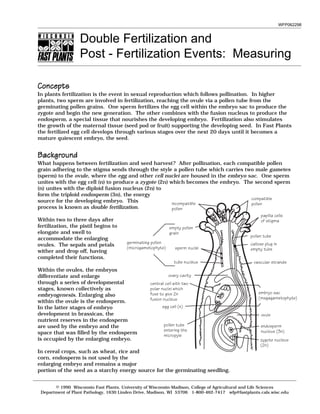
What happens between fertilization and seed harvest? After pollination, each compatible pollen
grain adhering to the stigma sends through the style a pollen tube which carries two male gametes
(sperm) to the ovule, where the egg and other cell nuclei are housed in the embryo sac. One sperm
unites with the egg cell (n) to produce a zygote (2n) which becomes the embryo. The second sperm
(n) unites with the diploid fusion nucleus (2n) to
form the triploid endosperm (3n), the energy
source for the developing embryo. This
process is known as double fertilization.
Within two to three days after
fertilization, the pistil begins to
elongate and swell to
accommodate the enlarging
ovules. The sepals and petals
wither and drop off, having
completed their functions.
Within the ovules, the embryos
differentiate and enlarge
through a series of developmental
stages, known collectively as
embryogenesis. Enlarging also
within the ovule is the endosperm.
In the latter stages of embryo
development in brassicas, the
nutrient reserves in the endosperm
are used by the embryo and the
space that was filled by the endosperm
is occupied by the enlarging embryo.
In cereal crops, such as wheat, rice and
corn, endosperm is not used by the
enlarging embryo and remains a major
portion of the seed as a starchy energy source for the germinating seedling.
© 1990 Wisconsin Fast Plants, University of Wisconsin-Madison, College of Agricultural and Life Sciences
Department of Plant Pathology, 1630 Linden Drive, Madison, WI 53706 1-800-462-7417 wfp@fastplants.cals.wisc.edu
A
C
T
I V
I T
Y
A
C
T
I V
I T
Y
A
C
T
I V
I T
Y
A
C
T
I V
I T
Y
A
C
T
I V
I T
Y
Measuring Time on the Floral Clock
IntroductionIntroductionIntroductionIntroductionIntroduction
Embryogenesis is a highly coordinated sequence of developmental events within the
ovule and supporting maternal tissues that ultimately leads to the development of a viable
seed.
Successful embryo and endosperm development is accompanied by rapid elongation and enlargement
of the pistil which serves as supportive nourishing maternal tissue. There is a strong interdependency
between the developing embryos, endosperm, ovule and maternal tissues of the pod: it is believed that
hormones produced by the developing embryos and endosperm regulate the growth and expansion of
maternal tissue (Stage G in the life cycle, see WFPID The Life Cycle). When either embryo or
endosperm fails in its development, ovule development also ceases and pod enlargement may be
slowed. Vigorous pod development supported by a healthy plant is also necessary for the developing
embryo and endosperm in the ovule. Seed failure can result if the maternal plant comes under
excessive environmental stress, as from excessive heat, water stress or nutrient deprivation.
Fertilization in sexually reproducing organisms represents the onset of the next generation. Following
double fertilization in plants, the most visible event is the rapid wasting of all those flower parts which
are no longer needed by the plant. Sepals, petals and stamens wither and fall. Nectaries dry up. At
the same time, within a few hours of fertilization, the pistil with its complement of fertilized ovules
begins rapid development.
This activity provides students with an opportunity to follow the results of student pollination by
measuring the increasing length of the pistil at regular intervals until mature seeds are formed and
harvested. Upon harvest, viability of the seeds will also be tested. In the WFPID Embryogensis,
students dissect pods at various stages of development and investigate in great detail the stages in
embryogenesis.
Question:Question:Question:Question:Question: What are the indicators of normal fertilization and post-fertilization development that follow
successful pollination?
Sample Hypothesis:Sample Hypothesis:Sample Hypothesis:Sample Hypothesis:Sample Hypothesis: Flower parts other than the pistil wither. The pistil enlarges to become a pod
containing developing seed. At maturity the pod and seeds dry. Viable seeds germinate.
DesignDesignDesignDesignDesign
• At specified intervals following pollination, measure the length of the pistil, observe developing
embryos and endosperm and estimate the number of developing embryos. At maturity, harvest
seed and verify viability with germination test. As a control follow the development of pistils of the
unpollinated control plants.
• Students will record observations and measurements on the Floral Clock Student Data Sheet.
Time FrameTime FrameTime FrameTime FrameTime Frame
A period of 36 days from the sowing of seed is required for the growth of the Fast Plants and the
completion of this activity. The time required each class period will vary according to the observations
or measurements being made. Time will be required on seven separate days through the course of
this activity, specified in the procedure.
Through the development of the seed, the plant has solved the problem of packaging its new
generation to survive until favorable conditions for growth return. As the seed matures, the walls
of each ovule develop into a protective seed coat and the entire ovary becomes a fruit (seed pod)
known as silques. In Fast Plants, embryos mature into seeds in 20 days after successful
pollination and fertilization.
stigma
receptacle
pistilpistilpistilpistilpistil
lengthlengthlengthlengthlength
2. Repeat Step 1 at 6 dap and 9 dap.
3. Students will notice that the pods at 9 dap, in addition to elongating, have swollen around what
appears to be developing seeds or ovules (Stage H, Life Cycle).
- Carefully hold the plants up to the light. Can you see the outlines of the developing ovules
within the pods?
- Estimate the number of developing seeds in each pod. Record the information on your Floral
Clock Student Data Sheet. At harvesting you will be able to verify your estimations by counting
the seed.
4. If students are not doing the activity on embryo dissection, each pair may sacrifice one pod from
one of their plants in order to observe the developing embryos within the ovules at 9 dap.
Learning ObjectivesLearning ObjectivesLearning ObjectivesLearning ObjectivesLearning Objectives
In participating in this activity students will:
• learn to make observations and accurate measurements of pistil enlargement;
• understand the role of pollination and compatible pollen germination as a precursor to double
fertilization (Stage F, Life Cycle);
• understand that following double fertilization a complex sequence of interdependent developmental
events occurs over a period of 20 days that results in the production of viable seed for a new
generation in the spiral of life (Stages F, G, H and I, Life Cycle);
• understand the unique nature of double fertilization in higher plants in which embryo and
endosperm are interdependent specialized tissues within the ovule that function in normal seed
development (Stage G, Life Cycle);
• understand the interdependent relationship of developing maternal tissue and developing fertilized
ovules (Stage G, Life Cycle);
• understand that the development of a viable seed requires a healthy (environmentally non-
stressed) plant during the period of growth in which the fertilized ovules are developing into seed.
MaterialsMaterialsMaterialsMaterialsMaterials
• flowering Fast Plants, post-pollination
• dissection strips (see WFPID Dissection Strips)
• fine scissors
• fine-tipped forceps and fine dissecting needles (e.g., tuberculin syringes with #23 or #25 needles)
• clear double stick tape
• 2 cm wide clear adhesive tape
• seed envelope
• glass microscope slide
• water and dropper
• sharp cutting blade
ProcedureProcedureProcedureProcedureProcedure
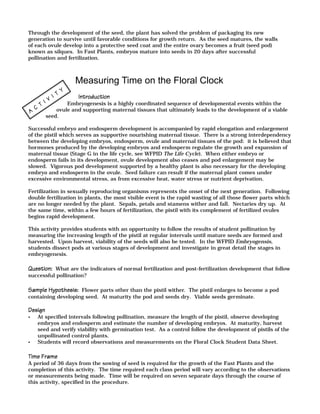
1. At 3 dap (days after pollination) students will notice that the flower
parts that were important in pollination have withered and fallen from
the plant.
- Using a dissection strip without tape as a ruler, carefully measure the
length of each expanding pistil, recording its length to the nearest
millimeter in the appropriate column of the Floral Clock Student Data
Sheet according to its position number. Remember the highest
number (4) is the most apical (top) flower.
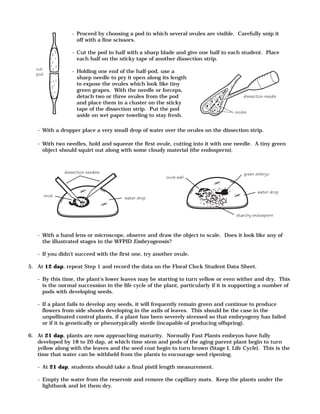
- With two needles, hold and squeeze the first ovule, cutting into it with one needle. A tiny green
object should squirt out along with some cloudy material (the endosperm).
- With a hand lens or microscope, observe and draw the object to scale. Does it look like any of
the illustrated stages in the WFPID Embryogensis?
- If you didn't succeed with the first one, try another ovule.
5. At 12 dap, repeat Step 1 and record the data on the Floral Clock Student Data Sheet.
- By this time, the plant's lower leaves may be starting to turn yellow or even wither and dry. This
is the normal succession in the life cycle of the plant, particularly if it is supporting a number of
pods with developing seeds.
- If a plant fails to develop any seeds, it will frequently remain green and continue to produce
flowers from side shoots developing in the axils of leaves. This should be the case in the
unpollinated control plants, if a plant has been severely stressed so that embryogeny has failed
or if it is genetically or phenotypically sterile (incapable of producing offspring).
6. At 21 dap, plants are now approaching maturity. Normally Fast Plants embryos have fully
developed by 18 to 20 dap, at which time stem and pods of the aging parent plant begin to turn
yellow along with the leaves and the seed coat begin to turn brown (Stage I, Life Cycle). This is the
time that water can be withheld from the plants to encourage seed ripening.
- At 21 dap, students should take a final pistil length measurement.
- Empty the water from the reservoir and remove the capillary mats. Keep the plants under the
lightbank and let them dry.
- With a dropper place a very small drop of water over the ovules on the dissection strip.
- Proceed by choosing a pod in which several ovules are visible. Carefully snip it
off with a fine scissors.
- Cut the pod in half with a sharp blade and give one half to each student. Place
each half on the sticky tape of another dissection strip.
- Holding one end of the half-pod, use a
sharp needle to pry it open along its length
to expose the ovules which look like tiny
green grapes. With the needle or forceps,
detach two or three ovules from the pod
and place them in a cluster on the sticky
tape of the dissection strip. Put the pod
aside on wet paper toweling to stay fresh.
dissection needledissection needles
water dropovule
cut
pod
ovules
dissection needle
ovules
dissection needle
starchy e
greengreen embryo
water drop
starchy endosperm
ovule wall
7. In about a week, or when the pods are dry, harvest the seeds from
each of your pods onto separate loops of sticky tape. Record the
plant and pod number on the tape.
- Count and record the number of seeds for each pod on the Floral
Clock Student Data Sheet.
- Did the number of seeds in each pod agree with the estimates
you made at 9 dap?
- As you harvest, notice any unusual seed. If these are of interest
with you, tape them to a card where they can be examined or
germinated later.
8. Take a sample of two seeds from each pod and test their viability in a bottle cap seed germinator
according to the instructions in WFPID Germination.
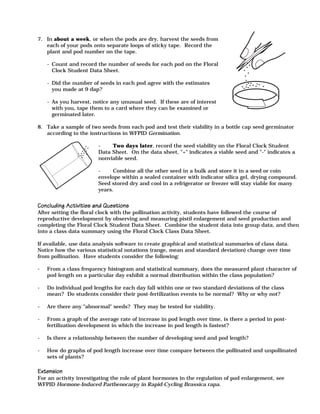
- Two days later, record the seed viability on the Floral Clock Student
Data Sheet. On the data sheet, "+" indicates a viable seed and "-" indicates a
nonviable seed.
- Combine all the other seed in a bulk and store it in a seed or coin
envelope within a sealed container with indicator silica gel, drying compound.
Seed stored dry and cool in a refrigerator or freezer will stay viable for many
years.
Concluding Activities and QuestionsConcluding Activities and QuestionsConcluding Activities and QuestionsConcluding Activities and QuestionsConcluding Activities and Questions
After setting the floral clock with the pollination activity, students have followed the course of
reproductive development by observing and measuring pistil enlargement and seed production and
completing the Floral Clock Student Data Sheet. Combine the student data into group data, and then
into a class data summary using the Floral Clock Class Data Sheet.
If available, use data analysis software to create graphical and statistical summaries of class data.
Notice how the various statistical notations (range, mean and standard deviation) change over time
from pollination. Have students consider the following:
- From a class frequency histogram and statistical summary, does the measured plant character of
pod length on a particular day exhibit a normal distribution within the class population?
- Do individual pod lengths for each day fall within one or two standard deviations of the class
mean? Do students consider their post-fertilization events to be normal? Why or why not?
- Are there any "abnormal" seeds? They may be tested for viability.
- From a graph of the average rate of increase in pod length over time, is there a period in post-
fertilization development in which the increase in pod length is fastest?
- Is there a relationship between the number of developing seed and pod length?
- How do graphs of pod length increase over time compare between the pollinated and unpollinated
sets of plants?
ExtensionExtensionExtensionExtensionExtension
For an activity investigating the role of plant hormones in the regulation of pod enlargement, see
WFPID Hormone-Induced Parthenocarpy in Rapid-Cycling Brassica rapa.
Double fertilization

Double fertilization

  • 1.
    WFP062298 Double Fertilization and Post- Fertilization Events: Measuring compatable pollen papilla cells of stigma pollen tube callose plug in empty tube embryo sac (female gametophyte) ovule endosperm nucleus (3n) zygote nucleus (2n) incompatable pollen empty pollen grain sperm nuclei tube nucleus ovary cavity central cell with 2 polar nuclei which fuse to give 2n fusion nucleus egg cell (n) pollen tube entering the micropyle male gametophyte (germinating pollen) compatible pollen papilla cells of stigma pollen tube callose plug in empty tube ovule endosperm nucleus (3n) zygote nucleus (2n) central cell with two polar nuclei which fuse to give 2n fusion nucleus tube nucleus sperm nuclei empty pollen grain germinating pollen (microgametophyte) incompatible pollen ovary cavity egg cell (n) pollen tube entering the micropyle embryo sac (megagametophyte) vascular strands ConceptsConceptsConceptsConceptsConcepts In plants fertilization is the event in sexual reproduction which follows pollination. In higher plants, two sperm are involved in fertilization, reaching the ovule via a pollen tube from the germinating pollen grains. One sperm fertilizes the egg cell within the embryo sac to produce the zygote and begin the new generation. The other combines with the fusion nucleus to produce the endosperm, a special tissue that nourishes the developing embryo. Fertilization also stimulates the growth of the maternal tissue (seed pod or fruit) supporting the developing seed. In Fast Plants the fertilized egg cell develops through various stages over the next 20 days until it becomes a mature quiescent embryo, the seed. BackgroundBackgroundBackgroundBackgroundBackground What happens between fertilization and seed harvest? After pollination, each compatible pollen grain adhering to the stigma sends through the style a pollen tube which carries two male gametes (sperm) to the ovule, where the egg and other cell nuclei are housed in the embryo sac. One sperm unites with the egg cell (n) to produce a zygote (2n) which becomes the embryo. The second sperm (n) unites with the diploid fusion nucleus (2n) to form the triploid endosperm (3n), the energy source for the developing embryo. This process is known as double fertilization. Within two to three days after fertilization, the pistil begins to elongate and swell to accommodate the enlarging ovules. The sepals and petals wither and drop off, having completed their functions. Within the ovules, the embryos differentiate and enlarge through a series of developmental stages, known collectively as embryogenesis. Enlarging also within the ovule is the endosperm. In the latter stages of embryo development in brassicas, the nutrient reserves in the endosperm are used by the embryo and the space that was filled by the endosperm is occupied by the enlarging embryo. In cereal crops, such as wheat, rice and corn, endosperm is not used by the enlarging embryo and remains a major portion of the seed as a starchy energy source for the germinating seedling. © 1990 Wisconsin Fast Plants, University of Wisconsin-Madison, College of Agricultural and Life Sciences Department of Plant Pathology, 1630 Linden Drive, Madison, WI 53706 1-800-462-7417 wfp@fastplants.cals.wisc.edu
  • 2.
    A C T I V I T Y A C T IV I T Y A C T I V I T Y A C T I V I T Y A C T I V I T Y Measuring Time on the Floral Clock IntroductionIntroductionIntroductionIntroductionIntroduction Embryogenesis is a highly coordinated sequence of developmental events within the ovule and supporting maternal tissues that ultimately leads to the development of a viable seed. Successful embryo and endosperm development is accompanied by rapid elongation and enlargement of the pistil which serves as supportive nourishing maternal tissue. There is a strong interdependency between the developing embryos, endosperm, ovule and maternal tissues of the pod: it is believed that hormones produced by the developing embryos and endosperm regulate the growth and expansion of maternal tissue (Stage G in the life cycle, see WFPID The Life Cycle). When either embryo or endosperm fails in its development, ovule development also ceases and pod enlargement may be slowed. Vigorous pod development supported by a healthy plant is also necessary for the developing embryo and endosperm in the ovule. Seed failure can result if the maternal plant comes under excessive environmental stress, as from excessive heat, water stress or nutrient deprivation. Fertilization in sexually reproducing organisms represents the onset of the next generation. Following double fertilization in plants, the most visible event is the rapid wasting of all those flower parts which are no longer needed by the plant. Sepals, petals and stamens wither and fall. Nectaries dry up. At the same time, within a few hours of fertilization, the pistil with its complement of fertilized ovules begins rapid development. This activity provides students with an opportunity to follow the results of student pollination by measuring the increasing length of the pistil at regular intervals until mature seeds are formed and harvested. Upon harvest, viability of the seeds will also be tested. In the WFPID Embryogensis, students dissect pods at various stages of development and investigate in great detail the stages in embryogenesis. Question:Question:Question:Question:Question: What are the indicators of normal fertilization and post-fertilization development that follow successful pollination? Sample Hypothesis:Sample Hypothesis:Sample Hypothesis:Sample Hypothesis:Sample Hypothesis: Flower parts other than the pistil wither. The pistil enlarges to become a pod containing developing seed. At maturity the pod and seeds dry. Viable seeds germinate. DesignDesignDesignDesignDesign • At specified intervals following pollination, measure the length of the pistil, observe developing embryos and endosperm and estimate the number of developing embryos. At maturity, harvest seed and verify viability with germination test. As a control follow the development of pistils of the unpollinated control plants. • Students will record observations and measurements on the Floral Clock Student Data Sheet. Time FrameTime FrameTime FrameTime FrameTime Frame A period of 36 days from the sowing of seed is required for the growth of the Fast Plants and the completion of this activity. The time required each class period will vary according to the observations or measurements being made. Time will be required on seven separate days through the course of this activity, specified in the procedure. Through the development of the seed, the plant has solved the problem of packaging its new generation to survive until favorable conditions for growth return. As the seed matures, the walls of each ovule develop into a protective seed coat and the entire ovary becomes a fruit (seed pod) known as silques. In Fast Plants, embryos mature into seeds in 20 days after successful pollination and fertilization.
  • 3.
    stigma receptacle pistilpistilpistilpistilpistil lengthlengthlengthlengthlength 2. Repeat Step1 at 6 dap and 9 dap. 3. Students will notice that the pods at 9 dap, in addition to elongating, have swollen around what appears to be developing seeds or ovules (Stage H, Life Cycle). - Carefully hold the plants up to the light. Can you see the outlines of the developing ovules within the pods? - Estimate the number of developing seeds in each pod. Record the information on your Floral Clock Student Data Sheet. At harvesting you will be able to verify your estimations by counting the seed. 4. If students are not doing the activity on embryo dissection, each pair may sacrifice one pod from one of their plants in order to observe the developing embryos within the ovules at 9 dap. Learning ObjectivesLearning ObjectivesLearning ObjectivesLearning ObjectivesLearning Objectives In participating in this activity students will: • learn to make observations and accurate measurements of pistil enlargement; • understand the role of pollination and compatible pollen germination as a precursor to double fertilization (Stage F, Life Cycle); • understand that following double fertilization a complex sequence of interdependent developmental events occurs over a period of 20 days that results in the production of viable seed for a new generation in the spiral of life (Stages F, G, H and I, Life Cycle); • understand the unique nature of double fertilization in higher plants in which embryo and endosperm are interdependent specialized tissues within the ovule that function in normal seed development (Stage G, Life Cycle); • understand the interdependent relationship of developing maternal tissue and developing fertilized ovules (Stage G, Life Cycle); • understand that the development of a viable seed requires a healthy (environmentally non- stressed) plant during the period of growth in which the fertilized ovules are developing into seed. MaterialsMaterialsMaterialsMaterialsMaterials • flowering Fast Plants, post-pollination • dissection strips (see WFPID Dissection Strips) • fine scissors • fine-tipped forceps and fine dissecting needles (e.g., tuberculin syringes with #23 or #25 needles) • clear double stick tape • 2 cm wide clear adhesive tape • seed envelope • glass microscope slide • water and dropper • sharp cutting blade ProcedureProcedureProcedureProcedureProcedure 1. At 3 dap (days after pollination) students will notice that the flower parts that were important in pollination have withered and fallen from the plant. - Using a dissection strip without tape as a ruler, carefully measure the length of each expanding pistil, recording its length to the nearest millimeter in the appropriate column of the Floral Clock Student Data Sheet according to its position number. Remember the highest number (4) is the most apical (top) flower.
  • 4.
    - With twoneedles, hold and squeeze the first ovule, cutting into it with one needle. A tiny green object should squirt out along with some cloudy material (the endosperm). - With a hand lens or microscope, observe and draw the object to scale. Does it look like any of the illustrated stages in the WFPID Embryogensis? - If you didn't succeed with the first one, try another ovule. 5. At 12 dap, repeat Step 1 and record the data on the Floral Clock Student Data Sheet. - By this time, the plant's lower leaves may be starting to turn yellow or even wither and dry. This is the normal succession in the life cycle of the plant, particularly if it is supporting a number of pods with developing seeds. - If a plant fails to develop any seeds, it will frequently remain green and continue to produce flowers from side shoots developing in the axils of leaves. This should be the case in the unpollinated control plants, if a plant has been severely stressed so that embryogeny has failed or if it is genetically or phenotypically sterile (incapable of producing offspring). 6. At 21 dap, plants are now approaching maturity. Normally Fast Plants embryos have fully developed by 18 to 20 dap, at which time stem and pods of the aging parent plant begin to turn yellow along with the leaves and the seed coat begin to turn brown (Stage I, Life Cycle). This is the time that water can be withheld from the plants to encourage seed ripening. - At 21 dap, students should take a final pistil length measurement. - Empty the water from the reservoir and remove the capillary mats. Keep the plants under the lightbank and let them dry. - With a dropper place a very small drop of water over the ovules on the dissection strip. - Proceed by choosing a pod in which several ovules are visible. Carefully snip it off with a fine scissors. - Cut the pod in half with a sharp blade and give one half to each student. Place each half on the sticky tape of another dissection strip. - Holding one end of the half-pod, use a sharp needle to pry it open along its length to expose the ovules which look like tiny green grapes. With the needle or forceps, detach two or three ovules from the pod and place them in a cluster on the sticky tape of the dissection strip. Put the pod aside on wet paper toweling to stay fresh. dissection needledissection needles water dropovule cut pod ovules dissection needle ovules dissection needle starchy e greengreen embryo water drop starchy endosperm ovule wall
  • 5.
    7. In abouta week, or when the pods are dry, harvest the seeds from each of your pods onto separate loops of sticky tape. Record the plant and pod number on the tape. - Count and record the number of seeds for each pod on the Floral Clock Student Data Sheet. - Did the number of seeds in each pod agree with the estimates you made at 9 dap? - As you harvest, notice any unusual seed. If these are of interest with you, tape them to a card where they can be examined or germinated later. 8. Take a sample of two seeds from each pod and test their viability in a bottle cap seed germinator according to the instructions in WFPID Germination. - Two days later, record the seed viability on the Floral Clock Student Data Sheet. On the data sheet, "+" indicates a viable seed and "-" indicates a nonviable seed. - Combine all the other seed in a bulk and store it in a seed or coin envelope within a sealed container with indicator silica gel, drying compound. Seed stored dry and cool in a refrigerator or freezer will stay viable for many years. Concluding Activities and QuestionsConcluding Activities and QuestionsConcluding Activities and QuestionsConcluding Activities and QuestionsConcluding Activities and Questions After setting the floral clock with the pollination activity, students have followed the course of reproductive development by observing and measuring pistil enlargement and seed production and completing the Floral Clock Student Data Sheet. Combine the student data into group data, and then into a class data summary using the Floral Clock Class Data Sheet. If available, use data analysis software to create graphical and statistical summaries of class data. Notice how the various statistical notations (range, mean and standard deviation) change over time from pollination. Have students consider the following: - From a class frequency histogram and statistical summary, does the measured plant character of pod length on a particular day exhibit a normal distribution within the class population? - Do individual pod lengths for each day fall within one or two standard deviations of the class mean? Do students consider their post-fertilization events to be normal? Why or why not? - Are there any "abnormal" seeds? They may be tested for viability. - From a graph of the average rate of increase in pod length over time, is there a period in post- fertilization development in which the increase in pod length is fastest? - Is there a relationship between the number of developing seed and pod length? - How do graphs of pod length increase over time compare between the pollinated and unpollinated sets of plants? ExtensionExtensionExtensionExtensionExtension For an activity investigating the role of plant hormones in the regulation of pod enlargement, see WFPID Hormone-Induced Parthenocarpy in Rapid-Cycling Brassica rapa.