Simplest Formula Series in Chemistry
Nuclear Chemistry Two
Stephen Joseph Boylan, steveboylan11@yahoo.com
April 2018
Course Learning Outcome: Learn about nuclear chemistry.
Nuclear Chemistry
Two
Stephen Joseph Boylan
April 2018
Subatomic Particles
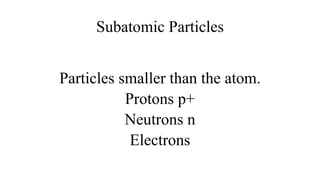
Particles smaller than the atom.
Protons p+
Neutrons n
Electrons
Subatomic Particles
Three Categories
Subatomic Particles
Subatomic Particles
Count the number of protons and neutrons
Subatomic Particles
Single atom Same number of protons
Different number of nuetrons
Subatomic Particles
Mixture Mass fractions of Isotopes
Subatomic Particles
Periodic Table of Elements
Number line of elements arranged by
increase number of protons, atomic
number
Periodic Table of Elements
Elements with similar properties align in
columns called groups.
Periodic Table of Elements
Look at an Element
Look at an Element
Look at an Element
Look at an Element
Isotope or Nuclide
Same number of protons
Different number of neutrons
Enrichment
Mixture of Isotopes
Weighted Average of Masses Same
number of protons
Atomic Number
Binding Energy
What holds the nucleus together?
Nuclear Binding Energy
Energy Equivalent of Mass Defect
Measure of Stability
Nuclear Binding Energy
Energy Produced when atomic nucleons
(p+ n) are bound together
Energy equivalent equation
E = m c 2
Binding Energy
E = energy
m = mass
c = speed of light
Binding Energy
Radioactivity
Spontaneous disintegration
of an atomic nuclei
Stable Nucleus
Does not transform into
another configuration
Unstable Nucleus
Exhibits radioactivity
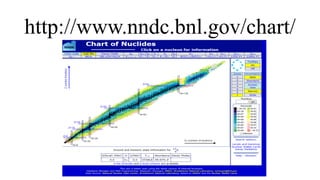
Chart of Nuclides
http://www.nndc.bnl.gov/chart/
C-12
C-12
U-235
U-235
U-235
Alpha Particles
Alpha particles are emitted by
radioactive nuclei and contain two
protons and two neutrons. Alpha
particle emission is represented by
the symbol α .
Beta Particles
Beta particles are emitted by
radioactive nuclei and has a mass
and charge that is identical to an
electron. Beta particle emission is
represented by the symbol β .
Gamma Rays
Gamma rays are emitted by
radioactive nuclei and is a type of
high energy radiation that does not
contain mass or charge. Gamma Ray
Emission is represented by the
symbol γ .
Nonionizing Radiation
Nonionizing radiation is radiation
that does not have a sufficient
amount of energy to remove an
electron from an atom or molecule.
Radiowaves and infrared light are
examples of nonionizing radiation.
Ionizing Radiation
Ionizing radiation is radiation that
has sufficient amount of energy to
remove an electron from an atom or
molecule. X-rays and cosmic rays are
examples of ionizing radiation.
Energy of Radiation
The following sources of radiation are listed
from highest energy to lowest energy .
Highest energy = ultra violet light > visible
light > infrared light = lowest energy
Wave Length
The following sources of radiation are
listed from shortest wave length to
longest wavelength.
Shortest wavelength ultra violet light <
visible light < infrared light longest
wave length
Nuclear Reactions
Fusion
Natural Decay
Fission
Chain Reaction
Fusion
Nuclear reaction between
small atoms to form larger
atoms and release energy.
Fusion
In nuclear fusion: two small nuclei
are merged together to generate a
larger nuclei and a tremendous
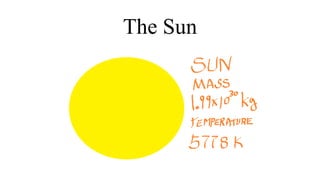
amount of energy. The sun generate
its energy nuclear fusion.
The Sun
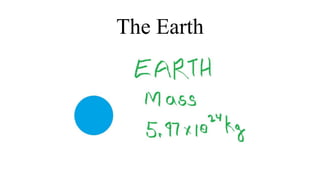
The Earth
Sun Fusion Reactions
Sun Fusion Reaction Overall
Sun Fusion Reaction
Carbon Nitrogen Oxygen Cycle
Natural Decay
Radioactivity
Ability of an isotope to undergo
transformation to another isotope
Natural Decay
Radioactivity
Gives off energy
Disintegration of original isotope
Radioactivity Statistical Analysis
Radioactivity
Gives off energy
Disintegration of original isotope
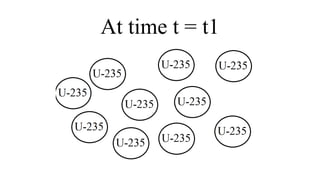
At time t = t1
At time t = t2
Radioactivity Statistical Analysis
D t = time interval
D t = t2 - t1
Radioactivity Statistical Analysis
P = probability that a particular
atom disintegrates in time
interval D t
P = probability
Independent of past history
Independent of present
circumstances
Depends only on D t
Radioactivity Statistical Analysis
D t = time interval is short
Radioactivity Statistical Analysis
P is proportional to D t
P = l Dt
Radioactivity Statistical Analysis
l is a proportionality constant
l is characteristic of the species
of radioactive atom
Probability of atom not
disintegrating
1 – P = (1 - l Dt )
Probability of atom not
disintegrating n intervals
Pn = (1 - l Dt )n
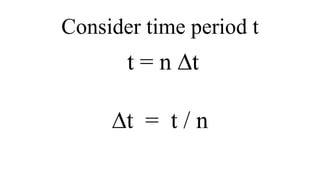
Consider time period t
t = n Dt
Dt = t / n
Substitute for Dt
Pn = (1 - l t / n )n
Take limit n goes to infinity
Pn = lim (1 - l t / n )n
Pn = e -lt
Probability that atom will survive
Pn = e -lt
For large number of atoms No
N / No = e -lt
N = Noe -lt
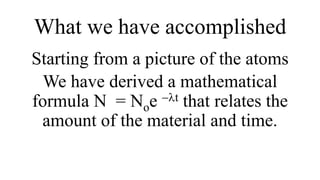
What we have accomplished
Starting from a picture of the atoms
We have derived a mathematical
formula N = Noe -lt that relates the
amount of the material and time.
Carbon Dating
• Radioactive Decay – Carbon Dating - A special sample has an activity
per gram of carbon 14 of 8.76 atoms per minute. The initial activity
from carbon 14 is 15.3 atoms per minute. The half-life of carbon 14 is
5730 year
• (29) Calculate the first order rate constant from the half-life.
• (30) Write the rate equation.
• (31) Solve for time.
• (32) Substitute values and calculate
• (33) The age of the sample in years is _____________________
Carbon Dating
• Radioactive Decay – Carbon Dating - A special sample has an activity
per gram of carbon 14 of 8.76 atoms per minute. The initial activity
from carbon 14 is 15.3 atoms per minute. The half-life of carbon 14 is
5730 year
• (29) Calculate the first order rate constant from the half-life.
• (30) Write the rate equation.
• (31) Solve for time.
• (32) Substitute values and calculate
• (33) The age of the sample in years is _____________________
Nuclear Fission
In nuclear fission: a large
nucleus splits into two smaller
nuclei with the release of a
large amount of energy.
Nuclear Fuel Cycle
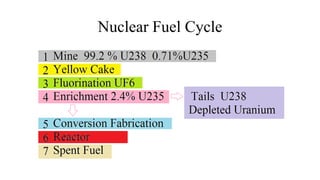
1 Mine 99.2%U238 0.71%U235
2 Yellow Cake
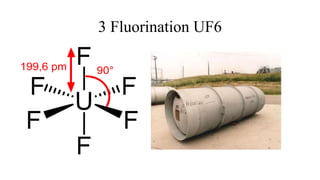
3 Fluorination UF6
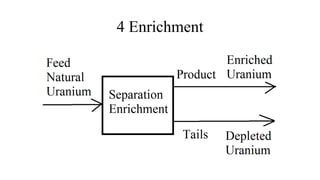
4 Enrichment
4 Enrichment to 2.4%U235
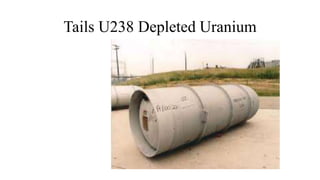
Tails U238 Depleted Uranium
5 Conversion Fabrication
6 Reactor
7 Spent Fuel
Nuclear Fuel Cycle
Thank you for taking the time to watch.
The End
steveboylan11@yahoo.com
__________

Nuclear chemistrylecturetwo006