Dr. Prashant Patil
Professor and Head
Oral Medicine and Radiology
Navodaya Dental College Raichur
Where does the
Radiation come from
???????????
Source
??????????
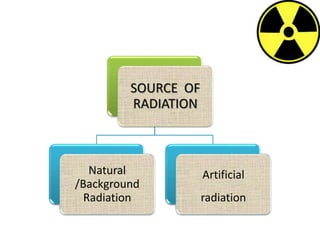
SOURCE OF
RADIATION
Natural
/Background
Radiation
Artificial
radiation
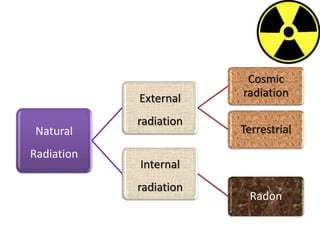
Natural
Radiation
External
radiation
Cosmic
radiation
Terrestrial
Internal
radiation
Radon
Artificial
Radiation
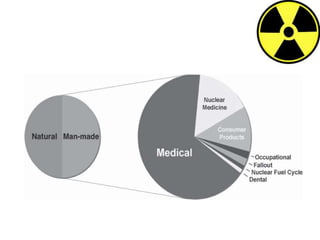
Medical
radiation
Consumer
products
Global contribution of
radiation
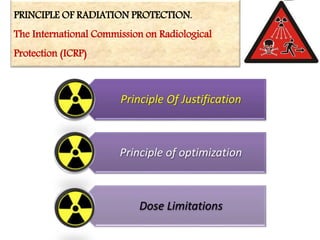
PRINCIPLE OF RADIATION PROTECTION.
The International Commission on Radiological
Protection (ICRP)
Principle Of Justification
Principle of optimization
Dose Limitations
“ALARA”- AS LOW AS REASONABLY ACHIEVABLE
• Dentists should use every means to reduce
unnecessary exposure to their patient and
themselves.
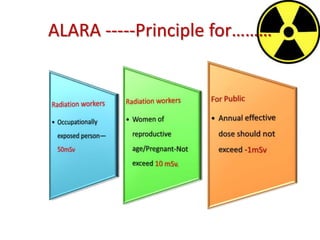
ALARA -----Principle for………
1. Patient selection
2.Conduct of the examination
Conduct of the examination …..
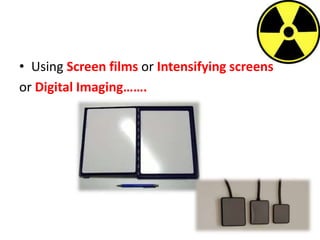
• Selection of Image Receptor---
• Using Screen films or Intensifying screens
or Digital Imaging…….
• Source skin distance[SSD]
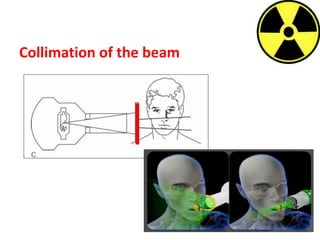
Collimation of the beam
• Filtration
Below 50kVp= 0.3-0.5mm aluminium
Layer
50-70kVp-=1.2—1.5mm
Above 7okVp=2.1-- 4.1mm
• Use of PID’s[ Positioning indicating devices]
• Film holding devices [XCP-Holder]
• Use of Protective barriers
LEAD GLOVES
THYROID COLLAR---
0.2mm-0.5 mm thickness lead
equivalent
LEAD APRON---
1/4THm mm [o.25mm] lead
• Use of Timers
• Use of Proper technique
• Processing of the Image
• Interpretation of the Image
• Position distance rule---
The radiation dose to dentists and their staff can come from:
• ● The primary beam, if they stand in its path
• ● Scattered radiation from the patient
• ● Radiation leakage from the tubehead.
Radiographic equipment Barrier protection
Barriers should contain a leaded glass window to
enable the operator to view the patient during
exposure.
• Walls constructed of gypsum wallboard (drywall or sheet rock)
are adequate for the average dental office.
• Use of------- Rectangular collimator
• Correct film placement and retention
• Adequate protection with a leaded apron.
• Neither the operator nor patient should hold the radiographic
tube housing during the exposure.
• Suspension arms should be adequately maintained to prevent
housing movement and drift.
• Personnel-monitoring devices. Commonly referred to as film
badges.
• TLD [ Thermoluminescent dosimeter]
• This group everyone who is not receiving a radiation
dose either as a patient or as a radiation worker, but who may
be exposed inadvertently.
• Eg-, Someone in a dental surgery waiting room, in other
rooms in the building or passers-by.
• The legal person must ensure that the dose to the
fetus of any pregnant member of staff is unlikely to
exceed 1 mSv during the declared term of the
pregnancy.
• The justification should be reviewed to ensure that only
radiographs that are absolutely necessary are taken,
e.g. delay routine periodic checks.
• The patient should be reassured that a minimal dose is being
employed and
• The patient given the option to delay the radiography.
• Primary beam-------never directed to any other person than
patient.
• Patient position------X-ray beam is aimed at wall not at door.
• Walls-------------------- 3 inch concrete /3X16 inch steel / 1mm
of lead.
• Windows to lead barrier --------not be targeted to primary
beam, lead glass should be used.
• Doors of radiology room should function as secondary
barriers.
• Continuing education------ new information about the
radiation safety issues as well as equipment
development,materials and techniques
RADIATION PROTECTION .pptx

RADIATION PROTECTION .pptx