www.presentationgo.com
GUIDELINES OF
RADIATION
SAFETY IN
DENTISTRY
www.presentationgo.com
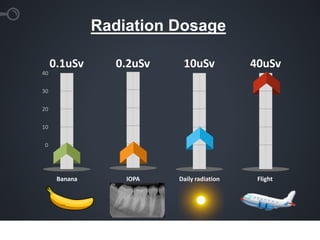
Radiation Dosage
0
10
20
30
40
0.1uSv 0.2uSv 10uSv 40uSv
Banana IOPA Daily radiation Flight
www.presentationgo.com
DENTAL
PERSONNEL
.
PATIENTS
.
PUBLIC
.
Reduce exposure to:
AIM
www.presentationgo.com
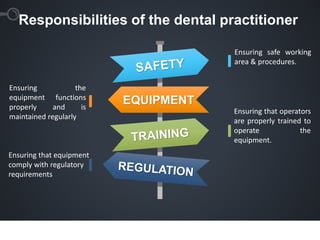
Responsibilities of the dental practitioner
EQUIPMENT
Ensuring safe working
area & procedures.
Ensuring that operators
are properly trained to
operate the
equipment.
Ensuring that equipment
comply with regulatory
requirements
Ensuring the
equipment functions
properly and is
maintained regularly
www.presentationgo.com
Equipment requirements
Panoramic/
Cephalometric
radiograph
Dimension of room :
2.5 m x 3.5 m
Thickness of
shielding at doors
and walls is: 1.5 mm
Pb eq.
Intraoral radiograph
Dimensions of room are: 2.0 x 3.0 m
Thickness of shielding at doors and walls
is: 1.0 mm Pb eq
www.presentationgo.com
Atomic Energy Licensing Act 1984 (Act 304) The Atomic Energy Licensing Act 1984
(Act 304) is an Act to provide for the regulation and control of atomic energy
Under Section 12(1) (b) of Act 304 no person shall deal in, possess or dispose of any
radioactive material, nuclear material, prescribed substance or irradiating
apparatus, unless he is under Section 16(5), the holder of a valid license issued by
the appropriate authority for such purpose and as specified in the license.
Regulations to Act 304
• The Radiation Protection (Licensing) Regulations 19864
• The Atomic Energy Licensing (Basic Safety Radiation Protection) Regulations 2010
• The Radiation Protection (Transport) Regulations 1989.
Ensuring the Dental Radiation Equipment
Comply with Regulatory Requirements
www.presentationgo.com
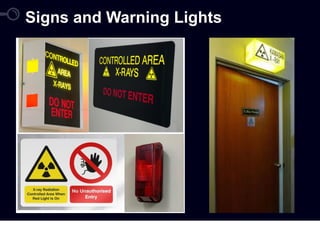
Signs and Warning Lights
www.presentationgo.com
Protection for the Operator
www.presentationgo.com
If a personnel is likely to be exposed to a
radiation dose exceeding 1 mSv in any one
year, or the equivalent of a weekly workload
that exceeds 100 intra-oral/ 50 panoramic
films, it is he/she should be provided with
personal radiation monitoring devices.
Personal Radiation-Monitoring
Devices for Personnel
Film Badge Dosimeter
Thermo-luminescent
Detector Badge
www.presentationgo.com
Lead apron >0.25 mm of lead equivalence
for reproductive organ protection.
Thyroid collars should be provided in
where the thyroid may be in the
primary beam. The use of a thyroid
shield for children is important,
especially during occlusal radiographic
examination.
Protection for the Patient
www.presentationgo.com
Patient Positioning:
The patient’s head and the
primary beam should be aligned
such that the primary beam is
not directed at patient’s
reproductive organs and body.
Female Patient of Child-bearing Age:
Always enquire into the pregnancy status.
www.presentationgo.com
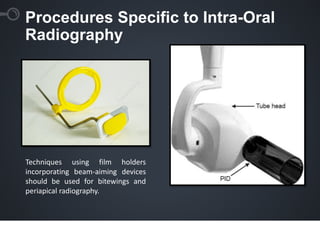
Techniques using film holders
incorporating beam-aiming devices
should be used for bitewings and
periapical radiography.
Procedures Specific to Intra-Oral
Radiography
www.presentationgo.com
Where automatic processing
is used, the processor should
be properly cleaned. In the
case of manual processing,
maintenance should be done
regularly.
Image Receptor, Processor &Viewer
Intra-oral films of ISO
speed group E, or faster,
are preferred.
A specially designed light-box
should be used, in order to
extract full diagnostic
information from the films.
www.presentationgo.com
Ensuring Proper Function and
Maintenance of Equipment
Maintenance and associated checks for intra-oral,
panoramic and cephalometric x-ray apparatus
shall be done once every two years.
An accredited Class H consultant shall possess
Class H license issued by the Director General of
Health Malaysia.
.
Performance Test and safety of the apparatus
must be undertaken by an accredited Class H
Consultant.
www.presentationgo.com
• ALARA principle-
Adequate diagnostic information, while radiation doses are controlled to
be As Low As Reasonably Achievable
• Observe the basic principles of radiation protection that is,
Quality assurance
www.presentationgo.com
Quality assurance
Quality control of equipment operation and baseline performance of
radiographic equipment should be done.
Professional education on
use of x-ray equipment,
hazard of ionising radiation
and radiation safety.
Image quality – monitoring
and analysis of film reject
rate - corrective action
should be taken if the reject
rate is more than 10%
www.presentationgo.com
Establishing Equipment Performance
Following the
manufacturer’s
preventive
maintenance
schedule
Calibration of
equipment
Proper radiation
beam alignment
Inspection and
replacement of
worn or broken
components
Mechanical
and electrical
performance
Technical evaluation of Dental X-Ray Equipment should include the following:
www.presentationgo.com
www.presentationgo
Establishing Equipment Performance
Unexposed film
Unexposed x-ray
films should be
stored in a
container that is
adequately
shielded against
radiation and away
from excessive
heat, or chemical
contamination.
Films
Processing
Equipment
Inspection of
storage tanks,
condition of
processing
equipment and
maintenance
schedule.
Protective Devices
Inspection of protective
devices, including lead
shields, aprons and
thyroid shield.
www.presentationgo.com
Establishing Administrative Procedures
Name of
manufacturer
.
.
2 4
1 3 5
Model number
Year of
manufacture&
installation
Maintenance
records
Serial
number
An up-to-date inventory of each item of x-ray equipment
is important should contain the following details:
www.presentationgo.com
Procedures to minimise radiation
exposure to personnel
1
2
3
4
Dental radiographic equipment must only
be operated by trained personnel
trained personnel
.
The controlled area must not be
used for more than one radiological
investigation at the same time.
Operators must keep as far away
from the primary radiation beam as
possible must use protective
devices.
5
6
7
8
The operation of the x-ray equipment
should be controlled from outside or
behind a protective screen.
.
All persons, except for the patient and those
whose presence are required must leave the
room when a radiographic examination is in
progress.
The dental personnel must not hold the film
in place for the patient during the
procedure.
If parents or personnel are called to assist,
they must be provided with protective
aprons.
All x-ray tube housing must not be held by
hand during operation
www.presentationgo.com
Procedures to minimise radiation
exposure to patients
• Every effort must be made to
avoid unnecessary radiological
examination.
• It should only be for the purpose
of obtaining diagnostic
information about the patient’s
condition.
• Determine whether there have
been previous radiographic
examinations.
www.presentationgo.com
THANK
YOU

RADIATION.pdf

  • 1.
  • 2.
    www.presentationgo.com Radiation Dosage 0 10 20 30 40 0.1uSv 0.2uSv10uSv 40uSv Banana IOPA Daily radiation Flight
  • 3.
  • 4.
    www.presentationgo.com Responsibilities of thedental practitioner EQUIPMENT Ensuring safe working area & procedures. Ensuring that operators are properly trained to operate the equipment. Ensuring that equipment comply with regulatory requirements Ensuring the equipment functions properly and is maintained regularly
  • 5.
    www.presentationgo.com Equipment requirements Panoramic/ Cephalometric radiograph Dimension ofroom : 2.5 m x 3.5 m Thickness of shielding at doors and walls is: 1.5 mm Pb eq. Intraoral radiograph Dimensions of room are: 2.0 x 3.0 m Thickness of shielding at doors and walls is: 1.0 mm Pb eq
  • 6.
    www.presentationgo.com Atomic Energy LicensingAct 1984 (Act 304) The Atomic Energy Licensing Act 1984 (Act 304) is an Act to provide for the regulation and control of atomic energy Under Section 12(1) (b) of Act 304 no person shall deal in, possess or dispose of any radioactive material, nuclear material, prescribed substance or irradiating apparatus, unless he is under Section 16(5), the holder of a valid license issued by the appropriate authority for such purpose and as specified in the license. Regulations to Act 304 • The Radiation Protection (Licensing) Regulations 19864 • The Atomic Energy Licensing (Basic Safety Radiation Protection) Regulations 2010 • The Radiation Protection (Transport) Regulations 1989. Ensuring the Dental Radiation Equipment Comply with Regulatory Requirements
  • 7.
  • 8.
  • 9.
    www.presentationgo.com If a personnelis likely to be exposed to a radiation dose exceeding 1 mSv in any one year, or the equivalent of a weekly workload that exceeds 100 intra-oral/ 50 panoramic films, it is he/she should be provided with personal radiation monitoring devices. Personal Radiation-Monitoring Devices for Personnel Film Badge Dosimeter Thermo-luminescent Detector Badge
  • 10.
    www.presentationgo.com Lead apron >0.25mm of lead equivalence for reproductive organ protection. Thyroid collars should be provided in where the thyroid may be in the primary beam. The use of a thyroid shield for children is important, especially during occlusal radiographic examination. Protection for the Patient
  • 11.
    www.presentationgo.com Patient Positioning: The patient’shead and the primary beam should be aligned such that the primary beam is not directed at patient’s reproductive organs and body. Female Patient of Child-bearing Age: Always enquire into the pregnancy status.
  • 12.
    www.presentationgo.com Techniques using filmholders incorporating beam-aiming devices should be used for bitewings and periapical radiography. Procedures Specific to Intra-Oral Radiography
  • 13.
    www.presentationgo.com Where automatic processing isused, the processor should be properly cleaned. In the case of manual processing, maintenance should be done regularly. Image Receptor, Processor &Viewer Intra-oral films of ISO speed group E, or faster, are preferred. A specially designed light-box should be used, in order to extract full diagnostic information from the films.
  • 14.
    www.presentationgo.com Ensuring Proper Functionand Maintenance of Equipment Maintenance and associated checks for intra-oral, panoramic and cephalometric x-ray apparatus shall be done once every two years. An accredited Class H consultant shall possess Class H license issued by the Director General of Health Malaysia. . Performance Test and safety of the apparatus must be undertaken by an accredited Class H Consultant.
  • 15.
    www.presentationgo.com • ALARA principle- Adequatediagnostic information, while radiation doses are controlled to be As Low As Reasonably Achievable • Observe the basic principles of radiation protection that is, Quality assurance
  • 16.
    www.presentationgo.com Quality assurance Quality controlof equipment operation and baseline performance of radiographic equipment should be done. Professional education on use of x-ray equipment, hazard of ionising radiation and radiation safety. Image quality – monitoring and analysis of film reject rate - corrective action should be taken if the reject rate is more than 10%
  • 17.
    www.presentationgo.com Establishing Equipment Performance Followingthe manufacturer’s preventive maintenance schedule Calibration of equipment Proper radiation beam alignment Inspection and replacement of worn or broken components Mechanical and electrical performance Technical evaluation of Dental X-Ray Equipment should include the following:
  • 18.
    www.presentationgo.com www.presentationgo Establishing Equipment Performance Unexposedfilm Unexposed x-ray films should be stored in a container that is adequately shielded against radiation and away from excessive heat, or chemical contamination. Films Processing Equipment Inspection of storage tanks, condition of processing equipment and maintenance schedule. Protective Devices Inspection of protective devices, including lead shields, aprons and thyroid shield.
  • 19.
    www.presentationgo.com Establishing Administrative Procedures Nameof manufacturer . . 2 4 1 3 5 Model number Year of manufacture& installation Maintenance records Serial number An up-to-date inventory of each item of x-ray equipment is important should contain the following details:
  • 20.
    www.presentationgo.com Procedures to minimiseradiation exposure to personnel 1 2 3 4 Dental radiographic equipment must only be operated by trained personnel trained personnel . The controlled area must not be used for more than one radiological investigation at the same time. Operators must keep as far away from the primary radiation beam as possible must use protective devices. 5 6 7 8 The operation of the x-ray equipment should be controlled from outside or behind a protective screen. . All persons, except for the patient and those whose presence are required must leave the room when a radiographic examination is in progress. The dental personnel must not hold the film in place for the patient during the procedure. If parents or personnel are called to assist, they must be provided with protective aprons. All x-ray tube housing must not be held by hand during operation
  • 21.
    www.presentationgo.com Procedures to minimiseradiation exposure to patients • Every effort must be made to avoid unnecessary radiological examination. • It should only be for the purpose of obtaining diagnostic information about the patient’s condition. • Determine whether there have been previous radiographic examinations.
  • 22.