Chapter 2
HEAT CONDUCTION
EQUATION
Abdul moiz Dota
Dept.Food Engineering
University of Agriculture Faisalabad
Copyright © 2011 The McGraw-Hill Companies, Inc. Permission required for reproduction or display.
Heat and Mass Transfer: Fundamentals & Applications
Fourth Edition
Yunus A. Cengel, Afshin J. Ghajar
McGraw-Hill, 2011
2
Objectives
• Understand multidimensionality and time dependence of heat transfer,
and the conditions under which a heat transfer problem can be
approximated as being one-dimensional.
• Obtain the differential equation of heat conduction in various
coordinate systems, and simplify it for steady one-dimensional case.
• Identify the thermal conditions on surfaces, and express them
mathematically as boundary and initial conditions.
• Solve one-dimensional heat conduction problems and obtain the
temperature distributions within a medium and the heat flux.
• Analyze one-dimensional heat conduction in solids that involve heat
generation.
• Evaluate heat conduction in solids with temperature-dependent
thermal conductivity.
3
INTRODUCTION
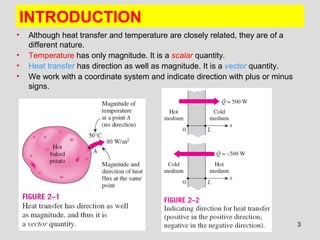
• Although heat transfer and temperature are closely related, they are of a
different nature.
• Temperature has only magnitude. It is a scalar quantity.
• Heat transfer has direction as well as magnitude. It is a vector quantity.
• We work with a coordinate system and indicate direction with plus or minus
signs.
4
• The driving force for any form of heat transfer is the temperature
difference.
• The larger the temperature difference, the larger the rate of heat
transfer.
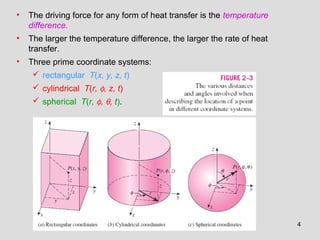
• Three prime coordinate systems:
 rectangular T(x, y, z, t)
 cylindrical T(r, φ, z, t)
 spherical T(r, φ, θ, t).
5
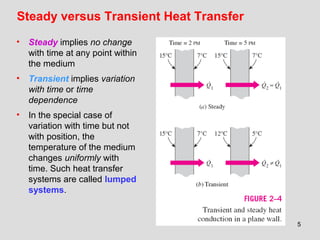
• Steady implies no change
with time at any point within
the medium
• Transient implies variation
with time or time
dependence
• In the special case of
variation with time but not
with position, the
temperature of the medium
changes uniformly with
time. Such heat transfer
systems are called lumped
systems.
Steady versus Transient Heat Transfer
6
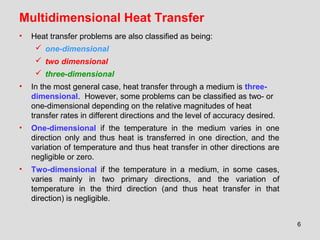
Multidimensional Heat Transfer
• Heat transfer problems are also classified as being:
 one-dimensional
 two dimensional
 three-dimensional
• In the most general case, heat transfer through a medium is three-
dimensional. However, some problems can be classified as two- or
one-dimensional depending on the relative magnitudes of heat
transfer rates in different directions and the level of accuracy desired.
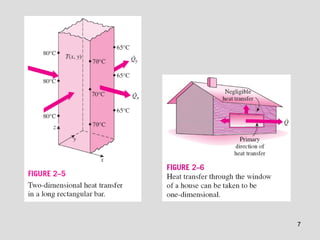
• One-dimensional if the temperature in the medium varies in one
direction only and thus heat is transferred in one direction, and the
variation of temperature and thus heat transfer in other directions are
negligible or zero.
• Two-dimensional if the temperature in a medium, in some cases,
varies mainly in two primary directions, and the variation of
temperature in the third direction (and thus heat transfer in that
direction) is negligible.
7
8
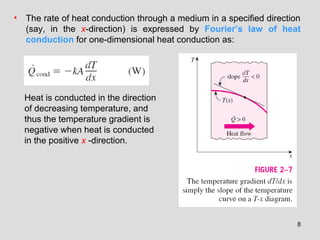
• The rate of heat conduction through a medium in a specified direction
(say, in the x-direction) is expressed by Fourier’s law of heat
conduction for one-dimensional heat conduction as:
Heat is conducted in the direction
of decreasing temperature, and
thus the temperature gradient is
negative when heat is conducted
in the positive x -direction.
9
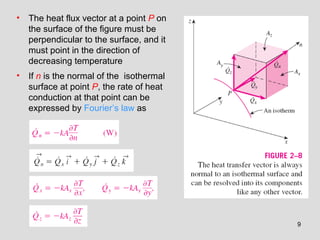
• The heat flux vector at a point P on
the surface of the figure must be
perpendicular to the surface, and it
must point in the direction of
decreasing temperature
• If n is the normal of the isothermal
surface at point P, the rate of heat
conduction at that point can be
expressed by Fourier’s law as
10
Heat
Generation
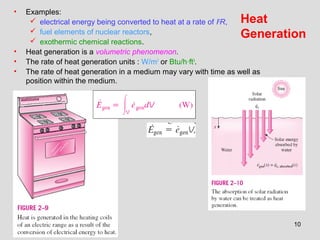
• Examples:
 electrical energy being converted to heat at a rate of I2
R,
 fuel elements of nuclear reactors,
 exothermic chemical reactions.
• Heat generation is a volumetric phenomenon.
• The rate of heat generation units : W/m3
or Btu/h·ft3
.
• The rate of heat generation in a medium may vary with time as well as
position within the medium.
11
ONE-DIMENSIONAL HEAT CONDUCTION
EQUATION
Consider heat conduction through a large plane wall such as the wall of a
house, the glass of a single pane window, the metal plate at the bottom of
a pressing iron, a cast-iron steam pipe, a cylindrical nuclear fuel element,
an electrical resistance wire, the wall of a spherical container, or a
spherical metal ball that is being quenched or tempered.
Heat conduction in these and many other geometries can be
approximated as being one-dimensional since heat conduction through
these geometries is dominant in one direction and negligible in other
directions.
Next we develop the onedimensional heat conduction equation in
rectangular, cylindrical, and spherical coordinates.
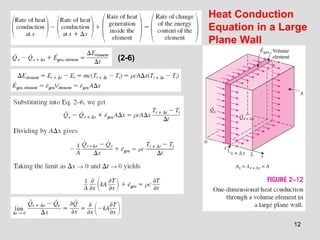
12
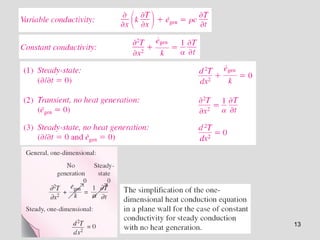
(2-6)
Heat Conduction
Equation in a Large
Plane Wall
13
14
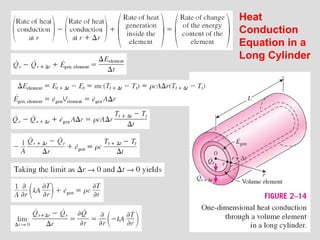
Heat
Conduction
Equation in a
Long Cylinder
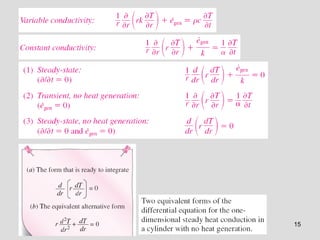
15
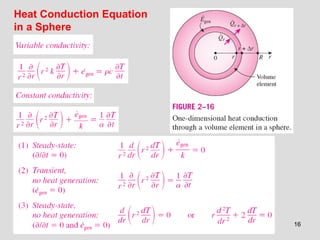
16
Heat Conduction Equation
in a Sphere
17
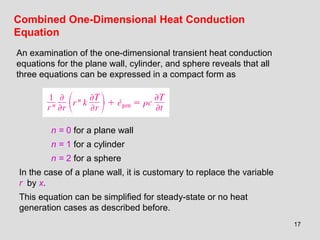
Combined One-Dimensional Heat Conduction
Equation
An examination of the one-dimensional transient heat conduction
equations for the plane wall, cylinder, and sphere reveals that all
three equations can be expressed in a compact form as
n = 0 for a plane wall
n = 1 for a cylinder
n = 2 for a sphere
In the case of a plane wall, it is customary to replace the variable
r by x.
This equation can be simplified for steady-state or no heat
generation cases as described before.
18
GENERAL HEAT CONDUCTION EQUATION
In the last section we considered one-dimensional heat conduction
and assumed heat conduction in other directions to be negligible.
Most heat transfer problems encountered in practice can be
approximated as being one-dimensional, and we mostly deal with
such problems in this text.
However, this is not always the case, and sometimes we need to
consider heat transfer in other directions as well.
In such cases heat conduction is said to be multidimensional, and
in this section we develop the governing differential equation in
such systems in rectangular, cylindrical, and spherical coordinate
systems.
19
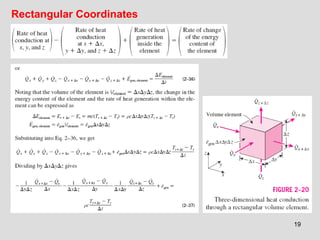
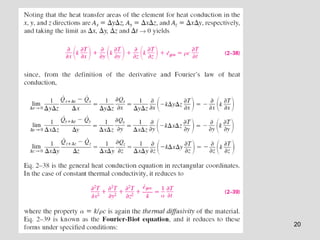
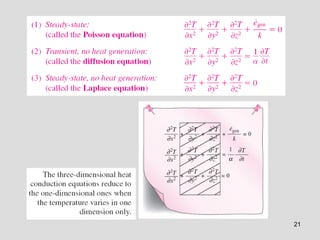
Rectangular Coordinates
20
21
22
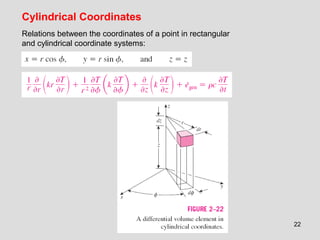
Cylindrical Coordinates
Relations between the coordinates of a point in rectangular
and cylindrical coordinate systems:
23
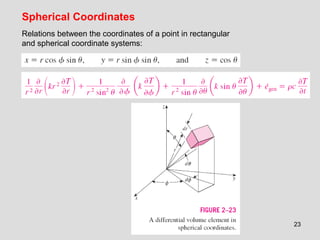
Spherical Coordinates
Relations between the coordinates of a point in rectangular
and spherical coordinate systems:
24
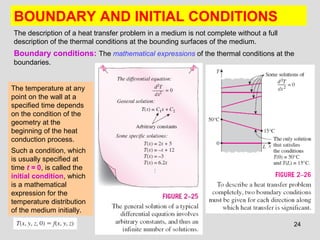
BOUNDARY AND INITIAL CONDITIONS
The description of a heat transfer problem in a medium is not complete without a full
description of the thermal conditions at the bounding surfaces of the medium.
Boundary conditions: The mathematical expressions of the thermal conditions at the
boundaries.
The temperature at any
point on the wall at a
specified time depends
on the condition of the
geometry at the
beginning of the heat
conduction process.
Such a condition, which
is usually specified at
time t = 0, is called the
initial condition, which
is a mathematical
expression for the
temperature distribution
of the medium initially.
25
• Specified Temperature Boundary Condition
• Specified Heat Flux Boundary Condition
• Convection Boundary Condition
• Radiation Boundary Condition
• Interface Boundary Conditions
• Generalized Boundary Conditions
Boundary Conditions
26
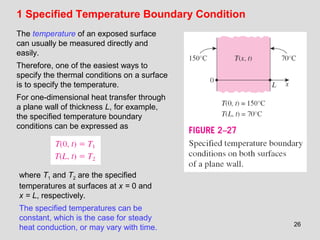
1 Specified Temperature Boundary Condition
The temperature of an exposed surface
can usually be measured directly and
easily.
Therefore, one of the easiest ways to
specify the thermal conditions on a surface
is to specify the temperature.
For one-dimensional heat transfer through
a plane wall of thickness L, for example,
the specified temperature boundary
conditions can be expressed as
where T1 and T2 are the specified
temperatures at surfaces at x = 0 and
x = L, respectively.
The specified temperatures can be
constant, which is the case for steady
heat conduction, or may vary with time.
27
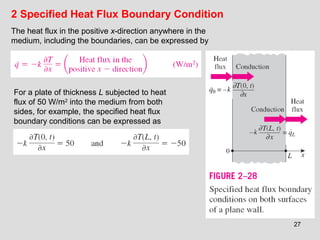
2 Specified Heat Flux Boundary Condition
For a plate of thickness L subjected to heat
flux of 50 W/m2
into the medium from both
sides, for example, the specified heat flux
boundary conditions can be expressed as
The heat flux in the positive x-direction anywhere in the
medium, including the boundaries, can be expressed by
28
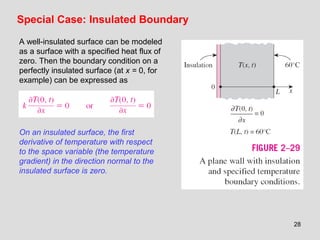
Special Case: Insulated Boundary
A well-insulated surface can be modeled
as a surface with a specified heat flux of
zero. Then the boundary condition on a
perfectly insulated surface (at x = 0, for
example) can be expressed as
On an insulated surface, the first
derivative of temperature with respect
to the space variable (the temperature
gradient) in the direction normal to the
insulated surface is zero.
29
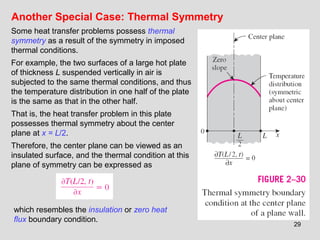
Another Special Case: Thermal Symmetry
Some heat transfer problems possess thermal
symmetry as a result of the symmetry in imposed
thermal conditions.
For example, the two surfaces of a large hot plate
of thickness L suspended vertically in air is
subjected to the same thermal conditions, and thus
the temperature distribution in one half of the plate
is the same as that in the other half.
That is, the heat transfer problem in this plate
possesses thermal symmetry about the center
plane at x = L/2.
Therefore, the center plane can be viewed as an
insulated surface, and the thermal condition at this
plane of symmetry can be expressed as
which resembles the insulation or zero heat
flux boundary condition.
30
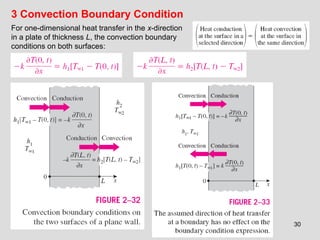
3 Convection Boundary Condition
For one-dimensional heat transfer in the x-direction
in a plate of thickness L, the convection boundary
conditions on both surfaces:
31
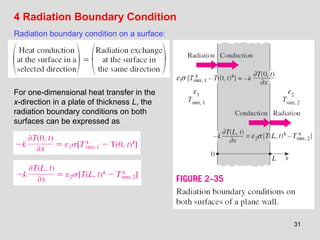
4 Radiation Boundary Condition
For one-dimensional heat transfer in the
x-direction in a plate of thickness L, the
radiation boundary conditions on both
surfaces can be expressed as
Radiation boundary condition on a surface:
32
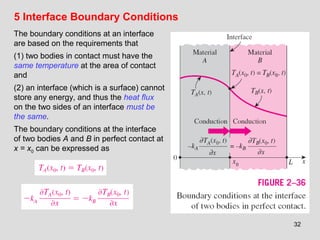
5 Interface Boundary Conditions
The boundary conditions at an interface
are based on the requirements that
(1) two bodies in contact must have the
same temperature at the area of contact
and
(2) an interface (which is a surface) cannot
store any energy, and thus the heat flux
on the two sides of an interface must be
the same.
The boundary conditions at the interface
of two bodies A and B in perfect contact at
x = x0 can be expressed as
33
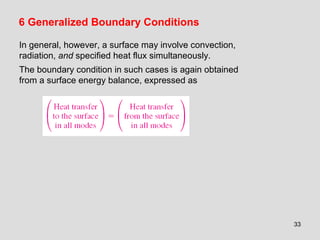
6 Generalized Boundary Conditions
In general, however, a surface may involve convection,
radiation, and specified heat flux simultaneously.
The boundary condition in such cases is again obtained
from a surface energy balance, expressed as
34
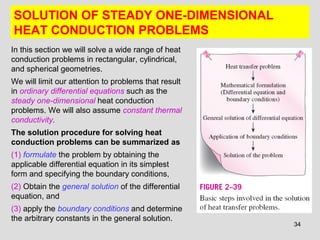
SOLUTION OF STEADY ONE-DIMENSIONAL
HEAT CONDUCTION PROBLEMS
In this section we will solve a wide range of heat
conduction problems in rectangular, cylindrical,
and spherical geometries.
We will limit our attention to problems that result
in ordinary differential equations such as the
steady one-dimensional heat conduction
problems. We will also assume constant thermal
conductivity.
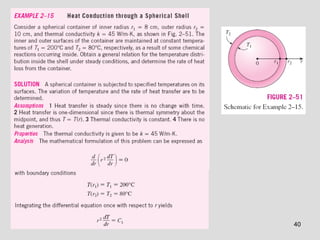
The solution procedure for solving heat
conduction problems can be summarized as
(1) formulate the problem by obtaining the
applicable differential equation in its simplest
form and specifying the boundary conditions,
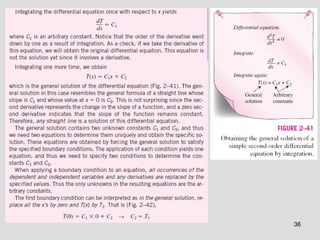
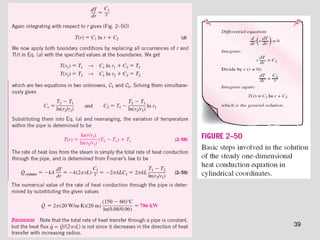
(2) Obtain the general solution of the differential
equation, and
(3) apply the boundary conditions and determine
the arbitrary constants in the general solution.
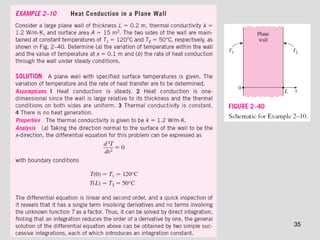
35
36
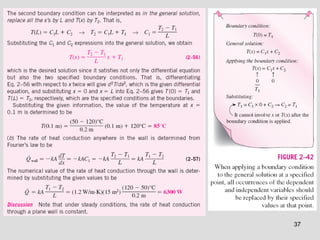
37
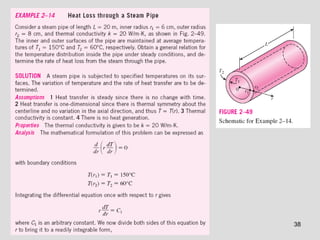
38
39
40
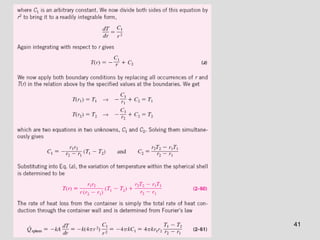
41
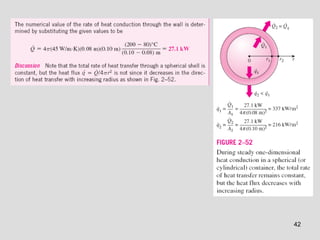
42
43
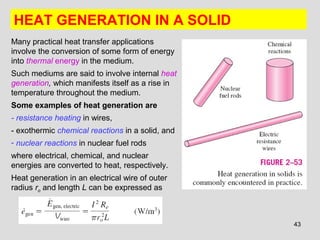
HEAT GENERATION IN A SOLID
Many practical heat transfer applications
involve the conversion of some form of energy
into thermal energy in the medium.
Such mediums are said to involve internal heat
generation, which manifests itself as a rise in
temperature throughout the medium.
Some examples of heat generation are
- resistance heating in wires,
- exothermic chemical reactions in a solid, and
- nuclear reactions in nuclear fuel rods
where electrical, chemical, and nuclear
energies are converted to heat, respectively.
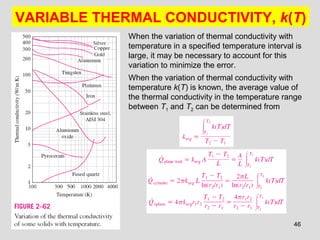
Heat generation in an electrical wire of outer
radius ro and length L can be expressed as
44
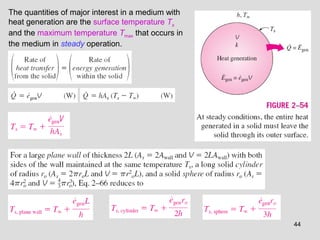
The quantities of major interest in a medium with
heat generation are the surface temperature Ts
and the maximum temperature Tmax that occurs in
the medium in steady operation.
45
46
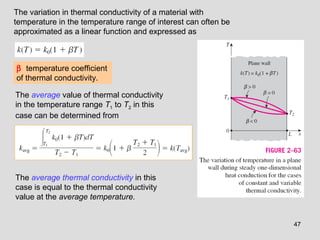
VARIABLE THERMAL CONDUCTIVITY, k(T)
When the variation of thermal conductivity with
temperature in a specified temperature interval is
large, it may be necessary to account for this
variation to minimize the error.
When the variation of thermal conductivity with
temperature k(T) is known, the average value of
the thermal conductivity in the temperature range
between T1 and T2 can be determined from
47
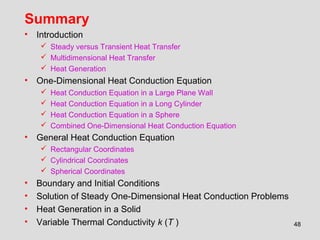
β temperature coefficient
of thermal conductivity.
The average value of thermal conductivity
in the temperature range T1 to T2 in this
case can be determined from
The average thermal conductivity in this
case is equal to the thermal conductivity
value at the average temperature.
The variation in thermal conductivity of a material with
temperature in the temperature range of interest can often be
approximated as a linear function and expressed as
48
Summary
• Introduction
 Steady versus Transient Heat Transfer
 Multidimensional Heat Transfer
 Heat Generation
• One-Dimensional Heat Conduction Equation
 Heat Conduction Equation in a Large Plane Wall
 Heat Conduction Equation in a Long Cylinder
 Heat Conduction Equation in a Sphere
 Combined One-Dimensional Heat Conduction Equation
• General Heat Conduction Equation
 Rectangular Coordinates
 Cylindrical Coordinates
 Spherical Coordinates
• Boundary and Initial Conditions
• Solution of Steady One-Dimensional Heat Conduction Problems
• Heat Generation in a Solid
• Variable Thermal Conductivity k (T )

Chapter 2 HEAT CONDUCTION EQUATION

  • 1.
    Chapter 2 HEAT CONDUCTION EQUATION Abdulmoiz Dota Dept.Food Engineering University of Agriculture Faisalabad Copyright © 2011 The McGraw-Hill Companies, Inc. Permission required for reproduction or display. Heat and Mass Transfer: Fundamentals & Applications Fourth Edition Yunus A. Cengel, Afshin J. Ghajar McGraw-Hill, 2011
  • 2.
    2 Objectives • Understand multidimensionalityand time dependence of heat transfer, and the conditions under which a heat transfer problem can be approximated as being one-dimensional. • Obtain the differential equation of heat conduction in various coordinate systems, and simplify it for steady one-dimensional case. • Identify the thermal conditions on surfaces, and express them mathematically as boundary and initial conditions. • Solve one-dimensional heat conduction problems and obtain the temperature distributions within a medium and the heat flux. • Analyze one-dimensional heat conduction in solids that involve heat generation. • Evaluate heat conduction in solids with temperature-dependent thermal conductivity.
  • 3.
    3 INTRODUCTION • Although heattransfer and temperature are closely related, they are of a different nature. • Temperature has only magnitude. It is a scalar quantity. • Heat transfer has direction as well as magnitude. It is a vector quantity. • We work with a coordinate system and indicate direction with plus or minus signs.
  • 4.
    4 • The drivingforce for any form of heat transfer is the temperature difference. • The larger the temperature difference, the larger the rate of heat transfer. • Three prime coordinate systems:  rectangular T(x, y, z, t)  cylindrical T(r, φ, z, t)  spherical T(r, φ, θ, t).
  • 5.
    5 • Steady impliesno change with time at any point within the medium • Transient implies variation with time or time dependence • In the special case of variation with time but not with position, the temperature of the medium changes uniformly with time. Such heat transfer systems are called lumped systems. Steady versus Transient Heat Transfer
  • 6.
    6 Multidimensional Heat Transfer •Heat transfer problems are also classified as being:  one-dimensional  two dimensional  three-dimensional • In the most general case, heat transfer through a medium is three- dimensional. However, some problems can be classified as two- or one-dimensional depending on the relative magnitudes of heat transfer rates in different directions and the level of accuracy desired. • One-dimensional if the temperature in the medium varies in one direction only and thus heat is transferred in one direction, and the variation of temperature and thus heat transfer in other directions are negligible or zero. • Two-dimensional if the temperature in a medium, in some cases, varies mainly in two primary directions, and the variation of temperature in the third direction (and thus heat transfer in that direction) is negligible.
  • 7.
  • 8.
    8 • The rateof heat conduction through a medium in a specified direction (say, in the x-direction) is expressed by Fourier’s law of heat conduction for one-dimensional heat conduction as: Heat is conducted in the direction of decreasing temperature, and thus the temperature gradient is negative when heat is conducted in the positive x -direction.
  • 9.
    9 • The heatflux vector at a point P on the surface of the figure must be perpendicular to the surface, and it must point in the direction of decreasing temperature • If n is the normal of the isothermal surface at point P, the rate of heat conduction at that point can be expressed by Fourier’s law as
  • 10.
    10 Heat Generation • Examples:  electricalenergy being converted to heat at a rate of I2 R,  fuel elements of nuclear reactors,  exothermic chemical reactions. • Heat generation is a volumetric phenomenon. • The rate of heat generation units : W/m3 or Btu/h·ft3 . • The rate of heat generation in a medium may vary with time as well as position within the medium.
  • 11.
    11 ONE-DIMENSIONAL HEAT CONDUCTION EQUATION Considerheat conduction through a large plane wall such as the wall of a house, the glass of a single pane window, the metal plate at the bottom of a pressing iron, a cast-iron steam pipe, a cylindrical nuclear fuel element, an electrical resistance wire, the wall of a spherical container, or a spherical metal ball that is being quenched or tempered. Heat conduction in these and many other geometries can be approximated as being one-dimensional since heat conduction through these geometries is dominant in one direction and negligible in other directions. Next we develop the onedimensional heat conduction equation in rectangular, cylindrical, and spherical coordinates.
  • 12.
  • 13.
  • 14.
  • 15.
  • 16.
  • 17.
    17 Combined One-Dimensional HeatConduction Equation An examination of the one-dimensional transient heat conduction equations for the plane wall, cylinder, and sphere reveals that all three equations can be expressed in a compact form as n = 0 for a plane wall n = 1 for a cylinder n = 2 for a sphere In the case of a plane wall, it is customary to replace the variable r by x. This equation can be simplified for steady-state or no heat generation cases as described before.
  • 18.
    18 GENERAL HEAT CONDUCTIONEQUATION In the last section we considered one-dimensional heat conduction and assumed heat conduction in other directions to be negligible. Most heat transfer problems encountered in practice can be approximated as being one-dimensional, and we mostly deal with such problems in this text. However, this is not always the case, and sometimes we need to consider heat transfer in other directions as well. In such cases heat conduction is said to be multidimensional, and in this section we develop the governing differential equation in such systems in rectangular, cylindrical, and spherical coordinate systems.
  • 19.
  • 20.
  • 21.
  • 22.
    22 Cylindrical Coordinates Relations betweenthe coordinates of a point in rectangular and cylindrical coordinate systems:
  • 23.
    23 Spherical Coordinates Relations betweenthe coordinates of a point in rectangular and spherical coordinate systems:
  • 24.
    24 BOUNDARY AND INITIALCONDITIONS The description of a heat transfer problem in a medium is not complete without a full description of the thermal conditions at the bounding surfaces of the medium. Boundary conditions: The mathematical expressions of the thermal conditions at the boundaries. The temperature at any point on the wall at a specified time depends on the condition of the geometry at the beginning of the heat conduction process. Such a condition, which is usually specified at time t = 0, is called the initial condition, which is a mathematical expression for the temperature distribution of the medium initially.
  • 25.
    25 • Specified TemperatureBoundary Condition • Specified Heat Flux Boundary Condition • Convection Boundary Condition • Radiation Boundary Condition • Interface Boundary Conditions • Generalized Boundary Conditions Boundary Conditions
  • 26.
    26 1 Specified TemperatureBoundary Condition The temperature of an exposed surface can usually be measured directly and easily. Therefore, one of the easiest ways to specify the thermal conditions on a surface is to specify the temperature. For one-dimensional heat transfer through a plane wall of thickness L, for example, the specified temperature boundary conditions can be expressed as where T1 and T2 are the specified temperatures at surfaces at x = 0 and x = L, respectively. The specified temperatures can be constant, which is the case for steady heat conduction, or may vary with time.
  • 27.
    27 2 Specified HeatFlux Boundary Condition For a plate of thickness L subjected to heat flux of 50 W/m2 into the medium from both sides, for example, the specified heat flux boundary conditions can be expressed as The heat flux in the positive x-direction anywhere in the medium, including the boundaries, can be expressed by
  • 28.
    28 Special Case: InsulatedBoundary A well-insulated surface can be modeled as a surface with a specified heat flux of zero. Then the boundary condition on a perfectly insulated surface (at x = 0, for example) can be expressed as On an insulated surface, the first derivative of temperature with respect to the space variable (the temperature gradient) in the direction normal to the insulated surface is zero.
  • 29.
    29 Another Special Case:Thermal Symmetry Some heat transfer problems possess thermal symmetry as a result of the symmetry in imposed thermal conditions. For example, the two surfaces of a large hot plate of thickness L suspended vertically in air is subjected to the same thermal conditions, and thus the temperature distribution in one half of the plate is the same as that in the other half. That is, the heat transfer problem in this plate possesses thermal symmetry about the center plane at x = L/2. Therefore, the center plane can be viewed as an insulated surface, and the thermal condition at this plane of symmetry can be expressed as which resembles the insulation or zero heat flux boundary condition.
  • 30.
    30 3 Convection BoundaryCondition For one-dimensional heat transfer in the x-direction in a plate of thickness L, the convection boundary conditions on both surfaces:
  • 31.
    31 4 Radiation BoundaryCondition For one-dimensional heat transfer in the x-direction in a plate of thickness L, the radiation boundary conditions on both surfaces can be expressed as Radiation boundary condition on a surface:
  • 32.
    32 5 Interface BoundaryConditions The boundary conditions at an interface are based on the requirements that (1) two bodies in contact must have the same temperature at the area of contact and (2) an interface (which is a surface) cannot store any energy, and thus the heat flux on the two sides of an interface must be the same. The boundary conditions at the interface of two bodies A and B in perfect contact at x = x0 can be expressed as
  • 33.
    33 6 Generalized BoundaryConditions In general, however, a surface may involve convection, radiation, and specified heat flux simultaneously. The boundary condition in such cases is again obtained from a surface energy balance, expressed as
  • 34.
    34 SOLUTION OF STEADYONE-DIMENSIONAL HEAT CONDUCTION PROBLEMS In this section we will solve a wide range of heat conduction problems in rectangular, cylindrical, and spherical geometries. We will limit our attention to problems that result in ordinary differential equations such as the steady one-dimensional heat conduction problems. We will also assume constant thermal conductivity. The solution procedure for solving heat conduction problems can be summarized as (1) formulate the problem by obtaining the applicable differential equation in its simplest form and specifying the boundary conditions, (2) Obtain the general solution of the differential equation, and (3) apply the boundary conditions and determine the arbitrary constants in the general solution.
  • 35.
  • 36.
  • 37.
  • 38.
  • 39.
  • 40.
  • 41.
  • 42.
  • 43.
    43 HEAT GENERATION INA SOLID Many practical heat transfer applications involve the conversion of some form of energy into thermal energy in the medium. Such mediums are said to involve internal heat generation, which manifests itself as a rise in temperature throughout the medium. Some examples of heat generation are - resistance heating in wires, - exothermic chemical reactions in a solid, and - nuclear reactions in nuclear fuel rods where electrical, chemical, and nuclear energies are converted to heat, respectively. Heat generation in an electrical wire of outer radius ro and length L can be expressed as
  • 44.
    44 The quantities ofmajor interest in a medium with heat generation are the surface temperature Ts and the maximum temperature Tmax that occurs in the medium in steady operation.
  • 45.
  • 46.
    46 VARIABLE THERMAL CONDUCTIVITY,k(T) When the variation of thermal conductivity with temperature in a specified temperature interval is large, it may be necessary to account for this variation to minimize the error. When the variation of thermal conductivity with temperature k(T) is known, the average value of the thermal conductivity in the temperature range between T1 and T2 can be determined from
  • 47.
    47 β temperature coefficient ofthermal conductivity. The average value of thermal conductivity in the temperature range T1 to T2 in this case can be determined from The average thermal conductivity in this case is equal to the thermal conductivity value at the average temperature. The variation in thermal conductivity of a material with temperature in the temperature range of interest can often be approximated as a linear function and expressed as
  • 48.
    48 Summary • Introduction  Steadyversus Transient Heat Transfer  Multidimensional Heat Transfer  Heat Generation • One-Dimensional Heat Conduction Equation  Heat Conduction Equation in a Large Plane Wall  Heat Conduction Equation in a Long Cylinder  Heat Conduction Equation in a Sphere  Combined One-Dimensional Heat Conduction Equation • General Heat Conduction Equation  Rectangular Coordinates  Cylindrical Coordinates  Spherical Coordinates • Boundary and Initial Conditions • Solution of Steady One-Dimensional Heat Conduction Problems • Heat Generation in a Solid • Variable Thermal Conductivity k (T )