Space Travel
 The intangible desire to explore and challenge the boundaries of what we
know and where we have been has provided benefits to the society for
centuries.
 Human space exploration helps to address fundamental questions about
our place in the universe and the history of solar system and the
everlasting question.
Are we alone?
 Through addressing the challenges related to human space exploration we
expand technology , create new industries and help to foster a peaceful
connection with other nations.
 Curiosity , exploration and accepting the challenge of deep space will invite
the citizens of the world today and tomorrow to join hands for a new era.
 The early era on space exploration was by Soviet Union and United States
of America. From 1990 onwards space tourism was also developed.
 Today the history of space exploration is seeing new horizons with space
tourism, which has also been promoted by the USA in which common
people are sent to space as a tourist.
 Not all can afford it as it is a very expensive program.
 An achievement in the history of USA was in this very year when the
Pioneer 4 was launched and which fell on the orbit of the sun making it the
first Sun mission from USA, a first in the space exploration timeline of the
country.
 The first person to fly in space was Alan Shepard in 1961 who belongs to
the United States of America.
 Commander Rakesh Sharma, AC, Hero of the Soviet Union is a former
Indian Air Force test pilot who flew aboard Soyuz T-11 as part of
the Intercosmos programme that made him the first Indian to travel in
space.He found that weightlessness can be achieved in space through
Yogasanas.
 Again in the 1961, that USSR launched a manned space craft Vostok 1. Yuri
A Gargarin became the first man in the history of space exploration to be
launched into space, orbiting the Earth once.
 The entire 1960s saw a large number of cosmonauts on board the space
flights and all were sent with a particular mission to be fulfilled.
 It was in last quarter of 1957 that man first send spaceship to orbit the
earth. The project was carried out by the USS. In fact both the Sputnik 1
and 2 were sent into space, the latter one carrying the dog Laika.
 It stayed in orbit for about 7 days. Both these space ships were in orbit till
the beginning of 1958 which paved the way for the space exploration
timeline to begin in a big way.
 It was in the year 1958 that the NASA was founded. The third by USA, the
Vanguard 1 was a successful mission and the satellite continued its orbit
for three years,the first two missions being Explorer 1 and 2.
 The Luna 1, Luna 2 and Luna 3 were all ‘destination moon’ missions which
were very successful in making a landing on the moon as well as taking
photographs of it.
 Mars, Moon etc are the prime contenders for human invasion and
expedition for life other than earth. The advancement in the space
technology has been the prime criterion for this ascent reached by man in
space expedition.
 Now many growing countries like China, India, France, and Germany have
launched space programs that can further develop this space technology
to the next level.
 Henceforth history of space exploration will reach new heights with
human invasion in other planets are prone to happen in the years to
come and man spending his life in Mars or Moon is a possibility in the near
future.
 The ISECG is a voluntary, non-binding international coordination
mechanism through which individual agencies may exchange information
regarding interests, objectives, and plans in space exploration with the goal
of strengthening both individual exploration programs as well as the
collective effort.
 ISECG was established in response to "The Global Exploration Strategy:The
Framework for Coordination," developed by fourteen space agencies and
released in May 2007.
 This GES Framework Document articulated a shared vision of coordinated
human and robotic space exploration focused on Solar System destinations
where humans may one day live and work.
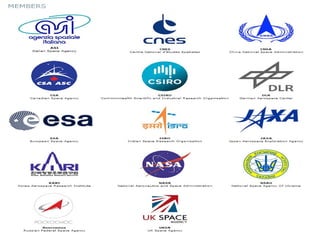
The following space agencies are ISECG members (in alphabetical order):
ASI (Italy)
CNES (France)
CNSA (China)
CSA (Canada)
CSIRO (Australia)
DLR (Germany)
ESA (European Space Agency)
ISRO (India)
JAXA (Japan)
KARI (Republic of Korea)
NASA (United States of America)
NSAU (Ukraine)
Roscosmos (Russia)
UKSA (United Kingdom)
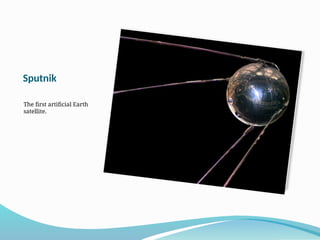
Sputnik
The first artificial Earth
satellite.
Specifications
Mission type : Technology
Operator : OKB-1
Harvard designation : 1957 Alpha 2
SATCAT No. : 2
Mission duration : 92 days
Orbits completed : 1440
Spacecraft properties
Manufacturer : OKB-1 Soviet Ministry of
Radiotechnical Industry
Launch mass : 83.60 kilograms (184.3 lb)
Start of mission
Launch date : 4 October 1957, 19:28:34 UTC
Rocket : Sputnik 8K71PS
End of mission
Last contact : 26 October 1957
Decay date : 4 January 1958
Orbital parameters
Reference system : Geocentric
 Sputnik itself provided scientists with valuable information. The density of
the upper atmosphere could be deduced from its drag on the orbit, and
the propagation of its radio signals gave information about the ionosphere.
 Sputnik 1 burned up on 4 January 1958, as it fell from orbit upon
reentering Earth's atmosphere, after travelling about 70 million km (43.5
million miles) and spending 3 months in orbit.
 The satellite was a 585-millimetre (23.0 in) diameter sphere, assembled
from two hemispheres which were hermetically sealed using o-rings and
connected using 36 bolts, and had a mass of 83.6 kilograms (184 lbs).
 The hemispheres were 2 mm thick,and were covered with a highly
polished 1 mm-thick heat shield made of aluminium-magnesium-
titanium AMG6T alloy.
 The power supply, with a mass of 51 kg (112 lb),was in the shape of an
octagonal nut with the radio transmitter in its hole.
 It consisted of three silver-zinc batteries, developed at the All-Union
Research Institute of Current Sources (VNIIT) .
 Two of these batteries powered the radio transmitter and one powered
the temperature regulation system.
 The satellite had a one-watt, 3.5 kg (7.7 lb)radio transmitting unit inside.
 At shut down, the 7.5 tonne core stage with PS-1 attached had attained an
altitude of 223 km (139 mi) above sea level, a velocity of 7,780 m/s
(25,500 ft/s).
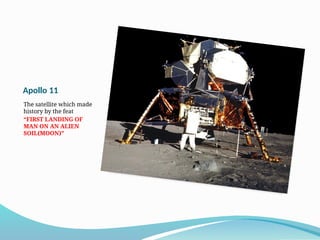
Apollo 11
The satellite which made
history by the feat
“FIRST LANDING OF
MAN ON AN ALIEN
SOIL(MOON)”
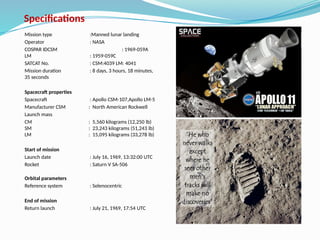
Specifications
Mission type :Manned lunar landing
Operator : NASA
COSPAR IDCSM : 1969-059A
LM : 1959-059C
SATCAT No. : CSM:4039 LM: 4041
Mission duration : 8 days, 3 hours, 18 minutes,
35 seconds
Spacecraft properties
Spacecraft : Apollo CSM-107,Apollo LM-5
Manufacturer CSM : North American Rockwell
Launch mass
CM : 5,560 kilograms (12,250 lb)
SM : 23,243 kilograms (51,243 lb)
LM : 15,095 kilograms (33,278 lb)
Start of mission
Launch date : July 16, 1969, 13:32:00 UTC
Rocket : Saturn V SA-506
Orbital parameters
Reference system : Selenocentric
End of mission
Return launch : July 21, 1969, 17:54 UTC
 Apollo 11 was the spaceflight that landed the first humans on the Moon,
Americans Neil Armstrong and Buzz Aldrin, on July 20, 1969, at 20:18 UTC.
 Armstrong became the first to step onto the lunar surface six hours later on
July 21 at 02:56 UTC.
 Armstrong spent about two and a half hours outside the spacecraft, Aldrin
slightly less, and together they collected 47.5 pounds (21.5 kg) of lunar
material for return to Earth.
 A third member of the mission, Michael Collins, piloted the command
spacecraft.
 Each crewman of Apollo 11 had made a spaceflight before this mission,
making it only the second all-veteran crew (the other being Apollo 10) in
human spaceflight history.
 Apollo 11 landed with less fuel than other missions, and the astronauts
encountered a premature low fuel warning.
 This was later found to be the result of greater propellant 'slosh' than
expected, uncovering a fuel sensor.
 On subsequent missions, extra anti-slosh baffles were added to the tanks
to prevent it.
 Three new minerals were discovered in the rock samples collected by the
astronauts: armalcolite, tranquillityite, and pyroxferroite. Armalcolite was
named after Armstrong, Aldrin, and Collins.
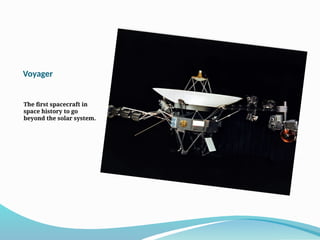
Voyager
The first spacecraft in
space history to go
beyond the solar system.
 A space probe with squat cylindrical body topped by a large parabolic radio antenna
dish pointing upwards, a three-element radioisotope thermoelectric generator on a
boom extending left, and scientific instruments on a boom extending right.
 The three radioisotope thermoelectric generators (RTGs) are mounted end-to-end
on the left-extending boom.
 One of the two planetary radio and plasma wave antenna extends diagonally left
and down, the other extends to the rear, mostly hidden here.
 The compact structure between the RTGs and the HGA are the high-field and low-
field magnetometers (MAG) in their stowed state;
 The instrument boom extending to the right holds, from left to right: the cosmic ray
subsystem (CRS) above and Low-Energy Charged Particle (LECP) detector below; the
Plasma Spectrometer (PLS) above; and the scan platform that rotates about a
vertical axis.
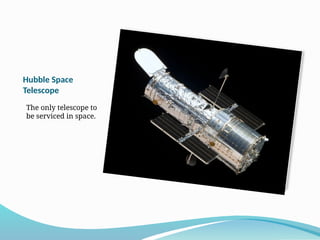
Hubble Space
Telescope
The only telescope to
be serviced in space.
 The Hubble Space Telescope (HST) is a space telescope that was launched
into low Earth orbit in 1990 and remains in operation.
 With a 2.4-meter (7.9 ft) mirror , Hubble's four main instruments observe
in the near ultraviolet, visible, and near infrared spectra. The telescope is
named after the astronomer Edwin Hubble.
 Hubble's orbit outside the distortion of Earth's atmosphere allows it to take
extremely high-resolution images with almost no background light.
 Hubble's Deep Field has recorded some of the most detailed visible-
light images ever, allowing a deep view into space and time.
 Many Hubble observations have led to breakthroughs in astrophysics, such
as accurately determining the rate of expansion of the universe.
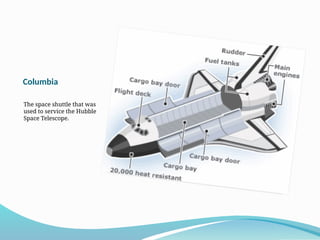
Columbia
The space shuttle that was
used to service the Hubble
Space Telescope.
 Space Shuttle Columbia (NASA Orbiter Vehicle Designation: OV-102) was
the first spaceworthy Space Shuttle in NASA's orbital fleet. Launched as
the STS-1 mission on April 12, 1981, it was the first of the Space Shuttle
program.
 It completed 27 missions before disintegrating during re-entry on February
1, 2003, near the end of its 28th mission, STS-107, resulting in the deaths
of all crew members aboard.
 Externally, Columbia was the first orbiter in the fleet whose surface was
mostly covered with High & Low Temperature Reusable Surface Insulation
(HRSI/LRSI) tiles as its main thermal protection system (TPS), with white
silicone rubber-painted Nomex — known as Felt Reusable Surface
Insulation (FRSI) blankets.
Mission to Mars
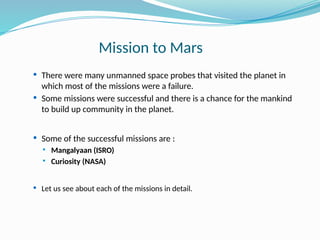
 There were many unmanned space probes that visited the planet in
which most of the missions were a failure.
 Some missions were successful and there is a chance for the mankind
to build up community in the planet.
 Some of the successful missions are :
 Mangalyaan (ISRO)
 Curiosity (NASA)
 Let us see about each of the missions in detail.
Curiosity
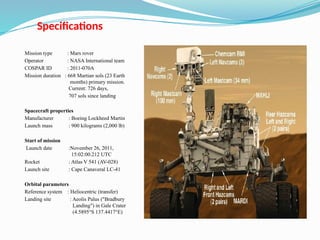
Specifications
Mission type : Mars rover
Operator : NASA International team
COSPAR ID : 2011-070A
Mission duration : 668 Martian sols (23 Earth
months) primary mission.
Current: 726 days,
707 sols since landing
Spacecraft properties
Manufacturer : Boeing Lockheed Martin
Launch mass : 900 kilograms (2,000 lb)
Start of mission
Launch date :November 26, 2011,
15:02:00.212 UTC
Rocket : Atlas V 541 (AV-028)
Launch site : Cape Canaveral LC-41
Orbital parameters
Reference system : Heliocentric (transfer)
Landing site : Aeolis Palus ("Bradbury
Landing") in Gale Crater
(4.5895°S 137.4417°E)
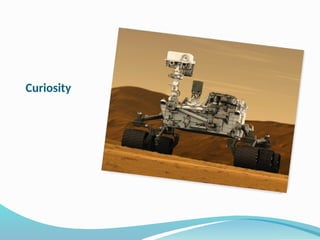
 Curiosity is a car-sized robotic rover exploring the Gale Crater in the
planet(Mars).
 Curiosity's design will serve as the basis for a planned Mars 2020 rover
mission.
 In December 2012, Curiosity's two-year mission was extended indefinitely.
 The rover has a 2.1 m (6.9 ft) long arm with a cross-shaped turret holding
five devices that can spin through a 350° turning range.
 The objectives of this rover includes the following:
1.To investigate the existence of life.
2.Interpret the processes that have formed and modified rocks and
soils.
3.Characterize the broad spectrum of surface radiation,
including galactic and cosmic radiation, solar proton
events and secondary neutrons.
 The source of power for the satellite is from a radio isotope thermoelectric
generator (MMRTG).
 Equipped with significant telecommunication redundancy by several means
– an X band transmitter and receiver that can communicate directly with
Earth, and a UHF Electra-Lite software-defined radio for communicating
with Mars orbiters
 It has 17 cameras: Eight Hazard Avoidance Cameras , Navigation Cameras
, Two Mast Cameras , a Mars Hard Lens Imager , a Mars Descent Imager
and a Chemistry and Camera Complex .
 Curiosity can vaporize a small portion of it with an infrared laser and
examine the resulting spectra signature to query the rock's elemental
composition.
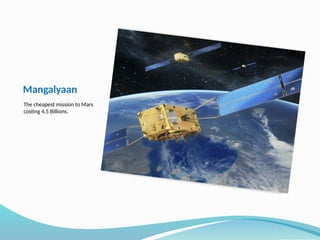
Mangalyaan
The cheapest mission to Mars
costing 4.5 Billions.
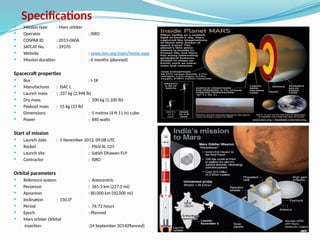
Specifications
 Mission type : Mars orbiter
 Operator : ISRO
 COSPAR ID : 2013-060A
 SATCAT No. : 39370
 Website : www.isro.org/mars/home.aspx
 Mission duration : 6 months (planned)
Spacecraft properties
 Bus : I-1K
 Manufacturer : ISAC L
 Launch mass : 337 kg (2,948 lb)
 Dry mass : 500 kg (1,100 lb)
 Payload mass : 15 kg (33 lb)
 Dimensions : 5 metres (4 ft 11 in) cube
 Power : 840 watts
Start of mission
 Launch date : 5 November 2013, 09:08 UTC
 Rocket : PSLV-XL C25
 Launch site : Satish Dhawan FLP
 Contractor : ISRO
Orbital parameters
 Reference system : Areocentric
 Periareon : 365.3 km (227.0 mi)
 Apoareon : 80,000 km (50,000 mi)
 Inclination : 150.0°
 Period : 76.72 hours
 Epoch : Planned
 Mars orbiter Orbital
insertion :24 September 2014(Planned)
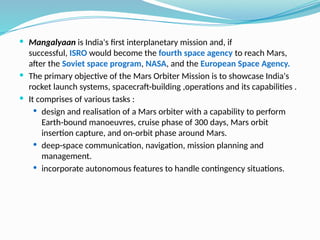
 Mangalyaan is India's first interplanetary mission and, if
successful, ISRO would become the fourth space agency to reach Mars,
after the Soviet space program, NASA, and the European Space Agency.
 The primary objective of the Mars Orbiter Mission is to showcase India's
rocket launch systems, spacecraft-building ,operations and its capabilities .
 It comprises of various tasks :
 design and realisation of a Mars orbiter with a capability to perform
Earth-bound manoeuvres, cruise phase of 300 days, Mars orbit
insertion capture, and on-orbit phase around Mars.
 deep-space communication, navigation, mission planning and
management.
 incorporate autonomous features to handle contingency situations.
 As of 22 July 2014, the spacecraft covered 80 per cent of its journey,
approximately 540 million km from Earth.
 The current plan is for insertion into Mars orbit on 24 September
2014,approximately 2 days after the arrival of NASA's MAVEN orbiter.
 For communication purpose,Mangalyaan uses two 230 W TWTAs and
two coherent transponders. The antenna array consists of a low-gain
antenna, a medium-gain antenna and a high-gain antenna.
 The cost of Mangalyaan project is Rs.500 crores which makes it the
cheapest mission to Mars.
 Fact:
 The cost of the film “THE GRAVITY” is estimated to be nearly 600 crores
which is amazing.
Missions to Moon
The advancement in technology made the human to explore the other
lunar bodies in the universe. Six missions landed men on the Moon,
beginning with Apollo 11 in July 1969.
 Missions to the moon have been conducted by the Soviet Union, United
States, European Space Agency, Japan, India and the People's Republic of
China.
 As part of man's exploration to the moon, many space missions have been
undertaken to study Earth's natural satellite.
 Luna 2 was the first spacecraft to reach the moon’s surface successfully on
14 September 1959.
 In 1966, Luna 9 became the first spacecraft to achieve a controlled soft
landing , while Luna 10 became the first mission to enter orbit.
 Between 1968 and 1972, manned missions to the Moon were conducted
by the United States as part of the Apollo programmme.
 Apollo 8 was the first manned mission to enter orbit in December 1968,
and was followed by Apollo 10 in May 1969.
 Apollo 13 was intended to land, however it was restricted to a flyby due to
a malfunction aboard the spacecraft. All nine manned missions returned
safely to the Earth.
 While the United States focused on the manned Apollo programme, the
Soviet Union conducted unmanned missions that deployed rovers and
returned samples to the Earth. Three rover missions were launched, of
which two were successful, and eleven sample return flights were
attempted with three successes.
Chandrayaan
“A small step by India , a
giant leap for the space
community”
Operator : Indian Space Research Organisation
COSPAR ID : 2008-052A
SATCAT No. : 33405
Website : www.isro.gov.in/Chandrayaan/htmls/home.htm
Mission duration
Planned : 2 years
Achieved : 312 days
Spacecraft properties
Launch mass : 380 kilograms (3,040 lb)
Start of mission
Launch date : 22 October 2008, 00:52 UTC
Rocket : PSLV-XL
Launch site : Satish Dhawan SLP
Contractor : ISRO
End of mission
Last contact : 28 August 2009, 20:00 UTC
Orbital parameters
Reference system : Selenocentric
Periselene : 200 kilometres (120 mi)
Aposelene : 200 kilometres (120 mi)
Epoch : May 2009
Lunar orbiter
Orbital insertion : November 2008
Orbits : 3,400 at EOM
The Chandrayaan mission had the following stated scientific objectives:
 to design, develop, launch and orbit a spacecraft around the Moon
using an Indian-made launch-vehicle
 to conduct scientific experiments using instruments on the
spacecraft which would yield data for the preparation of a three-
dimensional atlas (with high spatial and altitude resolution of 5–
10 m) of both the near and far sides of the Moon.
 for chemical and mineralogical mapping of the entire lunar surface
at high spatial resolution, mapping particularly the chemical
elements such as magnesium , aluminium , silicon , calcium , iron
, titanium , radon , uranium and thorium.
 to increase scientific knowledge.
 to test the impact of a sub-satellite (Moon Impact Probe — MIP) on
the surface on the Moon as a fore-runner to future soft-landing
missions.
 Chandrayaan uses X band and 0.7 m diameter dual gimballed parabolic
antenna for payload data transmission.
 The Telemetry, Tracking & Command (TTC) communication operates in S
band frequency.
 The power source of the spacecraft was mainly powered by its solar array,
which included one solar panel covering a total area of 2.15 x 1.8 m
generating 750 W of peak power, which was stored in a 36 A·h lithium-ion
battery for use during eclipses.
 Chandrayaan-1 spacecraft was successfully placed into a mission-specific
lunar polar orbit of 100 km above the lunar surface on 12 November 2008.
 The Mineral content on the lunar surface was mapped with the Moon
Mineralogy Mapper (M3
), a NASA instrument on board the orbiter.
 The presence of iron was reiterated and changes in rock and mineral
composition have been identified.
 The Oriental Basin region of the Moon was mapped, and it indicates
abundance of iron-bearing minerals such as pyroxene.
 The spacecraft completed 3000 orbits acquiring 70000 images of the lunar
surface , which many in ISRO believe is quite a record compared to the
lunar flights of other nations.
 ISRO officials estimated that if more than 40,000 images have been
transmitted by Chandrayaan's cameras in 75 days, it worked out to nearly
535 images being sent daily.

spacetravelpresentation-copy-140805103027-phpapp02.pptx

  • 1.
  • 3.
     The intangibledesire to explore and challenge the boundaries of what we know and where we have been has provided benefits to the society for centuries.  Human space exploration helps to address fundamental questions about our place in the universe and the history of solar system and the everlasting question. Are we alone?  Through addressing the challenges related to human space exploration we expand technology , create new industries and help to foster a peaceful connection with other nations.  Curiosity , exploration and accepting the challenge of deep space will invite the citizens of the world today and tomorrow to join hands for a new era.
  • 4.
     The earlyera on space exploration was by Soviet Union and United States of America. From 1990 onwards space tourism was also developed.  Today the history of space exploration is seeing new horizons with space tourism, which has also been promoted by the USA in which common people are sent to space as a tourist.  Not all can afford it as it is a very expensive program.  An achievement in the history of USA was in this very year when the Pioneer 4 was launched and which fell on the orbit of the sun making it the first Sun mission from USA, a first in the space exploration timeline of the country.
  • 5.
     The firstperson to fly in space was Alan Shepard in 1961 who belongs to the United States of America.  Commander Rakesh Sharma, AC, Hero of the Soviet Union is a former Indian Air Force test pilot who flew aboard Soyuz T-11 as part of the Intercosmos programme that made him the first Indian to travel in space.He found that weightlessness can be achieved in space through Yogasanas.  Again in the 1961, that USSR launched a manned space craft Vostok 1. Yuri A Gargarin became the first man in the history of space exploration to be launched into space, orbiting the Earth once.  The entire 1960s saw a large number of cosmonauts on board the space flights and all were sent with a particular mission to be fulfilled.
  • 6.
     It wasin last quarter of 1957 that man first send spaceship to orbit the earth. The project was carried out by the USS. In fact both the Sputnik 1 and 2 were sent into space, the latter one carrying the dog Laika.  It stayed in orbit for about 7 days. Both these space ships were in orbit till the beginning of 1958 which paved the way for the space exploration timeline to begin in a big way.  It was in the year 1958 that the NASA was founded. The third by USA, the Vanguard 1 was a successful mission and the satellite continued its orbit for three years,the first two missions being Explorer 1 and 2.  The Luna 1, Luna 2 and Luna 3 were all ‘destination moon’ missions which were very successful in making a landing on the moon as well as taking photographs of it.
  • 7.
     Mars, Moonetc are the prime contenders for human invasion and expedition for life other than earth. The advancement in the space technology has been the prime criterion for this ascent reached by man in space expedition.  Now many growing countries like China, India, France, and Germany have launched space programs that can further develop this space technology to the next level.  Henceforth history of space exploration will reach new heights with human invasion in other planets are prone to happen in the years to come and man spending his life in Mars or Moon is a possibility in the near future.
  • 8.
     The ISECGis a voluntary, non-binding international coordination mechanism through which individual agencies may exchange information regarding interests, objectives, and plans in space exploration with the goal of strengthening both individual exploration programs as well as the collective effort.  ISECG was established in response to "The Global Exploration Strategy:The Framework for Coordination," developed by fourteen space agencies and released in May 2007.  This GES Framework Document articulated a shared vision of coordinated human and robotic space exploration focused on Solar System destinations where humans may one day live and work.
  • 10.
    The following spaceagencies are ISECG members (in alphabetical order): ASI (Italy) CNES (France) CNSA (China) CSA (Canada) CSIRO (Australia) DLR (Germany) ESA (European Space Agency) ISRO (India)
  • 11.
    JAXA (Japan) KARI (Republicof Korea) NASA (United States of America) NSAU (Ukraine) Roscosmos (Russia) UKSA (United Kingdom)
  • 12.
  • 13.
    Specifications Mission type :Technology Operator : OKB-1 Harvard designation : 1957 Alpha 2 SATCAT No. : 2 Mission duration : 92 days Orbits completed : 1440 Spacecraft properties Manufacturer : OKB-1 Soviet Ministry of Radiotechnical Industry Launch mass : 83.60 kilograms (184.3 lb) Start of mission Launch date : 4 October 1957, 19:28:34 UTC Rocket : Sputnik 8K71PS End of mission Last contact : 26 October 1957 Decay date : 4 January 1958 Orbital parameters Reference system : Geocentric
  • 14.
     Sputnik itselfprovided scientists with valuable information. The density of the upper atmosphere could be deduced from its drag on the orbit, and the propagation of its radio signals gave information about the ionosphere.  Sputnik 1 burned up on 4 January 1958, as it fell from orbit upon reentering Earth's atmosphere, after travelling about 70 million km (43.5 million miles) and spending 3 months in orbit.  The satellite was a 585-millimetre (23.0 in) diameter sphere, assembled from two hemispheres which were hermetically sealed using o-rings and connected using 36 bolts, and had a mass of 83.6 kilograms (184 lbs).  The hemispheres were 2 mm thick,and were covered with a highly polished 1 mm-thick heat shield made of aluminium-magnesium- titanium AMG6T alloy.
  • 15.
     The powersupply, with a mass of 51 kg (112 lb),was in the shape of an octagonal nut with the radio transmitter in its hole.  It consisted of three silver-zinc batteries, developed at the All-Union Research Institute of Current Sources (VNIIT) .  Two of these batteries powered the radio transmitter and one powered the temperature regulation system.  The satellite had a one-watt, 3.5 kg (7.7 lb)radio transmitting unit inside.  At shut down, the 7.5 tonne core stage with PS-1 attached had attained an altitude of 223 km (139 mi) above sea level, a velocity of 7,780 m/s (25,500 ft/s).
  • 16.
    Apollo 11 The satellitewhich made history by the feat “FIRST LANDING OF MAN ON AN ALIEN SOIL(MOON)”
  • 17.
    Specifications Mission type :Mannedlunar landing Operator : NASA COSPAR IDCSM : 1969-059A LM : 1959-059C SATCAT No. : CSM:4039 LM: 4041 Mission duration : 8 days, 3 hours, 18 minutes, 35 seconds Spacecraft properties Spacecraft : Apollo CSM-107,Apollo LM-5 Manufacturer CSM : North American Rockwell Launch mass CM : 5,560 kilograms (12,250 lb) SM : 23,243 kilograms (51,243 lb) LM : 15,095 kilograms (33,278 lb) Start of mission Launch date : July 16, 1969, 13:32:00 UTC Rocket : Saturn V SA-506 Orbital parameters Reference system : Selenocentric End of mission Return launch : July 21, 1969, 17:54 UTC
  • 18.
     Apollo 11was the spaceflight that landed the first humans on the Moon, Americans Neil Armstrong and Buzz Aldrin, on July 20, 1969, at 20:18 UTC.  Armstrong became the first to step onto the lunar surface six hours later on July 21 at 02:56 UTC.  Armstrong spent about two and a half hours outside the spacecraft, Aldrin slightly less, and together they collected 47.5 pounds (21.5 kg) of lunar material for return to Earth.  A third member of the mission, Michael Collins, piloted the command spacecraft.  Each crewman of Apollo 11 had made a spaceflight before this mission, making it only the second all-veteran crew (the other being Apollo 10) in human spaceflight history.
  • 19.
     Apollo 11landed with less fuel than other missions, and the astronauts encountered a premature low fuel warning.  This was later found to be the result of greater propellant 'slosh' than expected, uncovering a fuel sensor.  On subsequent missions, extra anti-slosh baffles were added to the tanks to prevent it.  Three new minerals were discovered in the rock samples collected by the astronauts: armalcolite, tranquillityite, and pyroxferroite. Armalcolite was named after Armstrong, Aldrin, and Collins.
  • 20.
    Voyager The first spacecraftin space history to go beyond the solar system.
  • 21.
     A spaceprobe with squat cylindrical body topped by a large parabolic radio antenna dish pointing upwards, a three-element radioisotope thermoelectric generator on a boom extending left, and scientific instruments on a boom extending right.  The three radioisotope thermoelectric generators (RTGs) are mounted end-to-end on the left-extending boom.  One of the two planetary radio and plasma wave antenna extends diagonally left and down, the other extends to the rear, mostly hidden here.  The compact structure between the RTGs and the HGA are the high-field and low- field magnetometers (MAG) in their stowed state;  The instrument boom extending to the right holds, from left to right: the cosmic ray subsystem (CRS) above and Low-Energy Charged Particle (LECP) detector below; the Plasma Spectrometer (PLS) above; and the scan platform that rotates about a vertical axis.
  • 22.
    Hubble Space Telescope The onlytelescope to be serviced in space.
  • 23.
     The HubbleSpace Telescope (HST) is a space telescope that was launched into low Earth orbit in 1990 and remains in operation.  With a 2.4-meter (7.9 ft) mirror , Hubble's four main instruments observe in the near ultraviolet, visible, and near infrared spectra. The telescope is named after the astronomer Edwin Hubble.  Hubble's orbit outside the distortion of Earth's atmosphere allows it to take extremely high-resolution images with almost no background light.  Hubble's Deep Field has recorded some of the most detailed visible- light images ever, allowing a deep view into space and time.  Many Hubble observations have led to breakthroughs in astrophysics, such as accurately determining the rate of expansion of the universe.
  • 24.
    Columbia The space shuttlethat was used to service the Hubble Space Telescope.
  • 25.
     Space ShuttleColumbia (NASA Orbiter Vehicle Designation: OV-102) was the first spaceworthy Space Shuttle in NASA's orbital fleet. Launched as the STS-1 mission on April 12, 1981, it was the first of the Space Shuttle program.  It completed 27 missions before disintegrating during re-entry on February 1, 2003, near the end of its 28th mission, STS-107, resulting in the deaths of all crew members aboard.  Externally, Columbia was the first orbiter in the fleet whose surface was mostly covered with High & Low Temperature Reusable Surface Insulation (HRSI/LRSI) tiles as its main thermal protection system (TPS), with white silicone rubber-painted Nomex — known as Felt Reusable Surface Insulation (FRSI) blankets.
  • 26.
    Mission to Mars There were many unmanned space probes that visited the planet in which most of the missions were a failure.  Some missions were successful and there is a chance for the mankind to build up community in the planet.  Some of the successful missions are :  Mangalyaan (ISRO)  Curiosity (NASA)  Let us see about each of the missions in detail.
  • 27.
  • 28.
    Specifications Mission type :Mars rover Operator : NASA International team COSPAR ID : 2011-070A Mission duration : 668 Martian sols (23 Earth months) primary mission. Current: 726 days, 707 sols since landing Spacecraft properties Manufacturer : Boeing Lockheed Martin Launch mass : 900 kilograms (2,000 lb) Start of mission Launch date :November 26, 2011, 15:02:00.212 UTC Rocket : Atlas V 541 (AV-028) Launch site : Cape Canaveral LC-41 Orbital parameters Reference system : Heliocentric (transfer) Landing site : Aeolis Palus ("Bradbury Landing") in Gale Crater (4.5895°S 137.4417°E)
  • 29.
     Curiosity isa car-sized robotic rover exploring the Gale Crater in the planet(Mars).  Curiosity's design will serve as the basis for a planned Mars 2020 rover mission.  In December 2012, Curiosity's two-year mission was extended indefinitely.  The rover has a 2.1 m (6.9 ft) long arm with a cross-shaped turret holding five devices that can spin through a 350° turning range.  The objectives of this rover includes the following: 1.To investigate the existence of life. 2.Interpret the processes that have formed and modified rocks and soils. 3.Characterize the broad spectrum of surface radiation, including galactic and cosmic radiation, solar proton events and secondary neutrons.
  • 30.
     The sourceof power for the satellite is from a radio isotope thermoelectric generator (MMRTG).  Equipped with significant telecommunication redundancy by several means – an X band transmitter and receiver that can communicate directly with Earth, and a UHF Electra-Lite software-defined radio for communicating with Mars orbiters  It has 17 cameras: Eight Hazard Avoidance Cameras , Navigation Cameras , Two Mast Cameras , a Mars Hard Lens Imager , a Mars Descent Imager and a Chemistry and Camera Complex .  Curiosity can vaporize a small portion of it with an infrared laser and examine the resulting spectra signature to query the rock's elemental composition.
  • 31.
    Mangalyaan The cheapest missionto Mars costing 4.5 Billions.
  • 32.
    Specifications  Mission type: Mars orbiter  Operator : ISRO  COSPAR ID : 2013-060A  SATCAT No. : 39370  Website : www.isro.org/mars/home.aspx  Mission duration : 6 months (planned) Spacecraft properties  Bus : I-1K  Manufacturer : ISAC L  Launch mass : 337 kg (2,948 lb)  Dry mass : 500 kg (1,100 lb)  Payload mass : 15 kg (33 lb)  Dimensions : 5 metres (4 ft 11 in) cube  Power : 840 watts Start of mission  Launch date : 5 November 2013, 09:08 UTC  Rocket : PSLV-XL C25  Launch site : Satish Dhawan FLP  Contractor : ISRO Orbital parameters  Reference system : Areocentric  Periareon : 365.3 km (227.0 mi)  Apoareon : 80,000 km (50,000 mi)  Inclination : 150.0°  Period : 76.72 hours  Epoch : Planned  Mars orbiter Orbital insertion :24 September 2014(Planned)
  • 33.
     Mangalyaan isIndia's first interplanetary mission and, if successful, ISRO would become the fourth space agency to reach Mars, after the Soviet space program, NASA, and the European Space Agency.  The primary objective of the Mars Orbiter Mission is to showcase India's rocket launch systems, spacecraft-building ,operations and its capabilities .  It comprises of various tasks :  design and realisation of a Mars orbiter with a capability to perform Earth-bound manoeuvres, cruise phase of 300 days, Mars orbit insertion capture, and on-orbit phase around Mars.  deep-space communication, navigation, mission planning and management.  incorporate autonomous features to handle contingency situations.
  • 34.
     As of22 July 2014, the spacecraft covered 80 per cent of its journey, approximately 540 million km from Earth.  The current plan is for insertion into Mars orbit on 24 September 2014,approximately 2 days after the arrival of NASA's MAVEN orbiter.  For communication purpose,Mangalyaan uses two 230 W TWTAs and two coherent transponders. The antenna array consists of a low-gain antenna, a medium-gain antenna and a high-gain antenna.  The cost of Mangalyaan project is Rs.500 crores which makes it the cheapest mission to Mars.  Fact:  The cost of the film “THE GRAVITY” is estimated to be nearly 600 crores which is amazing.
  • 35.
    Missions to Moon Theadvancement in technology made the human to explore the other lunar bodies in the universe. Six missions landed men on the Moon, beginning with Apollo 11 in July 1969.  Missions to the moon have been conducted by the Soviet Union, United States, European Space Agency, Japan, India and the People's Republic of China.  As part of man's exploration to the moon, many space missions have been undertaken to study Earth's natural satellite.  Luna 2 was the first spacecraft to reach the moon’s surface successfully on 14 September 1959.  In 1966, Luna 9 became the first spacecraft to achieve a controlled soft landing , while Luna 10 became the first mission to enter orbit.
  • 36.
     Between 1968and 1972, manned missions to the Moon were conducted by the United States as part of the Apollo programmme.  Apollo 8 was the first manned mission to enter orbit in December 1968, and was followed by Apollo 10 in May 1969.  Apollo 13 was intended to land, however it was restricted to a flyby due to a malfunction aboard the spacecraft. All nine manned missions returned safely to the Earth.  While the United States focused on the manned Apollo programme, the Soviet Union conducted unmanned missions that deployed rovers and returned samples to the Earth. Three rover missions were launched, of which two were successful, and eleven sample return flights were attempted with three successes.
  • 37.
    Chandrayaan “A small stepby India , a giant leap for the space community”
  • 38.
    Operator : IndianSpace Research Organisation COSPAR ID : 2008-052A SATCAT No. : 33405 Website : www.isro.gov.in/Chandrayaan/htmls/home.htm Mission duration Planned : 2 years Achieved : 312 days Spacecraft properties Launch mass : 380 kilograms (3,040 lb) Start of mission Launch date : 22 October 2008, 00:52 UTC Rocket : PSLV-XL Launch site : Satish Dhawan SLP Contractor : ISRO End of mission Last contact : 28 August 2009, 20:00 UTC Orbital parameters Reference system : Selenocentric Periselene : 200 kilometres (120 mi) Aposelene : 200 kilometres (120 mi) Epoch : May 2009 Lunar orbiter Orbital insertion : November 2008 Orbits : 3,400 at EOM
  • 39.
    The Chandrayaan missionhad the following stated scientific objectives:  to design, develop, launch and orbit a spacecraft around the Moon using an Indian-made launch-vehicle  to conduct scientific experiments using instruments on the spacecraft which would yield data for the preparation of a three- dimensional atlas (with high spatial and altitude resolution of 5– 10 m) of both the near and far sides of the Moon.  for chemical and mineralogical mapping of the entire lunar surface at high spatial resolution, mapping particularly the chemical elements such as magnesium , aluminium , silicon , calcium , iron , titanium , radon , uranium and thorium.  to increase scientific knowledge.  to test the impact of a sub-satellite (Moon Impact Probe — MIP) on the surface on the Moon as a fore-runner to future soft-landing missions.
  • 40.
     Chandrayaan usesX band and 0.7 m diameter dual gimballed parabolic antenna for payload data transmission.  The Telemetry, Tracking & Command (TTC) communication operates in S band frequency.  The power source of the spacecraft was mainly powered by its solar array, which included one solar panel covering a total area of 2.15 x 1.8 m generating 750 W of peak power, which was stored in a 36 A·h lithium-ion battery for use during eclipses.  Chandrayaan-1 spacecraft was successfully placed into a mission-specific lunar polar orbit of 100 km above the lunar surface on 12 November 2008.
  • 41.
     The Mineralcontent on the lunar surface was mapped with the Moon Mineralogy Mapper (M3 ), a NASA instrument on board the orbiter.  The presence of iron was reiterated and changes in rock and mineral composition have been identified.  The Oriental Basin region of the Moon was mapped, and it indicates abundance of iron-bearing minerals such as pyroxene.  The spacecraft completed 3000 orbits acquiring 70000 images of the lunar surface , which many in ISRO believe is quite a record compared to the lunar flights of other nations.  ISRO officials estimated that if more than 40,000 images have been transmitted by Chandrayaan's cameras in 75 days, it worked out to nearly 535 images being sent daily.