Pablo Andrés Dorado Suárez
VOYAGER PROGRAM
HISTORY
… ONCE UPON A TIME
• The Voyager program started as an observation mission which launched two space
probes, Voyager 1 and Voyager 2, to take advantage of an unusually convenient planetary
alignment between Saturn – Neptune in the late 70’s and make studies in Jupiter and
Saturn.
THE MISSION
LAUNCH
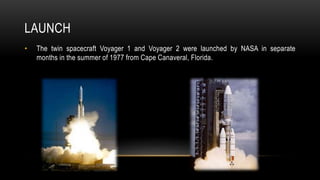
• The twin spacecraft Voyager 1 and Voyager 2 were launched by NASA in separate
months in the summer of 1977 from Cape Canaveral, Florida.
THE PLANETARY VOYAGE (1977-1989)
• They were part of the 70’s “Grand Tour”, which made studies of Jupiter and Saturn, taking
advantage of the “gravitational help” of these planets.
• When this part finishes, they were allowed to keep being listened from the JPL centre in
Pasadena, California.
• With this permission, they were adjusted to fly and study Uranus and Neptune.
• Then they discovered many interesting things that changed the study of space as we
knew it. Some of them are the discover of new satellites, volcanos, a ring system in
Uranus, etc.
JUPITER
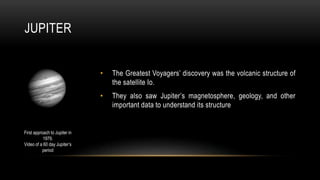
• The Greatest Voyagers’ discovery was the volcanic structure of
the satellite Io.
• They also saw Jupiter’s magnetosphere, geology, and other
important data to understand its structure
First approach to Jupiter in
1979.
Video of a 60 day Jupiter’s
period
SATURN
• While passing behind Saturn (as viewed from Earth), Voyager
2 probed Saturn's upper atmosphere with its radio link to
gather information on atmospheric temperature and density
profiles.
• Voyager 2 found that at the highest pressure levels (seven
kilopascals of pressure), Saturn's temperature was 70 kelvins
(−203 °C), while at the deepest levels measured (120
kilopascals) the temperature increased to 143 K (−130 °C).
• The north pole was found to be 10 kelvins cooler, although
this may be seasonal (see also Saturn Oppositions).
URANUS
• The closest approach to Uranus occurred on January 24,
1986, when Voyager 2 came within 81,500 kilometres (50,600
miles) of the planet's cloud tops.
• Voyager 2 also discovered 10 previously unknown moons of
Uranus; studied the planet's unique atmosphere, caused by
its axial tilt of 97.8°; and examined the Uranian ring system.
NEPTUNE
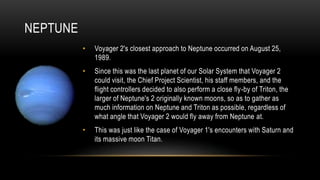
• Voyager 2's closest approach to Neptune occurred on August 25,
1989.
• Since this was the last planet of our Solar System that Voyager 2
could visit, the Chief Project Scientist, his staff members, and the
flight controllers decided to also perform a close fly-by of Triton, the
larger of Neptune's 2 originally known moons, so as to gather as
much information on Neptune and Triton as possible, regardless of
what angle that Voyager 2 would fly away from Neptune at.
• This was just like the case of Voyager 1's encounters with Saturn and
its massive moon Titan.
THE INTERSTELLAR MISSION (1990)
• With both probes coming out of the solar system, the mission of the voyager program
started calling “The Interstellar Mission”.
• Since this time, the had studied the different effects of the sun in our solar system, looking
for the heliopause.
• When they arrive there, they’ll continue sending information about the interstellar space
(outside our sun’s influence)
• Finally, it’s expected that the RPG’s which give them the energy for their scientific
instruments will be over, with the consequent finish of the mission between 2025 and
2030.
SO, WHERE ARE THEY NOW?
• In 2003, Voyager 1 informs that has passed the
solar system’s final frontier
• Then, in 2005, both Voyagers were outside the
sun gas influence and in the heliosheat.
• In 2008, Voyager 2, took this picture of the Milky
Way.
• In 2009, both passed the heliosheat, entering to
the heliopause, the final border of our solar
system.
… AND NOW?
• Also, Voyager 1 completed 12,000 days from its launch on
June 28, 2010.
• Actually, they are sending information from outside the solar
system.
NOTE: Until now, they’ve sent more than one trillion bits of
scientific data.
Year Date
Voyager 1
Radial Distance
(Million Kms)
Heliographic
Latitude
Heliographic
Rotating Longitude
Heliographic
Inertial Longitude
2010 16 Sept 17,149.90 34.4 34.4 122.6 173.7
Year Date
Voyager 2
Radial Distance
(Million Kms)
Heliographic
Latitude
Heliographic
Rotating Longitude
Heliographic
Inertial Longitude
2010 16 Sept 13,950.00 -29.1 165.9 217.0
THE VOYAGER GOLDEN RECORD
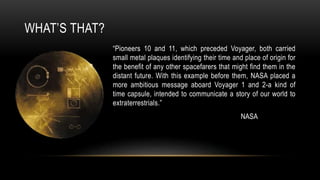
WHAT’S THAT?
“Pioneers 10 and 11, which preceded Voyager, both carried
small metal plaques identifying their time and place of origin for
the benefit of any other spacefarers that might find them in the
distant future. With this example before them, NASA placed a
more ambitious message aboard Voyager 1 and 2-a kind of
time capsule, intended to communicate a story of our world to
extraterrestrials.”
NASA
WHAT’S INSIDE THAT?
• The Voyager’s Golden Record is a 30cm gold-covered
copper phonograph disc, with the title of “The Sounds of
Earth”.
• Inside it, there’s our world history, as well as our culture.
• It has three parts
FIRST PART: “GREETINGS FROM EARTH”
• When the playing starts, it begins with a greeting from the
president of the US those years, president Carter.
• Then, there’s a greeting form the General Secretary of the
UN.
• Finally, there are greetings from 55 languages all over the
world
SECOND PART: “SOUNDS OF EARTH” AND
“MUSIC FROM EARTH”
• After the greetings, we can hear some daily sounds from
our planet (Remasterized).
• Finally, there’s a little selection of world’s music, such as
Mozart, Beethoven, and actual singers (to 1974).
THIRD PART: “SCENES FROM EARTH”
Voyager mission

Voyager mission

  • 1.
    Pablo Andrés DoradoSuárez VOYAGER PROGRAM
  • 2.
  • 3.
    … ONCE UPONA TIME • The Voyager program started as an observation mission which launched two space probes, Voyager 1 and Voyager 2, to take advantage of an unusually convenient planetary alignment between Saturn – Neptune in the late 70’s and make studies in Jupiter and Saturn.
  • 5.
  • 6.
    LAUNCH • The twinspacecraft Voyager 1 and Voyager 2 were launched by NASA in separate months in the summer of 1977 from Cape Canaveral, Florida.
  • 7.
    THE PLANETARY VOYAGE(1977-1989) • They were part of the 70’s “Grand Tour”, which made studies of Jupiter and Saturn, taking advantage of the “gravitational help” of these planets. • When this part finishes, they were allowed to keep being listened from the JPL centre in Pasadena, California. • With this permission, they were adjusted to fly and study Uranus and Neptune. • Then they discovered many interesting things that changed the study of space as we knew it. Some of them are the discover of new satellites, volcanos, a ring system in Uranus, etc.
  • 8.
    JUPITER • The GreatestVoyagers’ discovery was the volcanic structure of the satellite Io. • They also saw Jupiter’s magnetosphere, geology, and other important data to understand its structure First approach to Jupiter in 1979. Video of a 60 day Jupiter’s period
  • 9.
    SATURN • While passingbehind Saturn (as viewed from Earth), Voyager 2 probed Saturn's upper atmosphere with its radio link to gather information on atmospheric temperature and density profiles. • Voyager 2 found that at the highest pressure levels (seven kilopascals of pressure), Saturn's temperature was 70 kelvins (−203 °C), while at the deepest levels measured (120 kilopascals) the temperature increased to 143 K (−130 °C). • The north pole was found to be 10 kelvins cooler, although this may be seasonal (see also Saturn Oppositions).
  • 10.
    URANUS • The closestapproach to Uranus occurred on January 24, 1986, when Voyager 2 came within 81,500 kilometres (50,600 miles) of the planet's cloud tops. • Voyager 2 also discovered 10 previously unknown moons of Uranus; studied the planet's unique atmosphere, caused by its axial tilt of 97.8°; and examined the Uranian ring system.
  • 11.
    NEPTUNE • Voyager 2'sclosest approach to Neptune occurred on August 25, 1989. • Since this was the last planet of our Solar System that Voyager 2 could visit, the Chief Project Scientist, his staff members, and the flight controllers decided to also perform a close fly-by of Triton, the larger of Neptune's 2 originally known moons, so as to gather as much information on Neptune and Triton as possible, regardless of what angle that Voyager 2 would fly away from Neptune at. • This was just like the case of Voyager 1's encounters with Saturn and its massive moon Titan.
  • 12.
    THE INTERSTELLAR MISSION(1990) • With both probes coming out of the solar system, the mission of the voyager program started calling “The Interstellar Mission”. • Since this time, the had studied the different effects of the sun in our solar system, looking for the heliopause. • When they arrive there, they’ll continue sending information about the interstellar space (outside our sun’s influence) • Finally, it’s expected that the RPG’s which give them the energy for their scientific instruments will be over, with the consequent finish of the mission between 2025 and 2030.
  • 13.
    SO, WHERE ARETHEY NOW? • In 2003, Voyager 1 informs that has passed the solar system’s final frontier • Then, in 2005, both Voyagers were outside the sun gas influence and in the heliosheat. • In 2008, Voyager 2, took this picture of the Milky Way. • In 2009, both passed the heliosheat, entering to the heliopause, the final border of our solar system.
  • 14.
    … AND NOW? •Also, Voyager 1 completed 12,000 days from its launch on June 28, 2010. • Actually, they are sending information from outside the solar system. NOTE: Until now, they’ve sent more than one trillion bits of scientific data.
  • 15.
    Year Date Voyager 1 RadialDistance (Million Kms) Heliographic Latitude Heliographic Rotating Longitude Heliographic Inertial Longitude 2010 16 Sept 17,149.90 34.4 34.4 122.6 173.7 Year Date Voyager 2 Radial Distance (Million Kms) Heliographic Latitude Heliographic Rotating Longitude Heliographic Inertial Longitude 2010 16 Sept 13,950.00 -29.1 165.9 217.0
  • 16.
  • 17.
    WHAT’S THAT? “Pioneers 10and 11, which preceded Voyager, both carried small metal plaques identifying their time and place of origin for the benefit of any other spacefarers that might find them in the distant future. With this example before them, NASA placed a more ambitious message aboard Voyager 1 and 2-a kind of time capsule, intended to communicate a story of our world to extraterrestrials.” NASA
  • 18.
    WHAT’S INSIDE THAT? •The Voyager’s Golden Record is a 30cm gold-covered copper phonograph disc, with the title of “The Sounds of Earth”. • Inside it, there’s our world history, as well as our culture. • It has three parts
  • 19.
    FIRST PART: “GREETINGSFROM EARTH” • When the playing starts, it begins with a greeting from the president of the US those years, president Carter. • Then, there’s a greeting form the General Secretary of the UN. • Finally, there are greetings from 55 languages all over the world
  • 20.
    SECOND PART: “SOUNDSOF EARTH” AND “MUSIC FROM EARTH” • After the greetings, we can hear some daily sounds from our planet (Remasterized). • Finally, there’s a little selection of world’s music, such as Mozart, Beethoven, and actual singers (to 1974).
  • 21.
    THIRD PART: “SCENESFROM EARTH”
  • 22.
    THIRD PART: “SCENESFROM EARTH”
  • 23.
    THIRD PART: “SCENESFROM EARTH”
  • 24.
    THIRD PART: “SCENESFROM EARTH”
  • 25.
    THIRD PART: “SCENESFROM EARTH”