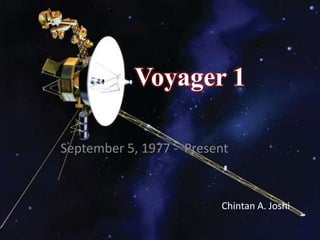
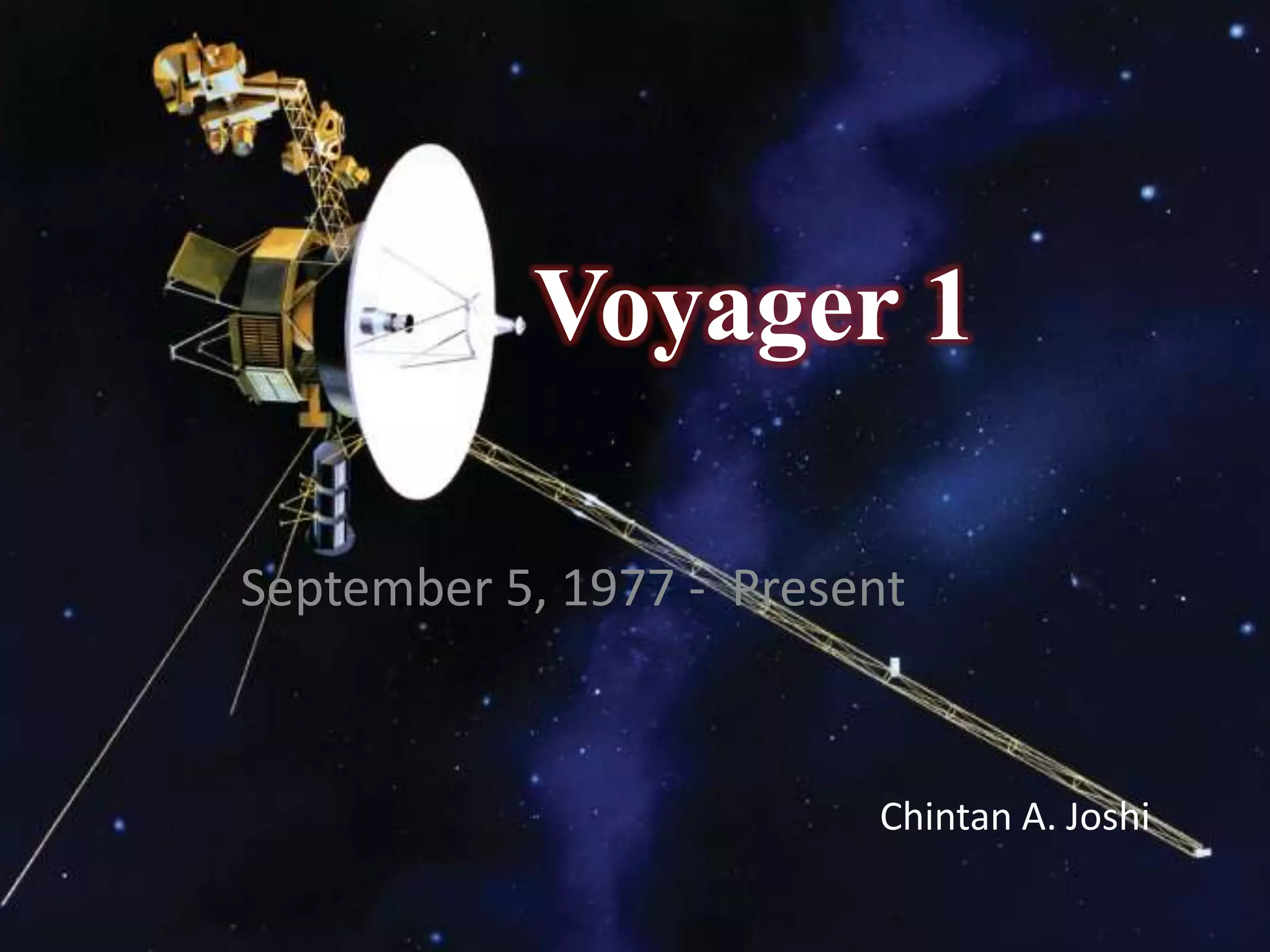
Voyager 1

September 5, 1977 - Present


                         Chintan A. Joshi
Mission Objective
• The Voyager mission was designed to take
  advantage of a rare geometric arrangement of
  the outer planets occurs at every 175 years
• Four-planet tour for using minimum
  propellant and trip time.
• Four planes were Jupiter, Saturn, Uranus and
  Neptune
• the spacecraft were built to last five years
Architecture
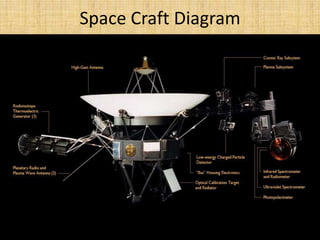
•   constructed by the Jet Propulsion Laboratory
•   payload of 11 instruments
•   has 16 hydrazine thrusters
•   Two antennas of s and x band
•   digital tape recorder (DTR)
•   three-axis stabilization gyroscopes to keep the
    probe's radio antenna pointed toward Earth.
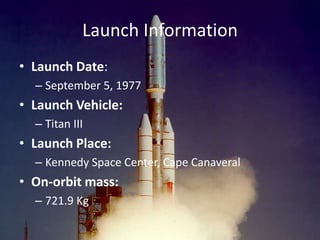
Launch Information
• Launch Date:
  – September 5, 1977
• Launch Vehicle:
  – Titan III
• Launch Place:
  – Kennedy Space Center, Cape Canaveral
• On-orbit mass:
  – 721.9 Kg
Internal Design
• Voyager was designed to operate in a highly-
  autonomous manner
• Three interconnected on-board computers
• spacecraft is controlled through the Deep
  Space Network (DSN) located in California's
  Mojave Desert.
Power
• Power was provided through three
  Radioisotope Thermoelectric
  Generators(RTG).
• Plutonium-238 as fuel
• The 2,400 watts of heat generated about 157
  watts of electric power
• Can operate till 2020
Golden Record
• carries a gold-plated audio-visual disc
• Disc contains photos of the Earth and its
  lifeforms, a range of scientific information,
  spoken greetings from people, address of
  solar system on galaxy.
Space Craft Diagram
Current Status
• Distance on 08-01-2013:
  – 18,500,838,259 KM(18.5 Billion KM)
• Roundtrip light time from the Sun
  – 34:17:04 (hh:mm:ss)


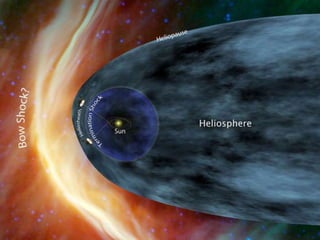
• First man made object which will go outside
  the solar system
                   Voyager-1
Referances
•   http://voyager.jpl.nasa.gov/
•   http://voyager.jpl.nasa.gov/mission/index.htm
•   http://en.wikipedia.org/wiki/Voyager_1
•   http://voyager.jpl.nasa.gov/imagesvideo/vide
    o.html
Thank You

Voyager 1

  • 1.
    Voyager 1 September 5,1977 - Present Chintan A. Joshi
  • 2.
    Mission Objective • TheVoyager mission was designed to take advantage of a rare geometric arrangement of the outer planets occurs at every 175 years • Four-planet tour for using minimum propellant and trip time. • Four planes were Jupiter, Saturn, Uranus and Neptune • the spacecraft were built to last five years
  • 3.
    Architecture • constructed by the Jet Propulsion Laboratory • payload of 11 instruments • has 16 hydrazine thrusters • Two antennas of s and x band • digital tape recorder (DTR) • three-axis stabilization gyroscopes to keep the probe's radio antenna pointed toward Earth.
  • 4.
    Launch Information • LaunchDate: – September 5, 1977 • Launch Vehicle: – Titan III • Launch Place: – Kennedy Space Center, Cape Canaveral • On-orbit mass: – 721.9 Kg
  • 5.
    Internal Design • Voyagerwas designed to operate in a highly- autonomous manner • Three interconnected on-board computers • spacecraft is controlled through the Deep Space Network (DSN) located in California's Mojave Desert.
  • 6.
    Power • Power wasprovided through three Radioisotope Thermoelectric Generators(RTG). • Plutonium-238 as fuel • The 2,400 watts of heat generated about 157 watts of electric power • Can operate till 2020
  • 7.
    Golden Record • carriesa gold-plated audio-visual disc • Disc contains photos of the Earth and its lifeforms, a range of scientific information, spoken greetings from people, address of solar system on galaxy.
  • 8.
  • 9.
    Current Status • Distanceon 08-01-2013: – 18,500,838,259 KM(18.5 Billion KM) • Roundtrip light time from the Sun – 34:17:04 (hh:mm:ss) • First man made object which will go outside the solar system Voyager-1
  • 11.
    Referances • http://voyager.jpl.nasa.gov/ • http://voyager.jpl.nasa.gov/mission/index.htm • http://en.wikipedia.org/wiki/Voyager_1 • http://voyager.jpl.nasa.gov/imagesvideo/vide o.html
  • 12.