WITH,
A.Selvaganesh.
D.Rajasekaran.
DEPT of ECE.
Adhiparasakthi Engineering College ,
Melmaruvathur.
Are u Ready for the Space travel
Wear the oxygen Mask and get
a free ride with me...
CONTENT:
 INTRODUCTION.
 WHAT IS SPACE...??
 WHO ARE THESE ASTRONOMER..??
 SPACE EXPLORATION.
 TOWARDS FUTURE......
 CONCLUSION.
Introduction:
 Space exploration is the ongoing discovery
and exploration of celestial structures in
outer space by means of continuously evolving
and growing space technology.
 While the study of space is carried out mainly
by astronomers with telescopes, the physical
exploration of space is conducted both by
unmanned robotic probes and
human spaceflight.
 A study that investigates natural objects in
space such as planets, stars, and others.
 The people who always investigates about
space often called as astronomers
 one of the oldest branches of science.
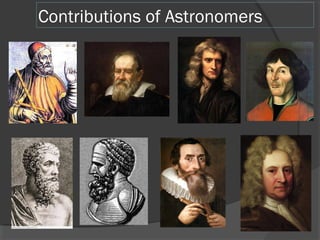
Who are Astronomers..??
Contributions of Astronomers
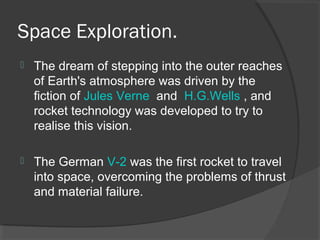
Space Exploration.
 The dream of stepping into the outer reaches
of Earth's atmosphere was driven by the
fiction of Jules Verne and H.G.Wells , and
rocket technology was developed to try to
realise this vision.
 The German V-2 was the first rocket to travel
into space, overcoming the problems of thrust
and material failure.
Space Exploration.
 In July 1950 the first Bumper rocket is launched
from Cape Canaveral, Florida. The Bumper was a
two-stage rocket consisting of a Post-War V-2
topped by a WAC Corporal rocket. It could reach
then-record altitudes of almost 400 km.
 The first successful orbital launch was of the
Soviet unmanned Sputnik 1 ("Satellite 1") mission
on 4 October 1957.
Space Exploration.
 The first successful human spaceflight was Vostok1
("East 1"), carrying 27-year-old Russian cosmonaut
Yuri Gagarin on 12 April 1961.
 Valentina Tereshkova, the first woman in space, orbited
Earth 48 times aboard Vostok 6 on 16 June 1963.
 Luna 10 became the first artificial satellite of the Moon.
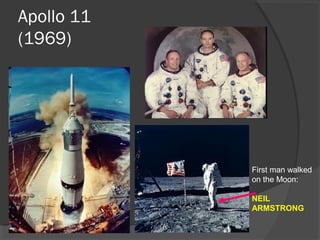
 The first manned landing on another celestial body was
performed by Apollo 11 on 20 July 1969.
Apollo 11
(1969)
First man walked
on the Moon:
NEIL
ARMSTRONG
Space Agencies:
Towards Future.......
 The exploration of Mars has been an important
part of the space exploration programs
 The idea of using high level automated systems
for space missions has become a desirable goal to
space agencies all around the world.
 Such systems are believed to yield benefits such
as lower cost, less human oversight, and ability to
explore deeper in space which is usually restricted
by long communications with human controllers.
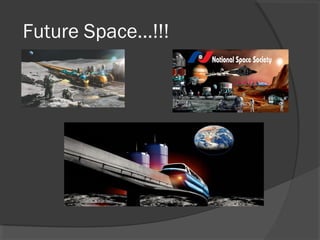
Future Space...!!!
Conclusion:
 Many past and current concepts for the
continued exploration and colonization
of space focus on a return to the Moon
as a "stepping stone" to the other
planets, especially Mars.
GET EASE AND TAKE OFF YOUR
OXYGEN MASK..!
THANK YOU

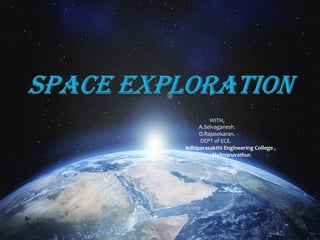
Space Exploration

  • 1.
  • 2.
    Are u Readyfor the Space travel Wear the oxygen Mask and get a free ride with me...
  • 3.
    CONTENT:  INTRODUCTION.  WHATIS SPACE...??  WHO ARE THESE ASTRONOMER..??  SPACE EXPLORATION.  TOWARDS FUTURE......  CONCLUSION.
  • 4.
    Introduction:  Space explorationis the ongoing discovery and exploration of celestial structures in outer space by means of continuously evolving and growing space technology.  While the study of space is carried out mainly by astronomers with telescopes, the physical exploration of space is conducted both by unmanned robotic probes and human spaceflight.
  • 5.
     A studythat investigates natural objects in space such as planets, stars, and others.  The people who always investigates about space often called as astronomers  one of the oldest branches of science. Who are Astronomers..??
  • 6.
  • 7.
    Space Exploration.  Thedream of stepping into the outer reaches of Earth's atmosphere was driven by the fiction of Jules Verne and H.G.Wells , and rocket technology was developed to try to realise this vision.  The German V-2 was the first rocket to travel into space, overcoming the problems of thrust and material failure.
  • 8.
    Space Exploration.  InJuly 1950 the first Bumper rocket is launched from Cape Canaveral, Florida. The Bumper was a two-stage rocket consisting of a Post-War V-2 topped by a WAC Corporal rocket. It could reach then-record altitudes of almost 400 km.  The first successful orbital launch was of the Soviet unmanned Sputnik 1 ("Satellite 1") mission on 4 October 1957.
  • 9.
    Space Exploration.  Thefirst successful human spaceflight was Vostok1 ("East 1"), carrying 27-year-old Russian cosmonaut Yuri Gagarin on 12 April 1961.  Valentina Tereshkova, the first woman in space, orbited Earth 48 times aboard Vostok 6 on 16 June 1963.  Luna 10 became the first artificial satellite of the Moon.  The first manned landing on another celestial body was performed by Apollo 11 on 20 July 1969.
  • 10.
    Apollo 11 (1969) First manwalked on the Moon: NEIL ARMSTRONG
  • 11.
  • 12.
    Towards Future.......  Theexploration of Mars has been an important part of the space exploration programs  The idea of using high level automated systems for space missions has become a desirable goal to space agencies all around the world.  Such systems are believed to yield benefits such as lower cost, less human oversight, and ability to explore deeper in space which is usually restricted by long communications with human controllers.
  • 13.
  • 14.
    Conclusion:  Many pastand current concepts for the continued exploration and colonization of space focus on a return to the Moon as a "stepping stone" to the other planets, especially Mars. GET EASE AND TAKE OFF YOUR OXYGEN MASK..!
  • 15.