Presented By: PUNEET CHOPADE
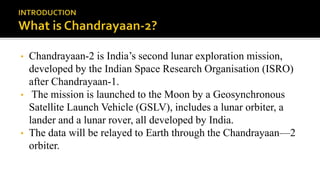
• Chandrayaan-2 is India’s second lunar exploration mission,
developed by the Indian Space Research Organisation (ISRO)
after Chandrayaan-1.
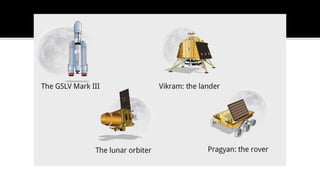
• The mission is launched to the Moon by a Geosynchronous
Satellite Launch Vehicle (GSLV), includes a lunar orbiter, a
lander and a lunar rover, all developed by India.
• The data will be relayed to Earth through the Chandrayaan—2
orbiter.
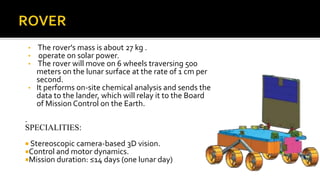
• The rover's mass is about 27 kg .
• operate on solar power.
• The rover will move on 6 wheels traversing 500
meters on the lunar surface at the rate of 1 cm per
second.
• It performs on-site chemical analysis and sends the
data to the lander, which will relay it to the Board
of Mission Control on the Earth.
.
SPECIALITIES:
 Stereoscopic camera-based 3D vision.
Control and motor dynamics.
Mission duration: ≤14 days (one lunar day)
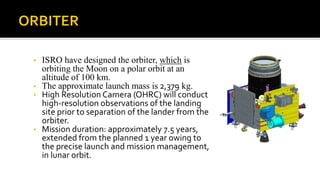
• ISRO have designed the orbiter, which is
orbiting the Moon on a polar orbit at an
altitude of 100 km.
• The approximate launch mass is 2,379 kg.
• High Resolution Camera (OHRC) will conduct
high-resolution observations of the landing
site prior to separation of the lander from the
orbiter.
• Mission duration: approximately 7.5 years,
extended from the planned 1 year owing to
the precise launch and mission management,
in lunar orbit.
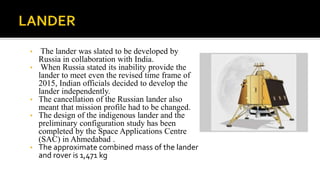
• The lander was slated to be developed by
Russia in collaboration with India.
• When Russia stated its inability provide the
lander to meet even the revised time frame of
2015, Indian officials decided to develop the
lander independently.
• The cancellation of the Russian lander also
meant that mission profile had to be changed.
• The design of the indigenous lander and the
preliminary configuration study has been
completed by the Space Applications Centre
(SAC) in Ahmedabad .
• The approximate combined mass of the lander
and rover is 1,471 kg
 The lander's trajectory began to deviate at about 2.1
kilometres (1.3 mi; 6,900 ft) above the surface.
 The final telemetry readings during ISRO's live-stream show
that Vikram's final vertical velocity was 58 m/s (210 km/h) from
330 meters above the surface
 Which was quiet fast for lunar landing.
 According to initial reports it suggested a crash.
 The crash have been confirmed by ISRO chairman K. Sivan,
stating that the lander location had been found by thermal
imagery obtained by orbitar.
 The mission was launched to the Moon from the second launch
pad at Satish Dhawan Space Centre on 22 July 2019 at 2.43 PM IST
(09:13 UTC) by a Geosynchronous Satellite LaunchVehicle Mark
III (GSLV Mk III).
 The craft reached the Moon's orbit on 20 August 2019 and began
orbital positioning for the landing of the Vikram lander
 Vikram separated from Chandrayaan-2 on 7 September 2019 and
was scheduled to land on the Moon at around 1:50 a.m. IST.The
initial descent was considered within mission parameters, passing
critical braking procedures as expected.
 The orbiter part of the mission, remains operational and will
continue its seven-year mission to study the Moon.
 As of June 2019, the mission has an allocated cost
of ₹978 crore (approximately US$141 million)
 This includes ₹603 crore for space segment and ₹375 crore as
launch costs on GSLV Mk III.
 NASA took 12 attempts to Reach .
 Germany took 7 attempts.
 This was India’s 1st attempt which is considered to be 95
percent successful till date.
Chandrayaan 2
Chandrayaan 2

Chandrayaan 2

  • 1.
  • 2.
    • Chandrayaan-2 isIndia’s second lunar exploration mission, developed by the Indian Space Research Organisation (ISRO) after Chandrayaan-1. • The mission is launched to the Moon by a Geosynchronous Satellite Launch Vehicle (GSLV), includes a lunar orbiter, a lander and a lunar rover, all developed by India. • The data will be relayed to Earth through the Chandrayaan—2 orbiter.
  • 4.
    • The rover'smass is about 27 kg . • operate on solar power. • The rover will move on 6 wheels traversing 500 meters on the lunar surface at the rate of 1 cm per second. • It performs on-site chemical analysis and sends the data to the lander, which will relay it to the Board of Mission Control on the Earth. . SPECIALITIES:  Stereoscopic camera-based 3D vision. Control and motor dynamics. Mission duration: ≤14 days (one lunar day)
  • 5.
    • ISRO havedesigned the orbiter, which is orbiting the Moon on a polar orbit at an altitude of 100 km. • The approximate launch mass is 2,379 kg. • High Resolution Camera (OHRC) will conduct high-resolution observations of the landing site prior to separation of the lander from the orbiter. • Mission duration: approximately 7.5 years, extended from the planned 1 year owing to the precise launch and mission management, in lunar orbit.
  • 6.
    • The landerwas slated to be developed by Russia in collaboration with India. • When Russia stated its inability provide the lander to meet even the revised time frame of 2015, Indian officials decided to develop the lander independently. • The cancellation of the Russian lander also meant that mission profile had to be changed. • The design of the indigenous lander and the preliminary configuration study has been completed by the Space Applications Centre (SAC) in Ahmedabad . • The approximate combined mass of the lander and rover is 1,471 kg
  • 7.
     The lander'strajectory began to deviate at about 2.1 kilometres (1.3 mi; 6,900 ft) above the surface.  The final telemetry readings during ISRO's live-stream show that Vikram's final vertical velocity was 58 m/s (210 km/h) from 330 meters above the surface  Which was quiet fast for lunar landing.  According to initial reports it suggested a crash.  The crash have been confirmed by ISRO chairman K. Sivan, stating that the lander location had been found by thermal imagery obtained by orbitar.
  • 8.
     The missionwas launched to the Moon from the second launch pad at Satish Dhawan Space Centre on 22 July 2019 at 2.43 PM IST (09:13 UTC) by a Geosynchronous Satellite LaunchVehicle Mark III (GSLV Mk III).  The craft reached the Moon's orbit on 20 August 2019 and began orbital positioning for the landing of the Vikram lander  Vikram separated from Chandrayaan-2 on 7 September 2019 and was scheduled to land on the Moon at around 1:50 a.m. IST.The initial descent was considered within mission parameters, passing critical braking procedures as expected.  The orbiter part of the mission, remains operational and will continue its seven-year mission to study the Moon.
  • 9.
     As ofJune 2019, the mission has an allocated cost of ₹978 crore (approximately US$141 million)  This includes ₹603 crore for space segment and ₹375 crore as launch costs on GSLV Mk III.  NASA took 12 attempts to Reach .  Germany took 7 attempts.  This was India’s 1st attempt which is considered to be 95 percent successful till date.