Time Series Analysis with R1
Yanchang Zhao
http://www.RDataMining.com
R and Data Mining Workshop @ AusDM 2014
27 November 2014
1
Presented at UJAT and Canberra R Users Group
1 / 39
Outline
Introduction
Time Series Decomposition
Time Series Forecasting
Time Series Clustering
Time Series Classification
Online Resources
2 / 39
Time Series Analysis with R 2
time series data in R
time series decomposition, forecasting, clustering and
classification
autoregressive integrated moving average (ARIMA) model
Dynamic Time Warping (DTW)
Discrete Wavelet Transform (DWT)
k-NN classification
2
Chapter 8: Time Series Analysis and Mining, in book
R and Data Mining: Examples and Case Studies.
http://www.rdatamining.com/docs/RDataMining.pdf
3 / 39
R
a free software environment for statistical computing and
graphics
runs on Windows, Linux and MacOS
widely used in academia and research, as well as industrial
applications
5,800+ packages (as of 13 Sept 2014)
CRAN Task View: Time Series Analysis
http://cran.r-project.org/web/views/TimeSeries.html
4 / 39
Time Series Data in R
class ts
represents data which has been sampled at equispaced points
in time
frequency=7: a weekly series
frequency=12: a monthly series
frequency=4: a quarterly series
5 / 39
Time Series Data in R
a <- ts(1:20, frequency = 12, start = c(2011, 3))
print(a)
## Jan Feb Mar Apr May Jun Jul Aug Sep Oct Nov Dec
## 2011 1 2 3 4 5 6 7 8 9 10
## 2012 11 12 13 14 15 16 17 18 19 20
str(a)
## Time-Series [1:20] from 2011 to 2013: 1 2 3 4 5 6 7 8 9 10...
attributes(a)
## $tsp
## [1] 2011 2013 12
##
## $class
## [1] "ts"
6 / 39
Outline
Introduction
Time Series Decomposition
Time Series Forecasting
Time Series Clustering
Time Series Classification
Online Resources
7 / 39
What is Time Series Decomposition
To decompose a time series into components:
Trend component: long term trend
Seasonal component: seasonal variation
Cyclical component: repeated but non-periodic fluctuations
Irregular component: the residuals
8 / 39
Data AirPassengers
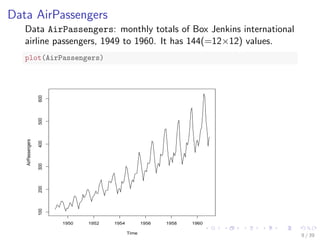
Data AirPassengers: monthly totals of Box Jenkins international
airline passengers, 1949 to 1960. It has 144(=12×12) values.
plot(AirPassengers)
Time
AirPassengers
1950 1952 1954 1956 1958 1960
100200300400500600
9 / 39
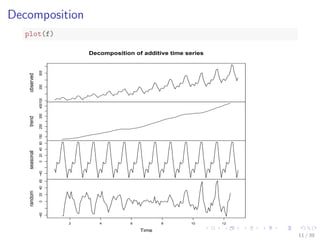
Decomposition
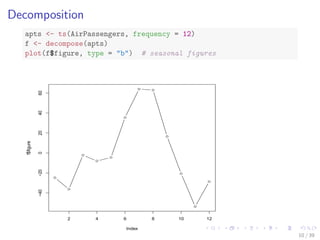
apts <- ts(AirPassengers, frequency = 12)
f <- decompose(apts)
plot(f$figure, type = "b") # seasonal figures
2 4 6 8 10 12
−40−200204060
Index
f$figure
10 / 39
Decomposition
plot(f)
100300500
observed
150250350450
trend
−400204060
seasonal
−400204060
2 4 6 8 10 12
random
Time
Decomposition of additive time series
11 / 39
Outline
Introduction
Time Series Decomposition
Time Series Forecasting
Time Series Clustering
Time Series Classification
Online Resources
12 / 39
Time Series Forecasting
To forecast future events based on known past data
For example, to predict the price of a stock based on its past
performance
Popular models
Autoregressive moving average (ARMA)
Autoregressive integrated moving average (ARIMA)
13 / 39
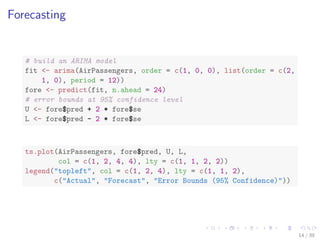
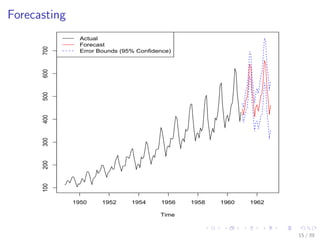
Forecasting
# build an ARIMA model
fit <- arima(AirPassengers, order = c(1, 0, 0), list(order = c(2,
1, 0), period = 12))
fore <- predict(fit, n.ahead = 24)
# error bounds at 95% confidence level
U <- fore$pred + 2 * fore$se
L <- fore$pred - 2 * fore$se
ts.plot(AirPassengers, fore$pred, U, L,
col = c(1, 2, 4, 4), lty = c(1, 1, 2, 2))
legend("topleft", col = c(1, 2, 4), lty = c(1, 1, 2),
c("Actual", "Forecast", "Error Bounds (95% Confidence)"))
14 / 39
Forecasting
Time
1950 1952 1954 1956 1958 1960 1962
100200300400500600700
Actual
Forecast
Error Bounds (95% Confidence)
15 / 39
Outline
Introduction
Time Series Decomposition
Time Series Forecasting
Time Series Clustering
Time Series Classification
Online Resources
16 / 39
Time Series Clustering
To partition time series data into groups based on similarity or
distance, so that time series in the same cluster are similar
Measure of distance/dissimilarity
Euclidean distance
Manhattan distance
Maximum norm
Hamming distance
The angle between two vectors (inner product)
Dynamic Time Warping (DTW) distance
...
17 / 39
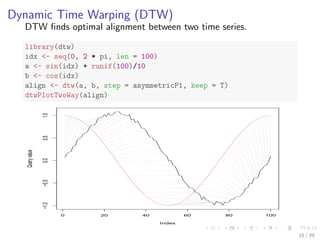
Dynamic Time Warping (DTW)
DTW finds optimal alignment between two time series.
library(dtw)
idx <- seq(0, 2 * pi, len = 100)
a <- sin(idx) + runif(100)/10
b <- cos(idx)
align <- dtw(a, b, step = asymmetricP1, keep = T)
dtwPlotTwoWay(align)
Index
Queryvalue
0 20 40 60 80 100
−1.0−0.50.00.51.0
18 / 39
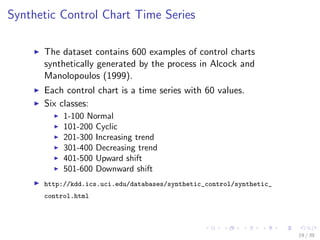
Synthetic Control Chart Time Series
The dataset contains 600 examples of control charts
synthetically generated by the process in Alcock and
Manolopoulos (1999).
Each control chart is a time series with 60 values.
Six classes:
1-100 Normal
101-200 Cyclic
201-300 Increasing trend
301-400 Decreasing trend
401-500 Upward shift
501-600 Downward shift
http://kdd.ics.uci.edu/databases/synthetic_control/synthetic_
control.html
19 / 39
Synthetic Control Chart Time Series
# read data into R sep='': the separator is white space, i.e., one
# or more spaces, tabs, newlines or carriage returns
sc <- read.table("./data/synthetic_control.data", header = F, sep = "")
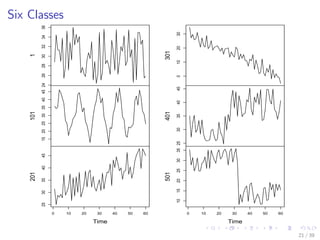
# show one sample from each class
idx <- c(1, 101, 201, 301, 401, 501)
sample1 <- t(sc[idx, ])
plot.ts(sample1, main = "")
20 / 39
Six Classes
24262830323436
1
15202530354045
101
2530354045
0 10 20 30 40 50 60
201
Time
0102030
301
2530354045
401
101520253035
0 10 20 30 40 50 60
501
Time
21 / 39
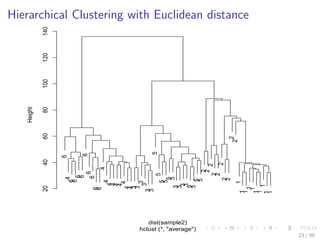
Hierarchical Clustering with Euclidean distance
# sample n cases from every class
n <- 10
s <- sample(1:100, n)
idx <- c(s, 100 + s, 200 + s, 300 + s, 400 + s, 500 + s)
sample2 <- sc[idx, ]
observedLabels <- rep(1:6, each = n)
# hierarchical clustering with Euclidean distance
hc <- hclust(dist(sample2), method = "ave")
plot(hc, labels = observedLabels, main = "")
22 / 39
Hierarchical Clustering with Euclidean distance
6
4
6
6
6
6
6
6
6
6
6
4
4
4
4
4
4
4
4
4
3
3
3
3
3
3
5
5
5
5
5
5
3
3
3
3
5
5
5
5
2
2
2
2
2
2
2
2
2
2
1
1
1
1
1
1
1
1
1
1
20406080100120140
hclust (*, "average")
dist(sample2)
Height
23 / 39
Hierarchical Clustering with Euclidean distance
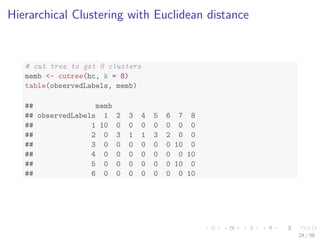
# cut tree to get 8 clusters
memb <- cutree(hc, k = 8)
table(observedLabels, memb)
## memb
## observedLabels 1 2 3 4 5 6 7 8
## 1 10 0 0 0 0 0 0 0
## 2 0 3 1 1 3 2 0 0
## 3 0 0 0 0 0 0 10 0
## 4 0 0 0 0 0 0 0 10
## 5 0 0 0 0 0 0 10 0
## 6 0 0 0 0 0 0 0 10
24 / 39
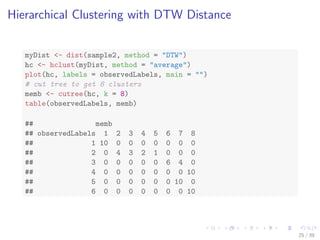
Hierarchical Clustering with DTW Distance
myDist <- dist(sample2, method = "DTW")
hc <- hclust(myDist, method = "average")
plot(hc, labels = observedLabels, main = "")
# cut tree to get 8 clusters
memb <- cutree(hc, k = 8)
table(observedLabels, memb)
## memb
## observedLabels 1 2 3 4 5 6 7 8
## 1 10 0 0 0 0 0 0 0
## 2 0 4 3 2 1 0 0 0
## 3 0 0 0 0 0 6 4 0
## 4 0 0 0 0 0 0 0 10
## 5 0 0 0 0 0 0 10 0
## 6 0 0 0 0 0 0 0 10
25 / 39
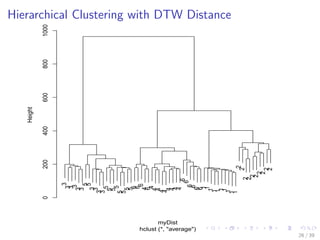
Hierarchical Clustering with DTW Distance
3
3
3
3
3
3
5
5
3
3
3
3
5
5
5
5
5
5
5
5
6
6
6
4
6
4
4
4
4
4
4
4
4
4
6
6
6
6
6
6
1
1
1
1
1
1
1
1
1
1
2
2
2
2
2
2
2
2
2
2
02004006008001000
hclust (*, "average")
myDist
Height
26 / 39
Outline
Introduction
Time Series Decomposition
Time Series Forecasting
Time Series Clustering
Time Series Classification
Online Resources
27 / 39
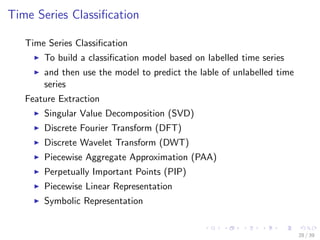
Time Series Classification
To build a classification model based on labelled time series
and then use the model to predict the lable of unlabelled time
series
Feature Extraction
Singular Value Decomposition (SVD)
Discrete Fourier Transform (DFT)
Discrete Wavelet Transform (DWT)
Piecewise Aggregate Approximation (PAA)
Perpetually Important Points (PIP)
Piecewise Linear Representation
Symbolic Representation
28 / 39
Decision Tree (ctree)
ctree from package party
classId <- rep(as.character(1:6), each = 100)
newSc <- data.frame(cbind(classId, sc))
library(party)
ct <- ctree(classId ~ ., data = newSc,
controls = ctree_control(minsplit = 20,
minbucket = 5, maxdepth = 5))
29 / 39
Decision Tree
pClassId <- predict(ct)
table(classId, pClassId)
## pClassId
## classId 1 2 3 4 5 6
## 1 100 0 0 0 0 0
## 2 1 97 2 0 0 0
## 3 0 0 99 0 1 0
## 4 0 0 0 100 0 0
## 5 4 0 8 0 88 0
## 6 0 3 0 90 0 7
# accuracy
(sum(classId == pClassId))/nrow(sc)
## [1] 0.8183
30 / 39
DWT (Discrete Wavelet Transform)
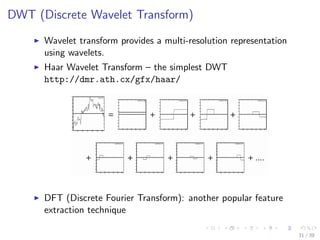
Wavelet transform provides a multi-resolution representation
using wavelets.
Haar Wavelet Transform – the simplest DWT
http://dmr.ath.cx/gfx/haar/
DFT (Discrete Fourier Transform): another popular feature
extraction technique
31 / 39
DWT (Discrete Wavelet Transform)
# extract DWT (with Haar filter) coefficients
library(wavelets)
wtData <- NULL
for (i in 1:nrow(sc)) {
a <- t(sc[i, ])
wt <- dwt(a, filter = "haar", boundary = "periodic")
wtData <- rbind(wtData, unlist(c(wt@W, wt@V[[wt@level]])))
}
wtData <- as.data.frame(wtData)
wtSc <- data.frame(cbind(classId, wtData))
32 / 39
Decision Tree with DWT
ct <- ctree(classId ~ ., data = wtSc,
controls = ctree_control(minsplit=20, minbucket=5,
maxdepth=5))
pClassId <- predict(ct)
table(classId, pClassId)
## pClassId
## classId 1 2 3 4 5 6
## 1 98 2 0 0 0 0
## 2 1 99 0 0 0 0
## 3 0 0 81 0 19 0
## 4 0 0 0 74 0 26
## 5 0 0 16 0 84 0
## 6 0 0 0 3 0 97
(sum(classId==pClassId)) / nrow(wtSc)
## [1] 0.8883
33 / 39
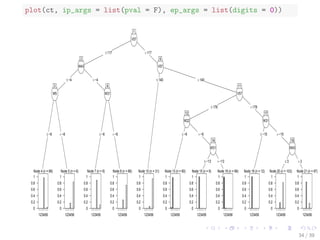
plot(ct, ip_args = list(pval = F), ep_args = list(digits = 0))
V57
1
≤ 117 > 117
W43
2
≤ −4 > −4
W5
3
≤ −8 > −8
Node 4 (n = 68)
123456
0
0.2
0.4
0.6
0.8
1
Node 5 (n = 6)
123456
0
0.2
0.4
0.6
0.8
1
W31
6
≤ −6 > −6
Node 7 (n = 9)
123456
0
0.2
0.4
0.6
0.8
1
Node 8 (n = 86)
123456
0
0.2
0.4
0.6
0.8
1
V57
9
≤ 140 > 140
Node 10 (n = 31)
123456
0
0.2
0.4
0.6
0.8
1
V57
11
≤ 178 > 178
W22
12
≤ −6 > −6
Node 13 (n = 80)
123456
0
0.2
0.4
0.6
0.8
1
W31
14
≤ −13 > −13
Node 15 (n = 9)
123456
0
0.2
0.4
0.6
0.8
1
Node 16 (n = 99)
123456
0
0.2
0.4
0.6
0.8
1
W31
17
≤ −15 > −15
Node 18 (n = 12)
123456
0
0.2
0.4
0.6
0.8
1
W43
19
≤ 3 > 3
Node 20 (n = 103)
123456
0
0.2
0.4
0.6
0.8
1
Node 21 (n = 97)
123456
0
0.2
0.4
0.6
0.8
1
34 / 39
k-NN Classification
find the k nearest neighbours of a new instance
label it by majority voting
needs an efficient indexing structure for large datasets
k <- 20
newTS <- sc[501, ] + runif(100) * 15
distances <- dist(newTS, sc, method = "DTW")
s <- sort(as.vector(distances), index.return = TRUE)
# class IDs of k nearest neighbours
table(classId[s$ix[1:k]])
##
## 4 6
## 3 17
35 / 39
k-NN Classification
find the k nearest neighbours of a new instance
label it by majority voting
needs an efficient indexing structure for large datasets
k <- 20
newTS <- sc[501, ] + runif(100) * 15
distances <- dist(newTS, sc, method = "DTW")
s <- sort(as.vector(distances), index.return = TRUE)
# class IDs of k nearest neighbours
table(classId[s$ix[1:k]])
##
## 4 6
## 3 17
Results of majority voting: class 6
35 / 39
The TSclust Package
TSclust: a package for time seriesclustering 3
measures of dissimilarity between time series to perform time
series clustering.
metrics based on raw data, on generating models and on the
forecast behavior
time series clustering algorithms and cluster evaluation metrics
3
http://cran.r-project.org/web/packages/TSclust/
36 / 39
Outline
Introduction
Time Series Decomposition
Time Series Forecasting
Time Series Clustering
Time Series Classification
Online Resources
37 / 39
Online Resources
Chapter 8: Time Series Analysis and Mining, in book
R and Data Mining: Examples and Case Studies
http://www.rdatamining.com/docs/RDataMining.pdf
R Reference Card for Data Mining
http://www.rdatamining.com/docs/R-refcard-data-mining.pdf
Free online courses and documents
http://www.rdatamining.com/resources/
RDataMining Group on LinkedIn (8,000+ members)
http://group.rdatamining.com
RDataMining on Twitter (1,800+ followers)
@RDataMining
38 / 39
The End
Thanks!
Email: yanchang(at)rdatamining.com
39 / 39

R data mining-Time Series Analysis with R

  • 1.
    Time Series Analysiswith R1 Yanchang Zhao http://www.RDataMining.com R and Data Mining Workshop @ AusDM 2014 27 November 2014 1 Presented at UJAT and Canberra R Users Group 1 / 39
  • 2.
    Outline Introduction Time Series Decomposition TimeSeries Forecasting Time Series Clustering Time Series Classification Online Resources 2 / 39
  • 3.
    Time Series Analysiswith R 2 time series data in R time series decomposition, forecasting, clustering and classification autoregressive integrated moving average (ARIMA) model Dynamic Time Warping (DTW) Discrete Wavelet Transform (DWT) k-NN classification 2 Chapter 8: Time Series Analysis and Mining, in book R and Data Mining: Examples and Case Studies. http://www.rdatamining.com/docs/RDataMining.pdf 3 / 39
  • 4.
    R a free softwareenvironment for statistical computing and graphics runs on Windows, Linux and MacOS widely used in academia and research, as well as industrial applications 5,800+ packages (as of 13 Sept 2014) CRAN Task View: Time Series Analysis http://cran.r-project.org/web/views/TimeSeries.html 4 / 39
  • 5.
    Time Series Datain R class ts represents data which has been sampled at equispaced points in time frequency=7: a weekly series frequency=12: a monthly series frequency=4: a quarterly series 5 / 39
  • 6.
    Time Series Datain R a <- ts(1:20, frequency = 12, start = c(2011, 3)) print(a) ## Jan Feb Mar Apr May Jun Jul Aug Sep Oct Nov Dec ## 2011 1 2 3 4 5 6 7 8 9 10 ## 2012 11 12 13 14 15 16 17 18 19 20 str(a) ## Time-Series [1:20] from 2011 to 2013: 1 2 3 4 5 6 7 8 9 10... attributes(a) ## $tsp ## [1] 2011 2013 12 ## ## $class ## [1] "ts" 6 / 39
  • 7.
    Outline Introduction Time Series Decomposition TimeSeries Forecasting Time Series Clustering Time Series Classification Online Resources 7 / 39
  • 8.
    What is TimeSeries Decomposition To decompose a time series into components: Trend component: long term trend Seasonal component: seasonal variation Cyclical component: repeated but non-periodic fluctuations Irregular component: the residuals 8 / 39
  • 9.
    Data AirPassengers Data AirPassengers:monthly totals of Box Jenkins international airline passengers, 1949 to 1960. It has 144(=12×12) values. plot(AirPassengers) Time AirPassengers 1950 1952 1954 1956 1958 1960 100200300400500600 9 / 39
  • 10.
    Decomposition apts <- ts(AirPassengers,frequency = 12) f <- decompose(apts) plot(f$figure, type = "b") # seasonal figures 2 4 6 8 10 12 −40−200204060 Index f$figure 10 / 39
  • 11.
  • 12.
    Outline Introduction Time Series Decomposition TimeSeries Forecasting Time Series Clustering Time Series Classification Online Resources 12 / 39
  • 13.
    Time Series Forecasting Toforecast future events based on known past data For example, to predict the price of a stock based on its past performance Popular models Autoregressive moving average (ARMA) Autoregressive integrated moving average (ARIMA) 13 / 39
  • 14.
    Forecasting # build anARIMA model fit <- arima(AirPassengers, order = c(1, 0, 0), list(order = c(2, 1, 0), period = 12)) fore <- predict(fit, n.ahead = 24) # error bounds at 95% confidence level U <- fore$pred + 2 * fore$se L <- fore$pred - 2 * fore$se ts.plot(AirPassengers, fore$pred, U, L, col = c(1, 2, 4, 4), lty = c(1, 1, 2, 2)) legend("topleft", col = c(1, 2, 4), lty = c(1, 1, 2), c("Actual", "Forecast", "Error Bounds (95% Confidence)")) 14 / 39
  • 15.
    Forecasting Time 1950 1952 19541956 1958 1960 1962 100200300400500600700 Actual Forecast Error Bounds (95% Confidence) 15 / 39
  • 16.
    Outline Introduction Time Series Decomposition TimeSeries Forecasting Time Series Clustering Time Series Classification Online Resources 16 / 39
  • 17.
    Time Series Clustering Topartition time series data into groups based on similarity or distance, so that time series in the same cluster are similar Measure of distance/dissimilarity Euclidean distance Manhattan distance Maximum norm Hamming distance The angle between two vectors (inner product) Dynamic Time Warping (DTW) distance ... 17 / 39
  • 18.
    Dynamic Time Warping(DTW) DTW finds optimal alignment between two time series. library(dtw) idx <- seq(0, 2 * pi, len = 100) a <- sin(idx) + runif(100)/10 b <- cos(idx) align <- dtw(a, b, step = asymmetricP1, keep = T) dtwPlotTwoWay(align) Index Queryvalue 0 20 40 60 80 100 −1.0−0.50.00.51.0 18 / 39
  • 19.
    Synthetic Control ChartTime Series The dataset contains 600 examples of control charts synthetically generated by the process in Alcock and Manolopoulos (1999). Each control chart is a time series with 60 values. Six classes: 1-100 Normal 101-200 Cyclic 201-300 Increasing trend 301-400 Decreasing trend 401-500 Upward shift 501-600 Downward shift http://kdd.ics.uci.edu/databases/synthetic_control/synthetic_ control.html 19 / 39
  • 20.
    Synthetic Control ChartTime Series # read data into R sep='': the separator is white space, i.e., one # or more spaces, tabs, newlines or carriage returns sc <- read.table("./data/synthetic_control.data", header = F, sep = "") # show one sample from each class idx <- c(1, 101, 201, 301, 401, 501) sample1 <- t(sc[idx, ]) plot.ts(sample1, main = "") 20 / 39
  • 21.
    Six Classes 24262830323436 1 15202530354045 101 2530354045 0 1020 30 40 50 60 201 Time 0102030 301 2530354045 401 101520253035 0 10 20 30 40 50 60 501 Time 21 / 39
  • 22.
    Hierarchical Clustering withEuclidean distance # sample n cases from every class n <- 10 s <- sample(1:100, n) idx <- c(s, 100 + s, 200 + s, 300 + s, 400 + s, 500 + s) sample2 <- sc[idx, ] observedLabels <- rep(1:6, each = n) # hierarchical clustering with Euclidean distance hc <- hclust(dist(sample2), method = "ave") plot(hc, labels = observedLabels, main = "") 22 / 39
  • 23.
    Hierarchical Clustering withEuclidean distance 6 4 6 6 6 6 6 6 6 6 6 4 4 4 4 4 4 4 4 4 3 3 3 3 3 3 5 5 5 5 5 5 3 3 3 3 5 5 5 5 2 2 2 2 2 2 2 2 2 2 1 1 1 1 1 1 1 1 1 1 20406080100120140 hclust (*, "average") dist(sample2) Height 23 / 39
  • 24.
    Hierarchical Clustering withEuclidean distance # cut tree to get 8 clusters memb <- cutree(hc, k = 8) table(observedLabels, memb) ## memb ## observedLabels 1 2 3 4 5 6 7 8 ## 1 10 0 0 0 0 0 0 0 ## 2 0 3 1 1 3 2 0 0 ## 3 0 0 0 0 0 0 10 0 ## 4 0 0 0 0 0 0 0 10 ## 5 0 0 0 0 0 0 10 0 ## 6 0 0 0 0 0 0 0 10 24 / 39
  • 25.
    Hierarchical Clustering withDTW Distance myDist <- dist(sample2, method = "DTW") hc <- hclust(myDist, method = "average") plot(hc, labels = observedLabels, main = "") # cut tree to get 8 clusters memb <- cutree(hc, k = 8) table(observedLabels, memb) ## memb ## observedLabels 1 2 3 4 5 6 7 8 ## 1 10 0 0 0 0 0 0 0 ## 2 0 4 3 2 1 0 0 0 ## 3 0 0 0 0 0 6 4 0 ## 4 0 0 0 0 0 0 0 10 ## 5 0 0 0 0 0 0 10 0 ## 6 0 0 0 0 0 0 0 10 25 / 39
  • 26.
    Hierarchical Clustering withDTW Distance 3 3 3 3 3 3 5 5 3 3 3 3 5 5 5 5 5 5 5 5 6 6 6 4 6 4 4 4 4 4 4 4 4 4 6 6 6 6 6 6 1 1 1 1 1 1 1 1 1 1 2 2 2 2 2 2 2 2 2 2 02004006008001000 hclust (*, "average") myDist Height 26 / 39
  • 27.
    Outline Introduction Time Series Decomposition TimeSeries Forecasting Time Series Clustering Time Series Classification Online Resources 27 / 39
  • 28.
    Time Series Classification TimeSeries Classification To build a classification model based on labelled time series and then use the model to predict the lable of unlabelled time series Feature Extraction Singular Value Decomposition (SVD) Discrete Fourier Transform (DFT) Discrete Wavelet Transform (DWT) Piecewise Aggregate Approximation (PAA) Perpetually Important Points (PIP) Piecewise Linear Representation Symbolic Representation 28 / 39
  • 29.
    Decision Tree (ctree) ctreefrom package party classId <- rep(as.character(1:6), each = 100) newSc <- data.frame(cbind(classId, sc)) library(party) ct <- ctree(classId ~ ., data = newSc, controls = ctree_control(minsplit = 20, minbucket = 5, maxdepth = 5)) 29 / 39
  • 30.
    Decision Tree pClassId <-predict(ct) table(classId, pClassId) ## pClassId ## classId 1 2 3 4 5 6 ## 1 100 0 0 0 0 0 ## 2 1 97 2 0 0 0 ## 3 0 0 99 0 1 0 ## 4 0 0 0 100 0 0 ## 5 4 0 8 0 88 0 ## 6 0 3 0 90 0 7 # accuracy (sum(classId == pClassId))/nrow(sc) ## [1] 0.8183 30 / 39
  • 31.
    DWT (Discrete WaveletTransform) Wavelet transform provides a multi-resolution representation using wavelets. Haar Wavelet Transform – the simplest DWT http://dmr.ath.cx/gfx/haar/ DFT (Discrete Fourier Transform): another popular feature extraction technique 31 / 39
  • 32.
    DWT (Discrete WaveletTransform) # extract DWT (with Haar filter) coefficients library(wavelets) wtData <- NULL for (i in 1:nrow(sc)) { a <- t(sc[i, ]) wt <- dwt(a, filter = "haar", boundary = "periodic") wtData <- rbind(wtData, unlist(c(wt@W, wt@V[[wt@level]]))) } wtData <- as.data.frame(wtData) wtSc <- data.frame(cbind(classId, wtData)) 32 / 39
  • 33.
    Decision Tree withDWT ct <- ctree(classId ~ ., data = wtSc, controls = ctree_control(minsplit=20, minbucket=5, maxdepth=5)) pClassId <- predict(ct) table(classId, pClassId) ## pClassId ## classId 1 2 3 4 5 6 ## 1 98 2 0 0 0 0 ## 2 1 99 0 0 0 0 ## 3 0 0 81 0 19 0 ## 4 0 0 0 74 0 26 ## 5 0 0 16 0 84 0 ## 6 0 0 0 3 0 97 (sum(classId==pClassId)) / nrow(wtSc) ## [1] 0.8883 33 / 39
  • 34.
    plot(ct, ip_args =list(pval = F), ep_args = list(digits = 0)) V57 1 ≤ 117 > 117 W43 2 ≤ −4 > −4 W5 3 ≤ −8 > −8 Node 4 (n = 68) 123456 0 0.2 0.4 0.6 0.8 1 Node 5 (n = 6) 123456 0 0.2 0.4 0.6 0.8 1 W31 6 ≤ −6 > −6 Node 7 (n = 9) 123456 0 0.2 0.4 0.6 0.8 1 Node 8 (n = 86) 123456 0 0.2 0.4 0.6 0.8 1 V57 9 ≤ 140 > 140 Node 10 (n = 31) 123456 0 0.2 0.4 0.6 0.8 1 V57 11 ≤ 178 > 178 W22 12 ≤ −6 > −6 Node 13 (n = 80) 123456 0 0.2 0.4 0.6 0.8 1 W31 14 ≤ −13 > −13 Node 15 (n = 9) 123456 0 0.2 0.4 0.6 0.8 1 Node 16 (n = 99) 123456 0 0.2 0.4 0.6 0.8 1 W31 17 ≤ −15 > −15 Node 18 (n = 12) 123456 0 0.2 0.4 0.6 0.8 1 W43 19 ≤ 3 > 3 Node 20 (n = 103) 123456 0 0.2 0.4 0.6 0.8 1 Node 21 (n = 97) 123456 0 0.2 0.4 0.6 0.8 1 34 / 39
  • 35.
    k-NN Classification find thek nearest neighbours of a new instance label it by majority voting needs an efficient indexing structure for large datasets k <- 20 newTS <- sc[501, ] + runif(100) * 15 distances <- dist(newTS, sc, method = "DTW") s <- sort(as.vector(distances), index.return = TRUE) # class IDs of k nearest neighbours table(classId[s$ix[1:k]]) ## ## 4 6 ## 3 17 35 / 39
  • 36.
    k-NN Classification find thek nearest neighbours of a new instance label it by majority voting needs an efficient indexing structure for large datasets k <- 20 newTS <- sc[501, ] + runif(100) * 15 distances <- dist(newTS, sc, method = "DTW") s <- sort(as.vector(distances), index.return = TRUE) # class IDs of k nearest neighbours table(classId[s$ix[1:k]]) ## ## 4 6 ## 3 17 Results of majority voting: class 6 35 / 39
  • 37.
    The TSclust Package TSclust:a package for time seriesclustering 3 measures of dissimilarity between time series to perform time series clustering. metrics based on raw data, on generating models and on the forecast behavior time series clustering algorithms and cluster evaluation metrics 3 http://cran.r-project.org/web/packages/TSclust/ 36 / 39
  • 38.
    Outline Introduction Time Series Decomposition TimeSeries Forecasting Time Series Clustering Time Series Classification Online Resources 37 / 39
  • 39.
    Online Resources Chapter 8:Time Series Analysis and Mining, in book R and Data Mining: Examples and Case Studies http://www.rdatamining.com/docs/RDataMining.pdf R Reference Card for Data Mining http://www.rdatamining.com/docs/R-refcard-data-mining.pdf Free online courses and documents http://www.rdatamining.com/resources/ RDataMining Group on LinkedIn (8,000+ members) http://group.rdatamining.com RDataMining on Twitter (1,800+ followers) @RDataMining 38 / 39
  • 40.