Association Rule Mining with R 
Yanchang Zhao 
http://www.RDataMining.com 
30 September 2014 
1 / 30
Outline 
Introduction 
Association Rule Mining 
Removing Redundancy 
Interpreting Rules 
Visualizing Association Rules 
Further Readings and Online Resources 
2 / 30
Association Rule Mining with R 1 
I basic concepts of association rules 
I association rules mining with R 
I pruning redundant rules 
I interpreting and visualizing association rules 
I recommended readings 
1Chapter 9: Association Rules, R and Data Mining: Examples and Case 
Studies. http://www.rdatamining.com/docs/RDataMining.pdf 
3 / 30
Association Rules 
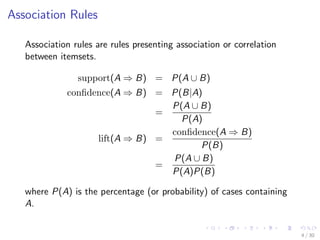
Association rules are rules presenting association or correlation 
between itemsets. 
support(A ) B) = P(A [ B) 
con
dence(A ) B) = P(BjA) 
= 
P(A [ B) 
P(A) 
lift(A ) B) = 
con
dence(A ) B) 
P(B) 
= 
P(A [ B) 
P(A)P(B) 
where P(A) is the percentage (or probability) of cases containing 
A. 
4 / 30
Association Rule Mining Algorithms in R 
I APRIORI 
I a level-wise, breadth-
rst algorithm which counts transactions 
to
nd frequent itemsets and then derive association rules from 
them 
I apriori() in package arules 
I ECLAT 
I
nds frequent itemsets with equivalence classes, depth-
rst 
search and set intersection instead of counting 
I eclat() in the same package 
5 / 30
Outline 
Introduction 
Association Rule Mining 
Removing Redundancy 
Interpreting Rules 
Visualizing Association Rules 
Further Readings and Online Resources 
6 / 30
The Titanic Dataset 
I The Titanic dataset in the datasets package is a 4-dimensional 
table with summarized information on the fate of passengers 
on the Titanic according to social class, sex, age and survival. 
I To make it suitable for association rule mining, we reconstruct 
the raw data as titanic.raw, where each row represents a 
person. 
I The reconstructed raw data can also be downloaded at 
http://www.rdatamining.com/data/titanic.raw.rdata. 
7 / 30
load("./data/titanic.raw.rdata") 
## draw a sample of 5 records 
idx <- sample(1:nrow(titanic.raw), 5) 
titanic.raw[idx, ] 
## Class Sex Age Survived 
## 950 Crew Male Adult No 
## 2176 3rd Female Adult Yes 
## 1716 Crew Male Adult Yes 
## 1001 Crew Male Adult No 
## 48 3rd Female Child No 
summary(titanic.raw) 
## Class Sex Age Survived 
## 1st :325 Female: 470 Adult:2092 No :1490 
## 2nd :285 Male :1731 Child: 109 Yes: 711 
## 3rd :706 
## Crew:885 
8 / 30
Function apriori() 
Mine frequent itemsets, association rules or association hyperedges 
using the Apriori algorithm. The Apriori algorithm employs 
level-wise search for frequent itemsets. 
Default settings: 
I minimum support: supp=0.1 
I minimum con
dence: conf=0.8 
I maximum length of rules: maxlen=10 
9 / 30
library(arules) 
rules.all <- apriori(titanic.raw) 
## 
## parameter specification: 
## confidence minval smax arem aval originalSupport support 
## 0.8 0.1 1 none FALSE TRUE 0.1 
## minlen maxlen target ext 
## 1 10 rules FALSE 
## 
## algorithmic control: 
## filter tree heap memopt load sort verbose 
## 0.1 TRUE TRUE FALSE TRUE 2 TRUE 
## 
## apriori - find association rules with the apriori algorithm 
## version 4.21 (2004.05.09) (c) 1996-2004 Christian ... 
## set item appearances ...[0 item(s)] done [0.00s]. 
## set transactions ...[10 item(s), 2201 transaction(s)] done ... 
## sorting and recoding items ... [9 item(s)] done [0.00s]. 
## creating transaction tree ... done [0.00s]. 
## checking subsets of size 1 2 3 4 done [0.00s]. 
## writing ... [27 rule(s)] done [0.00s]. 
## creating S4 object ... done [0.00s]. 
10 / 30
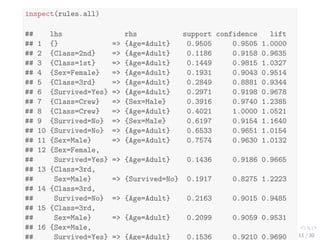
inspect(rules.all) 
## lhs rhs support confidence lift 
## 1 {} => {Age=Adult} 0.9505 0.9505 1.0000 
## 2 {Class=2nd} => {Age=Adult} 0.1186 0.9158 0.9635 
## 3 {Class=1st} => {Age=Adult} 0.1449 0.9815 1.0327 
## 4 {Sex=Female} => {Age=Adult} 0.1931 0.9043 0.9514 
## 5 {Class=3rd} => {Age=Adult} 0.2849 0.8881 0.9344 
## 6 {Survived=Yes} => {Age=Adult} 0.2971 0.9198 0.9678 
## 7 {Class=Crew} => {Sex=Male} 0.3916 0.9740 1.2385 
## 8 {Class=Crew} => {Age=Adult} 0.4021 1.0000 1.0521 
## 9 {Survived=No} => {Sex=Male} 0.6197 0.9154 1.1640 
## 10 {Survived=No} => {Age=Adult} 0.6533 0.9651 1.0154 
## 11 {Sex=Male} => {Age=Adult} 0.7574 0.9630 1.0132 
## 12 {Sex=Female, 
## Survived=Yes} => {Age=Adult} 0.1436 0.9186 0.9665 
## 13 {Class=3rd, 
## Sex=Male} => {Survived=No} 0.1917 0.8275 1.2223 
## 14 {Class=3rd, 
## Survived=No} => {Age=Adult} 0.2163 0.9015 0.9485 
## 15 {Class=3rd, 
## Sex=Male} => {Age=Adult} 0.2099 0.9059 0.9531 
## 16 {Sex=Male, 
## Survived=Yes} => {Age=Adult} 0.1536 0.9210 0.9690 
11 / 30
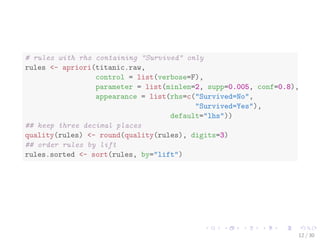
# rules with rhs containing "Survived" only 
rules <- apriori(titanic.raw, 
control = list(verbose=F), 
parameter = list(minlen=2, supp=0.005, conf=0.8), 
appearance = list(rhs=c("Survived=No", 
"Survived=Yes"), 
default="lhs")) 
## keep three decimal places 
quality(rules) <- round(quality(rules), digits=3) 
## order rules by lift 
rules.sorted <- sort(rules, by="lift") 
12 / 30
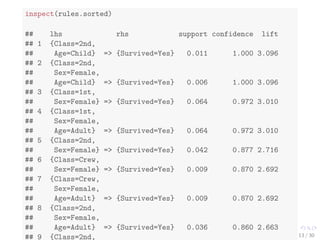
inspect(rules.sorted) 
## lhs rhs support confidence lift 
## 1 {Class=2nd, 
## Age=Child} => {Survived=Yes} 0.011 1.000 3.096 
## 2 {Class=2nd, 
## Sex=Female, 
## Age=Child} => {Survived=Yes} 0.006 1.000 3.096 
## 3 {Class=1st, 
## Sex=Female} => {Survived=Yes} 0.064 0.972 3.010 
## 4 {Class=1st, 
## Sex=Female, 
## Age=Adult} => {Survived=Yes} 0.064 0.972 3.010 
## 5 {Class=2nd, 
## Sex=Female} => {Survived=Yes} 0.042 0.877 2.716 
## 6 {Class=Crew, 
## Sex=Female} => {Survived=Yes} 0.009 0.870 2.692 
## 7 {Class=Crew, 
## Sex=Female, 
## Age=Adult} => {Survived=Yes} 0.009 0.870 2.692 
## 8 {Class=2nd, 
## Sex=Female, 
## Age=Adult} => {Survived=Yes} 0.036 0.860 2.663 
## 9 {Class=2nd, 
13 / 30
Outline 
Introduction 
Association Rule Mining 
Removing Redundancy 
Interpreting Rules 
Visualizing Association Rules 
Further Readings and Online Resources 
14 / 30
Redundant Rules 
inspect(rules.sorted[1:2]) 
## lhs rhs support confidence lift 
## 1 {Class=2nd, 
## Age=Child} => {Survived=Yes} 0.011 1 3.096 
## 2 {Class=2nd, 
## Sex=Female, 
## Age=Child} => {Survived=Yes} 0.006 1 3.096 
I Rule #2 provides no extra knowledge in addition to rule #1, 
since rules #1 tells us that all 2nd-class children survived. 
I When a rule (such as #2) is a super rule of another rule (#1) 
and the former has the same or a lower lift, the former rule 
(#2) is considered to be redundant. 
I Other redundant rules in the above result are rules #4, #7 
and #8, compared respectively with #3, #6 and #5. 
15 / 30
Remove Redundant Rules 
## find redundant rules 
subset.matrix <- is.subset(rules.sorted, rules.sorted) 
subset.matrix[lower.tri(subset.matrix, diag = T)] <- NA 
redundant <- colSums(subset.matrix, na.rm = T) >= 1 
## which rules are redundant 
which(redundant) 
## [1] 2 4 7 8 
## remove redundant rules 
rules.pruned <- rules.sorted[!redundant] 
16 / 30
Remaining Rules 
inspect(rules.pruned) 
## lhs rhs support confidence lift 
## 1 {Class=2nd, 
## Age=Child} => {Survived=Yes} 0.011 1.000 3.096 
## 2 {Class=1st, 
## Sex=Female} => {Survived=Yes} 0.064 0.972 3.010 
## 3 {Class=2nd, 
## Sex=Female} => {Survived=Yes} 0.042 0.877 2.716 
## 4 {Class=Crew, 
## Sex=Female} => {Survived=Yes} 0.009 0.870 2.692 
## 5 {Class=2nd, 
## Sex=Male, 
## Age=Adult} => {Survived=No} 0.070 0.917 1.354 
## 6 {Class=2nd, 
## Sex=Male} => {Survived=No} 0.070 0.860 1.271 
## 7 {Class=3rd, 
## Sex=Male, 
## Age=Adult} => {Survived=No} 0.176 0.838 1.237 
## 8 {Class=3rd, 
## Sex=Male} => {Survived=No} 0.192 0.827 1.222 
17 / 30
Outline 
Introduction 
Association Rule Mining 
Removing Redundancy 
Interpreting Rules 
Visualizing Association Rules 
Further Readings and Online Resources 
18 / 30
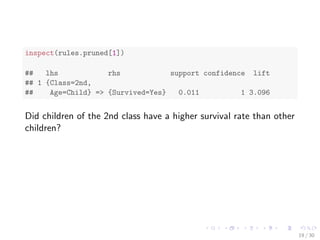
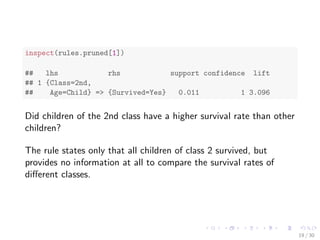
inspect(rules.pruned[1]) 
## lhs rhs support confidence lift 
## 1 {Class=2nd, 
## Age=Child} => {Survived=Yes} 0.011 1 3.096 
Did children of the 2nd class have a higher survival rate than other 
children? 
19 / 30
inspect(rules.pruned[1]) 
## lhs rhs support confidence lift 
## 1 {Class=2nd, 
## Age=Child} => {Survived=Yes} 0.011 1 3.096 
Did children of the 2nd class have a higher survival rate than other 
children? 
The rule states only that all children of class 2 survived, but 
provides no information at all to compare the survival rates of 
dierent classes. 
19 / 30
Rules about Children 
rules - apriori(titanic.raw, control = list(verbose=F), 
parameter = list(minlen=3, supp=0.002, conf=0.2), 
appearance = list(default=none, rhs=c(Survived=Yes), 
lhs=c(Class=1st, Class=2nd, Class=3rd, 
Age=Child, Age=Adult))) 
rules.sorted - sort(rules, by=confidence) 
inspect(rules.sorted) 
## lhs rhs support confidence lift 
## 1 {Class=2nd, 
## Age=Child} = {Survived=Yes} 0.010904 1.0000 3.0956 
## 2 {Class=1st, 
## Age=Child} = {Survived=Yes} 0.002726 1.0000 3.0956 
## 3 {Class=1st, 
## Age=Adult} = {Survived=Yes} 0.089505 0.6176 1.9117 
## 4 {Class=2nd, 
## Age=Adult} = {Survived=Yes} 0.042708 0.3602 1.1149 
## 5 {Class=3rd, 
## Age=Child} = {Survived=Yes} 0.012267 0.3418 1.0580 
## 6 {Class=3rd, 
## Age=Adult} = {Survived=Yes} 0.068605 0.2408 0.7455 
20 / 30
Outline 
Introduction 
Association Rule Mining 
Removing Redundancy 
Interpreting Rules 
Visualizing Association Rules 
Further Readings and Online Resources 
21 / 30
library(arulesViz) 
plot(rules.all) 
Scatter plot for 27 rules 
1.25 
1.2 
1.15 
1.1 
1.05 
1 
0.95 
lift 
0.2 0.4 0.6 0.8 
1 
0.95 
0.9 
0.85 
support 
confidence 
22 / 30
plot(rules.all, method = grouped) 
Grouped matrix for 27 rules 
size: support 
1 (Class=Crew +2) 
1 (Class=Crew +1) 
1 (Class=3rd +2) 
1 (Age=Adult +1) 
2 (Class=Crew +1) 
2 (Class=Crew +0) 
2 (Survived=No +0) 
2 (Class=3rd +1) 
2 (Class=Crew +2) 
1 (Class=3rd +2) 
1 (Class=1st +0) 
1 (Sex=Male +1) 
1 (Sex=Male +0) 
1 (Class=1st +−1) 
2 (Survived=Yes +1) 
1 (Sex=Female +1) 
2 (Class=2nd +3) 
1 (Sex=Female +0) 
1 (Class=3rd +1) 
1 (Class=3rd +0) 
color: lift 
{Age=Adult} 
{Survived=No} 
{Sex=Male} 
LHS 
RHS 
23 / 30

Association Rule Mining with R

  • 1.
    Association Rule Miningwith R Yanchang Zhao http://www.RDataMining.com 30 September 2014 1 / 30
  • 2.
    Outline Introduction AssociationRule Mining Removing Redundancy Interpreting Rules Visualizing Association Rules Further Readings and Online Resources 2 / 30
  • 3.
    Association Rule Miningwith R 1 I basic concepts of association rules I association rules mining with R I pruning redundant rules I interpreting and visualizing association rules I recommended readings 1Chapter 9: Association Rules, R and Data Mining: Examples and Case Studies. http://www.rdatamining.com/docs/RDataMining.pdf 3 / 30
  • 4.
    Association Rules Associationrules are rules presenting association or correlation between itemsets. support(A ) B) = P(A [ B) con
  • 5.
    dence(A ) B)= P(BjA) = P(A [ B) P(A) lift(A ) B) = con
  • 6.
    dence(A ) B) P(B) = P(A [ B) P(A)P(B) where P(A) is the percentage (or probability) of cases containing A. 4 / 30
  • 7.
    Association Rule MiningAlgorithms in R I APRIORI I a level-wise, breadth-
  • 8.
    rst algorithm whichcounts transactions to
  • 9.
    nd frequent itemsetsand then derive association rules from them I apriori() in package arules I ECLAT I
  • 10.
    nds frequent itemsetswith equivalence classes, depth-
  • 11.
    rst search andset intersection instead of counting I eclat() in the same package 5 / 30
  • 12.
    Outline Introduction AssociationRule Mining Removing Redundancy Interpreting Rules Visualizing Association Rules Further Readings and Online Resources 6 / 30
  • 13.
    The Titanic Dataset I The Titanic dataset in the datasets package is a 4-dimensional table with summarized information on the fate of passengers on the Titanic according to social class, sex, age and survival. I To make it suitable for association rule mining, we reconstruct the raw data as titanic.raw, where each row represents a person. I The reconstructed raw data can also be downloaded at http://www.rdatamining.com/data/titanic.raw.rdata. 7 / 30
  • 14.
    load("./data/titanic.raw.rdata") ## drawa sample of 5 records idx <- sample(1:nrow(titanic.raw), 5) titanic.raw[idx, ] ## Class Sex Age Survived ## 950 Crew Male Adult No ## 2176 3rd Female Adult Yes ## 1716 Crew Male Adult Yes ## 1001 Crew Male Adult No ## 48 3rd Female Child No summary(titanic.raw) ## Class Sex Age Survived ## 1st :325 Female: 470 Adult:2092 No :1490 ## 2nd :285 Male :1731 Child: 109 Yes: 711 ## 3rd :706 ## Crew:885 8 / 30
  • 15.
    Function apriori() Minefrequent itemsets, association rules or association hyperedges using the Apriori algorithm. The Apriori algorithm employs level-wise search for frequent itemsets. Default settings: I minimum support: supp=0.1 I minimum con
  • 16.
    dence: conf=0.8 Imaximum length of rules: maxlen=10 9 / 30
  • 17.
    library(arules) rules.all <-apriori(titanic.raw) ## ## parameter specification: ## confidence minval smax arem aval originalSupport support ## 0.8 0.1 1 none FALSE TRUE 0.1 ## minlen maxlen target ext ## 1 10 rules FALSE ## ## algorithmic control: ## filter tree heap memopt load sort verbose ## 0.1 TRUE TRUE FALSE TRUE 2 TRUE ## ## apriori - find association rules with the apriori algorithm ## version 4.21 (2004.05.09) (c) 1996-2004 Christian ... ## set item appearances ...[0 item(s)] done [0.00s]. ## set transactions ...[10 item(s), 2201 transaction(s)] done ... ## sorting and recoding items ... [9 item(s)] done [0.00s]. ## creating transaction tree ... done [0.00s]. ## checking subsets of size 1 2 3 4 done [0.00s]. ## writing ... [27 rule(s)] done [0.00s]. ## creating S4 object ... done [0.00s]. 10 / 30
  • 18.
    inspect(rules.all) ## lhsrhs support confidence lift ## 1 {} => {Age=Adult} 0.9505 0.9505 1.0000 ## 2 {Class=2nd} => {Age=Adult} 0.1186 0.9158 0.9635 ## 3 {Class=1st} => {Age=Adult} 0.1449 0.9815 1.0327 ## 4 {Sex=Female} => {Age=Adult} 0.1931 0.9043 0.9514 ## 5 {Class=3rd} => {Age=Adult} 0.2849 0.8881 0.9344 ## 6 {Survived=Yes} => {Age=Adult} 0.2971 0.9198 0.9678 ## 7 {Class=Crew} => {Sex=Male} 0.3916 0.9740 1.2385 ## 8 {Class=Crew} => {Age=Adult} 0.4021 1.0000 1.0521 ## 9 {Survived=No} => {Sex=Male} 0.6197 0.9154 1.1640 ## 10 {Survived=No} => {Age=Adult} 0.6533 0.9651 1.0154 ## 11 {Sex=Male} => {Age=Adult} 0.7574 0.9630 1.0132 ## 12 {Sex=Female, ## Survived=Yes} => {Age=Adult} 0.1436 0.9186 0.9665 ## 13 {Class=3rd, ## Sex=Male} => {Survived=No} 0.1917 0.8275 1.2223 ## 14 {Class=3rd, ## Survived=No} => {Age=Adult} 0.2163 0.9015 0.9485 ## 15 {Class=3rd, ## Sex=Male} => {Age=Adult} 0.2099 0.9059 0.9531 ## 16 {Sex=Male, ## Survived=Yes} => {Age=Adult} 0.1536 0.9210 0.9690 11 / 30
  • 19.
    # rules withrhs containing "Survived" only rules <- apriori(titanic.raw, control = list(verbose=F), parameter = list(minlen=2, supp=0.005, conf=0.8), appearance = list(rhs=c("Survived=No", "Survived=Yes"), default="lhs")) ## keep three decimal places quality(rules) <- round(quality(rules), digits=3) ## order rules by lift rules.sorted <- sort(rules, by="lift") 12 / 30
  • 20.
    inspect(rules.sorted) ## lhsrhs support confidence lift ## 1 {Class=2nd, ## Age=Child} => {Survived=Yes} 0.011 1.000 3.096 ## 2 {Class=2nd, ## Sex=Female, ## Age=Child} => {Survived=Yes} 0.006 1.000 3.096 ## 3 {Class=1st, ## Sex=Female} => {Survived=Yes} 0.064 0.972 3.010 ## 4 {Class=1st, ## Sex=Female, ## Age=Adult} => {Survived=Yes} 0.064 0.972 3.010 ## 5 {Class=2nd, ## Sex=Female} => {Survived=Yes} 0.042 0.877 2.716 ## 6 {Class=Crew, ## Sex=Female} => {Survived=Yes} 0.009 0.870 2.692 ## 7 {Class=Crew, ## Sex=Female, ## Age=Adult} => {Survived=Yes} 0.009 0.870 2.692 ## 8 {Class=2nd, ## Sex=Female, ## Age=Adult} => {Survived=Yes} 0.036 0.860 2.663 ## 9 {Class=2nd, 13 / 30
  • 21.
    Outline Introduction AssociationRule Mining Removing Redundancy Interpreting Rules Visualizing Association Rules Further Readings and Online Resources 14 / 30
  • 22.
    Redundant Rules inspect(rules.sorted[1:2]) ## lhs rhs support confidence lift ## 1 {Class=2nd, ## Age=Child} => {Survived=Yes} 0.011 1 3.096 ## 2 {Class=2nd, ## Sex=Female, ## Age=Child} => {Survived=Yes} 0.006 1 3.096 I Rule #2 provides no extra knowledge in addition to rule #1, since rules #1 tells us that all 2nd-class children survived. I When a rule (such as #2) is a super rule of another rule (#1) and the former has the same or a lower lift, the former rule (#2) is considered to be redundant. I Other redundant rules in the above result are rules #4, #7 and #8, compared respectively with #3, #6 and #5. 15 / 30
  • 23.
    Remove Redundant Rules ## find redundant rules subset.matrix <- is.subset(rules.sorted, rules.sorted) subset.matrix[lower.tri(subset.matrix, diag = T)] <- NA redundant <- colSums(subset.matrix, na.rm = T) >= 1 ## which rules are redundant which(redundant) ## [1] 2 4 7 8 ## remove redundant rules rules.pruned <- rules.sorted[!redundant] 16 / 30
  • 24.
    Remaining Rules inspect(rules.pruned) ## lhs rhs support confidence lift ## 1 {Class=2nd, ## Age=Child} => {Survived=Yes} 0.011 1.000 3.096 ## 2 {Class=1st, ## Sex=Female} => {Survived=Yes} 0.064 0.972 3.010 ## 3 {Class=2nd, ## Sex=Female} => {Survived=Yes} 0.042 0.877 2.716 ## 4 {Class=Crew, ## Sex=Female} => {Survived=Yes} 0.009 0.870 2.692 ## 5 {Class=2nd, ## Sex=Male, ## Age=Adult} => {Survived=No} 0.070 0.917 1.354 ## 6 {Class=2nd, ## Sex=Male} => {Survived=No} 0.070 0.860 1.271 ## 7 {Class=3rd, ## Sex=Male, ## Age=Adult} => {Survived=No} 0.176 0.838 1.237 ## 8 {Class=3rd, ## Sex=Male} => {Survived=No} 0.192 0.827 1.222 17 / 30
  • 25.
    Outline Introduction AssociationRule Mining Removing Redundancy Interpreting Rules Visualizing Association Rules Further Readings and Online Resources 18 / 30
  • 26.
    inspect(rules.pruned[1]) ## lhsrhs support confidence lift ## 1 {Class=2nd, ## Age=Child} => {Survived=Yes} 0.011 1 3.096 Did children of the 2nd class have a higher survival rate than other children? 19 / 30
  • 27.
    inspect(rules.pruned[1]) ## lhsrhs support confidence lift ## 1 {Class=2nd, ## Age=Child} => {Survived=Yes} 0.011 1 3.096 Did children of the 2nd class have a higher survival rate than other children? The rule states only that all children of class 2 survived, but provides no information at all to compare the survival rates of dierent classes. 19 / 30
  • 28.
    Rules about Children rules - apriori(titanic.raw, control = list(verbose=F), parameter = list(minlen=3, supp=0.002, conf=0.2), appearance = list(default=none, rhs=c(Survived=Yes), lhs=c(Class=1st, Class=2nd, Class=3rd, Age=Child, Age=Adult))) rules.sorted - sort(rules, by=confidence) inspect(rules.sorted) ## lhs rhs support confidence lift ## 1 {Class=2nd, ## Age=Child} = {Survived=Yes} 0.010904 1.0000 3.0956 ## 2 {Class=1st, ## Age=Child} = {Survived=Yes} 0.002726 1.0000 3.0956 ## 3 {Class=1st, ## Age=Adult} = {Survived=Yes} 0.089505 0.6176 1.9117 ## 4 {Class=2nd, ## Age=Adult} = {Survived=Yes} 0.042708 0.3602 1.1149 ## 5 {Class=3rd, ## Age=Child} = {Survived=Yes} 0.012267 0.3418 1.0580 ## 6 {Class=3rd, ## Age=Adult} = {Survived=Yes} 0.068605 0.2408 0.7455 20 / 30
  • 29.
    Outline Introduction AssociationRule Mining Removing Redundancy Interpreting Rules Visualizing Association Rules Further Readings and Online Resources 21 / 30
  • 30.
    library(arulesViz) plot(rules.all) Scatterplot for 27 rules 1.25 1.2 1.15 1.1 1.05 1 0.95 lift 0.2 0.4 0.6 0.8 1 0.95 0.9 0.85 support confidence 22 / 30
  • 31.
    plot(rules.all, method =grouped) Grouped matrix for 27 rules size: support 1 (Class=Crew +2) 1 (Class=Crew +1) 1 (Class=3rd +2) 1 (Age=Adult +1) 2 (Class=Crew +1) 2 (Class=Crew +0) 2 (Survived=No +0) 2 (Class=3rd +1) 2 (Class=Crew +2) 1 (Class=3rd +2) 1 (Class=1st +0) 1 (Sex=Male +1) 1 (Sex=Male +0) 1 (Class=1st +−1) 2 (Survived=Yes +1) 1 (Sex=Female +1) 2 (Class=2nd +3) 1 (Sex=Female +0) 1 (Class=3rd +1) 1 (Class=3rd +0) color: lift {Age=Adult} {Survived=No} {Sex=Male} LHS RHS 23 / 30