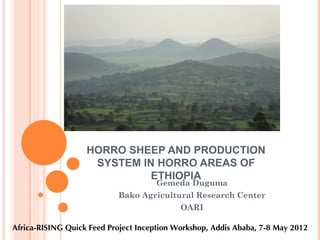
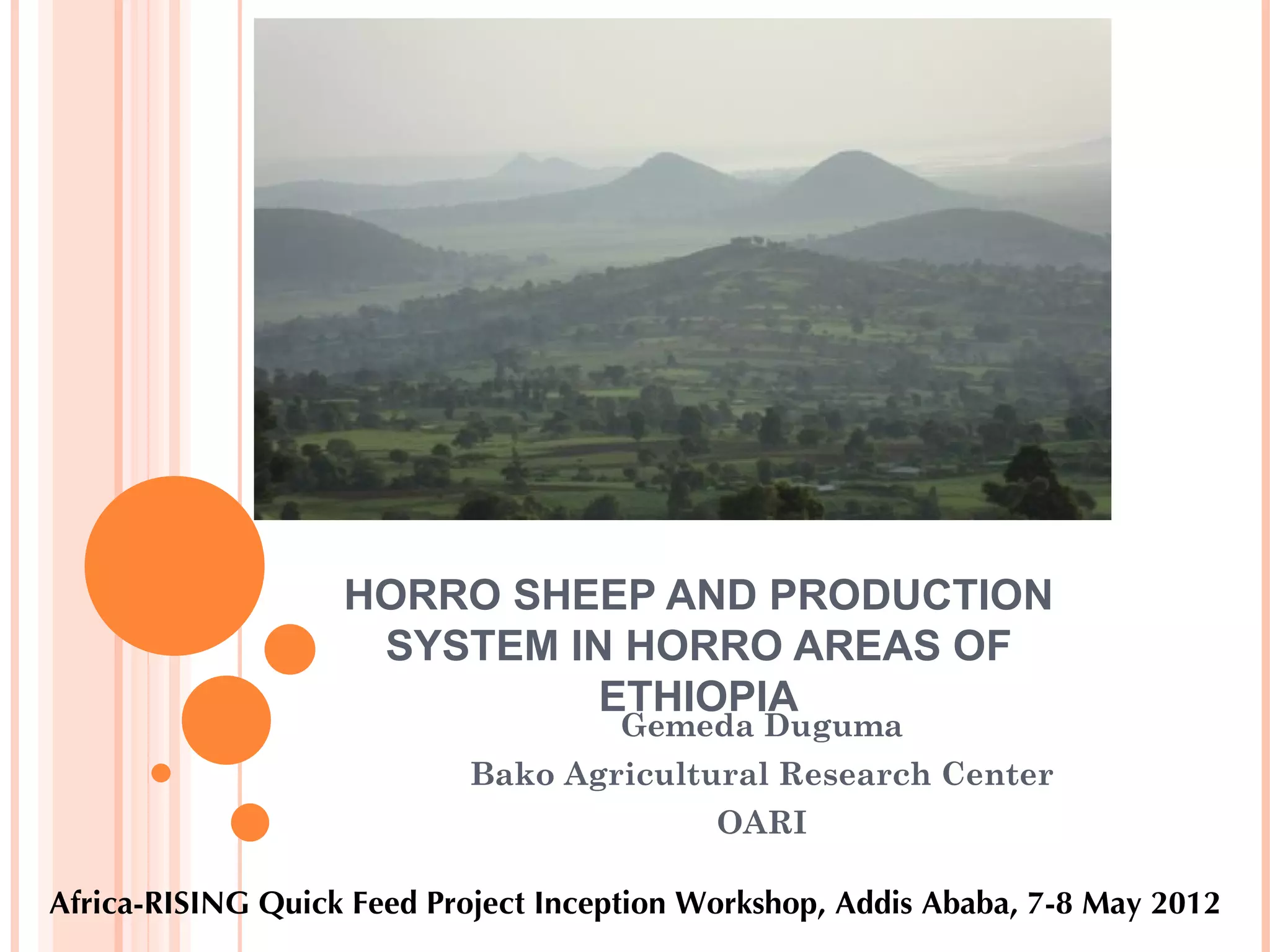

HORRO SHEEP AND PRODUCTION
                    SYSTEM IN HORRO AREAS OF
                             ETHIOPIA
                                      Gemeda Duguma
                            Bako Agricultural Research Center
                                            OARI

Africa-RISING Quick Feed Project Inception Workshop, Addis Ababa, 7-8 May 2012
OUTLINE OF PRESENTATION


                                                             05/07/12
 Introduction
 Description of Horro sheep


                                                    Workshop_07-08 May 2012
                                                    USAID Quick Feed Project_Inception
 Production system in Horro area (Home tract of
  the Horro sheep)
 Interventions made so far and major bottlenecks

 Improvement options


                                                    2
INTRODUCTION


                                                                    05/07/12
   Sheep is the second most important livestock species
    in Ethiopia


                                                           Workshop_07-08 May 2012
                                                           USAID Quick Feed Project_Inception
   The country possesses ≈ 26 million head of sheep
   Ethiopia’s great variation in climate & topography
    represents a good reservoir of sheep genotypes
   Diverse sheep breeds and ecotypes are kept in
    different regions and ecologies – from the
    mountainous highlands to the arid pastoral lowland
    areas
                                                           3
INTRODUCTION


                                                            05/07/12
   Few of them have been studied and
    characterized – only nine sheep breeds have


                                                   Workshop_07-08 May 2012
                                                   USAID Quick Feed Project_Inception
    identified by phenotypic and molecular
    characterization methods
   Horro sheep is one of the nine sheep breeds
    identified & is situated in western Ethiopia


                                                   4
HORRO SHEEP - HABITAT


                                                        05/07/12
  Most dominant sheep breed in western
   Ethiopia


                                               Workshop_07-08 May 2012
                                               USAID Quick Feed Project_Inception
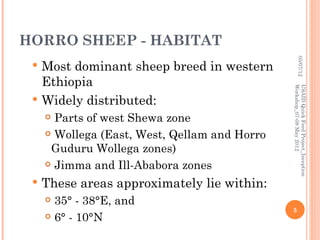
  Widely distributed:
      Parts of west Shewa zone
      Wollega (East, West, Qellam and Horro

      Guduru Wollega zones)
      Jimma and Ill-Ababora zones

    These areas approximately lie within:
      35° - 38°E, and
                                               5
      6° - 10°N
HORRO SHEEP - HABITAT


                                                                          05/07/12
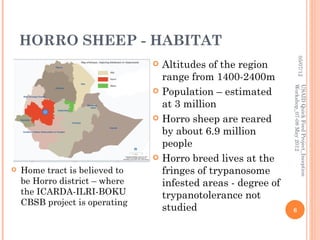
                                   Altitudes of the region
                                    range from 1400-2400m


                                                                 Workshop_07-08 May 2012
                                                                 USAID Quick Feed Project_Inception
                                   Population – estimated
                                    at 3 million
                                   Horro sheep are reared
                                    by about 6.9 million
                                    people
                                   Horro breed lives at the
   Home tract is believed to       fringes of trypanosome
    be Horro district – where       infested areas - degree of
    the ICARDA-ILRI-BOKU            trypanotolerance not
    CBSB project is operating
                                    studied                      6
BREED DESCRIPTION – COAT COLOR


                                                                   05/07/12
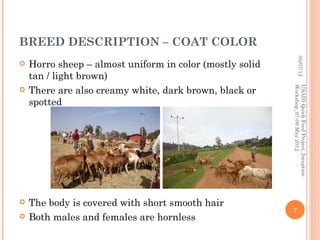
   Horro sheep – almost uniform in color (mostly solid
    tan / light brown)
    There are also creamy white, dark brown, black or


                                                          Workshop_07-08 May 2012
                                                          USAID Quick Feed Project_Inception

    spotted


   The body is covered with short smooth hair
                                                          7
   Both males and females are hornless
BREED DESCRIPTION – GROWTH
PERFORMANCE


                                                                                              05/07/12
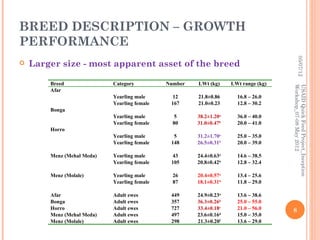
   Larger size - most apparent asset of the breed

        Breed               Category          Number   LWt (kg)     LWt range (kg)


                                                                                     Workshop_07-08 May 2012
                                                                                     USAID Quick Feed Project_Inception
        Afar
                            Yearling male       12     21.8±0.86      16.8 – 26.0
                            Yearling female    167     21.0±0.23      12.8 – 30.2
        Bonga
                            Yearling male        5     38.2±1.20a     36.0 – 40.0
                            Yearling female     80     31.0±0.47b     20.0 – 41.0
        Horro
                            Yearling male       5      31.2±1.70a     25.0 – 35.0
                            Yearling female    148     26.5±0.31b     20.0 – 39.0

        Menz (Mehal Meda)   Yearling male       43     24.4±0.63a     14.6 – 38.5
                            Yearling female    105     20.8±0.42b     12.8 – 32.4

        Menz (Molale)       Yearling male       26     20.4±0.57a     13.4 – 25.6
                            Yearling female     87     18.1±0.31b     11.8 – 29.0

        Afar                Adult ewes         449     24.9±0.23a     13.6 – 38.6
        Bonga               Adult ewes         357     36.3±0.26b     25.0 – 55.0
        Horro               Adult ewes         727     33.4±0.18c     21.0 – 56.0    8
        Menz (Mehal Meda)   Adult ewes         497     23.6±0.16d     15.0 – 35.0
        Menz (Molale)       Adult ewes         298     21.3±0.20f     13.6 – 29.0
BREED DESCRIPTION – GROWTH
PERFORMANCE


                                                                    05/07/12
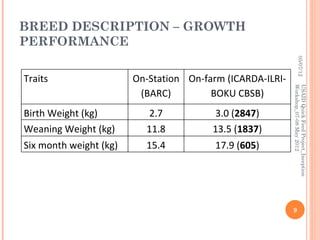
Traits                  On-Station On-farm (ICARDA-ILRI-


                                                           Workshop_07-08 May 2012
                                                           USAID Quick Feed Project_Inception
                         (BARC)         BOKU CBSB)
Birth Weight (kg)          2.7          3.0 (2847)
Weaning Weight (kg)       11.8          13.5 (1837)
Six month weight (kg)     15.4           17.9 (605)


                                                           9
BREED DESCRIPTION –
REPRODUCTION PERFORMANCE


                                                                                   05/07/12
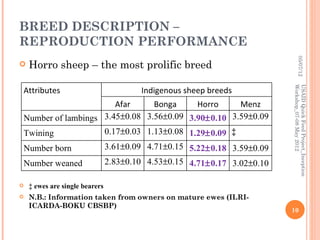
   Horro sheep – the most prolific breed


                                                                          Workshop_07-08 May 2012
                                                                          USAID Quick Feed Project_Inception
Attributes                              Indigenous sheep breeds
                      Afar     Bonga     Horro     Menz
Number of lambings 3.45±0.08 3.56±0.09 3.90±0.10 3.59±0.09
Twining                         0.17±0.03 1.13±0.08 1.29±0.09 ‡
Number born                     3.61±0.09 4.71±0.15 5.22±0.18 3.59±0.09
Number weaned                   2.83±0.10 4.53±0.15 4.71±0.17 3.02±0.10

   ‡ ewes are single bearers
   N.B.: Information taken from owners on mature ewes (ILRI-
    ICARDA-BOKU CBSBP)
                                                                          10
PRODUCTION SYSTEM IN HORRO
AREAS


                                                   05/07/12
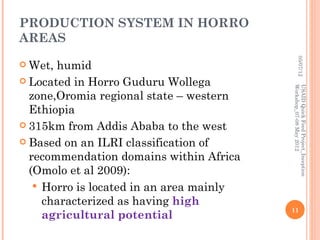
 Wet, humid
 Located in Horro Guduru Wollega


                                          Workshop_07-08 May 2012
                                          USAID Quick Feed Project_Inception
  zone,Oromia regional state – western
  Ethiopia
 315km from Addis Ababa to the west

 Based on an ILRI classification of
  recommendation domains within Africa
  (Omolo et al 2009):
    Horro is located in an area mainly
     characterized as having high
                                          11
     agricultural potential
PRODUCTION SYSTEM…
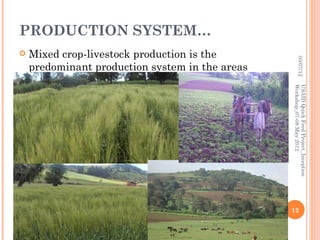
   Mixed crop-livestock production is the


                                                          05/07/12
    predominant production system in the areas


                                                 Workshop_07-08 May 2012
                                                 USAID Quick Feed Project_Inception
                                                 12
MAJOR LS AND CROPS
RAISED/GROWN


                                                             05/07/12
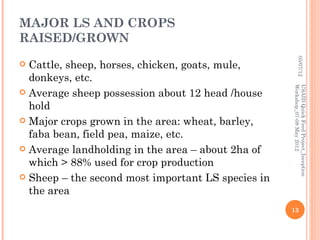
 Cattle, sheep, horses, chicken, goats, mule,
  donkeys, etc.


                                                    Workshop_07-08 May 2012
                                                    USAID Quick Feed Project_Inception
 Average sheep possession about 12 head /house
  hold
 Major crops grown in the area: wheat, barley,
  faba bean, field pea, maize, etc.
 Average landholding in the area – about 2ha of
  which > 88% used for crop production
 Sheep – the second most important LS species in
  the area
                                                    13
SHEEP BREEDING MANAGEMENT


                                                               05/07/12
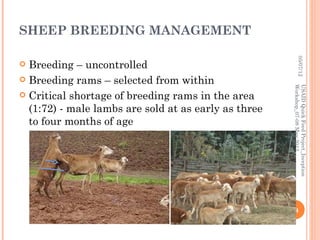
 Breeding – uncontrolled
 Breeding rams – selected from within


                                                      Workshop_07-08 May 2012
                                                      USAID Quick Feed Project_Inception
 Critical shortage of breeding rams in the area
  (1:72) - male lambs are sold at as early as three
  to four months of age


                                                      14
WHY SELL MALES EARLY?


                                                             05/07/12
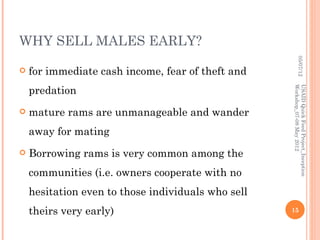
   for immediate cash income, fear of theft and
    predation


                                                    Workshop_07-08 May 2012
                                                    USAID Quick Feed Project_Inception
   mature rams are unmanageable and wander
    away for mating
   Borrowing rams is very common among the
    communities (i.e. owners cooperate with no
    hesitation even to those individuals who sell
    theirs very early)                              15
MARKETING


                                                                05/07/12
   Producers sale their animals:


                                                       Workshop_07-08 May 2012
                                                       USAID Quick Feed Project_Inception
       at farm gate, nearby/distant markets
       whenever there is an immediate need for cash
   High price differences between them
   High number of middlemen, less bargaining
    power and thus small producer margins

                                                       16
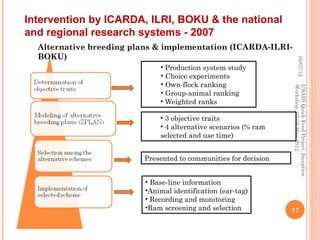
Intervention by ICARDA, ILRI, BOKU & the national
and regional research systems - 2007
  Alternative breeding plans & implementation (ICARDA-ILRI-
  BOKU)


                                                                          05/07/12
                              • Production system study
                              • Choice experiments
                              • Own-flock ranking


                                                                 Workshop_07-08 May 2012
                                                                 USAID Quick Feed Project_Inception
                              • Group-animal ranking
                              • Weighted ranks

                              • 3 objective traits
                              • 4 alternative scenarios (% ram
                              selected and use time)


                         Presented to communities for decision


                          • Base-line information
                          •Animal identification (ear-tag)
                          • Recording and monitoring
                          •Ram screening and selection           17
SHEEP BREEDING MANAGEMENT –
(ICARDA-ILRI-BOKU CBSBP
MEMBERS)


                                                                         05/07/12
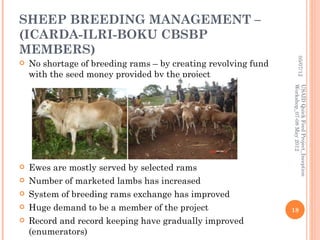
   No shortage of breeding rams – by creating revolving fund
    with the seed money provided by the project


                                                                Workshop_07-08 May 2012
                                                                USAID Quick Feed Project_Inception
   Ewes are mostly served by selected rams
   Number of marketed lambs has increased
   System of breeding rams exchange has improved
   Huge demand to be a member of the project                   18
   Record and record keeping have gradually improved
    (enumerators)
BOTTLENECKS - ICARDA-ILRI-
BOKU CBSBP


                                                            05/07/12
 Unable to scale-up/scale-out the improvement
  program to wider areas - does have its own
  influence on genetic improvement and marketing


                                                   Workshop_07-08 May 2012
                                                   USAID Quick Feed Project_Inception
  of more uniform animals at a time
 Lack of uniformity among young rams presented
  for selection (eg. age differences)
 Production of uniform animals for market

 Matching of lambing with feed availability and
  market
 Organizing project members into cooperative

                                                   19
BOTTLENECKS…


                                                                          05/07/12
   Having legally functioning breeding cooperatives
    is important to coordinate and perform


                                                                 Workshop_07-08 May 2012
                                                                 USAID Quick Feed Project_Inception
    community-level collective actions like:
       exchange of breeding rams,
       culling of non-selected rams,
       joint procurement of medicaments, supplementary feeds
        to condition/fatten non-selected rams before marketing
        and marketing of such animals, etc.
                                                                 20
MAJOR FEED RESOURCES – HORRO
AREAS


                                                                      05/07/12
1)   Natural pasture        Two types of grazing
     (grazing)               lands prevail in the
                             area: communal and


                                                             Workshop_07-08 May 2012
                                                             USAID Quick Feed Project_Inception
2)   Crop residues
                             the private
3)   Fallow land
                            The communal
4)   Crop aftermath, and
                             grazing area is:
5)   Hay from natural             The most commonly
     pasture                       exploited and depleted
                                   type - because all
                                   livestock species found
                                   in the area are kept on
                                   it throughout the year
                                                             21
MAJOR FEED…


                                                                  05/07/12
                                                         Workshop_07-08 May 2012
                                                         USAID Quick Feed Project_Inception
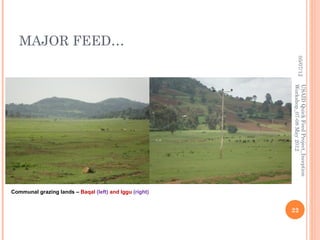
Communal grazing lands – Baqal (left) and Iggu (right)


                                                         22
MAJOR FEED …


                                                                              05/07/12
   The communal grazing area is neither protected nor
    given any sort of management.
    It is decreasing in size & pasture production from


                                                                     Workshop_07-08 May 2012
                                                                     USAID Quick Feed Project_Inception

    time to time:
       population pressure – newly emerging households forced to
        settle on it
       animals are kept on it particularly during peak seasons to
        minimize labor demand for herding
       still others do so in order to defer their private pasture
        land for later use
       various health problems are common – due to different
        species /herds / flocks mix
       most communal grazing areas are swampy bottom lands –
                                                                     23
        hard to find a sheep with an unaffected liver
MAJOR FEED …


                                                                      05/07/12
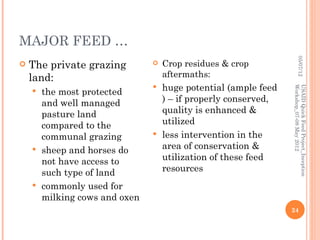
   The private grazing          Crop residues & crop
    land:                         aftermaths:
                               huge potential (ample feed


                                                             Workshop_07-08 May 2012
                                                             USAID Quick Feed Project_Inception
     the most protected
      and well managed          ) – if properly conserved,
      pasture land              quality is enhanced &
      compared to the           utilized
      communal grazing         less intervention in the

     sheep and horses do       area of conservation &
      not have access to        utilization of these feed
      such type of land         resources
     commonly used for
      milking cows and oxen
                                                             24
PERIODS OF CRITICAL FEED
 SHORTAGE


                                                                           05/07/12
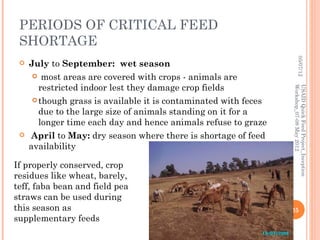
    July to September: wet season
       most areas are covered with crops - animals are
        restricted indoor lest they damage crop fields


                                                                  Workshop_07-08 May 2012
                                                                  USAID Quick Feed Project_Inception
       though grass is available it is contaminated with feces
        due to the large size of animals standing on it for a
        longer time each day and hence animals refuse to graze
    April to May: dry season where there is shortage of feed
     availability

If properly conserved, crop
residues like wheat, barely,
teff, faba bean and field pea
straws can be used during
this season as                                                    25
supplementary feeds
IMPROVEMENT OPTIONS


                                                                       05/07/12
   Oestrus synchronization
   Cooperative formation


                                                              Workshop_07-08 May 2012
                                                              USAID Quick Feed Project_Inception
   Market linkage
   Conservation and enhancing quality of crop residues
   Harvesting and conserving pastures /grasses during time
    of ‘plenty’
   Reduction of flock size in some cases and focus on
    productivity rather than mere number –
    genetic improvement (eg. ILRI-ICARDA-BOKU CBSB)
   Establishing backyard forage production
   Devising intervention mechanisms for the improvement of
    communal grazing areas
                                                              26
USAID Quick Feed Project_Inception
05/07/12
           Workshop_07-08 May 2012
                                                27
              Thank You!
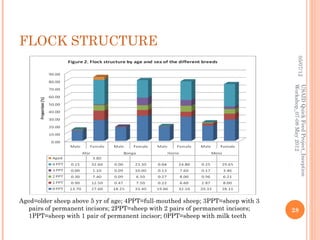
FLOCK STRUCTURE


                                                                                          05/07/12
                                                                                 Workshop_07-08 May 2012
                                                                                 USAID Quick Feed Project_Inception
Aged=older sheep above 5 yr of age; 4PPT=full-mouthed sheep; 3PPT=sheep with 3
   pairs of permanent incisors; 2PPT=sheep with 2 pairs of permanent incisors;   28
   1PPT=sheep with 1 pair of permanent incisor; 0PPT=sheep with milk teeth

Horro sheep and production system in Horro areas of Ethiopia

  • 1.
    HORRO SHEEP ANDPRODUCTION SYSTEM IN HORRO AREAS OF ETHIOPIA Gemeda Duguma Bako Agricultural Research Center OARI Africa-RISING Quick Feed Project Inception Workshop, Addis Ababa, 7-8 May 2012
  • 2.
    OUTLINE OF PRESENTATION 05/07/12  Introduction  Description of Horro sheep Workshop_07-08 May 2012 USAID Quick Feed Project_Inception  Production system in Horro area (Home tract of the Horro sheep)  Interventions made so far and major bottlenecks  Improvement options 2
  • 3.
    INTRODUCTION 05/07/12  Sheep is the second most important livestock species in Ethiopia Workshop_07-08 May 2012 USAID Quick Feed Project_Inception  The country possesses ≈ 26 million head of sheep  Ethiopia’s great variation in climate & topography represents a good reservoir of sheep genotypes  Diverse sheep breeds and ecotypes are kept in different regions and ecologies – from the mountainous highlands to the arid pastoral lowland areas 3
  • 4.
    INTRODUCTION 05/07/12  Few of them have been studied and characterized – only nine sheep breeds have Workshop_07-08 May 2012 USAID Quick Feed Project_Inception identified by phenotypic and molecular characterization methods  Horro sheep is one of the nine sheep breeds identified & is situated in western Ethiopia 4
  • 5.
    HORRO SHEEP -HABITAT 05/07/12  Most dominant sheep breed in western Ethiopia Workshop_07-08 May 2012 USAID Quick Feed Project_Inception  Widely distributed:  Parts of west Shewa zone  Wollega (East, West, Qellam and Horro Guduru Wollega zones)  Jimma and Ill-Ababora zones  These areas approximately lie within:  35° - 38°E, and 5  6° - 10°N
  • 6.
    HORRO SHEEP -HABITAT 05/07/12  Altitudes of the region range from 1400-2400m Workshop_07-08 May 2012 USAID Quick Feed Project_Inception  Population – estimated at 3 million  Horro sheep are reared by about 6.9 million people  Horro breed lives at the  Home tract is believed to fringes of trypanosome be Horro district – where infested areas - degree of the ICARDA-ILRI-BOKU trypanotolerance not CBSB project is operating studied 6
  • 7.
    BREED DESCRIPTION –COAT COLOR 05/07/12  Horro sheep – almost uniform in color (mostly solid tan / light brown) There are also creamy white, dark brown, black or Workshop_07-08 May 2012 USAID Quick Feed Project_Inception  spotted  The body is covered with short smooth hair 7  Both males and females are hornless
  • 8.
    BREED DESCRIPTION –GROWTH PERFORMANCE 05/07/12  Larger size - most apparent asset of the breed Breed Category Number LWt (kg) LWt range (kg) Workshop_07-08 May 2012 USAID Quick Feed Project_Inception Afar Yearling male 12 21.8±0.86 16.8 – 26.0 Yearling female 167 21.0±0.23 12.8 – 30.2 Bonga Yearling male 5 38.2±1.20a 36.0 – 40.0 Yearling female 80 31.0±0.47b 20.0 – 41.0 Horro Yearling male 5 31.2±1.70a 25.0 – 35.0 Yearling female 148 26.5±0.31b 20.0 – 39.0 Menz (Mehal Meda) Yearling male 43 24.4±0.63a 14.6 – 38.5 Yearling female 105 20.8±0.42b 12.8 – 32.4 Menz (Molale) Yearling male 26 20.4±0.57a 13.4 – 25.6 Yearling female 87 18.1±0.31b 11.8 – 29.0 Afar Adult ewes 449 24.9±0.23a 13.6 – 38.6 Bonga Adult ewes 357 36.3±0.26b 25.0 – 55.0 Horro Adult ewes 727 33.4±0.18c 21.0 – 56.0 8 Menz (Mehal Meda) Adult ewes 497 23.6±0.16d 15.0 – 35.0 Menz (Molale) Adult ewes 298 21.3±0.20f 13.6 – 29.0
  • 9.
    BREED DESCRIPTION –GROWTH PERFORMANCE 05/07/12 Traits On-Station On-farm (ICARDA-ILRI- Workshop_07-08 May 2012 USAID Quick Feed Project_Inception (BARC) BOKU CBSB) Birth Weight (kg) 2.7 3.0 (2847) Weaning Weight (kg) 11.8 13.5 (1837) Six month weight (kg) 15.4 17.9 (605) 9
  • 10.
    BREED DESCRIPTION – REPRODUCTIONPERFORMANCE 05/07/12  Horro sheep – the most prolific breed Workshop_07-08 May 2012 USAID Quick Feed Project_Inception Attributes Indigenous sheep breeds Afar Bonga Horro Menz Number of lambings 3.45±0.08 3.56±0.09 3.90±0.10 3.59±0.09 Twining 0.17±0.03 1.13±0.08 1.29±0.09 ‡ Number born 3.61±0.09 4.71±0.15 5.22±0.18 3.59±0.09 Number weaned 2.83±0.10 4.53±0.15 4.71±0.17 3.02±0.10  ‡ ewes are single bearers  N.B.: Information taken from owners on mature ewes (ILRI- ICARDA-BOKU CBSBP) 10
  • 11.
    PRODUCTION SYSTEM INHORRO AREAS 05/07/12  Wet, humid  Located in Horro Guduru Wollega Workshop_07-08 May 2012 USAID Quick Feed Project_Inception zone,Oromia regional state – western Ethiopia  315km from Addis Ababa to the west  Based on an ILRI classification of recommendation domains within Africa (Omolo et al 2009):  Horro is located in an area mainly characterized as having high 11 agricultural potential
  • 12.
    PRODUCTION SYSTEM…  Mixed crop-livestock production is the 05/07/12 predominant production system in the areas Workshop_07-08 May 2012 USAID Quick Feed Project_Inception 12
  • 13.
    MAJOR LS ANDCROPS RAISED/GROWN 05/07/12  Cattle, sheep, horses, chicken, goats, mule, donkeys, etc. Workshop_07-08 May 2012 USAID Quick Feed Project_Inception  Average sheep possession about 12 head /house hold  Major crops grown in the area: wheat, barley, faba bean, field pea, maize, etc.  Average landholding in the area – about 2ha of which > 88% used for crop production  Sheep – the second most important LS species in the area 13
  • 14.
    SHEEP BREEDING MANAGEMENT 05/07/12  Breeding – uncontrolled  Breeding rams – selected from within Workshop_07-08 May 2012 USAID Quick Feed Project_Inception  Critical shortage of breeding rams in the area (1:72) - male lambs are sold at as early as three to four months of age 14
  • 15.
    WHY SELL MALESEARLY? 05/07/12  for immediate cash income, fear of theft and predation Workshop_07-08 May 2012 USAID Quick Feed Project_Inception  mature rams are unmanageable and wander away for mating  Borrowing rams is very common among the communities (i.e. owners cooperate with no hesitation even to those individuals who sell theirs very early) 15
  • 16.
    MARKETING 05/07/12  Producers sale their animals: Workshop_07-08 May 2012 USAID Quick Feed Project_Inception  at farm gate, nearby/distant markets  whenever there is an immediate need for cash  High price differences between them  High number of middlemen, less bargaining power and thus small producer margins 16
  • 17.
    Intervention by ICARDA,ILRI, BOKU & the national and regional research systems - 2007 Alternative breeding plans & implementation (ICARDA-ILRI- BOKU) 05/07/12 • Production system study • Choice experiments • Own-flock ranking Workshop_07-08 May 2012 USAID Quick Feed Project_Inception • Group-animal ranking • Weighted ranks • 3 objective traits • 4 alternative scenarios (% ram selected and use time) Presented to communities for decision • Base-line information •Animal identification (ear-tag) • Recording and monitoring •Ram screening and selection 17
  • 18.
    SHEEP BREEDING MANAGEMENT– (ICARDA-ILRI-BOKU CBSBP MEMBERS) 05/07/12  No shortage of breeding rams – by creating revolving fund with the seed money provided by the project Workshop_07-08 May 2012 USAID Quick Feed Project_Inception  Ewes are mostly served by selected rams  Number of marketed lambs has increased  System of breeding rams exchange has improved  Huge demand to be a member of the project 18  Record and record keeping have gradually improved (enumerators)
  • 19.
    BOTTLENECKS - ICARDA-ILRI- BOKUCBSBP 05/07/12  Unable to scale-up/scale-out the improvement program to wider areas - does have its own influence on genetic improvement and marketing Workshop_07-08 May 2012 USAID Quick Feed Project_Inception of more uniform animals at a time  Lack of uniformity among young rams presented for selection (eg. age differences)  Production of uniform animals for market  Matching of lambing with feed availability and market  Organizing project members into cooperative 19
  • 20.
    BOTTLENECKS… 05/07/12  Having legally functioning breeding cooperatives is important to coordinate and perform Workshop_07-08 May 2012 USAID Quick Feed Project_Inception community-level collective actions like:  exchange of breeding rams,  culling of non-selected rams,  joint procurement of medicaments, supplementary feeds to condition/fatten non-selected rams before marketing and marketing of such animals, etc. 20
  • 21.
    MAJOR FEED RESOURCES– HORRO AREAS 05/07/12 1) Natural pasture  Two types of grazing (grazing) lands prevail in the area: communal and Workshop_07-08 May 2012 USAID Quick Feed Project_Inception 2) Crop residues the private 3) Fallow land  The communal 4) Crop aftermath, and grazing area is: 5) Hay from natural  The most commonly pasture exploited and depleted type - because all livestock species found in the area are kept on it throughout the year 21
  • 22.
    MAJOR FEED… 05/07/12 Workshop_07-08 May 2012 USAID Quick Feed Project_Inception Communal grazing lands – Baqal (left) and Iggu (right) 22
  • 23.
    MAJOR FEED … 05/07/12  The communal grazing area is neither protected nor given any sort of management. It is decreasing in size & pasture production from Workshop_07-08 May 2012 USAID Quick Feed Project_Inception  time to time:  population pressure – newly emerging households forced to settle on it  animals are kept on it particularly during peak seasons to minimize labor demand for herding  still others do so in order to defer their private pasture land for later use  various health problems are common – due to different species /herds / flocks mix  most communal grazing areas are swampy bottom lands – 23 hard to find a sheep with an unaffected liver
  • 24.
    MAJOR FEED … 05/07/12  The private grazing  Crop residues & crop land: aftermaths:  huge potential (ample feed Workshop_07-08 May 2012 USAID Quick Feed Project_Inception  the most protected and well managed ) – if properly conserved, pasture land quality is enhanced & compared to the utilized communal grazing  less intervention in the  sheep and horses do area of conservation & not have access to utilization of these feed such type of land resources  commonly used for milking cows and oxen 24
  • 25.
    PERIODS OF CRITICALFEED SHORTAGE 05/07/12  July to September: wet season  most areas are covered with crops - animals are restricted indoor lest they damage crop fields Workshop_07-08 May 2012 USAID Quick Feed Project_Inception  though grass is available it is contaminated with feces due to the large size of animals standing on it for a longer time each day and hence animals refuse to graze  April to May: dry season where there is shortage of feed availability If properly conserved, crop residues like wheat, barely, teff, faba bean and field pea straws can be used during this season as 25 supplementary feeds
  • 26.
    IMPROVEMENT OPTIONS 05/07/12  Oestrus synchronization  Cooperative formation Workshop_07-08 May 2012 USAID Quick Feed Project_Inception  Market linkage  Conservation and enhancing quality of crop residues  Harvesting and conserving pastures /grasses during time of ‘plenty’  Reduction of flock size in some cases and focus on productivity rather than mere number – genetic improvement (eg. ILRI-ICARDA-BOKU CBSB)  Establishing backyard forage production  Devising intervention mechanisms for the improvement of communal grazing areas 26
  • 27.
    USAID Quick FeedProject_Inception 05/07/12 Workshop_07-08 May 2012 27 Thank You!
  • 28.
    FLOCK STRUCTURE 05/07/12 Workshop_07-08 May 2012 USAID Quick Feed Project_Inception Aged=older sheep above 5 yr of age; 4PPT=full-mouthed sheep; 3PPT=sheep with 3 pairs of permanent incisors; 2PPT=sheep with 2 pairs of permanent incisors; 28 1PPT=sheep with 1 pair of permanent incisor; 0PPT=sheep with milk teeth