HORSE MARKINGS AND
IDENTIFICATION
-DARSHANA SHINGNE
3RD YEAR
Contents....
PURPOSE
METHODS:
-Natural methods
-Acquired methods
(pros and cons)
REFERENCES
PURPOSE
Health and disease control
Theft prevention and to identify lost horse
Breed registry requirement
Recovery
Fraud prevention
Breeding
Separation- forced evacuation due to flood, fire
or hurricane
Help prove ownership
METHODS
Coat colour
Body Markings
Blood typing
Tattoos eg. Lip tattoo
Freeze Branding
Hoof Branding
Microchip placement
Iris Scanning
1.Coat Colour
 BAY
• Tan or red body
• Black mane and tail
 BROWN
• Brown or black body
• Black mane and tail
• Black legs
BLUE ROAN
•White and black body
•Dark head, lower legs
RED ROAN
•White and red body
•Dark head, lower legs
DUN
•Yellow or gold body
•Dorsal stripe
•Mane and tail varies
•Zebra stripe on legs
•Stripe on withers
RED DUN
•Red mane and tail, dorsal
stripe
Other coat colours:
• Appaloosa
• Buckskin
• Paint- Tobiano
• Paint-Overo
• Dapple
• Flea bitten
• White chestnut
• Grullo etc.
Body Markings
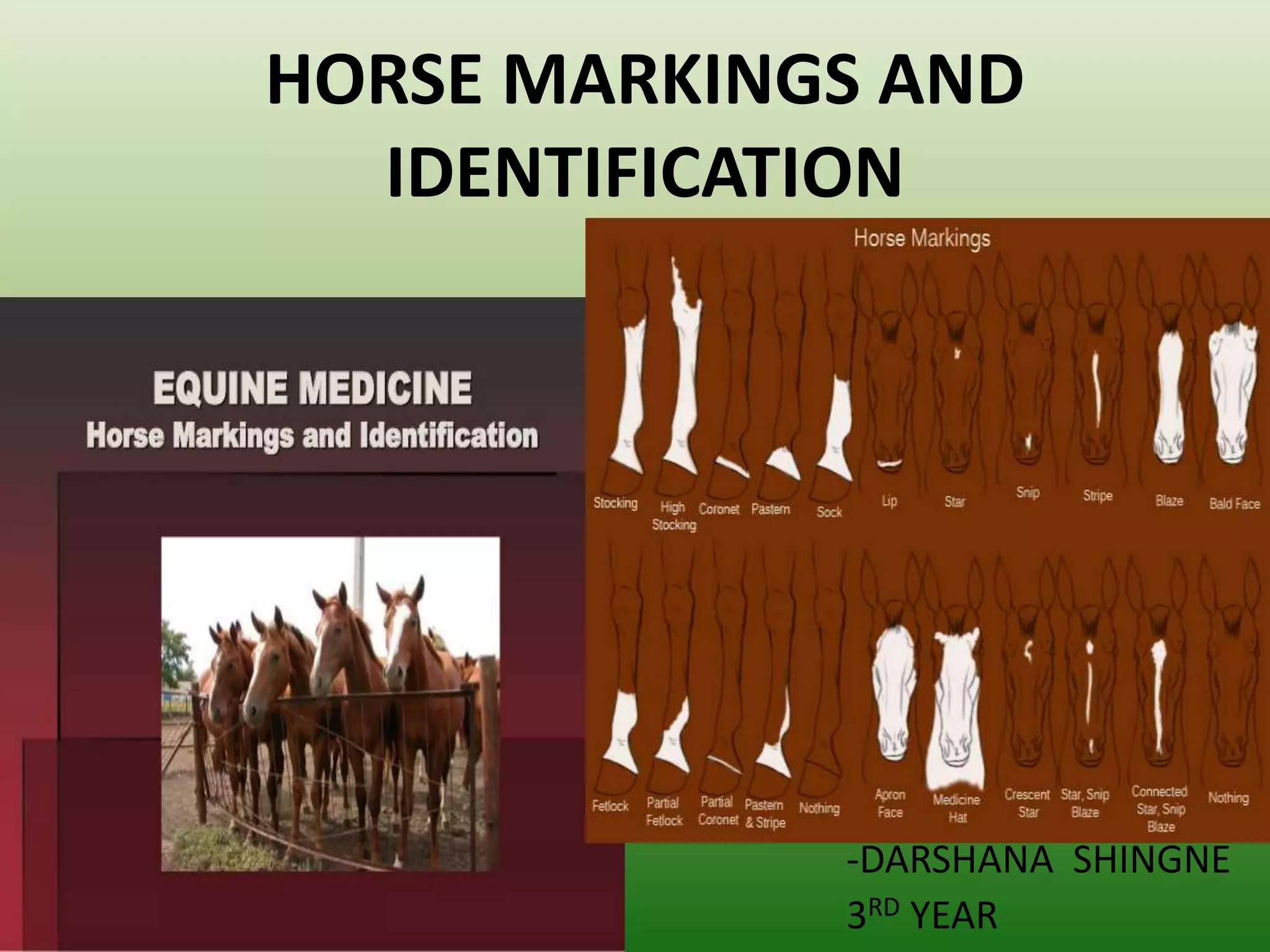
1.Facial horse markings
STAR
A star is a white mark on forehead.
SNIP
A snip is a white mark on the
nose/muzzle area. It can be large or
small.
STRIPE
A stripe is a narrow mark that
runs down the length of the
face.
BLAZE
A blaze is a much wider than a
stripe and can take up much
of the face.
WHITE MUZZLE & LIP MARKS
Lip marks are focused on the
mouth, while a white muzzle
includes the whole muzzle.
BALD
A bald face or white face has
the white extending past the
eyes. Often accompanied by
blue eyes.
2.MARKING ON LEGS AND HOOVES
CORONET
Is a white marking around the coronet just above the hoof
PASTERN
Is a white marking on pastern portion of leg
STOCKING
White marking that extends to the knee or even higher
SOCK
Is a white on lower leg below the knee
ZEBRA STRIPES
Are the black horizontal marks
found on the legs. They are
most often found above the
knees but not always
BLACK/ BLUE HOOF
STRIPED HOOF FEATHERS
4.Cowlicks
Cowlicks are permanent hair
whorls which cannot be brushed
or clipped out. They are located
mainly on the forehead and neck
5. Dimples
Dimples are the permanent
indentations in the muscle under
the skin. They are usually located
at the point of the shoulder or in
the neck muscles
6.Blood typing and DNA testing
• Blood typing is used by most breed organizations. Seven blood groups (including red
cells, red cell antigens, and serum proteins) and 10 biochemical markers are tested for
40 different factors.
• For example, the parentage of a foal that was DNA tested cannot be confirmed if its
parents were only blood typed.
• However, depending on the lab, if the blood samples used to determine blood type
were stored, DNA types can be generated from those stored samples, and parentage
can be determined.
ADVANTAGES
• DNA does not change, so this
method is precise and
accurate for life.
• These are most useful
methods for establishing
parentage.
• Permanent.
DISADVANTAGES
• Expensive technology at
present and time consuming.
• If the parents aren’t
registered, then it becomes
difficult to confirm DNA of the
foal.
7.Microchip placement
•It involves implantation of a microchip the size of a grain of rice
containing the horse’s registration number or identification number.
•The veterinarian uses a specially designed needle and syringe to implant
the microchip about midway down the horse’s neck, just below the crest.
•The chip is inserted into the ligament in the neck,and is lodged about an
inch underneath the skin’s surface. It is equipped with a non-migratory
tip to ensure that it stays in place.
•The chip is read using a hand-held scanner. Its main purpose is to
identify ownership of the horse.
ADVANTAGES
• Definite.
• Permanent,
• Tamper-proof.
• Minor cost.
• Little pain involved in
insertion.
• Can be read from a distance
with the appropriate reader
gun (Eg . From outside a
truck).
DISADVANTAGES
• Invasive procedure.
• Invisible.
• May move/ migrate.
• The occasional horse may
require sedation or twitching.
• Detection relies on possession
of a ‘reader’.
• Reader must be passed over
the chip.
8.FREEZE BRANDING
•Freeze branding uses copper stamps or marking rods cooled in liquid
nitrogen or dry ice.
•The brand is most commonly applied to an area approximately 2” x 7”
in size midway on the neck and underneath the mane. However,
different horse farm and organizations may choose to identify their
horses by freeze branding them elsewhere, such as the thigh or shoulder
•On dark-coloured animals, the hair grows back white, and on white
animals an area with no hair results.
ADVANTAGES
• Simple method.
• Painless.
• Cheap.
• Definite. No scope for
tampering.
• Visible from a
distance(thieves will be less
inclined to steal a horse with
a visible mark).
DISADVANTAGES
• Requires a skilled technician.
• Not always clearly visible
( differences in gray horses).
9.LIP TATTOO
•The tattoo may be placed in several areas, but the upper lip is the
most common site. However, a horse owner can tattoo his or her
horse in other areas with different letters and numbers.
• Lip tattooing is found on Thoroughbreds, Standardbreeds,
Appaloosas, Arabians and Quarter Horses, because these breeds also
race. A horse with an official tattoo is necessarily registered,
meaning he has papers out there.
ADVANTAGES
• Clear, permanent and
definite.
• Little specialist equipment is
needed (often indian ink is
used).
• Cheap.
• Very difficult to erase/ tamper
with.
DISADVANTAGES
• Painful.
• Messy.
• Not visible from a distance.
• Not easily visible on dark skin.
• Liable to be irregular( not
every needle takes in the
same amount of dye and
some foci will not take up the
dye).
• Many are difficult to read
accurately.
10.IRIS SCANNING
•The system works like this: A veterinarian uses a special camera to take a
digital photo of each of the horse’s eyes, called an eyePrint. No two irises
are alike, so the eyePrint provides each horse with a unique identification.
•The images are stored online in a secure database, along with pedigree
registrations and medical records and other information, and can be
accessed anytime.
•The company says its eyeD system is more accurate than markings or
tattoos, provides more security than paper documents, and offers a greater
chance for recovering stolen horses.
ADVANTAGES
• Scanning a horse’s iris is a
pain-free, non-invasive
alternative to branding,
tattooing and other
identification methods.
• It limits undue stress to the
animal.
• Definitive identity of horse
can be established because
no two irises are alike. Iris
scans are more accurate than
even a human fingerprint.
DISADVANTAGES
• It is an expensive method.
• Special scanners are required
with skilled technician to scan
and read it properly.
• The iris is a very small organ
to scan from a distance. It is a
moving target and can be
obscured by objects such as
the eyelid and eyelashes.
• The camera used in the
process needs to have the
correct amount of
illumination. Without this, it is
very difficult to capture an
accurate image of the iris.
11.HOOF BRANDING
•Hoof Branding is a form of hot iron branding and is not a permanent
mark. The owner's chosen information, such as phone number or
zip code, is branded onto the horse's hooves, which is a painless
process.
•Studies have also shown that, when properly applied, there is no
long-term damage to the hoof wall. It is a safe method of temporary
identification.
ADVANTAGES
• Reasonable duration of
marking( it usually takes
atleast 4-6 months to grow
out completely).
• Painless
• Quick.
• Cheap.
• Difficult if not possible to
delete but can be altered.
DISADVANTAGES
• Temporary. It relies on some
identification held else
where( e.g. At the owner’s
home address: postcode/
zipcode or telephone
number).
• Possibly alterable within
limits.
• Needs to be repeated as
required.
REFERENCES
• Alberta Horse Reference Manual
• Equine Science
• KHVCR Kit and KHVCR Manual
• "Identifying Horse parts and
markings," Adapted From: Horses For
Dummies, 2nd Edition
Equines(Horses) markings and identification

Equines(Horses) markings and identification

  • 1.
  • 2.
  • 3.
    PURPOSE Health and diseasecontrol Theft prevention and to identify lost horse Breed registry requirement Recovery Fraud prevention Breeding Separation- forced evacuation due to flood, fire or hurricane Help prove ownership
  • 4.
    METHODS Coat colour Body Markings Bloodtyping Tattoos eg. Lip tattoo Freeze Branding Hoof Branding Microchip placement Iris Scanning
  • 5.
    1.Coat Colour  BAY •Tan or red body • Black mane and tail  BROWN • Brown or black body • Black mane and tail • Black legs
  • 6.
    BLUE ROAN •White andblack body •Dark head, lower legs RED ROAN •White and red body •Dark head, lower legs
  • 7.
    DUN •Yellow or goldbody •Dorsal stripe •Mane and tail varies •Zebra stripe on legs •Stripe on withers RED DUN •Red mane and tail, dorsal stripe
  • 8.
    Other coat colours: •Appaloosa • Buckskin • Paint- Tobiano • Paint-Overo • Dapple • Flea bitten • White chestnut • Grullo etc.
  • 9.
    Body Markings 1.Facial horsemarkings STAR A star is a white mark on forehead. SNIP A snip is a white mark on the nose/muzzle area. It can be large or small.
  • 10.
    STRIPE A stripe isa narrow mark that runs down the length of the face. BLAZE A blaze is a much wider than a stripe and can take up much of the face.
  • 11.
    WHITE MUZZLE &LIP MARKS Lip marks are focused on the mouth, while a white muzzle includes the whole muzzle. BALD A bald face or white face has the white extending past the eyes. Often accompanied by blue eyes.
  • 12.
    2.MARKING ON LEGSAND HOOVES CORONET Is a white marking around the coronet just above the hoof PASTERN Is a white marking on pastern portion of leg STOCKING White marking that extends to the knee or even higher SOCK Is a white on lower leg below the knee
  • 13.
    ZEBRA STRIPES Are theblack horizontal marks found on the legs. They are most often found above the knees but not always BLACK/ BLUE HOOF
  • 14.
  • 15.
    4.Cowlicks Cowlicks are permanenthair whorls which cannot be brushed or clipped out. They are located mainly on the forehead and neck 5. Dimples Dimples are the permanent indentations in the muscle under the skin. They are usually located at the point of the shoulder or in the neck muscles
  • 16.
    6.Blood typing andDNA testing • Blood typing is used by most breed organizations. Seven blood groups (including red cells, red cell antigens, and serum proteins) and 10 biochemical markers are tested for 40 different factors. • For example, the parentage of a foal that was DNA tested cannot be confirmed if its parents were only blood typed. • However, depending on the lab, if the blood samples used to determine blood type were stored, DNA types can be generated from those stored samples, and parentage can be determined.
  • 17.
    ADVANTAGES • DNA doesnot change, so this method is precise and accurate for life. • These are most useful methods for establishing parentage. • Permanent. DISADVANTAGES • Expensive technology at present and time consuming. • If the parents aren’t registered, then it becomes difficult to confirm DNA of the foal.
  • 18.
    7.Microchip placement •It involvesimplantation of a microchip the size of a grain of rice containing the horse’s registration number or identification number. •The veterinarian uses a specially designed needle and syringe to implant the microchip about midway down the horse’s neck, just below the crest. •The chip is inserted into the ligament in the neck,and is lodged about an inch underneath the skin’s surface. It is equipped with a non-migratory tip to ensure that it stays in place. •The chip is read using a hand-held scanner. Its main purpose is to identify ownership of the horse.
  • 19.
    ADVANTAGES • Definite. • Permanent, •Tamper-proof. • Minor cost. • Little pain involved in insertion. • Can be read from a distance with the appropriate reader gun (Eg . From outside a truck). DISADVANTAGES • Invasive procedure. • Invisible. • May move/ migrate. • The occasional horse may require sedation or twitching. • Detection relies on possession of a ‘reader’. • Reader must be passed over the chip.
  • 20.
    8.FREEZE BRANDING •Freeze brandinguses copper stamps or marking rods cooled in liquid nitrogen or dry ice. •The brand is most commonly applied to an area approximately 2” x 7” in size midway on the neck and underneath the mane. However, different horse farm and organizations may choose to identify their horses by freeze branding them elsewhere, such as the thigh or shoulder •On dark-coloured animals, the hair grows back white, and on white animals an area with no hair results.
  • 21.
    ADVANTAGES • Simple method. •Painless. • Cheap. • Definite. No scope for tampering. • Visible from a distance(thieves will be less inclined to steal a horse with a visible mark). DISADVANTAGES • Requires a skilled technician. • Not always clearly visible ( differences in gray horses).
  • 22.
    9.LIP TATTOO •The tattoomay be placed in several areas, but the upper lip is the most common site. However, a horse owner can tattoo his or her horse in other areas with different letters and numbers. • Lip tattooing is found on Thoroughbreds, Standardbreeds, Appaloosas, Arabians and Quarter Horses, because these breeds also race. A horse with an official tattoo is necessarily registered, meaning he has papers out there.
  • 23.
    ADVANTAGES • Clear, permanentand definite. • Little specialist equipment is needed (often indian ink is used). • Cheap. • Very difficult to erase/ tamper with. DISADVANTAGES • Painful. • Messy. • Not visible from a distance. • Not easily visible on dark skin. • Liable to be irregular( not every needle takes in the same amount of dye and some foci will not take up the dye). • Many are difficult to read accurately.
  • 24.
    10.IRIS SCANNING •The systemworks like this: A veterinarian uses a special camera to take a digital photo of each of the horse’s eyes, called an eyePrint. No two irises are alike, so the eyePrint provides each horse with a unique identification. •The images are stored online in a secure database, along with pedigree registrations and medical records and other information, and can be accessed anytime. •The company says its eyeD system is more accurate than markings or tattoos, provides more security than paper documents, and offers a greater chance for recovering stolen horses.
  • 25.
    ADVANTAGES • Scanning ahorse’s iris is a pain-free, non-invasive alternative to branding, tattooing and other identification methods. • It limits undue stress to the animal. • Definitive identity of horse can be established because no two irises are alike. Iris scans are more accurate than even a human fingerprint. DISADVANTAGES • It is an expensive method. • Special scanners are required with skilled technician to scan and read it properly. • The iris is a very small organ to scan from a distance. It is a moving target and can be obscured by objects such as the eyelid and eyelashes. • The camera used in the process needs to have the correct amount of illumination. Without this, it is very difficult to capture an accurate image of the iris.
  • 26.
    11.HOOF BRANDING •Hoof Brandingis a form of hot iron branding and is not a permanent mark. The owner's chosen information, such as phone number or zip code, is branded onto the horse's hooves, which is a painless process. •Studies have also shown that, when properly applied, there is no long-term damage to the hoof wall. It is a safe method of temporary identification.
  • 27.
    ADVANTAGES • Reasonable durationof marking( it usually takes atleast 4-6 months to grow out completely). • Painless • Quick. • Cheap. • Difficult if not possible to delete but can be altered. DISADVANTAGES • Temporary. It relies on some identification held else where( e.g. At the owner’s home address: postcode/ zipcode or telephone number). • Possibly alterable within limits. • Needs to be repeated as required.
  • 28.
    REFERENCES • Alberta HorseReference Manual • Equine Science • KHVCR Kit and KHVCR Manual • "Identifying Horse parts and markings," Adapted From: Horses For Dummies, 2nd Edition