Queuing Theory and Traffic Flow
Analysis
Dimensions of Traffic Queuing Models
Purpose:
To provide a means to estimate important
measures of highway performance including
vehicle delay and traffic queue lengths.
e.g. the required length of left turning bays
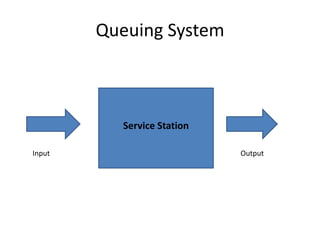
Queuing System

Service Station
Input

Output
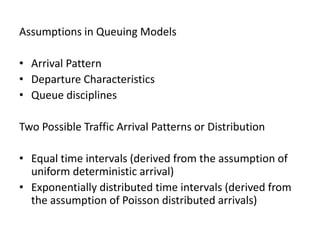
Assumptions in Queuing Models
• Arrival Pattern
• Departure Characteristics
• Queue disciplines

Two Possible Traffic Arrival Patterns or Distribution
• Equal time intervals (derived from the assumption of
uniform deterministic arrival)
• Exponentially distributed time intervals (derived from
the assumption of Poisson distributed arrivals)
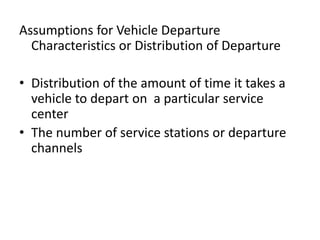
Assumptions for Vehicle Departure
Characteristics or Distribution of Departure
• Distribution of the amount of time it takes a
vehicle to depart on a particular service
center
• The number of service stations or departure
channels
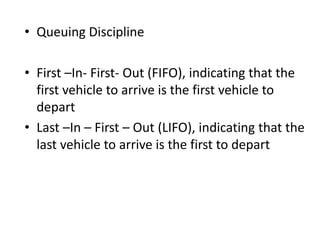
• Queuing Discipline

• First –In- First- Out (FIFO), indicating that the
first vehicle to arrive is the first vehicle to
depart
• Last –In – First – Out (LIFO), indicating that the
last vehicle to arrive is the first to depart
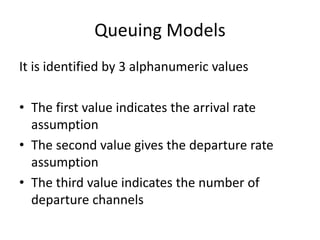
Queuing Models
It is identified by 3 alphanumeric values
• The first value indicates the arrival rate
assumption
• The second value gives the departure rate
assumption
• The third value indicates the number of
departure channels
Queuing Models
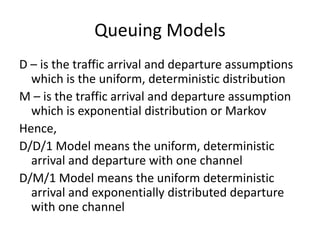
D – is the traffic arrival and departure assumptions
which is the uniform, deterministic distribution
M – is the traffic arrival and departure assumption
which is exponential distribution or Markov
Hence,
D/D/1 Model means the uniform, deterministic
arrival and departure with one channel
D/M/1 Model means the uniform deterministic
arrival and exponentially distributed departure
with one channel
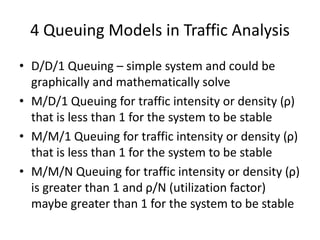
4 Queuing Models in Traffic Analysis
• D/D/1 Queuing – simple system and could be
graphically and mathematically solve
• M/D/1 Queuing for traffic intensity or density (ρ)
that is less than 1 for the system to be stable
• M/M/1 Queuing for traffic intensity or density (ρ)
that is less than 1 for the system to be stable
• M/M/N Queuing for traffic intensity or density (ρ)
is greater than 1 and ρ/N (utilization factor)
maybe greater than 1 for the system to be stable
D/D/1 Queuing
• Use Cumulative Plot Method
M/D/1 Queuing
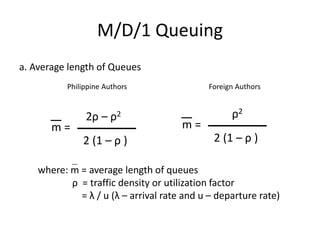
a. Average length of Queues
Philippine Authors

m=

2ρ – ρ2
2 (1 – ρ )

Foreign Authors

m=

ρ2
2 (1 – ρ )

where: m = average length of queues
ρ = traffic density or utilization factor
= λ / u (λ – arrival rate and u – departure rate)
M/D/1 Queuing
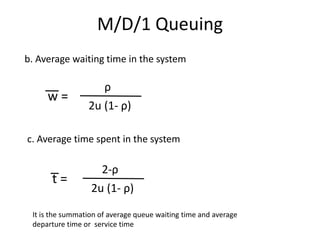
b. Average waiting time in the system

w=

ρ
2u (1- ρ)

c. Average time spent in the system

t=

2-ρ
2u (1- ρ)

It is the summation of average queue waiting time and average
departure time or service time
M/M/1 Queuing
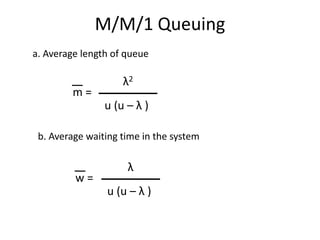
a. Average length of queue

m=

λ2
u (u – λ )

b. Average waiting time in the system

w=

λ
u (u – λ )
M/M/1 Queuing
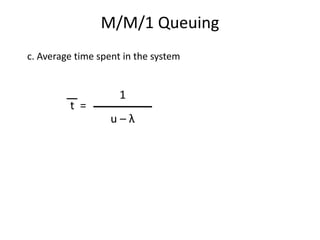
c. Average time spent in the system

t =

1
u–λ
M/M/N Queuing
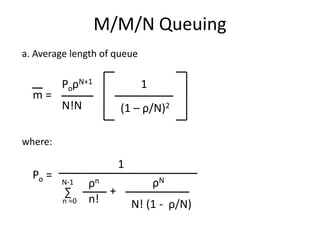
a. Average length of queue

m=

PoρN+1
N!N

1
(1 – ρ/N)2

where:

Po =

1
N-1

∑

n =0

ρn
+
n!

ρN
N! (1 - ρ/N)
M/M/N Queuing
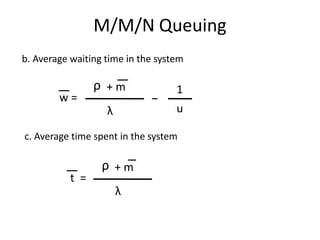
b. Average waiting time in the system

1

λ

w=

ρ +m

u

c. Average time spent in the system

t =

ρ +m
λ
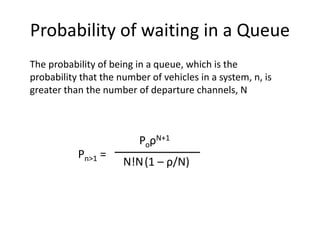
Probability of waiting in a Queue
The probability of being in a queue, which is the
probability that the number of vehicles in a system, n, is
greater than the number of departure channels, N

Pn>1 =

PoρN+1
N!N (1 – ρ/N)

Queuing theory and traffic flow analysis

  • 1.
    Queuing Theory andTraffic Flow Analysis
  • 2.
    Dimensions of TrafficQueuing Models Purpose: To provide a means to estimate important measures of highway performance including vehicle delay and traffic queue lengths. e.g. the required length of left turning bays
  • 3.
  • 4.
    Assumptions in QueuingModels • Arrival Pattern • Departure Characteristics • Queue disciplines Two Possible Traffic Arrival Patterns or Distribution • Equal time intervals (derived from the assumption of uniform deterministic arrival) • Exponentially distributed time intervals (derived from the assumption of Poisson distributed arrivals)
  • 5.
    Assumptions for VehicleDeparture Characteristics or Distribution of Departure • Distribution of the amount of time it takes a vehicle to depart on a particular service center • The number of service stations or departure channels
  • 6.
    • Queuing Discipline •First –In- First- Out (FIFO), indicating that the first vehicle to arrive is the first vehicle to depart • Last –In – First – Out (LIFO), indicating that the last vehicle to arrive is the first to depart
  • 7.
    Queuing Models It isidentified by 3 alphanumeric values • The first value indicates the arrival rate assumption • The second value gives the departure rate assumption • The third value indicates the number of departure channels
  • 8.
    Queuing Models D –is the traffic arrival and departure assumptions which is the uniform, deterministic distribution M – is the traffic arrival and departure assumption which is exponential distribution or Markov Hence, D/D/1 Model means the uniform, deterministic arrival and departure with one channel D/M/1 Model means the uniform deterministic arrival and exponentially distributed departure with one channel
  • 9.
    4 Queuing Modelsin Traffic Analysis • D/D/1 Queuing – simple system and could be graphically and mathematically solve • M/D/1 Queuing for traffic intensity or density (ρ) that is less than 1 for the system to be stable • M/M/1 Queuing for traffic intensity or density (ρ) that is less than 1 for the system to be stable • M/M/N Queuing for traffic intensity or density (ρ) is greater than 1 and ρ/N (utilization factor) maybe greater than 1 for the system to be stable
  • 10.
    D/D/1 Queuing • UseCumulative Plot Method
  • 11.
    M/D/1 Queuing a. Averagelength of Queues Philippine Authors m= 2ρ – ρ2 2 (1 – ρ ) Foreign Authors m= ρ2 2 (1 – ρ ) where: m = average length of queues ρ = traffic density or utilization factor = λ / u (λ – arrival rate and u – departure rate)
  • 12.
    M/D/1 Queuing b. Averagewaiting time in the system w= ρ 2u (1- ρ) c. Average time spent in the system t= 2-ρ 2u (1- ρ) It is the summation of average queue waiting time and average departure time or service time
  • 13.
    M/M/1 Queuing a. Averagelength of queue m= λ2 u (u – λ ) b. Average waiting time in the system w= λ u (u – λ )
  • 14.
    M/M/1 Queuing c. Averagetime spent in the system t = 1 u–λ
  • 15.
    M/M/N Queuing a. Averagelength of queue m= PoρN+1 N!N 1 (1 – ρ/N)2 where: Po = 1 N-1 ∑ n =0 ρn + n! ρN N! (1 - ρ/N)
  • 16.
    M/M/N Queuing b. Averagewaiting time in the system 1 λ w= ρ +m u c. Average time spent in the system t = ρ +m λ
  • 17.
    Probability of waitingin a Queue The probability of being in a queue, which is the probability that the number of vehicles in a system, n, is greater than the number of departure channels, N Pn>1 = PoρN+1 N!N (1 – ρ/N)