Queuing theory is the mathematical study of waiting lines in systems like customer service lines. It enables the analysis of processes like customer arrivals, waiting times, and service times. The document discusses the M/M/c queuing model, which assumes arrivals and service times follow exponential distributions and there are c parallel servers. It provides the steady state probabilities and performance measures like expected number of customers in the system and in the queue for the M/M/c model. An example applies the M/M/1 model to analyze whether a hospital should hire a second doctor based on arrival and service rates.
In this document
Powered by AI
Queuing Theory focuses on analyzing waiting lines, emphasizing efficiency and utilization.
Covers definitions, examples, components, models, and terminology related to queuing systems.
A mathematical method for analyzing queues and waiting times to optimize service processes.
Explains transient and steady state conditions, along with terms like balking, reneging, and jockeying.
Models calculate average customers, waiting times, system utilization, and probable states in queues.
Describes various real-world queuing systems, including commercial, transportation, and social services.
Outlines components like arrival characteristics, waiting line, and service characteristics in quues.
Explains calling population and the process of arrival in queuing systems, emphasizing statistical analysis.
Details on queue structure, including the number of queues, behavior, and capacity considerations.
Focuses on service facilities, service time distribution, and general rules for serving queue disciplines.
Introduces the structure of commonly seen queuing models and their representation.
Explains the notation used in queuing models, detailing service and arrival characteristics.
Discusses the concept of service utilization in queuing models, including capacity and demand.
Defines terms related to the number of customers in the system and their probabilities.
Provides the notation for steady-state analysis, outlining expected customer numbers and wait times.
Introduces Little’s formula for relating average values in steady state analysis of queues.
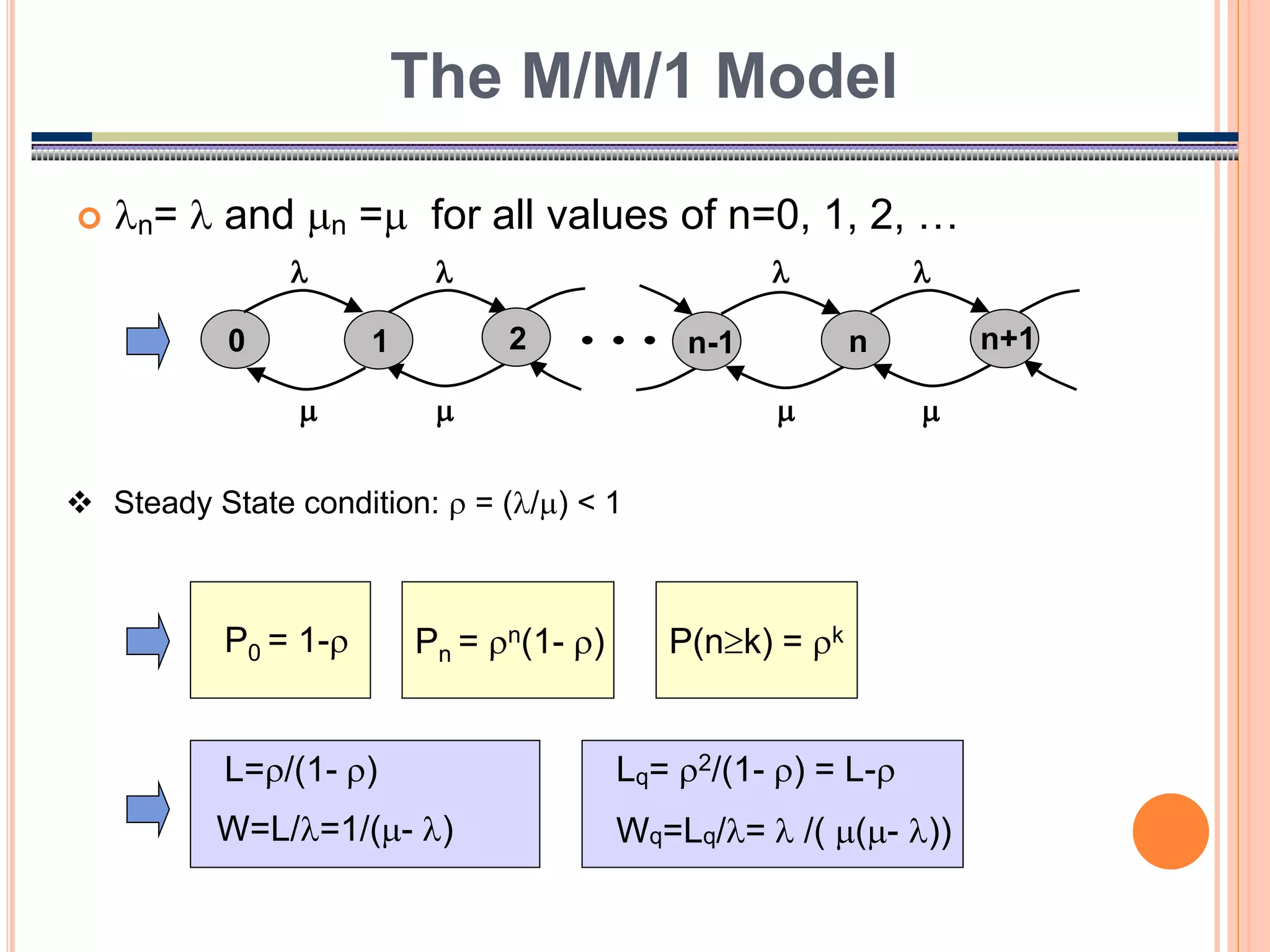
Outlines assumptions needed to apply the M/M/1 queuing model and its characteristics.
Discusses the steady state conditions and performance metrics for the M/M/1 queuing model.
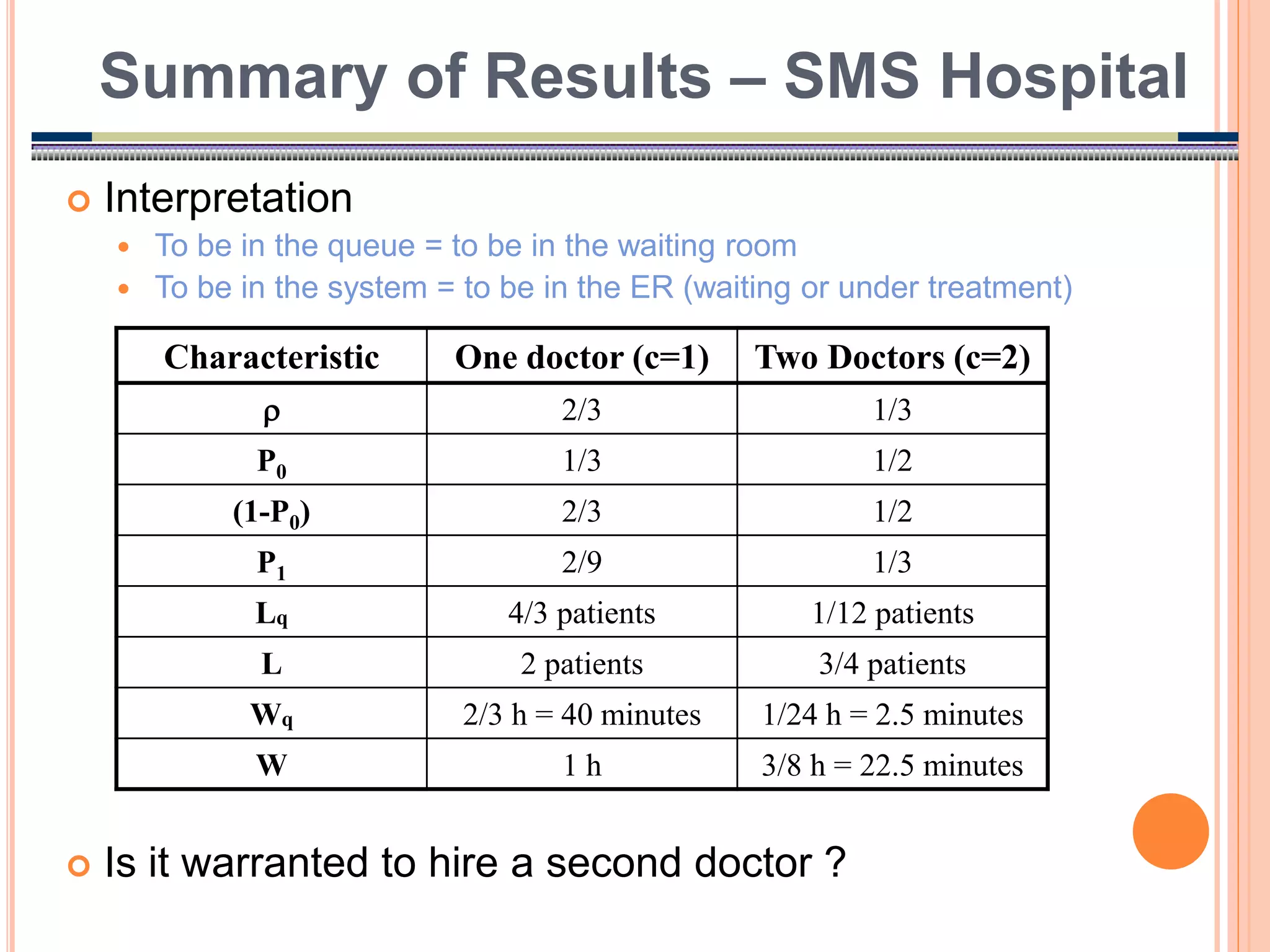
Uses a hospital scenario to model queuing systems and evaluate resource allocation.
Compares performance measures with one and two doctors in the SMS hospital scenario.
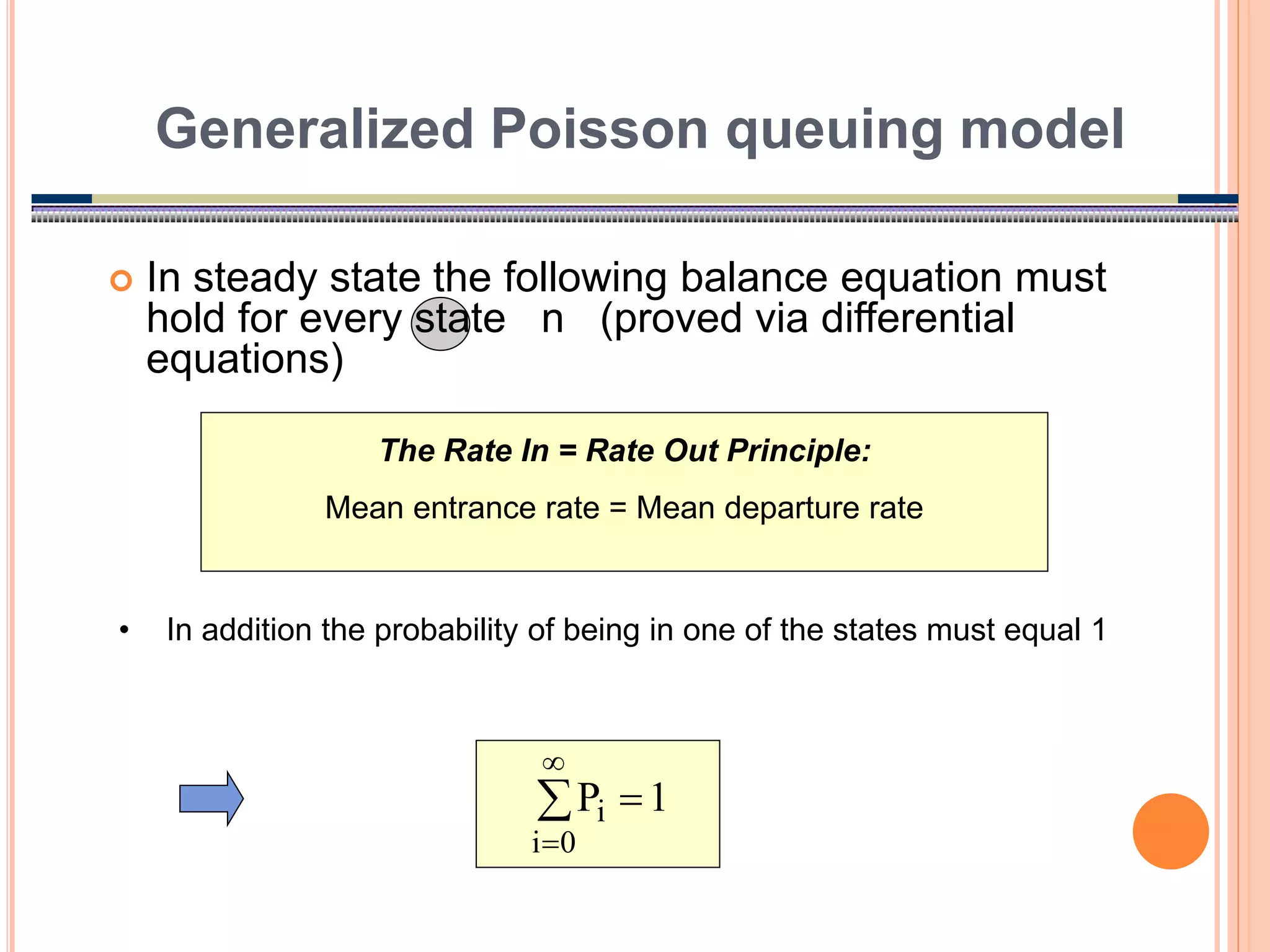
Discusses steady state balance equations in a generalized Poisson queuing system.
Presents state balance equations for determining steady-state probabilities in queuing.
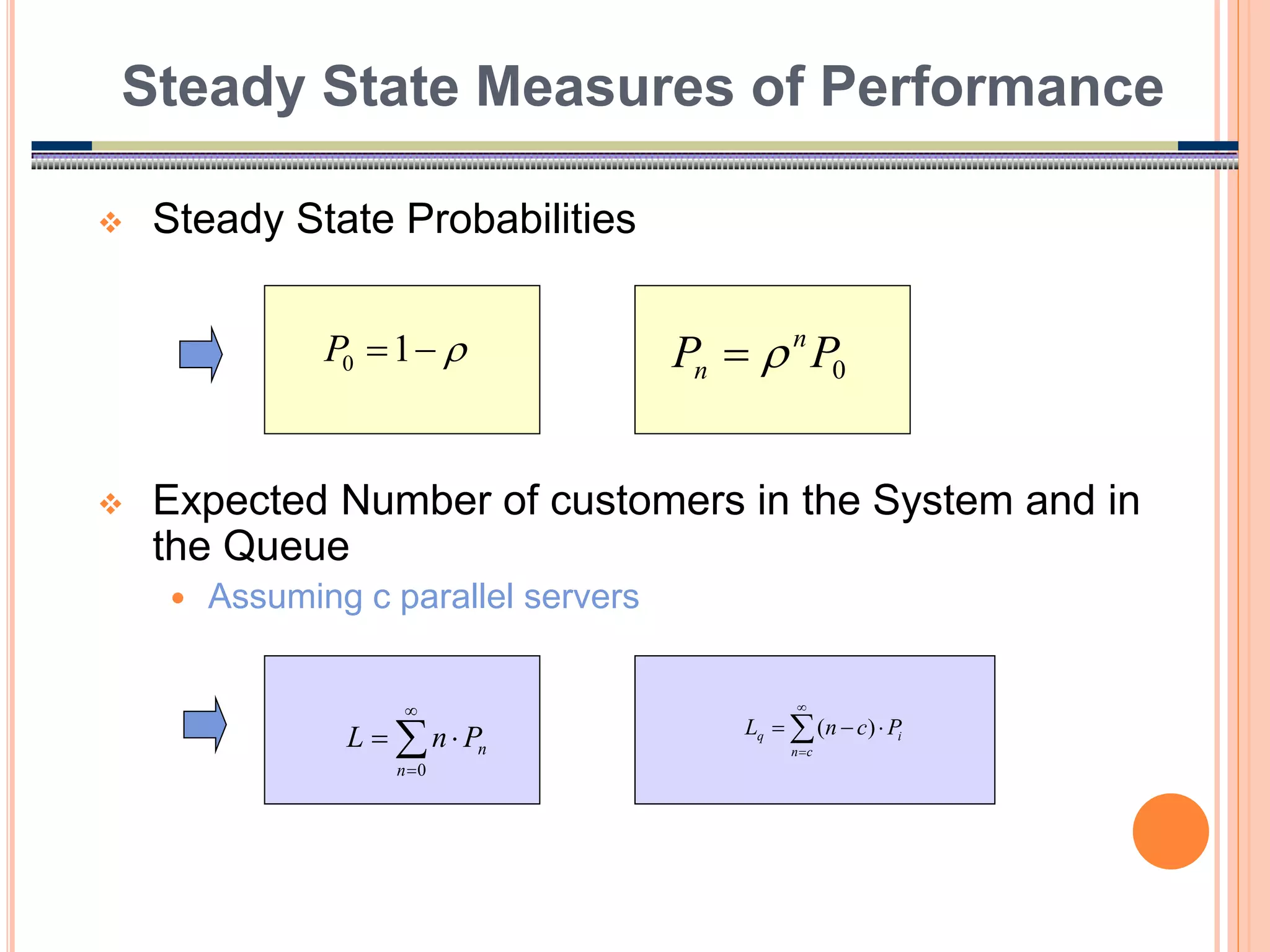
Focuses on steady state probabilities, expected customer numbers, queue lengths, and metrics.
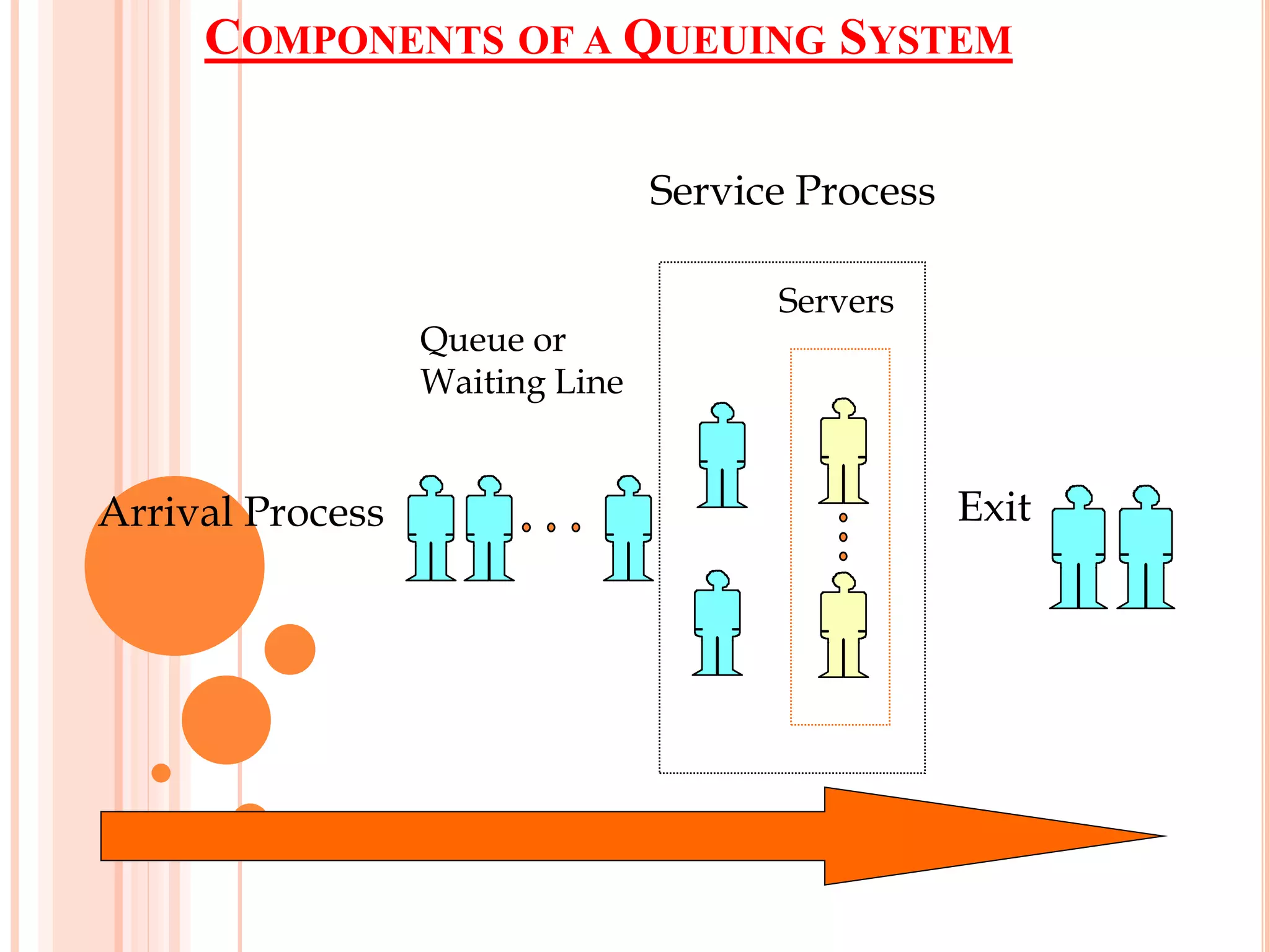
Outlines basic components involved in queuing systems and their interactions.
Introduces the M/M/c model, allowing multiple servers for enhanced queuing system performance.
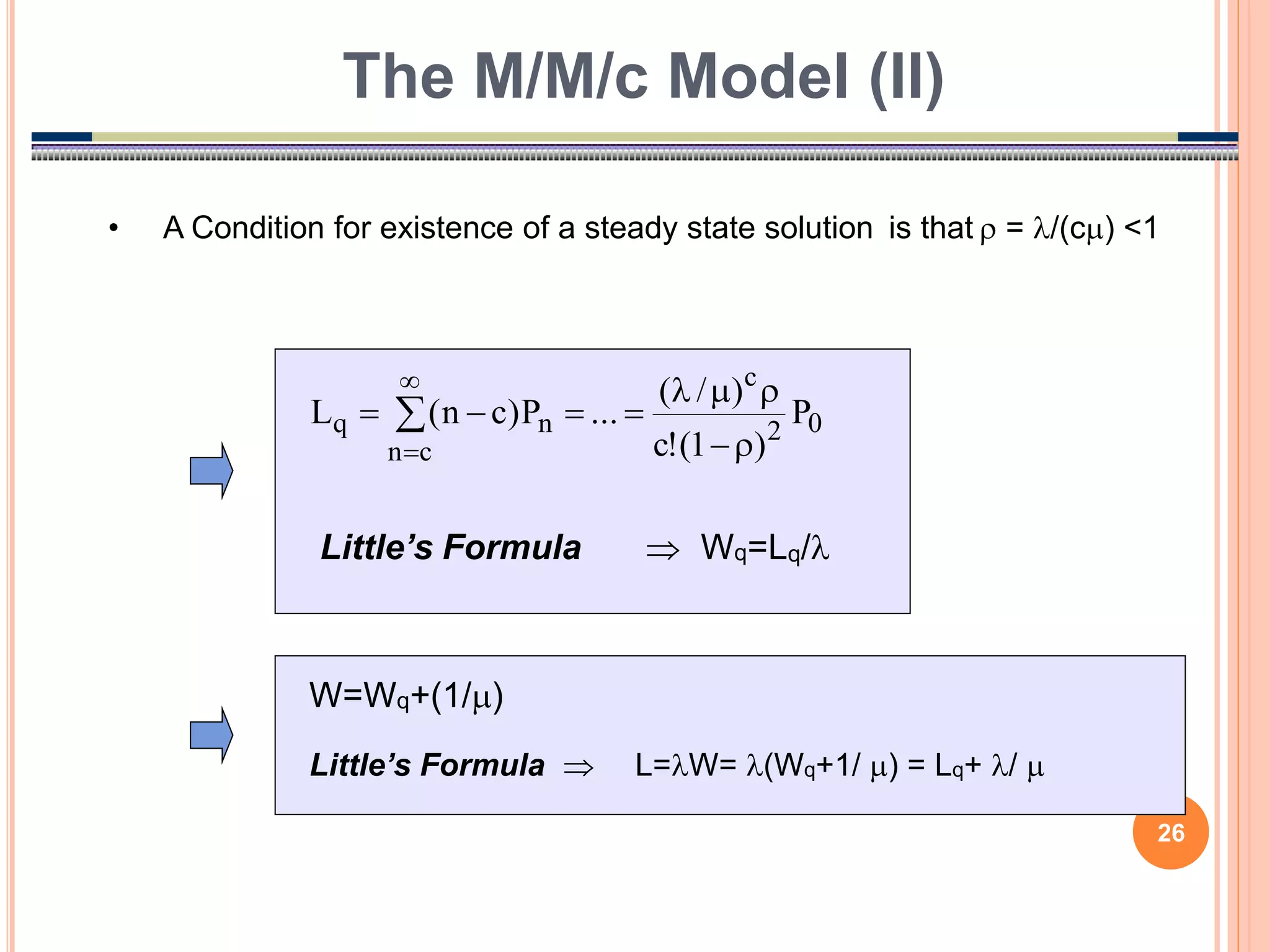
Explains Little’s formula related to the M/M/c model, covering system metrics.
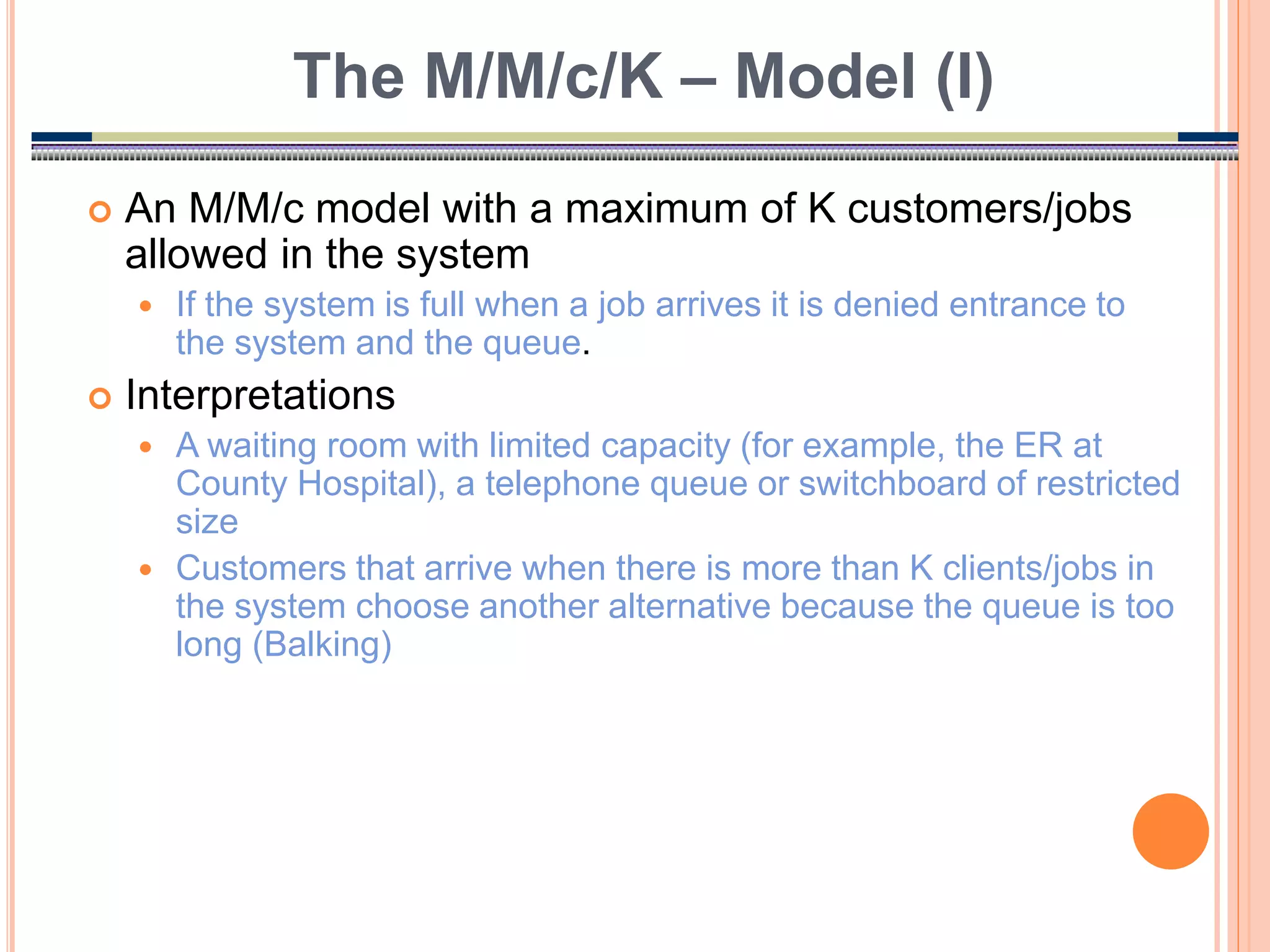
Describes a queuing model with maximum customers allowed in the system, relating to capacity.
Discusses the state diagram for the M/M/c/K model, highlighting balance equations.
Details an M/M/c model appropriate for limited calling population and machine maintenance.
Illustrates the state diagram for the M/M/c/∞/N, detailing machine operation and breakdown.
Lists sources for further reading and understanding of operations research and queuing theory.
QUEUING THEORY
[M/M/C MODEL]
StudentAdviser:-Assist.Prof. Sanjay Kumar
Student:-Ram Niwas Meena
Semester:-Fourth
“Delay is the enemy of efficiency” and “Waiting is the enemy of utilization”
2.
1
OVERVIEW
What isqueuing theory?
Examples of Real World Queuing Systems?
Components of a Basic Queuing Process
A Commonly Seen Queuing Model
Terminology and Notation
Little’s Formula
The M/M/1 – model
Example
M/M/c Model
3.
2
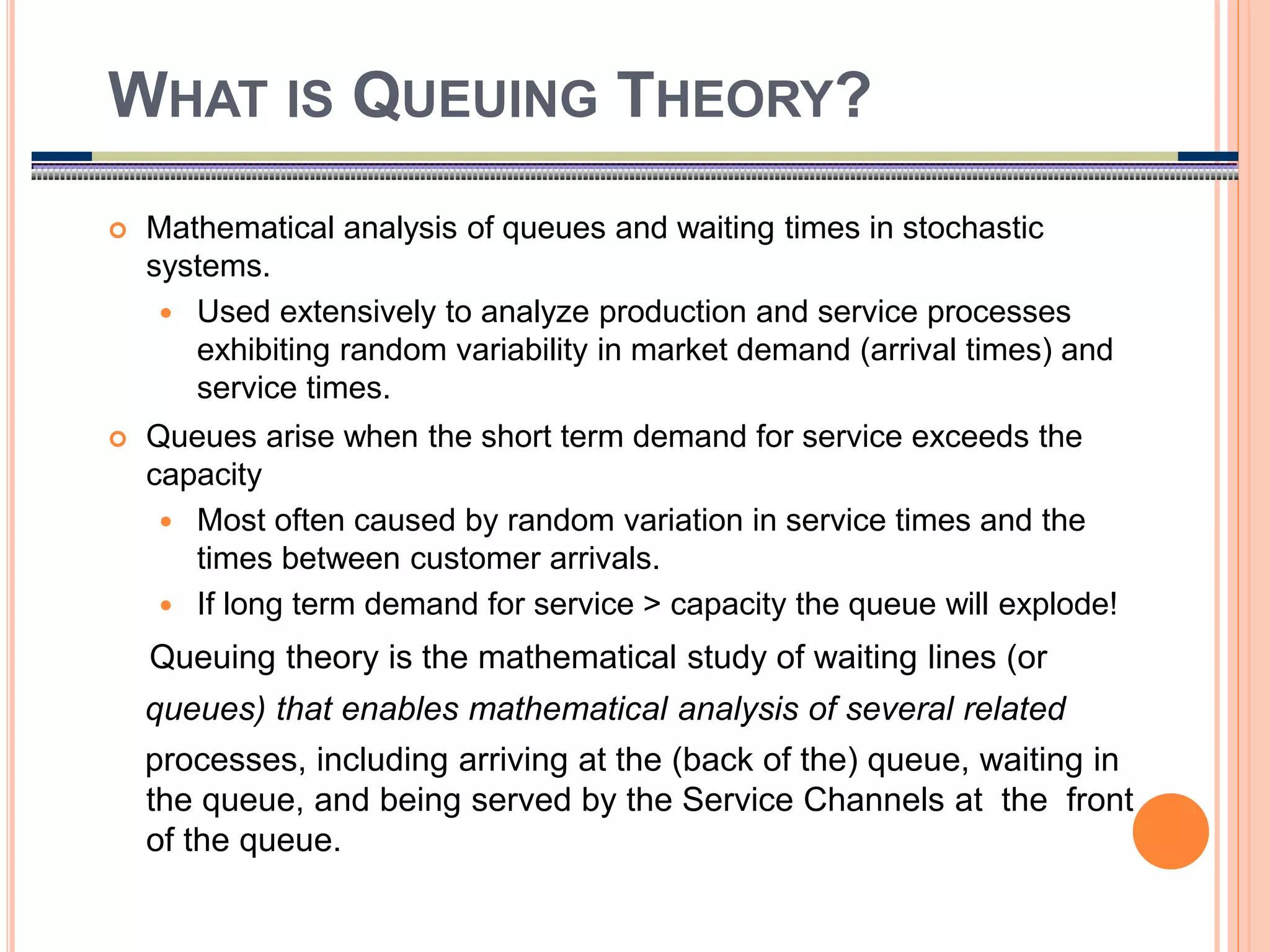
Mathematical analysisof queues and waiting times in stochastic
systems.
Used extensively to analyze production and service processes
exhibiting random variability in market demand (arrival times) and
service times.
Queues arise when the short term demand for service exceeds the
capacity
Most often caused by random variation in service times and the
times between customer arrivals.
If long term demand for service > capacity the queue will explode!
Queuing theory is the mathematical study of waiting lines (or
queues) that enables mathematical analysis of several related
processes, including arriving at the (back of the) queue, waiting in
the queue, and being served by the Service Channels at the front
of the queue.
WHAT IS QUEUING THEORY?
4.
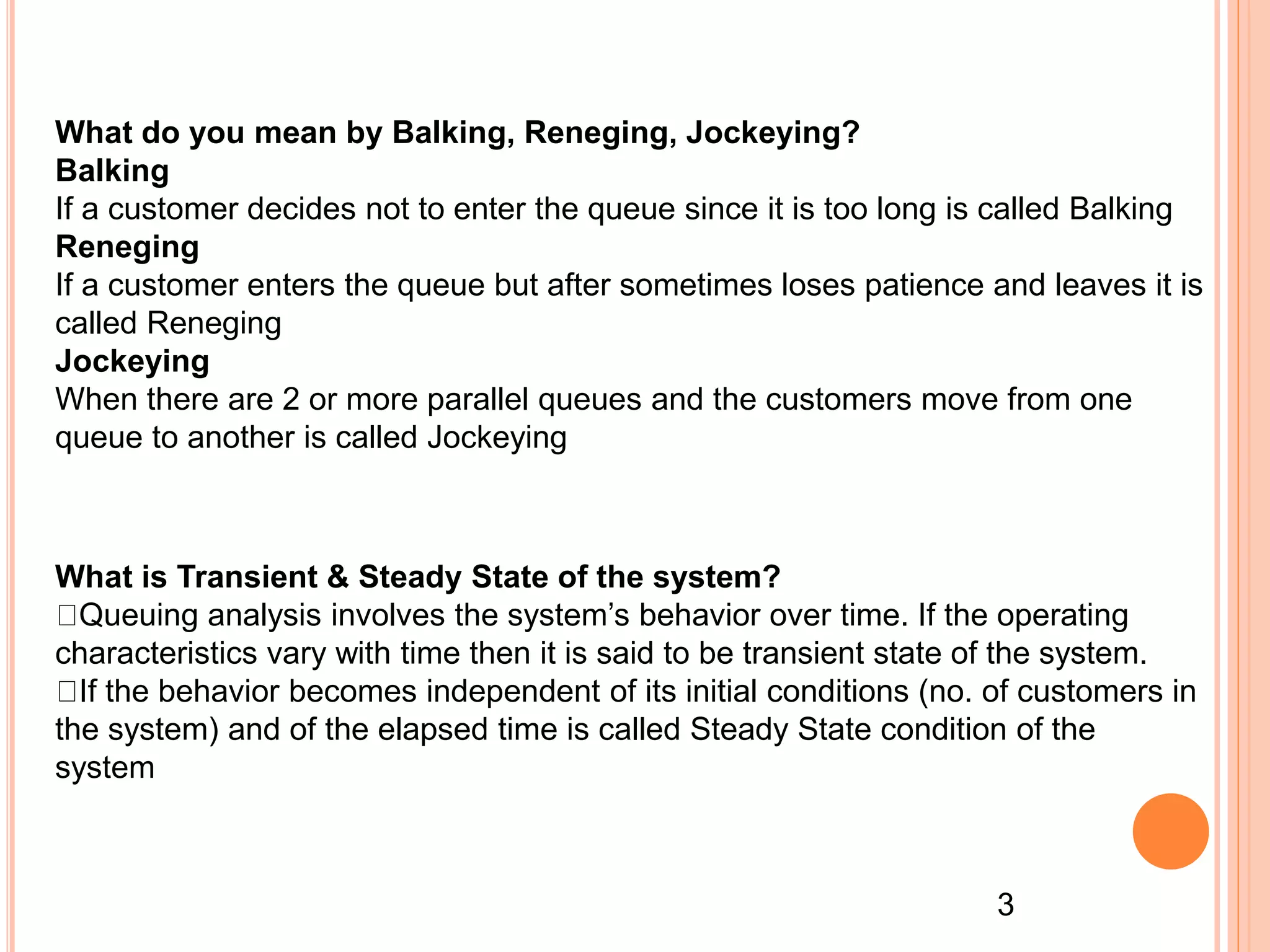
What is Transient& Steady State of the system?
Queuing analysis involves the system’s behavior over time. If the operating
characteristics vary with time then it is said to be transient state of the system.
If the behavior becomes independent of its initial conditions (no. of customers in
the system) and of the elapsed time is called Steady State condition of the
system
What do you mean by Balking, Reneging, Jockeying?
Balking
If a customer decides not to enter the queue since it is too long is called Balking
Reneging
If a customer enters the queue but after sometimes loses patience and leaves it is
called Reneging
Jockeying
When there are 2 or more parallel queues and the customers move from one
queue to another is called Jockeying
3
5.
QUEUING MODELS CALCULATE:
Average number of customers in the system waiting and being served
Average number of customers waiting in the line
Average time a customer spends in the system waiting and being served
Average time a customer spends waiting in the waiting line or queue.
Probability no customers in the system
Probability n customers in the system
Utilization rate: The proportion of time the system is in use.
4
6.
5
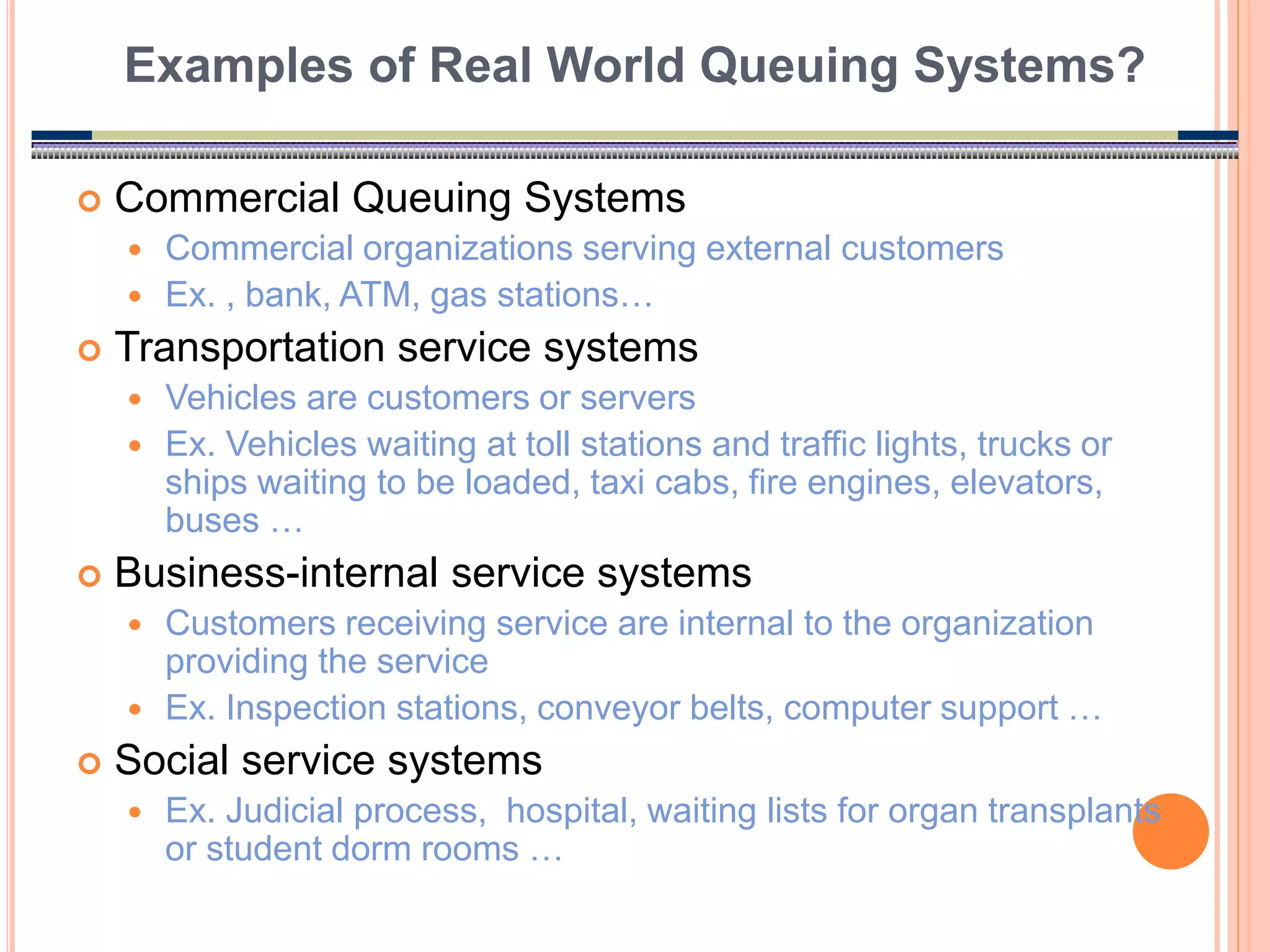
Commercial QueuingSystems
Commercial organizations serving external customers
Ex. , bank, ATM, gas stations…
Transportation service systems
Vehicles are customers or servers
Ex. Vehicles waiting at toll stations and traffic lights, trucks or
ships waiting to be loaded, taxi cabs, fire engines, elevators,
buses …
Business-internal service systems
Customers receiving service are internal to the organization
providing the service
Ex. Inspection stations, conveyor belts, computer support …
Social service systems
Ex. Judicial process, hospital, waiting lists for organ transplants
or student dorm rooms …
Examples of Real World Queuing Systems?
7.
Prabhakar
Car Wash
enter exit
Populationof
dirty cars
Arrivals
from the
general
population …
Queue
(waiting line)
Service
facility Exit the system
Exit the system
Arrivals to the system In the system
Arrival Characteristics
•Size of the population
•Behavior of arrivals
•Statistical distribution
of arrivals
Waiting Line
Characteristics
•Limited vs. unlimited
•Queue discipline
Service Characteristics
•Service design
•Statistical distribution of
service
8.
7
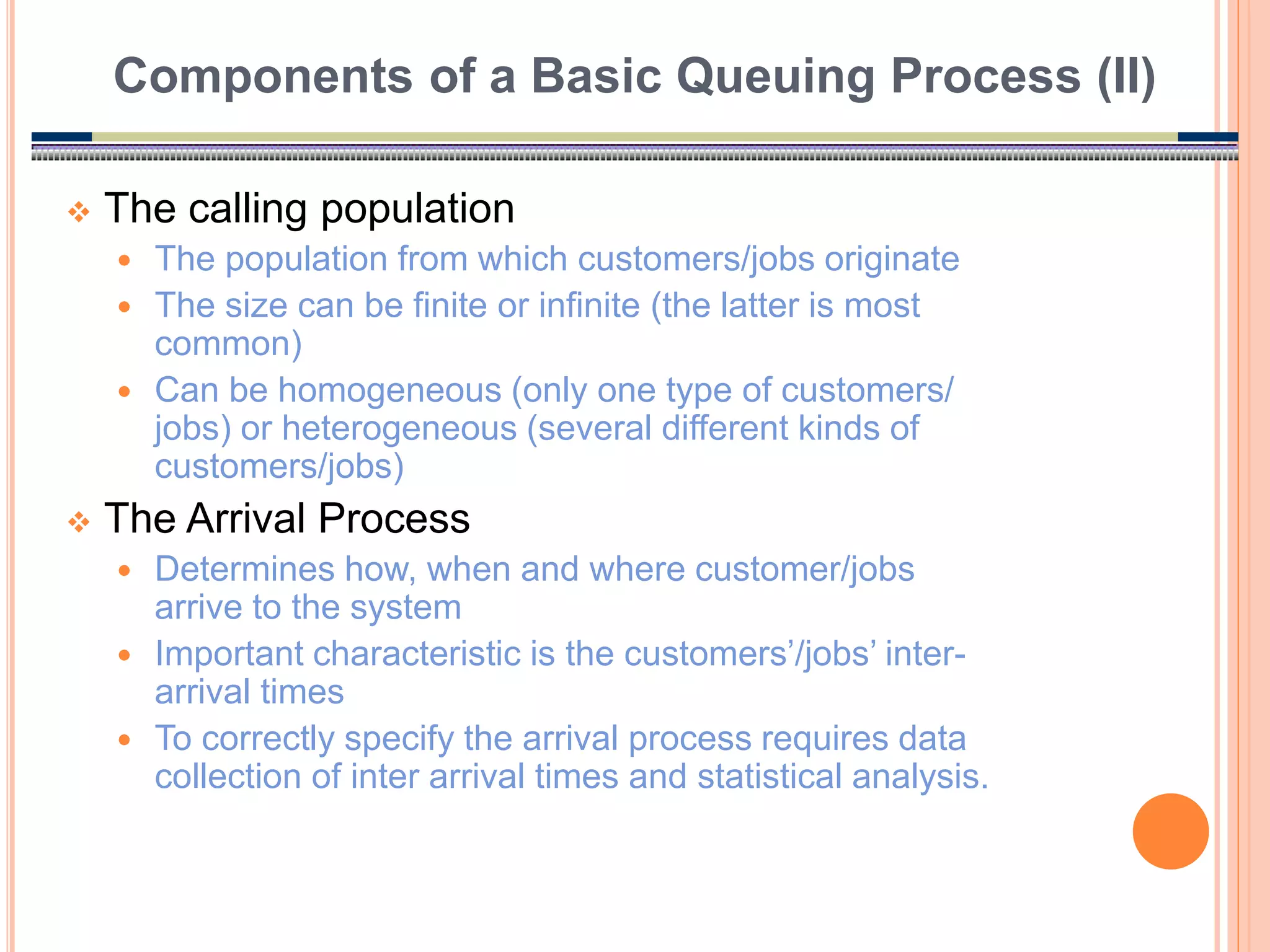
The callingpopulation
The population from which customers/jobs originate
The size can be finite or infinite (the latter is most
common)
Can be homogeneous (only one type of customers/
jobs) or heterogeneous (several different kinds of
customers/jobs)
The Arrival Process
Determines how, when and where customer/jobs
arrive to the system
Important characteristic is the customers’/jobs’ inter-
arrival times
To correctly specify the arrival process requires data
collection of inter arrival times and statistical analysis.
Components of a Basic Queuing Process (II)
9.
8
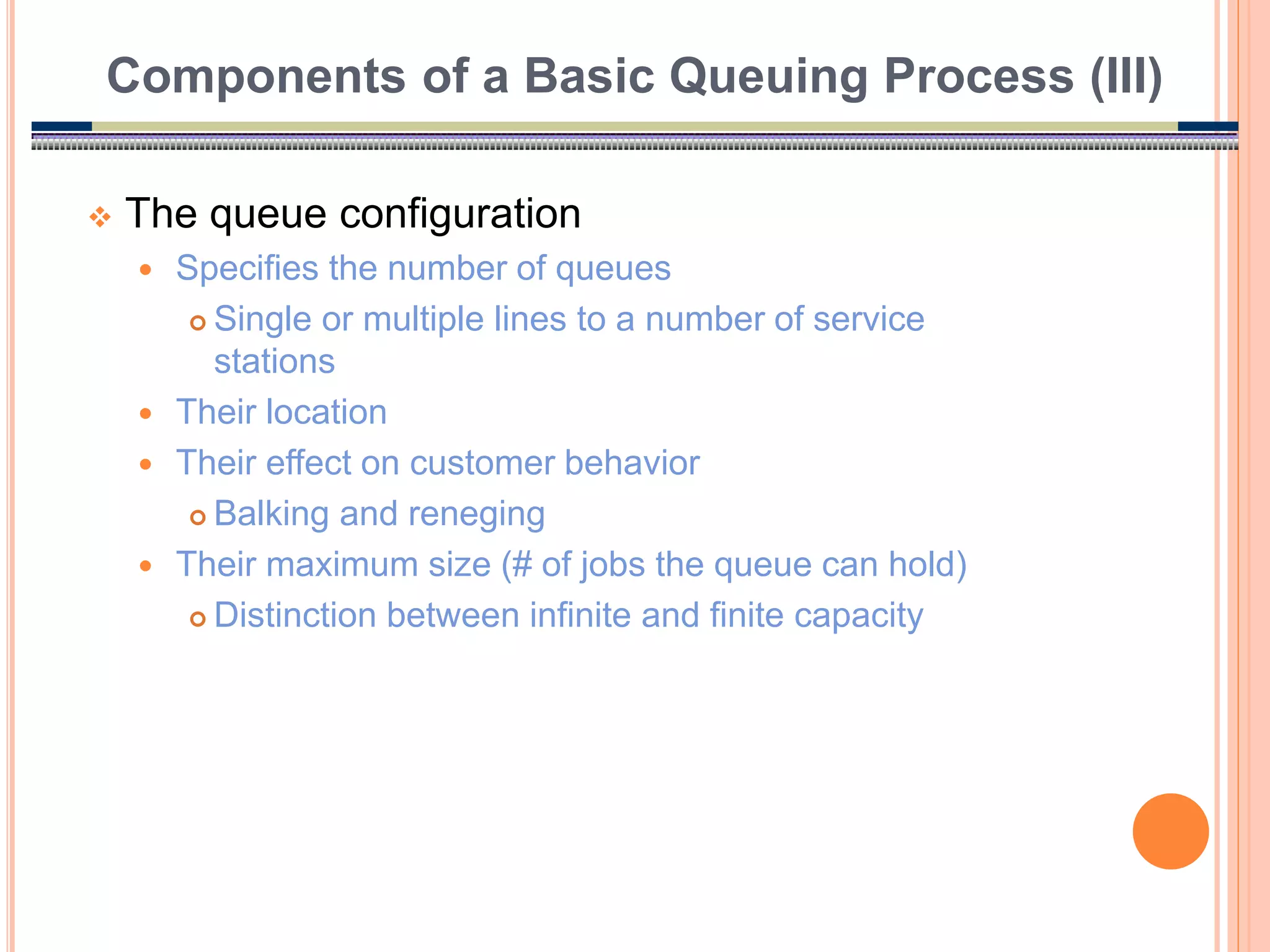
The queueconfiguration
Specifies the number of queues
Single or multiple lines to a number of service
stations
Their location
Their effect on customer behavior
Balking and reneging
Their maximum size (# of jobs the queue can hold)
Distinction between infinite and finite capacity
Components of a Basic Queuing Process (III)
10.
9
The ServiceMechanism
Can involve one or several service facilities with one or several
parallel service channels (servers) - Specification is required
The service provided by a server is characterized by its service time
Specification is required and typically involves data gathering and
statistical analysis.
Most analytical queuing models are based on the assumption of
exponentially distributed service times, with some generalizations.
The queue discipline
Specifies the order by which jobs in the queue are being served.
Most commonly used principle is FIFO.
Other rules are, for example, LIFO, SPT, EDD…
Can entail prioritization based on customer type.
Components of a Basic Queuing Process (IV)
11.
11
A Commonly SeenQueuing Model (I)
C C C … C
Customers (C)
C S = Server
C S
•
•
•
C S
Customer =C
The Queuing System
The Queue
The Service Facility
12.
12
Service timesas well as inter arrival times are assumed
independent and identically distributed
If not otherwise specified
Commonly used notation principle: (a/b/c):(d/e/f)
a = The inter arrival time distribution
b = The service time distribution
c = The number of parallel servers
d= Queue discipline
e = maximum number (finite/infinite) allowed in the system
f = size of the calling source(finite/infinite)
Commonly used distributions
M = Markovian (exponential/possion) –arrivals or departurs
distribution Memoryless
D = Deterministic distribution
G = General distribution
Example: M/M/c
Queuing system with exponentially distributed service and inter-
arrival times and c servers
A Commonly Seen Queuing Model (II)
13.
14
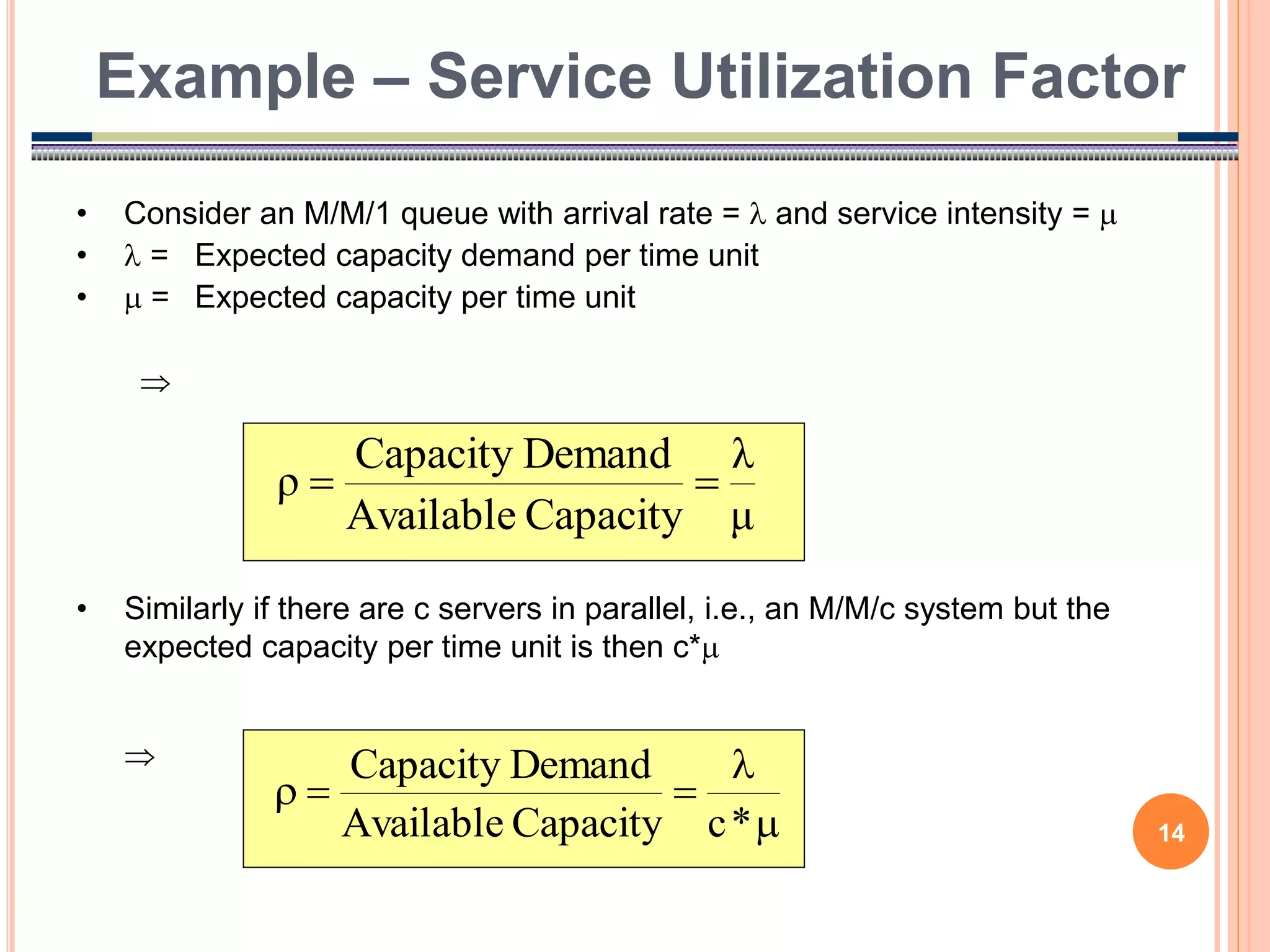
Example – ServiceUtilization Factor
• Consider an M/M/1 queue with arrival rate = and service intensity =
• = Expected capacity demand per time unit
• = Expected capacity per time unit
μ
λ
Capacity
Available
Demand
Capacity
ρ
*
c
Capacity
Available
Demand
Capacity
• Similarly if there are c servers in parallel, i.e., an M/M/c system but the
expected capacity per time unit is then c*
14.
13
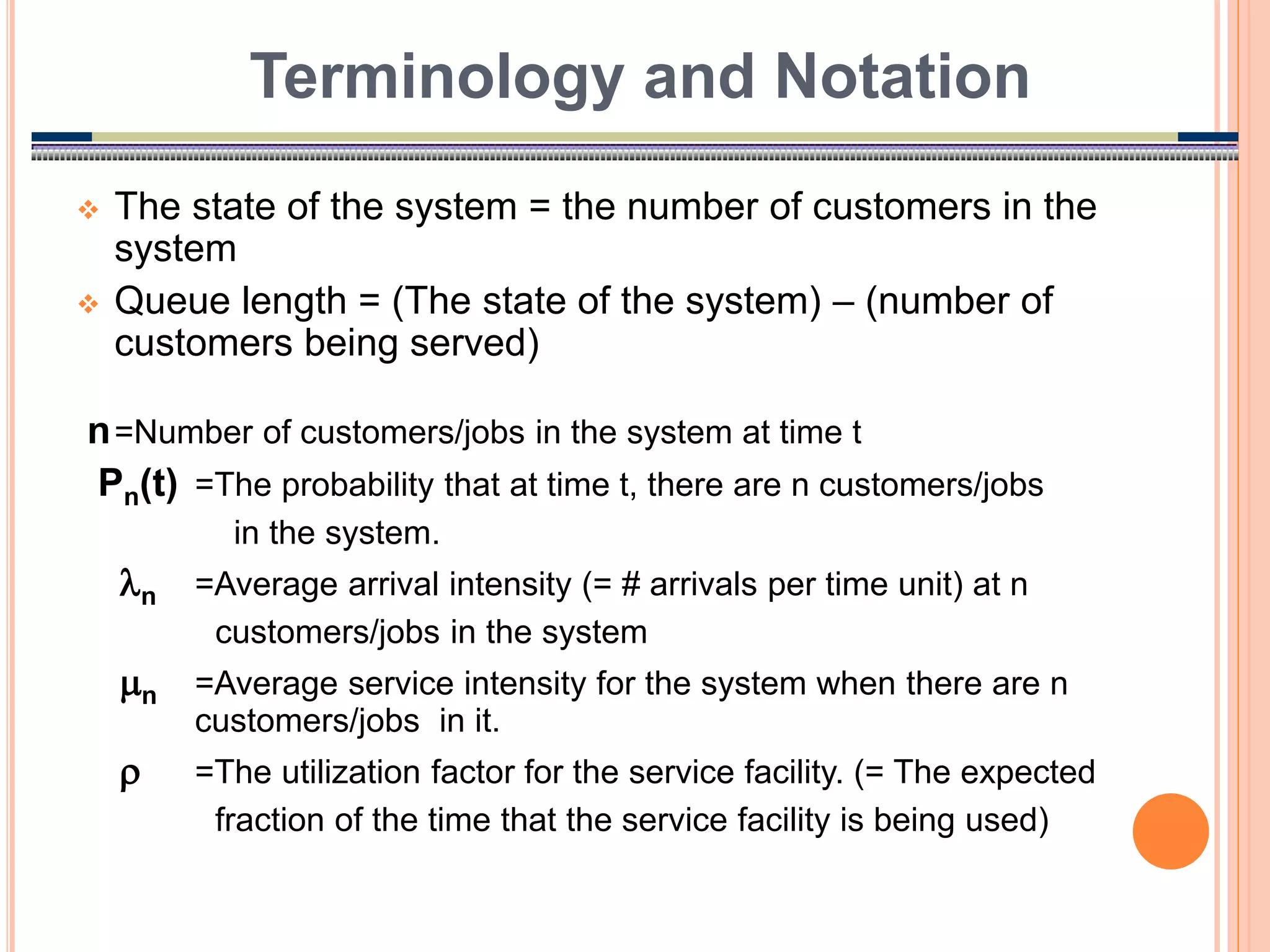
The stateof the system = the number of customers in the
system
Queue length = (The state of the system) – (number of
customers being served)
n=Number of customers/jobs in the system at time t
Pn(t) =The probability that at time t, there are n customers/jobs
in the system.
n =Average arrival intensity (= # arrivals per time unit) at n
customers/jobs in the system
n =Average service intensity for the system when there are n
customers/jobs in it.
=The utilization factor for the service facility. (= The expected
fraction of the time that the service facility is being used)
Terminology and Notation
15.
15
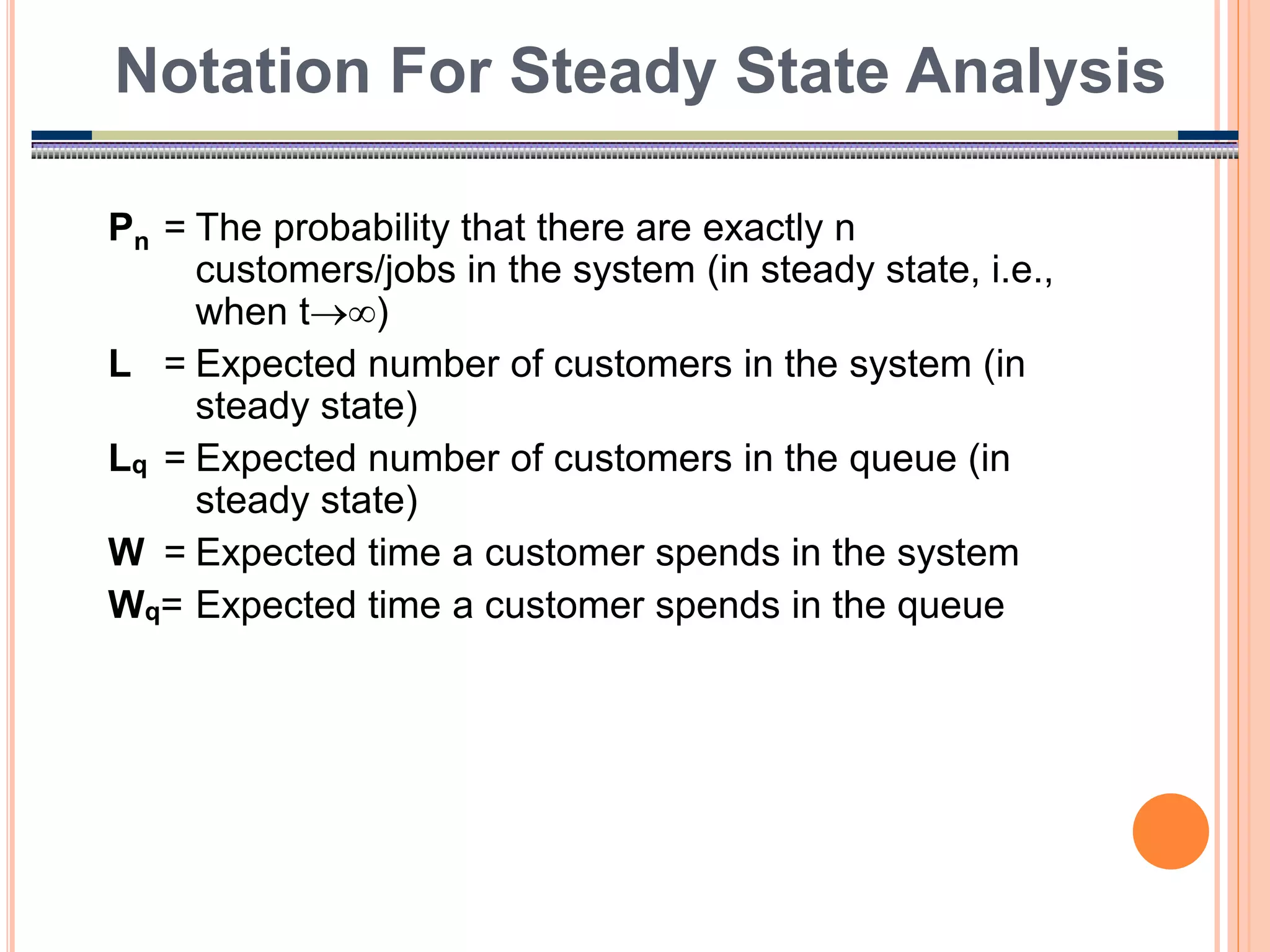
Pn = Theprobability that there are exactly n
customers/jobs in the system (in steady state, i.e.,
when t)
L = Expected number of customers in the system (in
steady state)
Lq = Expected number of customers in the queue (in
steady state)
W = Expected time a customer spends in the system
Wq= Expected time a customer spends in the queue
Notation For Steady State Analysis
16.
16
Assume thatn = and n = for all n
Assume that n is dependent on n
Little’s Formula
W
L
q
q W
L
W
L
q
q W
L
0
n
n
n
P
Let
17.
17
Assumptions - theBasic Queuing Process
Infinite Calling Populations
Independence between arrivals
The arrival process is Poisson with an expected arrival rate
Independent of the number of customers currently in the system
The queue configuration is a single queue with possibly
infinite length
No reneging or balking
The queue discipline is FIFO
The service mechanism consists of a single server with
exponentially distributed service times
= expected service rate when the server is busy
The M/M/1 - model
18.
18
n= and n = for all values of n=0, 1, 2, …
The M/M/1 Model
0
1 n
n-1
2 n+1
L=/(1- ) Lq= 2/(1- ) = L-
W=L/=1/(- ) Wq=Lq/= /( (- ))
Steady State condition: = (/) < 1
Pn = n(1- )
P0 = 1- P(nk) = k
19.
19
Situation
Patientsarrive according to a Poisson process with
intensity ( the time between arrivals is exp()
distributed.
The service time (the doctor’s examination and treatment
time of a patient) follows an exponential distribution with
mean 1/ (=exp() distributed)
The SMS can be modeled as an M/M/c system where
c=the number of doctors
Example – SMS Hospital
Data gathering
= 2 patients per hour
= 3 patients per hour
Questions
– Should the capacity be increased from 1 to 2 doctors?
– How are the characteristics of the system (, Wq, W, Lq and
L) affected by an increase in service capacity?
20.
20
Interpretation
Tobe in the queue = to be in the waiting room
To be in the system = to be in the ER (waiting or under treatment)
Is it warranted to hire a second doctor ?
Summary of Results – SMS Hospital
Characteristic One doctor (c=1) Two Doctors (c=2)
2/3 1/3
P0 1/3 1/2
(1-P0) 2/3 1/2
P1 2/9 1/3
Lq 4/3 patients 1/12 patients
L 2 patients 3/4 patients
Wq 2/3 h = 40 minutes 1/24 h = 2.5 minutes
W 1 h 3/8 h = 22.5 minutes
21.
21
In steadystate the following balance equation must
hold for every state n (proved via differential
equations)
Generalized Poisson queuing model
The Rate In = Rate Out Principle:
Mean entrance rate = Mean departure rate
0
i
i 1
P
• In addition the probability of being in one of the states must equal 1
22.
22
0
0
1
1 P
P
StateBalance Equation
0
1
n
1
1
1
1
2
2
0
0 P
P
P
P
n
n
n
1
n
1
n
1
n
1
n P
)
(
P
P
Generalized Poisson queuing model
0
1
0
1 P
P
1
2
1
2 P
P
1
n
n
1
n
n P
P
1
1
P
P
:
ion
Normalizat
0
i 3
2
1
2
1
0
2
1
1
0
1
0
0
i
C0 C2
23.
23
Steady StateProbabilities
Expected Number of customers in the System and in
the Queue
Assuming c parallel servers
Steady State Measures of Performance
1
0
P 0
P
P n
n
0
n
n
P
n
L
c
n
i
q P
c
n
L )
(
24.
COMPONENTS OF AQUEUING SYSTEM
Arrival Process
Servers
Queue or
Waiting Line
Service Process
Exit
25.
25
The M/M/c Model(I)
1
c
1
c
0
n
n
0
)
c
/(
(
1
1
!
c
)
/
(
!
n
)
/
(
P
,
2
c
,
1
c
n
for
P
c
!
c
)
/
(
c
,
,
2
,
1
n
for
P
!
n
)
/
(
P
0
c
n
n
0
n
n
0
2 (c-1) c
1 c
c-2
2 c+1
c
c-1
(c-2)
• Generalization of the M/M/1 model
– Allows for c identical servers working independently from each
other
Steady State
Condition:
=(/c)<1
26.
26
W=Wq+(1/)
Little’s Formula Wq=Lq/
The M/M/c Model (II)
0
2
c
c
n
n
q P
)
1
(
!
c
)
/
(
...
P
)
c
n
(
L
• A Condition for existence of a steady state solution is that = /(c) <1
Little’s Formula L=W= (Wq+1/ ) = Lq+ /
27.
27
An M/M/cmodel with a maximum of K customers/jobs
allowed in the system
If the system is full when a job arrives it is denied entrance to
the system and the queue.
Interpretations
A waiting room with limited capacity (for example, the ER at
County Hospital), a telephone queue or switchboard of restricted
size
Customers that arrive when there is more than K clients/jobs in
the system choose another alternative because the queue is too
long (Balking)
The M/M/c/K – Model (I)
28.
28
The statediagram has exactly K states provided that
c<K
The general expressions for the steady state
probabilities, waiting times, queue lengths etc. are
obtained through the balance equations as before
(Rate In = Rate Out; for every state)
The M/M/c/K – Model (II)
0
2 (c-1) c
1 K-1
c-1
2 K
c
c
c
3
29.
29
An M/M/cmodel with limited calling population, i.e., N
clients
A common application: Machine maintenance
c service technicians is responsible for keeping N service
stations (machines) running, that is, to repair them as soon as
they break
Customer/job arrivals = machine breakdowns
Note, the maximum number of clients in the system = N
Assume that (N-n) machines are operating and the time
until breakdown for each machine i, Ti, is exponentially
distributed (Tiexp()). If U = the time until the next
breakdown
U = Min{T1, T2, …, TN-n} Uexp((N-n))).
The M/M/c//N – Model (I)
30.
30
• The StateDiagram (c service technicians and N machines)
– = Arrival intensity per operating machine
– = The service intensity for a service technician
• General expressions for this queuing model can be obtained from the
balance equations as before
The M/M/c//N – Model (II)
0
N (N-1) (N-(c-1))
2 (c-1) c
1 N-1
c-1
2 N
c
c
3
![QUEUING THEORY
[M/M/C MODEL]
Student Adviser:-Assist.Prof. Sanjay Kumar
Student:-Ram Niwas Meena
Semester:-Fourth
“Delay is the enemy of efficiency” and “Waiting is the enemy of utilization”](https://image.slidesharecdn.com/ramniwasfinal-130117061239-phpapp02/75/Ramniwas-final-1-2048.jpg)