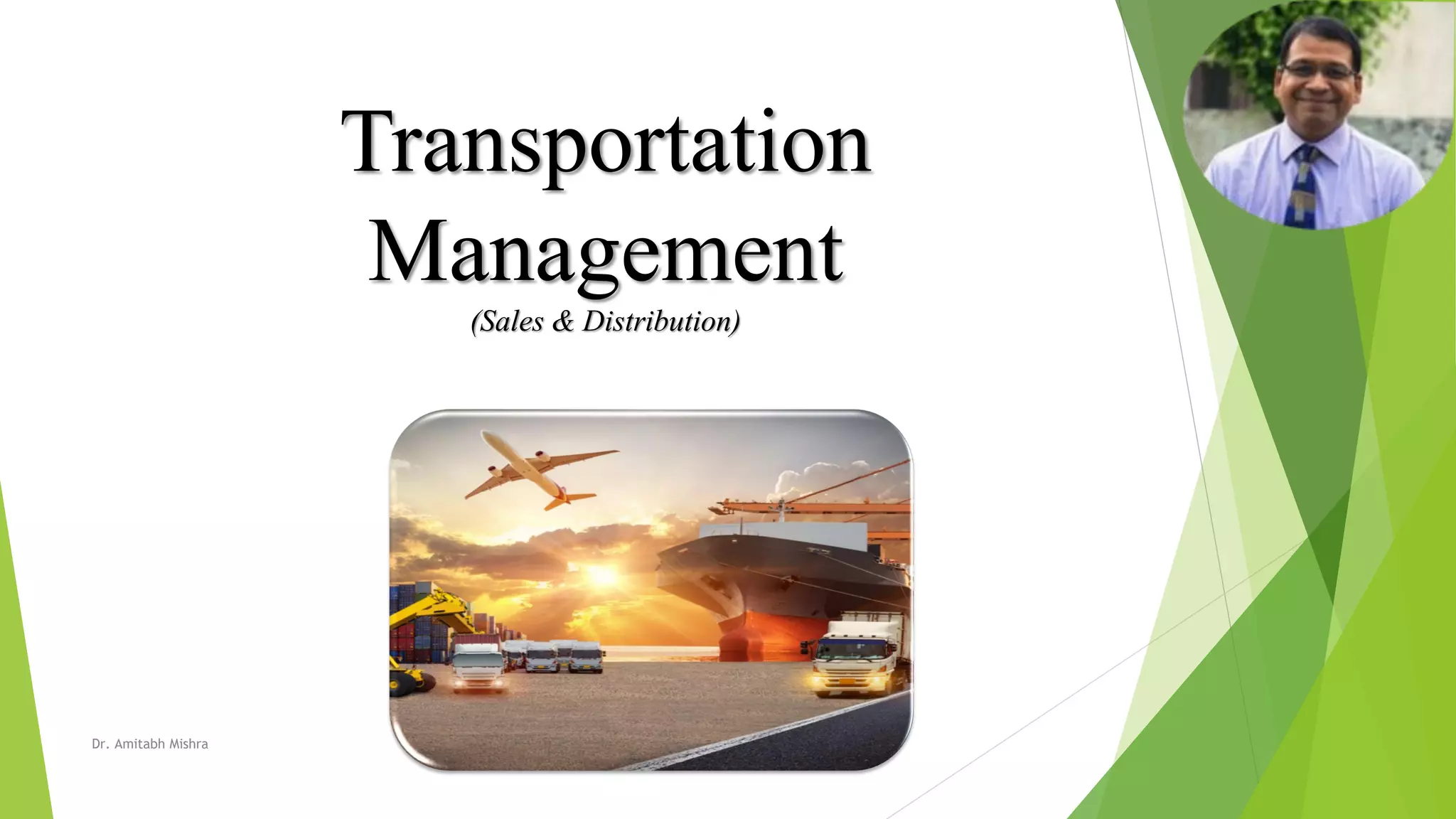
Transportation
Management
(Sales & Distribution)
Dr. Amitabh Mishra
Transportation
 Transportation is the operational area of logistics that
geographically moves and positions inventory.
 Almost all enterprises have managers responsible for
transportation.
 Transportation requirements can be satisfied in three basic ways:
 A private fleet of equipment may be operated.
 Contracts may be arranged with dedicated transport specialists.
 An enterprise may engage the services of a wide variety of carriers that provide
different transportation services as needed on a per shipment basis.
Dr. Amitabh Mishra
Transportation system
 Transportation system is the physical link
connecting a company with the customers, raw
material suppliers, plants, ware houses and
distribution channel members.
 All these elements of logistic system are fixed
points, transportation is the connecting medium.
Dr. Amitabh Mishra
Transportation Infrastructure
 Transportation infrastructure consists of the rights-of-way,
vehicles, and carrier organizations that offer transportation
services on a for-hire or internal basis.
 Transportation infrastructure can broadly be classified as:
 Hardware: physical assets that comprise terminals, storage facilities,
right of way for movement and vehicles/equipment. software.
 Software: Essentially the service superstructure, consists primarily
of maintenance, operations and value added services.
Dr. Amitabh Mishra
Transportation management decisions
 The overall goal in transportation is to connect sourcing locations
with customers at the lowest possible transportation cost within
the constraints of the customer service policy.
 Transport Management decisions involves:
 How much to move?
 When to move?
 Where to move?
 By what mode, or combination of modes to move?
Dr. Amitabh Mishra
The considerations in making these
decisions are:
 The lead time for stock replenishment
 Sales expected in the territory in the intervening time
 The normal cycles of inventory build up at the
warehouse/dealer points
Dr. Amitabh Mishra
 If a firm can estimate these factors fairly accurately,
it can make the basic decisions on transportation.
 In a fundamental sense, transportation has to be
based on the sales forecast.
 Decisions on when to move, how much to move and
where to move will essentially depend on the sales
forecast
Dr. Amitabh Mishra
Main Tasks in Transportation
Management
 Assessment of the transportation requirement
 Choosing the ‘mix’ of transport modes
 Deciding the routing
 Development of operational plans
 Implementation/review
 Control of transportation costs
Dr. Amitabh Mishra
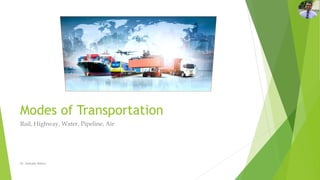
Modes of Transportation
Rail, Highway, Water, Pipeline, Air
Dr. Amitabh Mishra
Modes of Transportation
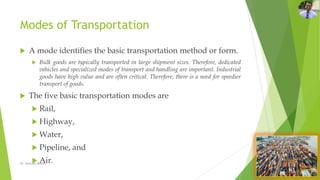
 A mode identifies the basic transportation method or form.
 Bulk goods are typically transported in large shipment sizes. Therefore, dedicated
vehicles and specialized modes of transport and handling are important. Industrial
goods have high value and are often critical. Therefore, there is a need for speedier
transport of goods.
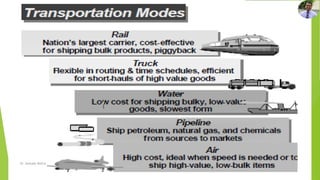
 The five basic transportation modes are
 Rail,
 Highway,
 Water,
 Pipeline, and
 Air.
Dr. Amitabh Mishra
Dr. Amitabh Mishra
Rail Network/Railroads
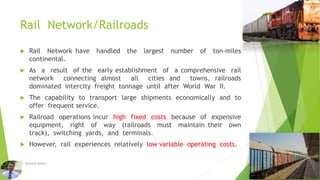
 Rail Network have handled the largest number of ton-miles
continental.
 As a result of the early establishment of a comprehensive rail
network connecting almost all cities and towns, railroads
dominated intercity freight tonnage until after World War II.
 The capability to transport large shipments economically and to
offer frequent service.
 Railroad operations incur high fixed costs because of expensive
equipment, right of way (railroads must maintain their own
track), switching yards, and terminals.
 However, rail experiences relatively low variable operating costs.
Dr. Amitabh Mishra
Highway/Motor Carriers/Trucks
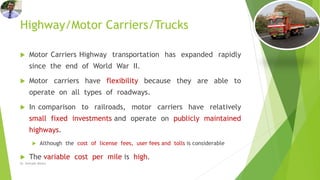
 Motor Carriers Highway transportation has expanded rapidly
since the end of World War II.
 Motor carriers have flexibility because they are able to
operate on all types of roadways.
 In comparison to railroads, motor carriers have relatively
small fixed investments and operate on publicly maintained
highways.
 Although the cost of license fees, user fees and tolls is considerable
 The variable cost per mile is high.
Dr. Amitabh Mishra
Water Transport
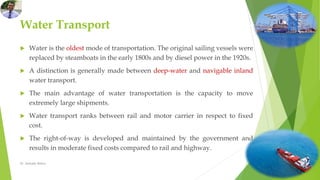
 Water is the oldest mode of transportation. The original sailing vessels were
replaced by steamboats in the early 1800s and by diesel power in the 1920s.
 A distinction is generally made between deep-water and navigable inland
water transport.
 The main advantage of water transportation is the capacity to move
extremely large shipments.
 Water transport ranks between rail and motor carrier in respect to fixed
cost.
 The right-of-way is developed and maintained by the government and
results in moderate fixed costs compared to rail and highway.
Dr. Amitabh Mishra
Pipelines
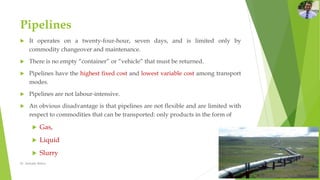
 It operates on a twenty-four-hour, seven days, and is limited only by
commodity changeover and maintenance.
 There is no empty “container” or “vehicle” that must be returned.
 Pipelines have the highest fixed cost and lowest variable cost among transport
modes.
 Pipelines are not labour-intensive.
 An obvious disadvantage is that pipelines are not flexible and are limited with
respect to commodities that can be transported: only products in the form of
 Gas,
 Liquid
 Slurry
Dr. Amitabh Mishra
Dr. Amitabh Mishra
https://www.thehindubusinessline.com/companies/psu-oil-majors-ink-jv-for-kandla-gorakhpur-
pipeline-project/article27439060.ece
Air Transport
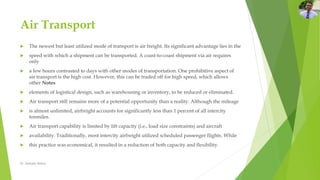
 The newest but least utilized mode of transport is air freight. Its significant advantage lies in the
 speed with which a shipment can be transported. A coast-to-coast shipment via air requires
only
 a few hours contrasted to days with other modes of transportation. One prohibitive aspect of
air transport is the high cost. However, this can be traded off for high speed, which allows
other Notes
 elements of logistical design, such as warehousing or inventory, to be reduced or eliminated.
 Air transport still remains more of a potential opportunity than a reality. Although the mileage
 is almost unlimited, airfreight accounts for significantly less than 1 percent of all intercity
tonmiles.
 Air transport capability is limited by lift capacity (i.e., load size constraints) and aircraft
 availability. Traditionally, most intercity airfreight utilized scheduled passenger flights. While
 this practice was economical, it resulted in a reduction of both capacity and flexibility.
Dr. Amitabh Mishra
Factors in Transportation/
Choosing Transportation Modes
Dr. Amitabh Mishra
Factors in Transportation/
Choosing Transportation Modes
1. Cost
2. Speed
3. Consistency
1. Dependability
2. Capability
3. Availability
Dr. Amitabh Mishra
 The cost of transport is the payment for shipment between two geographical
locations and the expenses related to maintaining in-transit inventory.
Logistical systems should utilize transportation that minimizes total system
cost.
 Least expensive method of transportation may not result in the lowest total cost of
logistics.
 Speed of transportation is the time required to complete a specific movement.
 Transport firms capable of offering faster service typically charge higher rates.
 Second, the faster the transportation service is, the shorter is the time interval during
which inventory is in transit and unavailable.
 Thus, a critical aspect of selecting the most desirable method of transportation is to
balance speed and cost of service.
 Consistency of transportation refers to variations in time required to perform a
specific movement over a number of shipments. Consistency reflects the
dependability of transportation.
Dr. Amitabh Mishra
Controlling Transportation Costs
 Optimizing the mix of the transport modes
 Reducing the transport lead-time through
effective routing and other means, and
 Eliminating multiple and wasteful transfer, and
handling of products
Dr. Amitabh Mishra

Transportation Management

  • 1.
  • 2.
    Transportation  Transportation isthe operational area of logistics that geographically moves and positions inventory.  Almost all enterprises have managers responsible for transportation.  Transportation requirements can be satisfied in three basic ways:  A private fleet of equipment may be operated.  Contracts may be arranged with dedicated transport specialists.  An enterprise may engage the services of a wide variety of carriers that provide different transportation services as needed on a per shipment basis. Dr. Amitabh Mishra
  • 3.
    Transportation system  Transportationsystem is the physical link connecting a company with the customers, raw material suppliers, plants, ware houses and distribution channel members.  All these elements of logistic system are fixed points, transportation is the connecting medium. Dr. Amitabh Mishra
  • 4.
    Transportation Infrastructure  Transportationinfrastructure consists of the rights-of-way, vehicles, and carrier organizations that offer transportation services on a for-hire or internal basis.  Transportation infrastructure can broadly be classified as:  Hardware: physical assets that comprise terminals, storage facilities, right of way for movement and vehicles/equipment. software.  Software: Essentially the service superstructure, consists primarily of maintenance, operations and value added services. Dr. Amitabh Mishra
  • 5.
    Transportation management decisions The overall goal in transportation is to connect sourcing locations with customers at the lowest possible transportation cost within the constraints of the customer service policy.  Transport Management decisions involves:  How much to move?  When to move?  Where to move?  By what mode, or combination of modes to move? Dr. Amitabh Mishra
  • 6.
    The considerations inmaking these decisions are:  The lead time for stock replenishment  Sales expected in the territory in the intervening time  The normal cycles of inventory build up at the warehouse/dealer points Dr. Amitabh Mishra
  • 7.
     If afirm can estimate these factors fairly accurately, it can make the basic decisions on transportation.  In a fundamental sense, transportation has to be based on the sales forecast.  Decisions on when to move, how much to move and where to move will essentially depend on the sales forecast Dr. Amitabh Mishra
  • 8.
    Main Tasks inTransportation Management  Assessment of the transportation requirement  Choosing the ‘mix’ of transport modes  Deciding the routing  Development of operational plans  Implementation/review  Control of transportation costs Dr. Amitabh Mishra
  • 9.
    Modes of Transportation Rail,Highway, Water, Pipeline, Air Dr. Amitabh Mishra
  • 10.
    Modes of Transportation A mode identifies the basic transportation method or form.  Bulk goods are typically transported in large shipment sizes. Therefore, dedicated vehicles and specialized modes of transport and handling are important. Industrial goods have high value and are often critical. Therefore, there is a need for speedier transport of goods.  The five basic transportation modes are  Rail,  Highway,  Water,  Pipeline, and  Air. Dr. Amitabh Mishra
  • 11.
  • 12.
    Rail Network/Railroads  RailNetwork have handled the largest number of ton-miles continental.  As a result of the early establishment of a comprehensive rail network connecting almost all cities and towns, railroads dominated intercity freight tonnage until after World War II.  The capability to transport large shipments economically and to offer frequent service.  Railroad operations incur high fixed costs because of expensive equipment, right of way (railroads must maintain their own track), switching yards, and terminals.  However, rail experiences relatively low variable operating costs. Dr. Amitabh Mishra
  • 13.
    Highway/Motor Carriers/Trucks  MotorCarriers Highway transportation has expanded rapidly since the end of World War II.  Motor carriers have flexibility because they are able to operate on all types of roadways.  In comparison to railroads, motor carriers have relatively small fixed investments and operate on publicly maintained highways.  Although the cost of license fees, user fees and tolls is considerable  The variable cost per mile is high. Dr. Amitabh Mishra
  • 14.
    Water Transport  Wateris the oldest mode of transportation. The original sailing vessels were replaced by steamboats in the early 1800s and by diesel power in the 1920s.  A distinction is generally made between deep-water and navigable inland water transport.  The main advantage of water transportation is the capacity to move extremely large shipments.  Water transport ranks between rail and motor carrier in respect to fixed cost.  The right-of-way is developed and maintained by the government and results in moderate fixed costs compared to rail and highway. Dr. Amitabh Mishra
  • 15.
    Pipelines  It operateson a twenty-four-hour, seven days, and is limited only by commodity changeover and maintenance.  There is no empty “container” or “vehicle” that must be returned.  Pipelines have the highest fixed cost and lowest variable cost among transport modes.  Pipelines are not labour-intensive.  An obvious disadvantage is that pipelines are not flexible and are limited with respect to commodities that can be transported: only products in the form of  Gas,  Liquid  Slurry Dr. Amitabh Mishra
  • 16.
  • 17.
    Air Transport  Thenewest but least utilized mode of transport is air freight. Its significant advantage lies in the  speed with which a shipment can be transported. A coast-to-coast shipment via air requires only  a few hours contrasted to days with other modes of transportation. One prohibitive aspect of air transport is the high cost. However, this can be traded off for high speed, which allows other Notes  elements of logistical design, such as warehousing or inventory, to be reduced or eliminated.  Air transport still remains more of a potential opportunity than a reality. Although the mileage  is almost unlimited, airfreight accounts for significantly less than 1 percent of all intercity tonmiles.  Air transport capability is limited by lift capacity (i.e., load size constraints) and aircraft  availability. Traditionally, most intercity airfreight utilized scheduled passenger flights. While  this practice was economical, it resulted in a reduction of both capacity and flexibility. Dr. Amitabh Mishra
  • 18.
    Factors in Transportation/ ChoosingTransportation Modes Dr. Amitabh Mishra
  • 19.
    Factors in Transportation/ ChoosingTransportation Modes 1. Cost 2. Speed 3. Consistency 1. Dependability 2. Capability 3. Availability Dr. Amitabh Mishra
  • 20.
     The costof transport is the payment for shipment between two geographical locations and the expenses related to maintaining in-transit inventory. Logistical systems should utilize transportation that minimizes total system cost.  Least expensive method of transportation may not result in the lowest total cost of logistics.  Speed of transportation is the time required to complete a specific movement.  Transport firms capable of offering faster service typically charge higher rates.  Second, the faster the transportation service is, the shorter is the time interval during which inventory is in transit and unavailable.  Thus, a critical aspect of selecting the most desirable method of transportation is to balance speed and cost of service.  Consistency of transportation refers to variations in time required to perform a specific movement over a number of shipments. Consistency reflects the dependability of transportation. Dr. Amitabh Mishra
  • 21.
    Controlling Transportation Costs Optimizing the mix of the transport modes  Reducing the transport lead-time through effective routing and other means, and  Eliminating multiple and wasteful transfer, and handling of products Dr. Amitabh Mishra