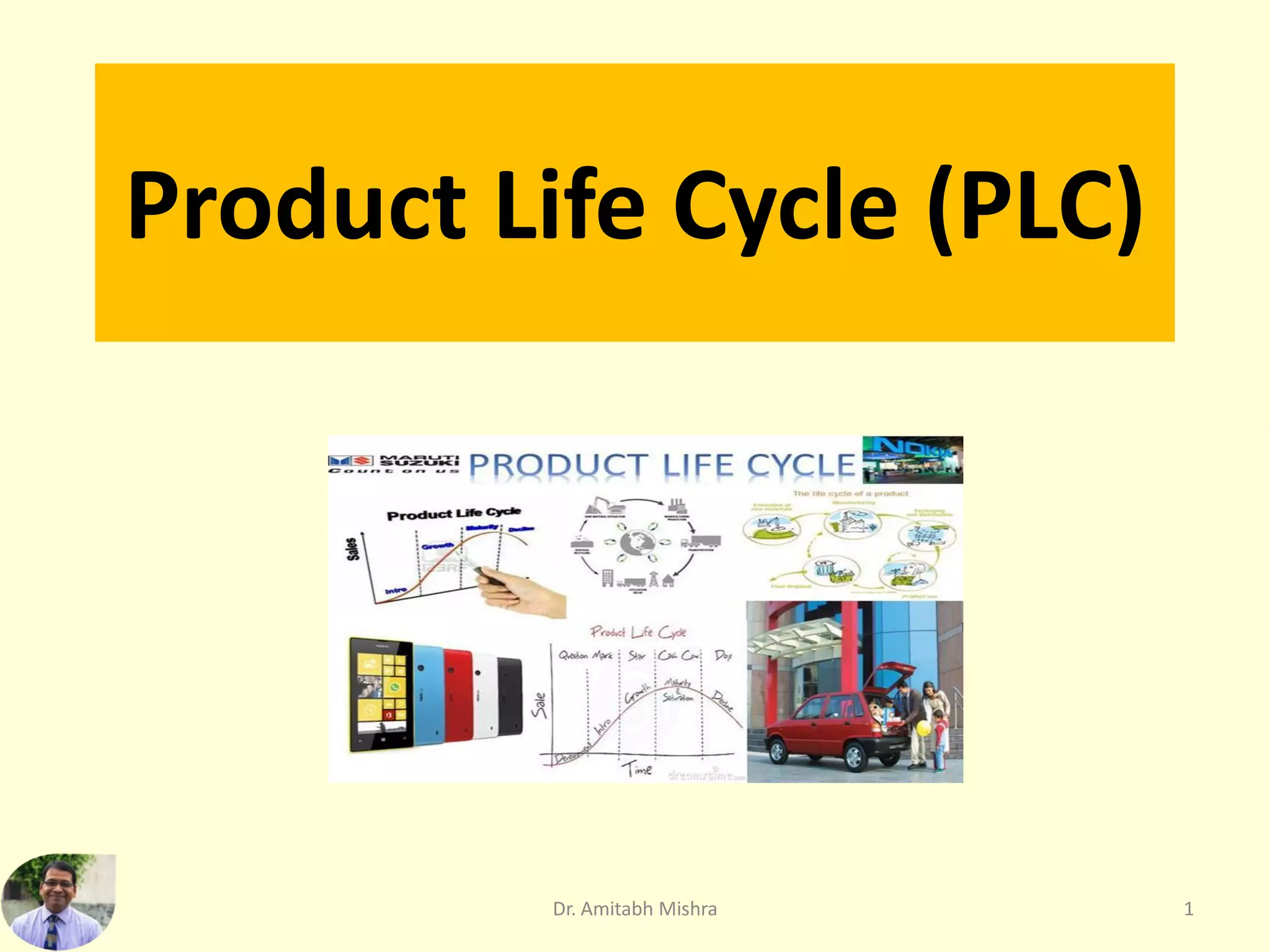
Product Life Cycle (PLC)
1
Dr. Amitabh Mishra
• Product Life Cycle shows the stages that products go
through from development to withdrawal from the
market.
• The company’s differentiation and positioning
strategies must change as the product, market,
competitors changes over time.
2
Dr. Amitabh Mishra
Characteristics of PLC
1. Each product may have a different life cycle.
2. PLC determines revenue earned.
3. PLC may help the firm to identify when
a product needs support, redesign, withdrawal, etc.
4. PLC may help in new product development planning.
5. PLC may help in forecasting and managing cash flow.
3
Dr. Amitabh Mishra
The Stages of the Product Life Cycle
Most product life cycle
curve take a bell shape
form.
Following are the stages of
a standard PLC-
1. Development
2. Introduction/Launch
3. Growth
4. Maturity
5. Saturation
6. Decline
7. Withdrawal
4
Dr. Amitabh Mishra
Product Life Cycles
Sales
Time
Development Introduction Growth Maturity Saturation Decline
5
Dr. Amitabh Mishra
Product Life Cycles
6
Dr. Amitabh Mishra
1. The Development Stage
• The Development stage of PLC begins when the
company develops a new-product idea. This stage is
characterized by-
– Possibly large number initial ideas
– Zero sales
– High investment costs and
– Negative profits
7
Dr. Amitabh Mishra
• The idea for New product may come from any of the
following –
1. Market research – identifies gaps in the market
2. Monitoring competitors
3. Planned research and development (R&D)
4. Luck or intuition – stumble across ideas?
5. Creative thinking – inventions, hunches?
6. Futures thinking (Ex-what will people be using/wanting/needing
5,10,20 years hence?)
8
Dr. Amitabh Mishra
2. Introduction/Launch
• Introduction/Launch stage of PLC is characterized by-
– Low sales
– Negative profits
– High cost per customer acquired
9
Dr. Amitabh Mishra
Sales
Costs
Profits
Marketing Objectives
Low sales
High cost per customer
Negative
Create product awareness
and trial
Characteristics of Introduction Stage
10
Dr. Amitabh Mishra
Marketing Strategies at Introduction Stage
Product
Price
Offer a basic product
Use cost-plus
Distribution Build selective distribution
Advertising Build product awareness among early
adopters and dealers
Sales Promotion
Heavy expenditures to create trial
11
Dr. Amitabh Mishra
Four Introductory
Marketing Strategies
Rapid-
skimming
strategy
Rapid-
penetration
strategy
Slow-
penetration
strategy
Slow-
skimming
strategy
Price
Low
High
Promotion
High Low
12
Dr. Amitabh Mishra
3. Growth
• The Growth stage of PLC is characterized by-
– Rapidly rising sales
– Increasing Revenues & Rising profits
– Average cost per customer
– Early adopters are targeted
– Growing competition
13
Dr. Amitabh Mishra
Sales
Costs
Profits
Marketing Objectives
Rapidly rising sales
Average cost per customer
Rising profits
Maximize market share
Characteristics of Growth Stage
14
Dr. Amitabh Mishra
Marketing Strategies at Growth Stage
Product
Price
Offer product extensions, service,
warranty
Price to penetrate market
Distribution Build intensive distribution
Advertising Build awareness and interest in the mass
market
Sales promotion Reduce expenditures to take advantage of
consumer demand
15
Dr. Amitabh Mishra
4. Maturity Stage
• The Maturity stage of PLC is characterized by-
1. Sales reach peak
2. High profits
3. Cost of supporting the product declines
4. Ratio of revenue to cost high
5. Sales growth likely to be low
6. Market share may be high
7. Competition likely to be greater
16
Dr. Amitabh Mishra
Sales
Costs
Profits
Peak sales
Low cost per customer
High profits
Characteristics of Maturity stage
17
Dr. Amitabh Mishra
Marketing Strategies at Maturity Stage
Marketing Objectives
Product
Price
Maximize profit while defending
market share
Diversify brand and models
Price to match or best competitors
Build more intensive distribution
Stress brand differences and benefits
Price Price to match or best competitors
Distribution
Advertising
18
Dr. Amitabh Mishra
5. Saturation
• The saturation stage of PLC is characterised by-
1. Searching out new markets:
1. Linking to changing fashions
2. Seeking new or exploiting market segments
3. Linking to joint ventures – media/music, etc.
2. Developing new uses
3. Focus on adapting the product
4. Re-packaging or format
5. Improving the standard or quality
6. Developing the product range
• New entrants likely to mean market is ‘flooded’.
19
Dr. Amitabh Mishra
6. Decline and Withdrawal
• The Decline and Withdrawal stage of PLC is characterized
by-
1. Declining sales
2. Low cost per customer
3. Declining profits
4. Laggards are targeted
5. Declining competition
6. Change in Fashion and Technology
20
Dr. Amitabh Mishra
Sales
Costs
Profits
Marketing Objectives
Declining sales
Low cost per customer
Declining profits
Reduce expenditure and milk the brand
Characteristics of Decline stage of PLC
21
Dr. Amitabh Mishra
Marketing Strategies at Decline Stage
Product
Price
Phase out weak items
Cut price
Distribution Go selective: phase out unprofitable
outlets
Advertising Reduce to level needed to retain
hard-core loyal customers
Sales Promotion
Reduce to minimal level
22
Dr. Amitabh Mishra
PLC- Important Observations
– Not all products follow this cycle:
• Fads
• Styles
• Fashions
• Individual brands may not follow this pattern
– Sometimes a product may crash and not get to the maturity stage
• Product Life Cycle - length of time at each stage - varies
– depends on the products
– can be a few months in each stage
– or it can be years
• Generally speaking, due to the
– Competitive Environment
– Technological Environment
– The PLC is getting shorter
23
Dr. Amitabh Mishra
PLC Length and Shape
Sales Sales Sales
Time
Time Time
Style Fashion Fad
24
Dr. Amitabh Mishra
Limitations of the PLC
1. The life cycle concept applies best to product
forms rather than to classes of products or
specific brands.
2. The life cycle concept may lead marketers to think
that a product has a predetermined life, which
may produce problems in interpreting sales and
profits.
3. It is only a descriptive way of looking at the
behavior of a product and the life cycle can not
predict the behavior of a product.
25
Dr. Amitabh Mishra
26
Dr. Amitabh Mishra

Product Life Cycle (PLC)

  • 1.
    Product Life Cycle(PLC) 1 Dr. Amitabh Mishra
  • 2.
    • Product LifeCycle shows the stages that products go through from development to withdrawal from the market. • The company’s differentiation and positioning strategies must change as the product, market, competitors changes over time. 2 Dr. Amitabh Mishra
  • 3.
    Characteristics of PLC 1.Each product may have a different life cycle. 2. PLC determines revenue earned. 3. PLC may help the firm to identify when a product needs support, redesign, withdrawal, etc. 4. PLC may help in new product development planning. 5. PLC may help in forecasting and managing cash flow. 3 Dr. Amitabh Mishra
  • 4.
    The Stages ofthe Product Life Cycle Most product life cycle curve take a bell shape form. Following are the stages of a standard PLC- 1. Development 2. Introduction/Launch 3. Growth 4. Maturity 5. Saturation 6. Decline 7. Withdrawal 4 Dr. Amitabh Mishra
  • 5.
    Product Life Cycles Sales Time DevelopmentIntroduction Growth Maturity Saturation Decline 5 Dr. Amitabh Mishra
  • 6.
  • 7.
    1. The DevelopmentStage • The Development stage of PLC begins when the company develops a new-product idea. This stage is characterized by- – Possibly large number initial ideas – Zero sales – High investment costs and – Negative profits 7 Dr. Amitabh Mishra
  • 8.
    • The ideafor New product may come from any of the following – 1. Market research – identifies gaps in the market 2. Monitoring competitors 3. Planned research and development (R&D) 4. Luck or intuition – stumble across ideas? 5. Creative thinking – inventions, hunches? 6. Futures thinking (Ex-what will people be using/wanting/needing 5,10,20 years hence?) 8 Dr. Amitabh Mishra
  • 9.
    2. Introduction/Launch • Introduction/Launchstage of PLC is characterized by- – Low sales – Negative profits – High cost per customer acquired 9 Dr. Amitabh Mishra
  • 10.
    Sales Costs Profits Marketing Objectives Low sales Highcost per customer Negative Create product awareness and trial Characteristics of Introduction Stage 10 Dr. Amitabh Mishra
  • 11.
    Marketing Strategies atIntroduction Stage Product Price Offer a basic product Use cost-plus Distribution Build selective distribution Advertising Build product awareness among early adopters and dealers Sales Promotion Heavy expenditures to create trial 11 Dr. Amitabh Mishra
  • 12.
  • 13.
    3. Growth • TheGrowth stage of PLC is characterized by- – Rapidly rising sales – Increasing Revenues & Rising profits – Average cost per customer – Early adopters are targeted – Growing competition 13 Dr. Amitabh Mishra
  • 14.
    Sales Costs Profits Marketing Objectives Rapidly risingsales Average cost per customer Rising profits Maximize market share Characteristics of Growth Stage 14 Dr. Amitabh Mishra
  • 15.
    Marketing Strategies atGrowth Stage Product Price Offer product extensions, service, warranty Price to penetrate market Distribution Build intensive distribution Advertising Build awareness and interest in the mass market Sales promotion Reduce expenditures to take advantage of consumer demand 15 Dr. Amitabh Mishra
  • 16.
    4. Maturity Stage •The Maturity stage of PLC is characterized by- 1. Sales reach peak 2. High profits 3. Cost of supporting the product declines 4. Ratio of revenue to cost high 5. Sales growth likely to be low 6. Market share may be high 7. Competition likely to be greater 16 Dr. Amitabh Mishra
  • 17.
    Sales Costs Profits Peak sales Low costper customer High profits Characteristics of Maturity stage 17 Dr. Amitabh Mishra
  • 18.
    Marketing Strategies atMaturity Stage Marketing Objectives Product Price Maximize profit while defending market share Diversify brand and models Price to match or best competitors Build more intensive distribution Stress brand differences and benefits Price Price to match or best competitors Distribution Advertising 18 Dr. Amitabh Mishra
  • 19.
    5. Saturation • Thesaturation stage of PLC is characterised by- 1. Searching out new markets: 1. Linking to changing fashions 2. Seeking new or exploiting market segments 3. Linking to joint ventures – media/music, etc. 2. Developing new uses 3. Focus on adapting the product 4. Re-packaging or format 5. Improving the standard or quality 6. Developing the product range • New entrants likely to mean market is ‘flooded’. 19 Dr. Amitabh Mishra
  • 20.
    6. Decline andWithdrawal • The Decline and Withdrawal stage of PLC is characterized by- 1. Declining sales 2. Low cost per customer 3. Declining profits 4. Laggards are targeted 5. Declining competition 6. Change in Fashion and Technology 20 Dr. Amitabh Mishra
  • 21.
    Sales Costs Profits Marketing Objectives Declining sales Lowcost per customer Declining profits Reduce expenditure and milk the brand Characteristics of Decline stage of PLC 21 Dr. Amitabh Mishra
  • 22.
    Marketing Strategies atDecline Stage Product Price Phase out weak items Cut price Distribution Go selective: phase out unprofitable outlets Advertising Reduce to level needed to retain hard-core loyal customers Sales Promotion Reduce to minimal level 22 Dr. Amitabh Mishra
  • 23.
    PLC- Important Observations –Not all products follow this cycle: • Fads • Styles • Fashions • Individual brands may not follow this pattern – Sometimes a product may crash and not get to the maturity stage • Product Life Cycle - length of time at each stage - varies – depends on the products – can be a few months in each stage – or it can be years • Generally speaking, due to the – Competitive Environment – Technological Environment – The PLC is getting shorter 23 Dr. Amitabh Mishra
  • 24.
    PLC Length andShape Sales Sales Sales Time Time Time Style Fashion Fad 24 Dr. Amitabh Mishra
  • 25.
    Limitations of thePLC 1. The life cycle concept applies best to product forms rather than to classes of products or specific brands. 2. The life cycle concept may lead marketers to think that a product has a predetermined life, which may produce problems in interpreting sales and profits. 3. It is only a descriptive way of looking at the behavior of a product and the life cycle can not predict the behavior of a product. 25 Dr. Amitabh Mishra
  • 26.