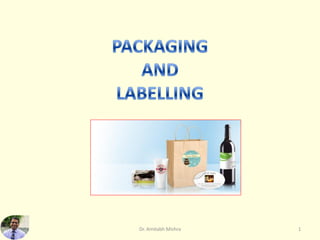
1
Dr. Amitabh Mishra
• Most physical products have to be packaged and
labeled.
• It has become a potent marketing tool.
2
Dr. Amitabh Mishra
PACKAGING
(As a Marketing Tool)
3
Dr. Amitabh Mishra
Packaging
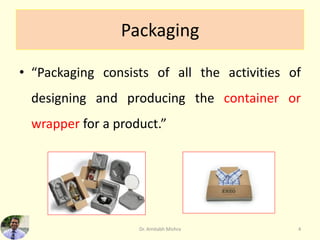
• “Packaging consists of all the activities of
designing and producing the container or
wrapper for a product.”
4
Dr. Amitabh Mishra
• “Packaging can be described as a coordinated system
of preparing goods for transport, warehousing,
logistics, sale, and end use.”
5
Dr. Amitabh Mishra
Levels/Types of Packaging
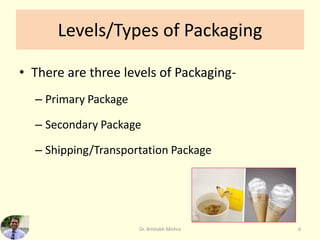
• There are three levels of Packaging-
– Primary Package
– Secondary Package
– Shipping/Transportation Package
6
Dr. Amitabh Mishra
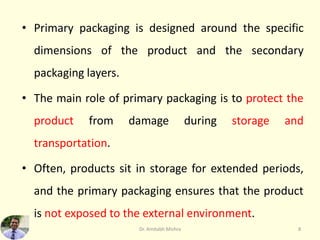
1. Primary Packaging: Primary packaging is the
layer of packaging that comes in direct contact
with the product.
7
Dr. Amitabh Mishra
• Primary packaging is designed around the specific
dimensions of the product and the secondary
packaging layers.
• The main role of primary packaging is to protect the
product from damage during storage and
transportation.
• Often, products sit in storage for extended periods,
and the primary packaging ensures that the product
is not exposed to the external environment.
8
Dr. Amitabh Mishra
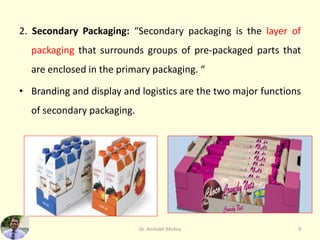
2. Secondary Packaging: “Secondary packaging is the layer of
packaging that surrounds groups of pre-packaged parts that
are enclosed in the primary packaging. “
• Branding and display and logistics are the two major functions
of secondary packaging.
9
Dr. Amitabh Mishra
• Secondary packaging is the external, visible face of the
product.
• Moreover, secondary packaging protects the primary
packaging and may group several products together for ease
of handling.
• This layer keeps the primary packaging safe and helps it retain
its original shape during transport to a retail or consumer
location.
• Cardboard boxes, cardboard cartons and plastic crates are
common types of secondary packaging.
10
Dr. Amitabh Mishra
• Packaging -
– Protects
– Preserves
– Transports
– Informs
– Sells
Purposes of Packaging
11
Dr. Amitabh Mishra
Requirement/Significances
of Packaging
• Package is the actual container or wrapper.
• It protects a product in the way to the consumer.
• It protects a product after it is purchased.
• It helps to identify a product and this may prevent
substitution of competitive products.
• It is the package, which first get the attention of the
customers.
12
Dr. Amitabh Mishra
• Well designed packages can create convenience and
promotional value.
• Packaging is one of the way through which marketer can
differentiate his product from the competitive brand.
• Innovative packaging can bring large benefits to the
customers and profit to producers.
13
Dr. Amitabh Mishra
LABELING
14
Dr. Amitabh Mishra
LABELING
• Labeling is closely related to the packaging.
• “A label is a part of the product that carries
information about the product and the seller.”
• Labeling is “Display of information about a product
on its container, packaging, or the product itself.”
15
Dr. Amitabh Mishra
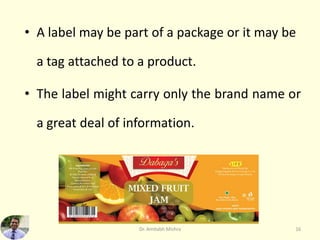
• A label may be part of a package or it may be
a tag attached to a product.
• The label might carry only the brand name or
a great deal of information.
16
Dr. Amitabh Mishra
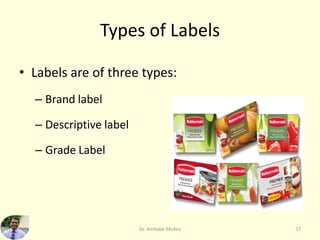
Types of Labels
• Labels are of three types:
– Brand label
– Descriptive label
– Grade Label
17
Dr. Amitabh Mishra
• Brand label: Brand label is simply the brand alone
applied to the product or package.
• Ex- Some clothes carry the brand label like Color
Plus.
18
Dr. Amitabh Mishra
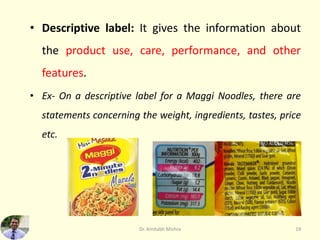
• Descriptive label: It gives the information about
the product use, care, performance, and other
features.
• Ex- On a descriptive label for a Maggi Noodles, there are
statements concerning the weight, ingredients, tastes, price
etc.
19
Dr. Amitabh Mishra
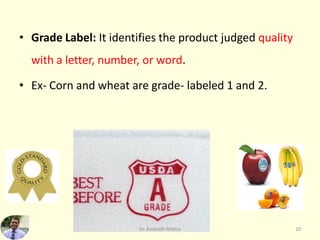
• Grade Label: It identifies the product judged quality
with a letter, number, or word.
• Ex- Corn and wheat are grade- labeled 1 and 2.
20
Dr. Amitabh Mishra
• Brand labeling is a acceptable form of labeling
but it does not provide sufficient information
about the product.
• Descriptive labels provide more information
about the product but not necessarily all that
is needed or desired by a consumer.
21
Dr. Amitabh Mishra
Labeling Functions/ Role of Labeling
• Major functions/Role of Labeling are-
– Identification
– Grading
– Description
22
Dr. Amitabh Mishra

Packaging and Labaling

  • 1.
  • 2.
    • Most physicalproducts have to be packaged and labeled. • It has become a potent marketing tool. 2 Dr. Amitabh Mishra
  • 3.
    PACKAGING (As a MarketingTool) 3 Dr. Amitabh Mishra
  • 4.
    Packaging • “Packaging consistsof all the activities of designing and producing the container or wrapper for a product.” 4 Dr. Amitabh Mishra
  • 5.
    • “Packaging canbe described as a coordinated system of preparing goods for transport, warehousing, logistics, sale, and end use.” 5 Dr. Amitabh Mishra
  • 6.
    Levels/Types of Packaging •There are three levels of Packaging- – Primary Package – Secondary Package – Shipping/Transportation Package 6 Dr. Amitabh Mishra
  • 7.
    1. Primary Packaging:Primary packaging is the layer of packaging that comes in direct contact with the product. 7 Dr. Amitabh Mishra
  • 8.
    • Primary packagingis designed around the specific dimensions of the product and the secondary packaging layers. • The main role of primary packaging is to protect the product from damage during storage and transportation. • Often, products sit in storage for extended periods, and the primary packaging ensures that the product is not exposed to the external environment. 8 Dr. Amitabh Mishra
  • 9.
    2. Secondary Packaging:“Secondary packaging is the layer of packaging that surrounds groups of pre-packaged parts that are enclosed in the primary packaging. “ • Branding and display and logistics are the two major functions of secondary packaging. 9 Dr. Amitabh Mishra
  • 10.
    • Secondary packagingis the external, visible face of the product. • Moreover, secondary packaging protects the primary packaging and may group several products together for ease of handling. • This layer keeps the primary packaging safe and helps it retain its original shape during transport to a retail or consumer location. • Cardboard boxes, cardboard cartons and plastic crates are common types of secondary packaging. 10 Dr. Amitabh Mishra
  • 11.
    • Packaging - –Protects – Preserves – Transports – Informs – Sells Purposes of Packaging 11 Dr. Amitabh Mishra
  • 12.
    Requirement/Significances of Packaging • Packageis the actual container or wrapper. • It protects a product in the way to the consumer. • It protects a product after it is purchased. • It helps to identify a product and this may prevent substitution of competitive products. • It is the package, which first get the attention of the customers. 12 Dr. Amitabh Mishra
  • 13.
    • Well designedpackages can create convenience and promotional value. • Packaging is one of the way through which marketer can differentiate his product from the competitive brand. • Innovative packaging can bring large benefits to the customers and profit to producers. 13 Dr. Amitabh Mishra
  • 14.
  • 15.
    LABELING • Labeling isclosely related to the packaging. • “A label is a part of the product that carries information about the product and the seller.” • Labeling is “Display of information about a product on its container, packaging, or the product itself.” 15 Dr. Amitabh Mishra
  • 16.
    • A labelmay be part of a package or it may be a tag attached to a product. • The label might carry only the brand name or a great deal of information. 16 Dr. Amitabh Mishra
  • 17.
    Types of Labels •Labels are of three types: – Brand label – Descriptive label – Grade Label 17 Dr. Amitabh Mishra
  • 18.
    • Brand label:Brand label is simply the brand alone applied to the product or package. • Ex- Some clothes carry the brand label like Color Plus. 18 Dr. Amitabh Mishra
  • 19.
    • Descriptive label:It gives the information about the product use, care, performance, and other features. • Ex- On a descriptive label for a Maggi Noodles, there are statements concerning the weight, ingredients, tastes, price etc. 19 Dr. Amitabh Mishra
  • 20.
    • Grade Label:It identifies the product judged quality with a letter, number, or word. • Ex- Corn and wheat are grade- labeled 1 and 2. 20 Dr. Amitabh Mishra
  • 21.
    • Brand labelingis a acceptable form of labeling but it does not provide sufficient information about the product. • Descriptive labels provide more information about the product but not necessarily all that is needed or desired by a consumer. 21 Dr. Amitabh Mishra
  • 22.
    Labeling Functions/ Roleof Labeling • Major functions/Role of Labeling are- – Identification – Grading – Description 22 Dr. Amitabh Mishra