Sales Forecasting
Dr. Amitabh Mishra 1
Sales Forecasting
• Sales forecast is about estimating future sales.
• Sales forecast is an estimated unit of sales in either
rupees or number of units which could be sold for a
specific period of time
• Better sales forecasts
– Enables a company to perform better
– Make more informed decisions; and
– Serves as a basis for determining the short run and the long term
performance of a organization
– Provide inputs for expected sales for a particular company or industry
Dr. Amitabh Mishra 2
USES OF SALES FORECAST BY OTHER
DEPARTMENT
Dr. Amitabh Mishra 3
Uses of
Sales forecast by other department
• For the production and operations
department
– It helps formulate the plans for production as well
as assess the adequacy of the production capacity
of an organization. Ex-
• Buy new machinery or up gradation of technology,
• Go for automation,
• Hire more workers,
• Working one shift or two shifts or three shifts
• Inventory levels
Dr. Amitabh Mishra 4
• Sales forecasts are also used by the purchase
department
– Resources that must be immediately procured
(raw material, components, or parts or supplies,
business services).
• Sales forecast would be used by finance
department
– To manage cash inflows and outflows,
– Planning for profits and working capital
management
– Planning for long-term investments.
Dr. Amitabh Mishra 5
• It would help the Human resource management
department
– To determine adequacy and appropriateness the manpower
requirements,
– To ensure that production, sales, marketing and other activities, can
be done in an effective manner.
Sales forecast act as a precursor for planning a
lot of activities for the organization
Dr. Amitabh Mishra 6
DIFFERENT KINDS OF SALES
FORECASTS
Product based/ Time-period/Geographical
Dr. Amitabh Mishra 7
Different kinds of Sales Forecasts
• Sales forecast could be prepared on the following
basis:
– Product based sales forecast
• It is done for a specific product
– Time-period based sale forecast
• Short term, medium term or long term
– Geographical area sales forecast
• Country, region, state
Dr. Amitabh Mishra 8
Types Sales Forecast
Product level
All (Total) Sales
Industry Sales
Company sales
Product Line sales
Product Variant/
form Sales
Time-period based
Long Term Sales
Short term sales
Medium range
sales
Geographical area
World
Nation:
India, USA
Region:
North, South
Territory :
District, Branch
Customer
Dr. Amitabh Mishra 9
SALES FORECASTING APPROACHES
Top-down approach; Bottom-up approach and
Combination of both
Dr. Amitabh Mishra 10
Sales Forecasting approaches
• Three different approaches may be adopted to
obtain sales forecasts for a product, in a
defined time period, in a defined geographical
territory:
– Top-down approach or a break-down approach.
– Bottom-up approach or a build-up approach; and
– Combination of both
Dr. Amitabh Mishra 11
Top-down approaches
• In top-down approaches
– Top management defines various goals/objectives/ targets
– Top management provides guidelines for preparation of
budgets
• The main task here is actually done by the top management
• Long/medium-range plans are further percolated down right
to the bottom/lower level sales team
• Day-to-day strategic planning lies with the middle and the
lower level sales management team
• Field selling team actually accomplish these objectives
Dr. Amitabh Mishra 12
Bottom-up or the build-up approach
• Authority to prepare the sales forecast and the budget, lies
with those who are to implement the sales plan and achieve
the targets, respective departments prepare their own
budget.
• Authority to prepare the broad guidelines, lies with those who
are actually to implement these sales plans and achieve
targets
Combined approach
• Of course, a combination of both these approaches can also
be used by the organization.
Dr. Amitabh Mishra 13
METHODS OF
SALES FORECASTING
Quantitative methods and Qualitative methods
Dr. Amitabh Mishra 14
• Sales forecasting methods can be divided into
two broad categories,
– Quantitative methods and
– Qualitative methods
• The Quantitative methods are more numeric
and more number oriented
• Qualitative methods are subjective and based
on expert opinion and secondary data
Dr. Amitabh Mishra 15
Methods of Sales Forecasting
Qualitative
Methods
Executive Opinion
Delphi method
Sales force composite
Survey of buyer intention
Test Marketing
Quantitative
Methods
Moving Average
Exponential
smoothing
Decomposition
Regression Analysis
Naïve/Ratio method
Dr. Amitabh Mishra 16
QUALITATIVE METHODS OF SALES
FORECASTING
Dr. Amitabh Mishra 17
Qualitative Methods
Executive
Opinion
Delphi
method
Sales force
composite
Survey of
buyer
intention
Test
Marketing
Executive Opinion method
• Many organizations prepare their sales forecast by taking opinions from
sales executives and by indulging in discussions with them.
Delphi method
• In the case of Delphi,
– The coordinator choose and contacts experts in selling a particular, kind of
product in particular territories
– The experts are asked for their sales estimates for a particular product in a
particular territory;
– Once these estimates are received from various experts, these are collated by
the coordinator and he may again send them back to the experts for further
opinion or for further suggestions.
– The process is repeated till a consensus with respect to numbers is reached by
different experts
Dr. Amitabh Mishra 18
Sales force composite method
• Sales people are asked to give their estimates which are later compiled for a branch or for a
zone and so forth; and forecasts are then calculated for broader levels.
• The positive part about this method is that it involves sales people who are in direct touch
with the customers, who are at the grass root, who have huge amount of experience in
dealing with the day-to-day market conditions.
Survey of Buyers Intention
• The buyers are directly asked if they would be willing to buy certain products.
• A survey is conducted, and buyers are interviewed. They are asked
– whether they would buy a product or they would not buy a product?
– whether they intend buying it n the future; if at all when?
– Whether buyers would actually be buying, or would not be buying, or if they would be buying, how
sooner or later is it going to be?
• So, such estimates are, you now, give inputs into calculating the forecast for the company.
Dr. Amitabh Mishra 19
Test marketing
• Test marketing is generally done during new product launch.
• It could be
– Full-blown: It is very similar to launching of a new product nation-
wide, but this is done in very few select cities. Then customer
response is studied; and based on this forecasts are determined.
– Controlled: Only selected locations are chosen. And within the
selected locations, only select stores are chosen. Based on the people
who visit these few stores, in these selected locations, sales forecasts
are determined.
– Simulated: 20 or 30 prospective buyers are called. A product is
demonstrated and the customer’s queries are handled and customers
are asked whether they would want to buy the product or not buy the
product. Their reaction is is studied.
Dr. Amitabh Mishra 20
QUANTITATIVE METHODS OF
SALES FORECASTING
Dr. Amitabh Mishra 21
Quantitative Methods
• Statistical methods proved to be very useful
in sales forecasting.
• Few quantitative methods are:
• Moving Average Method
• Exponential Smoothing Method
• Decomposition Method
• Naive/Ratio Method
• Regression Analysis Method
• Econometric Analysis Method
22
Dr. Amitabh Mishra
Moving Average Method
• The method suggests drawing an average of
the sales of a number of years to predict the
sales of a coming period.
• The objective is to remove deviations due to
fluctuations and provide a close estimate of
the forecasted sales.
23
Dr. Amitabh Mishra
Dr. Amitabh Mishra 24
Exponential Smoothing Method
• Exponential smoothing is a time series forecasting method
for uni-variate data.
• In exponential smoothing, the recent past sales are given
more weight than the earlier pasts.
• Exponential smoothing forecasting methods are
similar in that a prediction is a weighted sum of past
observations, but the model explicitly uses an
exponentially decreasing weight for past observations.
25
Dr. Amitabh Mishra
26
Dr. Amitabh Mishra
Decomposition Method
• Breaking down the data into its component parts
is called decomposition.
• The decomposition model assumes that sales are
affected by four factors: the general trend in the
data, general economic cycles, seasonality, and
irregular or random occurrences.
• The forecast is made by considering each of these
components separately and then combining them
together.
27
Dr. Amitabh Mishra
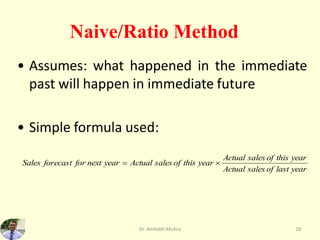
Naive/Ratio Method
• Assumes: what happened in the immediate
past will happen in immediate future
• Simple formula used:
28
year
last
of
sales
Actual
year
this
of
sales
Actual
year
this
of
sales
Actual
year
next
for
forecast
Sales 

Dr. Amitabh Mishra
Regression Analysis Method
• This method can be used in sales forecasting
to measure the relationship between a firm’s
sales and other indicators.
29
Dr. Amitabh Mishra
Econometric Analysis Method
•The econometric forecasting model is a tool
that reveals relationships among economic
variables to forecast future developments.
•Econometrics means economic measurement;
applying statistical techniques to relevant data.
30
Dr. Amitabh Mishra
• Econometric forecasting models are systems of
relationships between variables such as GNP,
inflation, exchange rates, PDI, Per capita income.
• Studies of these relationships help managers to take
economic decisions. Econometrics determines how
different economic variables interact and affect one
another.
31
Dr. Amitabh Mishra

Sales Forecasting

  • 1.
  • 2.
    Sales Forecasting • Salesforecast is about estimating future sales. • Sales forecast is an estimated unit of sales in either rupees or number of units which could be sold for a specific period of time • Better sales forecasts – Enables a company to perform better – Make more informed decisions; and – Serves as a basis for determining the short run and the long term performance of a organization – Provide inputs for expected sales for a particular company or industry Dr. Amitabh Mishra 2
  • 3.
    USES OF SALESFORECAST BY OTHER DEPARTMENT Dr. Amitabh Mishra 3
  • 4.
    Uses of Sales forecastby other department • For the production and operations department – It helps formulate the plans for production as well as assess the adequacy of the production capacity of an organization. Ex- • Buy new machinery or up gradation of technology, • Go for automation, • Hire more workers, • Working one shift or two shifts or three shifts • Inventory levels Dr. Amitabh Mishra 4
  • 5.
    • Sales forecastsare also used by the purchase department – Resources that must be immediately procured (raw material, components, or parts or supplies, business services). • Sales forecast would be used by finance department – To manage cash inflows and outflows, – Planning for profits and working capital management – Planning for long-term investments. Dr. Amitabh Mishra 5
  • 6.
    • It wouldhelp the Human resource management department – To determine adequacy and appropriateness the manpower requirements, – To ensure that production, sales, marketing and other activities, can be done in an effective manner. Sales forecast act as a precursor for planning a lot of activities for the organization Dr. Amitabh Mishra 6
  • 7.
    DIFFERENT KINDS OFSALES FORECASTS Product based/ Time-period/Geographical Dr. Amitabh Mishra 7
  • 8.
    Different kinds ofSales Forecasts • Sales forecast could be prepared on the following basis: – Product based sales forecast • It is done for a specific product – Time-period based sale forecast • Short term, medium term or long term – Geographical area sales forecast • Country, region, state Dr. Amitabh Mishra 8
  • 9.
    Types Sales Forecast Productlevel All (Total) Sales Industry Sales Company sales Product Line sales Product Variant/ form Sales Time-period based Long Term Sales Short term sales Medium range sales Geographical area World Nation: India, USA Region: North, South Territory : District, Branch Customer Dr. Amitabh Mishra 9
  • 10.
    SALES FORECASTING APPROACHES Top-downapproach; Bottom-up approach and Combination of both Dr. Amitabh Mishra 10
  • 11.
    Sales Forecasting approaches •Three different approaches may be adopted to obtain sales forecasts for a product, in a defined time period, in a defined geographical territory: – Top-down approach or a break-down approach. – Bottom-up approach or a build-up approach; and – Combination of both Dr. Amitabh Mishra 11
  • 12.
    Top-down approaches • Intop-down approaches – Top management defines various goals/objectives/ targets – Top management provides guidelines for preparation of budgets • The main task here is actually done by the top management • Long/medium-range plans are further percolated down right to the bottom/lower level sales team • Day-to-day strategic planning lies with the middle and the lower level sales management team • Field selling team actually accomplish these objectives Dr. Amitabh Mishra 12
  • 13.
    Bottom-up or thebuild-up approach • Authority to prepare the sales forecast and the budget, lies with those who are to implement the sales plan and achieve the targets, respective departments prepare their own budget. • Authority to prepare the broad guidelines, lies with those who are actually to implement these sales plans and achieve targets Combined approach • Of course, a combination of both these approaches can also be used by the organization. Dr. Amitabh Mishra 13
  • 14.
    METHODS OF SALES FORECASTING Quantitativemethods and Qualitative methods Dr. Amitabh Mishra 14
  • 15.
    • Sales forecastingmethods can be divided into two broad categories, – Quantitative methods and – Qualitative methods • The Quantitative methods are more numeric and more number oriented • Qualitative methods are subjective and based on expert opinion and secondary data Dr. Amitabh Mishra 15
  • 16.
    Methods of SalesForecasting Qualitative Methods Executive Opinion Delphi method Sales force composite Survey of buyer intention Test Marketing Quantitative Methods Moving Average Exponential smoothing Decomposition Regression Analysis Naïve/Ratio method Dr. Amitabh Mishra 16
  • 17.
    QUALITATIVE METHODS OFSALES FORECASTING Dr. Amitabh Mishra 17 Qualitative Methods Executive Opinion Delphi method Sales force composite Survey of buyer intention Test Marketing
  • 18.
    Executive Opinion method •Many organizations prepare their sales forecast by taking opinions from sales executives and by indulging in discussions with them. Delphi method • In the case of Delphi, – The coordinator choose and contacts experts in selling a particular, kind of product in particular territories – The experts are asked for their sales estimates for a particular product in a particular territory; – Once these estimates are received from various experts, these are collated by the coordinator and he may again send them back to the experts for further opinion or for further suggestions. – The process is repeated till a consensus with respect to numbers is reached by different experts Dr. Amitabh Mishra 18
  • 19.
    Sales force compositemethod • Sales people are asked to give their estimates which are later compiled for a branch or for a zone and so forth; and forecasts are then calculated for broader levels. • The positive part about this method is that it involves sales people who are in direct touch with the customers, who are at the grass root, who have huge amount of experience in dealing with the day-to-day market conditions. Survey of Buyers Intention • The buyers are directly asked if they would be willing to buy certain products. • A survey is conducted, and buyers are interviewed. They are asked – whether they would buy a product or they would not buy a product? – whether they intend buying it n the future; if at all when? – Whether buyers would actually be buying, or would not be buying, or if they would be buying, how sooner or later is it going to be? • So, such estimates are, you now, give inputs into calculating the forecast for the company. Dr. Amitabh Mishra 19
  • 20.
    Test marketing • Testmarketing is generally done during new product launch. • It could be – Full-blown: It is very similar to launching of a new product nation- wide, but this is done in very few select cities. Then customer response is studied; and based on this forecasts are determined. – Controlled: Only selected locations are chosen. And within the selected locations, only select stores are chosen. Based on the people who visit these few stores, in these selected locations, sales forecasts are determined. – Simulated: 20 or 30 prospective buyers are called. A product is demonstrated and the customer’s queries are handled and customers are asked whether they would want to buy the product or not buy the product. Their reaction is is studied. Dr. Amitabh Mishra 20
  • 21.
    QUANTITATIVE METHODS OF SALESFORECASTING Dr. Amitabh Mishra 21
  • 22.
    Quantitative Methods • Statisticalmethods proved to be very useful in sales forecasting. • Few quantitative methods are: • Moving Average Method • Exponential Smoothing Method • Decomposition Method • Naive/Ratio Method • Regression Analysis Method • Econometric Analysis Method 22 Dr. Amitabh Mishra
  • 23.
    Moving Average Method •The method suggests drawing an average of the sales of a number of years to predict the sales of a coming period. • The objective is to remove deviations due to fluctuations and provide a close estimate of the forecasted sales. 23 Dr. Amitabh Mishra
  • 24.
  • 25.
    Exponential Smoothing Method •Exponential smoothing is a time series forecasting method for uni-variate data. • In exponential smoothing, the recent past sales are given more weight than the earlier pasts. • Exponential smoothing forecasting methods are similar in that a prediction is a weighted sum of past observations, but the model explicitly uses an exponentially decreasing weight for past observations. 25 Dr. Amitabh Mishra
  • 26.
  • 27.
    Decomposition Method • Breakingdown the data into its component parts is called decomposition. • The decomposition model assumes that sales are affected by four factors: the general trend in the data, general economic cycles, seasonality, and irregular or random occurrences. • The forecast is made by considering each of these components separately and then combining them together. 27 Dr. Amitabh Mishra
  • 28.
    Naive/Ratio Method • Assumes:what happened in the immediate past will happen in immediate future • Simple formula used: 28 year last of sales Actual year this of sales Actual year this of sales Actual year next for forecast Sales   Dr. Amitabh Mishra
  • 29.
    Regression Analysis Method •This method can be used in sales forecasting to measure the relationship between a firm’s sales and other indicators. 29 Dr. Amitabh Mishra
  • 30.
    Econometric Analysis Method •Theeconometric forecasting model is a tool that reveals relationships among economic variables to forecast future developments. •Econometrics means economic measurement; applying statistical techniques to relevant data. 30 Dr. Amitabh Mishra
  • 31.
    • Econometric forecastingmodels are systems of relationships between variables such as GNP, inflation, exchange rates, PDI, Per capita income. • Studies of these relationships help managers to take economic decisions. Econometrics determines how different economic variables interact and affect one another. 31 Dr. Amitabh Mishra