QUESTIONNAIRE    DESIGN PRESENTED BY: ROHIT CHANDRA SIMRANJEET SINGH  RAJAN MITTAL  PARMEET SINGH MANVIR SINGH
“ It is not every question that deserves an answer.” Publius Syrus (roman,1st century B.C.)
A Good Questionnaire Appears As easy to compose as a good poem But, it is usually the result of long, painstaking work
QUESTIONNAIRE DESIGN: AN OVERVIEW OF THE MAJOR DECISIONS 1. What should be asked Questionnaire relevancy All information collected should address a research question in helping the decision maker in solving the current marketing problem Questionnaire  accuracy Increasing the reliability and validity of respondent information requires that: 2.  How should each question be phrased? 3.  In what sequence should the questions be arranged? 4.  What questionnaire layout will best serve the research objectives? 5.  How should the questionnaire be pretested?  Does the questionnaire need to be revised?
PHRASING QUESTIONS Open ended questions Pose some problem and ask respondents to answer in their own words What things do you like most about your job? What comes to mind when you look at this advertisement?
Advantages: Are most beneficial in exploratory research, especially when the range of responses is not known. May reveal unanticipated reactions toward the product. Are good first questions because they allow respondents to warm up to the questioning process. Disadvantages: High cost of administering open-ended response questions The possibility that interviewer bias will influence the answer Bias introduced by articulate individuals’ longer answers
Fixed –alternative questions Questions in which respondents are given specific, limited-alternative responses and asked to choose the one closest to their own viewpoint . Did you work overtime ? Yes or NO.
Advantages : Require less interviewer skill Take less time to answer Are easier for the respondent to answer Provides comparability of answers Disadvantages: Lack of range in the response alternatives Tendency of respondents to choose convenient alternative
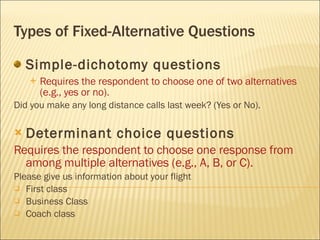
Types of Fixed-Alternative Questions Simple-dichotomy questions Requires the respondent to choose one of two alternatives (e.g., yes or no). Did you make any long distance calls last week? (Yes or No). Determinant choice questions Requires the respondent to choose one response from among multiple alternatives (e.g., A, B, or C). Please give us information about your flight First class  Business Class  Coach class
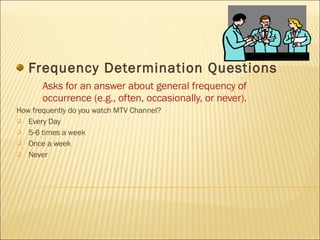
Frequency Determination Questions Asks for an answer about general frequency of occurrence (e.g., often, occasionally, or never). How frequently do you watch MTV Channel? Every Day 5-6 times a week Once a week Never
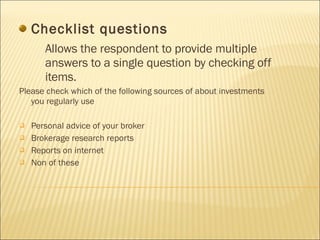
Checklist questions Allows the respondent to provide multiple answers to a single question by checking off items. Please check which of the following sources of about investments you regularly use Personal advice of your broker Brokerage research reports Reports on internet Non of these
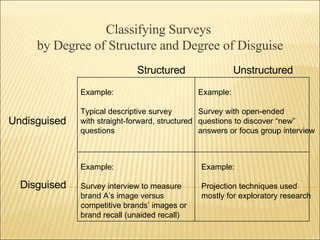
Structured Unstructured Undisguised Disguised Classifying Surveys  by Degree of Structure and Degree of Disguise Example: Typical descriptive survey with straight-forward, structured  questions Example: Survey with open-ended questions to discover “new” answers or focus group interview Example: Survey interview to measure brand A’s image versus competitive brands’ images or  brand recall (unaided recall) Example: Projection techniques used mostly for exploratory research
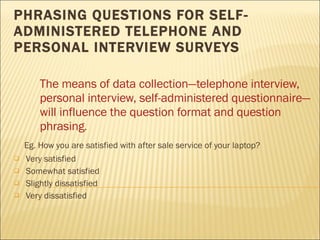
PHRASING QUESTIONS FOR SELF-ADMINISTERED TELEPHONE AND PERSONAL INTERVIEW SURVEYS The means of data collection—telephone interview, personal interview, self-administered questionnaire—will influence the question format and question phrasing .  Eg. How you are satisfied with after sale service of your laptop? Very satisfied Somewhat satisfied Slightly dissatisfied  Very dissatisfied
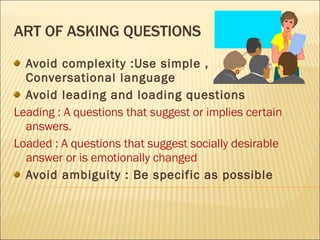
ART OF ASKING QUESTIONS Avoid complexity :Use simple , Conversational language Avoid leading and loading questions Leading : A questions that suggest or implies certain answers. Loaded : A questions that suggest socially desirable answer or is emotionally changed Avoid ambiguity : Be specific as possible
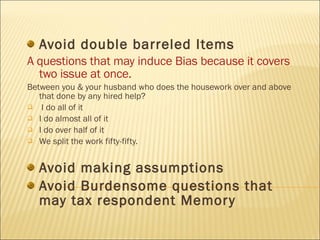
Avoid double barreled Items A questions that may induce Bias because it covers two issue at once. Between you & your husband who does the housework over and above that done by any hired help? I do all of it I do almost all of it I do over half of it We split the work fifty-fifty. Avoid making assumptions Avoid Burdensome questions that may tax respondent Memory
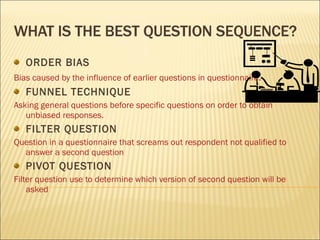
WHAT IS THE BEST QUESTION SEQUENCE? ORDER BIAS Bias caused by the influence of earlier questions in questionnaire . FUNNEL TECHNIQUE Asking general questions before specific questions on order to obtain unbiased responses. FILTER QUESTION Question in a questionnaire that screams out respondent not qualified to answer a second question PIVOT QUESTION Filter question use to determine which version of second question will be asked
Factors Influencing the Sequencing Questions  Anchoring effect   The first concept measured tends to become a comparison point from which subsequent evaluations are made. Randomization of items on a questionnaire susceptible to the anchoring effect helps minimize order bias. Order of alternatives on closed questions The order of choices should be rotated if producing alternative forms of the questionnaire is possible.
WHAT IS THE BEST LAYOUT? Layout of traditional questionnaire Layout of internet  questionnaire
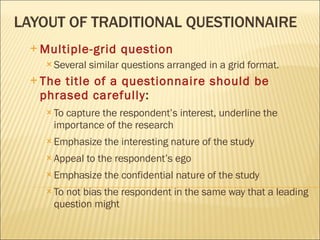
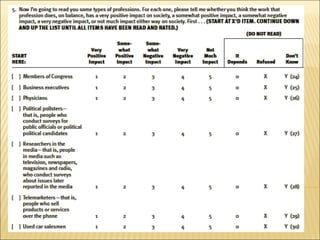
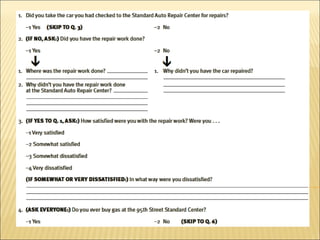
LAYOUT OF TRADITIONAL QUESTIONNAIRE Multiple-grid question Several similar questions arranged in a grid format. The title of a questionnaire should be phrased carefully : To capture the respondent’s interest, underline the importance of the research Emphasize the interesting nature of the study Appeal to the respondent’s ego Emphasize the confidential nature of the study To not bias the respondent in the same way that a leading question might
 
 
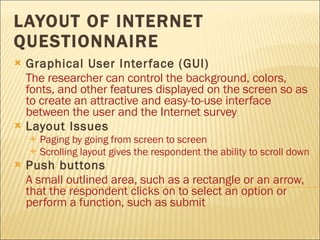
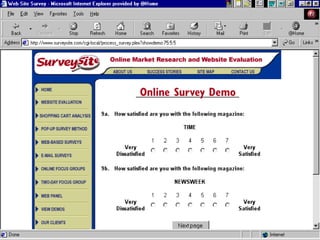
LAYOUT OF INTERNET QUESTIONNAIRE Graphical User Interface (GUI) The researcher can control the background, colors, fonts, and other features displayed on the screen so as to create an attractive and easy-to-use interface between the user and the Internet survey Layout Issues Paging by going from screen to screen Scrolling layout gives the respondent the ability to scroll down Push buttons   A small outlined area, such as a rectangle or an arrow, that the respondent clicks on to select an option or perform a function, such as submit
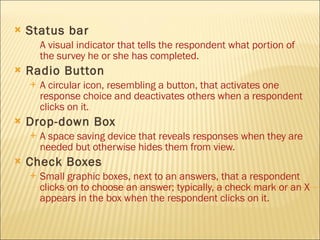
Status bar   A visual indicator that tells the respondent what portion of the survey he or she has completed. Radio Button A circular icon, resembling a button, that activates one response choice and deactivates others when a respondent clicks on it. Drop-down Box A space saving device that reveals responses when they are needed but otherwise hides them from view. Check Boxes Small graphic boxes, next to an answers, that a respondent clicks on to choose an answer; typically, a check mark or an X appears in the box when the respondent clicks on it.
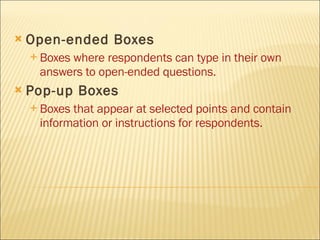
Open-ended Boxes Boxes where respondents can type in their own answers to open-ended questions. Pop-up Boxes Boxes that appear at selected points and contain information or instructions for respondents.
 
SOFTWARE THAT MAKES QUESTIONNAIRE INTERACTIVE Variable piping software Allows variables to be inserted into an Internet questionnaire as a respondent is completing it. Error trapping software Controls the flow of an internet questionnaire . Forced answering software Prevents respondents from continuing with an Internet questionnaire if they fail to answer a question. Interactive help desk A live, real-time support feature that solves problems or answers questions respondents may encounter in completing the questionnaire .
HOW MUCH PRE TESTING AND REVISING ARE NECESSARY ? Pretesting Process Seeks to determine whether respondents have any difficulty understanding the questionnaire and whether there are any ambiguous or biased questions. Preliminary Tabulation A tabulation of the results of a pretest to help determine whether the questionnaire will meet the objectives of the research.
Designing Questionnaires for Global Markets Back Translation Taking a questionnaire that has previously been translated into another language and having a second, independent translator translate it back to the original language. A questionnaire developed in one country may be difficult to translate because equivalent language concepts do not exist or because of differences in idiom and vernacular.
THANK YOU LMT School Of Management

Questionnaire Design Business Research

  • 1.
    QUESTIONNAIRE DESIGN PRESENTED BY: ROHIT CHANDRA SIMRANJEET SINGH RAJAN MITTAL PARMEET SINGH MANVIR SINGH
  • 2.
    “ It isnot every question that deserves an answer.” Publius Syrus (roman,1st century B.C.)
  • 3.
    A Good QuestionnaireAppears As easy to compose as a good poem But, it is usually the result of long, painstaking work
  • 4.
    QUESTIONNAIRE DESIGN: ANOVERVIEW OF THE MAJOR DECISIONS 1. What should be asked Questionnaire relevancy All information collected should address a research question in helping the decision maker in solving the current marketing problem Questionnaire accuracy Increasing the reliability and validity of respondent information requires that: 2. How should each question be phrased? 3. In what sequence should the questions be arranged? 4. What questionnaire layout will best serve the research objectives? 5. How should the questionnaire be pretested? Does the questionnaire need to be revised?
  • 5.
    PHRASING QUESTIONS Openended questions Pose some problem and ask respondents to answer in their own words What things do you like most about your job? What comes to mind when you look at this advertisement?
  • 6.
    Advantages: Are mostbeneficial in exploratory research, especially when the range of responses is not known. May reveal unanticipated reactions toward the product. Are good first questions because they allow respondents to warm up to the questioning process. Disadvantages: High cost of administering open-ended response questions The possibility that interviewer bias will influence the answer Bias introduced by articulate individuals’ longer answers
  • 7.
    Fixed –alternative questionsQuestions in which respondents are given specific, limited-alternative responses and asked to choose the one closest to their own viewpoint . Did you work overtime ? Yes or NO.
  • 8.
    Advantages : Requireless interviewer skill Take less time to answer Are easier for the respondent to answer Provides comparability of answers Disadvantages: Lack of range in the response alternatives Tendency of respondents to choose convenient alternative
  • 9.
    Types of Fixed-AlternativeQuestions Simple-dichotomy questions Requires the respondent to choose one of two alternatives (e.g., yes or no). Did you make any long distance calls last week? (Yes or No). Determinant choice questions Requires the respondent to choose one response from among multiple alternatives (e.g., A, B, or C). Please give us information about your flight First class Business Class Coach class
  • 10.
    Frequency Determination QuestionsAsks for an answer about general frequency of occurrence (e.g., often, occasionally, or never). How frequently do you watch MTV Channel? Every Day 5-6 times a week Once a week Never
  • 11.
    Checklist questions Allowsthe respondent to provide multiple answers to a single question by checking off items. Please check which of the following sources of about investments you regularly use Personal advice of your broker Brokerage research reports Reports on internet Non of these
  • 12.
    Structured Unstructured UndisguisedDisguised Classifying Surveys by Degree of Structure and Degree of Disguise Example: Typical descriptive survey with straight-forward, structured questions Example: Survey with open-ended questions to discover “new” answers or focus group interview Example: Survey interview to measure brand A’s image versus competitive brands’ images or brand recall (unaided recall) Example: Projection techniques used mostly for exploratory research
  • 13.
    PHRASING QUESTIONS FORSELF-ADMINISTERED TELEPHONE AND PERSONAL INTERVIEW SURVEYS The means of data collection—telephone interview, personal interview, self-administered questionnaire—will influence the question format and question phrasing . Eg. How you are satisfied with after sale service of your laptop? Very satisfied Somewhat satisfied Slightly dissatisfied Very dissatisfied
  • 14.
    ART OF ASKINGQUESTIONS Avoid complexity :Use simple , Conversational language Avoid leading and loading questions Leading : A questions that suggest or implies certain answers. Loaded : A questions that suggest socially desirable answer or is emotionally changed Avoid ambiguity : Be specific as possible
  • 15.
    Avoid double barreledItems A questions that may induce Bias because it covers two issue at once. Between you & your husband who does the housework over and above that done by any hired help? I do all of it I do almost all of it I do over half of it We split the work fifty-fifty. Avoid making assumptions Avoid Burdensome questions that may tax respondent Memory
  • 16.
    WHAT IS THEBEST QUESTION SEQUENCE? ORDER BIAS Bias caused by the influence of earlier questions in questionnaire . FUNNEL TECHNIQUE Asking general questions before specific questions on order to obtain unbiased responses. FILTER QUESTION Question in a questionnaire that screams out respondent not qualified to answer a second question PIVOT QUESTION Filter question use to determine which version of second question will be asked
  • 17.
    Factors Influencing theSequencing Questions Anchoring effect The first concept measured tends to become a comparison point from which subsequent evaluations are made. Randomization of items on a questionnaire susceptible to the anchoring effect helps minimize order bias. Order of alternatives on closed questions The order of choices should be rotated if producing alternative forms of the questionnaire is possible.
  • 18.
    WHAT IS THEBEST LAYOUT? Layout of traditional questionnaire Layout of internet questionnaire
  • 19.
    LAYOUT OF TRADITIONALQUESTIONNAIRE Multiple-grid question Several similar questions arranged in a grid format. The title of a questionnaire should be phrased carefully : To capture the respondent’s interest, underline the importance of the research Emphasize the interesting nature of the study Appeal to the respondent’s ego Emphasize the confidential nature of the study To not bias the respondent in the same way that a leading question might
  • 20.
  • 21.
  • 22.
    LAYOUT OF INTERNETQUESTIONNAIRE Graphical User Interface (GUI) The researcher can control the background, colors, fonts, and other features displayed on the screen so as to create an attractive and easy-to-use interface between the user and the Internet survey Layout Issues Paging by going from screen to screen Scrolling layout gives the respondent the ability to scroll down Push buttons A small outlined area, such as a rectangle or an arrow, that the respondent clicks on to select an option or perform a function, such as submit
  • 23.
    Status bar A visual indicator that tells the respondent what portion of the survey he or she has completed. Radio Button A circular icon, resembling a button, that activates one response choice and deactivates others when a respondent clicks on it. Drop-down Box A space saving device that reveals responses when they are needed but otherwise hides them from view. Check Boxes Small graphic boxes, next to an answers, that a respondent clicks on to choose an answer; typically, a check mark or an X appears in the box when the respondent clicks on it.
  • 24.
    Open-ended Boxes Boxeswhere respondents can type in their own answers to open-ended questions. Pop-up Boxes Boxes that appear at selected points and contain information or instructions for respondents.
  • 25.
  • 26.
    SOFTWARE THAT MAKESQUESTIONNAIRE INTERACTIVE Variable piping software Allows variables to be inserted into an Internet questionnaire as a respondent is completing it. Error trapping software Controls the flow of an internet questionnaire . Forced answering software Prevents respondents from continuing with an Internet questionnaire if they fail to answer a question. Interactive help desk A live, real-time support feature that solves problems or answers questions respondents may encounter in completing the questionnaire .
  • 27.
    HOW MUCH PRETESTING AND REVISING ARE NECESSARY ? Pretesting Process Seeks to determine whether respondents have any difficulty understanding the questionnaire and whether there are any ambiguous or biased questions. Preliminary Tabulation A tabulation of the results of a pretest to help determine whether the questionnaire will meet the objectives of the research.
  • 28.
    Designing Questionnaires forGlobal Markets Back Translation Taking a questionnaire that has previously been translated into another language and having a second, independent translator translate it back to the original language. A questionnaire developed in one country may be difficult to translate because equivalent language concepts do not exist or because of differences in idiom and vernacular.
  • 29.
    THANK YOU LMTSchool Of Management