Research Methodology In SOCIAL
SCIENCES
(For Undergraduate Students)

Presented by
Dr. Sanjay PS Dessai
Associate Professor of Commerce
VVM’s Shree Damodar College, Margao, Goa.
&
Dr. B.P. Sarath Chandran
Associate Professor of Economics
VVM’s Shree Damodar College, Margao, Goa.
11/1/2013

sanjaydessai@gmail.com &
sarath.chandran7@gmail.com

1
Part A
What is Research?
•

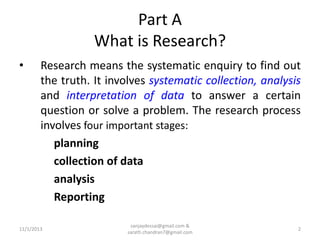
Research means the systematic enquiry to find out
the truth. It involves systematic collection, analysis
and interpretation of data to answer a certain
question or solve a problem. The research process
involves four important stages:
planning
collection of data
analysis
Reporting

11/1/2013

sanjaydessai@gmail.com &
sarath.chandran7@gmail.com

2
Steps involved in research
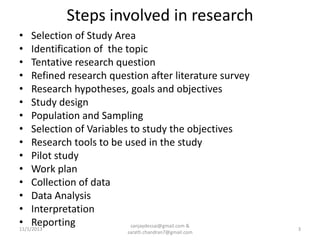
• Selection of Study Area
• Identification of the topic
• Tentative research question
• Refined research question after literature survey
• Research hypotheses, goals and objectives
• Study design
• Population and Sampling
• Selection of Variables to study the objectives
• Research tools to be used in the study
• Pilot study
• Work plan
• Collection of data
• Data Analysis
• Interpretation
• Reporting
sanjaydessai@gmail.com &
11/1/2013
sarath.chandran7@gmail.com

3
Research Area and Research Topic
• Identification of the area (Ex: finance,
economics, marketing, entrepreneurship etc.)
• Look out for problems/issues in that area that
can be studied.
• Curious problem or a pressing issue can also
be studied
• Topics should be narrowly focused and
carefully defined
11/1/2013

sanjaydessai@gmail.com &
sarath.chandran7@gmail.com

4
Sources of research topic
• Theories
• Personal/professional questions

• Replication
• Library search

• Sponsoring agencies
• Issues confronting the society
• Problems that urgent solutions are required.

11/1/2013

sanjaydessai@gmail.com &
sarath.chandran7@gmail.com

5
How to refine research question
• Who?
• What?

• When?
• Where?
• Why?
Research topic can come ,
•
•
•
•
•

personal experience
theory
observations
contemporary issues
engagement with the literature

11/1/2013

sanjaydessai@gmail.com &
sarath.chandran7@gmail.com

6
Objectives
Objectives are the clear statements indicating
what the researcher wanted to answer at the
end of the study.
 The research problem becomes the broad
objective of the study
 This is can be divided in to specific objectives
 At the end of the study, the researcher should
be able to satisfactorily answer the objectives
of the study.
11/1/2013

sanjaydessai@gmail.com &
sarath.chandran7@gmail.com

7
Hypothesis
Hypothesis is a tentative statement to be tested
positive or negative.
When relationship between variables are not
known, it is better to formulate the hypothesis
and to be tested.
Null Hypothesis (H0): There is no perceptible
difference in the variables being studied.
Alternate Hypothesis (H1): Opposite of null
hypothesis. There is perceptible differences in
the variables being studied.
11/1/2013

sanjaydessai@gmail.com &
sarath.chandran7@gmail.com

8
Research Design
Research design basically answers the
following questions
(i) What is the study about?
(ii) Why is the study being made?
(iii) Where will the study be carried out?
(iv) What type of data is required?
(v) Where can the required data be found?
(vi) What periods of time will the study include?
(vii) What will be the sample design?
(viii) What techniques of data collection will be used?
(ix) How will the data be analyzed?
(x) In what style will the report be prepared?
11/1/2013

sanjaydessai@gmail.com &
sarath.chandran7@gmail.com

9
Population and Sampling
•

Sampling is the process of selection of a number of units
from a defined study population.

The process of sampling
1.
2.
3.
4.
5.

Identification of study population
Determination of sampling population
Definition of the sampling unit
Choice of sampling method
Estimation of the sample size

11/1/2013

sanjaydessai@gmail.com &
sarath.chandran7@gmail.com

10
Variables
Variable: a characteristic or phenomenon that may take on
different values; variables must vary!
There may be different characteristics affecting the
outcome we are studying
Variables are generally classified as Dependent and
Independent
Dependent Variable (DV): an outcome of interest that is
observed and measured by the researcher; hypothesised to
be affected by the independent variable
Independent Variable (IV): the controlled variable in a
study; hypothesised to have an effect on the dependent
variable
11/1/2013

sanjaydessai@gmail.com &
sarath.chandran7@gmail.com

11
Research Tools
•
•
•
•
•
•

11/1/2013

Experiments
Observations
Surveys
Questionnaire
Interviews
Standardized tests

sanjaydessai@gmail.com &
sarath.chandran7@gmail.com

12
Pilot Survey
• A small scale survey carried out prior to the
main survey
• to improve the efficiency of the main survey.
• To test whether questions are giving you the
type of answers you want.
• to modify questions to get better response
• pilot test help to work out solutions to the
problems encountered for better response.
11/1/2013

sanjaydessai@gmail.com &
sarath.chandran7@gmail.com

13
Work Plan
• Work plan is important for the timely
completion of the research.
• The research process is divided in to various
stages and a time frame is given.
• By following the time frame the researcher is
able to evaluate the progress of the study and
make the necessary changes if required.
• Work plan should not be rigid and it should be
able to incorporate the changes required.
11/1/2013

sanjaydessai@gmail.com &
sarath.chandran7@gmail.com

14
Collection of Data
• Data Collection is an important aspect of any
type of research study. Inaccurate data
collection can impact the results of a study
and ultimately lead to invalid results.
• Data Collected can be
• Qualitative
• Quantitative

11/1/2013

sanjaydessai@gmail.com &
sarath.chandran7@gmail.com

15
Data Analysis
• When selecting the tools of data analysis, a
researcher should make sure that the assumptions
related to the technique are satisfied.
• Descriptive Analysis – percentage, ratio, proportions
etc.
• Qualitative Data Analysis
• Statistical Data Analysis
• Descriptive Statistics
• Regression Analysis

• Economic Modeling
• Statistical software's such as SPSS, EVIEWS, STATA,
Gretel etc. are used for data analysis.
11/1/2013

sanjaydessai@gmail.com &
sarath.chandran7@gmail.com

16
Interpretation
Interpretation transforms the data collected into credible evidence of
outcome.
This includes the following steps:
·
Organising the data for analysis (data preparation)
·
Describing the data
·
Interpreting the data
Where quantitative data have been collected, statistical analysis can:

· help measure the degree of change that has taken place
· allow an assessment to be made about the consistency of data
Where qualitative data have been collected, interpretation is more
difficult.
Here, it is important to group similar responses into categories and
identify common patterns that can help derive meaning from what
may seem unrelated and diffuse responses.
11/1/2013

sanjaydessai@gmail.com &
sarath.chandran7@gmail.com

17
Reporting
• A report is a presentation of facts and
findings,
usually
as
a
basis
for
recommendations.
• Written for a specific readership, and probably
intended to be kept as a record.
• Report is written to be read by the intended
audience

11/1/2013

sanjaydessai@gmail.com &
sarath.chandran7@gmail.com

18
Structure of a Report
Title of the Report
Introduction
Background
Statement of the problem
Importance
Research gap
Objectives
Methodology of the study
Limitations of the study/Challenges
Chapter Structure
Review of the Literature
Profile of the Study Units
Analysis of data
Summary, Suggestions and scope for future research
11/1/2013

sanjaydessai@gmail.com &
sarath.chandran7@gmail.com

19
Part B
Project requirements for undergraduate
students of Goa University
based on project manual
of
Goa university

11/1/2013

sanjaydessai@gmail.com &
sarath.chandran7@gmail.com

20
Preliminaries
•
•
•
•
•
•

Title page
Declaration certificate
Certificate signed by supervisor
Acknowledgement / preface
Table of contents
Numbering of pages

11/1/2013

sanjaydessai@gmail.com &
sarath.chandran7@gmail.com

21
Table of contents
•
•
•
•

The chapter title
References / bibliography
Appendices
Annexures

11/1/2013

sanjaydessai@gmail.com &
sarath.chandran7@gmail.com

22
Introductory chapter
Includes
1. Introduction
2. Objectives of the study
3. Scope
4. Statement of the problem/ Hypothesis
5. Methodology
6. Chapter scheme and
7. limitations if any
11/1/2013

sanjaydessai@gmail.com &
sarath.chandran7@gmail.com

23
End matter
•
•
•
•
•

Reference notes
Bibliography- proper citation
Style and format important
Alphabetical order
(Name of the author, date of publication, title,
place of publication and name of the
publisher)

11/1/2013

sanjaydessai@gmail.com &
sarath.chandran7@gmail.com

24
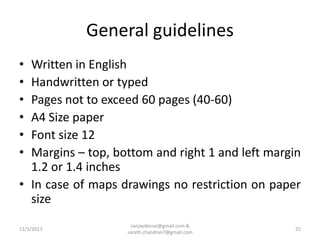
General guidelines
•
•
•
•
•
•

Written in English
Handwritten or typed
Pages not to exceed 60 pages (40-60)
A4 Size paper
Font size 12
Margins – top, bottom and right 1 and left margin
1.2 or 1.4 inches
• In case of maps drawings no restriction on paper
size
11/1/2013

sanjaydessai@gmail.com &
sarath.chandran7@gmail.com

25
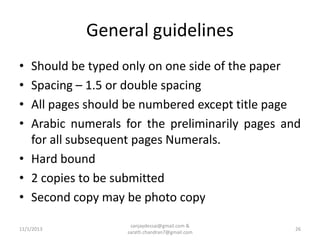
General guidelines
•
•
•
•

Should be typed only on one side of the paper
Spacing – 1.5 or double spacing
All pages should be numbered except title page
Arabic numerals for the preliminarily pages and
for all subsequent pages Numerals.
• Hard bound
• 2 copies to be submitted
• Second copy may be photo copy
11/1/2013

sanjaydessai@gmail.com &
sarath.chandran7@gmail.com

26
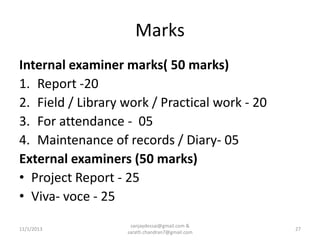
Marks
Internal examiner marks( 50 marks)
1. Report -20
2. Field / Library work / Practical work - 20
3. For attendance - 05
4. Maintenance of records / Diary- 05
External examiners (50 marks)
• Project Report - 25
• Viva- voce - 25
11/1/2013

sanjaydessai@gmail.com &
sarath.chandran7@gmail.com

27
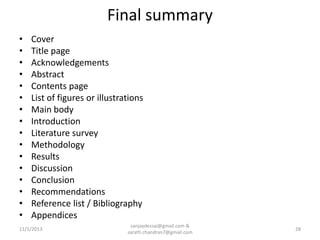
Final summary
•
•
•
•
•
•
•
•
•
•
•
•
•
•
•
•

Cover
Title page
Acknowledgements
Abstract
Contents page
List of figures or illustrations
Main body
Introduction
Literature survey
Methodology
Results
Discussion
Conclusion
Recommendations
Reference list / Bibliography
Appendices

11/1/2013

sanjaydessai@gmail.com &
sarath.chandran7@gmail.com

28
Thank you

11/1/2013

sanjaydessai@gmail.com &
sarath.chandran7@gmail.com

29

Research methodology for project work for undergraduate students

  • 1.
    Research Methodology InSOCIAL SCIENCES (For Undergraduate Students) Presented by Dr. Sanjay PS Dessai Associate Professor of Commerce VVM’s Shree Damodar College, Margao, Goa. & Dr. B.P. Sarath Chandran Associate Professor of Economics VVM’s Shree Damodar College, Margao, Goa. 11/1/2013 sanjaydessai@gmail.com & sarath.chandran7@gmail.com 1
  • 2.
    Part A What isResearch? • Research means the systematic enquiry to find out the truth. It involves systematic collection, analysis and interpretation of data to answer a certain question or solve a problem. The research process involves four important stages: planning collection of data analysis Reporting 11/1/2013 sanjaydessai@gmail.com & sarath.chandran7@gmail.com 2
  • 3.
    Steps involved inresearch • Selection of Study Area • Identification of the topic • Tentative research question • Refined research question after literature survey • Research hypotheses, goals and objectives • Study design • Population and Sampling • Selection of Variables to study the objectives • Research tools to be used in the study • Pilot study • Work plan • Collection of data • Data Analysis • Interpretation • Reporting sanjaydessai@gmail.com & 11/1/2013 sarath.chandran7@gmail.com 3
  • 4.
    Research Area andResearch Topic • Identification of the area (Ex: finance, economics, marketing, entrepreneurship etc.) • Look out for problems/issues in that area that can be studied. • Curious problem or a pressing issue can also be studied • Topics should be narrowly focused and carefully defined 11/1/2013 sanjaydessai@gmail.com & sarath.chandran7@gmail.com 4
  • 5.
    Sources of researchtopic • Theories • Personal/professional questions • Replication • Library search • Sponsoring agencies • Issues confronting the society • Problems that urgent solutions are required. 11/1/2013 sanjaydessai@gmail.com & sarath.chandran7@gmail.com 5
  • 6.
    How to refineresearch question • Who? • What? • When? • Where? • Why? Research topic can come , • • • • • personal experience theory observations contemporary issues engagement with the literature 11/1/2013 sanjaydessai@gmail.com & sarath.chandran7@gmail.com 6
  • 7.
    Objectives Objectives are theclear statements indicating what the researcher wanted to answer at the end of the study.  The research problem becomes the broad objective of the study  This is can be divided in to specific objectives  At the end of the study, the researcher should be able to satisfactorily answer the objectives of the study. 11/1/2013 sanjaydessai@gmail.com & sarath.chandran7@gmail.com 7
  • 8.
    Hypothesis Hypothesis is atentative statement to be tested positive or negative. When relationship between variables are not known, it is better to formulate the hypothesis and to be tested. Null Hypothesis (H0): There is no perceptible difference in the variables being studied. Alternate Hypothesis (H1): Opposite of null hypothesis. There is perceptible differences in the variables being studied. 11/1/2013 sanjaydessai@gmail.com & sarath.chandran7@gmail.com 8
  • 9.
    Research Design Research designbasically answers the following questions (i) What is the study about? (ii) Why is the study being made? (iii) Where will the study be carried out? (iv) What type of data is required? (v) Where can the required data be found? (vi) What periods of time will the study include? (vii) What will be the sample design? (viii) What techniques of data collection will be used? (ix) How will the data be analyzed? (x) In what style will the report be prepared? 11/1/2013 sanjaydessai@gmail.com & sarath.chandran7@gmail.com 9
  • 10.
    Population and Sampling • Samplingis the process of selection of a number of units from a defined study population. The process of sampling 1. 2. 3. 4. 5. Identification of study population Determination of sampling population Definition of the sampling unit Choice of sampling method Estimation of the sample size 11/1/2013 sanjaydessai@gmail.com & sarath.chandran7@gmail.com 10
  • 11.
    Variables Variable: a characteristicor phenomenon that may take on different values; variables must vary! There may be different characteristics affecting the outcome we are studying Variables are generally classified as Dependent and Independent Dependent Variable (DV): an outcome of interest that is observed and measured by the researcher; hypothesised to be affected by the independent variable Independent Variable (IV): the controlled variable in a study; hypothesised to have an effect on the dependent variable 11/1/2013 sanjaydessai@gmail.com & sarath.chandran7@gmail.com 11
  • 12.
  • 13.
    Pilot Survey • Asmall scale survey carried out prior to the main survey • to improve the efficiency of the main survey. • To test whether questions are giving you the type of answers you want. • to modify questions to get better response • pilot test help to work out solutions to the problems encountered for better response. 11/1/2013 sanjaydessai@gmail.com & sarath.chandran7@gmail.com 13
  • 14.
    Work Plan • Workplan is important for the timely completion of the research. • The research process is divided in to various stages and a time frame is given. • By following the time frame the researcher is able to evaluate the progress of the study and make the necessary changes if required. • Work plan should not be rigid and it should be able to incorporate the changes required. 11/1/2013 sanjaydessai@gmail.com & sarath.chandran7@gmail.com 14
  • 15.
    Collection of Data •Data Collection is an important aspect of any type of research study. Inaccurate data collection can impact the results of a study and ultimately lead to invalid results. • Data Collected can be • Qualitative • Quantitative 11/1/2013 sanjaydessai@gmail.com & sarath.chandran7@gmail.com 15
  • 16.
    Data Analysis • Whenselecting the tools of data analysis, a researcher should make sure that the assumptions related to the technique are satisfied. • Descriptive Analysis – percentage, ratio, proportions etc. • Qualitative Data Analysis • Statistical Data Analysis • Descriptive Statistics • Regression Analysis • Economic Modeling • Statistical software's such as SPSS, EVIEWS, STATA, Gretel etc. are used for data analysis. 11/1/2013 sanjaydessai@gmail.com & sarath.chandran7@gmail.com 16
  • 17.
    Interpretation Interpretation transforms thedata collected into credible evidence of outcome. This includes the following steps: · Organising the data for analysis (data preparation) · Describing the data · Interpreting the data Where quantitative data have been collected, statistical analysis can: · help measure the degree of change that has taken place · allow an assessment to be made about the consistency of data Where qualitative data have been collected, interpretation is more difficult. Here, it is important to group similar responses into categories and identify common patterns that can help derive meaning from what may seem unrelated and diffuse responses. 11/1/2013 sanjaydessai@gmail.com & sarath.chandran7@gmail.com 17
  • 18.
    Reporting • A reportis a presentation of facts and findings, usually as a basis for recommendations. • Written for a specific readership, and probably intended to be kept as a record. • Report is written to be read by the intended audience 11/1/2013 sanjaydessai@gmail.com & sarath.chandran7@gmail.com 18
  • 19.
    Structure of aReport Title of the Report Introduction Background Statement of the problem Importance Research gap Objectives Methodology of the study Limitations of the study/Challenges Chapter Structure Review of the Literature Profile of the Study Units Analysis of data Summary, Suggestions and scope for future research 11/1/2013 sanjaydessai@gmail.com & sarath.chandran7@gmail.com 19
  • 20.
    Part B Project requirementsfor undergraduate students of Goa University based on project manual of Goa university 11/1/2013 sanjaydessai@gmail.com & sarath.chandran7@gmail.com 20
  • 21.
    Preliminaries • • • • • • Title page Declaration certificate Certificatesigned by supervisor Acknowledgement / preface Table of contents Numbering of pages 11/1/2013 sanjaydessai@gmail.com & sarath.chandran7@gmail.com 21
  • 22.
    Table of contents • • • • Thechapter title References / bibliography Appendices Annexures 11/1/2013 sanjaydessai@gmail.com & sarath.chandran7@gmail.com 22
  • 23.
    Introductory chapter Includes 1. Introduction 2.Objectives of the study 3. Scope 4. Statement of the problem/ Hypothesis 5. Methodology 6. Chapter scheme and 7. limitations if any 11/1/2013 sanjaydessai@gmail.com & sarath.chandran7@gmail.com 23
  • 24.
    End matter • • • • • Reference notes Bibliography-proper citation Style and format important Alphabetical order (Name of the author, date of publication, title, place of publication and name of the publisher) 11/1/2013 sanjaydessai@gmail.com & sarath.chandran7@gmail.com 24
  • 25.
    General guidelines • • • • • • Written inEnglish Handwritten or typed Pages not to exceed 60 pages (40-60) A4 Size paper Font size 12 Margins – top, bottom and right 1 and left margin 1.2 or 1.4 inches • In case of maps drawings no restriction on paper size 11/1/2013 sanjaydessai@gmail.com & sarath.chandran7@gmail.com 25
  • 26.
    General guidelines • • • • Should betyped only on one side of the paper Spacing – 1.5 or double spacing All pages should be numbered except title page Arabic numerals for the preliminarily pages and for all subsequent pages Numerals. • Hard bound • 2 copies to be submitted • Second copy may be photo copy 11/1/2013 sanjaydessai@gmail.com & sarath.chandran7@gmail.com 26
  • 27.
    Marks Internal examiner marks(50 marks) 1. Report -20 2. Field / Library work / Practical work - 20 3. For attendance - 05 4. Maintenance of records / Diary- 05 External examiners (50 marks) • Project Report - 25 • Viva- voce - 25 11/1/2013 sanjaydessai@gmail.com & sarath.chandran7@gmail.com 27
  • 28.
    Final summary • • • • • • • • • • • • • • • • Cover Title page Acknowledgements Abstract Contentspage List of figures or illustrations Main body Introduction Literature survey Methodology Results Discussion Conclusion Recommendations Reference list / Bibliography Appendices 11/1/2013 sanjaydessai@gmail.com & sarath.chandran7@gmail.com 28
  • 29.