Conceptualizing in Research:An
overview
By
Dr.Aloysius H. Sequeira,
Professor,
National Institute of Technology Karnataka,
Surathkal.
email : aloysiushs@gmail.com
Alice’s adventures in wonderland
Part of Alice’s conversation with the Cheshire Cat :
Alice asks the Cat :„would you tell me, please , which way I ought to walk
from here?‟
„That depends a good deal on where you want to get to,‟ said the Cat
„I don’t much care where,‟ said Alice
‘Then it doesn’t matter which way you walk,’ said the Cat.
Formulating and clarifying your research topic is the starting of
research
11/9/2014 Prof.A.H.Sequeira 2
Conceptualization
 Imagine you speak of abstract words –
“ satisfaction”, “happiness”,“healthy” , etc.
 We cannot research these words until we
know exactly what they are.
 Everyday language is often vague and
unspecified meanings.
 Most fundamental process of science is
abstract conceptualization.
11/9/2014 Prof.A.H.Sequeira 3
Conceptualization
 Conceptualization is to specify exactly
what we mean and don‟t mean by the
terms we use in our research.
11/9/2014 Prof.A.H.Sequeira 4
• Conceptualization is mental
process of organizing one‟s
observations and experiences
into meaningful and coherent
wholes.
11/9/2014 Prof.A.H.Sequeira 5
 Term „concept’ (also referred as
„construct‟)refers to end product of
„conceptualization‟ .
 Concept could be a word or complex set of
events or ideas referred by the word.
 Concept can be word or symbol used to
represent a meaningful whole .
Concept description
 Words we use to form the description of
a concept are also concepts.
 To fully understand the description of a
given concept , each concept in that
definition must also be understood.
 In addition to organizing observations
into meaning wholes , concepts also
needed to be organized into separate
phenomena.
11/9/2014 Prof.A.H.Sequeira 6
Limitations in conceptualization.
 Data-gathering process is a complex
interplay between the conceptual process
and the actual observation or
measurement process.
 There are : Physical , Psychological,
Cultural andTechnological
limitations to conceptualization and
measurement.
11/9/2014 Prof.A.H.Sequeira 7
Concept vs Reality
 Facts do not speak for themselves or
stand out.
 They are limited by the creation of
conceptual and perceptual frameworks
and by measurement techniques.
 Concepts are not completely arbitrary ;
they must match with reality .
 Disagreements arise about whether
reality is always exist or we create
reality by using concepts?
11/9/2014 Prof.A.H.Sequeira 8
Conceptualization of
Framework for Design
1.Ontology – claims about what is knowledge-
theoretical vs reality -philosophical- lies in
methodology behind questions ( positivism , post-
positivism , constructivism, interpretivism ,
pragmatism , etc )
2. Epistemology- science of knowing
(objectivism , subjectivism, etc ).
11/9/2014 Prof.A.H.Sequeira 9
Conceptualization of
Framework for Design
3. Methodology –science of finding
(experimental, survey , observation,
ethnography, etc )
4. Methods – ways to capture data
(questionnaire, interview , focus group , etc )
5. Structure ( flow in writing- intro,
literature review , methodology , analysis of
data , findings and conclusions )
11/9/2014 Prof.A.H.Sequeira 10
Triangulation
 The idea that looking at something from
Multiple points of view for same
phenomenon- improves accuracy .
 eg A persons health –observation ,
questionnaire , interview , physical
examination , la/medical reports –multiple
measures .
11/9/2014 Prof.A.H.Sequeira 11
Four types of Triangulation
 1. Measures-Quantitative units
 2. Observes- Independently watch
 3.Theory- compare theories
 4. Method- Mix methods
11/9/2014 Prof.A.H.Sequeira 12
Research Paradigms
 Filling Knowledge Gaps - Positivism ,
Objectivism , Hypothesist – Common in
Quantitative Research
 Problem Solving -Interpretivism
,Constructivism , Pragmatism – Common
in Qualitative Research
11/9/2014 Prof.A.H.Sequeira 13
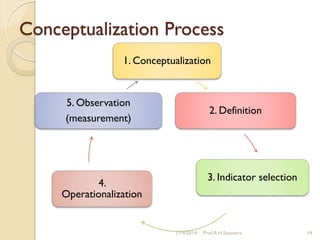
Conceptualization Process
1. Conceptualization
2. Definition
3. Indicator selection
4.
Operationalization
5. Observation
(measurement)
11/9/2014 Prof.A.H.Sequeira 14
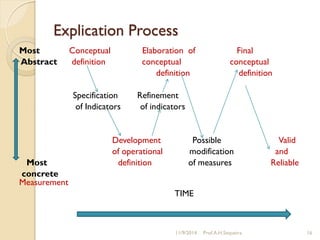
Explication
 The process of moving from definition to
measurement and back to the definition .
 One does not always start with a clear ,
observable , complete and useful conceptual
definition and then attempt to observe(measure)
that variable.
 Process of explication indicates that final
conceptualization and measurement results from
interplay of these two activities.
11/9/2014 Prof.A.H.Sequeira 15
Explication Process
Most Conceptual Elaboration of Final
Abstract definition conceptual conceptual
definition definition
Specification Refinement
of Indicators of indicators
Development Possible Valid
of operational modification and
Most definition of measures Reliable
concrete
Measurement
TIME
11/9/2014 Prof.A.H.Sequeira 16
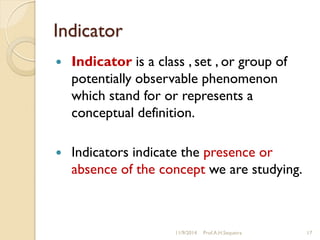
Indicator
 Indicator is a class , set , or group of
potentially observable phenomenon
which stand for or represents a
conceptual definition.
 Indicators indicate the presence or
absence of the concept we are studying.
11/9/2014 Prof.A.H.Sequeira 17
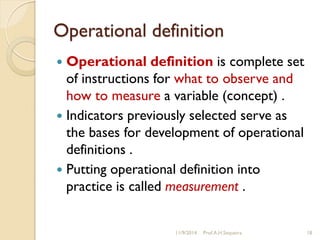
Operational definition
 Operational definition is complete set
of instructions for what to observe and
how to measure a variable (concept) .
 Indicators previously selected serve as
the bases for development of operational
definitions .
 Putting operational definition into
practice is called measurement .
11/9/2014 Prof.A.H.Sequeira 18
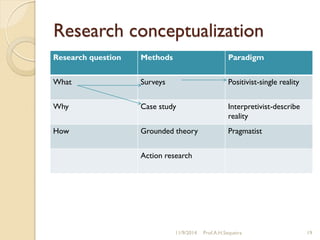
Research conceptualization
Research question Methods Paradigm
What Surveys Positivist-single reality
Why Case study Interpretivist-describe
reality
How Grounded theory Pragmatist
Action research
11/9/2014 Prof.A.H.Sequeira 19
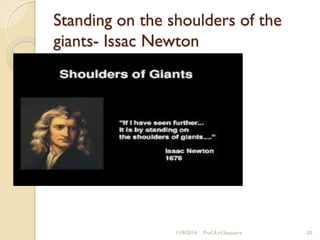
Standing on the shoulders of the
giants- Issac Newton
11/9/2014 Prof.A.H.Sequeira 20
Conclusion
 There is no one best way of conducting
research .
 Each study is unique , has its own
strengths and weaknesses.
 Three common approaches used in
research include: qualitative , quantitative
and mixed(triangulation).
 They contain philosophical assumptions
about knowledge claims , strategies for
inquiry and specific research methods.
11/9/2014 Prof.A.H.Sequeira 21
Conclusion
 When philosophy , strategies and
methods are combined , they provide
different frameworks for conducting
research.
 Choice of research approach to use is
based on the research problem , personal
experiences and the audience for whom
you want to write.
11/9/2014 Prof.A.H.Sequeira 22
References
Dahlia K. Remler and Gregg G. Van Rayzin , Research Methods In Practice , SAGE ,
London , 2010.
Michael H. Walizer and Paul L Wienir, Research Methods And Analysis-Searching
For Relationships, Harper & Row Publishers , London , 2012.
Lawrence Neuman W. , Social Research Methods: Quantitative And Qualitative
Approaches , Pearson , 7th
Ed., 2011.
John W. Creswell , Research Design-qualitative, quantitative and mixed methods
approaches, SAGE , UK, 2nd
Ed, 2003
http://www.shanghairanking.com/ARWU-FIELD-Statistics-2013.html#2
http://www.topuniversities.com/university-rankings/university-subject-
rankings/2013/medicine
http://www.timeshighereducation.co.uk/world-university-rankings/
11/9/2014 Prof.A.H.Sequeira 23
 http://www.socialresearchmethods.net/kb/
probform.php
11/9/2014 Prof.A.H.Sequeira 24

Conceptualizing in research : an overview

  • 1.
    Conceptualizing in Research:An overview By Dr.AloysiusH. Sequeira, Professor, National Institute of Technology Karnataka, Surathkal. email : aloysiushs@gmail.com
  • 2.
    Alice’s adventures inwonderland Part of Alice’s conversation with the Cheshire Cat : Alice asks the Cat :„would you tell me, please , which way I ought to walk from here?‟ „That depends a good deal on where you want to get to,‟ said the Cat „I don’t much care where,‟ said Alice ‘Then it doesn’t matter which way you walk,’ said the Cat. Formulating and clarifying your research topic is the starting of research 11/9/2014 Prof.A.H.Sequeira 2
  • 3.
    Conceptualization  Imagine youspeak of abstract words – “ satisfaction”, “happiness”,“healthy” , etc.  We cannot research these words until we know exactly what they are.  Everyday language is often vague and unspecified meanings.  Most fundamental process of science is abstract conceptualization. 11/9/2014 Prof.A.H.Sequeira 3
  • 4.
    Conceptualization  Conceptualization isto specify exactly what we mean and don‟t mean by the terms we use in our research. 11/9/2014 Prof.A.H.Sequeira 4 • Conceptualization is mental process of organizing one‟s observations and experiences into meaningful and coherent wholes.
  • 5.
    11/9/2014 Prof.A.H.Sequeira 5 Term „concept’ (also referred as „construct‟)refers to end product of „conceptualization‟ .  Concept could be a word or complex set of events or ideas referred by the word.  Concept can be word or symbol used to represent a meaningful whole .
  • 6.
    Concept description  Wordswe use to form the description of a concept are also concepts.  To fully understand the description of a given concept , each concept in that definition must also be understood.  In addition to organizing observations into meaning wholes , concepts also needed to be organized into separate phenomena. 11/9/2014 Prof.A.H.Sequeira 6
  • 7.
    Limitations in conceptualization. Data-gathering process is a complex interplay between the conceptual process and the actual observation or measurement process.  There are : Physical , Psychological, Cultural andTechnological limitations to conceptualization and measurement. 11/9/2014 Prof.A.H.Sequeira 7
  • 8.
    Concept vs Reality Facts do not speak for themselves or stand out.  They are limited by the creation of conceptual and perceptual frameworks and by measurement techniques.  Concepts are not completely arbitrary ; they must match with reality .  Disagreements arise about whether reality is always exist or we create reality by using concepts? 11/9/2014 Prof.A.H.Sequeira 8
  • 9.
    Conceptualization of Framework forDesign 1.Ontology – claims about what is knowledge- theoretical vs reality -philosophical- lies in methodology behind questions ( positivism , post- positivism , constructivism, interpretivism , pragmatism , etc ) 2. Epistemology- science of knowing (objectivism , subjectivism, etc ). 11/9/2014 Prof.A.H.Sequeira 9
  • 10.
    Conceptualization of Framework forDesign 3. Methodology –science of finding (experimental, survey , observation, ethnography, etc ) 4. Methods – ways to capture data (questionnaire, interview , focus group , etc ) 5. Structure ( flow in writing- intro, literature review , methodology , analysis of data , findings and conclusions ) 11/9/2014 Prof.A.H.Sequeira 10
  • 11.
    Triangulation  The ideathat looking at something from Multiple points of view for same phenomenon- improves accuracy .  eg A persons health –observation , questionnaire , interview , physical examination , la/medical reports –multiple measures . 11/9/2014 Prof.A.H.Sequeira 11
  • 12.
    Four types ofTriangulation  1. Measures-Quantitative units  2. Observes- Independently watch  3.Theory- compare theories  4. Method- Mix methods 11/9/2014 Prof.A.H.Sequeira 12
  • 13.
    Research Paradigms  FillingKnowledge Gaps - Positivism , Objectivism , Hypothesist – Common in Quantitative Research  Problem Solving -Interpretivism ,Constructivism , Pragmatism – Common in Qualitative Research 11/9/2014 Prof.A.H.Sequeira 13
  • 14.
    Conceptualization Process 1. Conceptualization 2.Definition 3. Indicator selection 4. Operationalization 5. Observation (measurement) 11/9/2014 Prof.A.H.Sequeira 14
  • 15.
    Explication  The processof moving from definition to measurement and back to the definition .  One does not always start with a clear , observable , complete and useful conceptual definition and then attempt to observe(measure) that variable.  Process of explication indicates that final conceptualization and measurement results from interplay of these two activities. 11/9/2014 Prof.A.H.Sequeira 15
  • 16.
    Explication Process Most ConceptualElaboration of Final Abstract definition conceptual conceptual definition definition Specification Refinement of Indicators of indicators Development Possible Valid of operational modification and Most definition of measures Reliable concrete Measurement TIME 11/9/2014 Prof.A.H.Sequeira 16
  • 17.
    Indicator  Indicator isa class , set , or group of potentially observable phenomenon which stand for or represents a conceptual definition.  Indicators indicate the presence or absence of the concept we are studying. 11/9/2014 Prof.A.H.Sequeira 17
  • 18.
    Operational definition  Operationaldefinition is complete set of instructions for what to observe and how to measure a variable (concept) .  Indicators previously selected serve as the bases for development of operational definitions .  Putting operational definition into practice is called measurement . 11/9/2014 Prof.A.H.Sequeira 18
  • 19.
    Research conceptualization Research questionMethods Paradigm What Surveys Positivist-single reality Why Case study Interpretivist-describe reality How Grounded theory Pragmatist Action research 11/9/2014 Prof.A.H.Sequeira 19
  • 20.
    Standing on theshoulders of the giants- Issac Newton 11/9/2014 Prof.A.H.Sequeira 20
  • 21.
    Conclusion  There isno one best way of conducting research .  Each study is unique , has its own strengths and weaknesses.  Three common approaches used in research include: qualitative , quantitative and mixed(triangulation).  They contain philosophical assumptions about knowledge claims , strategies for inquiry and specific research methods. 11/9/2014 Prof.A.H.Sequeira 21
  • 22.
    Conclusion  When philosophy, strategies and methods are combined , they provide different frameworks for conducting research.  Choice of research approach to use is based on the research problem , personal experiences and the audience for whom you want to write. 11/9/2014 Prof.A.H.Sequeira 22
  • 23.
    References Dahlia K. Remlerand Gregg G. Van Rayzin , Research Methods In Practice , SAGE , London , 2010. Michael H. Walizer and Paul L Wienir, Research Methods And Analysis-Searching For Relationships, Harper & Row Publishers , London , 2012. Lawrence Neuman W. , Social Research Methods: Quantitative And Qualitative Approaches , Pearson , 7th Ed., 2011. John W. Creswell , Research Design-qualitative, quantitative and mixed methods approaches, SAGE , UK, 2nd Ed, 2003 http://www.shanghairanking.com/ARWU-FIELD-Statistics-2013.html#2 http://www.topuniversities.com/university-rankings/university-subject- rankings/2013/medicine http://www.timeshighereducation.co.uk/world-university-rankings/ 11/9/2014 Prof.A.H.Sequeira 23
  • 24.