Topic 8
Questionnaire Designing
Questionnaire
A prepared set of questions (or measures) used
by respondents or interviewers to record
answers (data).
There are 3 major types:
1. Personally administered questionnaires
2. Mail questionnaires
3. Electronic and online questionnaires
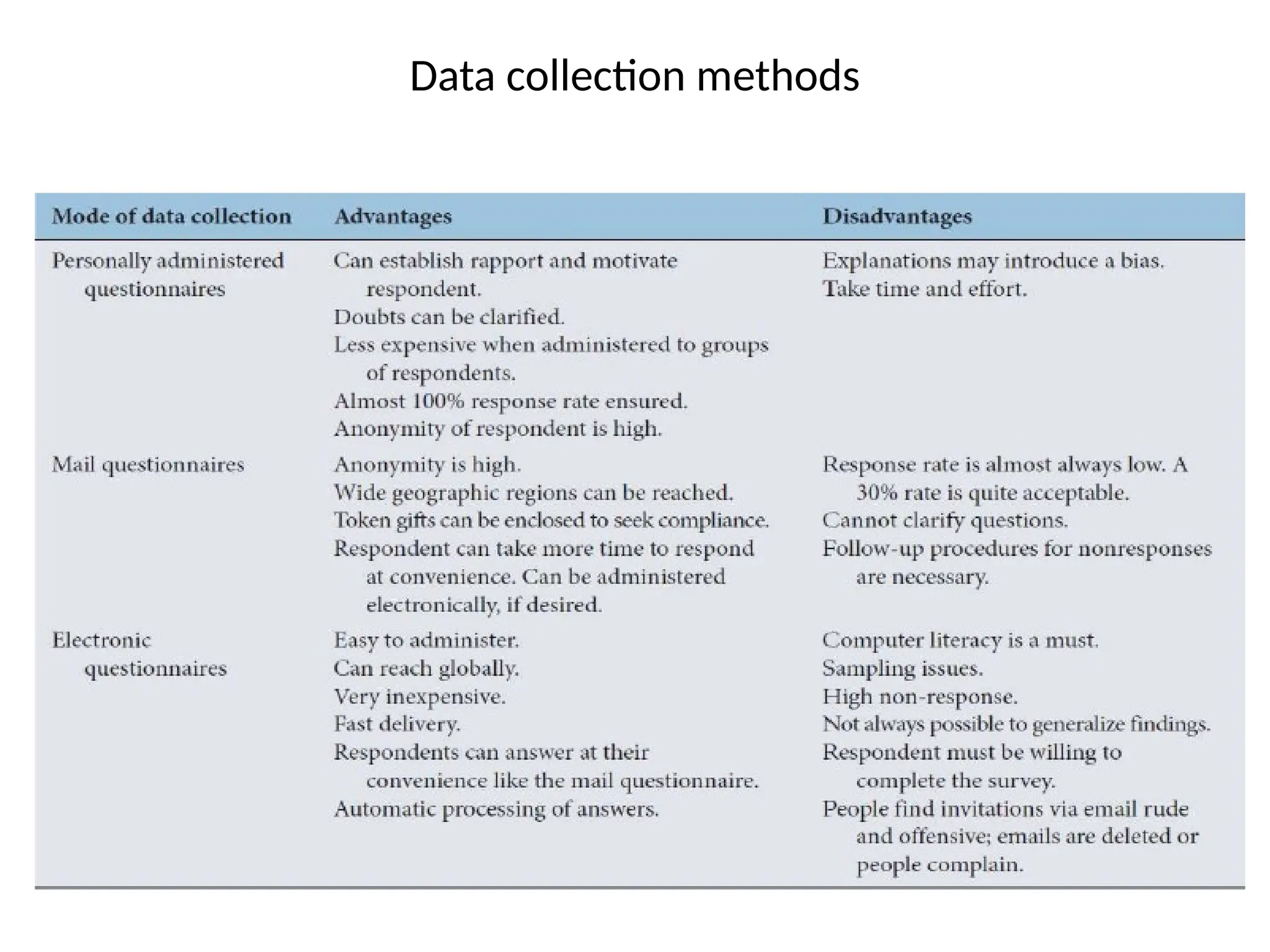
Data collection methods
Questionnaire Quality and Design: Basic
Considerations
Questionnaire design is one of the most critical
stages in the survey research process.
• A questionnaire (survey) is only as good as the
questions it asks—ask a bad question, get bad
results.
• Composing a good questionnaire appears easy,
but it is usually the result of long, painstaking work.
• The questions must meet the basic criteria of
relevance and accuracy.
Questionnaire Quality and Design: Basic
Considerations
• The appropriateness of the content of the
questions
• The wording of the questions and the level of
sophistication of the language used
• The type and form of questions asked
• The sequencing of the questions
• • The pre-test of the questionnaire
Questionnaire Relevancy
• All information collected should address a research question
in helping the decision maker in solving the current business
problem.
• Irrelevant questions are more than a nuisance because they
make the survey needlessly long.
• The response rate was nearly twice as high for the one-page
questionnaire as compared to a three-page questionnaire.
• Researchers must think about possible omissions.
Content of the Questions
Questionnaire Accuracy
Increasing the reliability and validity of respondent
information requires that:
 Questionnaires should use simple, understandable,
unbiased, unambiguous, and nonirritating words.
 Questionnaire design should facilitate recall and
motivate respondents to cooperate.
 Proper question wording and sequencing to avoid
confusion and biased answers.
Content of the Questions
• Measurement: Operationalizing
 Objective construct:
• 1 element/items => 1 question
• E.g., age, educational level
Subjective construct:
• Multiple elements/items => multiple questions
• E.g., satisfaction, involvement
Recently a survey was conducted by the United Nations using a
sample from several different countries. One of the questions
asked was: “Would you please give your opinion about the food
shortage in the rest of the world?”
The survey was a huge failure. Why?
• In Africa they did not know what food meant.
• In Western Europe they did not know what shortage meant.
• In Eastern Europe they did not know what opinion meant.
• In South America they did not know what please meant.
• And in the United States they did not know what the rest of the
world meant.
Why survey can be a failure?
Language and Wording of the
Questionnaire
• The choice of words will depend on their educational level, the
usage of terms and idioms in the culture, and the frames of
reference of the respondents.
• Terms such as “working here is a drag” and “she is a
compulsive worker” may not be interpreted the same way in
different cultures.
• If some questions are either not understood or are interpreted
differently by the respondent, the researcher will obtain the
wrong answers to the questions, and responses will thus be
biased.
Two Types of Questions
Open-ended Questions = place no constraints on
respondents who are free to answer in their
own words.
Closed-ended Questions = respondent is given
the option of choosing from a number of
predetermined answers.
Two Types of Questions
Closed vs. Open-ended questions
– Closed questions
• Helps respondents to make quick decisions
• Helps researchers to code
– Open-ended question
• First: unbiased point of view
• Final: additional insights
• Complementary to closed question: for
interpretation purpose
12
Examples: Open-Ended Questions
• What do you think about the National
Health Service?
• Which mutual funds have you been
investing in for the past year?
• How are the funds you are investing in
performing?
• What do you think of airport security?
Open-Ended Questions
• Typically used in exploratory/qualitative studies.
• Typically used in personal interview surveys
involving small samples.
• Allows respondent freedom of response.
• Respondent must be articulate and willing to
spend time giving a full answer.
• Data is in narrative form which can be time
consuming and difficult to code and analyze.
• Possible researcher bias in interpretation.
• Narrative can be analyzed using content analysis.
Software is available.
Examples: Closed-Ended Questions
• Did you check your email this
morning? __ Yes __ No
• Do you believe Enron senior
executives should be put in jail? __
Yes __ No
• Should the United Kingdom adopt
the Euro or keep the pound?
o Adopt the Euro __
o Keep the pound __
Closed-Ended Questions
• Typically used in quantitative studies.
• Assumption is researcher has knowledge to pre-
specify response categories.
• Data can be pre-coded and therefore in a form
amenable for use with statistical packages (e.g.,
SPSS, SAS) – data capture therefore easier.
• More difficult to design but simplifies analysis.
• Used in studies involving large samples.
• Limited range of response options.
Phrasing Questions for Self-Administered,
Telephone, and Personal Interview Surveys
Influences on Question Phrasing:
 The methods of data collection — telephone interview,
personal interview, self-administered questionnaire —
will influence the question format and question
phrasing.
 Questions for mail, Internet, and telephone surveys must
be less complex than those used in personal interviews.
 Questionnaires for telephone and personal interviews
should be written in a conversational style.
Guidelines for Constructing Questions
• Avoid complexity: Use simple, conversational language
• Avoid leading questions
• Avoid loaded questions: suggests a socially desirable answer or
is emotionally charged.
• Avoid ambiguity: Be as specific as possible.
• Avoid double-barreled items: may induce bias because it covers
two or more issues at once (asks a question that touches upon
more than one issue, yet allows only for one answer)
• Avoid making assumptions.
• Avoid burdensome questions that may tax the respondent’s
memory.
Guidelines for Constructing
Questions
• Use positive and negative statements
– Dresdner delivers high quality banking service
Dresdner has poor customer operational support
– Avoid double negatives
• Limit the length of the questions
Rules of thumb:
– < 20 words
– < one full line in print
19
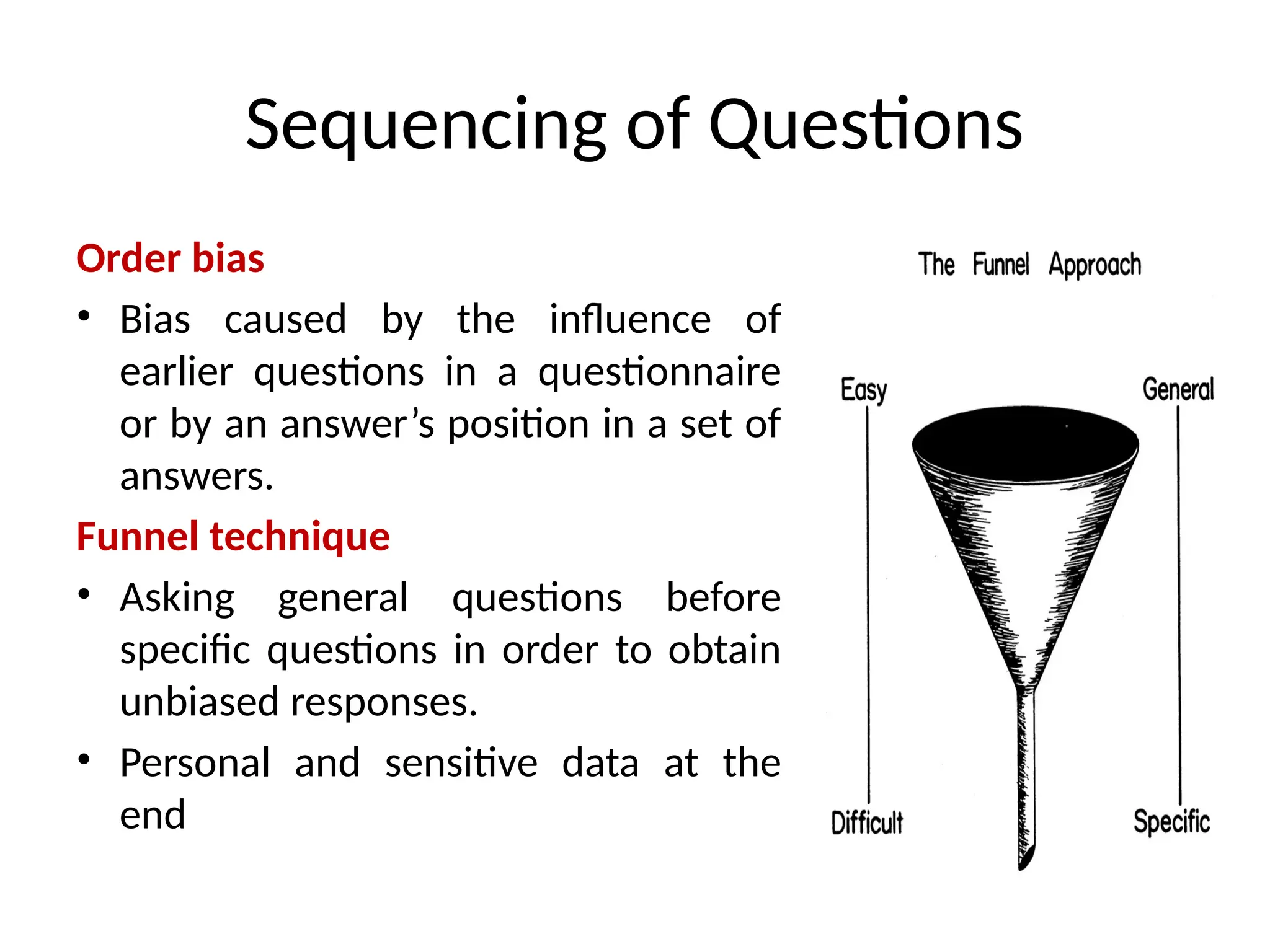
Sequencing of Questions
Order bias
• Bias caused by the influence of
earlier questions in a questionnaire
or by an answer’s position in a set of
answers.
Funnel technique
• Asking general questions before
specific questions in order to obtain
unbiased responses.
• Personal and sensitive data at the
end
Screening or filter questions
Screening or filter questions . . . are used to ensure
respondents included in the study are those that meet
the pre-determined criteria of the target population.
Example:
“Tonight we are talking with individuals who are 18
years of age or older and have 50 percent or more of
the responsibility for banking decisions in your
household. Are you that person?” __ Yes __ No
Layout of Questionnaire
Traditional Questionnaires
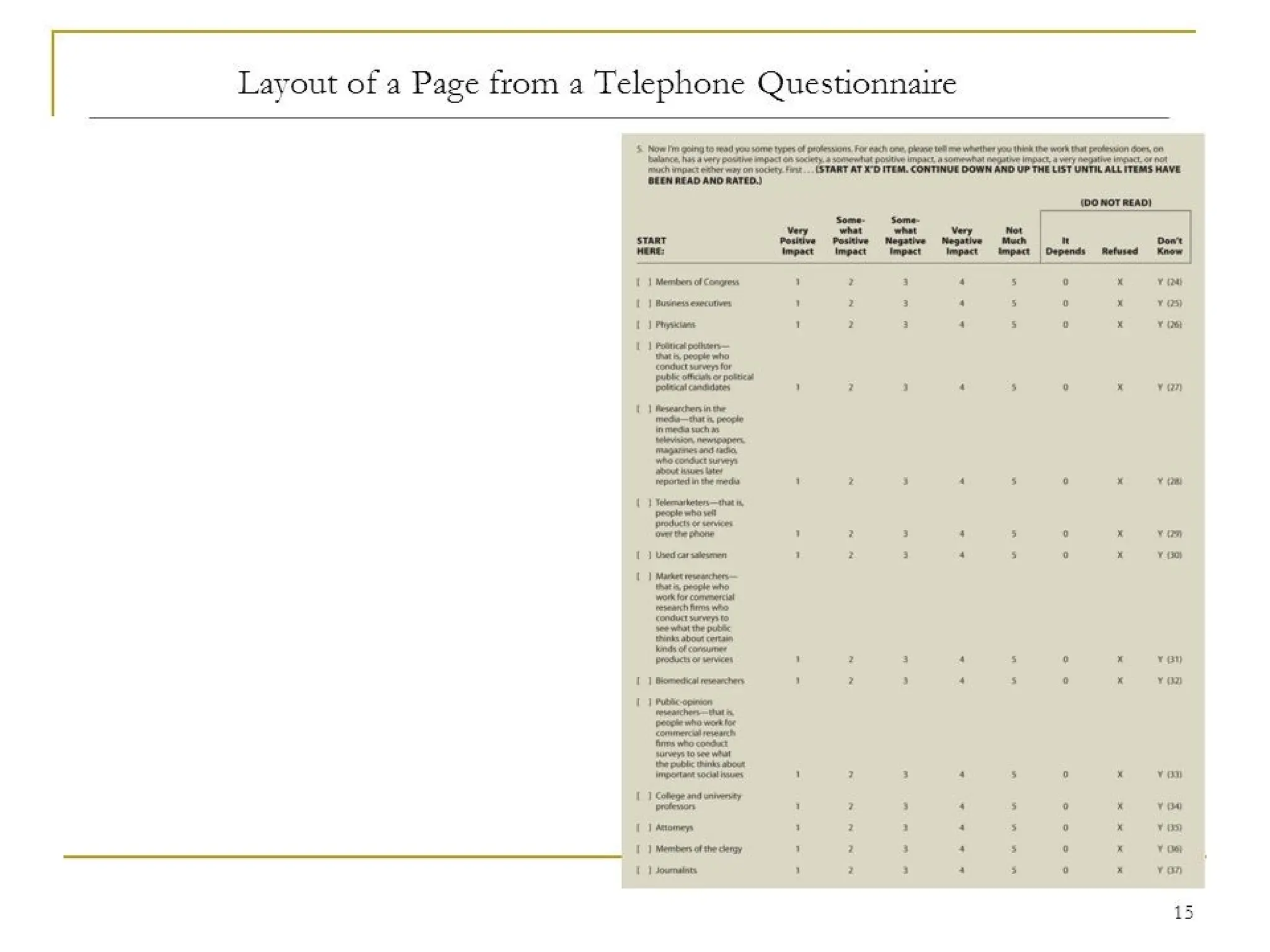
 Multiple-grid question
 Several similar questions arranged in a grid format.
The title of a questionnaire should be phrased carefully:
 To capture the respondent’s interest, underline the importance of the
research
 Emphasize the interesting nature of the study
 Appeal to the respondent’s ego
 Emphasize the confidential nature of the study
 To not bias the respondent in the same way that a leading question
might
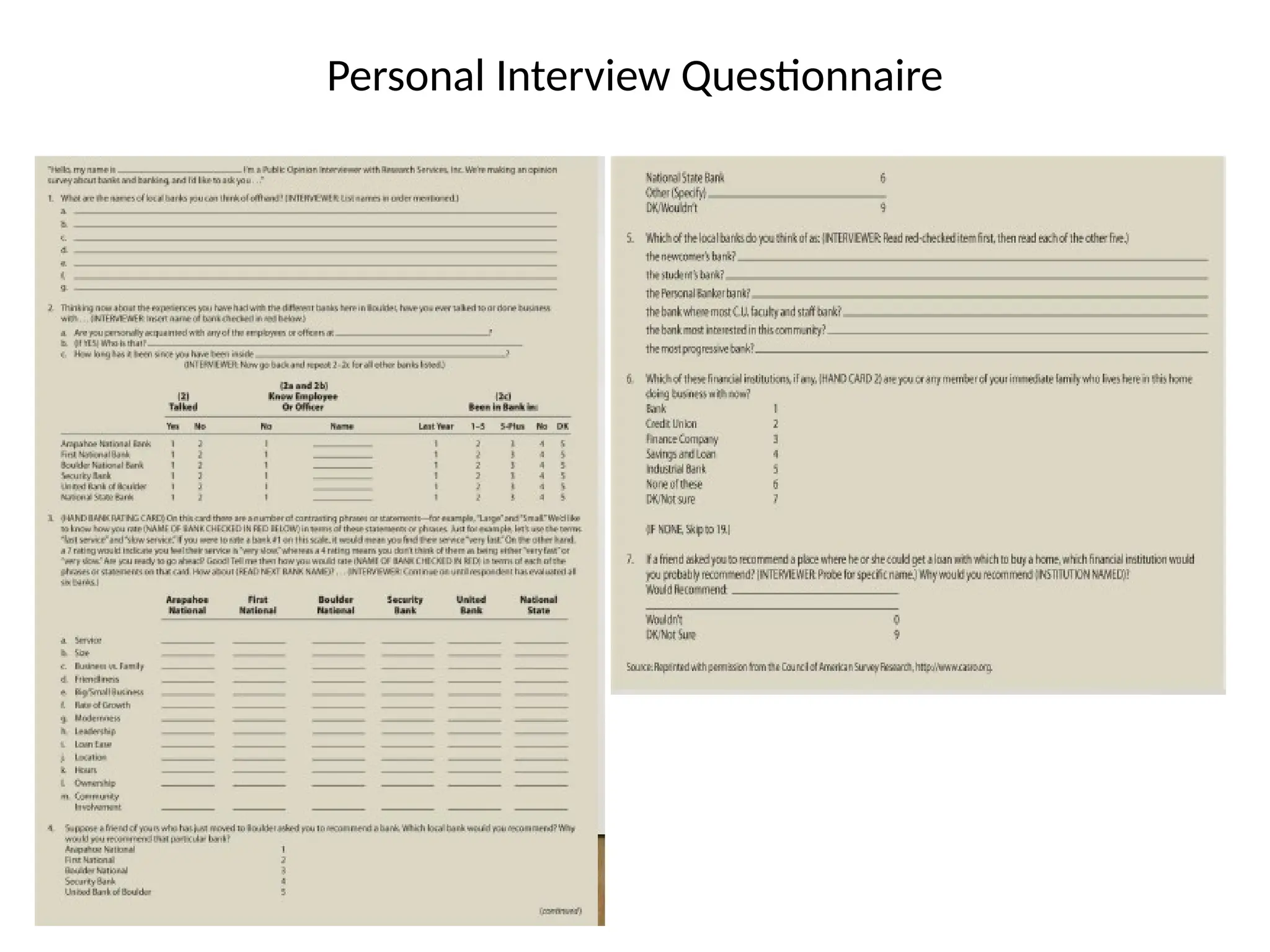
Personal Interview Questionnaire
Internet Questionnaires
• Graphical User Interface (GUI) Software
 The researcher can control the background, colors, fonts, and
other features displayed on the screen so as to create an
attractive and easy-to-use interface between the user and the
Internet survey.
• Layout Issues
 Paging layout – going from screen to screen.
 Scrolling layout – entire questionnaire appears on one page
and respondent has the ability to scroll down.
Internet Questionnaire Layout
• Push Button -A small outlined area, such as a rectangle
or an arrow, that the respondent clicks on to select an
option or perform a function, such as submit.
• Status Bar - A visual indicator that tells the respondent
what portion of the survey he or she has completed.
• Radio Button - A circular icon, resembling a button, that
activates one response choice and deactivates others
when a respondent clicks on it.
Internet Questionnaire Layout (cont’)
• Drop-down Box - A space saving device that reveals responses
when they are needed but otherwise hides them from view.
• Check Boxes -Small graphic boxes, next to an answers, that a
respondent clicks on to choose an answer; typically, a check mark
or an X appears in the box when the respondent clicks on it.
• Open-ended Boxes -Boxes where respondents can type in their
own answers to open-ended questions.
• Pop-up Boxes - Boxes that appear at selected points and contain
information or instructions for respondents.
Pre-testing and Revising Questionnaires
Pre-testing Process
• Seeks to determine whether respondents have any
difficulty understanding the questionnaire and whether
there are any ambiguous or biased questions.
Preliminary Tabulation
• A tabulation of the results of a pre-test to help
determine whether the questionnaire will meet the
objectives of the research.
Designing Questionnaires for Global Markets
Back Translation
• Taking a questionnaire that has previously been
translated into another language and having a second,
independent translator translate it back to the original
language.
• A questionnaire developed in one country may be
difficult to translate because equivalent language
concepts do not exist or because of differences in
idiom and vernacular.
Cover Letter
• The cover letter is the introductory page of
the questionnaire
• It includes:
– Identification of the researcher
– Motivation for respondents to fill it in
– Confidentiality
– Thanking of the respondent
30

Topic 8 Questionnaire Designing -explore the essential principles, techniques, and best practices behind crafting effective questionnaires for data collection.

  • 1.
  • 2.
    Questionnaire A prepared setof questions (or measures) used by respondents or interviewers to record answers (data). There are 3 major types: 1. Personally administered questionnaires 2. Mail questionnaires 3. Electronic and online questionnaires
  • 3.
  • 4.
    Questionnaire Quality andDesign: Basic Considerations Questionnaire design is one of the most critical stages in the survey research process. • A questionnaire (survey) is only as good as the questions it asks—ask a bad question, get bad results. • Composing a good questionnaire appears easy, but it is usually the result of long, painstaking work. • The questions must meet the basic criteria of relevance and accuracy.
  • 5.
    Questionnaire Quality andDesign: Basic Considerations • The appropriateness of the content of the questions • The wording of the questions and the level of sophistication of the language used • The type and form of questions asked • The sequencing of the questions • • The pre-test of the questionnaire
  • 6.
    Questionnaire Relevancy • Allinformation collected should address a research question in helping the decision maker in solving the current business problem. • Irrelevant questions are more than a nuisance because they make the survey needlessly long. • The response rate was nearly twice as high for the one-page questionnaire as compared to a three-page questionnaire. • Researchers must think about possible omissions. Content of the Questions
  • 7.
    Content of theQuestions Questionnaire Accuracy Increasing the reliability and validity of respondent information requires that:  Questionnaires should use simple, understandable, unbiased, unambiguous, and nonirritating words.  Questionnaire design should facilitate recall and motivate respondents to cooperate.  Proper question wording and sequencing to avoid confusion and biased answers.
  • 8.
    Content of theQuestions • Measurement: Operationalizing  Objective construct: • 1 element/items => 1 question • E.g., age, educational level Subjective construct: • Multiple elements/items => multiple questions • E.g., satisfaction, involvement
  • 9.
    Recently a surveywas conducted by the United Nations using a sample from several different countries. One of the questions asked was: “Would you please give your opinion about the food shortage in the rest of the world?” The survey was a huge failure. Why? • In Africa they did not know what food meant. • In Western Europe they did not know what shortage meant. • In Eastern Europe they did not know what opinion meant. • In South America they did not know what please meant. • And in the United States they did not know what the rest of the world meant. Why survey can be a failure?
  • 10.
    Language and Wordingof the Questionnaire • The choice of words will depend on their educational level, the usage of terms and idioms in the culture, and the frames of reference of the respondents. • Terms such as “working here is a drag” and “she is a compulsive worker” may not be interpreted the same way in different cultures. • If some questions are either not understood or are interpreted differently by the respondent, the researcher will obtain the wrong answers to the questions, and responses will thus be biased.
  • 11.
    Two Types ofQuestions Open-ended Questions = place no constraints on respondents who are free to answer in their own words. Closed-ended Questions = respondent is given the option of choosing from a number of predetermined answers.
  • 12.
    Two Types ofQuestions Closed vs. Open-ended questions – Closed questions • Helps respondents to make quick decisions • Helps researchers to code – Open-ended question • First: unbiased point of view • Final: additional insights • Complementary to closed question: for interpretation purpose 12
  • 13.
    Examples: Open-Ended Questions •What do you think about the National Health Service? • Which mutual funds have you been investing in for the past year? • How are the funds you are investing in performing? • What do you think of airport security?
  • 14.
    Open-Ended Questions • Typicallyused in exploratory/qualitative studies. • Typically used in personal interview surveys involving small samples. • Allows respondent freedom of response. • Respondent must be articulate and willing to spend time giving a full answer. • Data is in narrative form which can be time consuming and difficult to code and analyze. • Possible researcher bias in interpretation. • Narrative can be analyzed using content analysis. Software is available.
  • 15.
    Examples: Closed-Ended Questions •Did you check your email this morning? __ Yes __ No • Do you believe Enron senior executives should be put in jail? __ Yes __ No • Should the United Kingdom adopt the Euro or keep the pound? o Adopt the Euro __ o Keep the pound __
  • 16.
    Closed-Ended Questions • Typicallyused in quantitative studies. • Assumption is researcher has knowledge to pre- specify response categories. • Data can be pre-coded and therefore in a form amenable for use with statistical packages (e.g., SPSS, SAS) – data capture therefore easier. • More difficult to design but simplifies analysis. • Used in studies involving large samples. • Limited range of response options.
  • 17.
    Phrasing Questions forSelf-Administered, Telephone, and Personal Interview Surveys Influences on Question Phrasing:  The methods of data collection — telephone interview, personal interview, self-administered questionnaire — will influence the question format and question phrasing.  Questions for mail, Internet, and telephone surveys must be less complex than those used in personal interviews.  Questionnaires for telephone and personal interviews should be written in a conversational style.
  • 18.
    Guidelines for ConstructingQuestions • Avoid complexity: Use simple, conversational language • Avoid leading questions • Avoid loaded questions: suggests a socially desirable answer or is emotionally charged. • Avoid ambiguity: Be as specific as possible. • Avoid double-barreled items: may induce bias because it covers two or more issues at once (asks a question that touches upon more than one issue, yet allows only for one answer) • Avoid making assumptions. • Avoid burdensome questions that may tax the respondent’s memory.
  • 19.
    Guidelines for Constructing Questions •Use positive and negative statements – Dresdner delivers high quality banking service Dresdner has poor customer operational support – Avoid double negatives • Limit the length of the questions Rules of thumb: – < 20 words – < one full line in print 19
  • 20.
    Sequencing of Questions Orderbias • Bias caused by the influence of earlier questions in a questionnaire or by an answer’s position in a set of answers. Funnel technique • Asking general questions before specific questions in order to obtain unbiased responses. • Personal and sensitive data at the end
  • 21.
    Screening or filterquestions Screening or filter questions . . . are used to ensure respondents included in the study are those that meet the pre-determined criteria of the target population. Example: “Tonight we are talking with individuals who are 18 years of age or older and have 50 percent or more of the responsibility for banking decisions in your household. Are you that person?” __ Yes __ No
  • 22.
    Layout of Questionnaire TraditionalQuestionnaires  Multiple-grid question  Several similar questions arranged in a grid format. The title of a questionnaire should be phrased carefully:  To capture the respondent’s interest, underline the importance of the research  Emphasize the interesting nature of the study  Appeal to the respondent’s ego  Emphasize the confidential nature of the study  To not bias the respondent in the same way that a leading question might
  • 24.
  • 25.
    Internet Questionnaires • GraphicalUser Interface (GUI) Software  The researcher can control the background, colors, fonts, and other features displayed on the screen so as to create an attractive and easy-to-use interface between the user and the Internet survey. • Layout Issues  Paging layout – going from screen to screen.  Scrolling layout – entire questionnaire appears on one page and respondent has the ability to scroll down.
  • 26.
    Internet Questionnaire Layout •Push Button -A small outlined area, such as a rectangle or an arrow, that the respondent clicks on to select an option or perform a function, such as submit. • Status Bar - A visual indicator that tells the respondent what portion of the survey he or she has completed. • Radio Button - A circular icon, resembling a button, that activates one response choice and deactivates others when a respondent clicks on it.
  • 27.
    Internet Questionnaire Layout(cont’) • Drop-down Box - A space saving device that reveals responses when they are needed but otherwise hides them from view. • Check Boxes -Small graphic boxes, next to an answers, that a respondent clicks on to choose an answer; typically, a check mark or an X appears in the box when the respondent clicks on it. • Open-ended Boxes -Boxes where respondents can type in their own answers to open-ended questions. • Pop-up Boxes - Boxes that appear at selected points and contain information or instructions for respondents.
  • 28.
    Pre-testing and RevisingQuestionnaires Pre-testing Process • Seeks to determine whether respondents have any difficulty understanding the questionnaire and whether there are any ambiguous or biased questions. Preliminary Tabulation • A tabulation of the results of a pre-test to help determine whether the questionnaire will meet the objectives of the research.
  • 29.
    Designing Questionnaires forGlobal Markets Back Translation • Taking a questionnaire that has previously been translated into another language and having a second, independent translator translate it back to the original language. • A questionnaire developed in one country may be difficult to translate because equivalent language concepts do not exist or because of differences in idiom and vernacular.
  • 30.
    Cover Letter • Thecover letter is the introductory page of the questionnaire • It includes: – Identification of the researcher – Motivation for respondents to fill it in – Confidentiality – Thanking of the respondent 30