Slide 1
Developing questionnaires for medical
research
By: Dr Hanaa Bayomy
Assistant professor of Community Medicine
Slide 2
Introduction
• Questionnaire is a measuring device used to
query a population/sample in order to obtain
information for analysis.
• A questionnaire is simply a list of questions
that is completed by or for a respondent.
(Health Research Methodology 2nd ed. 2001
WHO)
Slide 3
Introduction
• Questionnaires are one of the most popular
survey methods. It is the most convenient
way to collect data from large numbers of
often geographically diverse individuals on a
wide range of issues.
• Questionnaire may be administered in a
variety of ways, including face to face,
telephone, post and online.
Slide 4
Introduction
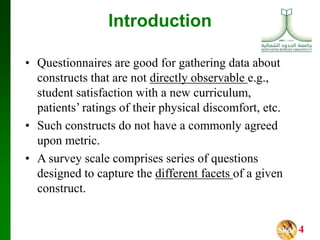
• Questionnaires are good for gathering data about
constructs that are not directly observable e.g.,
student satisfaction with a new curriculum,
patients’ ratings of their physical discomfort, etc.
• Such constructs do not have a commonly agreed
upon metric.
• A survey scale comprises series of questions
designed to capture the different facets of a given
construct.
Slide 5
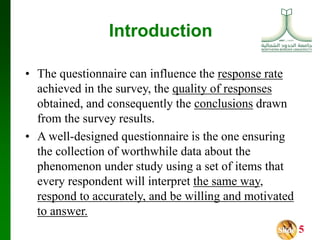
Introduction
• The questionnaire can influence the response rate
achieved in the survey, the quality of responses
obtained, and consequently the conclusions drawn
from the survey results.
• A well-designed questionnaire is the one ensuring
the collection of worthwhile data about the
phenomenon under study using a set of items that
every respondent will interpret the same way,
respond to accurately, and be willing and motivated
to answer.
Slide 6
Introduction
Definitions:
– A construct is A hypothesized concept or characteristic
that a survey or test is designed to measure.
– Key variables are those which describe the construct,
for example if the study is relative to cancer, key
variables will be relative to cancer.
– Explicative variables are all those variables which
might be correlated to the key variables, for example in
the case of cancer it could be the environment, stress,
food, etc.
– Structure variables are variables which are usually
used to describe the sample of the study such as age,
sex, education, and profession.
Slide 7
Types of survey
questionnaires
1. Exploratory
questionnaires
If the data to be collected is
qualitative for the
purpose of better
understanding or
generation of
hypotheses on a subject.
It may be that no formal
questionnaire is needed.
2. Formal standardized
questionnaires:
If the researcher is looking
to test and quantify
hypotheses and the data
is to be analyzed
statistically.
A formal standardized
questionnaire is needed.
Slide 8
Forms of questionnaires
Both structured and semi-structured forms can be
used in quantitative surveys.
• closed questions
Structured
• mixture of closed and
open questions
Semi-
structured
• open responses, suitable
for qualitative surveys
Unstructured
Slide 9
Questionnaire design
It should be borne in mind:
1. A well-designed questionnaire should meet the
research objectives.
2. It should obtain complete and accurate
information.
3. It should make it easy for respondents to give the
necessary information and for the interviewer to
record the answer, do sound analysis, and
interpretation.
4. It should be brief, to the point, and so arranged that
the respondent(s) remain interested throughout the
interview.
Slide 10
Questionnaire design for
medical education
research
Slide 11
AMEE (Association of Medical
Education in Europe) seven-step
design process:
1.Conduct a literature review,
2.Conduct interviews and/or focus groups,
3.Synthesize the literature review and
interviews/ focus groups,
4.Develop items,
5.Conduct expert validation,
6.Conduct cognitive interviews.
7.Conduct pilot testing.
Slide 12
AMEE seven-step survey
design process
Step 1: Conduct a literature review
To define the construct and identify
existing survey scales that might be
used.
Previously validated scales are
sensitive to target population, local
context, and intended use of the
scale.
Slide 13
AMEE seven-step survey
design process
Step 2: Conduct interviews and/or
focus groups
When a new scale is used, it is
necessary to learn how the
population of interest conceptualizes
and describes the construct of
interest
Slide 14
AMEE seven-step survey
design process
Step 3: Synthesize the literature review
and interviews/focus groups
By merging the results of the literature
review and interviews/focus groups
to ensure that the conceptualization
of the construct makes theoretical
sense to scholars in the field and
uses language that the population of
interest understands.
Slide 15
AMEE seven-step survey
design process
Step 4: Develop items
To write survey items that adequately
represent the construct of interest in
a language that respondents can
easily understand and are written in
accordance with current best
practices in survey design.
Slide 16
Types of questions
• Closed-ended question – A survey question
with a finite number of response categories
from which the respondent can choose.
• Open-ended question – A survey question
that asks respondents to provide an answer
in an open space (e.g., a number, a list or a
longer in-depth answer).
Slide 17
Ideal qualities of a question
1. Yields a truthful, accurate answer.
2. Asks for one answer on one dimension.
3. Accommodates all possible responses.
4. Uses specific, simple language.
5. Has mutually exclusive and response
options.
6. Produces variability in response.
7. Minimizes social desirability.
8. Pretested
Slide 18
Avoiding five common pitfalls in survey design.
Artino et al. 2011. Lippincott Williams and Wilkins/Wolters Kluwer Health
Pitfalls
1- Creating a double-barreled item. e.g.,
How often do you talk to your nurses and
administrative staff when you have a
problem?
2- Creating a negatively worded item.
e.g., The chief resident should not be
responsible for denying admission to
patients.
3- Using statements instead of
questions. e.g., I am confident I can do
well in this course (not at all to completely
true).
4- Using agreement response anchors.
e.g., The high cost of health care is the
most important issue in America today.
(strongly disagree to strongly agree).
5- Using too few or too many response
anchors
Solutions
 Create multiple items for each
questions.
 Wording items positively.
Should the chief resident be responsible
for admitting patients?
 Formulate survey items as
questions.
How confident are you that you can do
well in this course?
 Use construct-specific response
anchors (not at all to extremely
important).
 Use 5-7 response anchors to
achieve stable participant responses.
Slide 19
Avoiding four visual-design pitfalls in survey
development.
Artino & Gehlbach (2012). Lippincott Williams and Wilkins/Wolters Kluwer Health
Pitfalls
1- Labeling only the end points of your
response options. E.g.,
How interesting did you find this clinical reasoning
course?
Not at all Extremely
interesting interesting
2- Labeling response options with both
numbers and verbal labels. E.g.,
How much did you learn in today’s workshop?
-2 -1 0 1 2
almost a little some quite a great
nothing bit a bit amount
3- Unequally spacing your response options.
E.g.,
How much did you learn from your peers in this
course?
almost a little some quite a great
nothing bit a bit amount
4. Placing non-substantive response options together
with substantive response options. E.g.,
How satisfied are you with the quality of the library services?
not at all slightly moderately quite extremely not
Satisfied Satisfied Satisfied Satisfied Satisfied applicable
Solutions
 Verbally label each response
option.
How interesting did you find this clinical
reasoning course?
Not at all slightly moderately quite Extremely
interesting interesting interesting interesting interesting
 Use only verbal labels.
How much did you learn in today’s workshop?
almost a little some quite a great
nothing bit a bit amount
 Maintain equal spacing between
response options.
How much did you learn from your peers in this
course?
almost a little some quite a great
nothing bit a bit amount
 Use additional space to separate non-
substantive response options from the
substantive options.
How satisfied are you with the quality of the library
services?
Slide 20
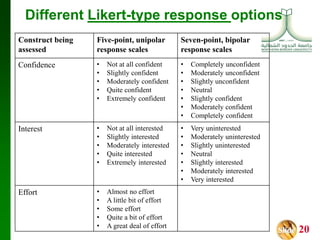
Different Likert-type response options
Construct being
assessed
Five-point, unipolar
response scales
Seven-point, bipolar
response scales
Confidence • Not at all confident
• Slightly confident
• Moderately confident
• Quite confident
• Extremely confident
• Completely unconfident
• Moderately unconfident
• Slightly unconfident
• Neutral
• Slightly confident
• Moderately confident
• Completely confident
Interest • Not at all interested
• Slightly interested
• Moderately interested
• Quite interested
• Extremely interested
• Very uninterested
• Moderately uninterested
• Slightly uninterested
• Neutral
• Slightly interested
• Moderately interested
• Very interested
Effort • Almost no effort
• A little bit of effort
• Some effort
• Quite a bit of effort
• A great deal of effort
Slide 21
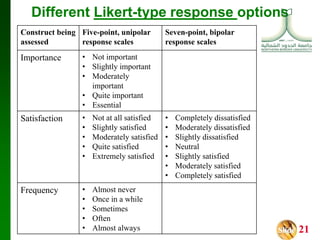
Different Likert-type response options
Construct being
assessed
Five-point, unipolar
response scales
Seven-point, bipolar
response scales
Importance • Not important
• Slightly important
• Moderately
important
• Quite important
• Essential
Satisfaction • Not at all satisfied
• Slightly satisfied
• Moderately satisfied
• Quite satisfied
• Extremely satisfied
• Completely dissatisfied
• Moderately dissatisfied
• Slightly dissatisfied
• Neutral
• Slightly satisfied
• Moderately satisfied
• Completely satisfied
Frequency • Almost never
• Once in a while
• Sometimes
• Often
• Almost always
Slide 22
Putting questions into a meaningful
order and format
• Opening questions should be easy, not embarrassing, and
within knowledge and experience of respondents to
encourage them to continue.
• Questions flow logically, items on one aspect are grouped
together, flow from general to specific, from least sensitive
to more sensitive, from factual and behavioral to attitudinal
and opinion questions.
• Question variety, using open-ended questions here and
there, showing cards/pictures to increase interest of
respondents.
• Closing questions: important questions should be in the
earlier part of the questionnaire and sensitive questions
should be left to the end.
Slide 23
Choose the methods of reaching target
respondents
• Face-to-face interview
– Pros: high response rates, can clarify questions, suitable
for longer questionnaires.
– Cons: high costs, time-consuming, need training of
interviewers, transportation, and respondents may give
socially acceptable answers.
Slide 24
Choose the methods of reaching target
respondents
• Telephone interviews
– Pros: high response rates, fast, suitable for short and not
complex questionnaire.
– Cons: interruptions, unsuitable timing of telephone calls,
require interviewers training, might be difficult to target
specific geographical locations.
Slide 25
Choose the methods of reaching target
respondents
• Mail questionnaires
– Pros: high response rates, easy, low cost, can cover
geographical area and large samples, and avoid
interviewer bias.
– Cons: difficult to control respondents and responses, and
time consuming.
Slide 26
Choose the methods of reaching target
respondents
• Internet questionnaire
– Pros: easy, fast, avoid interviewers bias and distortion,
low cost, and avoid socially influenced responses.
– Cons: poor control over respondents' selection, difficult
to follow up, and need special design.
Slide 27
AMEE seven-step survey
design process
Step 5: Conduct expert validation
(content validation)
This step involves collecting data from
content experts to establish that individual
survey items are relevant to the construct
of interest and that key items or indicators
have not been omitted.
Both quantitative and qualitative assessment
methods are used to improve the content
validity of a new questionnaire/scale.
Slide 28
AMEE seven-step survey
design process
Step 6: Conduct cognitive interviews
(cognitive pre-testing/ response
process validity)
An evidence-based qualitative method
specifically designed to investigate
whether a survey question satisfies
its intended purpose.
To ensure that respondents interpret
items in the manner that survey
designer intends.
Slide 29
Cognitive processes when
responding to a survey
Comprehension
Retrieval of
information
judgment
Selection of a
response
Slide 30
Cognitive interview
1. The think-aloud technique requires
respondents to verbalize every
thought that they have while
answering each item.
2. The verbal probing is a more active
form of data collection where the
interviewer administers a series of
probe questions designed to elicit
specific information.
Slide 31
Commonly used verbal probes.
Willis & Artino (2013). J grad Med Edu.
Slide 32
AMEE seven-step survey
design process
Step 7: Conduct pilot testing
The data obtained from the pilot testing
are used to ascertain the internal
structure of the questionnaire (scale
uni-dimensionality) using factor
analysis, and reliability (internal
consistency) using the Cronbach’s
alpha coefficient.
Slide 33
Reliability
Slide 34
Reliability
Reliability – The extent to which the scores
produced by a particular measurement
procedure or instrument (e.g., a survey)
are consistent and reproducible.
Reliability is a necessary but insufficient
condition for validity.
If a questionnaire is unreliable, then it can’t
be valid.
Slide 35
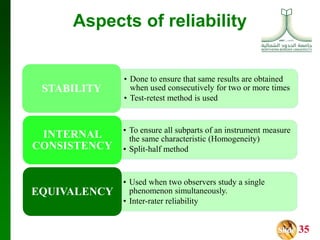
Aspects of reliability
• Done to ensure that same results are obtained
when used consecutively for two or more times
• Test-retest method is used
STABILITY
• To ensure all subparts of an instrument measure
the same characteristic (Homogeneity)
• Split-half method
INTERNAL
CONSISTENCY
• Used when two observers study a single
phenomenon simultaneously.
• Inter-rater reliability
EQUIVALENCY
Slide 36
Test-retest reliability
• It is used to assess the consistency of response to
the items in a questionnaire from one time to
another.
• Test administered twice to the same participants at
different times.
• Disadvantages:
– Practice effect
– Too short intervals
– Some traits may change with time.
Slide 37
Test-retest reliability
• The reliability coefficient is the correlation
coefficient (Pearson; r)
– Ranges from -1 to +1
– Correlation coefficient 0.7-1.0 is considered strong, 0.3-
0.69 is moderate.
• The test-retest reliability can be evaluated by using
intra-class correlation coefficient (ICC).
– ICC ranges between 0 and 1.
– The value of ICC is considered appropriate if it is at
least 0.70
Slide 38
Internal consistency reliability
• Here one should judge the reliability of the tool by
estimating how well the items that reflect the same
construct yield similar results i.e., how consistent
the results are for different items for the same
construct.
• Internal consistency reliability is expressed using:
– Split-half reliability
– Coefficient alpha
Slide 39
Split-half Reliability
• Split the contents of the questionnaire into two
equivalent halves; either odd/even number,
first/second half, or randomly selected contents.
• Then, we treat the halves as alternate forms.
• Correlation between the two halves indicates the
reliability of one half.
• Problems with how we split the test.
Slide 40
Spearman-Brown formula
Spearman-Brown formula is used to express reliability
of the entire test.
Slide 41
Cronbach’s alpha
• Most commonly used.
• It is acceptable if value is 80% or above.
• The result says to what extent all items represent the
same construct
Slide 42
Inter-rater reliability
• Assesses how two or more scorers differ in
their evaluation of a test.
• Intraclass Correlation Coefficient (ICC):
used for continuous data and captures both
correlation and agreement among raters
• Kappa: used for categorical data and takes
into account possibility of chance agreement
between examiners
Slide 43
VALIDITY
Slide 44
Concept of Validity
The degree to which a questionnaire
measures what it was intended to
measure.
Degree to which the researcher has
measured what he has set out to
measure. (Smith, 1991)
Are we measuring what we think we are
measuring? (Kerlinger, 1973)
Slide 45
Types of Validity
Validity
Face
validity
Content
validity
Criterion
related
Concurrent Predictive
Construct
validity
Slide 46
1- Face validity
• The extent to which a measuring instrument
appears valid on its surface
• Each question must have a logical link with the
objective
E.g.: Questionnaire about domestic violence should have
questions related to that issue.
• Not a validity in technical sense because it does
not refer to what is being measured rather what
it appears to measure.
• It has more to do with rapport and public
relations than with actual validity.
Slide 47
Face validity
Evaluate in terms of:
Face validity can be done
using 2 methods:
1.Interview/prob method: The
investigator discuss with participants
each item, and whether it is
appropriate to elicit accurate
responses.
2.Bilingual method: It is employed
if the tool is translated into a regional
language. A bilingual expert is
employed to assess the face validity.
Readability
Layout
& style
Feasibility
Clarity
of
wording
Slide 48
2- Content validity
• The degree to which the items on the
instrument are representative of the knowledge
being tested or the characteristic being
investigated.
• Expert judgment is the primary method used to
determine whether a test has content validity.
– Coverage of issue should be balanced
– Each aspect should have similar and adequate
representation in questions.
• No statistical test is employed here.
Slide 49
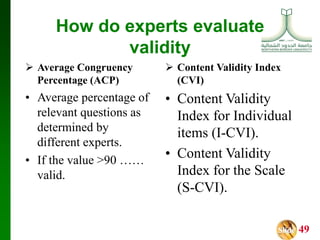
How do experts evaluate
validity
 Average Congruency
Percentage (ACP)
• Average percentage of
relevant questions as
determined by
different experts.
• If the value >90 ……
valid.
 Content Validity Index
(CVI)
• Content Validity
Index for Individual
items (I-CVI).
• Content Validity
Index for the Scale
(S-CVI).
Slide 50
CVI: a panel of 3-10 experts are invited to
review the relevance of each question.
Slide 51
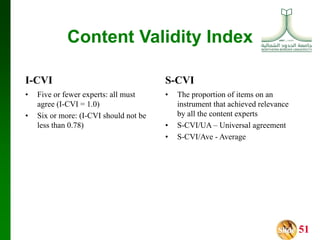
Content Validity Index
I-CVI
• Five or fewer experts: all must
agree (I-CVI = 1.0)
• Six or more: (I-CVI should not be
less than 0.78)
S-CVI
• The proportion of items on an
instrument that achieved relevance
by all the content experts
• S-CVI/UA – Universal agreement
• S-CVI/Ave - Average
Slide 52
3- Criterion validity
• The instrument’s capacity to predict behaviour or
ability in a given area.
• The measuring instrument is called ‘criteria’.
• The responses on the questionnaire being
developed are checked against a gold standard tool
which is direct and independent measure of what
the new questionnaire is designed to measure.
• In the absence of such a gold standard one, can use
proxy measures like clinical examination or direct
questions to respondents.
Slide 53
Criterion validity
1. Concurrent validity: the measurement and the
criterion refer to the same point in time.
– E.g.: visual inspection of a wound for evidence of
infection validated against bacteriological
examination of a specimen taken at the same time.
2. Predictive validity: If the test is used to predict
future performance.
– Academic aptitude test that is validated against
subsequent academic performance.
Slide 54
4- Construct validity
• Most important type of validity.
• It refers to the extent to which the new
questionnaire accurately measures an existing
ideas/hypothesis concerning the concepts/
constructs that are being measured.
• Construct validity can further be subdivided into:
1. Convergent validity: It is a general agreement
between an item and its own scale.
2. Discriminate validity: It is a general disagreement
between an item and other scales.
Slide 55
Construct validity
Factor analysis
• For newly developed tools.
• Factor analysis is a complicated statistical
procedure used to estimate where each item
in the questionnaire is correctly reflecting
the corresponding construct.
• If the tool has high construct validity, then
shows increased correlation with the
corresponding domains.
Slide 56
Construct validity
Factor Analysis
 Various items are gathered
into common factors
 Common factors are
synthesized into fewer factors
and then relation between each
item and factor is measured
 Unrelated items are eliminated
Slide 57
Questionnaire
translation
• A questionnaire translation
process should focus in
achieving the conceptual
equivalence instead of
achieving linguistic
equivalence.
• In view of this, the forward
–backward-forward
translation technique
should be applied
Slide 58
Questionnaire translation
1- Forward translation : two independent
professional bilingual translators are hired
to translate the original English version of
the questionnaire into the relevant language.
2- Backward translation: translate back
into English by another two independent
bilingual translators.
3- The final product of this process is
known as the finalized forward
translation.
Slide 59
Questionnaire translation
• VALIDATION STUDY
• It is highly recommended to conduct a validation
study on the translated questionnaire to examine its
psychometric properties such as the validity and
reliability of the questionnaire.
• The appropriate study design for validation study is
cross-sectional with at least 100 participants.
• These participants should be selected from various
social demographic as well as socio economic
background, so that the sample is more
representative of the population.
Slide 60
Conclusion
• It is necessary that data collection tools are
constructed systematically based on a sound
scientific method since research outcome is directly
dependent on the quality and the completeness of
the data collected.
• Reduced response rates and incomplete responses
to self administered questionnaires make it
mandatory that the tool be developed as simple and
respondent friendly as possible.
Slide 61
References
Artino Jr, A. R., La Rochelle, J. S., Dezee, K. J., & Gehlbach, H. (2014).
Developing questionnaires for educational research: AMEE Guide No. 87.
Medical teacher, 36(6), 463-474.
Trivedi, C. (2020, December 16). Reliability coefficients. ConceptsHacked.
Retrieved from https://conceptshacked.com/reliability-coefficients
Morrison Jo. Assessing questionnaire validity. 2022. Select statistical services
Ltd. https://select-statistics.co.uk/blog/assessing-questionnaire-reliability/
Morrison Jo. Assessing questionnaire validity. 2022. Select statistical services
Ltd. https://select-statistics.co.uk/blog/assessing-questionnaire-validity/
Slide 62
Thank you

QUESTIONNAIRE DEVELOPMENT new.pptx

  • 1.
    Slide 1 Developing questionnairesfor medical research By: Dr Hanaa Bayomy Assistant professor of Community Medicine
  • 2.
    Slide 2 Introduction • Questionnaireis a measuring device used to query a population/sample in order to obtain information for analysis. • A questionnaire is simply a list of questions that is completed by or for a respondent. (Health Research Methodology 2nd ed. 2001 WHO)
  • 3.
    Slide 3 Introduction • Questionnairesare one of the most popular survey methods. It is the most convenient way to collect data from large numbers of often geographically diverse individuals on a wide range of issues. • Questionnaire may be administered in a variety of ways, including face to face, telephone, post and online.
  • 4.
    Slide 4 Introduction • Questionnairesare good for gathering data about constructs that are not directly observable e.g., student satisfaction with a new curriculum, patients’ ratings of their physical discomfort, etc. • Such constructs do not have a commonly agreed upon metric. • A survey scale comprises series of questions designed to capture the different facets of a given construct.
  • 5.
    Slide 5 Introduction • Thequestionnaire can influence the response rate achieved in the survey, the quality of responses obtained, and consequently the conclusions drawn from the survey results. • A well-designed questionnaire is the one ensuring the collection of worthwhile data about the phenomenon under study using a set of items that every respondent will interpret the same way, respond to accurately, and be willing and motivated to answer.
  • 6.
    Slide 6 Introduction Definitions: – Aconstruct is A hypothesized concept or characteristic that a survey or test is designed to measure. – Key variables are those which describe the construct, for example if the study is relative to cancer, key variables will be relative to cancer. – Explicative variables are all those variables which might be correlated to the key variables, for example in the case of cancer it could be the environment, stress, food, etc. – Structure variables are variables which are usually used to describe the sample of the study such as age, sex, education, and profession.
  • 7.
    Slide 7 Types ofsurvey questionnaires 1. Exploratory questionnaires If the data to be collected is qualitative for the purpose of better understanding or generation of hypotheses on a subject. It may be that no formal questionnaire is needed. 2. Formal standardized questionnaires: If the researcher is looking to test and quantify hypotheses and the data is to be analyzed statistically. A formal standardized questionnaire is needed.
  • 8.
    Slide 8 Forms ofquestionnaires Both structured and semi-structured forms can be used in quantitative surveys. • closed questions Structured • mixture of closed and open questions Semi- structured • open responses, suitable for qualitative surveys Unstructured
  • 9.
    Slide 9 Questionnaire design Itshould be borne in mind: 1. A well-designed questionnaire should meet the research objectives. 2. It should obtain complete and accurate information. 3. It should make it easy for respondents to give the necessary information and for the interviewer to record the answer, do sound analysis, and interpretation. 4. It should be brief, to the point, and so arranged that the respondent(s) remain interested throughout the interview.
  • 10.
    Slide 10 Questionnaire designfor medical education research
  • 11.
    Slide 11 AMEE (Associationof Medical Education in Europe) seven-step design process: 1.Conduct a literature review, 2.Conduct interviews and/or focus groups, 3.Synthesize the literature review and interviews/ focus groups, 4.Develop items, 5.Conduct expert validation, 6.Conduct cognitive interviews. 7.Conduct pilot testing.
  • 12.
    Slide 12 AMEE seven-stepsurvey design process Step 1: Conduct a literature review To define the construct and identify existing survey scales that might be used. Previously validated scales are sensitive to target population, local context, and intended use of the scale.
  • 13.
    Slide 13 AMEE seven-stepsurvey design process Step 2: Conduct interviews and/or focus groups When a new scale is used, it is necessary to learn how the population of interest conceptualizes and describes the construct of interest
  • 14.
    Slide 14 AMEE seven-stepsurvey design process Step 3: Synthesize the literature review and interviews/focus groups By merging the results of the literature review and interviews/focus groups to ensure that the conceptualization of the construct makes theoretical sense to scholars in the field and uses language that the population of interest understands.
  • 15.
    Slide 15 AMEE seven-stepsurvey design process Step 4: Develop items To write survey items that adequately represent the construct of interest in a language that respondents can easily understand and are written in accordance with current best practices in survey design.
  • 16.
    Slide 16 Types ofquestions • Closed-ended question – A survey question with a finite number of response categories from which the respondent can choose. • Open-ended question – A survey question that asks respondents to provide an answer in an open space (e.g., a number, a list or a longer in-depth answer).
  • 17.
    Slide 17 Ideal qualitiesof a question 1. Yields a truthful, accurate answer. 2. Asks for one answer on one dimension. 3. Accommodates all possible responses. 4. Uses specific, simple language. 5. Has mutually exclusive and response options. 6. Produces variability in response. 7. Minimizes social desirability. 8. Pretested
  • 18.
    Slide 18 Avoiding fivecommon pitfalls in survey design. Artino et al. 2011. Lippincott Williams and Wilkins/Wolters Kluwer Health Pitfalls 1- Creating a double-barreled item. e.g., How often do you talk to your nurses and administrative staff when you have a problem? 2- Creating a negatively worded item. e.g., The chief resident should not be responsible for denying admission to patients. 3- Using statements instead of questions. e.g., I am confident I can do well in this course (not at all to completely true). 4- Using agreement response anchors. e.g., The high cost of health care is the most important issue in America today. (strongly disagree to strongly agree). 5- Using too few or too many response anchors Solutions  Create multiple items for each questions.  Wording items positively. Should the chief resident be responsible for admitting patients?  Formulate survey items as questions. How confident are you that you can do well in this course?  Use construct-specific response anchors (not at all to extremely important).  Use 5-7 response anchors to achieve stable participant responses.
  • 19.
    Slide 19 Avoiding fourvisual-design pitfalls in survey development. Artino & Gehlbach (2012). Lippincott Williams and Wilkins/Wolters Kluwer Health Pitfalls 1- Labeling only the end points of your response options. E.g., How interesting did you find this clinical reasoning course? Not at all Extremely interesting interesting 2- Labeling response options with both numbers and verbal labels. E.g., How much did you learn in today’s workshop? -2 -1 0 1 2 almost a little some quite a great nothing bit a bit amount 3- Unequally spacing your response options. E.g., How much did you learn from your peers in this course? almost a little some quite a great nothing bit a bit amount 4. Placing non-substantive response options together with substantive response options. E.g., How satisfied are you with the quality of the library services? not at all slightly moderately quite extremely not Satisfied Satisfied Satisfied Satisfied Satisfied applicable Solutions  Verbally label each response option. How interesting did you find this clinical reasoning course? Not at all slightly moderately quite Extremely interesting interesting interesting interesting interesting  Use only verbal labels. How much did you learn in today’s workshop? almost a little some quite a great nothing bit a bit amount  Maintain equal spacing between response options. How much did you learn from your peers in this course? almost a little some quite a great nothing bit a bit amount  Use additional space to separate non- substantive response options from the substantive options. How satisfied are you with the quality of the library services?
  • 20.
    Slide 20 Different Likert-typeresponse options Construct being assessed Five-point, unipolar response scales Seven-point, bipolar response scales Confidence • Not at all confident • Slightly confident • Moderately confident • Quite confident • Extremely confident • Completely unconfident • Moderately unconfident • Slightly unconfident • Neutral • Slightly confident • Moderately confident • Completely confident Interest • Not at all interested • Slightly interested • Moderately interested • Quite interested • Extremely interested • Very uninterested • Moderately uninterested • Slightly uninterested • Neutral • Slightly interested • Moderately interested • Very interested Effort • Almost no effort • A little bit of effort • Some effort • Quite a bit of effort • A great deal of effort
  • 21.
    Slide 21 Different Likert-typeresponse options Construct being assessed Five-point, unipolar response scales Seven-point, bipolar response scales Importance • Not important • Slightly important • Moderately important • Quite important • Essential Satisfaction • Not at all satisfied • Slightly satisfied • Moderately satisfied • Quite satisfied • Extremely satisfied • Completely dissatisfied • Moderately dissatisfied • Slightly dissatisfied • Neutral • Slightly satisfied • Moderately satisfied • Completely satisfied Frequency • Almost never • Once in a while • Sometimes • Often • Almost always
  • 22.
    Slide 22 Putting questionsinto a meaningful order and format • Opening questions should be easy, not embarrassing, and within knowledge and experience of respondents to encourage them to continue. • Questions flow logically, items on one aspect are grouped together, flow from general to specific, from least sensitive to more sensitive, from factual and behavioral to attitudinal and opinion questions. • Question variety, using open-ended questions here and there, showing cards/pictures to increase interest of respondents. • Closing questions: important questions should be in the earlier part of the questionnaire and sensitive questions should be left to the end.
  • 23.
    Slide 23 Choose themethods of reaching target respondents • Face-to-face interview – Pros: high response rates, can clarify questions, suitable for longer questionnaires. – Cons: high costs, time-consuming, need training of interviewers, transportation, and respondents may give socially acceptable answers.
  • 24.
    Slide 24 Choose themethods of reaching target respondents • Telephone interviews – Pros: high response rates, fast, suitable for short and not complex questionnaire. – Cons: interruptions, unsuitable timing of telephone calls, require interviewers training, might be difficult to target specific geographical locations.
  • 25.
    Slide 25 Choose themethods of reaching target respondents • Mail questionnaires – Pros: high response rates, easy, low cost, can cover geographical area and large samples, and avoid interviewer bias. – Cons: difficult to control respondents and responses, and time consuming.
  • 26.
    Slide 26 Choose themethods of reaching target respondents • Internet questionnaire – Pros: easy, fast, avoid interviewers bias and distortion, low cost, and avoid socially influenced responses. – Cons: poor control over respondents' selection, difficult to follow up, and need special design.
  • 27.
    Slide 27 AMEE seven-stepsurvey design process Step 5: Conduct expert validation (content validation) This step involves collecting data from content experts to establish that individual survey items are relevant to the construct of interest and that key items or indicators have not been omitted. Both quantitative and qualitative assessment methods are used to improve the content validity of a new questionnaire/scale.
  • 28.
    Slide 28 AMEE seven-stepsurvey design process Step 6: Conduct cognitive interviews (cognitive pre-testing/ response process validity) An evidence-based qualitative method specifically designed to investigate whether a survey question satisfies its intended purpose. To ensure that respondents interpret items in the manner that survey designer intends.
  • 29.
    Slide 29 Cognitive processeswhen responding to a survey Comprehension Retrieval of information judgment Selection of a response
  • 30.
    Slide 30 Cognitive interview 1.The think-aloud technique requires respondents to verbalize every thought that they have while answering each item. 2. The verbal probing is a more active form of data collection where the interviewer administers a series of probe questions designed to elicit specific information.
  • 31.
    Slide 31 Commonly usedverbal probes. Willis & Artino (2013). J grad Med Edu.
  • 32.
    Slide 32 AMEE seven-stepsurvey design process Step 7: Conduct pilot testing The data obtained from the pilot testing are used to ascertain the internal structure of the questionnaire (scale uni-dimensionality) using factor analysis, and reliability (internal consistency) using the Cronbach’s alpha coefficient.
  • 33.
  • 34.
    Slide 34 Reliability Reliability –The extent to which the scores produced by a particular measurement procedure or instrument (e.g., a survey) are consistent and reproducible. Reliability is a necessary but insufficient condition for validity. If a questionnaire is unreliable, then it can’t be valid.
  • 35.
    Slide 35 Aspects ofreliability • Done to ensure that same results are obtained when used consecutively for two or more times • Test-retest method is used STABILITY • To ensure all subparts of an instrument measure the same characteristic (Homogeneity) • Split-half method INTERNAL CONSISTENCY • Used when two observers study a single phenomenon simultaneously. • Inter-rater reliability EQUIVALENCY
  • 36.
    Slide 36 Test-retest reliability •It is used to assess the consistency of response to the items in a questionnaire from one time to another. • Test administered twice to the same participants at different times. • Disadvantages: – Practice effect – Too short intervals – Some traits may change with time.
  • 37.
    Slide 37 Test-retest reliability •The reliability coefficient is the correlation coefficient (Pearson; r) – Ranges from -1 to +1 – Correlation coefficient 0.7-1.0 is considered strong, 0.3- 0.69 is moderate. • The test-retest reliability can be evaluated by using intra-class correlation coefficient (ICC). – ICC ranges between 0 and 1. – The value of ICC is considered appropriate if it is at least 0.70
  • 38.
    Slide 38 Internal consistencyreliability • Here one should judge the reliability of the tool by estimating how well the items that reflect the same construct yield similar results i.e., how consistent the results are for different items for the same construct. • Internal consistency reliability is expressed using: – Split-half reliability – Coefficient alpha
  • 39.
    Slide 39 Split-half Reliability •Split the contents of the questionnaire into two equivalent halves; either odd/even number, first/second half, or randomly selected contents. • Then, we treat the halves as alternate forms. • Correlation between the two halves indicates the reliability of one half. • Problems with how we split the test.
  • 40.
    Slide 40 Spearman-Brown formula Spearman-Brownformula is used to express reliability of the entire test.
  • 41.
    Slide 41 Cronbach’s alpha •Most commonly used. • It is acceptable if value is 80% or above. • The result says to what extent all items represent the same construct
  • 42.
    Slide 42 Inter-rater reliability •Assesses how two or more scorers differ in their evaluation of a test. • Intraclass Correlation Coefficient (ICC): used for continuous data and captures both correlation and agreement among raters • Kappa: used for categorical data and takes into account possibility of chance agreement between examiners
  • 43.
  • 44.
    Slide 44 Concept ofValidity The degree to which a questionnaire measures what it was intended to measure. Degree to which the researcher has measured what he has set out to measure. (Smith, 1991) Are we measuring what we think we are measuring? (Kerlinger, 1973)
  • 45.
    Slide 45 Types ofValidity Validity Face validity Content validity Criterion related Concurrent Predictive Construct validity
  • 46.
    Slide 46 1- Facevalidity • The extent to which a measuring instrument appears valid on its surface • Each question must have a logical link with the objective E.g.: Questionnaire about domestic violence should have questions related to that issue. • Not a validity in technical sense because it does not refer to what is being measured rather what it appears to measure. • It has more to do with rapport and public relations than with actual validity.
  • 47.
    Slide 47 Face validity Evaluatein terms of: Face validity can be done using 2 methods: 1.Interview/prob method: The investigator discuss with participants each item, and whether it is appropriate to elicit accurate responses. 2.Bilingual method: It is employed if the tool is translated into a regional language. A bilingual expert is employed to assess the face validity. Readability Layout & style Feasibility Clarity of wording
  • 48.
    Slide 48 2- Contentvalidity • The degree to which the items on the instrument are representative of the knowledge being tested or the characteristic being investigated. • Expert judgment is the primary method used to determine whether a test has content validity. – Coverage of issue should be balanced – Each aspect should have similar and adequate representation in questions. • No statistical test is employed here.
  • 49.
    Slide 49 How doexperts evaluate validity  Average Congruency Percentage (ACP) • Average percentage of relevant questions as determined by different experts. • If the value >90 …… valid.  Content Validity Index (CVI) • Content Validity Index for Individual items (I-CVI). • Content Validity Index for the Scale (S-CVI).
  • 50.
    Slide 50 CVI: apanel of 3-10 experts are invited to review the relevance of each question.
  • 51.
    Slide 51 Content ValidityIndex I-CVI • Five or fewer experts: all must agree (I-CVI = 1.0) • Six or more: (I-CVI should not be less than 0.78) S-CVI • The proportion of items on an instrument that achieved relevance by all the content experts • S-CVI/UA – Universal agreement • S-CVI/Ave - Average
  • 52.
    Slide 52 3- Criterionvalidity • The instrument’s capacity to predict behaviour or ability in a given area. • The measuring instrument is called ‘criteria’. • The responses on the questionnaire being developed are checked against a gold standard tool which is direct and independent measure of what the new questionnaire is designed to measure. • In the absence of such a gold standard one, can use proxy measures like clinical examination or direct questions to respondents.
  • 53.
    Slide 53 Criterion validity 1.Concurrent validity: the measurement and the criterion refer to the same point in time. – E.g.: visual inspection of a wound for evidence of infection validated against bacteriological examination of a specimen taken at the same time. 2. Predictive validity: If the test is used to predict future performance. – Academic aptitude test that is validated against subsequent academic performance.
  • 54.
    Slide 54 4- Constructvalidity • Most important type of validity. • It refers to the extent to which the new questionnaire accurately measures an existing ideas/hypothesis concerning the concepts/ constructs that are being measured. • Construct validity can further be subdivided into: 1. Convergent validity: It is a general agreement between an item and its own scale. 2. Discriminate validity: It is a general disagreement between an item and other scales.
  • 55.
    Slide 55 Construct validity Factoranalysis • For newly developed tools. • Factor analysis is a complicated statistical procedure used to estimate where each item in the questionnaire is correctly reflecting the corresponding construct. • If the tool has high construct validity, then shows increased correlation with the corresponding domains.
  • 56.
    Slide 56 Construct validity FactorAnalysis  Various items are gathered into common factors  Common factors are synthesized into fewer factors and then relation between each item and factor is measured  Unrelated items are eliminated
  • 57.
    Slide 57 Questionnaire translation • Aquestionnaire translation process should focus in achieving the conceptual equivalence instead of achieving linguistic equivalence. • In view of this, the forward –backward-forward translation technique should be applied
  • 58.
    Slide 58 Questionnaire translation 1-Forward translation : two independent professional bilingual translators are hired to translate the original English version of the questionnaire into the relevant language. 2- Backward translation: translate back into English by another two independent bilingual translators. 3- The final product of this process is known as the finalized forward translation.
  • 59.
    Slide 59 Questionnaire translation •VALIDATION STUDY • It is highly recommended to conduct a validation study on the translated questionnaire to examine its psychometric properties such as the validity and reliability of the questionnaire. • The appropriate study design for validation study is cross-sectional with at least 100 participants. • These participants should be selected from various social demographic as well as socio economic background, so that the sample is more representative of the population.
  • 60.
    Slide 60 Conclusion • Itis necessary that data collection tools are constructed systematically based on a sound scientific method since research outcome is directly dependent on the quality and the completeness of the data collected. • Reduced response rates and incomplete responses to self administered questionnaires make it mandatory that the tool be developed as simple and respondent friendly as possible.
  • 61.
    Slide 61 References Artino Jr,A. R., La Rochelle, J. S., Dezee, K. J., & Gehlbach, H. (2014). Developing questionnaires for educational research: AMEE Guide No. 87. Medical teacher, 36(6), 463-474. Trivedi, C. (2020, December 16). Reliability coefficients. ConceptsHacked. Retrieved from https://conceptshacked.com/reliability-coefficients Morrison Jo. Assessing questionnaire validity. 2022. Select statistical services Ltd. https://select-statistics.co.uk/blog/assessing-questionnaire-reliability/ Morrison Jo. Assessing questionnaire validity. 2022. Select statistical services Ltd. https://select-statistics.co.uk/blog/assessing-questionnaire-validity/
  • 62.