
APPENDIX
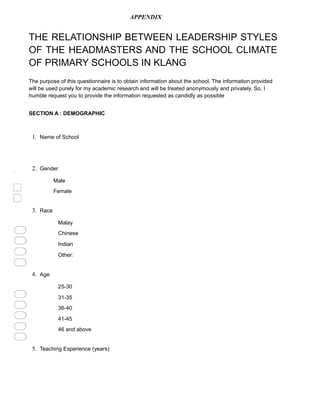
THE RELATIONSHIP BETWEEN LEADERSHIP STYLES
OF THE HEADMASTERS AND THE SCHOOL CLIMATE
OF PRIMARY SCHOOLS IN KLANG
The purpose of this questionnaire is to obtain information about the school. The information provided
will be used purely for my academic research and will be treated anonymously and privately. So, I
humble request you to provide the information requested as candidly as possible
SECTION A : DEMOGRAPHIC
1. Name of School
2. Gender
Male
Female
3. Race
Malay
Chinese
Indian
Other:
4. Age
25-30
31-35
36-40
41-45
46 and above
5. Teaching Experience (years)
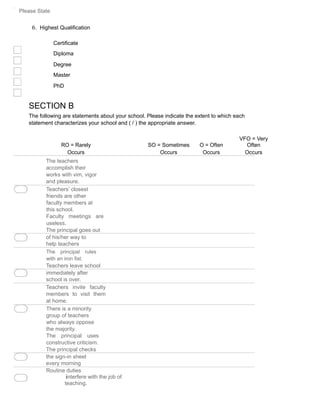
Please State
6. Highest Qualification
Certificate
Diploma
Degree
Master
PhD
SECTION B
The following are statements about your school. Please indicate the extent to which each
statement characterizes your school and ( / ) the appropriate answer.
RO = Rarely SO = Sometimes O = Often
VFO = Very
Often
Occurs Occurs Occurs Occurs
The teachers
accomplish their
works with vim, vigor
and pleasure.
Teachers’ closest
friends are other
faculty members at
this school.
Faculty meetings are
useless.
The principal goes out
of his/her way to
help teachers
The principal rules
with an iron fist.
Teachers leave school
immediately after
school is over.
Teachers invite faculty
members to visit them
at home.
There is a minority
group of teachers
who always oppose
the majority.
The principal uses
constructive criticism.
The principal checks
the sign-in sheet
every morning
Routine duties
interfere with the job of
teaching.
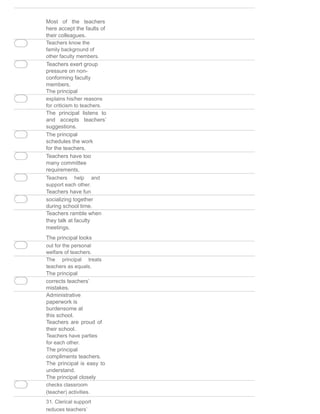
Most of the teachers
here accept the faults of
their colleagues.
Teachers know the
family background of
other faculty members.
Teachers exert group
pressure on non-
conforming faculty
members.
The principal
explains his/her reasons
for criticism to teachers.
The principal listens to
and accepts teachers’
suggestions.
The principal
schedules the work
for the teachers.
Teachers have too
many committee
requirements.
Teachers help and
support each other.
Teachers have fun
socializing together
during school time.
Teachers ramble when
they talk at faculty
meetings.
The principal looks
out for the personal
welfare of teachers.
The principal treats
teachers as equals.
The principal
corrects teachers’
mistakes.
Administrative
paperwork is
burdensome at
this school.
Teachers are proud of
their school.
Teachers have parties
for each other.
The principal
compliments teachers.
The principal is easy to
understand.
The principal closely
checks classroom
(teacher) activities.
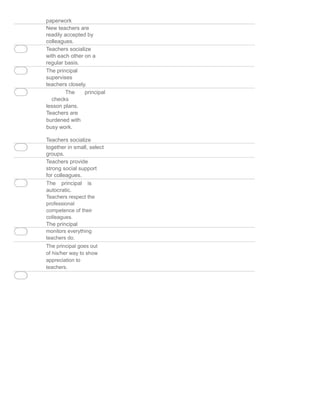
31. Clerical support
reduces teachers’
paperwork
New teachers are
readily accepted by
colleagues.
Teachers socialize
with each other on a
regular basis.
The principal
supervises
teachers closely.
The principal
checks
lesson plans.
Teachers are
burdened with
busy work.
Teachers socialize
together in small, select
groups.
Teachers provide
strong social support
for colleagues.
The principal is
autocratic.
Teachers respect the
professional
competence of their
colleagues.
The principal
monitors everything
teachers do.
The principal goes out
of his/her way to show
appreciation to
teachers.
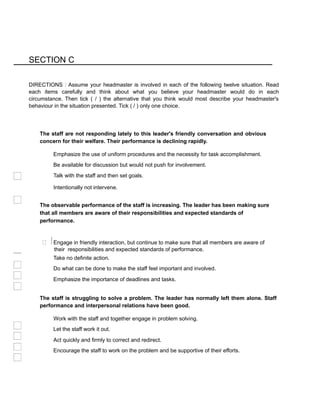
SECTION C
DIRECTIONS : Assume your headmaster is involved in each of the following twelve situation. Read
each items carefully and think about what you believe your headmaster would do in each
circumstance. Then tick ( / ) the alternative that you think would most describe your headmaster's
behaviour in the situation presented. Tick ( / ) only one choice.
The staff are not responding lately to this leader's friendly conversation and obvious
concern for their welfare. Their performance is declining rapidly.
Emphasize the use of uniform procedures and the necessity for task accomplishment.
Be available for discussion but would not push for involvement.
Talk with the staff and then set goals.
Intentionally not intervene.
The observable performance of the staff is increasing. The leader has been making sure
that all members are aware of their responsibilities and expected standards of
performance.
 Engage in friendly interaction, but continue to make sure that all members are aware of
their responsibilities and expected standards of performance.
Take no definite action.
Do what can be done to make the staff feel important and involved.
Emphasize the importance of deadlines and tasks.
The staff is struggling to solve a problem. The leader has normally left them alone. Staff
performance and interpersonal relations have been good.
Work with the staff and together engage in problem solving.
Let the staff work it out.
Act quickly and firmly to correct and redirect.
Encourage the staff to work on the problem and be supportive of their efforts.
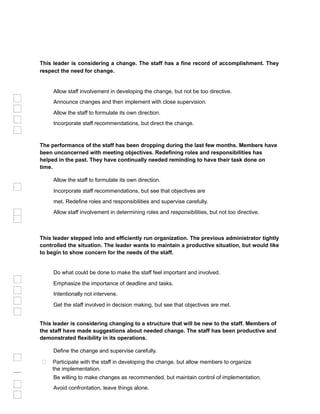
This leader is considering a change. The staff has a fine record of accomplishment. They
respect the need for change.
Allow staff involvement in developing the change, but not be too directive.
Announce changes and then implement with close supervision.
Allow the staff to formulate its own direction.
Incorporate staff recommendations, but direct the change.
The performance of the staff has been dropping during the last few months. Members have
been unconcerned with meeting objectives. Redefining roles and responsibilities has
helped in the past. They have continually needed reminding to have their task done on
time.
Allow the staff to formulate its own direction.
Incorporate staff recommendations, but see that objectives are
met. Redefine roles and responsibilities and supervise carefully.
Allow staff involvement in determining roles and responsibilities, but not too directive.
This leader stepped into and efficiently run organization. The previous administrator tightly
controlled the situation. The leader wants to maintain a productive situation, but would like
to begin to show concern for the needs of the staff.
Do what could be done to make the staff feel important and involved.
Emphasize the importance of deadline and tasks.
Intentionally not intervene.
Get the staff involved in decision making, but see that objectives are met.
This leader is considering changing to a structure that will be new to the staff. Members of
the staff have made suggestions about needed change. The staff has been productive and
demonstrated flexibility in its operations.
Define the change and supervise carefully.
 Participate with the staff in developing the change, but allow members to organize
the implementation.
Be willing to make changes as recommended, but maintain control of implementation.
Avoid confrontation, leave things alone.
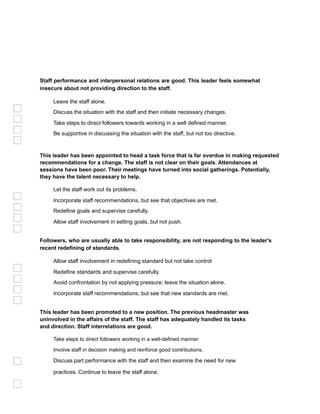
Staff performance and interpersonal relations are good. This leader feels somewhat
insecure about not providing direction to the staff.
Leave the staff alone.
Discuss the situation with the staff and then initiate necessary changes.
Take steps to direct followers towards working in a well defined manner.
Be supportive in discussing the situation with the staff, but not too directive.
This leader has been appointed to head a task force that is far overdue in making requested
recommendations for a change. The staff is not clear on their goals. Attendances at
sessions have been poor. Their meetings have turned into social gatherings. Potentially,
they have the talent necessary to help.
Let the staff work out its problems.
Incorporate staff recommendations, but see that objectives are met.
Redefine goals and supervise carefully.
Allow staff involvement in setting goals, but not push.
Followers, who are usually able to take responsibility, are not responding to the leader's
recent redefining of standards.
Allow staff involvement in redefining standard but not take control
Redefine standards and supervise carefully.
Avoid confrontation by not applying pressure; leave the situation alone.
Incorporate staff recommendations, but see that new standards are met.
This leader has been promoted to a new position. The previous headmaster was
uninvolved in the affairs of the staff. The staff has adequately handled its tasks
and direction. Staff interrelations are good.
Take steps to direct followers working in a well-defined manner.
Involve staff in decision making and reinforce good contributions,
Discuss part performance with the staff and then examine the need for new
practices. Continue to leave the staff alone.
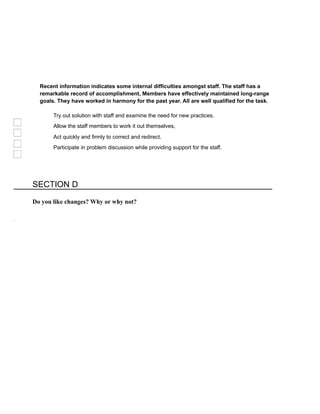
Recent information indicates some internal difficulties amongst staff. The staff has a
remarkable record of accomplishment, Members have effectively maintained long-range
goals. They have worked in harmony for the past year. All are well qualified for the task.
Try out solution with staff and examine the need for new practices.
Allow the staff members to work it out themselves,
Act quickly and firmly to correct and redirect.
Participate in problem discussion while providing support for the staff.
SECTION D
Do you like changes? Why or why not?
What changes do you expect from the leadership style of your headmaster?
What will you do to improve the school climate?

Questionnaire

  • 1.
    APPENDIX THE RELATIONSHIP BETWEENLEADERSHIP STYLES OF THE HEADMASTERS AND THE SCHOOL CLIMATE OF PRIMARY SCHOOLS IN KLANG The purpose of this questionnaire is to obtain information about the school. The information provided will be used purely for my academic research and will be treated anonymously and privately. So, I humble request you to provide the information requested as candidly as possible SECTION A : DEMOGRAPHIC 1. Name of School 2. Gender Male Female 3. Race Malay Chinese Indian Other: 4. Age 25-30 31-35 36-40 41-45 46 and above 5. Teaching Experience (years)
  • 2.
    Please State 6. HighestQualification Certificate Diploma Degree Master PhD SECTION B The following are statements about your school. Please indicate the extent to which each statement characterizes your school and ( / ) the appropriate answer. RO = Rarely SO = Sometimes O = Often VFO = Very Often Occurs Occurs Occurs Occurs The teachers accomplish their works with vim, vigor and pleasure. Teachers’ closest friends are other faculty members at this school. Faculty meetings are useless. The principal goes out of his/her way to help teachers The principal rules with an iron fist. Teachers leave school immediately after school is over. Teachers invite faculty members to visit them at home. There is a minority group of teachers who always oppose the majority. The principal uses constructive criticism. The principal checks the sign-in sheet every morning Routine duties interfere with the job of teaching.
  • 3.
    Most of theteachers here accept the faults of their colleagues. Teachers know the family background of other faculty members. Teachers exert group pressure on non- conforming faculty members. The principal explains his/her reasons for criticism to teachers. The principal listens to and accepts teachers’ suggestions. The principal schedules the work for the teachers. Teachers have too many committee requirements. Teachers help and support each other. Teachers have fun socializing together during school time. Teachers ramble when they talk at faculty meetings. The principal looks out for the personal welfare of teachers. The principal treats teachers as equals. The principal corrects teachers’ mistakes. Administrative paperwork is burdensome at this school. Teachers are proud of their school. Teachers have parties for each other. The principal compliments teachers. The principal is easy to understand. The principal closely checks classroom (teacher) activities. 31. Clerical support reduces teachers’
  • 5.
    paperwork New teachers are readilyaccepted by colleagues. Teachers socialize with each other on a regular basis. The principal supervises teachers closely. The principal checks lesson plans. Teachers are burdened with busy work. Teachers socialize together in small, select groups. Teachers provide strong social support for colleagues. The principal is autocratic. Teachers respect the professional competence of their colleagues. The principal monitors everything teachers do. The principal goes out of his/her way to show appreciation to teachers.
  • 6.
    SECTION C DIRECTIONS :Assume your headmaster is involved in each of the following twelve situation. Read each items carefully and think about what you believe your headmaster would do in each circumstance. Then tick ( / ) the alternative that you think would most describe your headmaster's behaviour in the situation presented. Tick ( / ) only one choice. The staff are not responding lately to this leader's friendly conversation and obvious concern for their welfare. Their performance is declining rapidly. Emphasize the use of uniform procedures and the necessity for task accomplishment. Be available for discussion but would not push for involvement. Talk with the staff and then set goals. Intentionally not intervene. The observable performance of the staff is increasing. The leader has been making sure that all members are aware of their responsibilities and expected standards of performance.  Engage in friendly interaction, but continue to make sure that all members are aware of their responsibilities and expected standards of performance. Take no definite action. Do what can be done to make the staff feel important and involved. Emphasize the importance of deadlines and tasks. The staff is struggling to solve a problem. The leader has normally left them alone. Staff performance and interpersonal relations have been good. Work with the staff and together engage in problem solving. Let the staff work it out. Act quickly and firmly to correct and redirect. Encourage the staff to work on the problem and be supportive of their efforts.
  • 7.
    This leader isconsidering a change. The staff has a fine record of accomplishment. They respect the need for change. Allow staff involvement in developing the change, but not be too directive. Announce changes and then implement with close supervision. Allow the staff to formulate its own direction. Incorporate staff recommendations, but direct the change. The performance of the staff has been dropping during the last few months. Members have been unconcerned with meeting objectives. Redefining roles and responsibilities has helped in the past. They have continually needed reminding to have their task done on time. Allow the staff to formulate its own direction. Incorporate staff recommendations, but see that objectives are met. Redefine roles and responsibilities and supervise carefully. Allow staff involvement in determining roles and responsibilities, but not too directive. This leader stepped into and efficiently run organization. The previous administrator tightly controlled the situation. The leader wants to maintain a productive situation, but would like to begin to show concern for the needs of the staff. Do what could be done to make the staff feel important and involved. Emphasize the importance of deadline and tasks. Intentionally not intervene. Get the staff involved in decision making, but see that objectives are met. This leader is considering changing to a structure that will be new to the staff. Members of the staff have made suggestions about needed change. The staff has been productive and demonstrated flexibility in its operations. Define the change and supervise carefully.  Participate with the staff in developing the change, but allow members to organize the implementation. Be willing to make changes as recommended, but maintain control of implementation. Avoid confrontation, leave things alone.
  • 8.
    Staff performance andinterpersonal relations are good. This leader feels somewhat insecure about not providing direction to the staff. Leave the staff alone. Discuss the situation with the staff and then initiate necessary changes. Take steps to direct followers towards working in a well defined manner. Be supportive in discussing the situation with the staff, but not too directive. This leader has been appointed to head a task force that is far overdue in making requested recommendations for a change. The staff is not clear on their goals. Attendances at sessions have been poor. Their meetings have turned into social gatherings. Potentially, they have the talent necessary to help. Let the staff work out its problems. Incorporate staff recommendations, but see that objectives are met. Redefine goals and supervise carefully. Allow staff involvement in setting goals, but not push. Followers, who are usually able to take responsibility, are not responding to the leader's recent redefining of standards. Allow staff involvement in redefining standard but not take control Redefine standards and supervise carefully. Avoid confrontation by not applying pressure; leave the situation alone. Incorporate staff recommendations, but see that new standards are met. This leader has been promoted to a new position. The previous headmaster was uninvolved in the affairs of the staff. The staff has adequately handled its tasks and direction. Staff interrelations are good. Take steps to direct followers working in a well-defined manner. Involve staff in decision making and reinforce good contributions, Discuss part performance with the staff and then examine the need for new practices. Continue to leave the staff alone.
  • 9.
    Recent information indicatessome internal difficulties amongst staff. The staff has a remarkable record of accomplishment, Members have effectively maintained long-range goals. They have worked in harmony for the past year. All are well qualified for the task. Try out solution with staff and examine the need for new practices. Allow the staff members to work it out themselves, Act quickly and firmly to correct and redirect. Participate in problem discussion while providing support for the staff. SECTION D Do you like changes? Why or why not?
  • 10.
    What changes doyou expect from the leadership style of your headmaster? What will you do to improve the school climate?