Assessing Teacher
Effectiveness
Charlotte Danielson
charlotte_danielson@hotmail.com
www.danielsongoup.org
The Framework for Teaching Charlotte Danielson
Why Assess Teacher Effectiveness?
 Quality Assurance
 Professional Learning
Assessing Teacher Effectiveness, Charlotte
Danielson
Defining Effective Teaching
Two basic approaches:
 Teacher practices, that is, what teachers do,
how well they do the work of teaching
 Results, that is, what teachers accomplish,
typically how well their students learn
Assessing Teacher Effectiveness, Charlotte
Danielson
Defining What Teachers Do
Two basic approaches:
 As judged by internal assessors, within the
school or district, based on specific criteria
 As judged by external assessors, for example
National Board Certification
Assessing Teacher Effectiveness, Charlotte
Danielson
Assumptions of Defining Good Teaching
Based on What Teachers Do
 There is consensus on what excellent teachers
do, that is, on standards of practice
 Teachers and administrators can accurately
recognize exemplary practice in different contexts
 School leaders have the skills to promote
excellent teaching with their teachers
These assumptions are difficult, but not
impossible, to realize.
Assessing Teacher Effectiveness, Charlotte
Danielson
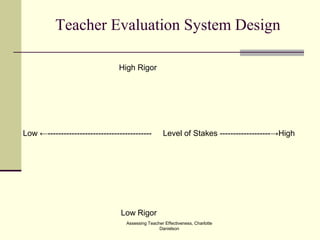
Teacher Evaluation System Design
High Rigor
Low ←--------------------------------------- Level of Stakes -------------------→High
Low Rigor
Assessing Teacher Effectiveness, Charlotte
Danielson
Teacher Evaluation System Design
High Rigor
Structured Mentoring Programs,
e.g. New Teacher Center
Low ←---------------------------------------
National Board Certification
Praxis III
Level of Stakes -------------------→High
Informal Mentoring Programs
Low Rigor
DANGER!!
Assessing Teacher Effectiveness, Charlotte
Danielson
Defining What Teachers Accomplish
 Typically linked to student achievement on
state-wide assessments
 Because of the importance of out-of-school
factors, validity and equity demand “value-
added” measures
 Recent approaches encourage classroom-
based assessments, school/district end-of-
course exams, etc.
Assessing Teacher Effectiveness, Charlotte
Danielson
Assumptions of Defining Good Teaching
Based on Student Test Scores
 Available assessments include all valuable
learning
 Assessments are available for all teachers
 In preparing students for the assessments,
teachers will use good instructional strategies
(That is, “teaching to the test” is good teaching)
 Statistical techniques can attribute student
learning to individual teachers
These assumptions are questionable
Assessing Teacher Effectiveness, Charlotte
Danielson
Negative Consequences of Defining
Effectiveness Based on Test Scores
Even if the assumptions are satisfied, and
especially if the stakes are high:
 Cheating, by teachers or administrators
 Narrowing the curriculum to what is assessed,
and the manner in which it is assessed
 If student achievement is defined as the
percentage who exceed a standard, teachers
concentrate their efforts on those close to the
line, shortchanging others
Unintended (but negative) Consequences
of Assessing Teacher Practice
In their concern to “look good” on the rubric,
especially if the stakes are high:
 Teachers become “legalistic,” parsing the
words, defending their performance
 Teachers adopt a low-risk approach, not
willing to try new approaches
 Teachers are unwilling to accept challenging
students in their classes
 Teachers may be reluctant to share
materials, expertise, etc.
Assessing Teacher Effectiveness, Charlotte
Danielson
Unintended (but positive) Consequences
of Assessing Teacher Practice
 Training for teachers and assessors
encourages them to better understand good
teaching
 Results of the assessment provide specific
feedback for teachers on where they should
focus their improvement efforts
 The assessment procedures them selves can
promote professional learning
Assessing Teacher Effectiveness, Charlotte
Danielson
Contributors to Teacher Learning
 Self-assessment
 Refection on practice
 Professional conversation
All done in an environment of trust
Assessing Teacher Effectiveness, Charlotte
Danielson
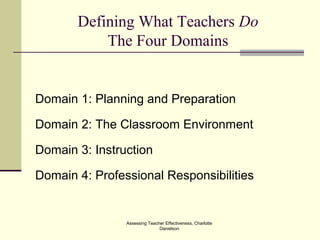
Defining What Teachers Do
The Four Domains
Domain 1: Planning and Preparation
Domain 2: The Classroom Environment
Domain 3: Instruction
Domain 4: Professional Responsibilities
Assessing Teacher Effectiveness, Charlotte
Danielson
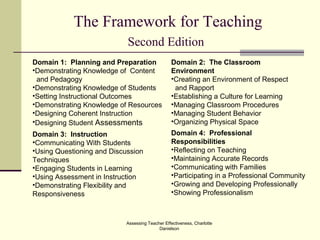
The Framework for Teaching
Second Edition
Domain 3: Instruction
•Communicating With Students
•Using Questioning and Discussion
Techniques
•Engaging Students in Learning
•Using Assessment in Instruction
•Demonstrating Flexibility and
Responsiveness
Domain 1: Planning and Preparation
•Demonstrating Knowledge of Content
and Pedagogy
•Demonstrating Knowledge of Students
•Setting Instructional Outcomes
•Demonstrating Knowledge of Resources
•Designing Coherent Instruction
•Designing Student Assessments
Domain 2: The Classroom
Environment
•Creating an Environment of Respect
and Rapport
•Establishing a Culture for Learning
•Managing Classroom Procedures
•Managing Student Behavior
•Organizing Physical Space
Domain 4: Professional
Responsibilities
•Reflecting on Teaching
•Maintaining Accurate Records
•Communicating with Families
•Participating in a Professional Community
•Growing and Developing Professionally
•Showing Professionalism
Assessing Teacher Effectiveness, Charlotte
Danielson
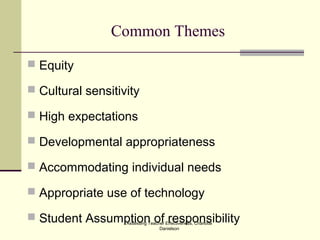
Common Themes
 Equity
 Cultural sensitivity
 High expectations
 Developmental appropriateness
 Accommodating individual needs
 Appropriate use of technology
 Student Assumption of responsibility
Assessing Teacher Effectiveness, Charlotte
Danielson
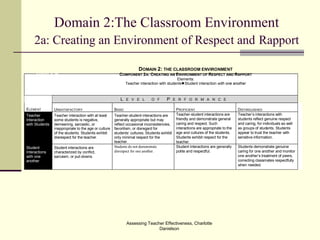
Domain 2:The Classroom Environment
2a: Creating an Environment of Respect and Rapport
L E V E L O F P E R F O R M A N C E
ELEMENT UNSATISFACTORY BASIC PROFICIENT DISTINGUISHED
Teacher
Interaction
with Students
Teacher interaction with at least
some students is negative,
demeaning, sarcastic, or
inappropriate to the age or culture
of the students. Students exhibit
disrespect for the teacher.
Teacher-student interactions are
generally appropriate but may
reflect occasional inconsistencies,
favoritism, or disregard for
students’ cultures. Students exhibit
only minimal respect for the
teacher.
Teacher-student interactions are
friendly and demonstrate general
caring and respect. Such
interactions are appropriate to the
age and cultures of the students.
Students exhibit respect for the
teacher.
Teacher’s interactions with
students reflect genuine respect
and caring, for individuals as well
as groups of students. Students
appear to trust the teacher with
sensitive information.
Student
Interactions
with one
another
Student interactions are
characterized by conflict,
sarcasm, or put-downs.
Students do not demonstrate
disrespect for one another.
Student interactions are generally
polite and respectful.
Students demonstrate genuine
caring for one another and monitor
one another’s treatment of peers,
correcting classmates respectfully
when needed.
DOMAIN 2: THE CLASSROOM ENVIRONMENT
COMPONENT 2A: CREATING AN ENVIRONMENT OF RESPECT AND RAPPORT
Elements:
Teacher interaction with studentsStudent interaction with one another
Figure 4.2b
Assessing Teacher Effectiveness, Charlotte
Danielson
Features of
The Framework for Teaching
 Comprehensive
 Grounded in research
 Public
 Generic
 Coherent in structure
 Independent of any particular teaching
methodology
One Use of Teacher Evaluation:
Differentiated Career Status
Possible career levels, for example:
 Probationary, or non-tenured teacher
 Career, or tenured teacher
 Master teacher, e.g. mentor or instructional coach
 Faculty leader, e.g. department chair, team leader,
or peer evaluator
Some of these roles require additional skills, but
high-quality teaching is essential
When is Robust Evaluation of Teacher
Effectiveness Essential?
 When offering a teacher a continuing contract
 When conducting a periodic assessment of
tenured teachers’ practice (in a multi-year
cycle)
 When determining a teacher’s eligibility for a
new career status
 When moving a teacher to, or removing the
teacher from, an “action plan”
In other situations, teacher evaluation plays a
developmental role, emphasizing professional
learning
Assessing Teacher Effectiveness, Charlotte
Danielson
Challenges in Implementing Robust
Teacher Evaluation Systems
 Clearly defining good teaching
 Building understanding and consensus on the
description of good teaching
 Developing instruments and procedures to
capture evidence of practice
 Training (and certifying?) evaluators
 Structuring expectations to permit time for
high-quality evaluation, including time for
professional conversation
Assessing Teacher Effectiveness, Charlotte
Danielson
Assessing Teacher Effectiveness, Charlotte
Danielson
State Policy Levers to Influence
Teacher Effectiveness
 Articulation of professional teaching standards
 Certification of teacher preparation programs
 Teacher licensing and re-licensing
 Student assessments on state content standards
 Certification of administrator preparation programs
 Administrator licensing and re-licensing
 State support for mentoring programs
 Requirements for district teacher evaluation
 State grants for district programs to encourage and
reward exemplary practice
 Direct state support for National Board Certification

Assessing teacher effectiveness

  • 1.
  • 2.
    The Framework forTeaching Charlotte Danielson Why Assess Teacher Effectiveness?  Quality Assurance  Professional Learning
  • 3.
    Assessing Teacher Effectiveness,Charlotte Danielson Defining Effective Teaching Two basic approaches:  Teacher practices, that is, what teachers do, how well they do the work of teaching  Results, that is, what teachers accomplish, typically how well their students learn
  • 4.
    Assessing Teacher Effectiveness,Charlotte Danielson Defining What Teachers Do Two basic approaches:  As judged by internal assessors, within the school or district, based on specific criteria  As judged by external assessors, for example National Board Certification
  • 5.
    Assessing Teacher Effectiveness,Charlotte Danielson Assumptions of Defining Good Teaching Based on What Teachers Do  There is consensus on what excellent teachers do, that is, on standards of practice  Teachers and administrators can accurately recognize exemplary practice in different contexts  School leaders have the skills to promote excellent teaching with their teachers These assumptions are difficult, but not impossible, to realize.
  • 6.
    Assessing Teacher Effectiveness,Charlotte Danielson Teacher Evaluation System Design High Rigor Low ←--------------------------------------- Level of Stakes -------------------→High Low Rigor
  • 7.
    Assessing Teacher Effectiveness,Charlotte Danielson Teacher Evaluation System Design High Rigor Structured Mentoring Programs, e.g. New Teacher Center Low ←--------------------------------------- National Board Certification Praxis III Level of Stakes -------------------→High Informal Mentoring Programs Low Rigor DANGER!!
  • 8.
    Assessing Teacher Effectiveness,Charlotte Danielson Defining What Teachers Accomplish  Typically linked to student achievement on state-wide assessments  Because of the importance of out-of-school factors, validity and equity demand “value- added” measures  Recent approaches encourage classroom- based assessments, school/district end-of- course exams, etc.
  • 9.
    Assessing Teacher Effectiveness,Charlotte Danielson Assumptions of Defining Good Teaching Based on Student Test Scores  Available assessments include all valuable learning  Assessments are available for all teachers  In preparing students for the assessments, teachers will use good instructional strategies (That is, “teaching to the test” is good teaching)  Statistical techniques can attribute student learning to individual teachers These assumptions are questionable
  • 10.
    Assessing Teacher Effectiveness,Charlotte Danielson Negative Consequences of Defining Effectiveness Based on Test Scores Even if the assumptions are satisfied, and especially if the stakes are high:  Cheating, by teachers or administrators  Narrowing the curriculum to what is assessed, and the manner in which it is assessed  If student achievement is defined as the percentage who exceed a standard, teachers concentrate their efforts on those close to the line, shortchanging others
  • 11.
    Unintended (but negative)Consequences of Assessing Teacher Practice In their concern to “look good” on the rubric, especially if the stakes are high:  Teachers become “legalistic,” parsing the words, defending their performance  Teachers adopt a low-risk approach, not willing to try new approaches  Teachers are unwilling to accept challenging students in their classes  Teachers may be reluctant to share materials, expertise, etc.
  • 12.
    Assessing Teacher Effectiveness,Charlotte Danielson Unintended (but positive) Consequences of Assessing Teacher Practice  Training for teachers and assessors encourages them to better understand good teaching  Results of the assessment provide specific feedback for teachers on where they should focus their improvement efforts  The assessment procedures them selves can promote professional learning
  • 13.
    Assessing Teacher Effectiveness,Charlotte Danielson Contributors to Teacher Learning  Self-assessment  Refection on practice  Professional conversation All done in an environment of trust
  • 14.
    Assessing Teacher Effectiveness,Charlotte Danielson Defining What Teachers Do The Four Domains Domain 1: Planning and Preparation Domain 2: The Classroom Environment Domain 3: Instruction Domain 4: Professional Responsibilities
  • 15.
    Assessing Teacher Effectiveness,Charlotte Danielson The Framework for Teaching Second Edition Domain 3: Instruction •Communicating With Students •Using Questioning and Discussion Techniques •Engaging Students in Learning •Using Assessment in Instruction •Demonstrating Flexibility and Responsiveness Domain 1: Planning and Preparation •Demonstrating Knowledge of Content and Pedagogy •Demonstrating Knowledge of Students •Setting Instructional Outcomes •Demonstrating Knowledge of Resources •Designing Coherent Instruction •Designing Student Assessments Domain 2: The Classroom Environment •Creating an Environment of Respect and Rapport •Establishing a Culture for Learning •Managing Classroom Procedures •Managing Student Behavior •Organizing Physical Space Domain 4: Professional Responsibilities •Reflecting on Teaching •Maintaining Accurate Records •Communicating with Families •Participating in a Professional Community •Growing and Developing Professionally •Showing Professionalism
  • 16.
    Assessing Teacher Effectiveness,Charlotte Danielson Common Themes  Equity  Cultural sensitivity  High expectations  Developmental appropriateness  Accommodating individual needs  Appropriate use of technology  Student Assumption of responsibility
  • 17.
    Assessing Teacher Effectiveness,Charlotte Danielson Domain 2:The Classroom Environment 2a: Creating an Environment of Respect and Rapport L E V E L O F P E R F O R M A N C E ELEMENT UNSATISFACTORY BASIC PROFICIENT DISTINGUISHED Teacher Interaction with Students Teacher interaction with at least some students is negative, demeaning, sarcastic, or inappropriate to the age or culture of the students. Students exhibit disrespect for the teacher. Teacher-student interactions are generally appropriate but may reflect occasional inconsistencies, favoritism, or disregard for students’ cultures. Students exhibit only minimal respect for the teacher. Teacher-student interactions are friendly and demonstrate general caring and respect. Such interactions are appropriate to the age and cultures of the students. Students exhibit respect for the teacher. Teacher’s interactions with students reflect genuine respect and caring, for individuals as well as groups of students. Students appear to trust the teacher with sensitive information. Student Interactions with one another Student interactions are characterized by conflict, sarcasm, or put-downs. Students do not demonstrate disrespect for one another. Student interactions are generally polite and respectful. Students demonstrate genuine caring for one another and monitor one another’s treatment of peers, correcting classmates respectfully when needed. DOMAIN 2: THE CLASSROOM ENVIRONMENT COMPONENT 2A: CREATING AN ENVIRONMENT OF RESPECT AND RAPPORT Elements: Teacher interaction with studentsStudent interaction with one another Figure 4.2b
  • 18.
    Assessing Teacher Effectiveness,Charlotte Danielson Features of The Framework for Teaching  Comprehensive  Grounded in research  Public  Generic  Coherent in structure  Independent of any particular teaching methodology
  • 19.
    One Use ofTeacher Evaluation: Differentiated Career Status Possible career levels, for example:  Probationary, or non-tenured teacher  Career, or tenured teacher  Master teacher, e.g. mentor or instructional coach  Faculty leader, e.g. department chair, team leader, or peer evaluator Some of these roles require additional skills, but high-quality teaching is essential
  • 20.
    When is RobustEvaluation of Teacher Effectiveness Essential?  When offering a teacher a continuing contract  When conducting a periodic assessment of tenured teachers’ practice (in a multi-year cycle)  When determining a teacher’s eligibility for a new career status  When moving a teacher to, or removing the teacher from, an “action plan” In other situations, teacher evaluation plays a developmental role, emphasizing professional learning Assessing Teacher Effectiveness, Charlotte Danielson
  • 21.
    Challenges in ImplementingRobust Teacher Evaluation Systems  Clearly defining good teaching  Building understanding and consensus on the description of good teaching  Developing instruments and procedures to capture evidence of practice  Training (and certifying?) evaluators  Structuring expectations to permit time for high-quality evaluation, including time for professional conversation Assessing Teacher Effectiveness, Charlotte Danielson
  • 22.
    Assessing Teacher Effectiveness,Charlotte Danielson State Policy Levers to Influence Teacher Effectiveness  Articulation of professional teaching standards  Certification of teacher preparation programs  Teacher licensing and re-licensing  Student assessments on state content standards  Certification of administrator preparation programs  Administrator licensing and re-licensing  State support for mentoring programs  Requirements for district teacher evaluation  State grants for district programs to encourage and reward exemplary practice  Direct state support for National Board Certification

Editor's Notes

  • #7 System Design Given what I have said thus far, we can think of two continua related to evaluation systems: one related to the level of stakes, (in the form of licensing, employment, or compensation) and the other concerning the rigor of the system (the clarity of the criteria, the design of the items to be assessed, the training of the assessors, etc.) If one maps one continuum on the other, the result is a graph with four quadrants like this one. (Show the graph.) In the quadrant where both the stakes and the rigor are low (for example in most mentoring programs) there are no negative consequences of the low rigor. That is, the mentoring program may not be as good as it might be, but no one is harmed. Those systems with both high stakes and high rigor (for example, where the assessors go through extensive training and must pass a proficiency test - as in Praxis III and National Board) the result is a system with high levels of credibility and defensibility. The difficulty arises, I think, where the system has high stakes but low rigor (and therefore low defensibility and credibility.) In those situations there is opportunity for harm, and mischief, and abuse. Those are the ones that really worry me. I also wonder whether the infrastructure required to establish, and maintain, a system of high rigor, is worth the benefits. It will be interesting to see the situations in which it turns out to be worth it.
  • #8 System Design Given what I have said thus far, we can think of two continua related to evaluation systems: one related to the level of stakes, (in the form of licensing, employment, or compensation) and the other concerning the rigor of the system (the clarity of the criteria, the design of the items to be assessed, the training of the assessors, etc.) If one maps one continuum on the other, the result is a graph with four quadrants like this one. (Show the graph.) In the quadrant where both the stakes and the rigor are low (for example in most mentoring programs) there are no negative consequences of the low rigor. That is, the mentoring program may not be as good as it might be, but no one is harmed. Those systems with both high stakes and high rigor (for example, where the assessors go through extensive training and must pass a proficiency test - as in Praxis III and National Board) the result is a system with high levels of credibility and defensibility. The difficulty arises, I think, where the system has high stakes but low rigor (and therefore low defensibility and credibility.) In those situations there is opportunity for harm, and mischief, and abuse. Those are the ones that really worry me. I also wonder whether the infrastructure required to establish, and maintain, a system of high rigor, is worth the benefits. It will be interesting to see the situations in which it turns out to be worth it.
  • #11 shor