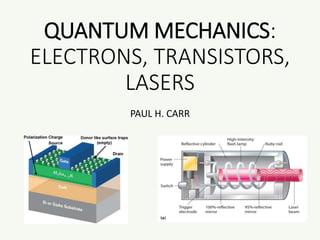
QUANTUM MECHANICS:
ELECTRONS, TRANSISTORS,
LASERS
PAUL H. CARR
ELECTRONIC QUANTUM TECHNOLOGY
1897 J. J Thompson used the cathode ray tube to discover
the electron..
1947 Transistors demonstrated at the Bell Telephone Labs
came from the quantum theory of electrons in solids.
1954 Charles Townes demonstrated the MASER principle
(Microwave Amplification by the Stimulated Emission of
Radiation)
1960 Ruby LASER demonstrated.
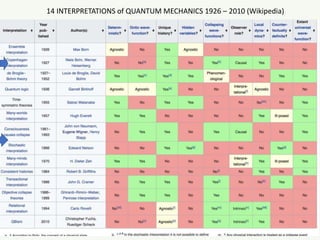
14 DIFFERENT INTERPRETATIONS OF
QUANTUM MECHANCS IN THE LAST CENTURY
PARTICLE-WAVE COMPLEMENTARITY
• Electron particles have wave-like
properties
• Electromagnetic waves have
particle properties (photons)
“If you think your understand quantum
mechanics, you don’t.”
(Physics Nobel Laureate Richard Feynman)
If you don’t
understand
Quantum Mechanics,
maybe you do.
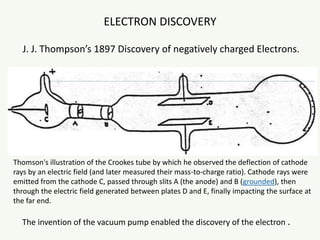
Thomson's illustration of the Crookes tube by which he observed the deflection of cathode
rays by an electric field (and later measured their mass-to-charge ratio). Cathode rays were
emitted from the cathode C, passed through slits A (the anode) and B (grounded), then
through the electric field generated between plates D and E, finally impacting the surface at
the far end.
J. J. Thompson’s 1897 Discovery of negatively charged Electrons.
The invention of the vacuum pump enabled the discovery of the electron .
ELECTRON DISCOVERY
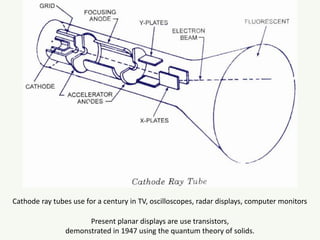
Cathode ray tubes use for a century in TV, oscilloscopes, radar displays, computer monitors
Present planar displays are use transistors,
demonstrated in 1947 using the quantum theory of solids.
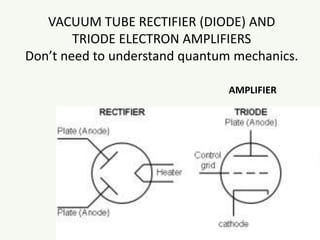
VACUUM TUBE RECTIFIER (DIODE) AND
TRIODE ELECTRON AMPLIFIERS
Don’t need to understand quantum mechanics.
AMPLIFIER
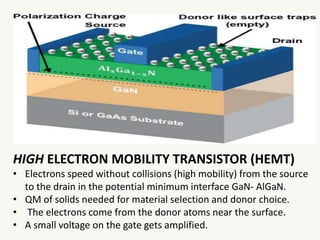
HIGH ELECTRON MOBILITY TRANSISTOR (HEMT)
• Electrons speed without collisions (high mobility) from the source
to the drain in the potential minimum interface GaN- AlGaN.
• QM of solids needed for material selection and donor choice.
• The electrons come from the donor atoms near the surface.
• A small voltage on the gate gets amplified.
Drawing of a photon (in green) being emitted from carbon molecules. [Image
source: Nancy Ambrosiano, Los Alamos National Laboratory, July 2017 News
Release, “Single-photon emitter has promise for quantum info-processing,” (Public
domain)] PHOTON PULSE OF PARTICLE-LIKE LIGHT
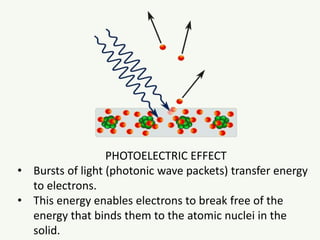
PHOTOELECTRIC EFFECT
• Bursts of light (photonic wave packets) transfer energy
to electrons.
• This energy enables electrons to break free of the
energy that binds them to the atomic nuclei in the
solid.
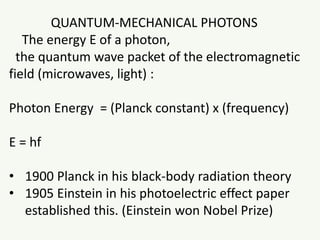
QUANTUM-MECHANICAL PHOTONS
The energy E of a photon,
the quantum wave packet of the electromagnetic
field (microwaves, light) :
Photon Energy = (Planck constant) x (frequency)
E = hf
• 1900 Planck in his black-body radiation theory
• 1905 Einstein in his photoelectric effect paper
established this. (Einstein won Nobel Prize)
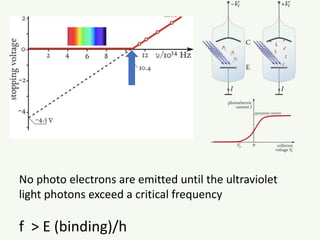
No photo electrons are emitted until the ultraviolet
light photons exceed a critical frequency
f > E (binding)/h
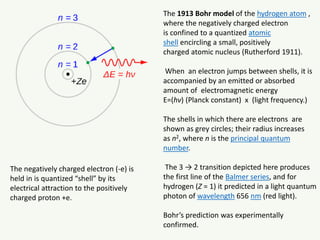
The 1913 Bohr model of the hydrogen atom ,
where the negatively charged electron
is confined to a quantized atomic
shell encircling a small, positively
charged atomic nucleus (Rutherford 1911).
When an electron jumps between shells, it is
accompanied by an emitted or absorbed
amount of electromagnetic energy
E=(hν) (Planck constant) x (light frequency.)
The shells in which there are electrons are
shown as grey circles; their radius increases
as n2, where n is the principal quantum
number.
The 3 → 2 transition depicted here produces
the first line of the Balmer series, and for
hydrogen (Z = 1) it predicted in a light quantum
photon of wavelength 656 nm (red light).
Bohr’s prediction was experimentally
confirmed.
The negatively charged electron (-e) is
held in is quantized “shell” by its
electrical attraction to the positively
charged proton +e.
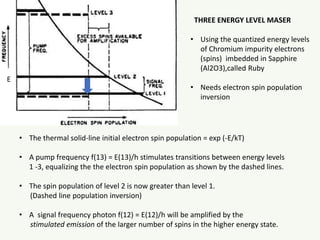
• The thermal solid-line initial electron spin population = exp (-E/kT)
• A pump frequency f(13) = E(13)/h stimulates transitions between energy levels
1 -3, equalizing the the electron spin population as shown by the dashed lines.
• The spin population of level 2 is now greater than level 1.
(Dashed line population inversion)
• A signal frequency photon f(12) = E(12)/h will be amplified by the
stimulated emission of the larger number of spins in the higher energy state.
THREE ENERGY LEVEL MASER
• Using the quantized energy levels
of Chromium impurity electrons
(spins) imbedded in Sapphire
(Al2O3),called Ruby
• Needs electron spin population
inversion
E
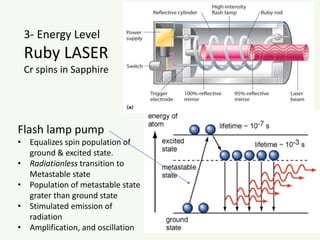
Flash lamp pump
• Equalizes spin population of
ground & excited state.
• Radiationless transition to
Metastable state
• Population of metastable state
grater than ground state
• Stimulated emission of
radiation
• Amplification, and oscillation
3- Energy Level
Ruby LASER
Cr spins in Sapphire
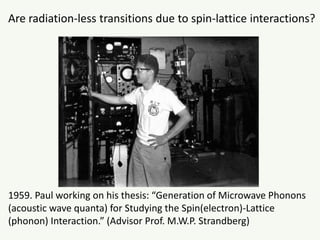
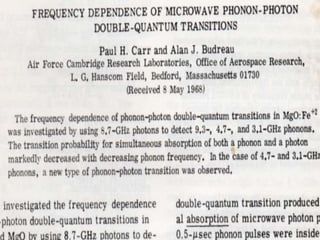
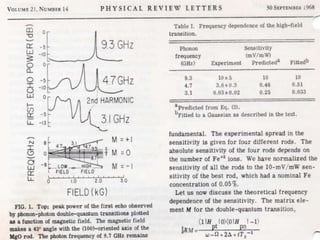
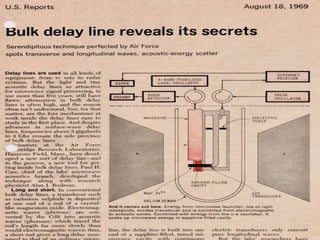
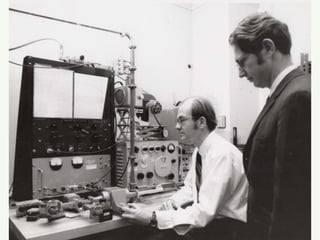
1959. Paul working on his thesis: “Generation of Microwave Phonons
(acoustic wave quanta) for Studying the Spin(electron)-Lattice
(phonon) Interaction.” (Advisor Prof. M.W.P. Strandberg)
Are radiation-less transitions due to spin-lattice interactions?
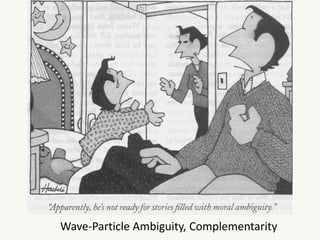
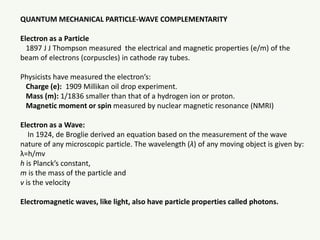
Wave-Particle Ambiguity, Complementarity
QUANTUM MECHANICAL PARTICLE-WAVE COMPLEMENTARITY
Electron as a Particle
1897 J J Thompson measured the electrical and magnetic properties (e/m) of the
beam of electrons (corpuscles) in cathode ray tubes.
Physicists have measured the electron’s:
Charge (e): 1909 Millikan oil drop experiment.
Mass (m): 1/1836 smaller than that of a hydrogen ion or proton.
Magnetic moment or spin measured by nuclear magnetic resonance (NMRI)
Electron as a Wave:
In 1924, de Broglie derived an equation based on the measurement of the wave
nature of any microscopic particle. The wavelength (λ) of any moving object is given by:
λ=h/mv
h is Planck’s constant,
m is the mass of the particle and
v is the velocity
Electromagnetic waves, like light, also have particle properties called photons.
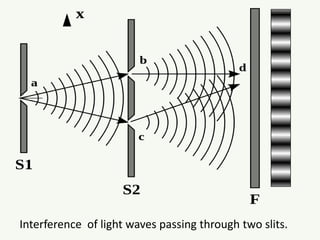
Interference of light waves passing through two slits.
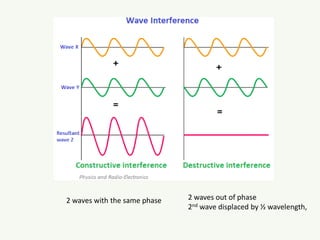
2 waves with the same phase 2 waves out of phase
2nd wave displaced by ½ wavelength,
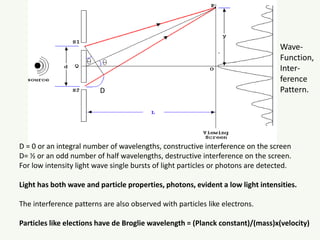
D
D = 0 or an integral number of wavelengths, constructive interference on the screen
D= ½ or an odd number of half wavelengths, destructive interference on the screen.
For low intensity light wave single bursts of light particles or photons are detected.
Light has both wave and particle properties, photons, evident a low light intensities.
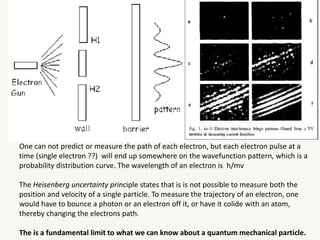
The interference patterns are also observed with particles like electrons.
Particles like elections have de Broglie wavelength = (Planck constant)/(mass)x(velocity)
Wave-
Function,
Inter-
ference
Pattern.
One can not predict or measure the path of each electron, but each electron pulse at a
time (single electron ??) will end up somewhere on the wavefunction pattern, which is a
probability distribution curve. The wavelength of an electron is h/mv
The Heisenberg uncertainty principle states that is is not possible to measure both the
position and velocity of a single particle. To measure the trajectory of an electron, one
would have to bounce a photon or an electron off it, or have it colide with an atom,
thereby changing the electrons path.
The is a fundamental limit to what we can know about a quantum mechanical particle.
Wavefunction
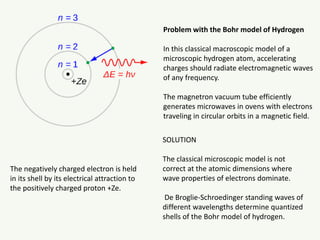
Problem with the Bohr model of Hydrogen
In this classical macroscopic model of a
microscopic hydrogen atom, accelerating
charges should radiate electromagnetic waves
of any frequency.
The magnetron vacuum tube efficiently
generates microwaves in ovens with electrons
traveling in circular orbits in a magnetic field.
The negatively charged electron is held
in its shell by its electrical attraction to
the positively charged proton +Ze.
SOLUTION
The classical microscopic model is not
correct at the atomic dimensions where
wave properties of electrons dominate.
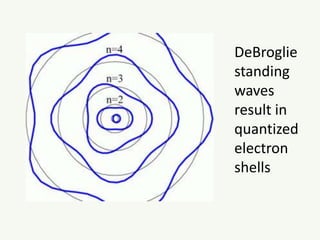
De Broglie-Schroedinger standing waves of
different wavelengths determine quantized
shells of the Bohr model of hydrogen.
DeBroglie
standing
waves
result in
quantized
electron
shells
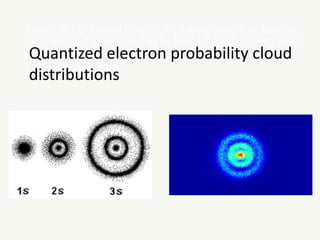
Quantum Mechanical Images of the wavefuction probability
clouds where the electron may be found in the Hydrogen Atom
Quantized electron probability cloud
distributions
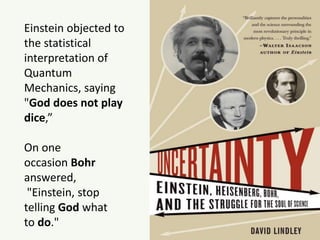
Einstein objected to
the statistical
interpretation of
Quantum
Mechanics, saying
"God does not play
dice,”
On one
occasion Bohr
answered,
"Einstein, stop
telling God what
to do."
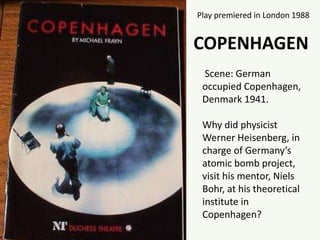
Play premiered in London 1988
COPENHAGEN
Scene: German
occupied Copenhagen,
Denmark 1941.
Why did physicist
Werner Heisenberg, in
charge of Germany’s
atomic bomb project,
visit his mentor, Niels
Bohr, at his theoretical
institute in
Copenhagen?
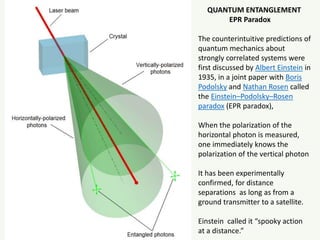
QUANTUM ENTANGLEMENT
EPR Paradox
The counterintuitive predictions of
quantum mechanics about
strongly correlated systems were
first discussed by Albert Einstein in
1935, in a joint paper with Boris
Podolsky and Nathan Rosen called
the Einstein–Podolsky–Rosen
paradox (EPR paradox),
When the polarization of the
horizontal photon is measured,
one immediately knows the
polarization of the vertical photon
It has been experimentally
confirmed, for distance
separations as long as from a
ground transmitter to a satellite.
Einstein called it “spooky action
at a distance.”
An interpretation of quantum mechanics is an
attempt to explain how the mathematical theory
of quantum mechanics corresponds" to reality.
Although quantum mechanics has held up to
rigorous and extremely precise tests in an
extraordinarily broad range of experiments (not
one prediction from quantum mechanics has been
found to be contradicted by experiments), there
exist a number of contending schools of thought
over their interpretation.
14 INTERPRETATIONS of QUANTUM MECHANICS 1926 – 2010 (Wikipedia)
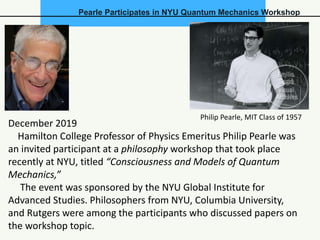
Pearle Participates in NYU Quantum Mechanics Workshop
December 2019
Hamilton College Professor of Physics Emeritus Philip Pearle was
an invited participant at a philosophy workshop that took place
recently at NYU, titled “Consciousness and Models of Quantum
Mechanics,”
The event was sponsored by the NYU Global Institute for
Advanced Studies. Philosophers from NYU, Columbia University,
and Rutgers were among the participants who discussed papers on
the workshop topic.
Philip Pearle, MIT Class of 1957
Pearle’s Continuous Spontaneous Localization theory (CSL) gives a
mathematical modification of quantum theory. It provides a
description of what is called “wave function collapse,” the actual
occurrence of events rather than just the probabilities of occurrence
of events as in the unaltered standard quantum theory.
CSL was an important part of two of the papers discussed in the
workshop. In these, the authors combined a recent mathematical
characterization of consciousness – known as Integrated
Information Theory – with CSL. The goal was to explore whether an
idea, attributed mainly to Physics Nobel Laureate Eugene Wigner,
could be made precise in order to create a theory in which an
individual’s conscious awareness would play an active role in the
physical world, causing wave function collapse.
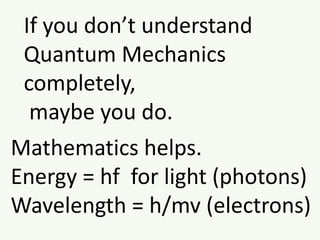
If you don’t understand
Quantum Mechanics
completely,
maybe you do.
Mathematics helps.
Energy = hf for light (photons)
Wavelength = h/mv (electrons)
QUANTUM-MECHANICS
The semantic and conceptual problem is we that we use macroscopic concepts and words
to describe microscopic particles like electrons.
We all can agree that the electron is a particle with a measured mass and charge.
Some experiments can only be explained if the electron also has a De Broglie
Wavelength = Planck’s Constant/(Mass) x (Velocity)
This is counterintuitive.
Physicist Niels Bohr explained this by introducing the new concept of
particle-wave complementarity.
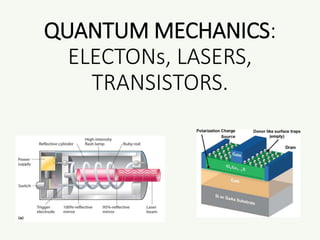
QUANTUM MECHANICS:
ELECTONs, LASERS,
TRANSISTORS.

Quantum Mechanics: Electrons, Transistors, & LASERS.

  • 1.
  • 3.
    ELECTRONIC QUANTUM TECHNOLOGY 1897J. J Thompson used the cathode ray tube to discover the electron.. 1947 Transistors demonstrated at the Bell Telephone Labs came from the quantum theory of electrons in solids. 1954 Charles Townes demonstrated the MASER principle (Microwave Amplification by the Stimulated Emission of Radiation) 1960 Ruby LASER demonstrated.
  • 4.
    14 DIFFERENT INTERPRETATIONSOF QUANTUM MECHANCS IN THE LAST CENTURY PARTICLE-WAVE COMPLEMENTARITY • Electron particles have wave-like properties • Electromagnetic waves have particle properties (photons) “If you think your understand quantum mechanics, you don’t.” (Physics Nobel Laureate Richard Feynman)
  • 5.
    If you don’t understand QuantumMechanics, maybe you do.
  • 6.
    Thomson's illustration ofthe Crookes tube by which he observed the deflection of cathode rays by an electric field (and later measured their mass-to-charge ratio). Cathode rays were emitted from the cathode C, passed through slits A (the anode) and B (grounded), then through the electric field generated between plates D and E, finally impacting the surface at the far end. J. J. Thompson’s 1897 Discovery of negatively charged Electrons. The invention of the vacuum pump enabled the discovery of the electron . ELECTRON DISCOVERY
  • 7.
    Cathode ray tubesuse for a century in TV, oscilloscopes, radar displays, computer monitors Present planar displays are use transistors, demonstrated in 1947 using the quantum theory of solids.
  • 8.
    VACUUM TUBE RECTIFIER(DIODE) AND TRIODE ELECTRON AMPLIFIERS Don’t need to understand quantum mechanics. AMPLIFIER
  • 9.
    HIGH ELECTRON MOBILITYTRANSISTOR (HEMT) • Electrons speed without collisions (high mobility) from the source to the drain in the potential minimum interface GaN- AlGaN. • QM of solids needed for material selection and donor choice. • The electrons come from the donor atoms near the surface. • A small voltage on the gate gets amplified.
  • 10.
    Drawing of aphoton (in green) being emitted from carbon molecules. [Image source: Nancy Ambrosiano, Los Alamos National Laboratory, July 2017 News Release, “Single-photon emitter has promise for quantum info-processing,” (Public domain)] PHOTON PULSE OF PARTICLE-LIKE LIGHT
  • 11.
    PHOTOELECTRIC EFFECT • Burstsof light (photonic wave packets) transfer energy to electrons. • This energy enables electrons to break free of the energy that binds them to the atomic nuclei in the solid.
  • 12.
    QUANTUM-MECHANICAL PHOTONS The energyE of a photon, the quantum wave packet of the electromagnetic field (microwaves, light) : Photon Energy = (Planck constant) x (frequency) E = hf • 1900 Planck in his black-body radiation theory • 1905 Einstein in his photoelectric effect paper established this. (Einstein won Nobel Prize)
  • 13.
    No photo electronsare emitted until the ultraviolet light photons exceed a critical frequency f > E (binding)/h
  • 14.
    The 1913 Bohrmodel of the hydrogen atom , where the negatively charged electron is confined to a quantized atomic shell encircling a small, positively charged atomic nucleus (Rutherford 1911). When an electron jumps between shells, it is accompanied by an emitted or absorbed amount of electromagnetic energy E=(hν) (Planck constant) x (light frequency.) The shells in which there are electrons are shown as grey circles; their radius increases as n2, where n is the principal quantum number. The 3 → 2 transition depicted here produces the first line of the Balmer series, and for hydrogen (Z = 1) it predicted in a light quantum photon of wavelength 656 nm (red light). Bohr’s prediction was experimentally confirmed. The negatively charged electron (-e) is held in is quantized “shell” by its electrical attraction to the positively charged proton +e.
  • 15.
    • The thermalsolid-line initial electron spin population = exp (-E/kT) • A pump frequency f(13) = E(13)/h stimulates transitions between energy levels 1 -3, equalizing the the electron spin population as shown by the dashed lines. • The spin population of level 2 is now greater than level 1. (Dashed line population inversion) • A signal frequency photon f(12) = E(12)/h will be amplified by the stimulated emission of the larger number of spins in the higher energy state. THREE ENERGY LEVEL MASER • Using the quantized energy levels of Chromium impurity electrons (spins) imbedded in Sapphire (Al2O3),called Ruby • Needs electron spin population inversion E
  • 16.
    Flash lamp pump •Equalizes spin population of ground & excited state. • Radiationless transition to Metastable state • Population of metastable state grater than ground state • Stimulated emission of radiation • Amplification, and oscillation 3- Energy Level Ruby LASER Cr spins in Sapphire
  • 17.
    1959. Paul workingon his thesis: “Generation of Microwave Phonons (acoustic wave quanta) for Studying the Spin(electron)-Lattice (phonon) Interaction.” (Advisor Prof. M.W.P. Strandberg) Are radiation-less transitions due to spin-lattice interactions?
  • 18.
  • 19.
    QUANTUM MECHANICAL PARTICLE-WAVECOMPLEMENTARITY Electron as a Particle 1897 J J Thompson measured the electrical and magnetic properties (e/m) of the beam of electrons (corpuscles) in cathode ray tubes. Physicists have measured the electron’s: Charge (e): 1909 Millikan oil drop experiment. Mass (m): 1/1836 smaller than that of a hydrogen ion or proton. Magnetic moment or spin measured by nuclear magnetic resonance (NMRI) Electron as a Wave: In 1924, de Broglie derived an equation based on the measurement of the wave nature of any microscopic particle. The wavelength (λ) of any moving object is given by: λ=h/mv h is Planck’s constant, m is the mass of the particle and v is the velocity Electromagnetic waves, like light, also have particle properties called photons.
  • 20.
    Interference of lightwaves passing through two slits.
  • 21.
    2 waves withthe same phase 2 waves out of phase 2nd wave displaced by ½ wavelength,
  • 22.
    D D = 0or an integral number of wavelengths, constructive interference on the screen D= ½ or an odd number of half wavelengths, destructive interference on the screen. For low intensity light wave single bursts of light particles or photons are detected. Light has both wave and particle properties, photons, evident a low light intensities. The interference patterns are also observed with particles like electrons. Particles like elections have de Broglie wavelength = (Planck constant)/(mass)x(velocity) Wave- Function, Inter- ference Pattern.
  • 23.
    One can notpredict or measure the path of each electron, but each electron pulse at a time (single electron ??) will end up somewhere on the wavefunction pattern, which is a probability distribution curve. The wavelength of an electron is h/mv The Heisenberg uncertainty principle states that is is not possible to measure both the position and velocity of a single particle. To measure the trajectory of an electron, one would have to bounce a photon or an electron off it, or have it colide with an atom, thereby changing the electrons path. The is a fundamental limit to what we can know about a quantum mechanical particle. Wavefunction
  • 24.
    Problem with theBohr model of Hydrogen In this classical macroscopic model of a microscopic hydrogen atom, accelerating charges should radiate electromagnetic waves of any frequency. The magnetron vacuum tube efficiently generates microwaves in ovens with electrons traveling in circular orbits in a magnetic field. The negatively charged electron is held in its shell by its electrical attraction to the positively charged proton +Ze. SOLUTION The classical microscopic model is not correct at the atomic dimensions where wave properties of electrons dominate. De Broglie-Schroedinger standing waves of different wavelengths determine quantized shells of the Bohr model of hydrogen.
  • 25.
  • 26.
    Quantum Mechanical Imagesof the wavefuction probability clouds where the electron may be found in the Hydrogen Atom Quantized electron probability cloud distributions
  • 27.
    Einstein objected to thestatistical interpretation of Quantum Mechanics, saying "God does not play dice,” On one occasion Bohr answered, "Einstein, stop telling God what to do."
  • 28.
    Play premiered inLondon 1988 COPENHAGEN Scene: German occupied Copenhagen, Denmark 1941. Why did physicist Werner Heisenberg, in charge of Germany’s atomic bomb project, visit his mentor, Niels Bohr, at his theoretical institute in Copenhagen?
  • 29.
    QUANTUM ENTANGLEMENT EPR Paradox Thecounterintuitive predictions of quantum mechanics about strongly correlated systems were first discussed by Albert Einstein in 1935, in a joint paper with Boris Podolsky and Nathan Rosen called the Einstein–Podolsky–Rosen paradox (EPR paradox), When the polarization of the horizontal photon is measured, one immediately knows the polarization of the vertical photon It has been experimentally confirmed, for distance separations as long as from a ground transmitter to a satellite. Einstein called it “spooky action at a distance.”
  • 30.
    An interpretation ofquantum mechanics is an attempt to explain how the mathematical theory of quantum mechanics corresponds" to reality. Although quantum mechanics has held up to rigorous and extremely precise tests in an extraordinarily broad range of experiments (not one prediction from quantum mechanics has been found to be contradicted by experiments), there exist a number of contending schools of thought over their interpretation.
  • 31.
    14 INTERPRETATIONS ofQUANTUM MECHANICS 1926 – 2010 (Wikipedia)
  • 32.
    Pearle Participates inNYU Quantum Mechanics Workshop December 2019 Hamilton College Professor of Physics Emeritus Philip Pearle was an invited participant at a philosophy workshop that took place recently at NYU, titled “Consciousness and Models of Quantum Mechanics,” The event was sponsored by the NYU Global Institute for Advanced Studies. Philosophers from NYU, Columbia University, and Rutgers were among the participants who discussed papers on the workshop topic. Philip Pearle, MIT Class of 1957
  • 33.
    Pearle’s Continuous SpontaneousLocalization theory (CSL) gives a mathematical modification of quantum theory. It provides a description of what is called “wave function collapse,” the actual occurrence of events rather than just the probabilities of occurrence of events as in the unaltered standard quantum theory. CSL was an important part of two of the papers discussed in the workshop. In these, the authors combined a recent mathematical characterization of consciousness – known as Integrated Information Theory – with CSL. The goal was to explore whether an idea, attributed mainly to Physics Nobel Laureate Eugene Wigner, could be made precise in order to create a theory in which an individual’s conscious awareness would play an active role in the physical world, causing wave function collapse.
  • 38.
    If you don’tunderstand Quantum Mechanics completely, maybe you do. Mathematics helps. Energy = hf for light (photons) Wavelength = h/mv (electrons)
  • 39.
    QUANTUM-MECHANICS The semantic andconceptual problem is we that we use macroscopic concepts and words to describe microscopic particles like electrons. We all can agree that the electron is a particle with a measured mass and charge. Some experiments can only be explained if the electron also has a De Broglie Wavelength = Planck’s Constant/(Mass) x (Velocity) This is counterintuitive. Physicist Niels Bohr explained this by introducing the new concept of particle-wave complementarity.
  • 40.