WAVE PARTICLE DUALITY
Evidence for wave-particle duality
• Photoelectric effect
• Compton effect
• Electron diffraction
• Interference of matter-waves
Consequence: Heisenberg uncertainty principle
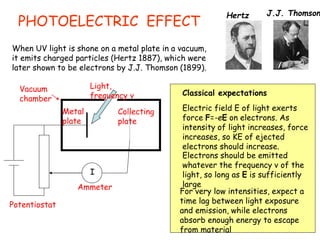
PHOTOELECTRIC EFFECT
When UV light is shone on a metal plate in a vacuum,
it emits charged particles (Hertz 1887), which were
later shown to be electrons by J.J. Thomson (1899).
Electric field E of light exerts
force F=-eE on electrons. As
intensity of light increases, force
increases, so KE of ejected
electrons should increase.
Electrons should be emitted
whatever the frequency ν of the
light, so long as E is sufficiently
large
For very low intensities, expect a
time lag between light exposure
and emission, while electrons
absorb enough energy to escape
from material
Classical expectations
Hertz J.J. Thomson
I
Vacuum
chamber
Metal
plate
Collecting
plate
Ammeter
Potentiostat
Light,
frequency ν
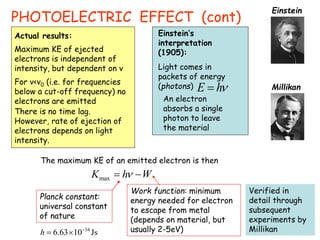
PHOTOELECTRIC EFFECT (cont)
The maximum KE of an emitted electron is then
max
K h W

 
Work function: minimum
energy needed for electron
to escape from metal
(depends on material, but
usually 2-5eV)
Planck constant:
universal constant
of nature
34
6.63 10 Js
h 
 
Einstein
Millikan
Verified in
detail through
subsequent
experiments by
Millikan
Maximum KE of ejected
electrons is independent of
intensity, but dependent on ν
For ν<ν0 (i.e. for frequencies
below a cut-off frequency) no
electrons are emitted
There is no time lag.
However, rate of ejection of
electrons depends on light
intensity.
Actual results:
E h

Einstein’s
interpretation
(1905):
Light comes in
packets of energy
(photons)
An electron
absorbs a single
photon to leave
the material
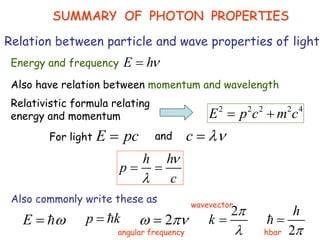
SUMMARY OF PHOTON PROPERTIES
E h

h h
p
c


 
E 
 p k

2
h


2
k



Energy and frequency
Also have relation between momentum and wavelength
2 2 2 2 4
E p c m c
 
c 

Relation between particle and wave properties of light
Relativistic formula relating
energy and momentum
E pc

For light and
Also commonly write these as
2
 

angular frequency
wavevector
hbar
COMPTON SCATTERING
X-ray source
Target
Crystal
(measure
wavelenght)
Collimator
(selects angle)
θ
Compton (1923) measured intensity of scattered X-
rays from solid target, as function of wavelength for
different angles. He won the 1927 Nobel prize.
Result: peak in scattered
radiation shifts to longer
wavelength than source. Amount
depends on θ (but not on the
target material). A.H. Compton, Phys. Rev. 22 409 (1923)
Detector
Compton
COMPTON SCATTERING (cont)
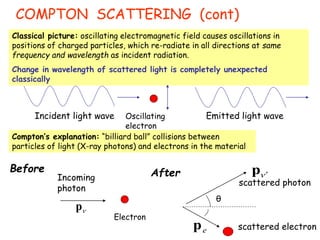
Compton’s explanation: “billiard ball” collisions between
particles of light (X-ray photons) and electrons in the material
Classical picture: oscillating electromagnetic field causes oscillations in
positions of charged particles, which re-radiate in all directions at same
frequency and wavelength as incident radiation.
Change in wavelength of scattered light is completely unexpected
classically
θ
e
p
 
p
Before After
Electron
Incoming
photon

p
scattered photon
scattered electron
Oscillating
electron
Incident light wave Emitted light wave
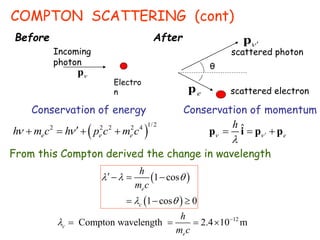
Conservation of energy Conservation of momentum
 
1/2
2 2 2 2 4
e e e
h m c h p c m c
 
    ˆ
e
h
 


  
p i p p
 
 
1 cos
1 cos 0
e
c
h
m c
  
 
  
  
12
Compton wavelength 2.4 10 m
c
e
h
m c
 
   
From this Compton derived the change in wavelength
θ
e
p
 
p
Before After
Electro
n
Incoming
photon

p
scattered photon
scattered electron
COMPTON SCATTERING (cont)
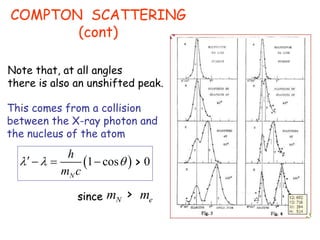
Note that, at all angles
there is also an unshifted peak.
This comes from a collision
between the X-ray photon and
the nucleus of the atom
 
1 cos 0
N
h
m c
  
  
N e
m m
since
COMPTON SCATTERING
(cont)
>
>
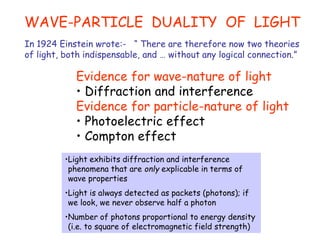
WAVE-PARTICLE DUALITY OF LIGHT
In 1924 Einstein wrote:- “ There are therefore now two theories
of light, both indispensable, and … without any logical connection.”
Evidence for wave-nature of light
• Diffraction and interference
Evidence for particle-nature of light
• Photoelectric effect
• Compton effect
•Light exhibits diffraction and interference
phenomena that are only explicable in terms of
wave properties
•Light is always detected as packets (photons); if
we look, we never observe half a photon
•Number of photons proportional to energy density
(i.e. to square of electromagnetic field strength)
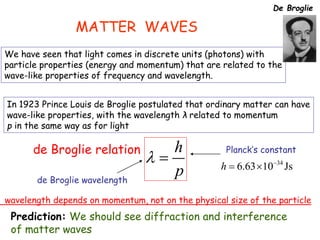
We have seen that light comes in discrete units (photons) with
particle properties (energy and momentum) that are related to the
wave-like properties of frequency and wavelength.
MATTER WAVES
h
p
 
In 1923 Prince Louis de Broglie postulated that ordinary matter can have
wave-like properties, with the wavelength λ related to momentum
p in the same way as for light
de Broglie wavelength
de Broglie relation
34
6.63 10 Js
h 
 
Planck’s constant
Prediction: We should see diffraction and interference
of matter waves
De Broglie
wavelength depends on momentum, not on the physical size of the particle
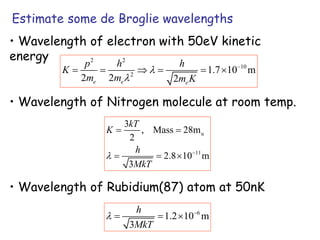
Estimate some de Broglie wavelengths
• Wavelength of electron with 50eV kinetic
energy 2 2
10
2
1.7 10 m
2 2 2
e e e
p h h
K
m m m K



     
• Wavelength of Nitrogen molecule at room temp.
u
11
3
, Mass 28m
2
2.8 10 m
3
kT
K
h
MkT
 
 
  
• Wavelength of Rubidium(87) atom at 50nK
6
1.2 10 m
3
h
MkT
 
  
Davisson
G.P.
Thomson
Davisson, C. J.,
"Are Electrons
Waves?,"
Franklin
Institute
Journal 205,
597 (1928)
The Davisson-Germer
experiment: scattering a beam
of electrons from a Ni crystal.
Davisson got the 1937 Nobel
prize.
At fixed accelerating voltage
(fixed electron energy) find a
pattern of sharp reflected beams
from the crystal
At fixed angle, find sharp peaks in
intensity as a function of electron
energy
G.P. Thomson performed similar
interference experiments with thin-
film samples
θi
θi
ELECTRON DIFFRACTION
The Davisson-Germer experiment (1927)
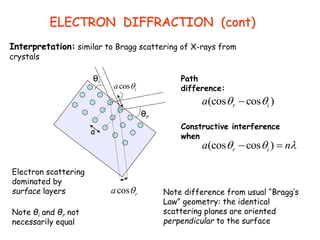
Interpretation: similar to Bragg scattering of X-rays from
crystals
a
θi
θr
cos i
a 
cos r
a 
Path
difference:
Constructive interference
when
Note difference from usual “Bragg’s
Law” geometry: the identical
scattering planes are oriented
perpendicular to the surface
Note θi and θr not
necessarily equal
Electron scattering
dominated by
surface layers
ELECTRON DIFFRACTION (cont)
(cos cos )
r i
a  

(cos cos )
r i
a n
  
 
sin
d 
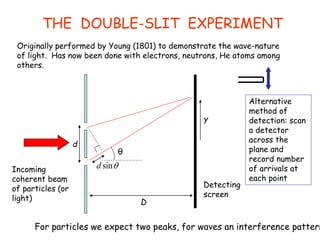
Originally performed by Young (1801) to demonstrate the wave-nature
of light. Has now been done with electrons, neutrons, He atoms among
others.
D
θ
d
Detecting
screen
Incoming
coherent beam
of particles (or
light)
y
Alternative
method of
detection: scan
a detector
across the
plane and
record number
of arrivals at
each point
THE DOUBLE-SLIT EXPERIMENT
For particles we expect two peaks, for waves an interference pattern
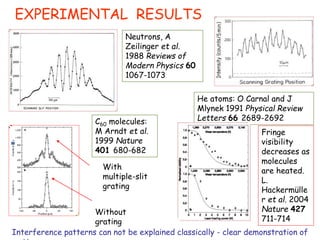
Neutrons, A
Zeilinger et al.
1988 Reviews of
Modern Physics 60
1067-1073
He atoms: O Carnal and J
Mlynek 1991 Physical Review
Letters 66 2689-2692
C60 molecules:
M Arndt et al.
1999 Nature
401 680-682
With
multiple-slit
grating
Without
grating
EXPERIMENTAL RESULTS
Interference patterns can not be explained classically - clear demonstration of
Fringe
visibility
decreases as
molecules
are heated.
L.
Hackermülle
r et al. 2004
Nature 427
711-714
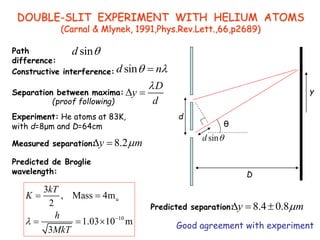
DOUBLE-SLIT EXPERIMENT WITH HELIUM ATOMS
(Carnal & Mlynek, 1991,Phys.Rev.Lett.,66,p2689)
sin
d 
D
θ
d
y
Path
difference:
Constructive interference:
sin
d 
sin
d n
 

Experiment: He atoms at 83K,
with d=8μm and D=64cm
8.4 0.8
y m

  
D
y
d

 
8.2
y m

 
Separation between maxima:
Measured separation:
Predicted separation:
u
10
3
, Mass 4m
2
1.03 10 m
3
kT
K
h
MkT
 
 
  
Predicted de Broglie
wavelength:
Good agreement with experiment
(proof following)
sin
d 
D
θ
d
y
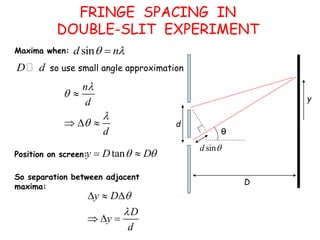
Maxima when: sin
d n
 

y D
D
y
d


  
  
Position on screen: tan
y D D
 
 
n
d
d





  
D d so use small angle approximation
So separation between adjacent
maxima:
FRINGE SPACING IN
DOUBLE-SLIT EXPERIMENT
INTERPRETATION
• The flux of particles arriving at the slits can be reduced so that only
one particle arrives at a time. Interference fringes are still observed!
Wave-behaviour can be shown by a single atom.
Each particle goes through both slits at once.
A matter wave can interfere with itself.
Hence matter-waves are distinct from H2O molecules collectively
giving rise to water waves.
• Wavelength of matter wave unconnected to any internal size of
particle. Instead it is determined by the momentum.
• If we try to find out which slit the particle goes through the
interference pattern vanishes!
We cannot see the wave/particle nature at the same time.
If we know which path the particle takes, we lose the fringes .
The importance of the two-slit experiment has been memorably summarized
by Richard Feynman: “…a phenomenon which is impossible, absolutely impossible,
to explain in any classical way, and which has in it the heart of quantum mechanics.
In reality it contains the only mystery.”
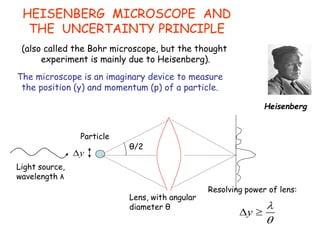
HEISENBERG MICROSCOPE AND
THE UNCERTAINTY PRINCIPLE
(also called the Bohr microscope, but the thought
experiment is mainly due to Heisenberg).
The microscope is an imaginary device to measure
the position (y) and momentum (p) of a particle.
Heisenberg
θ/2
y

Light source,
wavelength λ
Particle
Lens, with angular
diameter θ
y


 
Resolving power of lens:
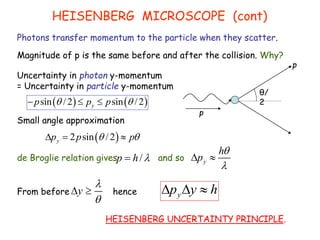
Photons transfer momentum to the particle when they scatter.
Magnitude of p is the same before and after the collision. Why?
θ/
2
p
p
HEISENBERG MICROSCOPE (cont)
y
h
p


 
/
p h 

y
p y h
  
HEISENBERG UNCERTAINTY PRINCIPLE.
y


 
Uncertainty in photon y-momentum
= Uncertainty in particle y-momentum
   
sin /2 sin /2
y
p p p
 
  
 
2 sin /2
y
p p p
 
  
de Broglie relation gives
Small angle approximation
and so
From before hence
Point for discussion
The thought experiment seems to imply that,
while prior to experiment we have well defined
values, it is the act of measurement which
introduces the uncertainty by disturbing the
particle’s position and momentum.
Nowadays it is more widely accepted that quantum
uncertainty (lack of determinism) is intrinsic to
the theory.
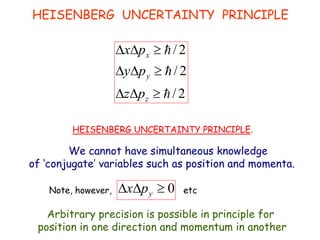
HEISENBERG UNCERTAINTY PRINCIPLE
/ 2
/ 2
/ 2
x
y
z
x p
y p
z p
  
  
  
We cannot have simultaneous knowledge
of ‘conjugate’ variables such as position and momenta.
HEISENBERG UNCERTAINTY PRINCIPLE.
0
y
x p
  
Note, however,
Arbitrary precision is possible in principle for
position in one direction and momentum in another
etc
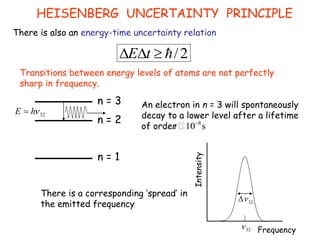
There is also an energy-time uncertainty relation
Transitions between energy levels of atoms are not perfectly
sharp in frequency.
/2
E t
  
n = 3
n = 2
n = 1
32
E h

32

Intensity
Frequency
32


HEISENBERG UNCERTAINTY PRINCIPLE
There is a corresponding ‘spread’ in
the emitted frequency
8
10 s
t 
An electron in n = 3 will spontaneously
decay to a lower level after a lifetime
of order
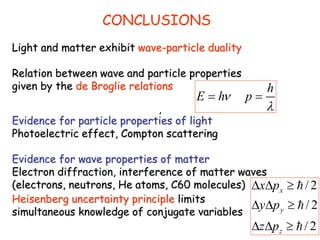
CONCLUSIONS
Light and matter exhibit wave-particle duality
Relation between wave and particle properties
given by the de Broglie relations
Evidence for particle properties of light
Photoelectric effect, Compton scattering
Evidence for wave properties of matter
Electron diffraction, interference of matter waves
(electrons, neutrons, He atoms, C60 molecules)
Heisenberg uncertainty principle limits
simultaneous knowledge of conjugate variables
h
E h p


 
,
/ 2
/ 2
/ 2
x
y
z
x p
y p
z p
  
  
  

lezione_3.ppt

  • 1.
    WAVE PARTICLE DUALITY Evidencefor wave-particle duality • Photoelectric effect • Compton effect • Electron diffraction • Interference of matter-waves Consequence: Heisenberg uncertainty principle
  • 2.
    PHOTOELECTRIC EFFECT When UVlight is shone on a metal plate in a vacuum, it emits charged particles (Hertz 1887), which were later shown to be electrons by J.J. Thomson (1899). Electric field E of light exerts force F=-eE on electrons. As intensity of light increases, force increases, so KE of ejected electrons should increase. Electrons should be emitted whatever the frequency ν of the light, so long as E is sufficiently large For very low intensities, expect a time lag between light exposure and emission, while electrons absorb enough energy to escape from material Classical expectations Hertz J.J. Thomson I Vacuum chamber Metal plate Collecting plate Ammeter Potentiostat Light, frequency ν
  • 3.
    PHOTOELECTRIC EFFECT (cont) Themaximum KE of an emitted electron is then max K h W    Work function: minimum energy needed for electron to escape from metal (depends on material, but usually 2-5eV) Planck constant: universal constant of nature 34 6.63 10 Js h    Einstein Millikan Verified in detail through subsequent experiments by Millikan Maximum KE of ejected electrons is independent of intensity, but dependent on ν For ν<ν0 (i.e. for frequencies below a cut-off frequency) no electrons are emitted There is no time lag. However, rate of ejection of electrons depends on light intensity. Actual results: E h  Einstein’s interpretation (1905): Light comes in packets of energy (photons) An electron absorbs a single photon to leave the material
  • 4.
    SUMMARY OF PHOTONPROPERTIES E h  h h p c     E   p k  2 h   2 k    Energy and frequency Also have relation between momentum and wavelength 2 2 2 2 4 E p c m c   c   Relation between particle and wave properties of light Relativistic formula relating energy and momentum E pc  For light and Also commonly write these as 2    angular frequency wavevector hbar
  • 5.
    COMPTON SCATTERING X-ray source Target Crystal (measure wavelenght) Collimator (selectsangle) θ Compton (1923) measured intensity of scattered X- rays from solid target, as function of wavelength for different angles. He won the 1927 Nobel prize. Result: peak in scattered radiation shifts to longer wavelength than source. Amount depends on θ (but not on the target material). A.H. Compton, Phys. Rev. 22 409 (1923) Detector Compton
  • 6.
    COMPTON SCATTERING (cont) Compton’sexplanation: “billiard ball” collisions between particles of light (X-ray photons) and electrons in the material Classical picture: oscillating electromagnetic field causes oscillations in positions of charged particles, which re-radiate in all directions at same frequency and wavelength as incident radiation. Change in wavelength of scattered light is completely unexpected classically θ e p   p Before After Electron Incoming photon  p scattered photon scattered electron Oscillating electron Incident light wave Emitted light wave
  • 7.
    Conservation of energyConservation of momentum   1/2 2 2 2 2 4 e e e h m c h p c m c       ˆ e h        p i p p     1 cos 1 cos 0 e c h m c            12 Compton wavelength 2.4 10 m c e h m c       From this Compton derived the change in wavelength θ e p   p Before After Electro n Incoming photon  p scattered photon scattered electron COMPTON SCATTERING (cont)
  • 8.
    Note that, atall angles there is also an unshifted peak. This comes from a collision between the X-ray photon and the nucleus of the atom   1 cos 0 N h m c       N e m m since COMPTON SCATTERING (cont) > >
  • 9.
    WAVE-PARTICLE DUALITY OFLIGHT In 1924 Einstein wrote:- “ There are therefore now two theories of light, both indispensable, and … without any logical connection.” Evidence for wave-nature of light • Diffraction and interference Evidence for particle-nature of light • Photoelectric effect • Compton effect •Light exhibits diffraction and interference phenomena that are only explicable in terms of wave properties •Light is always detected as packets (photons); if we look, we never observe half a photon •Number of photons proportional to energy density (i.e. to square of electromagnetic field strength)
  • 10.
    We have seenthat light comes in discrete units (photons) with particle properties (energy and momentum) that are related to the wave-like properties of frequency and wavelength. MATTER WAVES h p   In 1923 Prince Louis de Broglie postulated that ordinary matter can have wave-like properties, with the wavelength λ related to momentum p in the same way as for light de Broglie wavelength de Broglie relation 34 6.63 10 Js h    Planck’s constant Prediction: We should see diffraction and interference of matter waves De Broglie wavelength depends on momentum, not on the physical size of the particle
  • 11.
    Estimate some deBroglie wavelengths • Wavelength of electron with 50eV kinetic energy 2 2 10 2 1.7 10 m 2 2 2 e e e p h h K m m m K          • Wavelength of Nitrogen molecule at room temp. u 11 3 , Mass 28m 2 2.8 10 m 3 kT K h MkT        • Wavelength of Rubidium(87) atom at 50nK 6 1.2 10 m 3 h MkT     
  • 12.
    Davisson G.P. Thomson Davisson, C. J., "AreElectrons Waves?," Franklin Institute Journal 205, 597 (1928) The Davisson-Germer experiment: scattering a beam of electrons from a Ni crystal. Davisson got the 1937 Nobel prize. At fixed accelerating voltage (fixed electron energy) find a pattern of sharp reflected beams from the crystal At fixed angle, find sharp peaks in intensity as a function of electron energy G.P. Thomson performed similar interference experiments with thin- film samples θi θi ELECTRON DIFFRACTION The Davisson-Germer experiment (1927)
  • 13.
    Interpretation: similar toBragg scattering of X-rays from crystals a θi θr cos i a  cos r a  Path difference: Constructive interference when Note difference from usual “Bragg’s Law” geometry: the identical scattering planes are oriented perpendicular to the surface Note θi and θr not necessarily equal Electron scattering dominated by surface layers ELECTRON DIFFRACTION (cont) (cos cos ) r i a    (cos cos ) r i a n     
  • 14.
    sin d  Originally performedby Young (1801) to demonstrate the wave-nature of light. Has now been done with electrons, neutrons, He atoms among others. D θ d Detecting screen Incoming coherent beam of particles (or light) y Alternative method of detection: scan a detector across the plane and record number of arrivals at each point THE DOUBLE-SLIT EXPERIMENT For particles we expect two peaks, for waves an interference pattern
  • 15.
    Neutrons, A Zeilinger etal. 1988 Reviews of Modern Physics 60 1067-1073 He atoms: O Carnal and J Mlynek 1991 Physical Review Letters 66 2689-2692 C60 molecules: M Arndt et al. 1999 Nature 401 680-682 With multiple-slit grating Without grating EXPERIMENTAL RESULTS Interference patterns can not be explained classically - clear demonstration of Fringe visibility decreases as molecules are heated. L. Hackermülle r et al. 2004 Nature 427 711-714
  • 16.
    DOUBLE-SLIT EXPERIMENT WITHHELIUM ATOMS (Carnal & Mlynek, 1991,Phys.Rev.Lett.,66,p2689) sin d  D θ d y Path difference: Constructive interference: sin d  sin d n    Experiment: He atoms at 83K, with d=8μm and D=64cm 8.4 0.8 y m     D y d    8.2 y m    Separation between maxima: Measured separation: Predicted separation: u 10 3 , Mass 4m 2 1.03 10 m 3 kT K h MkT        Predicted de Broglie wavelength: Good agreement with experiment (proof following)
  • 17.
    sin d  D θ d y Maxima when:sin d n    y D D y d         Position on screen: tan y D D     n d d         D d so use small angle approximation So separation between adjacent maxima: FRINGE SPACING IN DOUBLE-SLIT EXPERIMENT
  • 18.
    DOUBLE-SLIT EXPERIMENT INTERPRETATION • Theflux of particles arriving at the slits can be reduced so that only one particle arrives at a time. Interference fringes are still observed! Wave-behaviour can be shown by a single atom. Each particle goes through both slits at once. A matter wave can interfere with itself. Hence matter-waves are distinct from H2O molecules collectively giving rise to water waves. • Wavelength of matter wave unconnected to any internal size of particle. Instead it is determined by the momentum. • If we try to find out which slit the particle goes through the interference pattern vanishes! We cannot see the wave/particle nature at the same time. If we know which path the particle takes, we lose the fringes . The importance of the two-slit experiment has been memorably summarized by Richard Feynman: “…a phenomenon which is impossible, absolutely impossible, to explain in any classical way, and which has in it the heart of quantum mechanics. In reality it contains the only mystery.”
  • 19.
    HEISENBERG MICROSCOPE AND THEUNCERTAINTY PRINCIPLE (also called the Bohr microscope, but the thought experiment is mainly due to Heisenberg). The microscope is an imaginary device to measure the position (y) and momentum (p) of a particle. Heisenberg θ/2 y  Light source, wavelength λ Particle Lens, with angular diameter θ y     Resolving power of lens:
  • 20.
    Photons transfer momentumto the particle when they scatter. Magnitude of p is the same before and after the collision. Why? θ/ 2 p p HEISENBERG MICROSCOPE (cont) y h p     / p h   y p y h    HEISENBERG UNCERTAINTY PRINCIPLE. y     Uncertainty in photon y-momentum = Uncertainty in particle y-momentum     sin /2 sin /2 y p p p        2 sin /2 y p p p      de Broglie relation gives Small angle approximation and so From before hence
  • 21.
    Point for discussion Thethought experiment seems to imply that, while prior to experiment we have well defined values, it is the act of measurement which introduces the uncertainty by disturbing the particle’s position and momentum. Nowadays it is more widely accepted that quantum uncertainty (lack of determinism) is intrinsic to the theory.
  • 22.
    HEISENBERG UNCERTAINTY PRINCIPLE /2 / 2 / 2 x y z x p y p z p          We cannot have simultaneous knowledge of ‘conjugate’ variables such as position and momenta. HEISENBERG UNCERTAINTY PRINCIPLE. 0 y x p    Note, however, Arbitrary precision is possible in principle for position in one direction and momentum in another etc
  • 23.
    There is alsoan energy-time uncertainty relation Transitions between energy levels of atoms are not perfectly sharp in frequency. /2 E t    n = 3 n = 2 n = 1 32 E h  32  Intensity Frequency 32   HEISENBERG UNCERTAINTY PRINCIPLE There is a corresponding ‘spread’ in the emitted frequency 8 10 s t  An electron in n = 3 will spontaneously decay to a lower level after a lifetime of order
  • 24.
    CONCLUSIONS Light and matterexhibit wave-particle duality Relation between wave and particle properties given by the de Broglie relations Evidence for particle properties of light Photoelectric effect, Compton scattering Evidence for wave properties of matter Electron diffraction, interference of matter waves (electrons, neutrons, He atoms, C60 molecules) Heisenberg uncertainty principle limits simultaneous knowledge of conjugate variables h E h p     , / 2 / 2 / 2 x y z x p y p z p         