Planck’s Hypothesis
In 1900 Planck reported his discovery of
a formula that accurately described the
shape of a blackbody spectrum for all
wavelengths and temperatures.
Having found an emperical formula that fit
the observations, he then sought a
physical reason for the success of the
formula.
Planck’s thinking began by supposing
the existence of identical vibrating
oscillators with in the walls of a hot
cavity. When a large number of
oscillators such as might be found in
any ordinary sized object exchange
energy radiation is emitted when an
oscillator makes a transition from one
energy level to a lower one. Absorption
of radiation is an inverse process in
which the oscillator jumps from a lower
energy level to higher one.
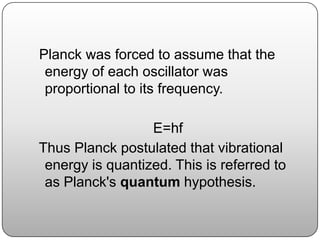
Planck was forced to assume that the
energy of each oscillator was
proportional to its frequency.
E=hf
Thus Planck postulated that vibrational
energy is quantized. This is referred to
as Planck's quantum hypothesis.
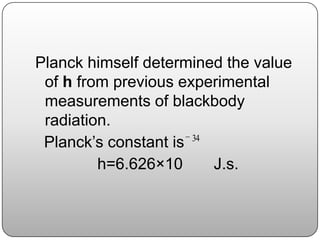
Planck himself determined the value
of h from previous experimental
measurements of blackbody
radiation.
Planck’s constant is
h=6.626×10 J.s.
34
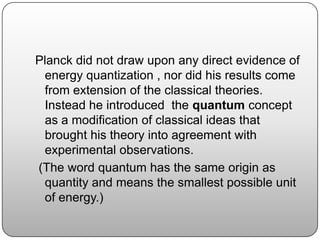
Planck did not draw upon any direct evidence of
energy quantization , nor did his results come
from extension of the classical theories.
Instead he introduced the quantum concept
as a modification of classical ideas that
brought his theory into agreement with
experimental observations.
(The word quantum has the same origin as
quantity and means the smallest possible unit
of energy.)
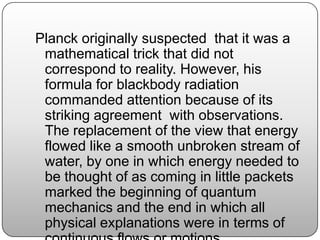
Planck originally suspected that it was a
mathematical trick that did not
correspond to reality. However, his
formula for blackbody radiation
commanded attention because of its
striking agreement with observations.
The replacement of the view that energy
flowed like a smooth unbroken stream of
water, by one in which energy needed to
be thought of as coming in little packets
marked the beginning of quantum
mechanics and the end in which all
physical explanations were in terms of
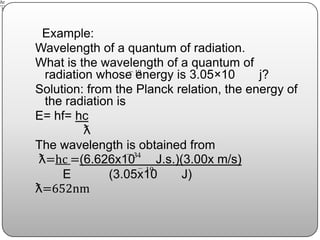
Example:
Wavelength of a quantum of radiation.
What is the wavelength of a quantum of
radiation whose energy is 3.05×10 j?
Solution: from the Planck relation, the energy of
the radiation is
E= hf= hc
ƛ
The wavelength is obtained from
ƛ=hc =(6.626x10 J.s.)(3.00x m/s)
E (3.05x10 J)
ƛ=652nm
19
34
19

Planck’s hypothesis

  • 1.
  • 2.
    In 1900 Planckreported his discovery of a formula that accurately described the shape of a blackbody spectrum for all wavelengths and temperatures. Having found an emperical formula that fit the observations, he then sought a physical reason for the success of the formula.
  • 3.
    Planck’s thinking beganby supposing the existence of identical vibrating oscillators with in the walls of a hot cavity. When a large number of oscillators such as might be found in any ordinary sized object exchange energy radiation is emitted when an oscillator makes a transition from one energy level to a lower one. Absorption of radiation is an inverse process in which the oscillator jumps from a lower energy level to higher one.
  • 4.
    Planck was forcedto assume that the energy of each oscillator was proportional to its frequency. E=hf Thus Planck postulated that vibrational energy is quantized. This is referred to as Planck's quantum hypothesis.
  • 5.
    Planck himself determinedthe value of h from previous experimental measurements of blackbody radiation. Planck’s constant is h=6.626×10 J.s. 34
  • 6.
    Planck did notdraw upon any direct evidence of energy quantization , nor did his results come from extension of the classical theories. Instead he introduced the quantum concept as a modification of classical ideas that brought his theory into agreement with experimental observations. (The word quantum has the same origin as quantity and means the smallest possible unit of energy.)
  • 7.
    Planck originally suspectedthat it was a mathematical trick that did not correspond to reality. However, his formula for blackbody radiation commanded attention because of its striking agreement with observations. The replacement of the view that energy flowed like a smooth unbroken stream of water, by one in which energy needed to be thought of as coming in little packets marked the beginning of quantum mechanics and the end in which all physical explanations were in terms of
  • 8.
    Example: Wavelength of aquantum of radiation. What is the wavelength of a quantum of radiation whose energy is 3.05×10 j? Solution: from the Planck relation, the energy of the radiation is E= hf= hc ƛ The wavelength is obtained from ƛ=hc =(6.626x10 J.s.)(3.00x m/s) E (3.05x10 J) ƛ=652nm 19 34 19