Quantum Cryptography & Key
Distribution
Gautam Agrawal
Nikhil Anil Kumar
Swathy Purushothaman
Wen Bo
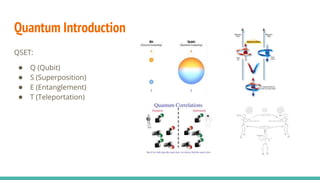
Quantum Introduction
QSET:
● Q (Qubit)
● S (Superposition)
● E (Entanglement)
● T (Teleportation)
Overview
● Modern cryptography algorithms are based over the fundamental process of
factoring large integers into their primes, which is said to be “INTRACTABLE”.
● But modern cryptography is vulnerable to both technological progress of
computing power and evolution in mathematics to quickly reverse one-way
functions such as that of factoring large integers.
● Quantum cryptography and how this technology contributes value to a defense-in-
depth strategy pertaining to completely secure key distribution.
○ the weaknesses of modern digital cryptosystems
○ the fundamental concepts of quantum cryptography
○ quantum key distribution
○ the real-world implementation of this technology along with its limitations
Limitation of Modern Cryptography
● Public key cryptosystems such as RSA and Diffie-Hellman are not based on
concrete mathematical proofs. Rather, these algorithms are considered to be
reasonably secure based on years of public scrutiny over the fundamental process
of factoring large integers into their primes
● While the DES algorithm, which has a 56 bit key, was once considered to be secure,
it is no longer thought of as such since advancements in technology have made it
trivial to defeat. The fact that powerful computers may crack DES in a few hours
served as a catalyst for the development of the replacement Advanced Encryption
Standard
● Risk is that public key cryptography may be vulnerable to the future technology
developments in computer processing.
● There is uncertainty whether a theorem may be developed in the future or perhaps
already available that can factor large numbers into their primes in a timely
manner.
● In sum, modern cryptography is vulnerable to both technological progress of
computing power and evolution in mathematics to quickly reverse one way
functions such as that of factoring large integers.
Quantum Cryptography
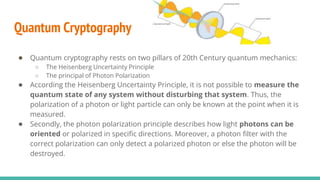
● Quantum cryptography rests on two pillars of 20th Century quantum mechanics:
○ The Heisenberg Uncertainty Principle
○ The principal of Photon Polarization
● According the Heisenberg Uncertainty Principle, it is not possible to measure the
quantum state of any system without disturbing that system. Thus, the
polarization of a photon or light particle can only be known at the point when it is
measured.
● Secondly, the photon polarization principle describes how light photons can be
oriented or polarized in specific directions. Moreover, a photon filter with the
correct polarization can only detect a polarized photon or else the photon will be
destroyed.
● These photons can be polarized at various orientations, and these orientations can
be used to represent bits encompassing ones and zeros. These bits can be used as
a reliable method of forming one time pads and support systems like PKI by
delivering keys in a secure fashion.
● The representation of bits through polarized photons is the foundation of
quantum cryptography that serves as the underlying principle of quantum key
distribution.
● Thus, while the strength of modern digital cryptography is dependent on the
computational difficulty of factoring large numbers, quantum cryptography is
completely dependent on the rules of physics and is also independent of the
processing power of current computing systems.
● It is no longer necessary to worry about the computing power of the malicious
attackers or development of theory to solve the large integer factorization problem
Quantum Key Distribution
● Here is an example of how quantum cryptography is used to distribute keys :-
Alice(Sender), Bob(Receiver) and Eve(Eavesdropper).
● Starting off Alice sends a random string of photons chosen in four random
polarizations.
● Bob for each photon will choose a random filter and use a photon receiver and
measure the polarization.
● Using an out of band communication system, Alice will inform Bob which
measurements were of the correct type. The photons that were incorrectly
measured will be discarded.
● It is important to point out that neither Alice nor Bob are able to determine what
the key will be in advance because the key is the product of both their random
choices.
Suppose malicious attacker attempts to infiltrate the
cryptosystem
● If the malicious attacker, Eve tries to eavesdrop, she too must also randomly select
either a rectilinear or diagonal filter to measure each of Alice’s photon.
● Eve will have an equal chance of selecting the right and wrong filter, and will not be
able to confirm with Alice the type of filter used.
● First, the Heisenberg Uncertainty principle means that information regarding
photons cannot be duplicated because photons will be destroyed once they are
measured or tampered with. Since photons are indivisible, once it hits a detector,
the photon no longer exists. Secondly, Alice and Bob must calculate beforehand
the amount of photons needed to form the encryption key so that the length of the
one-time pad will correspond to the length of the message.
Desirable QKD Attributes
● QKD offers a technique to come to a conclusion on a random sequence of bits with
to entities by also observing low probability of success upon eavesdropping.
1. Confidentiality
● The key agreement primitives in today’s internet architecture like Diffie-
Hellman may be broken at some point in the future
● Classic secret key systems have suffered from different problems, insider
threats and burden of distributing keying materials
● Assuming that QKD techniques are properly embedded into an overall secure
system, they can provide automatic distribution of keys that may offer security
superior to that of its competitors.
Desirable QKD Attributes
2. Authentication
● QKD in itself does not provide authentication.
● Current strategies in place :-
○ Prepositioning of secret keys at pairs of devices (Not appealing)
■ Prepositioned secret keys require some means of distributing these
keys before QKD itself begins, e.g., by human courier, which may be
costly and logistically challenging.
■ Vulnerable to denial of service attacks caused by exhaustion in
stockpile of key material
○ Hybrid QKD public key techniques (Not appealing)
■ Hybrid QKD-public key schemes inherit the possible vulnerabilities of
public key systems to cracking via quantum computers or
unexpected advances in mathematics.
Desirable QKD Attributes
3. Sufficient Rapid Key Delivery and Robustness
● Key distribution systems must deliver keys fast enough so that encryption
devices do not exhaust their supply of key bits.
● QKD’s systems achieve very low throughput on the order of 1,000 bits/second.
This is unacceptably low if one uses it as one time pads for high speed traffic
flows.
● It may well be acceptable if the keying material is used as input for less secure
(but often secure enough) algorithms such as the Advanced Encryption
Standard.
● QKD has provided a highly fragile service to date since QKD techniques have
implicitly been employed along a single point-to-point link.
● A meshed QKD network is inherently far more robust than any single point-to-
point link since it offers multiple paths for key distribution.
Desirable QKD Attributes
4. Distances and Location Independence
● The Internet’s security architecture does offer this feature, that any computer
on the Internet can form a security association with any other, agreeing upon
keys through the Internet IPsec protocols.
● This feature is notably lacking in QKD, which requires the two entities to have
a direct and unencumbered path for photons between them, and which can
only operate for a few tens of kilometers through fiber.
Desirable QKD Attributes
5. Resistance to Traffic Analysis
● An adversary will not be able to perform Traffic analysis without disturbing the
system. This is desirable to impede such analysis.
● Here QKD in general has had a rather weak approach since most setups have
assumed dedicated, point-to-point QKD links between communicating
entities, which thus clearly lays out the underlying key distribution
relationships.
QKD Protocols Implementation
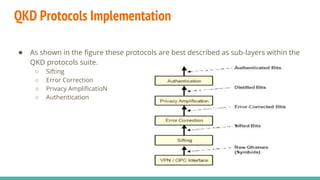
● As shown in the figure these protocols are best described as sub-layers within the
QKD protocols suite.
○ Sifting
○ Error Correction
○ Privacy AmplificatioN
○ Authentication
QKD Protocols Implementation
1. Sifting
● Sifting is the process whereby Alice and Bob window away all the obvious
“failed q bits” from a series of pulses
● Failures include the phases where Alice’s laser never transmitted and Bob’s
detectors never detected or the photons which were lost in transmission.
● They also include those symbols where Alice chose one basis for transmission
but Bob chose the other for receiving.
● Alice and Bob discard all the useless symbols from their internal storage,
leaving only those symbols that Bob received and for which Bob’s basis
matches Alice’s.
QKD Protocols Implementation
2. Error Correction
● Error correction allows Alice and Bob to determine all the “error bits” among
their shared, sifted bits, and correct them so that Alice and Bob share the
same sequence of error-corrected bits. Error bits are ones that Alice
transmitted as a 0 but Bob received as a 1, or vice versa.
● These bit errors can be caused by noise or by eavesdropping.
● evidence revealed in error detection and correction (e.g. parity bits) must be
assumed to be known to Eve, and thus to reduce the hidden entropy available
for key material
QKD Protocols Implementation
3. Privacy Amplification
● Privacy amplification is the process whereby Alice and Bob reduce Eve’s
knowledge of their shared bits to an acceptable level. This technique is also
often called advantage distillation.
● The side that initiates privacy amplification chooses a linear hash function
over the Galois Field GF[2n] where n is the number of bits as input, rounded
up to a multiple of 32.
● He then transmits four things to the other end—the number of bits m of the
shortened result, the (sparse) primitive polynomial of the Galois field, a
multiplier (n bits long), and an m-bit polynomial to add (i.e. a bit string to
exclusive-or) with the product.
● Each side then performs the corresponding hash and truncates the result to
m bits to perform privacy amplification.
QKD Protocols Implementation
4. Authentication
● Authentication allows Alice and Bob to guard against “man in the middle
attacks,” i.e., allows Alice to ensure that she is communicating with Bob (and
not Eve) and vice versa.
● Authentication must be performed on an ongoing basis for all key
management traffic, since Eve may insert herself into the conversation
between Alice and Bob at any stage in their communication.
● The original BB84 paper described the authentication problem and sketched a
solution to it based on universal families of hash functions, introduced by
Wegman and Carter. This approach requires Alice and Bob to already share a
small secret key, which is used to select a hash function from the family to
generate an authentication hash of the public correspondence between them.
By the nature of universal hashing, any party who didn’t know the secret key
would have an extremely low probability of being able to forge the
correspondence, even an adversary with unlimited computational power.
Conclusion
● DARPA is now starting to build multiple QKD links woven into an overall QKD
network that connects its QKD endpoints via a mesh of QKD relays or routers.
● When a given point-to-point QKD link within the relay mesh fails – e.g. fiber cut or
too much eavesdropping or noise abandons that link abandoned and another used
instead.
● This emerging DARPA Quantum Network can be engineered to be resilient even in
the face of active eavesdropping or other denial-of-service attacks.
● Such a design may be termed a “key transport network.” Looking to the later years
of the DARPA Quantum Network, the principal weakness in untrusted QKD
networks – limited geographic reach – may perhaps be countered by quantum
repeaters.
Demo
Quantum Network
References
1. (2022) Cs.stanford.edu. Available at:
https://cs.stanford.edu/people/adityaj/QuantumCryptography.pdf (Accessed: 7 May
2022).
2. https://www.quantum-network.com/applications/
3. https://www.quantum-network.com/quantum-networks/
4. https://qutech.nl/lab/quantum-cryptography-lab/
5. https://qiskit.org/textbook/ch-algorithms/quantum-key-distribution.html
6. https://scienceexchange.caltech.edu/topics/quantum-science-explained/entanglement

Quantum Cryptography & Key Distribution.pptx

  • 1.
    Quantum Cryptography &Key Distribution Gautam Agrawal Nikhil Anil Kumar Swathy Purushothaman Wen Bo
  • 2.
    Quantum Introduction QSET: ● Q(Qubit) ● S (Superposition) ● E (Entanglement) ● T (Teleportation)
  • 3.
    Overview ● Modern cryptographyalgorithms are based over the fundamental process of factoring large integers into their primes, which is said to be “INTRACTABLE”. ● But modern cryptography is vulnerable to both technological progress of computing power and evolution in mathematics to quickly reverse one-way functions such as that of factoring large integers. ● Quantum cryptography and how this technology contributes value to a defense-in- depth strategy pertaining to completely secure key distribution. ○ the weaknesses of modern digital cryptosystems ○ the fundamental concepts of quantum cryptography ○ quantum key distribution ○ the real-world implementation of this technology along with its limitations
  • 4.
    Limitation of ModernCryptography ● Public key cryptosystems such as RSA and Diffie-Hellman are not based on concrete mathematical proofs. Rather, these algorithms are considered to be reasonably secure based on years of public scrutiny over the fundamental process of factoring large integers into their primes ● While the DES algorithm, which has a 56 bit key, was once considered to be secure, it is no longer thought of as such since advancements in technology have made it trivial to defeat. The fact that powerful computers may crack DES in a few hours served as a catalyst for the development of the replacement Advanced Encryption Standard
  • 5.
    ● Risk isthat public key cryptography may be vulnerable to the future technology developments in computer processing. ● There is uncertainty whether a theorem may be developed in the future or perhaps already available that can factor large numbers into their primes in a timely manner. ● In sum, modern cryptography is vulnerable to both technological progress of computing power and evolution in mathematics to quickly reverse one way functions such as that of factoring large integers.
  • 6.
    Quantum Cryptography ● Quantumcryptography rests on two pillars of 20th Century quantum mechanics: ○ The Heisenberg Uncertainty Principle ○ The principal of Photon Polarization ● According the Heisenberg Uncertainty Principle, it is not possible to measure the quantum state of any system without disturbing that system. Thus, the polarization of a photon or light particle can only be known at the point when it is measured. ● Secondly, the photon polarization principle describes how light photons can be oriented or polarized in specific directions. Moreover, a photon filter with the correct polarization can only detect a polarized photon or else the photon will be destroyed.
  • 7.
    ● These photonscan be polarized at various orientations, and these orientations can be used to represent bits encompassing ones and zeros. These bits can be used as a reliable method of forming one time pads and support systems like PKI by delivering keys in a secure fashion. ● The representation of bits through polarized photons is the foundation of quantum cryptography that serves as the underlying principle of quantum key distribution. ● Thus, while the strength of modern digital cryptography is dependent on the computational difficulty of factoring large numbers, quantum cryptography is completely dependent on the rules of physics and is also independent of the processing power of current computing systems. ● It is no longer necessary to worry about the computing power of the malicious attackers or development of theory to solve the large integer factorization problem
  • 8.
    Quantum Key Distribution ●Here is an example of how quantum cryptography is used to distribute keys :- Alice(Sender), Bob(Receiver) and Eve(Eavesdropper). ● Starting off Alice sends a random string of photons chosen in four random polarizations. ● Bob for each photon will choose a random filter and use a photon receiver and measure the polarization. ● Using an out of band communication system, Alice will inform Bob which measurements were of the correct type. The photons that were incorrectly measured will be discarded. ● It is important to point out that neither Alice nor Bob are able to determine what the key will be in advance because the key is the product of both their random choices.
  • 9.
    Suppose malicious attackerattempts to infiltrate the cryptosystem ● If the malicious attacker, Eve tries to eavesdrop, she too must also randomly select either a rectilinear or diagonal filter to measure each of Alice’s photon. ● Eve will have an equal chance of selecting the right and wrong filter, and will not be able to confirm with Alice the type of filter used. ● First, the Heisenberg Uncertainty principle means that information regarding photons cannot be duplicated because photons will be destroyed once they are measured or tampered with. Since photons are indivisible, once it hits a detector, the photon no longer exists. Secondly, Alice and Bob must calculate beforehand the amount of photons needed to form the encryption key so that the length of the one-time pad will correspond to the length of the message.
  • 10.
    Desirable QKD Attributes ●QKD offers a technique to come to a conclusion on a random sequence of bits with to entities by also observing low probability of success upon eavesdropping. 1. Confidentiality ● The key agreement primitives in today’s internet architecture like Diffie- Hellman may be broken at some point in the future ● Classic secret key systems have suffered from different problems, insider threats and burden of distributing keying materials ● Assuming that QKD techniques are properly embedded into an overall secure system, they can provide automatic distribution of keys that may offer security superior to that of its competitors.
  • 11.
    Desirable QKD Attributes 2.Authentication ● QKD in itself does not provide authentication. ● Current strategies in place :- ○ Prepositioning of secret keys at pairs of devices (Not appealing) ■ Prepositioned secret keys require some means of distributing these keys before QKD itself begins, e.g., by human courier, which may be costly and logistically challenging. ■ Vulnerable to denial of service attacks caused by exhaustion in stockpile of key material ○ Hybrid QKD public key techniques (Not appealing) ■ Hybrid QKD-public key schemes inherit the possible vulnerabilities of public key systems to cracking via quantum computers or unexpected advances in mathematics.
  • 12.
    Desirable QKD Attributes 3.Sufficient Rapid Key Delivery and Robustness ● Key distribution systems must deliver keys fast enough so that encryption devices do not exhaust their supply of key bits. ● QKD’s systems achieve very low throughput on the order of 1,000 bits/second. This is unacceptably low if one uses it as one time pads for high speed traffic flows. ● It may well be acceptable if the keying material is used as input for less secure (but often secure enough) algorithms such as the Advanced Encryption Standard. ● QKD has provided a highly fragile service to date since QKD techniques have implicitly been employed along a single point-to-point link. ● A meshed QKD network is inherently far more robust than any single point-to- point link since it offers multiple paths for key distribution.
  • 13.
    Desirable QKD Attributes 4.Distances and Location Independence ● The Internet’s security architecture does offer this feature, that any computer on the Internet can form a security association with any other, agreeing upon keys through the Internet IPsec protocols. ● This feature is notably lacking in QKD, which requires the two entities to have a direct and unencumbered path for photons between them, and which can only operate for a few tens of kilometers through fiber.
  • 14.
    Desirable QKD Attributes 5.Resistance to Traffic Analysis ● An adversary will not be able to perform Traffic analysis without disturbing the system. This is desirable to impede such analysis. ● Here QKD in general has had a rather weak approach since most setups have assumed dedicated, point-to-point QKD links between communicating entities, which thus clearly lays out the underlying key distribution relationships.
  • 15.
    QKD Protocols Implementation ●As shown in the figure these protocols are best described as sub-layers within the QKD protocols suite. ○ Sifting ○ Error Correction ○ Privacy AmplificatioN ○ Authentication
  • 16.
    QKD Protocols Implementation 1.Sifting ● Sifting is the process whereby Alice and Bob window away all the obvious “failed q bits” from a series of pulses ● Failures include the phases where Alice’s laser never transmitted and Bob’s detectors never detected or the photons which were lost in transmission. ● They also include those symbols where Alice chose one basis for transmission but Bob chose the other for receiving. ● Alice and Bob discard all the useless symbols from their internal storage, leaving only those symbols that Bob received and for which Bob’s basis matches Alice’s.
  • 17.
    QKD Protocols Implementation 2.Error Correction ● Error correction allows Alice and Bob to determine all the “error bits” among their shared, sifted bits, and correct them so that Alice and Bob share the same sequence of error-corrected bits. Error bits are ones that Alice transmitted as a 0 but Bob received as a 1, or vice versa. ● These bit errors can be caused by noise or by eavesdropping. ● evidence revealed in error detection and correction (e.g. parity bits) must be assumed to be known to Eve, and thus to reduce the hidden entropy available for key material
  • 18.
    QKD Protocols Implementation 3.Privacy Amplification ● Privacy amplification is the process whereby Alice and Bob reduce Eve’s knowledge of their shared bits to an acceptable level. This technique is also often called advantage distillation. ● The side that initiates privacy amplification chooses a linear hash function over the Galois Field GF[2n] where n is the number of bits as input, rounded up to a multiple of 32. ● He then transmits four things to the other end—the number of bits m of the shortened result, the (sparse) primitive polynomial of the Galois field, a multiplier (n bits long), and an m-bit polynomial to add (i.e. a bit string to exclusive-or) with the product. ● Each side then performs the corresponding hash and truncates the result to m bits to perform privacy amplification.
  • 19.
    QKD Protocols Implementation 4.Authentication ● Authentication allows Alice and Bob to guard against “man in the middle attacks,” i.e., allows Alice to ensure that she is communicating with Bob (and not Eve) and vice versa. ● Authentication must be performed on an ongoing basis for all key management traffic, since Eve may insert herself into the conversation between Alice and Bob at any stage in their communication. ● The original BB84 paper described the authentication problem and sketched a solution to it based on universal families of hash functions, introduced by Wegman and Carter. This approach requires Alice and Bob to already share a small secret key, which is used to select a hash function from the family to generate an authentication hash of the public correspondence between them. By the nature of universal hashing, any party who didn’t know the secret key would have an extremely low probability of being able to forge the correspondence, even an adversary with unlimited computational power.
  • 20.
    Conclusion ● DARPA isnow starting to build multiple QKD links woven into an overall QKD network that connects its QKD endpoints via a mesh of QKD relays or routers. ● When a given point-to-point QKD link within the relay mesh fails – e.g. fiber cut or too much eavesdropping or noise abandons that link abandoned and another used instead. ● This emerging DARPA Quantum Network can be engineered to be resilient even in the face of active eavesdropping or other denial-of-service attacks. ● Such a design may be termed a “key transport network.” Looking to the later years of the DARPA Quantum Network, the principal weakness in untrusted QKD networks – limited geographic reach – may perhaps be countered by quantum repeaters.
  • 21.
  • 22.
    References 1. (2022) Cs.stanford.edu.Available at: https://cs.stanford.edu/people/adityaj/QuantumCryptography.pdf (Accessed: 7 May 2022). 2. https://www.quantum-network.com/applications/ 3. https://www.quantum-network.com/quantum-networks/ 4. https://qutech.nl/lab/quantum-cryptography-lab/ 5. https://qiskit.org/textbook/ch-algorithms/quantum-key-distribution.html 6. https://scienceexchange.caltech.edu/topics/quantum-science-explained/entanglement

Editor's Notes

  • #3 For Qubits and Entanglement give example of schrodinger's cat
  • #8 it is no longer necessary to make assumptions about the computing power of malicious attackers or the development of a theorem to quickly solve the large integer Factorization problem.