

Thinking of trip
7/23/2020
1
Dinsha Patel College of Nursing, Nadiad7/23/2020
2
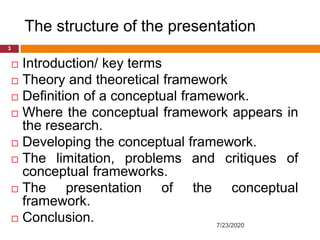
The structure of the presentation
 Introduction/ key terms
 Theory and theoretical framework
 Definition of a conceptual framework.
 Where the conceptual framework appears in
the research.
 Developing the conceptual framework.
 The limitation, problems and critiques of
conceptual frameworks.
 The presentation of the conceptual
framework.
 Conclusion. 7/23/2020
3
Introduction
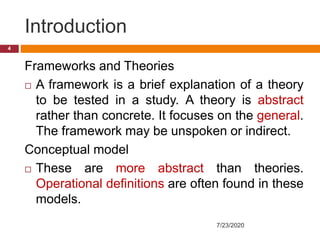
Frameworks and Theories
 A framework is a brief explanation of a theory
to be tested in a study. A theory is abstract
rather than concrete. It focuses on the general.
The framework may be unspoken or indirect.
Conceptual model
 These are more abstract than theories.
Operational definitions are often found in these
models.
7/23/2020
4
key terms
7/23/2020
5
 Theroy: is a set of interrelated concepts and
predicting the phenomenon.
 Model: a symbolic representation of some
phenomenon.
 Framework: is brief portion of theory, which
is going to be tested in quantitative study.
 Conceptual model: made up of concepts
and its relationship, shows variables, logical
and quantitative relationship.
key terms
7/23/2020
6
 Theoretical framework: it represent broad,
general explanation of relationship between
the concepts of the research study based on
an existing theory.
 Conceptual framework: it is constructed by
researcher’s own experience, previous
research findings or conceps of theories and
model
Theory
 Theories are constructed in order to
explain, predict the master phenomena
(e.g. relationships, events, or the
behavior). In many instances we are
constructing models of reality.
 A theory makes generalizations about
observations and consists of an
interrelated, coherent set of ideas and
models.
7/23/2020
7
“Traditional” Types of Theories
 “Grand or macro-theories” attempt to describe &
explain large segments of phenomenon (e.g.,
chaos theory, theory of evolution, Roger’s,
Orem’s, Newman’s)-
 “Middle-range” are more narrow/ restricted in
scope (e.g., decision-making, infant bonding)
 “Micro-range” link concrete concepts into a
statement that can be examined in practice &
research (hypotheses are examples here)
7/23/2020
8
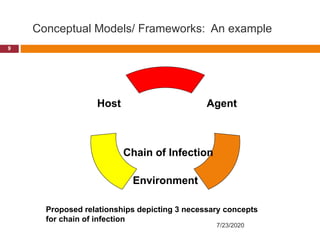
Conceptual Models/ Frameworks: An example
Agent
Environment
Host
Chain of Infection
Proposed relationships depicting 3 necessary concepts
for chain of infection
7/23/2020
9
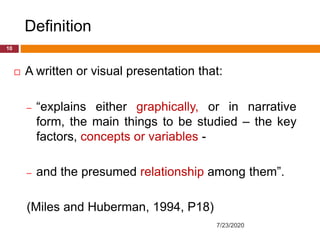
Definition
 A written or visual presentation that:
– “explains either graphically, or in narrative
form, the main things to be studied – the key
factors, concepts or variables -
– and the presumed relationship among them”.
(Miles and Huberman, 1994, P18)
7/23/2020
10
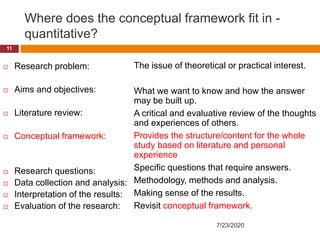
Where does the conceptual framework fit in -
quantitative?
 Research problem:
 Aims and objectives:
 Literature review:
 Conceptual framework:
 Research questions:
 Data collection and analysis:
 Interpretation of the results:
 Evaluation of the research:
The issue of theoretical or practical interest.
What we want to know and how the answer
may be built up.
A critical and evaluative review of the thoughts
and experiences of others.
Provides the structure/content for the whole
study based on literature and personal
experience
Specific questions that require answers.
Methodology, methods and analysis.
Making sense of the results.
Revisit conceptual framework.
7/23/2020
11
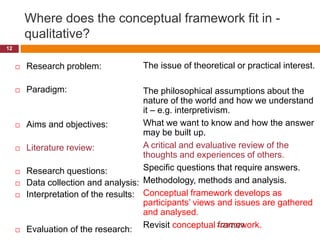
Where does the conceptual framework fit in -
qualitative?
 Research problem:
 Paradigm:
 Aims and objectives:
 Literature review:
 Research questions:
 Data collection and analysis:
 Interpretation of the results:
 Evaluation of the research:
The issue of theoretical or practical interest.
The philosophical assumptions about the
nature of the world and how we understand
it – e.g. interpretivism.
What we want to know and how the answer
may be built up.
A critical and evaluative review of the
thoughts and experiences of others.
Specific questions that require answers.
Methodology, methods and analysis.
Conceptual framework develops as
participants’ views and issues are gathered
and analysed.
Revisit conceptual framework.7/23/2020
12
Purposes:
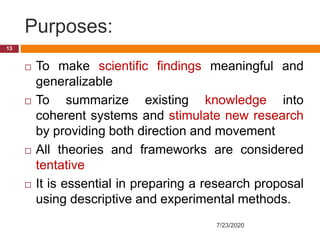
 To make scientific findings meaningful and
generalizable
 To summarize existing knowledge into
coherent systems and stimulate new research
by providing both direction and movement
 All theories and frameworks are considered
tentative
 It is essential in preparing a research proposal
using descriptive and experimental methods.
7/23/2020
13
Purposes:
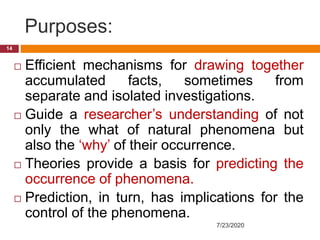
 Efficient mechanisms for drawing together
accumulated facts, sometimes from
separate and isolated investigations.
 Guide a researcher’s understanding of not
only the what of natural phenomena but
also the ‘why’ of their occurrence.
 Theories provide a basis for predicting the
occurrence of phenomena.
 Prediction, in turn, has implications for the
control of the phenomena.
7/23/2020
14
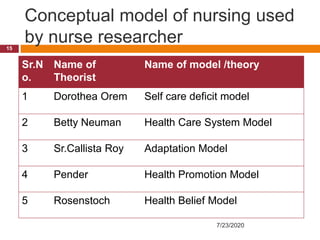
Conceptual model of nursing used
by nurse researcher
7/23/2020
15
Sr.N
o.
Name of
Theorist
Name of model /theory
1 Dorothea Orem Self care deficit model
2 Betty Neuman Health Care System Model
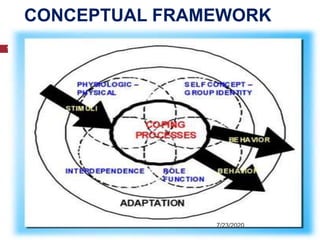
3 Sr.Callista Roy Adaptation Model
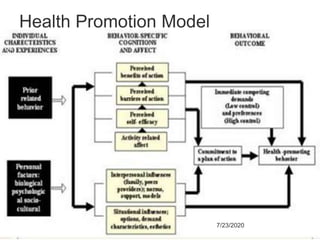
4 Pender Health Promotion Model
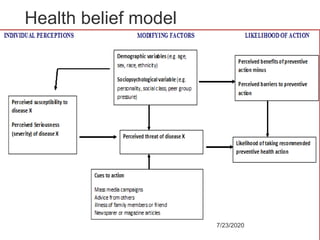
5 Rosenstoch Health Belief Model
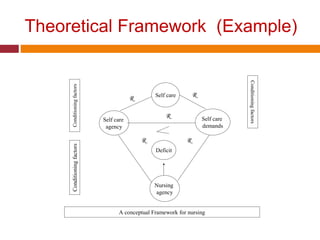
Theoretical Framework (Example)
Self care
Self care
agency
Self care
demands
Deficit
Nursing
agency
ConditioningfactorsConditioningfactors
Conditioningfactors
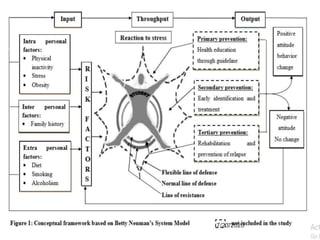
A conceptual Framework for nursing
R
R
R
R
R
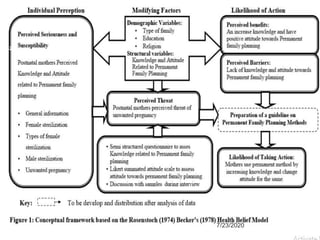
Health belief model
7/23/2020
17
Health Promotion Model
7/23/2020
18
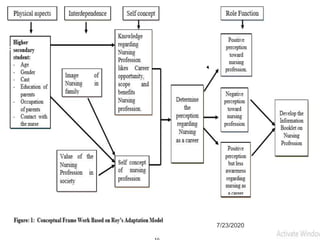
CONCEPTUAL FRAMEWORK
7/23/2020
19
How should a theoretical framework
formulated?
 Specifies the theory used as basis for the study
 Mentions the proponents of the theory
 Mention the main points emphasized in the
theory
 Supports his exposition of the theory by ideas
from other experts;
 Illustrates his theoretical framework by means
of a diagram; and,
 Restate his theoretical proposition in the study.
7/23/2020
20
Concept
 After formulating the theoretical framework, the
researcher has to develop the conceptual
framework of the study.
 A conceptual framework is an image or symbolic
representation of an abstract idea. Chinn and
Kramer (1999) define a concept as a “complex
mental formulation of experience”.
 While the theoretical framework is the theory on
which the study is based, the conceptual
framework is the operationalization of the theory.
7/23/2020
21
Conceptual framework
 Conceptual frameworks (theoretical frameworks)
are a type of intermediate theory that attempt to
connect to all aspects of inquiry (e.g., problem
definition, purpose, literature review,
methodology, data collection and analysis).
 Conceptual frameworks can act like maps that
give coherence to empirical inquiry.
 Because conceptual frameworks are potentially
so close to empirical inquiry, they take different
forms depending upon the research question or
problem.
7/23/2020
22
Conceptual framework
7/23/2020
23
 Conceptual framework are constructed by
using researcher’s own experiences,
previous research finding and concepts of
several theories and models
DEVELOPING CONCEPTUAL
FRAMEWORK
 Developing conceptual framework requires five main
steps:
1. Identifying the relevant concepts.
2. Defining those concepts.
3. Operationalising the concepts.
4. Identifying any moderating or intervening variables.
5. Identifying the relationship between variables.7/23/2020
24
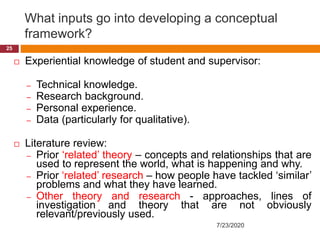
What inputs go into developing a conceptual
framework?
 Experiential knowledge of student and supervisor:
– Technical knowledge.
– Research background.
– Personal experience.
– Data (particularly for qualitative).
 Literature review:
– Prior ‘related’ theory – concepts and relationships that are
used to represent the world, what is happening and why.
– Prior ‘related’ research – how people have tackled ‘similar’
problems and what they have learned.
– Other theory and research - approaches, lines of
investigation and theory that are not obviously
relevant/previously used.
7/23/2020
25
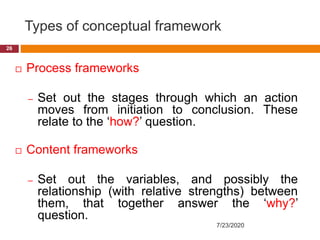
Types of conceptual framework
 Process frameworks
– Set out the stages through which an action
moves from initiation to conclusion. These
relate to the ‘how?’ question.
 Content frameworks
– Set out the variables, and possibly the
relationship (with relative strengths) between
them, that together answer the ‘why?’
question.
7/23/2020
26
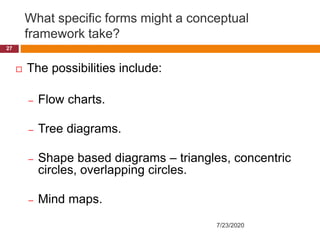
What specific forms might a conceptual
framework take?
 The possibilities include:
– Flow charts.
– Tree diagrams.
– Shape based diagrams – triangles, concentric
circles, overlapping circles.
– Mind maps.
7/23/2020
27
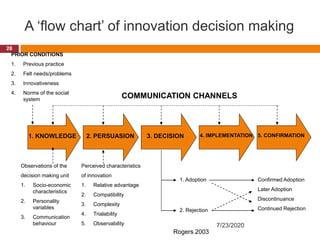
A ‘flow chart’ of innovation decision making
PRIOR CONDITIONS
1. Previous practice
2. Felt needs/problems
3. Innovativeness
4. Norms of the social
system
COMMUNICATION CHANNELS
1. KNOWLEDGE 2. PERSUASION 4. IMPLEMENTATION3. DECISION
1. Adoption
2. Rejection
Confirmed Adoption
Later Adoption
Discontinuance
Continued Rejection
Perceived characteristics
of innovation
1. Relative advantage
2. Compatibility
3. Complexity
4. Trialability
5. Observability
Observations of the
decision making unit
1. Socio-economic
characteristics
2. Personality
variables
3. Communication
behaviour
5. CONFIRMATION
Rogers 2003
7/23/2020
28
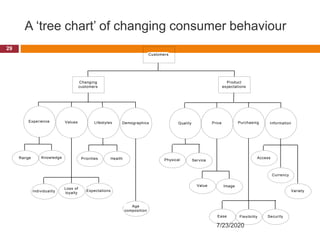
A ‘tree chart’ of changing consumer behaviour
Customers
Changing
customers
Experience Values Lifestyles Demographics
Product
expectations
Quality Price Purchasing Information
Physical Service
Ease Flexibility
Range
Individuality
Health
Age
composition
Security
Loss of
loyalty
Value Image
Priorities
Expectations
Knowledge Access
Currency
Variety
7/23/2020
29
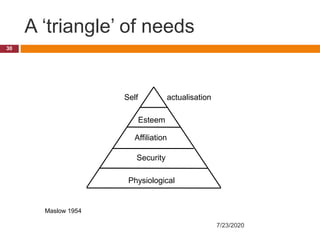
A ‘triangle’ of needs
Self actualisation
Esteem
Affiliation
Security
Physiological
Maslow 1954
7/23/2020
30
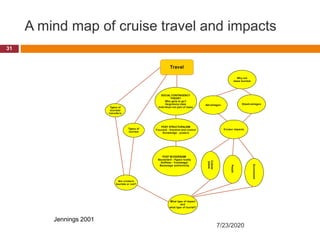
A mind map of cruise travel and impacts
Travel
Types of
tourists/
travellers
Types of
tourism
Are cruisers
tourists or not?
SOCIAL CONTINGENCY
THEORY
Who gets to go?
Hegemony class
Individual not part of mass
POST STRUCTURALISM
Foucault - freedom and control
Knowledge - powers
POST MODERNISM
Baudsilard - Hypes reality
Goffman - frontstage/
Backstage authenticity
Culture/
places
People
Environment
Cruiser impacts
Advantages Disadvantages
Why not
mass tourism
What type of impact
and
what type of tourist?
Jennings 2001
7/23/2020
31
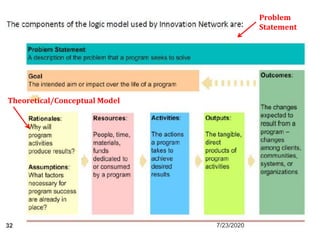
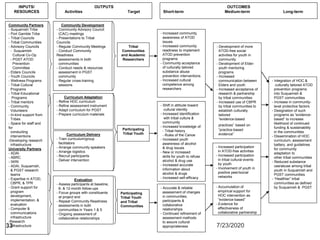
Problem
Statement
Theoretical/Conceptual Model
7/23/202032
Community Partners
- Suquamish Tribe
- Port Gamble Tribe
- Tribal Councils
- Tribal Communities
- Advisory Councils
- Suquamish
Cultural Co-Op
- PGST ATOD
Prevention
Committee
- Elders Councils
- Youth Councils
- Wellness Programs
- Tribal Cultural
Programs
- Tribal Educational
Programs
- Tribal mentors
- Community
Volunteers
- In-kind support from
Tribes
- Space for staff and
for
conducting
interventions
-Developing research
infrastructure
University Partners
- ADAI
- ABRC
- IWRI
- ADAI, Suquamish,
& PGST research
teams
- Expertise in ATOD,
CBPR, & TPR
- Grant support for
program
development,
implementation, &
evaluation
- Computer &
communications
infrastructure
-Research
infrastructure
Community Development
- Community Advisory Council
(CAC) meetings
- Presentations to Tribal
Councils
- Regular Community Meetings
- Conduct Community
Readiness
assessments in both
communities
- Conduct needs & resources
assessment in PGST
community
- Regular cross-training
sessions
Tribal
Communities
and Academic
Researchers
Curriculum Adaptation
- Refine HOC curriculum
- Refine assessment instrument
- Adapt curriculum for PGST
- Prepare curriculum materials
Participating
Tribal Youth
- Increased community
awareness of ATOD
issues
- Increased community
readiness to implement
ATOD prevention
programs
- Community acceptance
of culturally tailored
substance abuse
prevention interventions
- Increased cultural
competence among
researchers
INPUTS/
RESOURCES
OUTPUTS
Activities Target
OUTCOMES
Short-term Medium-term Long-term
Curriculum Delivery
- Train curriculum/group
facilitators
- Arrange community speakers
- Arrange logistics
- Recruit participants
- Deliver intervention
Evaluation
- Assess participants at baseline,
6- & 12-month follow-ups
- Focus groups with constituents
at project end
- Repeat Community Readiness
assessments in both
communities in Years 1 & 5
- Ongoing assessment of
collaborative relationships
- Increased participation
in ATOD-free activities
- Increased participation
in tribal cultural events
by youth
- Involvement of youth in
positive peer/social
networks
- Shift in attitude toward
cultural identity
- Increased identification
with tribal culture &
community
- Increased knowledge of:
- Tribal history
- Rules of the Canoe
- Increased youth
awareness of alcohol
& drug issues
- New or increased
skills for youth to refuse
alcohol & drug use
- Increased accurate
information about
alcohol & drugs
- Increased self-efficacy
- Accurate & reliable
assessment of changes
in communities,
participants &
collaborative
relationships
- Continued refinement of
assessment methods
to assure cultural
appropriateness
Participating
Tribal Youth
and Tribal
Communities
- Development of more
ATOD-free social
activities for youth in
community
- Development of Elder-
youth mentoring
programs
- Increased
communication between
Elders and youth
- Increased acceptance of
research & partnership
by tribal communities
- Increased use of CBPR
by tribal communities to
establish culturally
tailored
“evidence-based
practices” based on
“practice-based
evidence”
- Integration of HOC &
culturally tailored ATOD
prevention programs
into Suquamish &
PGST communities
- Increase in community-
level protective factors
- Designation of such
programs as “evidence-
based” to increase
likelihood of continued
funding & sustainability
in the communities
- Dissemination of HOC
curriculum, assessment
battery, and guidelines
for community
adaptation to
other tribal communities
- Reduced substance
use/abuse among tribal
youth in Suquamish and
PGST communities
- “Healthier” tribal
communities as defined
by Suquamish & PGST- Accumulation of
empirical support for
HOC intervention as
“evidence-based”
- Evidence for
effectiveness of
collaborative partnership
7/23/202033
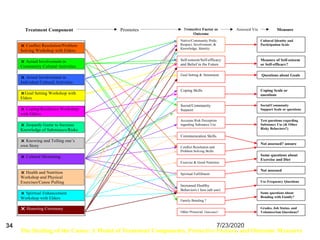
 Conflict Resolution/Problem
Solving Workshop with Elders
 Actual Involvement in
Community Cultural Activities
 Actual Involvement in
Individual Cultural Activities
Goal Setting Workshop with
Elders
 Coping/Resilience Workshop
with Elders
 Jeopardy Game to Increase
Knowledge of Substances/Risks
 Knowing and Telling one’s
own Story
 Cultural Mentoring
 Health and Nutrition
Workshop and Physical
Exercises/Canoe Pulling
 Spiritual Enhancement
Workshop with Elders
 Honoring Ceremony
Native/Community Pride,
Respect, Involvement, &
Knowledge, Identity
Self-esteem/Self-efficacy
and Belief in the Future
Goal Setting & Attainment
Social/Community
Support
Communication Skills
Conflict Resolution and
Problem Solving Skills
Exercise & Good Nutrition
Spiritual Fulfillment
Accurate Risk Perception
regarding Substance Use
Increased Healthy
Behaviors ( less sub use)
Coping Skills
Cultural Identity and
Participation Scale
Questions about Goals
Measure of Self-esteem
or Self-efficacy?
Coping Scale or
questions
Test questions regarding
Substance Use (& Other
Risky Behaviors?)
Social/Community
Support Scale or questions
Not assessed? unsure
Some questions about
Exercise and Diet
Not assessed
Some questions about
Bonding with Family?
Family Bonding ?
Other Prosocial Outcomes?
Grades, Job Status, and
Volunteerism Questions?
Use Frequency Questions
Treatment Component Promotes Protective Factor or
Outcome
Assessed Via Measure
Treatment Component Promotes
Protective Factor
or Outcome Assessed Via
The Healing of the Canoe: A Model of Treatment Components, Protective Factors, and Outcome Measures
7/23/202034
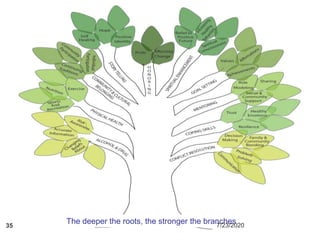
The deeper the roots, the stronger the branches7/23/202035
Why are conceptual frameworks useful?
 Conceptual frameworks provide researchers with:
– The ability to move beyond descriptions of ‘what’ to explanations
of ‘why’ and ‘how’.
– A means of setting out an explanation set that might be used to
define and make sense of the data that flow from the research
question.
– An filtering tool for selecting appropriate research questions and
related data collection methods.
– A reference point/structure for the discussion of the literature,
methodology and results.
– The boundaries of the work.
7/23/2020
36
What are the limitations of a conceptual
framework?
 Conceptual frameworks, however, also have problems in that the
framework:
– Is influenced by the experience and knowledge of the individual –
initial bias.
– Once developed will influence the researcher’s thinking and may
result in some things being given prominence and others being
ignored – ongoing bias.
 The solution is to revisit the conceptual framework, particularly at the
end when evaluating your work.
7/23/2020
37
 Inappropriate framework
 Disconnected framework
 Multiple frameworks
 Unidentified framework
Problems with Frameworks
7/23/202038
Critiquing Criteria For Theories, Conceptual
Models & Frameworks
 Is it clearly identified & transparent to the
reader?
 Is it consistent with a nursing perspective?
 Is it appropriate to guide the research
question(s) of interest?
 Are concepts/ variables clearly defined?
 Are the links consistent with concepts being
studied and the methods of measurements?
 Are the results (data, findings) examined &
interpreted employing these theories,
conceptual models or frameworks?
7/23/2020
39
7/23/2020
40
7/23/2020
41
7/23/2020
42
7/23/2020
43
CONCLUSION
Theories and conceptual frameworks provide
direction and guidance for structuring
professional nursing practice, education and
research
References
1. Botha, M.E. (1989) Theory Development in perspective : The
role of conceptual frameworks and models in theory
development, Journal of Advanced Nursing, 14(1), 49-55
2. Bwens N. & Grove, S.K. (1997). The practice of Nursing
Research, 3rd Ed. Philadelphia : W.B. Saunders Company.
3. Heath, D.L. & Reid-Finlay, M.M. (1988). A Conceputal
framework for Nursing Management of Pain, Contemp Nurse,
June, 7(2); 68-71 (Abstract)
4. Meleis, A.L. (1997), Theoretical Nursing : Development and
progress, 3rd Ed. Philadelphia; Lippincott.
5. Stulbergen, A.K. & Sarephire, A. & Roberta.G. (2000) An
explanatory model of health promotion and quality of life in
chronic disabling conditions. Nursing Research, 49, 122-129.
THANK YOU

Development of conceptual framework in Nursing Research

  • 1.
  • 2.
    Dinsha Patel Collegeof Nursing, Nadiad7/23/2020 2
  • 3.
    The structure ofthe presentation  Introduction/ key terms  Theory and theoretical framework  Definition of a conceptual framework.  Where the conceptual framework appears in the research.  Developing the conceptual framework.  The limitation, problems and critiques of conceptual frameworks.  The presentation of the conceptual framework.  Conclusion. 7/23/2020 3
  • 4.
    Introduction Frameworks and Theories A framework is a brief explanation of a theory to be tested in a study. A theory is abstract rather than concrete. It focuses on the general. The framework may be unspoken or indirect. Conceptual model  These are more abstract than theories. Operational definitions are often found in these models. 7/23/2020 4
  • 5.
    key terms 7/23/2020 5  Theroy:is a set of interrelated concepts and predicting the phenomenon.  Model: a symbolic representation of some phenomenon.  Framework: is brief portion of theory, which is going to be tested in quantitative study.  Conceptual model: made up of concepts and its relationship, shows variables, logical and quantitative relationship.
  • 6.
    key terms 7/23/2020 6  Theoreticalframework: it represent broad, general explanation of relationship between the concepts of the research study based on an existing theory.  Conceptual framework: it is constructed by researcher’s own experience, previous research findings or conceps of theories and model
  • 7.
    Theory  Theories areconstructed in order to explain, predict the master phenomena (e.g. relationships, events, or the behavior). In many instances we are constructing models of reality.  A theory makes generalizations about observations and consists of an interrelated, coherent set of ideas and models. 7/23/2020 7
  • 8.
    “Traditional” Types ofTheories  “Grand or macro-theories” attempt to describe & explain large segments of phenomenon (e.g., chaos theory, theory of evolution, Roger’s, Orem’s, Newman’s)-  “Middle-range” are more narrow/ restricted in scope (e.g., decision-making, infant bonding)  “Micro-range” link concrete concepts into a statement that can be examined in practice & research (hypotheses are examples here) 7/23/2020 8
  • 9.
    Conceptual Models/ Frameworks:An example Agent Environment Host Chain of Infection Proposed relationships depicting 3 necessary concepts for chain of infection 7/23/2020 9
  • 10.
    Definition  A writtenor visual presentation that: – “explains either graphically, or in narrative form, the main things to be studied – the key factors, concepts or variables - – and the presumed relationship among them”. (Miles and Huberman, 1994, P18) 7/23/2020 10
  • 11.
    Where does theconceptual framework fit in - quantitative?  Research problem:  Aims and objectives:  Literature review:  Conceptual framework:  Research questions:  Data collection and analysis:  Interpretation of the results:  Evaluation of the research: The issue of theoretical or practical interest. What we want to know and how the answer may be built up. A critical and evaluative review of the thoughts and experiences of others. Provides the structure/content for the whole study based on literature and personal experience Specific questions that require answers. Methodology, methods and analysis. Making sense of the results. Revisit conceptual framework. 7/23/2020 11
  • 12.
    Where does theconceptual framework fit in - qualitative?  Research problem:  Paradigm:  Aims and objectives:  Literature review:  Research questions:  Data collection and analysis:  Interpretation of the results:  Evaluation of the research: The issue of theoretical or practical interest. The philosophical assumptions about the nature of the world and how we understand it – e.g. interpretivism. What we want to know and how the answer may be built up. A critical and evaluative review of the thoughts and experiences of others. Specific questions that require answers. Methodology, methods and analysis. Conceptual framework develops as participants’ views and issues are gathered and analysed. Revisit conceptual framework.7/23/2020 12
  • 13.
    Purposes:  To makescientific findings meaningful and generalizable  To summarize existing knowledge into coherent systems and stimulate new research by providing both direction and movement  All theories and frameworks are considered tentative  It is essential in preparing a research proposal using descriptive and experimental methods. 7/23/2020 13
  • 14.
    Purposes:  Efficient mechanismsfor drawing together accumulated facts, sometimes from separate and isolated investigations.  Guide a researcher’s understanding of not only the what of natural phenomena but also the ‘why’ of their occurrence.  Theories provide a basis for predicting the occurrence of phenomena.  Prediction, in turn, has implications for the control of the phenomena. 7/23/2020 14
  • 15.
    Conceptual model ofnursing used by nurse researcher 7/23/2020 15 Sr.N o. Name of Theorist Name of model /theory 1 Dorothea Orem Self care deficit model 2 Betty Neuman Health Care System Model 3 Sr.Callista Roy Adaptation Model 4 Pender Health Promotion Model 5 Rosenstoch Health Belief Model
  • 16.
    Theoretical Framework (Example) Selfcare Self care agency Self care demands Deficit Nursing agency ConditioningfactorsConditioningfactors Conditioningfactors A conceptual Framework for nursing R R R R R
  • 17.
  • 18.
  • 19.
  • 20.
    How should atheoretical framework formulated?  Specifies the theory used as basis for the study  Mentions the proponents of the theory  Mention the main points emphasized in the theory  Supports his exposition of the theory by ideas from other experts;  Illustrates his theoretical framework by means of a diagram; and,  Restate his theoretical proposition in the study. 7/23/2020 20
  • 21.
    Concept  After formulatingthe theoretical framework, the researcher has to develop the conceptual framework of the study.  A conceptual framework is an image or symbolic representation of an abstract idea. Chinn and Kramer (1999) define a concept as a “complex mental formulation of experience”.  While the theoretical framework is the theory on which the study is based, the conceptual framework is the operationalization of the theory. 7/23/2020 21
  • 22.
    Conceptual framework  Conceptualframeworks (theoretical frameworks) are a type of intermediate theory that attempt to connect to all aspects of inquiry (e.g., problem definition, purpose, literature review, methodology, data collection and analysis).  Conceptual frameworks can act like maps that give coherence to empirical inquiry.  Because conceptual frameworks are potentially so close to empirical inquiry, they take different forms depending upon the research question or problem. 7/23/2020 22
  • 23.
    Conceptual framework 7/23/2020 23  Conceptualframework are constructed by using researcher’s own experiences, previous research finding and concepts of several theories and models
  • 24.
    DEVELOPING CONCEPTUAL FRAMEWORK  Developingconceptual framework requires five main steps: 1. Identifying the relevant concepts. 2. Defining those concepts. 3. Operationalising the concepts. 4. Identifying any moderating or intervening variables. 5. Identifying the relationship between variables.7/23/2020 24
  • 25.
    What inputs gointo developing a conceptual framework?  Experiential knowledge of student and supervisor: – Technical knowledge. – Research background. – Personal experience. – Data (particularly for qualitative).  Literature review: – Prior ‘related’ theory – concepts and relationships that are used to represent the world, what is happening and why. – Prior ‘related’ research – how people have tackled ‘similar’ problems and what they have learned. – Other theory and research - approaches, lines of investigation and theory that are not obviously relevant/previously used. 7/23/2020 25
  • 26.
    Types of conceptualframework  Process frameworks – Set out the stages through which an action moves from initiation to conclusion. These relate to the ‘how?’ question.  Content frameworks – Set out the variables, and possibly the relationship (with relative strengths) between them, that together answer the ‘why?’ question. 7/23/2020 26
  • 27.
    What specific formsmight a conceptual framework take?  The possibilities include: – Flow charts. – Tree diagrams. – Shape based diagrams – triangles, concentric circles, overlapping circles. – Mind maps. 7/23/2020 27
  • 28.
    A ‘flow chart’of innovation decision making PRIOR CONDITIONS 1. Previous practice 2. Felt needs/problems 3. Innovativeness 4. Norms of the social system COMMUNICATION CHANNELS 1. KNOWLEDGE 2. PERSUASION 4. IMPLEMENTATION3. DECISION 1. Adoption 2. Rejection Confirmed Adoption Later Adoption Discontinuance Continued Rejection Perceived characteristics of innovation 1. Relative advantage 2. Compatibility 3. Complexity 4. Trialability 5. Observability Observations of the decision making unit 1. Socio-economic characteristics 2. Personality variables 3. Communication behaviour 5. CONFIRMATION Rogers 2003 7/23/2020 28
  • 29.
    A ‘tree chart’of changing consumer behaviour Customers Changing customers Experience Values Lifestyles Demographics Product expectations Quality Price Purchasing Information Physical Service Ease Flexibility Range Individuality Health Age composition Security Loss of loyalty Value Image Priorities Expectations Knowledge Access Currency Variety 7/23/2020 29
  • 30.
    A ‘triangle’ ofneeds Self actualisation Esteem Affiliation Security Physiological Maslow 1954 7/23/2020 30
  • 31.
    A mind mapof cruise travel and impacts Travel Types of tourists/ travellers Types of tourism Are cruisers tourists or not? SOCIAL CONTINGENCY THEORY Who gets to go? Hegemony class Individual not part of mass POST STRUCTURALISM Foucault - freedom and control Knowledge - powers POST MODERNISM Baudsilard - Hypes reality Goffman - frontstage/ Backstage authenticity Culture/ places People Environment Cruiser impacts Advantages Disadvantages Why not mass tourism What type of impact and what type of tourist? Jennings 2001 7/23/2020 31
  • 32.
  • 33.
    Community Partners - SuquamishTribe - Port Gamble Tribe - Tribal Councils - Tribal Communities - Advisory Councils - Suquamish Cultural Co-Op - PGST ATOD Prevention Committee - Elders Councils - Youth Councils - Wellness Programs - Tribal Cultural Programs - Tribal Educational Programs - Tribal mentors - Community Volunteers - In-kind support from Tribes - Space for staff and for conducting interventions -Developing research infrastructure University Partners - ADAI - ABRC - IWRI - ADAI, Suquamish, & PGST research teams - Expertise in ATOD, CBPR, & TPR - Grant support for program development, implementation, & evaluation - Computer & communications infrastructure -Research infrastructure Community Development - Community Advisory Council (CAC) meetings - Presentations to Tribal Councils - Regular Community Meetings - Conduct Community Readiness assessments in both communities - Conduct needs & resources assessment in PGST community - Regular cross-training sessions Tribal Communities and Academic Researchers Curriculum Adaptation - Refine HOC curriculum - Refine assessment instrument - Adapt curriculum for PGST - Prepare curriculum materials Participating Tribal Youth - Increased community awareness of ATOD issues - Increased community readiness to implement ATOD prevention programs - Community acceptance of culturally tailored substance abuse prevention interventions - Increased cultural competence among researchers INPUTS/ RESOURCES OUTPUTS Activities Target OUTCOMES Short-term Medium-term Long-term Curriculum Delivery - Train curriculum/group facilitators - Arrange community speakers - Arrange logistics - Recruit participants - Deliver intervention Evaluation - Assess participants at baseline, 6- & 12-month follow-ups - Focus groups with constituents at project end - Repeat Community Readiness assessments in both communities in Years 1 & 5 - Ongoing assessment of collaborative relationships - Increased participation in ATOD-free activities - Increased participation in tribal cultural events by youth - Involvement of youth in positive peer/social networks - Shift in attitude toward cultural identity - Increased identification with tribal culture & community - Increased knowledge of: - Tribal history - Rules of the Canoe - Increased youth awareness of alcohol & drug issues - New or increased skills for youth to refuse alcohol & drug use - Increased accurate information about alcohol & drugs - Increased self-efficacy - Accurate & reliable assessment of changes in communities, participants & collaborative relationships - Continued refinement of assessment methods to assure cultural appropriateness Participating Tribal Youth and Tribal Communities - Development of more ATOD-free social activities for youth in community - Development of Elder- youth mentoring programs - Increased communication between Elders and youth - Increased acceptance of research & partnership by tribal communities - Increased use of CBPR by tribal communities to establish culturally tailored “evidence-based practices” based on “practice-based evidence” - Integration of HOC & culturally tailored ATOD prevention programs into Suquamish & PGST communities - Increase in community- level protective factors - Designation of such programs as “evidence- based” to increase likelihood of continued funding & sustainability in the communities - Dissemination of HOC curriculum, assessment battery, and guidelines for community adaptation to other tribal communities - Reduced substance use/abuse among tribal youth in Suquamish and PGST communities - “Healthier” tribal communities as defined by Suquamish & PGST- Accumulation of empirical support for HOC intervention as “evidence-based” - Evidence for effectiveness of collaborative partnership 7/23/202033
  • 34.
     Conflict Resolution/Problem SolvingWorkshop with Elders  Actual Involvement in Community Cultural Activities  Actual Involvement in Individual Cultural Activities Goal Setting Workshop with Elders  Coping/Resilience Workshop with Elders  Jeopardy Game to Increase Knowledge of Substances/Risks  Knowing and Telling one’s own Story  Cultural Mentoring  Health and Nutrition Workshop and Physical Exercises/Canoe Pulling  Spiritual Enhancement Workshop with Elders  Honoring Ceremony Native/Community Pride, Respect, Involvement, & Knowledge, Identity Self-esteem/Self-efficacy and Belief in the Future Goal Setting & Attainment Social/Community Support Communication Skills Conflict Resolution and Problem Solving Skills Exercise & Good Nutrition Spiritual Fulfillment Accurate Risk Perception regarding Substance Use Increased Healthy Behaviors ( less sub use) Coping Skills Cultural Identity and Participation Scale Questions about Goals Measure of Self-esteem or Self-efficacy? Coping Scale or questions Test questions regarding Substance Use (& Other Risky Behaviors?) Social/Community Support Scale or questions Not assessed? unsure Some questions about Exercise and Diet Not assessed Some questions about Bonding with Family? Family Bonding ? Other Prosocial Outcomes? Grades, Job Status, and Volunteerism Questions? Use Frequency Questions Treatment Component Promotes Protective Factor or Outcome Assessed Via Measure Treatment Component Promotes Protective Factor or Outcome Assessed Via The Healing of the Canoe: A Model of Treatment Components, Protective Factors, and Outcome Measures 7/23/202034
  • 35.
    The deeper theroots, the stronger the branches7/23/202035
  • 36.
    Why are conceptualframeworks useful?  Conceptual frameworks provide researchers with: – The ability to move beyond descriptions of ‘what’ to explanations of ‘why’ and ‘how’. – A means of setting out an explanation set that might be used to define and make sense of the data that flow from the research question. – An filtering tool for selecting appropriate research questions and related data collection methods. – A reference point/structure for the discussion of the literature, methodology and results. – The boundaries of the work. 7/23/2020 36
  • 37.
    What are thelimitations of a conceptual framework?  Conceptual frameworks, however, also have problems in that the framework: – Is influenced by the experience and knowledge of the individual – initial bias. – Once developed will influence the researcher’s thinking and may result in some things being given prominence and others being ignored – ongoing bias.  The solution is to revisit the conceptual framework, particularly at the end when evaluating your work. 7/23/2020 37
  • 38.
     Inappropriate framework Disconnected framework  Multiple frameworks  Unidentified framework Problems with Frameworks 7/23/202038
  • 39.
    Critiquing Criteria ForTheories, Conceptual Models & Frameworks  Is it clearly identified & transparent to the reader?  Is it consistent with a nursing perspective?  Is it appropriate to guide the research question(s) of interest?  Are concepts/ variables clearly defined?  Are the links consistent with concepts being studied and the methods of measurements?  Are the results (data, findings) examined & interpreted employing these theories, conceptual models or frameworks? 7/23/2020 39
  • 40.
  • 41.
  • 42.
  • 43.
  • 44.
    CONCLUSION Theories and conceptualframeworks provide direction and guidance for structuring professional nursing practice, education and research
  • 45.
    References 1. Botha, M.E.(1989) Theory Development in perspective : The role of conceptual frameworks and models in theory development, Journal of Advanced Nursing, 14(1), 49-55 2. Bwens N. & Grove, S.K. (1997). The practice of Nursing Research, 3rd Ed. Philadelphia : W.B. Saunders Company. 3. Heath, D.L. & Reid-Finlay, M.M. (1988). A Conceputal framework for Nursing Management of Pain, Contemp Nurse, June, 7(2); 68-71 (Abstract) 4. Meleis, A.L. (1997), Theoretical Nursing : Development and progress, 3rd Ed. Philadelphia; Lippincott. 5. Stulbergen, A.K. & Sarephire, A. & Roberta.G. (2000) An explanatory model of health promotion and quality of life in chronic disabling conditions. Nursing Research, 49, 122-129.
  • 46.