 Cresswel:
“an inquiry into a social or human
problem based on testing a
theory composed of variables,
measured with numbers, and analyzed
with statistical procedures, in order to
determine whether the predictive
generalizations of the theory hold true”.
 Burns & Grove:
“a formal, objective, systematic process
in which numerical data are utilized to
obtain information about the world“.
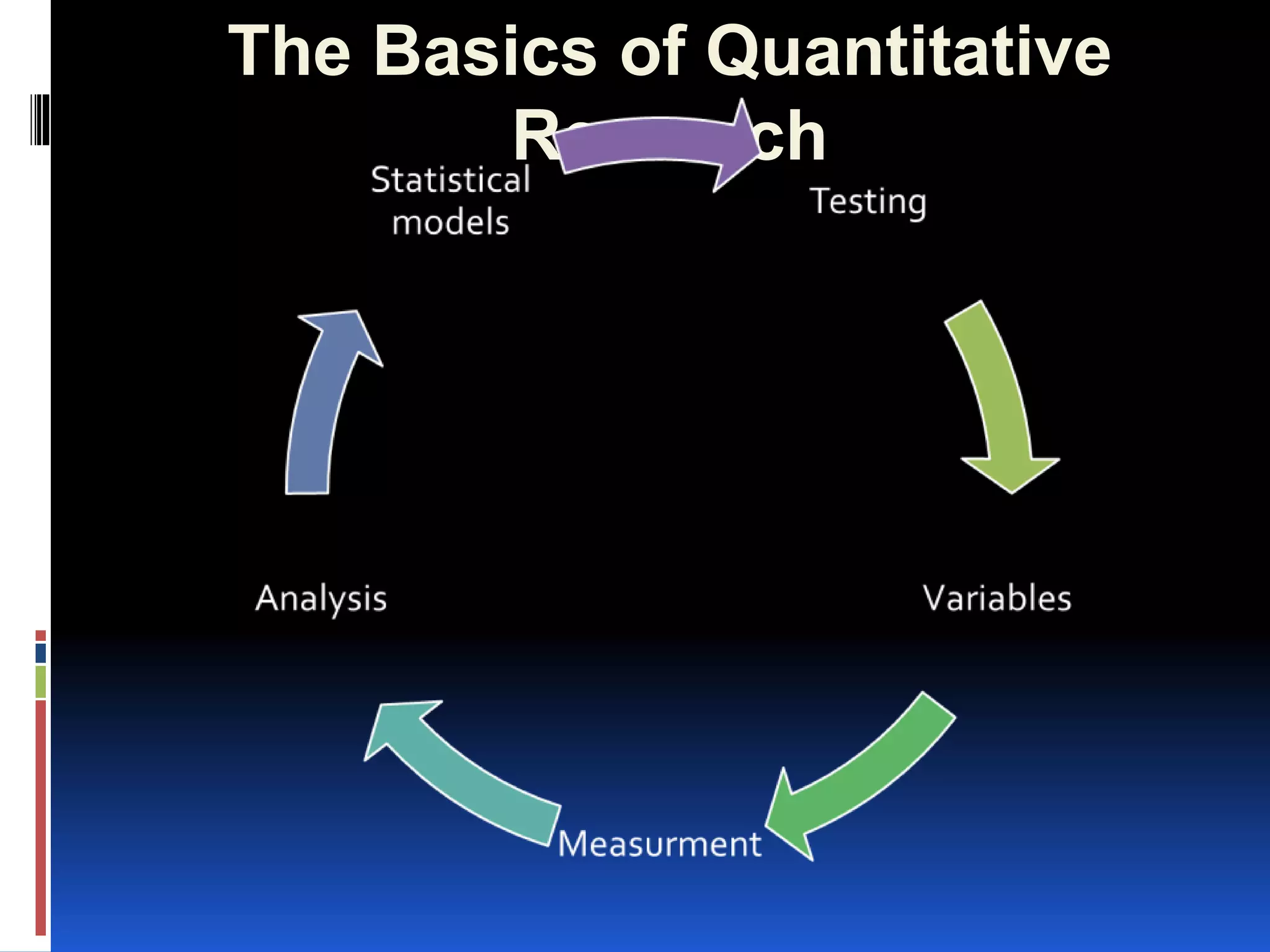
The Basics of Quantitative
Research
 Quantitative research: systematic empirical
investigation of quantitative properties and
phenomena and their relationships;
 It generates numerical data/ or data that can be
converted into numbers for a statistical review;
 Measurment: central to quantitative research;
 It provides the fundamental connection between
empirical observation and mathematical expression
of quantitative relationships;
 It collects numerical data in order to explain, predict
and or control phenomena of interest;
 Data analysis is mainly statistical.
Characteristics
 Questionnaires and surveys are used as data collection
methods;
 Data is numerical, statistical;
 Large sample sizes are used to produce generalizations for
a population;
 Quantitative research is about quantifying the relationships
between variables:
 We measure them,
 Construct statistical models to explain what we observed,
 Objective: the researcher observes but does not actively
participate;
 Data are in the form of numbers and statistics;
 Objective: seeks precise measurement & analysis of target
concepts, e.g., using surveys and questionnaires;
 The methodology section of a quantitative research
paper:
 A statement of the broad nature of the data you are
seeking to obtain;
 A description and explanation of your choice of
methodology;
 A description of how, when and where you obtained
your data;
 An indication of some of the shortcomings or
problems encountered with the methodology and
the ways in which you solved them;
Writing the Methodology Chapter
Organizing the Methodology Chapter
of a Quantitative Dissertation
Your middle section of your quantitative
dissertation should contain:
 Description of the methods used in the practical
study;
 Description of the results obtained;
 Discussion of the results;
 Recommendations;
Research
methodsIn a quantitative dissertation we should rely
on the following methods of:
 Questionnaire;
 Survey;
Questionnaire
 A very important aspect of research work;
 One of the most popular methods of conducting
scholarly research;
 It provides a convenient way of gathering information
from a target population;
 Research instrument consisting of a series of
questions and other prompts for the purpose of
gathering information from respondents;
 It is designed for statistical analysis of the responses;
 It is usually composed of one or more questions,
answered by a number of people;
 The results can be collected as a table of results
and/or a graph or pictogram;
 Questionnaires will help you design a product,
because they may tell you what the market wants;
 The questionnaire was invented by Francis Galton;
 If you are designing an alarm system,
you need to know what type of alarms
people want to buy;
 You could carry out a questionnaire
based on the following question and
store the results as a table:
 112 people were asked, which type of
alarm they were in most need of ?
 Bicycle, brief case, door, personal, car,
anti pick pocket or window;
AlarmType N° of people
Bicycle 15
brief case 20
door 24
personal 5
car 7
pick pocket 10
window 29
Total 112
When to use a
questionnaire?There is no all encompassing rule for when
to use a questionnaire;
The choice will be made based on a variety
of factors including the type of information
to be gathered and the available resources
for the experiment;
 A questionnaire should be considered in
the following circumstances:
When resources and money are limited:
 A Questionnaire can be quite inexpensive
to administer;
The administration cost per person of a
questionnaire can be as low as postage and
few photocopies;
Time is also an important resource that
questionnaires can maximize;
 If a questionnaire is self-administering,
such as an e-mail questionnaire, potentially
several thousand people could respond in a
few days;
General Layout and Format
Considerations Every questionnaire should have a title that is short and meaningful
to the respondent (Berdie, Anderson, and Niebuhr, 1986);
 Well-designed questionnaires include clear and concise instructions:
These must be very easy to understand;
 Questionnaires should use simple and direct language (Norton,
1930);
 The questions must be clearly understood by the respondent, and
have the same meaning that the researcher intended (Freed, 1964;
Huffman, 1948);
 The wording of a question should be simple and familiar to the target
population (Freed, 1964; Moser and Kalton, 1971);
 Uncommon words and abbreviations may be included in a
questionnaire provided that they are familiar to the population being
investigated (Bartholomew, 1963);
 Questionnaires should leave adequate space for respondents to
make comments;
 Leaving white space also makes the questionnaire look easier and
this might increase response (Berdie, Anderson, and Neibuhr, 1986);
The Order of the Questions
 Questionnaires should begin with a few non-threatening (Erdos, 1957;
Robinson, 1952; Sletto, 1940);
 People generally look at the first few questions before deciding
whether or not to complete the questionnaire;
 The most important items should appear in the first half of the
questionnaire (Levine and Gordon, 1958);
 By putting the most important items near the beginning, the partially
completed questionnaires will still contain important information;
 Items on a questionnaire should be grouped into logically coherent
sections (Levine and Gordon, 1958; Robinson, 1952; Seitz, 1944);
 Grouping questions that are similar will make the questionnaire easier
to complete, and the respondent will feel more comfortable;
 Each question should follow comfortably from the previous question;
 Transitions between questions should be smooth;
 McFarland (1981) reported that when specific questions were asked
before general questions, respondents tended to exhibit greater
interest in the general questions;
Results/data
 The presentation of research results is
incorporated into the ‘Discussion’ chapter of
a thesis, which is then headed ‘Results and
Discussion’;
 This will tend to happen where it is felt that
the results are likely to raise immediate
questions or concerns in the mind of the
reader;
 In general, the ‘Results’ section presents the
findings of your research together with brief
comments, particularly where statistical
analysis is involved;
Styles of Presentation
 Quantitative data are usually presented
using figures set out in the form of
tables, graphs, charts and diagrams;
 When you present information in this
way, you must make reference to it in
your text, adding commentary to
highlight and explain key aspects of the
data;
 When making reference to a table,
figure, chart or diagram, the following
expressions may be helpful:
 The graph in Figure 2 illustrates this trend . . .
 As can be seen in the graph below (Figure 8), there was a
clear correlation between . . . and . . .
 Figure 3 highlights this growth in income over the past
decade . . .
 The results obtained are presented as a bar chart in Figure
15. They clearly indicate . . .
 The table in Figure 4 records . . .
 The chart in figure 7 indicates/suggests . . .
 The response times of subjects were recorded and plotted on
a graph (see Figure 8) . . .
 Over 70% of respondents showed greater improvement in
health as a result of taking the drug on a regular basis, as
indicated in Figure 24 . . .
 As Figure 5 illustrates, observations over a 3-month period
reinforced these initial perceptions . . .
 Subjects’ responses to the questionnaire were carefully
compiled and recorded in tablature form . . .
Tables
 Data presented in a table are arranged in columns and rows;
 A computer spreadsheet ,Excel, uses this pattern;
 Tables can be an effective method of presenting small sets of
data as long as the table is well designed, clearly laid out and
easy to understand;
 Poorly designed tables can be confusing and act as barriers to
comprehension;
 Do not make the mistake of overloading your reader:
 If you have a lot of statistics to present, consider how you can
divide them into two or more tables rather than using one long
table;
 Do not forget to give your table a title;
 This should be as short as possible but also meaningful,
accurately reflecting the content of the table;
 Titles tend to consist of definite and indefinite articles (the/a),
adjectives, nouns and prepositions; verbs are often omitted;
Charts
 Data presented in charts have an
immediate visual impact upon the reader
and can provide an at-a-glance idea of
trends, quantities and proportions;
 With the help of elegant computer
programmes such as Excel, spreadsheet
data arranged in tables can be converted
into charts and graphs quickly and easily
with just a few mouse clicks;
 Two main types: pie charts and bar
charts;
Pie
ChartsPie charts are useful for presenting percentage
data, with each ‘slice’ or segment of the pie
representing a certain percentage of the total pie;
For example, a pie chart would be an effective way
of presenting sources of energy, by indicating the
proportion of energy each source (oil, gas, coal,
nuclear) contributes to the total energy supply;
Avoid including too many segments in a pie chart
as this will make it look cluttered;
If you do choose to display a large amount of data
using a pie chart, selecting different shades and
colors can help maintain clarity;
Include a key explaining what each color/pattern-
coded segment represents;
Bar charts
 Bar charts should be used when making comparisons
between two or more items;
 The data can be represented either by vertical bars or
horizontal bars;
 Bar charts are effective ways of presenting
comparative data as the reader can see at a glance
the similarities and differences between the items
being compared;
 Bar charts are also used to draw attention, in a single
chart, to multiple features within a particular data set;
 Component bar charts, for example, can be used to
show the proportions of a number of components or
‘characteristics’ within a particular item;
Graphs
 Line graphs compare two variables;
 Used to show how something changes over time;
 Usually, the x-axis has numbers for the time period, and
the y-axis has numbers for what is being measured;
 Line graphs can be used when you are plotting data
that has peaks (ups) and valleys (downs), or that was
collected in a short time period;
 A line graph has a vertical axis and a horizontal axis (x-
axis or y-axis);
 They are good at showing specific values of data: given
one variable, the other can easily be determined;
 They show trends in data clearly: they visibly show how
one variable is affected by the other, as it increases or
decreases;
 They enable the viewer to make predictions about the
results of data not yet recorded;
A line graph comprises the following parts:
 Title The title of the line graph tells us what the
graph is about.
 Labels The horizontal label across the bottom and the
vertical scale along the side tells us what
kinds of facts are listed.
 Scales The vertical scale across the bottom and the
horizontal label along the side tell us how
much or how many.
 Points The points or dots on the graph show us the
facts.
 Lines The lines connecting the points give estimates
of the values between the points.
Scatter
graphs With a scatter plot a mark, usually a dot or small
circle, represents a single data point;
 With one mark for every data point a visual
distribution of the data can be seen;
 Depending on how tightly the points cluster
together, you may be able to discern a clear trend
in the data;
 A regression line can be used to statistically
describe the trend of the points in the scatter plot
to help tie the data back to a theoretical ideal;
 This regression line expresses a mathematical
relationship between the independent and
dependent variable;
Analysis and
Discussion The “Discussion section”: the most important part of the
quantitative dissertation;
 It describes the meaning of observations and findings in light of
previous findings made by other researchers;
 This is the section where you comment on the results you have
obtained from your investigations and assess their significance
in light of your objectives, stated hypotheses and the state of
the debate in the field as discussed in your literature review;
 Purpose: to present the relationships and generalizations that
come out of the results of the study comes up with;
 Do not repeat your results;
 Interpret them and show how they agree or disagree with
previously published work;
 The limitations and weaknesses of the proposed research;
 May be justified by time and financial constraints as well as by
the early developmental stage of your research area;
 What, specifically, do the results mean?
 How can they be interpreted?
 Can they be interpreted in multiple
ways?
 What do the findings tell you about your
hypothesis?
 Function:
 Interpret the results presented in the
results section;
 Discuss them in relation to your
research question and to the results of
Language: Verb tense choices in discussion
sectionsDiscussion section, or chapter, uses a range of
tenses depending on whether results are being
discussed, or whether claims or generalizations
based on the results are being made;
Avoid making claims your data cannot support;
Be careful not to exaggerate your claims beyond
what the data suggests;
Making statements that are not justified by the data
will make you look naïve and undisciplined and
could critically undermine the credibility of your
whole study, as well as your credibility as a precise
and discriminating researcher;
You can do this by using such expressions as:
Recommendations
 It would be very odd if you finish your
dissertation without offering the reader no
advice on what you think should happen
next;
 There are two types of recommendations
that you can make: recommendations
specific to the evidence presented in your
study; and suggestions for future research;
 One way to deal with your recommendations
is to link them to your previous conclusions,
which in turn were linked to each of your
specific research objectives;
Quantitative research paper

Quantitative research paper

  • 2.
     Cresswel: “an inquiryinto a social or human problem based on testing a theory composed of variables, measured with numbers, and analyzed with statistical procedures, in order to determine whether the predictive generalizations of the theory hold true”.  Burns & Grove: “a formal, objective, systematic process in which numerical data are utilized to obtain information about the world“.
  • 3.
    The Basics ofQuantitative Research
  • 4.
     Quantitative research:systematic empirical investigation of quantitative properties and phenomena and their relationships;  It generates numerical data/ or data that can be converted into numbers for a statistical review;  Measurment: central to quantitative research;  It provides the fundamental connection between empirical observation and mathematical expression of quantitative relationships;  It collects numerical data in order to explain, predict and or control phenomena of interest;  Data analysis is mainly statistical.
  • 5.
    Characteristics  Questionnaires andsurveys are used as data collection methods;  Data is numerical, statistical;  Large sample sizes are used to produce generalizations for a population;  Quantitative research is about quantifying the relationships between variables:  We measure them,  Construct statistical models to explain what we observed,  Objective: the researcher observes but does not actively participate;  Data are in the form of numbers and statistics;  Objective: seeks precise measurement & analysis of target concepts, e.g., using surveys and questionnaires;
  • 6.
     The methodologysection of a quantitative research paper:  A statement of the broad nature of the data you are seeking to obtain;  A description and explanation of your choice of methodology;  A description of how, when and where you obtained your data;  An indication of some of the shortcomings or problems encountered with the methodology and the ways in which you solved them; Writing the Methodology Chapter
  • 7.
    Organizing the MethodologyChapter of a Quantitative Dissertation Your middle section of your quantitative dissertation should contain:  Description of the methods used in the practical study;  Description of the results obtained;  Discussion of the results;  Recommendations;
  • 8.
    Research methodsIn a quantitativedissertation we should rely on the following methods of:  Questionnaire;  Survey;
  • 9.
    Questionnaire  A veryimportant aspect of research work;  One of the most popular methods of conducting scholarly research;  It provides a convenient way of gathering information from a target population;  Research instrument consisting of a series of questions and other prompts for the purpose of gathering information from respondents;  It is designed for statistical analysis of the responses;  It is usually composed of one or more questions, answered by a number of people;  The results can be collected as a table of results and/or a graph or pictogram;  Questionnaires will help you design a product, because they may tell you what the market wants;  The questionnaire was invented by Francis Galton;
  • 10.
     If youare designing an alarm system, you need to know what type of alarms people want to buy;  You could carry out a questionnaire based on the following question and store the results as a table:  112 people were asked, which type of alarm they were in most need of ?  Bicycle, brief case, door, personal, car, anti pick pocket or window;
  • 11.
    AlarmType N° ofpeople Bicycle 15 brief case 20 door 24 personal 5 car 7 pick pocket 10 window 29 Total 112
  • 12.
    When to usea questionnaire?There is no all encompassing rule for when to use a questionnaire; The choice will be made based on a variety of factors including the type of information to be gathered and the available resources for the experiment;  A questionnaire should be considered in the following circumstances:
  • 13.
    When resources andmoney are limited:  A Questionnaire can be quite inexpensive to administer; The administration cost per person of a questionnaire can be as low as postage and few photocopies; Time is also an important resource that questionnaires can maximize;  If a questionnaire is self-administering, such as an e-mail questionnaire, potentially several thousand people could respond in a few days;
  • 14.
    General Layout andFormat Considerations Every questionnaire should have a title that is short and meaningful to the respondent (Berdie, Anderson, and Niebuhr, 1986);  Well-designed questionnaires include clear and concise instructions: These must be very easy to understand;  Questionnaires should use simple and direct language (Norton, 1930);  The questions must be clearly understood by the respondent, and have the same meaning that the researcher intended (Freed, 1964; Huffman, 1948);  The wording of a question should be simple and familiar to the target population (Freed, 1964; Moser and Kalton, 1971);  Uncommon words and abbreviations may be included in a questionnaire provided that they are familiar to the population being investigated (Bartholomew, 1963);  Questionnaires should leave adequate space for respondents to make comments;  Leaving white space also makes the questionnaire look easier and this might increase response (Berdie, Anderson, and Neibuhr, 1986);
  • 15.
    The Order ofthe Questions  Questionnaires should begin with a few non-threatening (Erdos, 1957; Robinson, 1952; Sletto, 1940);  People generally look at the first few questions before deciding whether or not to complete the questionnaire;  The most important items should appear in the first half of the questionnaire (Levine and Gordon, 1958);  By putting the most important items near the beginning, the partially completed questionnaires will still contain important information;  Items on a questionnaire should be grouped into logically coherent sections (Levine and Gordon, 1958; Robinson, 1952; Seitz, 1944);  Grouping questions that are similar will make the questionnaire easier to complete, and the respondent will feel more comfortable;  Each question should follow comfortably from the previous question;  Transitions between questions should be smooth;  McFarland (1981) reported that when specific questions were asked before general questions, respondents tended to exhibit greater interest in the general questions;
  • 16.
    Results/data  The presentationof research results is incorporated into the ‘Discussion’ chapter of a thesis, which is then headed ‘Results and Discussion’;  This will tend to happen where it is felt that the results are likely to raise immediate questions or concerns in the mind of the reader;  In general, the ‘Results’ section presents the findings of your research together with brief comments, particularly where statistical analysis is involved;
  • 17.
    Styles of Presentation Quantitative data are usually presented using figures set out in the form of tables, graphs, charts and diagrams;  When you present information in this way, you must make reference to it in your text, adding commentary to highlight and explain key aspects of the data;  When making reference to a table, figure, chart or diagram, the following expressions may be helpful:
  • 18.
     The graphin Figure 2 illustrates this trend . . .  As can be seen in the graph below (Figure 8), there was a clear correlation between . . . and . . .  Figure 3 highlights this growth in income over the past decade . . .  The results obtained are presented as a bar chart in Figure 15. They clearly indicate . . .  The table in Figure 4 records . . .  The chart in figure 7 indicates/suggests . . .  The response times of subjects were recorded and plotted on a graph (see Figure 8) . . .  Over 70% of respondents showed greater improvement in health as a result of taking the drug on a regular basis, as indicated in Figure 24 . . .  As Figure 5 illustrates, observations over a 3-month period reinforced these initial perceptions . . .  Subjects’ responses to the questionnaire were carefully compiled and recorded in tablature form . . .
  • 19.
    Tables  Data presentedin a table are arranged in columns and rows;  A computer spreadsheet ,Excel, uses this pattern;  Tables can be an effective method of presenting small sets of data as long as the table is well designed, clearly laid out and easy to understand;  Poorly designed tables can be confusing and act as barriers to comprehension;  Do not make the mistake of overloading your reader:  If you have a lot of statistics to present, consider how you can divide them into two or more tables rather than using one long table;  Do not forget to give your table a title;  This should be as short as possible but also meaningful, accurately reflecting the content of the table;  Titles tend to consist of definite and indefinite articles (the/a), adjectives, nouns and prepositions; verbs are often omitted;
  • 21.
    Charts  Data presentedin charts have an immediate visual impact upon the reader and can provide an at-a-glance idea of trends, quantities and proportions;  With the help of elegant computer programmes such as Excel, spreadsheet data arranged in tables can be converted into charts and graphs quickly and easily with just a few mouse clicks;  Two main types: pie charts and bar charts;
  • 22.
    Pie ChartsPie charts areuseful for presenting percentage data, with each ‘slice’ or segment of the pie representing a certain percentage of the total pie; For example, a pie chart would be an effective way of presenting sources of energy, by indicating the proportion of energy each source (oil, gas, coal, nuclear) contributes to the total energy supply; Avoid including too many segments in a pie chart as this will make it look cluttered; If you do choose to display a large amount of data using a pie chart, selecting different shades and colors can help maintain clarity; Include a key explaining what each color/pattern- coded segment represents;
  • 24.
    Bar charts  Barcharts should be used when making comparisons between two or more items;  The data can be represented either by vertical bars or horizontal bars;  Bar charts are effective ways of presenting comparative data as the reader can see at a glance the similarities and differences between the items being compared;  Bar charts are also used to draw attention, in a single chart, to multiple features within a particular data set;  Component bar charts, for example, can be used to show the proportions of a number of components or ‘characteristics’ within a particular item;
  • 30.
    Graphs  Line graphscompare two variables;  Used to show how something changes over time;  Usually, the x-axis has numbers for the time period, and the y-axis has numbers for what is being measured;  Line graphs can be used when you are plotting data that has peaks (ups) and valleys (downs), or that was collected in a short time period;  A line graph has a vertical axis and a horizontal axis (x- axis or y-axis);  They are good at showing specific values of data: given one variable, the other can easily be determined;  They show trends in data clearly: they visibly show how one variable is affected by the other, as it increases or decreases;  They enable the viewer to make predictions about the results of data not yet recorded;
  • 31.
    A line graphcomprises the following parts:  Title The title of the line graph tells us what the graph is about.  Labels The horizontal label across the bottom and the vertical scale along the side tells us what kinds of facts are listed.  Scales The vertical scale across the bottom and the horizontal label along the side tell us how much or how many.  Points The points or dots on the graph show us the facts.  Lines The lines connecting the points give estimates of the values between the points.
  • 35.
    Scatter graphs With ascatter plot a mark, usually a dot or small circle, represents a single data point;  With one mark for every data point a visual distribution of the data can be seen;  Depending on how tightly the points cluster together, you may be able to discern a clear trend in the data;  A regression line can be used to statistically describe the trend of the points in the scatter plot to help tie the data back to a theoretical ideal;  This regression line expresses a mathematical relationship between the independent and dependent variable;
  • 39.
    Analysis and Discussion The“Discussion section”: the most important part of the quantitative dissertation;  It describes the meaning of observations and findings in light of previous findings made by other researchers;  This is the section where you comment on the results you have obtained from your investigations and assess their significance in light of your objectives, stated hypotheses and the state of the debate in the field as discussed in your literature review;  Purpose: to present the relationships and generalizations that come out of the results of the study comes up with;  Do not repeat your results;  Interpret them and show how they agree or disagree with previously published work;  The limitations and weaknesses of the proposed research;  May be justified by time and financial constraints as well as by the early developmental stage of your research area;
  • 40.
     What, specifically,do the results mean?  How can they be interpreted?  Can they be interpreted in multiple ways?  What do the findings tell you about your hypothesis?  Function:  Interpret the results presented in the results section;  Discuss them in relation to your research question and to the results of
  • 43.
    Language: Verb tensechoices in discussion sectionsDiscussion section, or chapter, uses a range of tenses depending on whether results are being discussed, or whether claims or generalizations based on the results are being made; Avoid making claims your data cannot support; Be careful not to exaggerate your claims beyond what the data suggests; Making statements that are not justified by the data will make you look naïve and undisciplined and could critically undermine the credibility of your whole study, as well as your credibility as a precise and discriminating researcher; You can do this by using such expressions as:
  • 44.
    Recommendations  It wouldbe very odd if you finish your dissertation without offering the reader no advice on what you think should happen next;  There are two types of recommendations that you can make: recommendations specific to the evidence presented in your study; and suggestions for future research;  One way to deal with your recommendations is to link them to your previous conclusions, which in turn were linked to each of your specific research objectives;