The US & the
Middle East issues
Boutkhil Guemide
University
Mohammed
Boudiaf, M’sila
Algeria
Lecture outline
Overview of the Middle East:
The importance of the Middle
East:
The US Foreign Policy in the
Middle East: The objectives,
priorities, and procedures:
George Bush and the Gulf
War:
 The Future of the Middle
East:
Overview of the Middle East
 The "Middle East“: Originated and coined
in the 1850s at the British India Office;
 Alfred Thayer Mahan: US naval strategist;
 The British and Russian rivalry in Central
Asia, aka the “Great Game”.
 Mahan: “The region is of strategic
importance; its center is the Arabian Gulf.”
 The "Middle East“ centers around the
Arabian Gulf, and after the Suez Canal;
 The most important passage/ route that
must be controlled by Great Britain to
prevent the Russian’s advance towards
India.
 The "Middle East": The US
government (1957), The Eisenhower
Doctrine, The Suez Crisis.
 John Foster Dulles, Secretary of State:
"The area lying between … Libya on the
West and Pakistan on the
East, Syria and Iraq on the North and
the Arabian Peninsula to the South, plus
the Sudan and Ethiopia˝ ’.
 1958: "Near East" Vs. "Middle East"
Egypt, Syria, Palestine, Lebanon, Jordan,
UAE, Iraq, Iran, Turkey, Yemen, Oman,
Saudi Arabia, Kuwait, Bahrain, and Qatar.
The Cradle of Civilizations
 Arabian Peninsula: The
“Cradle of Civilizations”
– Birthplace of the worlds
first civilizations
–Sumerians
–Mesopotamians
–Babylonians
–Assyrians
–Phoenicians
–Egyptians
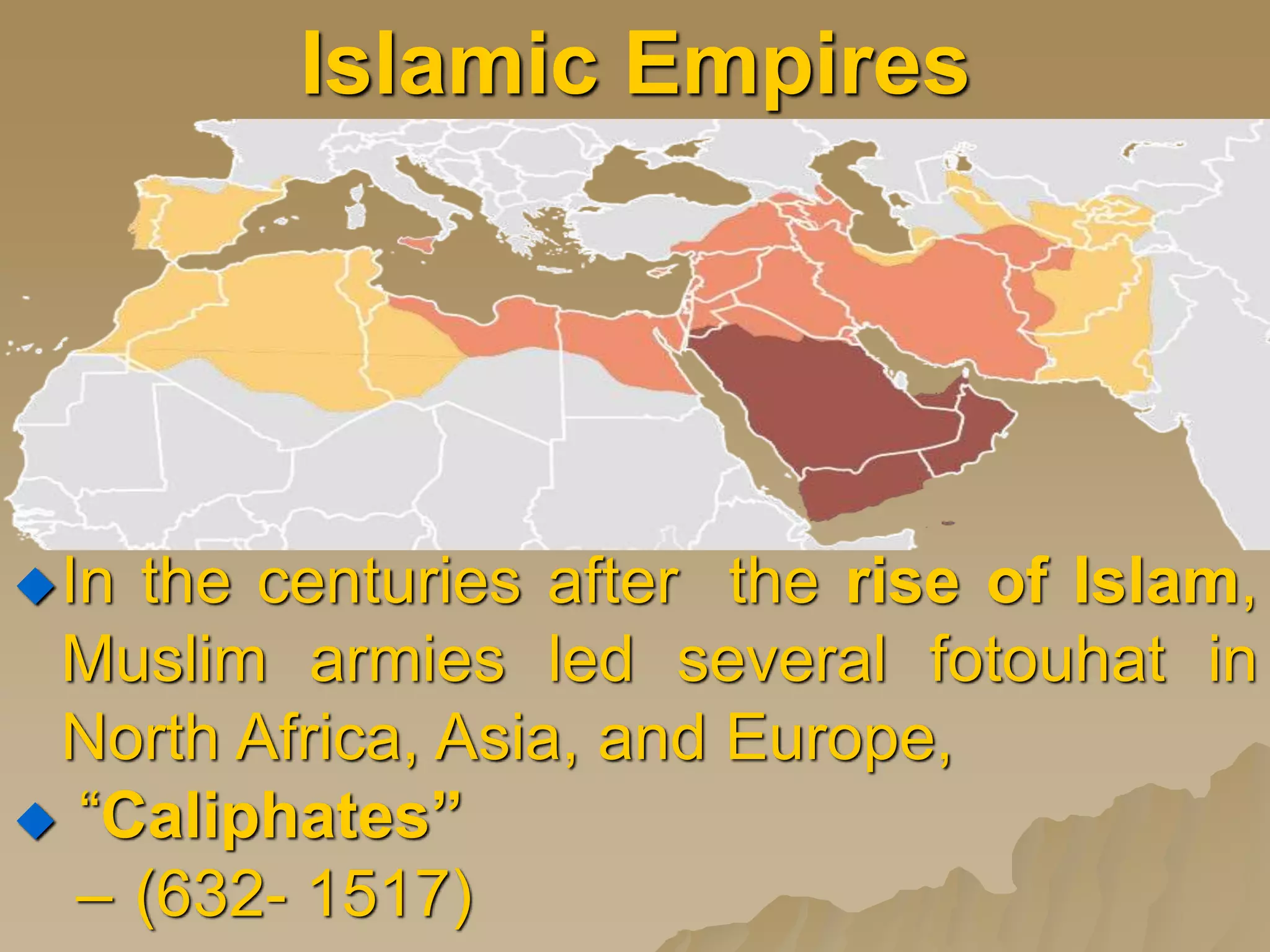
Islamic Empires
In the centuries after the rise of Islam,
Muslim armies led several fotouhat in
North Africa, Asia, and Europe,
 “Caliphates”
– (632- 1517)
The Ottoman Empire
Centered around
modern-day Turkey
Osman I
consolidated power
in late 13th century
At height, Ottoman
Empire
encompassed:
Ottoman Empire Expansion
The importance of the Middle East
 Lakhovsky, G. : ‘A rational
foreign policy can not ignore
the Middle East and its
impact on the rest of the
world. This stems from its
geopolitical importance’.
 Mackinder, H. J. (1861-
1947): ‘HeartLand
Theory’,
 ‘Who rules East Europe,
Commands the Heartland.
Who rules the heartland,
Commands the Island.
Who rules the Island,
Commands the World’.
 The Globe: The Heart Land (World Island),
Inner Crescent, and the Outer Crescent,
 The Heart Land (World Island): Europe,
Africa, & Asia,
 Inner/ Marginal Crescent: Europe, India,
South-East Asia, and China.
 Outlying Island: England and Japan.
 Secondary Heartland: Sub- Saharan Africa
connected to the main Heartland through a
main bridge (Gulf region).
 Outer/ Insular Crescent: The Americas and
Australia,
 The Heartland: The center of the world
island, stretching from the Volga to
the Yangtze and from the Himalayas to
 The natural characteristics of the
Middle East: It is located at the
crossroads of the major Asian, African,
and European continents, the
Mediterranean Sea, Arabian Gulf, and
Indian Ocean.
 Rivers & waterways: The Nile River,
the Euphrates and the Tigris, and
Jordan River,
 Important international traffic
sites: The Suez Canal, Bosphorus,
Dardanelles, Bab el-Mandeb, and the
Strait of Hormuz.
1. Economic importance:
 The presence of oil:
The Middle East oil reserves are estimated at 66% of
the world oil reserves.
Oil production: 1/3 of world oil production.
Oil supply to Europe, the US, Russia and Japan,
The Gulf region: inexpensive oil,
Gas: 25%
2. Strategic importance:
 A very great strategic importance: It links
between the countries and continents of the world.
 Sea routes in the Middle East are of great
importance to the world: They link between the
continents of the world,
 Linking the countries of Europe, America, and Asia
(China, Korea, and India), and other countries
whose ports depend on export and import.
The US Foreign Policy in the Middle East:
The objectives, priorities, and procedures
 The Middle East region is of the utmost
importance for the major countries: Its
strategic importance in the political scene and
natural resources abundance.
 Rivalry for energy resources: One of the main
goals of the major countries seeking to assert
their influence, and secure their needs of crude
oil and gas, in light of the accelerated production
pace and the financial turmoil that afflict the
global economy.
 The Middle East: After the end of the Cold War
and the emergence of new poles on the
international stage.
 The US strategy towards the Middle East: A constant and
changing approach;
 ‘The national interest is the primary determinant of foreign
policy’;
 Identifying the national interests as a means of expecting foreign
policy trends and international interactions within the international
system;
 US Politics: It is the internal political balance. i. e. agreement-
within the administration, or within the political system- which
determines the US foreign policy towards a particular region, or
country, not the national interests;
 The US national interest and influence of political decision- making,
Think Tanks, and lobby groups.
 1990’s: The US strategy focused on building a new world order for
post- Cold War era: Portraying the great success of the liberal
ideology, uni- polar system, and US hegemony.
 US Strategy: New threats;
 The rise of new international powers: Japan, Germany, China, and
Russia;
 The threat of proliferation of nuclear weapons;
 The rise of global terrorism,
 Threats from other powers: Rogue States or Axis of Evil: Iraq,
Iran, Syria and North Korea.
US President Bush (1989-
1993): Building a new world
order.
Responsible engagement in
resolving international conflicts;
US strategy: Defending the vital
interests of the US together with
high military readiness;
Military factor: A major option in
resolving international disputes;
The Militarization of the US foreign
US Foreign Policy Key Issues
towards the Middle East
US- Israeli relations
 John Mearcheimer & Stephan Walt The
Isreali Lobby and the US Foreign Policy:
For decades, especially since the … War of
1967, the US foreign policy and strategy in
the Middle East was established, in essence,
on the relationship with Israel. This
unconditional support to Israel and the
promotion of democracy and liberalism
throughout the region, led to the rise of both
Arab and Islamic … resentment, which
endangered not only the US security, but
also the security of many countries of the
 US Pro- Israeli policy:
 The US efforts in the region have served
Israel's security: It is the only Western
Democratic country in the Middle East
 Maintains great ties with the Us to protect US
interests in the Middle East.
 The US has worked for a long time to establish
the state of Israel;
 Creating conditions with Arabs and Jews to end
the Arab- Israeli conflict and establish a lasting
peace in the region.
 By virtue of its geographical location in the
region, Israel plays the role of strengthening
the existing regimes and in preventing any
radical or religious transformation that might
harm Israel and US in the region.
The War on Terror
 Countering terrorism: US priority in the
Middle East after 9/11;
 Terrorist organizations, Al Qaeda, Islamic
State in Iraq and the Levant (ISIS);
 Financial support to run military activities
and develop capabilities in the Islamic
world;
 The main objective: To undermine the
US allies in the Middle East;
 The US sought to counter those threats
and provided the allies with the necessary
assistance to maintain stability in the
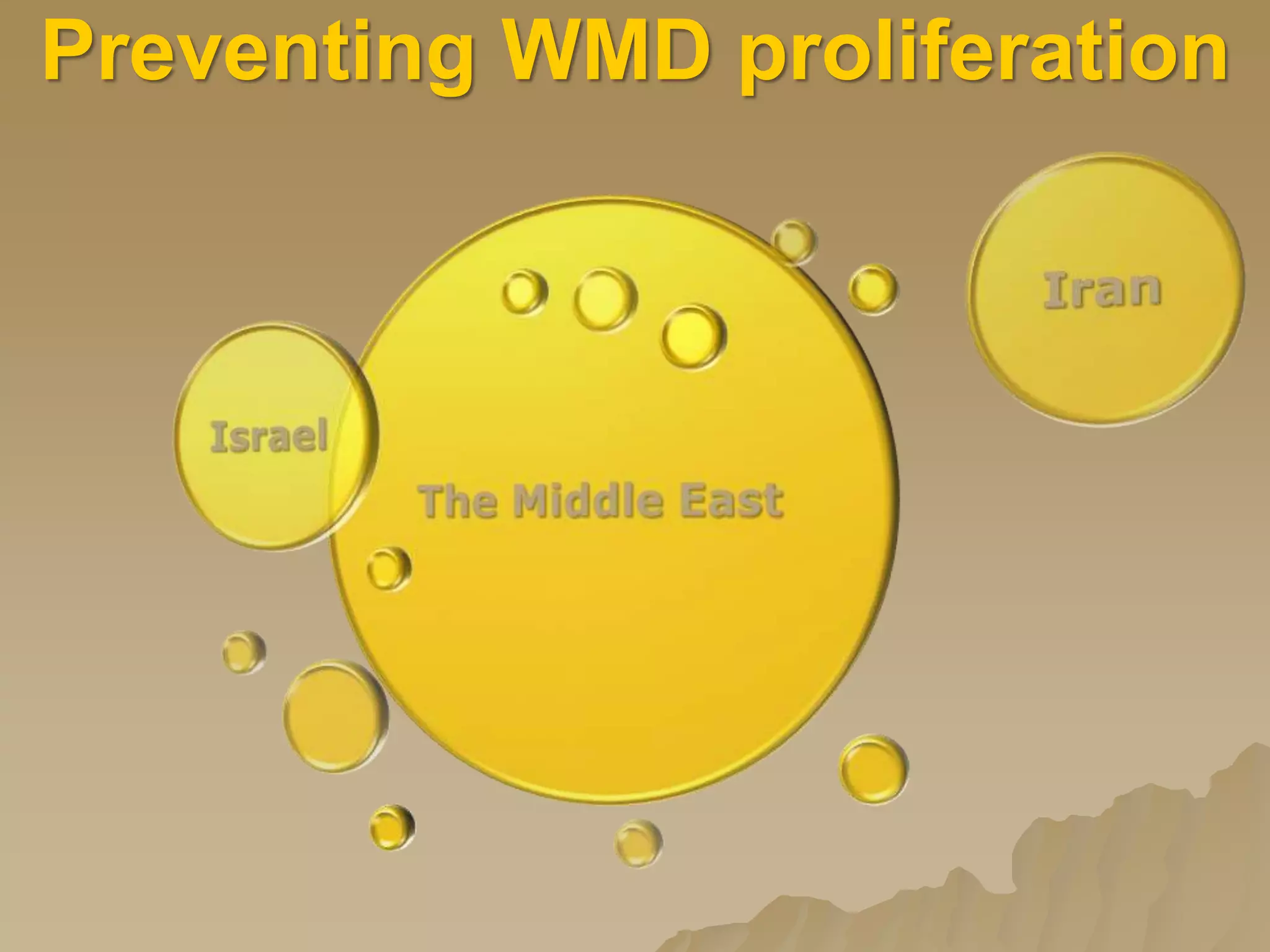
Preventing WMD proliferation
The Middle East: The nuclear issue
arises from time to time;
Political, economic and geographic
importance;
Strategic realization of the major
powers: Failure to establish a
nuclear- weapon- free zone;
US strategic objective in the
Middle East: Preventing the
proliferation of WMD, threatening the
US allies in the region (the Gulf,
Israel, and US forces deployed in the
Deterring Iran & the Rogue States
 US Vs. Iran: Conflictual relations;
 The US has always adopted a particular
foreign policy towards Iran.
 The Israeli (Zionist) lobby intervention:
Adopting agendas and interests to support
the US foreign policy towards Iran (more
rigorous).
 The Israeli lobby: Successful in affecting
and directing the US foreign policy towards
Iran and in favor of Israel in the Middle East.
 The lobby’s ability:
 To gain widespread support;
 To promote legislation that it favors posing
several sanctions to curb the Iranian regime.
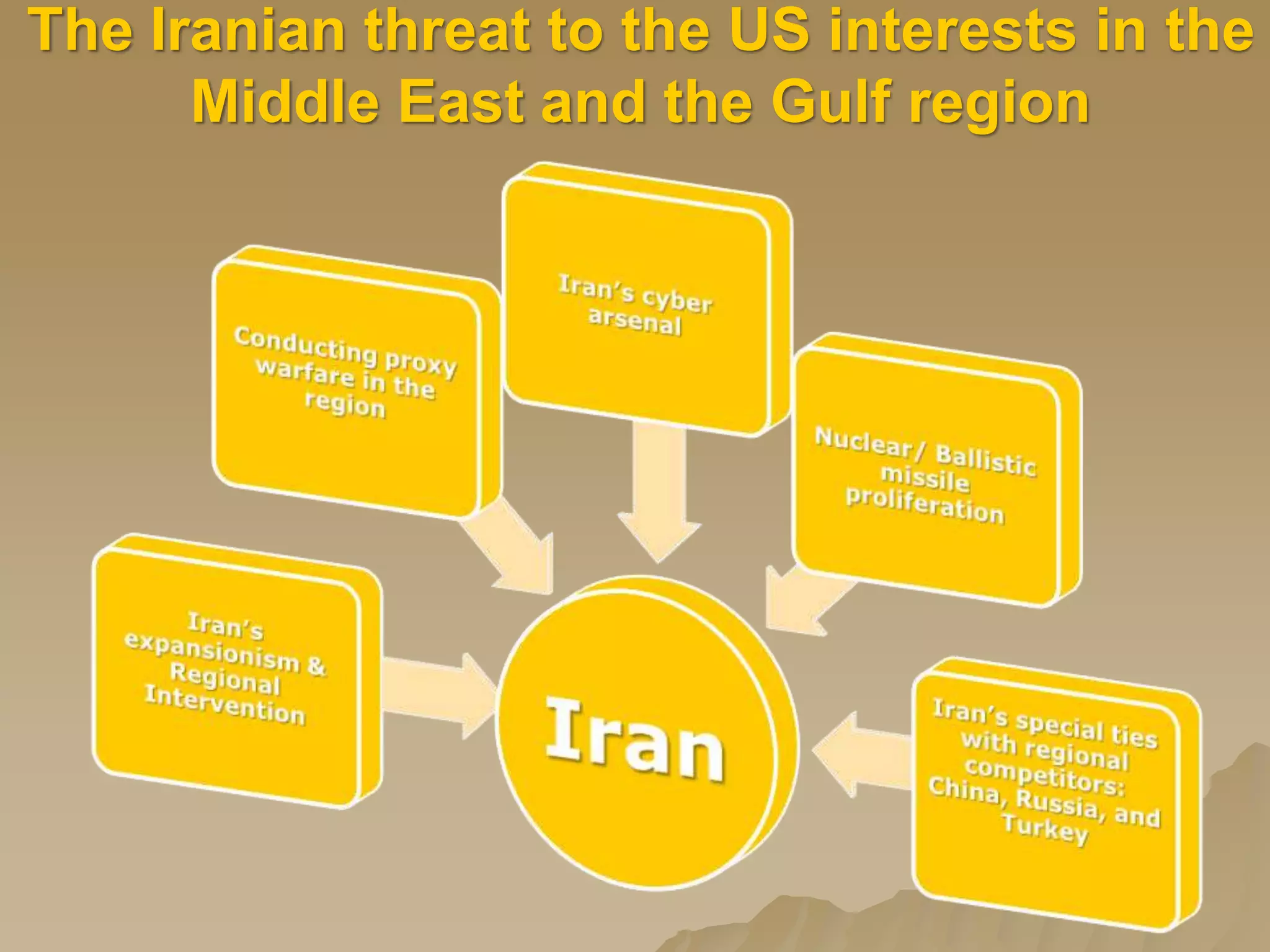
The Iranian threat to the US interests in the
Middle East and the Gulf region
Wars & conflicts that changed
the Middle East
Middle East Leaders
Anwar Sadat
Hosni
Mubarak
Yasser
Arafat
Mahmoud
Abbas
Golda Mayer
Menachem
Begin
Hafez Al
Assad
Bashar Al
Assad
Hassan Nasr
Allah
King
Hussein
King Abad
Allah II
Al Khomeini
Mahmoud
Ahmadi
Nejad
King Abd Al
Aziz
King Faisal
King Fahd
Prince
Muhammad
Ibn Sulman
Muhammad
Ibn Zayed
Saddam
Hussein
DESERT SHIELD &
DESERT STORM
OPERATION GRANBY
OPERATION FRICTION
OPÉRATION DAGUET
George Bush and the Gulf War
(Aug. 2, 1990- Feb. 28, 1991)
TIMELIINE
 Aug. 2, 1990: Iraq invades Kuwait
 Aug. 7, 1990: President George Bush launches Operation
Desert Shield, sending US troops to try to stop an Iraqi attack on
Saudi Arabia. First U.S. Fighter plains arrive in Saudi Arabia.
 Jan. 16- 7, 1991: The air war begins. Bombers and cruise
missiles strike at power plants and other important targets. Iraq
attacks Israel with scud missiles .This air war last 42 days.
 Feb. 24, 1991: Allied ground assault begins. Iraqis leave
Kuwait igniting an estimated 700 oil wells in Kuwait
 Feb. 28, 1991: Conclusion of war declared after 100 hours.
 Battles of the Gulf War:
Battle of 73 Easting
Battle of Ad-Dawrah Battle of Al Busayyah
Attack of Ras Tanura Battle of Bubiyan
Battle of Dasman Palace Battle of Failaka
Highway of Death Battle for Jalibah Airfield
Battle of Khafji Battle of Kuwait Int. Airport
Battle of Medina Ridge Battle of Norfolk
Battle of Phase Line Bullet Battle of Qurah & Um al Maradim
Battle of Rumaila Battle of Wadi Al-Batin
The Gulf
War:
Major
Actor
Leaders
Dick Cheney
Saddam Hussein
George W. Bush
Colin Powell
Jaber al-Ahmad
al-Sabah
Fahd Ibn Abdelaziz
Al Saoud
Khalid Ibn Sultan
Ibn Abdelaziz Al
Saoud
Margaret Tatcher
Norman
Schwarzkopf
 The Gulf War was the first American
conflict shown on live television: CNN
aired live images of bombs exploding and
other events of the war onto people’s
home television sets.
Background to the War
 Iraq had a number of reasons for attacking Kuwait.
Iraq had never really accepted the state of Kuwait
and considered it to be part the land between the
rivers, Euphrates and Tigris rivers that belong to
Iraq.
 Iraq thought the underground oil along the border
with Kuwait was theirs.
 Iraq claimed before the war, Kuwait was responsible
for the reducing world oil prices.
 Saddam Hussein claimed that Kuwait owed his
country money for Iraq’s economic losses. Kuwait's
leaders refused all of Saddam's demands and
increased its oil production by 40 %.
 It is clear that Iraq expected to claim as its territory
Kuwait and that they initially never expected an allied
force to fight back.
IRAQI INVASION
 On August 2, 1990 Iraqi troops crossed the border
between Kuwait and Iraq.
 Within a few days of the attack the country of
Kuwait was occupied and the Iraqi forces were
closing on the border with Saudi Arabia.
 At that time if Saddam's troops were not stopped
at the Kuwait-Saudi Arabia border he would attack
other oil producing countries.
 President George H. Bush ordered U.S. Air Force
fighter aircraft to go to Saudi Arabia to stop the
Iraqis. Operation Desert Shield started on August
2, 1990.
 Saddam Hussein was being presented as the evil
dictatorship that he had come to destroy a peaceful
and militarily weak neighbor.
OPERATION DESERT STORM
 Shortly before 3:00 a.m. on the morning of
January 17, 1991, several stealth F-117 and B-1
soared across the skies of the brightly lit city of
Baghdad.
 The Iraqi radar failed to the detect the present of
any aircraft. Within minutes of the attack most of
Iraq's Command and Control Communications
Center, Air Force Headquarters and Air Defense
Operations Center were destroyed.
 Operation Desert Storm the air phase of the war
had started.
 During the next few hours coalition aircraft
destroyed the electrical system in Baghdad, most
of Iraq’s radar defenses and any remaining
fighter aircraft.
 Feb. 24, 1991: Ground Attack Day One, American and
allied troops crossed the borders into Kuwait.
 US and allied troops begin two ground offensives in the
deserts of western Iraq to defeat the Iraq forces in
Kuwait.
 The allied troops advanced further on all fronts. The
troops approached Kuwait City, whiled the western troops
began to cut off the Iraqis ability to leave.
 Ground attack day three of the war saw the largest tank
battle in history. The American armored forces engaged
the tank forces of the Republican Guard, Iraq's elite force.
American tanks complete destroyed over 500 Iraqi tanks
and other heavy armor without losing a single tank.
 During the third day, the Iraqi army began a headlong
retreat from Kuwait and southern Iraq in doing so set
over 400 Kuwait oil wells on fire. Their retreat being cut
off by allied aircraft and with their vehicles being
destroyed from the air the Iraqis fled on foot. That night
allied troops freed Kuwait City.
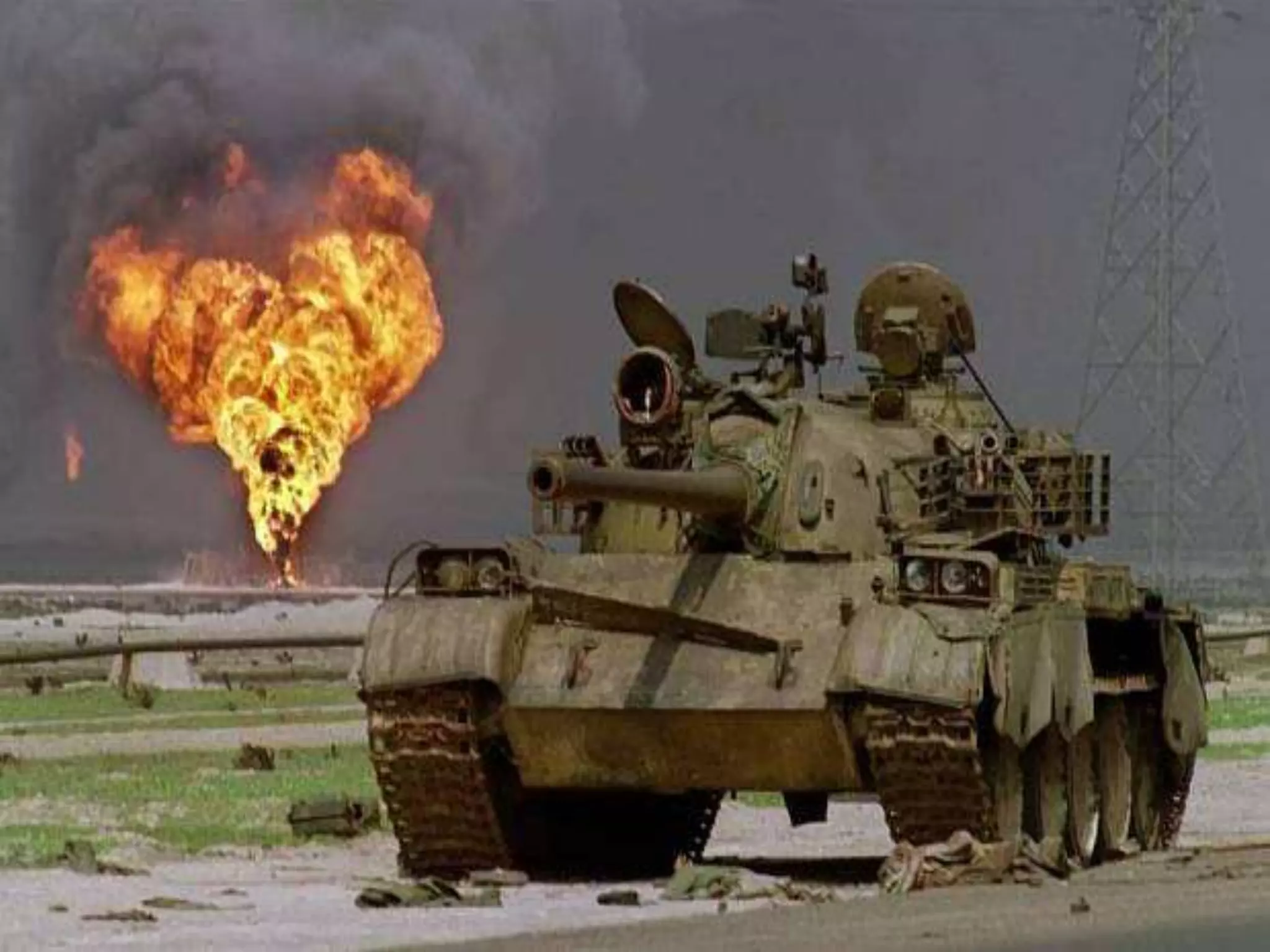
The fourth and last day of the war saw
the US and allied troops continuing
the destruction of much of the Iraqi
army.
A decision had already been made in
Washington to end the war at 100
hours.
It was thought that an assault on
Baghdad was impractical, and the best
that could be done was to destroy as
much Iraqi equipment as possible.
At 8:01 a.m. after 100 hours of battles
a conclusion of the war was declared.
War losses
 Coalition forces:
 US (killed 293 / injured 467),
 United Kingdom (47),
 Saudi Arabia (18),
 Egypt (10),
 UAE (3),
 Syria (3),
 France (2),
 Kuwait (1).
 75 aircrafts were destroyed (27 were
disrupted for non-military reasons).
 The US: 63 aircrafts & 23 helicopters.
Iraqi forces:
70,000- 100,000 dead and
30,000 prisoners.
4,000 tanks, 3,100 artillery
pieces and 1,856 vehicles
were destroyed.
240 aircrafts were
destroyed.
2,300- 200,000 civilians
 The destruction of Iraq's infrastructure facilities,
army, and Republican Guard,
 Posing UN emargo and economic sactions on Iraq,
 Damage to Iraq's infrastructure from oil refineries,
power generators and water purification plants: A
dramatic decline in economic, health and social
facilities,
 The destruction of 96% power generators,
 The US established a no-fly zone to protect Iraqi
civilians in the north and south,
 The blockade led to inflation rising to 2400% in
1994, emigration of more than 23,000 Iraqi
researchers, doctors and engineers,
 High rates of child mortality and malnutrition and low
educational attainment,
 Allocating 5% from sale of oil revenues to
compensate Kuwait for damage caused by the Iraqi
 Economic results:
 Igniting and destroying more than 727 oil
Kuwaiti wells out of 1080: The value of oil and
natural gas lost from these wells was
estimated at $ 120 million per day,
 Oil well fires have not only affected Kuwait,
with visible smoke reaching Greece, China,
and even effects of the smoke cloud reach the
US, albeit at low concentrations,
 The cost of rebuilding the oil sector: $ 80
billion,
 Destruction of government institutions and
facilities resulting in billions of dollars in
losses,
 The cost of the liberation war in Kuwait: $
The Future of the Middle East
 The Call of the War in the Middle East:
 Rising tensions on Israel's northern border: Concerns about
another confrontation between Israel and Hezbollah, or a
war between Israel and Iran in Syria (Not to be confined to
the original participants, but may involve a range of Shiite
militias and even the Assad regime, and may spread
throughout the region),
 Affecting the vital US interests in the region,
 These tensions are due to two main factors:
 The efforts of Hezbollah and Syria, with the help of Iran, to
produce high-precision missiles in Lebanon and Syria that
could paralyze Israel's vital infrastructure and make life
there intolerable,
 Iran's efforts to turn Syria into a starting point for Military
operations against Israel and a platform to highlight the
strength in the region,
 Iran pursues an agenda against the continuation of the
status quo,
 Iran seeks to avoid conventional wars,
 Relying on proxy wars.
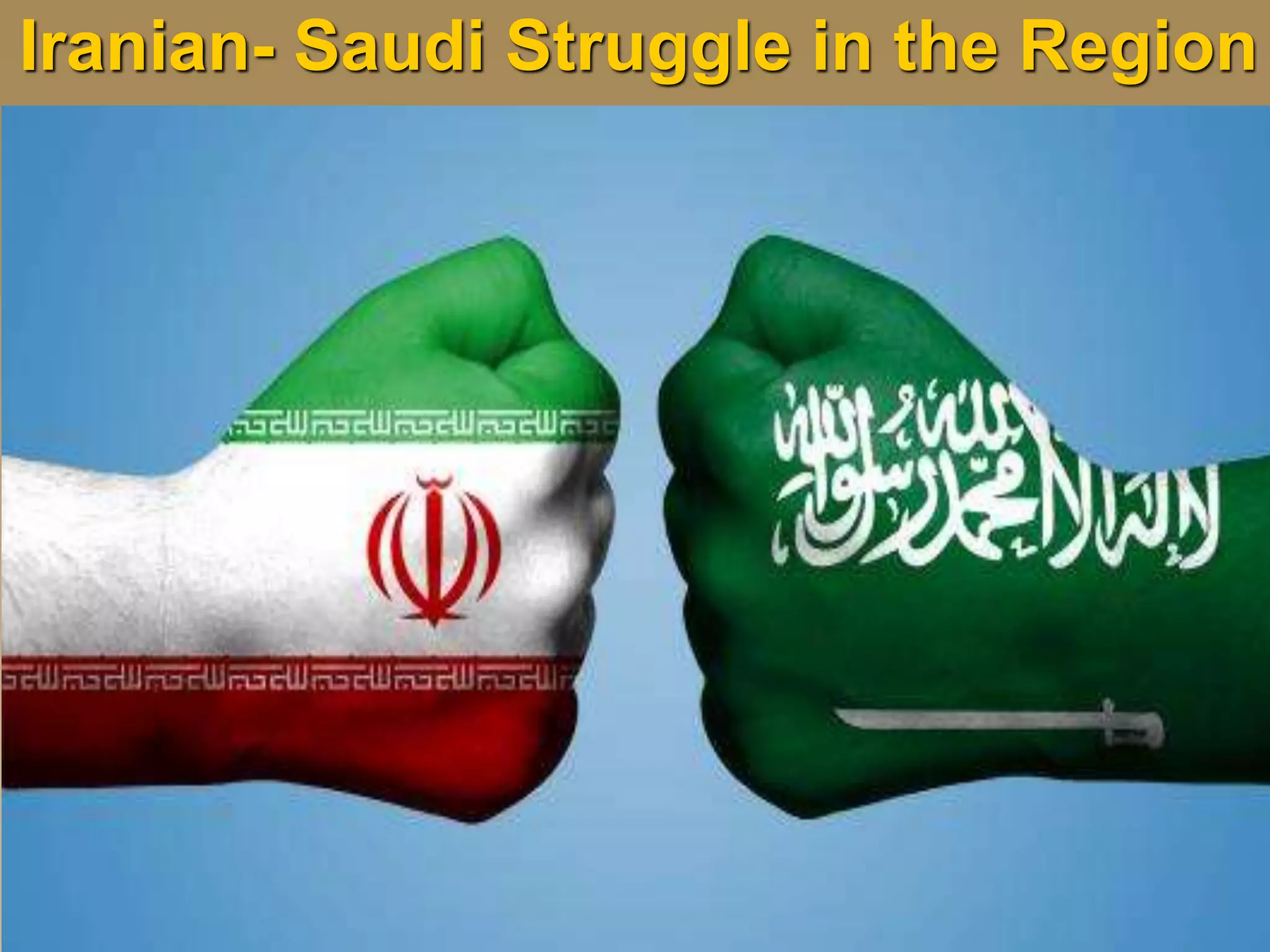
Iranian- Saudi Struggle in the Region
 The conflict between Iran and
Saudi Arabia is not sectarian; it is
driven by power politics and
competition for regional influence:
 Saudi Arabia, the wealthy Sunni-
dominated power in the region,
 Embracing regional hegemonic
ambitions, in the Persian Gulf and
Arabian Peninsula, and sees Shiite-
dominated Iran as its main rival.
 Iran and Saudi Arabia have waged
catastrophic proxy wars in Yemen
and Syria,
Marginalization of the Israeli-Palestinian conflict
All Arab countries are
preoccupied with Saudi- Iranian
conflict (struggle);
Saudi Arabia gives priority to its
rivalry with Iran:
The other side of the Shiite-
Sunni conflict,
 The absence of the Arab
League’s role in resolving the
conflict,
The Rise of the Sunni- Sunni conflict
Egypt, Saudi Arabia, and
UAE Vs. Qatar and Turkey.
The most serious division
in the region.
Imposing sovereignty on
the Sunni world so as to
shape status and role of
political Islam in the region.
The Rise of political ideologies
and Jihadists movements
The presence of Political Islam
and jihadist movements.
The Muslim Brotherhood:
Egypt, Iraq, Jordan, Palestine,
Syria, Turkey, the Gulf States,
and North Africa.
The jihadist movements: Al-
Qaeda and ISIS.
Thank you for your attention

The US and the Middle East issues

  • 1.
    The US &the Middle East issues Boutkhil Guemide University Mohammed Boudiaf, M’sila Algeria
  • 3.
    Lecture outline Overview ofthe Middle East: The importance of the Middle East: The US Foreign Policy in the Middle East: The objectives, priorities, and procedures: George Bush and the Gulf War:  The Future of the Middle East:
  • 4.
    Overview of theMiddle East  The "Middle East“: Originated and coined in the 1850s at the British India Office;  Alfred Thayer Mahan: US naval strategist;  The British and Russian rivalry in Central Asia, aka the “Great Game”.  Mahan: “The region is of strategic importance; its center is the Arabian Gulf.”  The "Middle East“ centers around the Arabian Gulf, and after the Suez Canal;  The most important passage/ route that must be controlled by Great Britain to prevent the Russian’s advance towards India.
  • 5.
     The "MiddleEast": The US government (1957), The Eisenhower Doctrine, The Suez Crisis.  John Foster Dulles, Secretary of State: "The area lying between … Libya on the West and Pakistan on the East, Syria and Iraq on the North and the Arabian Peninsula to the South, plus the Sudan and Ethiopia˝ ’.  1958: "Near East" Vs. "Middle East" Egypt, Syria, Palestine, Lebanon, Jordan, UAE, Iraq, Iran, Turkey, Yemen, Oman, Saudi Arabia, Kuwait, Bahrain, and Qatar.
  • 6.
    The Cradle ofCivilizations  Arabian Peninsula: The “Cradle of Civilizations” – Birthplace of the worlds first civilizations –Sumerians –Mesopotamians –Babylonians –Assyrians –Phoenicians –Egyptians
  • 7.
    Islamic Empires In thecenturies after the rise of Islam, Muslim armies led several fotouhat in North Africa, Asia, and Europe,  “Caliphates” – (632- 1517)
  • 8.
    The Ottoman Empire Centeredaround modern-day Turkey Osman I consolidated power in late 13th century At height, Ottoman Empire encompassed:
  • 9.
  • 10.
    The importance ofthe Middle East  Lakhovsky, G. : ‘A rational foreign policy can not ignore the Middle East and its impact on the rest of the world. This stems from its geopolitical importance’.  Mackinder, H. J. (1861- 1947): ‘HeartLand Theory’,  ‘Who rules East Europe, Commands the Heartland. Who rules the heartland, Commands the Island. Who rules the Island, Commands the World’.
  • 11.
     The Globe:The Heart Land (World Island), Inner Crescent, and the Outer Crescent,  The Heart Land (World Island): Europe, Africa, & Asia,  Inner/ Marginal Crescent: Europe, India, South-East Asia, and China.  Outlying Island: England and Japan.  Secondary Heartland: Sub- Saharan Africa connected to the main Heartland through a main bridge (Gulf region).  Outer/ Insular Crescent: The Americas and Australia,  The Heartland: The center of the world island, stretching from the Volga to the Yangtze and from the Himalayas to
  • 13.
     The naturalcharacteristics of the Middle East: It is located at the crossroads of the major Asian, African, and European continents, the Mediterranean Sea, Arabian Gulf, and Indian Ocean.  Rivers & waterways: The Nile River, the Euphrates and the Tigris, and Jordan River,  Important international traffic sites: The Suez Canal, Bosphorus, Dardanelles, Bab el-Mandeb, and the Strait of Hormuz.
  • 15.
    1. Economic importance: The presence of oil: The Middle East oil reserves are estimated at 66% of the world oil reserves. Oil production: 1/3 of world oil production. Oil supply to Europe, the US, Russia and Japan, The Gulf region: inexpensive oil, Gas: 25% 2. Strategic importance:  A very great strategic importance: It links between the countries and continents of the world.  Sea routes in the Middle East are of great importance to the world: They link between the continents of the world,  Linking the countries of Europe, America, and Asia (China, Korea, and India), and other countries whose ports depend on export and import.
  • 16.
    The US ForeignPolicy in the Middle East: The objectives, priorities, and procedures  The Middle East region is of the utmost importance for the major countries: Its strategic importance in the political scene and natural resources abundance.  Rivalry for energy resources: One of the main goals of the major countries seeking to assert their influence, and secure their needs of crude oil and gas, in light of the accelerated production pace and the financial turmoil that afflict the global economy.  The Middle East: After the end of the Cold War and the emergence of new poles on the international stage.
  • 17.
     The USstrategy towards the Middle East: A constant and changing approach;  ‘The national interest is the primary determinant of foreign policy’;  Identifying the national interests as a means of expecting foreign policy trends and international interactions within the international system;  US Politics: It is the internal political balance. i. e. agreement- within the administration, or within the political system- which determines the US foreign policy towards a particular region, or country, not the national interests;  The US national interest and influence of political decision- making, Think Tanks, and lobby groups.  1990’s: The US strategy focused on building a new world order for post- Cold War era: Portraying the great success of the liberal ideology, uni- polar system, and US hegemony.  US Strategy: New threats;  The rise of new international powers: Japan, Germany, China, and Russia;  The threat of proliferation of nuclear weapons;  The rise of global terrorism,  Threats from other powers: Rogue States or Axis of Evil: Iraq, Iran, Syria and North Korea.
  • 18.
    US President Bush(1989- 1993): Building a new world order. Responsible engagement in resolving international conflicts; US strategy: Defending the vital interests of the US together with high military readiness; Military factor: A major option in resolving international disputes; The Militarization of the US foreign
  • 20.
    US Foreign PolicyKey Issues towards the Middle East
  • 21.
    US- Israeli relations John Mearcheimer & Stephan Walt The Isreali Lobby and the US Foreign Policy: For decades, especially since the … War of 1967, the US foreign policy and strategy in the Middle East was established, in essence, on the relationship with Israel. This unconditional support to Israel and the promotion of democracy and liberalism throughout the region, led to the rise of both Arab and Islamic … resentment, which endangered not only the US security, but also the security of many countries of the
  • 22.
     US Pro-Israeli policy:  The US efforts in the region have served Israel's security: It is the only Western Democratic country in the Middle East  Maintains great ties with the Us to protect US interests in the Middle East.  The US has worked for a long time to establish the state of Israel;  Creating conditions with Arabs and Jews to end the Arab- Israeli conflict and establish a lasting peace in the region.  By virtue of its geographical location in the region, Israel plays the role of strengthening the existing regimes and in preventing any radical or religious transformation that might harm Israel and US in the region.
  • 23.
    The War onTerror  Countering terrorism: US priority in the Middle East after 9/11;  Terrorist organizations, Al Qaeda, Islamic State in Iraq and the Levant (ISIS);  Financial support to run military activities and develop capabilities in the Islamic world;  The main objective: To undermine the US allies in the Middle East;  The US sought to counter those threats and provided the allies with the necessary assistance to maintain stability in the
  • 24.
  • 25.
    The Middle East:The nuclear issue arises from time to time; Political, economic and geographic importance; Strategic realization of the major powers: Failure to establish a nuclear- weapon- free zone; US strategic objective in the Middle East: Preventing the proliferation of WMD, threatening the US allies in the region (the Gulf, Israel, and US forces deployed in the
  • 26.
    Deterring Iran &the Rogue States  US Vs. Iran: Conflictual relations;  The US has always adopted a particular foreign policy towards Iran.  The Israeli (Zionist) lobby intervention: Adopting agendas and interests to support the US foreign policy towards Iran (more rigorous).  The Israeli lobby: Successful in affecting and directing the US foreign policy towards Iran and in favor of Israel in the Middle East.  The lobby’s ability:  To gain widespread support;  To promote legislation that it favors posing several sanctions to curb the Iranian regime.
  • 27.
    The Iranian threatto the US interests in the Middle East and the Gulf region
  • 29.
    Wars & conflictsthat changed the Middle East
  • 30.
    Middle East Leaders AnwarSadat Hosni Mubarak Yasser Arafat Mahmoud Abbas Golda Mayer Menachem Begin Hafez Al Assad Bashar Al Assad Hassan Nasr Allah King Hussein King Abad Allah II Al Khomeini Mahmoud Ahmadi Nejad King Abd Al Aziz King Faisal King Fahd Prince Muhammad Ibn Sulman Muhammad Ibn Zayed Saddam Hussein
  • 32.
    DESERT SHIELD & DESERTSTORM OPERATION GRANBY OPERATION FRICTION OPÉRATION DAGUET George Bush and the Gulf War (Aug. 2, 1990- Feb. 28, 1991)
  • 33.
    TIMELIINE  Aug. 2,1990: Iraq invades Kuwait  Aug. 7, 1990: President George Bush launches Operation Desert Shield, sending US troops to try to stop an Iraqi attack on Saudi Arabia. First U.S. Fighter plains arrive in Saudi Arabia.  Jan. 16- 7, 1991: The air war begins. Bombers and cruise missiles strike at power plants and other important targets. Iraq attacks Israel with scud missiles .This air war last 42 days.  Feb. 24, 1991: Allied ground assault begins. Iraqis leave Kuwait igniting an estimated 700 oil wells in Kuwait  Feb. 28, 1991: Conclusion of war declared after 100 hours.  Battles of the Gulf War: Battle of 73 Easting Battle of Ad-Dawrah Battle of Al Busayyah Attack of Ras Tanura Battle of Bubiyan Battle of Dasman Palace Battle of Failaka Highway of Death Battle for Jalibah Airfield Battle of Khafji Battle of Kuwait Int. Airport Battle of Medina Ridge Battle of Norfolk Battle of Phase Line Bullet Battle of Qurah & Um al Maradim Battle of Rumaila Battle of Wadi Al-Batin
  • 34.
    The Gulf War: Major Actor Leaders Dick Cheney SaddamHussein George W. Bush Colin Powell Jaber al-Ahmad al-Sabah Fahd Ibn Abdelaziz Al Saoud Khalid Ibn Sultan Ibn Abdelaziz Al Saoud Margaret Tatcher Norman Schwarzkopf
  • 35.
     The GulfWar was the first American conflict shown on live television: CNN aired live images of bombs exploding and other events of the war onto people’s home television sets.
  • 36.
    Background to theWar  Iraq had a number of reasons for attacking Kuwait. Iraq had never really accepted the state of Kuwait and considered it to be part the land between the rivers, Euphrates and Tigris rivers that belong to Iraq.  Iraq thought the underground oil along the border with Kuwait was theirs.  Iraq claimed before the war, Kuwait was responsible for the reducing world oil prices.  Saddam Hussein claimed that Kuwait owed his country money for Iraq’s economic losses. Kuwait's leaders refused all of Saddam's demands and increased its oil production by 40 %.  It is clear that Iraq expected to claim as its territory Kuwait and that they initially never expected an allied force to fight back.
  • 37.
    IRAQI INVASION  OnAugust 2, 1990 Iraqi troops crossed the border between Kuwait and Iraq.  Within a few days of the attack the country of Kuwait was occupied and the Iraqi forces were closing on the border with Saudi Arabia.  At that time if Saddam's troops were not stopped at the Kuwait-Saudi Arabia border he would attack other oil producing countries.  President George H. Bush ordered U.S. Air Force fighter aircraft to go to Saudi Arabia to stop the Iraqis. Operation Desert Shield started on August 2, 1990.  Saddam Hussein was being presented as the evil dictatorship that he had come to destroy a peaceful and militarily weak neighbor.
  • 38.
    OPERATION DESERT STORM Shortly before 3:00 a.m. on the morning of January 17, 1991, several stealth F-117 and B-1 soared across the skies of the brightly lit city of Baghdad.  The Iraqi radar failed to the detect the present of any aircraft. Within minutes of the attack most of Iraq's Command and Control Communications Center, Air Force Headquarters and Air Defense Operations Center were destroyed.  Operation Desert Storm the air phase of the war had started.  During the next few hours coalition aircraft destroyed the electrical system in Baghdad, most of Iraq’s radar defenses and any remaining fighter aircraft.
  • 40.
     Feb. 24,1991: Ground Attack Day One, American and allied troops crossed the borders into Kuwait.  US and allied troops begin two ground offensives in the deserts of western Iraq to defeat the Iraq forces in Kuwait.  The allied troops advanced further on all fronts. The troops approached Kuwait City, whiled the western troops began to cut off the Iraqis ability to leave.  Ground attack day three of the war saw the largest tank battle in history. The American armored forces engaged the tank forces of the Republican Guard, Iraq's elite force. American tanks complete destroyed over 500 Iraqi tanks and other heavy armor without losing a single tank.  During the third day, the Iraqi army began a headlong retreat from Kuwait and southern Iraq in doing so set over 400 Kuwait oil wells on fire. Their retreat being cut off by allied aircraft and with their vehicles being destroyed from the air the Iraqis fled on foot. That night allied troops freed Kuwait City.
  • 41.
    The fourth andlast day of the war saw the US and allied troops continuing the destruction of much of the Iraqi army. A decision had already been made in Washington to end the war at 100 hours. It was thought that an assault on Baghdad was impractical, and the best that could be done was to destroy as much Iraqi equipment as possible. At 8:01 a.m. after 100 hours of battles a conclusion of the war was declared.
  • 44.
    War losses  Coalitionforces:  US (killed 293 / injured 467),  United Kingdom (47),  Saudi Arabia (18),  Egypt (10),  UAE (3),  Syria (3),  France (2),  Kuwait (1).  75 aircrafts were destroyed (27 were disrupted for non-military reasons).  The US: 63 aircrafts & 23 helicopters.
  • 45.
    Iraqi forces: 70,000- 100,000dead and 30,000 prisoners. 4,000 tanks, 3,100 artillery pieces and 1,856 vehicles were destroyed. 240 aircrafts were destroyed. 2,300- 200,000 civilians
  • 46.
     The destructionof Iraq's infrastructure facilities, army, and Republican Guard,  Posing UN emargo and economic sactions on Iraq,  Damage to Iraq's infrastructure from oil refineries, power generators and water purification plants: A dramatic decline in economic, health and social facilities,  The destruction of 96% power generators,  The US established a no-fly zone to protect Iraqi civilians in the north and south,  The blockade led to inflation rising to 2400% in 1994, emigration of more than 23,000 Iraqi researchers, doctors and engineers,  High rates of child mortality and malnutrition and low educational attainment,  Allocating 5% from sale of oil revenues to compensate Kuwait for damage caused by the Iraqi
  • 47.
     Economic results: Igniting and destroying more than 727 oil Kuwaiti wells out of 1080: The value of oil and natural gas lost from these wells was estimated at $ 120 million per day,  Oil well fires have not only affected Kuwait, with visible smoke reaching Greece, China, and even effects of the smoke cloud reach the US, albeit at low concentrations,  The cost of rebuilding the oil sector: $ 80 billion,  Destruction of government institutions and facilities resulting in billions of dollars in losses,  The cost of the liberation war in Kuwait: $
  • 48.
    The Future ofthe Middle East  The Call of the War in the Middle East:  Rising tensions on Israel's northern border: Concerns about another confrontation between Israel and Hezbollah, or a war between Israel and Iran in Syria (Not to be confined to the original participants, but may involve a range of Shiite militias and even the Assad regime, and may spread throughout the region),  Affecting the vital US interests in the region,  These tensions are due to two main factors:  The efforts of Hezbollah and Syria, with the help of Iran, to produce high-precision missiles in Lebanon and Syria that could paralyze Israel's vital infrastructure and make life there intolerable,  Iran's efforts to turn Syria into a starting point for Military operations against Israel and a platform to highlight the strength in the region,  Iran pursues an agenda against the continuation of the status quo,  Iran seeks to avoid conventional wars,  Relying on proxy wars.
  • 49.
  • 50.
     The conflictbetween Iran and Saudi Arabia is not sectarian; it is driven by power politics and competition for regional influence:  Saudi Arabia, the wealthy Sunni- dominated power in the region,  Embracing regional hegemonic ambitions, in the Persian Gulf and Arabian Peninsula, and sees Shiite- dominated Iran as its main rival.  Iran and Saudi Arabia have waged catastrophic proxy wars in Yemen and Syria,
  • 51.
    Marginalization of theIsraeli-Palestinian conflict All Arab countries are preoccupied with Saudi- Iranian conflict (struggle); Saudi Arabia gives priority to its rivalry with Iran: The other side of the Shiite- Sunni conflict,  The absence of the Arab League’s role in resolving the conflict,
  • 52.
    The Rise ofthe Sunni- Sunni conflict Egypt, Saudi Arabia, and UAE Vs. Qatar and Turkey. The most serious division in the region. Imposing sovereignty on the Sunni world so as to shape status and role of political Islam in the region.
  • 53.
    The Rise ofpolitical ideologies and Jihadists movements The presence of Political Islam and jihadist movements. The Muslim Brotherhood: Egypt, Iraq, Jordan, Palestine, Syria, Turkey, the Gulf States, and North Africa. The jihadist movements: Al- Qaeda and ISIS.
  • 55.
    Thank you foryour attention