Writing Your Doctoral Dissertation
or Thesis Faster
A Proven Map to Success
by E. Alana James and Tracesea Slater
Chapter 12:
Are You Ready to Write Up Your Quantitative
Data?
The Main Challenges Advisors See With
Qualitative Work
• Complex statistical models and tests
are not always necessary or
preferable
• Use the right tools
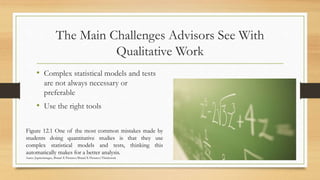
Figure 12.1 One of the most common mistakes made by
students doing quantitative studies is that they use
complex statistical models and tests, thinking this
automatically makes for a better analysis.
Source: Jupiterimages, Brand X Pictures/Brand X Pictures/Thinkstock
Organizing Quantitative Evidence
• Statistical significance and variance of
results
• Directions of the findings
• Effect size
• Use tables and figures
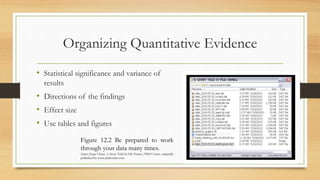
Figure 12.2 Be prepared to work
through your data many times.
Source: Jorge Cham: A Story Told In File Names, PhD Comic, originally
published by www.phdcomic.com
Building a Quantitative Argument
• Argumentation
• Claim
• Evidence
• Warrant
• Backing
Figure 11.5 Make sure there is
a strong clear link between
your evidence and your claim.
Source: Stockbyte/Stockbyte/Thinkstock
Assessment Standards for Quantitative
Research
• Golden thread
• Three standards apply to all doctoral
research: “objectivity, clarity, and
replicability” (Bryant, 2004, p. 117).
• Outstanding quantitative discussion
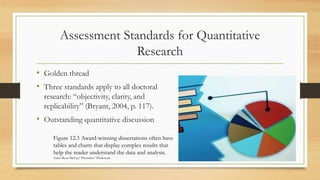
Figure 12.3 Award-winning dissertations often have
tables and charts that display complex results that
help the reader understand the data and analysis.
Source: Ryan McVay/ Photodisc/Thinkstock
Quantitative Research Tips: Do…
• Be clear on the difference between your results and your findings.
• Tell your reader at the beginning of each section how the results and findings will be presented and then follow
that order.
• Superimpose a routine on your explanation of results, repeating that routine throughout your argumentation in
order for your reader to understand the sequence of thoughts and how they develop.
• Use the tables and charts to present your data.
• Clearly explain the statistical models and tests you used and why they are best suited to your study.
• Include a substantive conversation about the statistical procedures used to arrive at the findings.
• Conclude with a summary through which the reader can follow the course of your argument and will be
convinced with the internal validity of your study.
Qualitative Research Tips: Don’t…
• Spend too much space on written descriptions, especially paragraph-long
descriptions of frequencies of responses; instead organize quantitative
evidence using tables and charts and show your readers how the qualitative
data compare with quotations from that evidence.
• Forget to consider the internal validity of your findings, discussion or
conclusions, and arguments in terms of both types of evidence. This
discussion should be considered as part of your final chapter.
Where Should I Go to Dig Deeper?
Suggested Resources to Consider
• Gliner, J. A., Morgan, G. A., & Leech, N. L. (2009). Research methods in applied settings: An integrated approach to design and analysis (2nd ed.). New York:
Routledge/Psychology Press. This is an excellent text recommended by one of our reviewers as a great basic for quantitative research.
• Huck, S. W. (2012). Reading statistics and research (6th ed.). Boston: Pearson. Also recommended by one of our reviewers, this book is known to be a “uniquely
accessible text [that] shows precisely how to decipher and critique statistically-based research reports. Praised for its non-intimidating writing style, the text
emphasizes concepts over formulas.”
• Morgan, G. A., Leech, N. L., Gloeckner, G. W., & Barrett, K. C. (2011). IBM SPSS for introductory statistics: Use and interpretation. New York: Routledge Taylor & Francis
Group. Chapters 1, 3, and 6 respectively are a must read for quantitative researchers covering variables, research problems, questions, measurement, and descriptive
statistics, and the selection of and interpretation of inferential statistics. Written in down-to-earth language and augmented by a thorough example that uses data from
the High School and Beyond study. Appendix B has an especially good discussion of how to ask questions in quantitative studies.
• Roberts, C. M. (2004). The dissertation journey. Thousand Oaks, CA: Corwin Press. Chapter 14 and 15 give a brief but useful description of the path from data gathering,
through analysis, and on to the final discussion or conclusions. Many pullout boxes offer helpful hints and additional resources.
• Rudestam, K. E., & Newton, R. R. (2007). Surviving your dissertation: A comprehensive guide to content and process (3rd ed.). Thousand Oaks, CA: Sage. This book contains an
excellent set of appendices that discuss ways in which to present data in tables.
• Salkind, N. J. (2012). 100 questions (and answers) about research methods. Thousand Oaks, CA: SAGE. This book is laid out in, usually single-paged, questions and answers
and has direct help for many of the most common challenges faced by the beginning quantitative researcher.
• Thompson, B. (2006). Foundations of behavioral statistics: An insight-based approach. New York: Guilford Press. This book shows readers how to interpret research
outcomes and make statistical decisions.

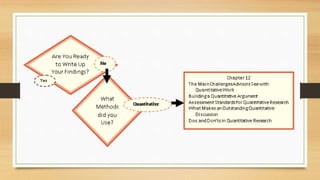
Are You Ready to Write Up Your Quantitative Data?

  • 1.
    Writing Your DoctoralDissertation or Thesis Faster A Proven Map to Success by E. Alana James and Tracesea Slater Chapter 12: Are You Ready to Write Up Your Quantitative Data?
  • 3.
    The Main ChallengesAdvisors See With Qualitative Work • Complex statistical models and tests are not always necessary or preferable • Use the right tools Figure 12.1 One of the most common mistakes made by students doing quantitative studies is that they use complex statistical models and tests, thinking this automatically makes for a better analysis. Source: Jupiterimages, Brand X Pictures/Brand X Pictures/Thinkstock
  • 4.
    Organizing Quantitative Evidence •Statistical significance and variance of results • Directions of the findings • Effect size • Use tables and figures Figure 12.2 Be prepared to work through your data many times. Source: Jorge Cham: A Story Told In File Names, PhD Comic, originally published by www.phdcomic.com
  • 5.
    Building a QuantitativeArgument • Argumentation • Claim • Evidence • Warrant • Backing Figure 11.5 Make sure there is a strong clear link between your evidence and your claim. Source: Stockbyte/Stockbyte/Thinkstock
  • 6.
    Assessment Standards forQuantitative Research • Golden thread • Three standards apply to all doctoral research: “objectivity, clarity, and replicability” (Bryant, 2004, p. 117). • Outstanding quantitative discussion Figure 12.3 Award-winning dissertations often have tables and charts that display complex results that help the reader understand the data and analysis. Source: Ryan McVay/ Photodisc/Thinkstock
  • 7.
    Quantitative Research Tips:Do… • Be clear on the difference between your results and your findings. • Tell your reader at the beginning of each section how the results and findings will be presented and then follow that order. • Superimpose a routine on your explanation of results, repeating that routine throughout your argumentation in order for your reader to understand the sequence of thoughts and how they develop. • Use the tables and charts to present your data. • Clearly explain the statistical models and tests you used and why they are best suited to your study. • Include a substantive conversation about the statistical procedures used to arrive at the findings. • Conclude with a summary through which the reader can follow the course of your argument and will be convinced with the internal validity of your study.
  • 8.
    Qualitative Research Tips:Don’t… • Spend too much space on written descriptions, especially paragraph-long descriptions of frequencies of responses; instead organize quantitative evidence using tables and charts and show your readers how the qualitative data compare with quotations from that evidence. • Forget to consider the internal validity of your findings, discussion or conclusions, and arguments in terms of both types of evidence. This discussion should be considered as part of your final chapter.
  • 9.
    Where Should IGo to Dig Deeper? Suggested Resources to Consider • Gliner, J. A., Morgan, G. A., & Leech, N. L. (2009). Research methods in applied settings: An integrated approach to design and analysis (2nd ed.). New York: Routledge/Psychology Press. This is an excellent text recommended by one of our reviewers as a great basic for quantitative research. • Huck, S. W. (2012). Reading statistics and research (6th ed.). Boston: Pearson. Also recommended by one of our reviewers, this book is known to be a “uniquely accessible text [that] shows precisely how to decipher and critique statistically-based research reports. Praised for its non-intimidating writing style, the text emphasizes concepts over formulas.” • Morgan, G. A., Leech, N. L., Gloeckner, G. W., & Barrett, K. C. (2011). IBM SPSS for introductory statistics: Use and interpretation. New York: Routledge Taylor & Francis Group. Chapters 1, 3, and 6 respectively are a must read for quantitative researchers covering variables, research problems, questions, measurement, and descriptive statistics, and the selection of and interpretation of inferential statistics. Written in down-to-earth language and augmented by a thorough example that uses data from the High School and Beyond study. Appendix B has an especially good discussion of how to ask questions in quantitative studies. • Roberts, C. M. (2004). The dissertation journey. Thousand Oaks, CA: Corwin Press. Chapter 14 and 15 give a brief but useful description of the path from data gathering, through analysis, and on to the final discussion or conclusions. Many pullout boxes offer helpful hints and additional resources. • Rudestam, K. E., & Newton, R. R. (2007). Surviving your dissertation: A comprehensive guide to content and process (3rd ed.). Thousand Oaks, CA: Sage. This book contains an excellent set of appendices that discuss ways in which to present data in tables. • Salkind, N. J. (2012). 100 questions (and answers) about research methods. Thousand Oaks, CA: SAGE. This book is laid out in, usually single-paged, questions and answers and has direct help for many of the most common challenges faced by the beginning quantitative researcher. • Thompson, B. (2006). Foundations of behavioral statistics: An insight-based approach. New York: Guilford Press. This book shows readers how to interpret research outcomes and make statistical decisions.