Welcome to our Presentation
We are… Group No: 16
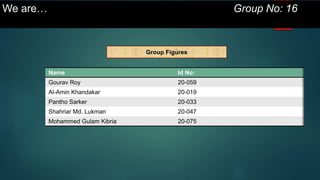
Name Id No:
Gourav Roy 20-059
Al-Amin Khandakar 20-019
Pantho Sarker 20-033
Shahriar Md. Lukman 20-047
Mohammed Gulam Kibria 20-075
Group Figures
We are Presenting on…
Monetary Policy in Bangladesh
Now you are with…
Gourav Roy
Id No: 20-059
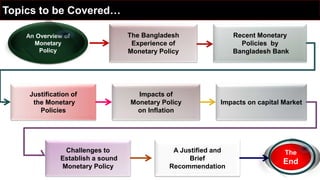
Impacts on capital Market
Impacts of
Monetary Policy
on Inflation
Justification of
the Monetary
Policies
Recent Monetary
Policies by
Bangladesh Bank
The Bangladesh
Experience of
Monetary Policy
A Justified and
Brief
Recommendation
Challenges to
Establish a sound
Monetary Policy
The
End
Topics to be Covered…
An Overview of
Monetary
Policy
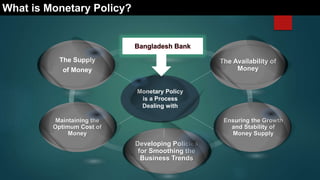
What is Monetary Policy?
Ensuring the Growth
and Stability of
Money Supply
Monetary Policy
is a Process
Dealing with
Maintaining the
Optimum Cost of
Money
The Supply
of Money
The Availability of
Money
Developing Policies
for Smoothing the
Business Trends
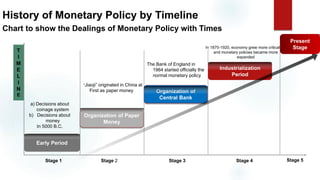
History of Monetary Policy by Timeline
Chart to show the Dealings of Monetary Policy with Times
Early Period
Organization of Paper
Money
Organization of
Central Bank
Industrialization
Period
“Jiaoji” originated in China at
First as paper money
In 1870-1920, economy grew more critical
and monetary policies became more
expanded
Stage 1 Stage 2 Stage 3 Stage 4
T
I
M
E
L
I
N
E
a) Decisions about
coinage system
b) Decisions about
money
In 5000 B.C.
The Bank of England in
1964 started officially the
normal monetary policy
Present
Stage
Stage 5
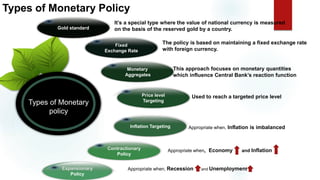
Types of Monetary Policy
Expansionary
Policy
Used to reach a targeted price level
Appropriate when, Inflation is imbalanced
Appropriate when, Economy and Inflation
Appropriate when, Recession and Unemployment
Types of Monetary
policy
Contractionary
Policy
Inflation Targeting
Price level
Targeting
Monetary
Aggregates
Gold standard
Fixed
Exchange Rate
This approach focuses on monetary quantities
which influence Central Bank’s reaction function
It’s a special type where the value of national currency is measured
on the basis of the reserved gold by a country.
The policy is based on maintaining a fixed exchange rate
with foreign currency.
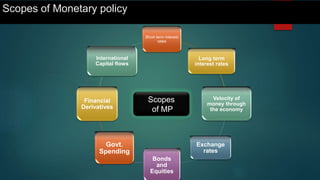
Scopes of Monetary policy
Short term interest
rates
Long term
interest rates
Velocity of
money through
the economy
Exchange
rates
Bonds
and
Equities
Govt.
Spending
Financial
Derivatives
International
Capital flows
Scopes
of MP
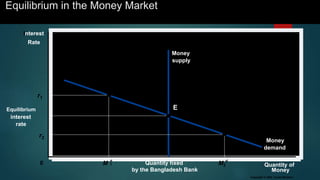
Equilibrium in the Money Market
Quantity of
Money
Interest
Rate
0
Money
demand
Quantity fixed
by the Bangladesh Bank
Money
supply
r2
M2
d
M d
r1
Equilibrium
interest
rate
Copyright © 2004 South-Western
E
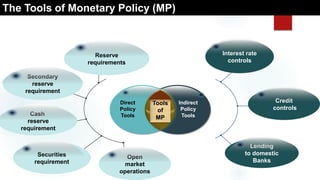
The Tools of Monetary Policy (MP)
Interest rate
controls
Credit
controls
Lending
to domestic
Banks
Reserve
requirements
Secondary
reserve
requirement
Cash
reserve
requirement
Securities
requirement
Direct
Policy
Tools
Indirect
Policy
Tools
Tools
of
MP
Open
market
operations
Now you are with…
SHAHRIAR MD. LUKMAN
ID; 20-047
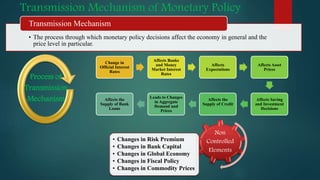
Transmission Mechanism of Monetary Policy
• The process through which monetary policy decisions affect the economy in general and the
price level in particular.
Transmission Mechanism
Change in
Official Interest
Rates
Affects Banks
and Money
Market Interest
Rates
Affects
Expectations
Affects Asset
Prices
Affects Saving
and Investment
Decisions
Affects the
Supply of Credit
Leads to Changes
in Aggregate
Demand and
Prices
Affects the
Supply of Bank
Loans
Process of
Transmission
Mechanism
Non
Controlled
Elements
• Changes in Risk Premium
• Changes in Bank Capital
• Changes in Global Economy
• Changes in Fiscal Policy
• Changes in Commodity Prices
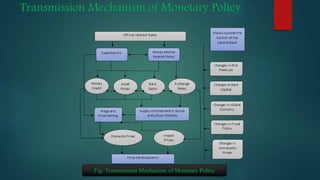
Transmission Mechanism of Monetary Policy
Fig: Transmission Mechanism of Monetary Policy
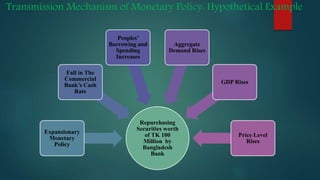
Repurchasing
Securities worth
of TK 100
Million by
Bangladesh
Bank
Expansionary
Monetary
Policy
Fall in The
Commercial
Bank’s Cash
Rate
Peoples’
Borrowing and
Spending
Increases
Aggregate
Demand Rises
GDP Rises
Price Level
Rises
Transmission Mechanism of Monetary Policy: Hypothetical Example
• Purchases Securities in the Open
Market;
• Lowers the Central Bank’s Discount
Rate;
• Lowers Reserve Requirements;
Expansionary
Monetary
Policy
• Sells Securities in the Open Market;
• Raises the Central Bank’s Discount
Rate;
• Raise Reserve Requirements;
Contractionary
Monetary
Policy
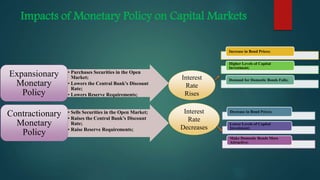
Impacts of Monetary Policy on Capital Markets
Interest
Rate
Rises
Interest
Rate
Decreases
Increase in Bond Prices;
Higher Levels of Capital
Investment;
Demand for Domestic Bonds Falls;
Decrease in Bond Prices;
Lower Levels of Capital
Investment;
Make Domestic Bonds More
Attractive;
Now you are with…
Md. Gulam kibria
ID: 20-075
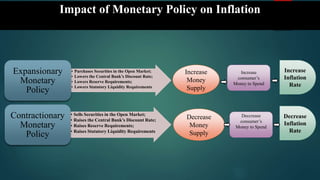
Impact of Monetary Policy on Inflation
• Purchases Securities in the Open Market;
• Lowers the Central Bank’s Discount Rate;
• Lowers Reserve Requirements;
• Lowers Statutory Liquidity Requirements
Expansionary
Monetary
Policy
• Sells Securities in the Open Market;
• Raises the Central Bank’s Discount Rate;
• Raises Reserve Requirements;
• Raises Statutory Liquidity Requirements
Contractionary
Monetary
Policy
Increase
Money
Supply
Decrease
Money
Supply
Increase
consumer’s
Money to Spend
Deccrease
consumer’s
Money to Spend
Increase
Inflation
Rate
Decrease
Inflation
Rate
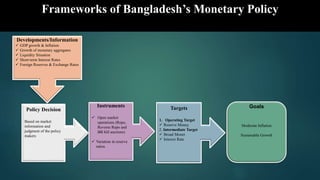
Frameworks of Bangladesh’s Monetary Policy
Developments/Information
 GDP growth & Inflation
 Growth of monetary aggregates
 Liquidity Situation
 Short-term Interest Rates
 Foreign Reserves & Exchange Rates
Policy Decision
Based on market
information and
judgment of the policy
makers
Instruments
 Open market
operations (Repo,
Reverse Repo and
BB bill auctions)
 Variation in reserve
ratios
Targets
1. Operating Target
 Reserve Money
2. Intermediate Target
 Broad Monet
 Interest Rate
Goals
Moderate Inflation
Sustainable Growth
Now you are with…
Al-amin khandakar
Id No: 20-019
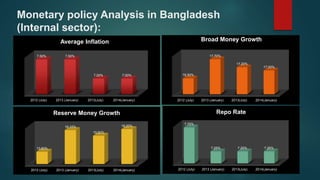
Monetary policy Analysis in Bangladesh
(Internal sector):
2012 (July) 2013 (January) 2013(July) 2014(January)
7.50% 7.50%
7.00% 7.00%
Average Inflation
2012 (July) 2013 (January) 2013(July) 2014(January)
16.50%
17.70%
17.20%
17.00%
Broad Money Growth
2012 (July) 2013 (January) 2013(July) 2014(January)
13.80%
16.10%
15.50%
16.20%
Reserve Money Growth
2012 (July) 2013 (January) 2013(July) 2014(January)
7.75%
7.25% 7.25% 7.25%
Repo Rate
Monetary policy Analysis in Bangladesh
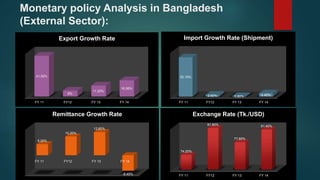
(External Sector):
FY 11 FY12 FY 13 FY 14
41.50%
6%
11.20%
16.56%
Export Growth Rate
FY 11 FY12 FY 13 FY 14
52.10%
2.50% 0.80% 4.40%
Import Growth Rate (Shipment)
FY 11 FY12 FY 13 FY 14
6.00%
10.20%
12.60%
-8.40%
Remittance Growth Rate
FY 11 FY12 FY 13 FY 14
74.20%
81.80%
77.80%
81.40%
Exchange Rate (Tk./USD)
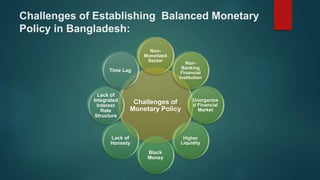
Challenges of Establishing Balanced Monetary
Policy in Bangladesh:
Challenges of
Monetary Policy
Non-
Monetized
Sector
Non-
Banking
Financial
Institution
Unorganize
d Financial
Market
Higher
Liquidity
Black
Money
Lack of
Honesty
Lack of
Integrated
Interest
Rate
Structure
Time Lag
Now you are with…
Pantho Sarker
ID: 20-033
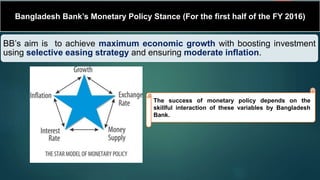
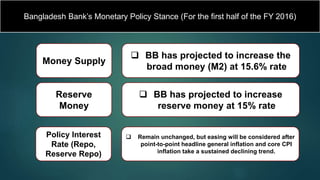
Bangladesh Bank’s Monetary Policy Stance (For the first half of the FY 2016)
BB’s aim is to achieve maximum economic growth with boosting investment
using selective easing strategy and ensuring moderate inflation.
The success of monetary policy depends on the
skillful interaction of these variables by Bangladesh
Bank.
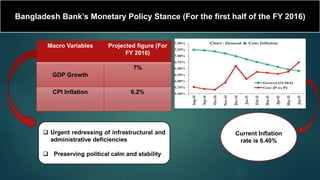
Bangladesh Bank’s Monetary Policy Stance (For the first half of the FY 2016)
Macro Variables Projected figure (For
FY 2016)
GDP Growth
7%
CPI Inflation 6.2%
 Urgent redressing of infrastructural and
administrative deficiencies
 Preserving political calm and stability
Current Inflation
rate is 6.40%
Bangladesh Bank’s Monetary Policy Stance (For the first half of the FY 2016)
Money Supply
 BB has projected to increase the
broad money (M2) at 15.6% rate
Reserve
Money
 BB has projected to increase
reserve money at 15% rate
Policy Interest
Rate (Repo,
Reserve Repo)
 Remain unchanged, but easing will be considered after
point-to-point headline general inflation and core CPI
inflation take a sustained declining trend.
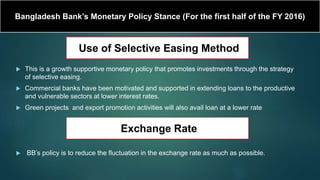
Bangladesh Bank’s Monetary Policy Stance (For the first half of the FY 2016)
 This is a growth supportive monetary policy that promotes investments through the strategy
of selective easing.
 Commercial banks have been motivated and supported in extending loans to the productive
and vulnerable sectors at lower interest rates.
 Green projects and export promotion activities will also avail loan at a lower rate
 BB’s policy is to reduce the fluctuation in the exchange rate as much as possible.
Use of Selective Easing Method
Exchange Rate
Thank You for Being with
us

Monetary Policy in Bangladesh

  • 1.
    Welcome to ourPresentation
  • 2.
    We are… GroupNo: 16 Name Id No: Gourav Roy 20-059 Al-Amin Khandakar 20-019 Pantho Sarker 20-033 Shahriar Md. Lukman 20-047 Mohammed Gulam Kibria 20-075 Group Figures
  • 3.
    We are Presentingon… Monetary Policy in Bangladesh
  • 4.
    Now you arewith… Gourav Roy Id No: 20-059
  • 5.
    Impacts on capitalMarket Impacts of Monetary Policy on Inflation Justification of the Monetary Policies Recent Monetary Policies by Bangladesh Bank The Bangladesh Experience of Monetary Policy A Justified and Brief Recommendation Challenges to Establish a sound Monetary Policy The End Topics to be Covered… An Overview of Monetary Policy
  • 6.
    What is MonetaryPolicy? Ensuring the Growth and Stability of Money Supply Monetary Policy is a Process Dealing with Maintaining the Optimum Cost of Money The Supply of Money The Availability of Money Developing Policies for Smoothing the Business Trends
  • 7.
    History of MonetaryPolicy by Timeline Chart to show the Dealings of Monetary Policy with Times Early Period Organization of Paper Money Organization of Central Bank Industrialization Period “Jiaoji” originated in China at First as paper money In 1870-1920, economy grew more critical and monetary policies became more expanded Stage 1 Stage 2 Stage 3 Stage 4 T I M E L I N E a) Decisions about coinage system b) Decisions about money In 5000 B.C. The Bank of England in 1964 started officially the normal monetary policy Present Stage Stage 5
  • 8.
    Types of MonetaryPolicy Expansionary Policy Used to reach a targeted price level Appropriate when, Inflation is imbalanced Appropriate when, Economy and Inflation Appropriate when, Recession and Unemployment Types of Monetary policy Contractionary Policy Inflation Targeting Price level Targeting Monetary Aggregates Gold standard Fixed Exchange Rate This approach focuses on monetary quantities which influence Central Bank’s reaction function It’s a special type where the value of national currency is measured on the basis of the reserved gold by a country. The policy is based on maintaining a fixed exchange rate with foreign currency.
  • 9.
    Scopes of Monetarypolicy Short term interest rates Long term interest rates Velocity of money through the economy Exchange rates Bonds and Equities Govt. Spending Financial Derivatives International Capital flows Scopes of MP
  • 10.
    Equilibrium in theMoney Market Quantity of Money Interest Rate 0 Money demand Quantity fixed by the Bangladesh Bank Money supply r2 M2 d M d r1 Equilibrium interest rate Copyright © 2004 South-Western E
  • 11.
    The Tools ofMonetary Policy (MP) Interest rate controls Credit controls Lending to domestic Banks Reserve requirements Secondary reserve requirement Cash reserve requirement Securities requirement Direct Policy Tools Indirect Policy Tools Tools of MP Open market operations
  • 12.
    Now you arewith… SHAHRIAR MD. LUKMAN ID; 20-047
  • 13.
    Transmission Mechanism ofMonetary Policy • The process through which monetary policy decisions affect the economy in general and the price level in particular. Transmission Mechanism Change in Official Interest Rates Affects Banks and Money Market Interest Rates Affects Expectations Affects Asset Prices Affects Saving and Investment Decisions Affects the Supply of Credit Leads to Changes in Aggregate Demand and Prices Affects the Supply of Bank Loans Process of Transmission Mechanism Non Controlled Elements • Changes in Risk Premium • Changes in Bank Capital • Changes in Global Economy • Changes in Fiscal Policy • Changes in Commodity Prices
  • 14.
    Transmission Mechanism ofMonetary Policy Fig: Transmission Mechanism of Monetary Policy
  • 15.
    Repurchasing Securities worth of TK100 Million by Bangladesh Bank Expansionary Monetary Policy Fall in The Commercial Bank’s Cash Rate Peoples’ Borrowing and Spending Increases Aggregate Demand Rises GDP Rises Price Level Rises Transmission Mechanism of Monetary Policy: Hypothetical Example
  • 16.
    • Purchases Securitiesin the Open Market; • Lowers the Central Bank’s Discount Rate; • Lowers Reserve Requirements; Expansionary Monetary Policy • Sells Securities in the Open Market; • Raises the Central Bank’s Discount Rate; • Raise Reserve Requirements; Contractionary Monetary Policy Impacts of Monetary Policy on Capital Markets Interest Rate Rises Interest Rate Decreases Increase in Bond Prices; Higher Levels of Capital Investment; Demand for Domestic Bonds Falls; Decrease in Bond Prices; Lower Levels of Capital Investment; Make Domestic Bonds More Attractive;
  • 17.
    Now you arewith… Md. Gulam kibria ID: 20-075
  • 18.
    Impact of MonetaryPolicy on Inflation • Purchases Securities in the Open Market; • Lowers the Central Bank’s Discount Rate; • Lowers Reserve Requirements; • Lowers Statutory Liquidity Requirements Expansionary Monetary Policy • Sells Securities in the Open Market; • Raises the Central Bank’s Discount Rate; • Raises Reserve Requirements; • Raises Statutory Liquidity Requirements Contractionary Monetary Policy Increase Money Supply Decrease Money Supply Increase consumer’s Money to Spend Deccrease consumer’s Money to Spend Increase Inflation Rate Decrease Inflation Rate
  • 19.
    Frameworks of Bangladesh’sMonetary Policy Developments/Information  GDP growth & Inflation  Growth of monetary aggregates  Liquidity Situation  Short-term Interest Rates  Foreign Reserves & Exchange Rates Policy Decision Based on market information and judgment of the policy makers Instruments  Open market operations (Repo, Reverse Repo and BB bill auctions)  Variation in reserve ratios Targets 1. Operating Target  Reserve Money 2. Intermediate Target  Broad Monet  Interest Rate Goals Moderate Inflation Sustainable Growth
  • 20.
    Now you arewith… Al-amin khandakar Id No: 20-019
  • 21.
    Monetary policy Analysisin Bangladesh (Internal sector): 2012 (July) 2013 (January) 2013(July) 2014(January) 7.50% 7.50% 7.00% 7.00% Average Inflation 2012 (July) 2013 (January) 2013(July) 2014(January) 16.50% 17.70% 17.20% 17.00% Broad Money Growth 2012 (July) 2013 (January) 2013(July) 2014(January) 13.80% 16.10% 15.50% 16.20% Reserve Money Growth 2012 (July) 2013 (January) 2013(July) 2014(January) 7.75% 7.25% 7.25% 7.25% Repo Rate
  • 22.
    Monetary policy Analysisin Bangladesh (External Sector): FY 11 FY12 FY 13 FY 14 41.50% 6% 11.20% 16.56% Export Growth Rate FY 11 FY12 FY 13 FY 14 52.10% 2.50% 0.80% 4.40% Import Growth Rate (Shipment) FY 11 FY12 FY 13 FY 14 6.00% 10.20% 12.60% -8.40% Remittance Growth Rate FY 11 FY12 FY 13 FY 14 74.20% 81.80% 77.80% 81.40% Exchange Rate (Tk./USD)
  • 23.
    Challenges of EstablishingBalanced Monetary Policy in Bangladesh: Challenges of Monetary Policy Non- Monetized Sector Non- Banking Financial Institution Unorganize d Financial Market Higher Liquidity Black Money Lack of Honesty Lack of Integrated Interest Rate Structure Time Lag
  • 24.
    Now you arewith… Pantho Sarker ID: 20-033
  • 25.
    Bangladesh Bank’s MonetaryPolicy Stance (For the first half of the FY 2016) BB’s aim is to achieve maximum economic growth with boosting investment using selective easing strategy and ensuring moderate inflation. The success of monetary policy depends on the skillful interaction of these variables by Bangladesh Bank.
  • 26.
    Bangladesh Bank’s MonetaryPolicy Stance (For the first half of the FY 2016) Macro Variables Projected figure (For FY 2016) GDP Growth 7% CPI Inflation 6.2%  Urgent redressing of infrastructural and administrative deficiencies  Preserving political calm and stability Current Inflation rate is 6.40%
  • 27.
    Bangladesh Bank’s MonetaryPolicy Stance (For the first half of the FY 2016) Money Supply  BB has projected to increase the broad money (M2) at 15.6% rate Reserve Money  BB has projected to increase reserve money at 15% rate Policy Interest Rate (Repo, Reserve Repo)  Remain unchanged, but easing will be considered after point-to-point headline general inflation and core CPI inflation take a sustained declining trend.
  • 28.
    Bangladesh Bank’s MonetaryPolicy Stance (For the first half of the FY 2016)  This is a growth supportive monetary policy that promotes investments through the strategy of selective easing.  Commercial banks have been motivated and supported in extending loans to the productive and vulnerable sectors at lower interest rates.  Green projects and export promotion activities will also avail loan at a lower rate  BB’s policy is to reduce the fluctuation in the exchange rate as much as possible. Use of Selective Easing Method Exchange Rate
  • 29.
    Thank You forBeing with us

Editor's Notes

  • #26 IDRA (Insurance Development and Regulatory Authority in Bangladesh) III (Insurance Information Institute)
  • #28 Reserve money is projected to grow at 16 per cent and broad money (M2) at 15.6 per cent which are adequate to support the growth and inflation targets.