www.sanjivanimba.org.inwww.sanjivanimba.org.inDept. of MBA, Sanjivani COE, Kopargaon
308FIN-INTERNATIONAL FINANCE
Dr. Mital Bhayani
Flexible Exchange rate system: 1973- Present
1
SanjivaniCollegeofEngineering,Kopargaon
DepartmentofMBA
www.sanjivanimba.org.in
www.sanjivanimba.org.inwww.sanjivanimba.org.inDept. of MBA, Sanjivani COE, Kopargaon
At the End of this video you should be able to:
ü Explain the fundamental “Trilemma” that affects the design of any
exchange rate system.
ü Distinguish between a free float, a managed float, a target-zone
arrangement, and a fixed-rate system of exchange rate determination
ü Describe how equilibrium in the foreign exchange market is achieved
under alternative exchange rate systems, including a gold standard
ü Identify the three categories of central bank intervention under a
managed float
Session Learning Outcome
www.sanjivanimba.org.inwww.sanjivanimba.org.in
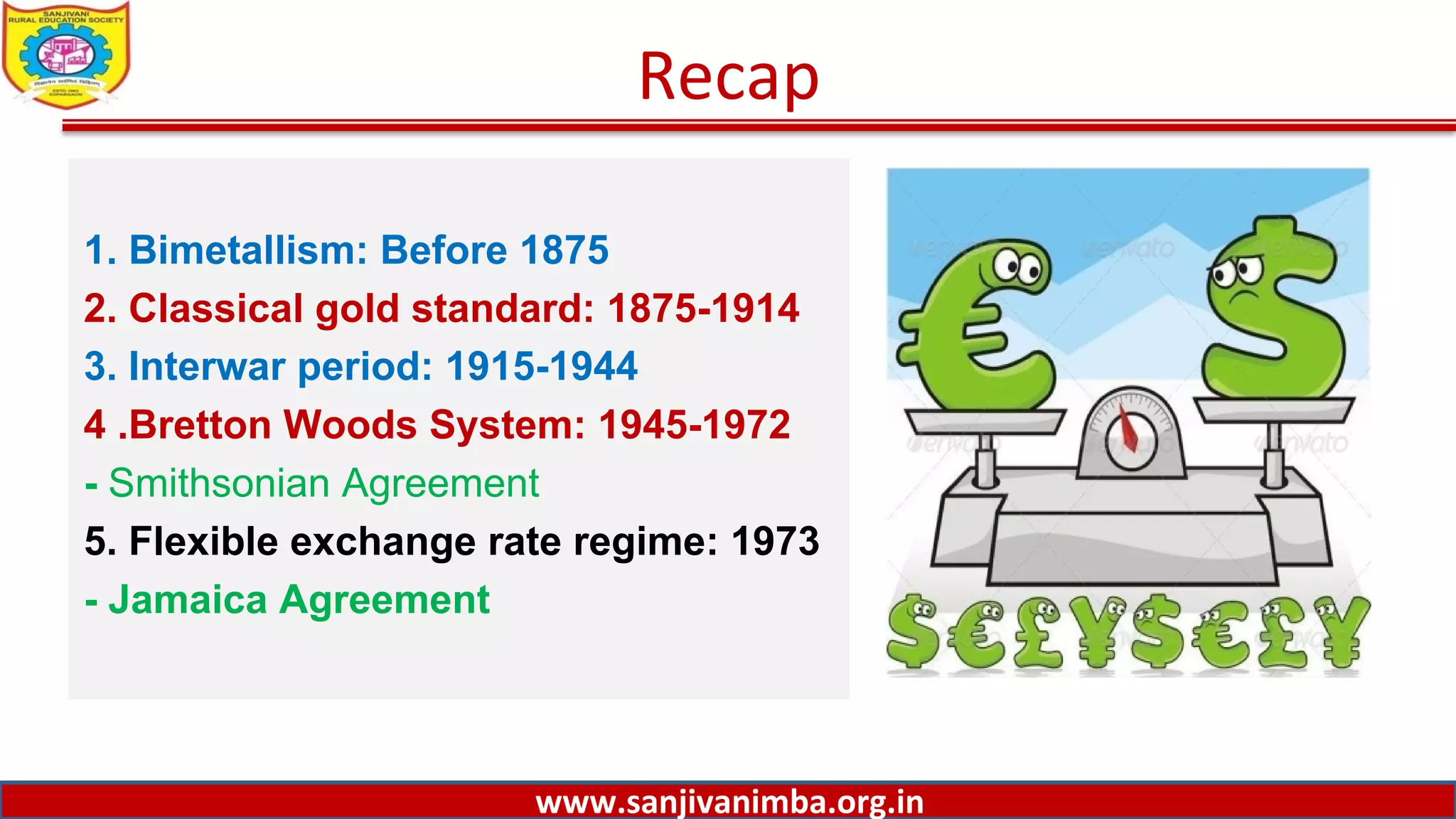
1. Bimetallism: Before 1875
2. Classical gold standard: 1875-1914
3. Interwar period: 1915-1944
4 .Bretton Woods System: 1945-1972
- Smithsonian Agreement
5. Flexible exchange rate regime: 1973
- Jamaica Agreement
Recap
www.sanjivanimba.org.inwww.sanjivanimba.org.in
“Followed by Smithsonian agreement - European and
Japanese currencies were allowed to float marking end of
Brettons woods”
• 1976- Jamaica Agreement
- Market determined exchange rate with government
intervention
- Gold was demonetized
- Preference to least developed countries for IMF assistance.
Flexible Exchange rates: 1973-Present
www.sanjivanimba.org.inwww.sanjivanimba.org.in
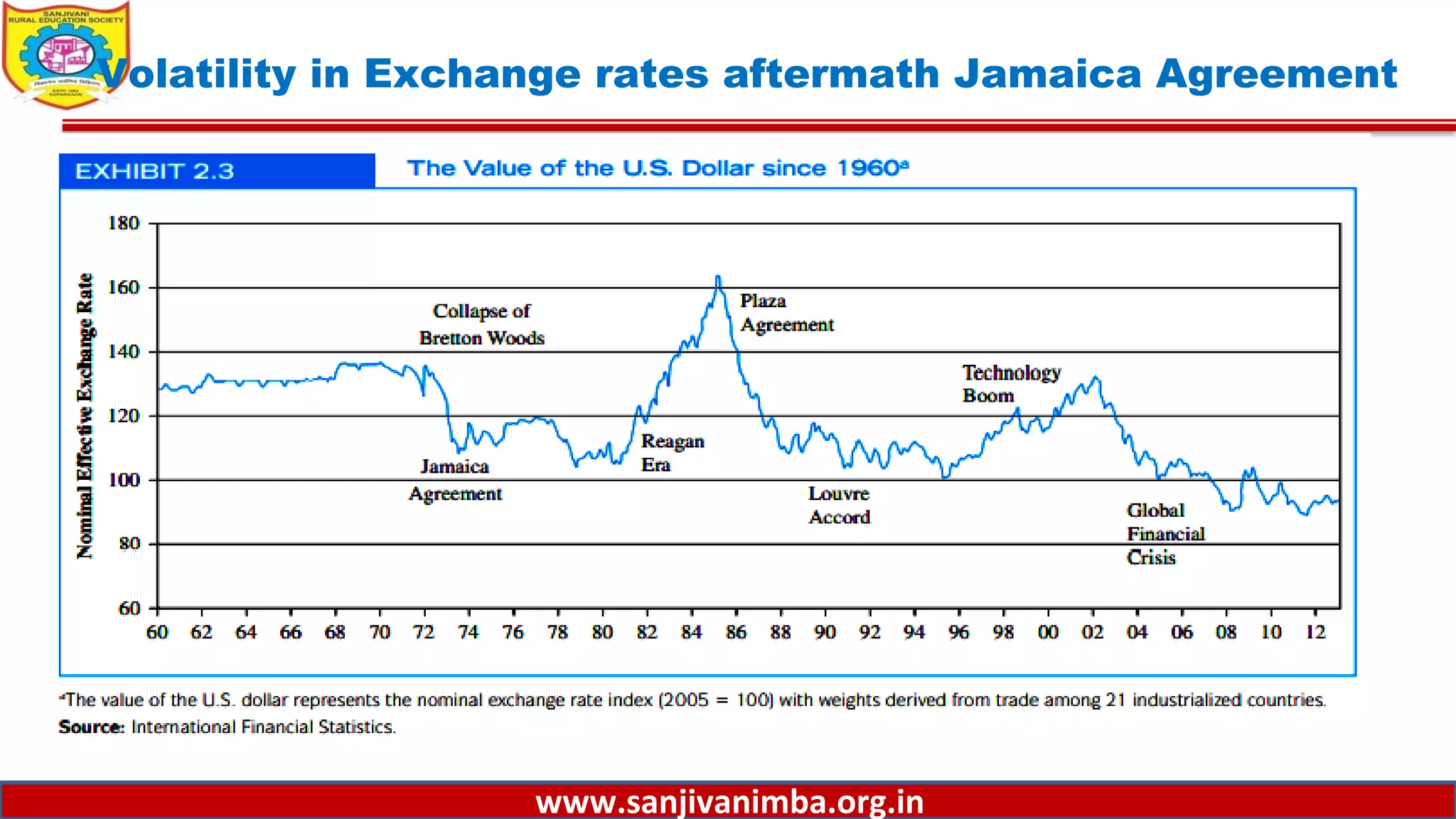
Volatility in Exchange rates aftermath Jamaica Agreement
www.sanjivanimba.org.inwww.sanjivanimba.org.in
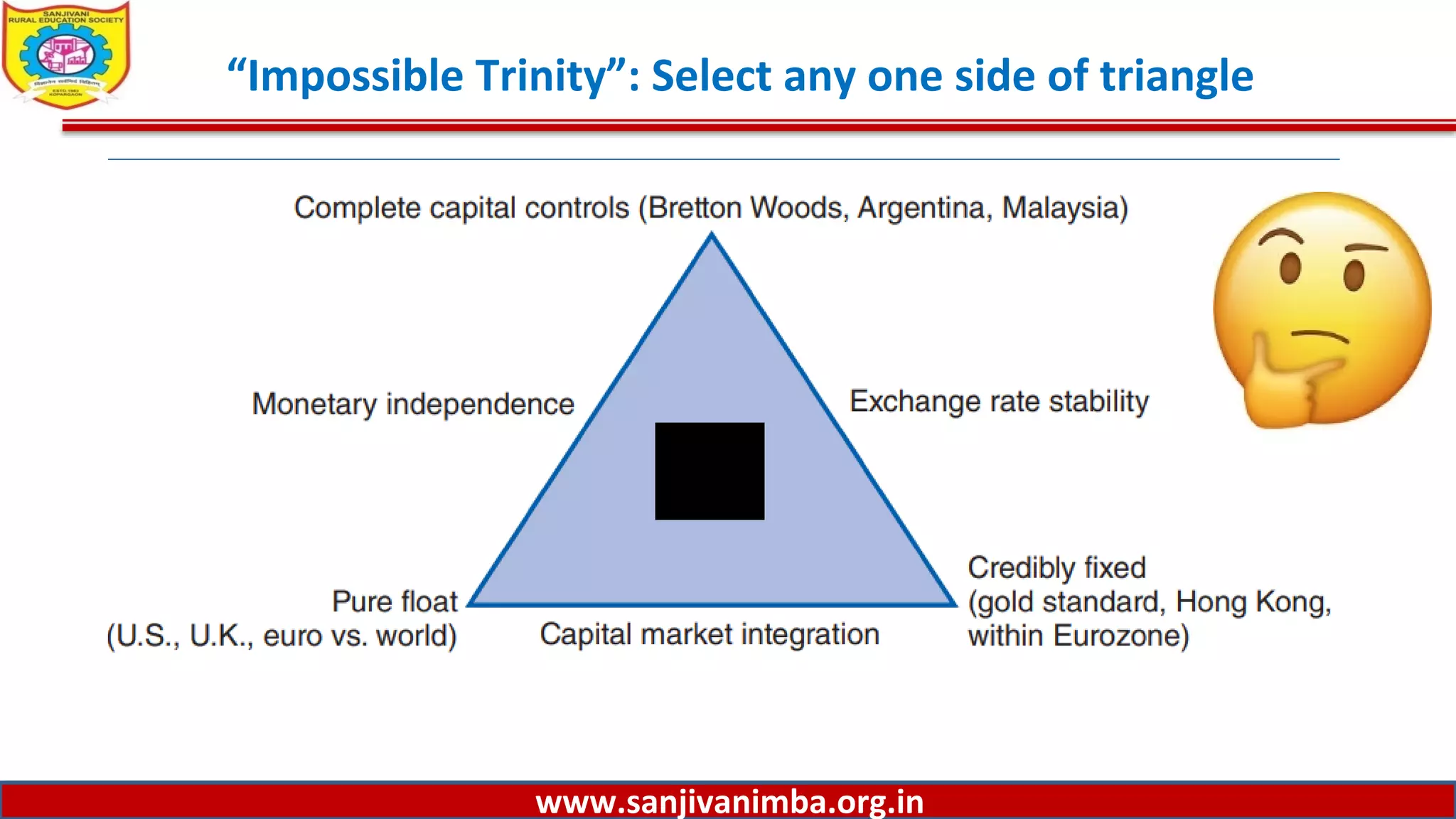
‘‘Impossible trinity’’ of
international finance:
1. A Stable exchange rate
2. An independent monetary
policy
3. Capital market integration
The Trilemma and Exchange Rate Regime Choice
Stability
Independence Integration
www.sanjivanimba.org.inwww.sanjivanimba.org.in
“Impossible Trinity”: Select any one side of triangle
www.sanjivanimba.org.inwww.sanjivanimba.org.in
Emerging economies capital controls
www.sanjivanimba.org.inwww.sanjivanimba.org.in
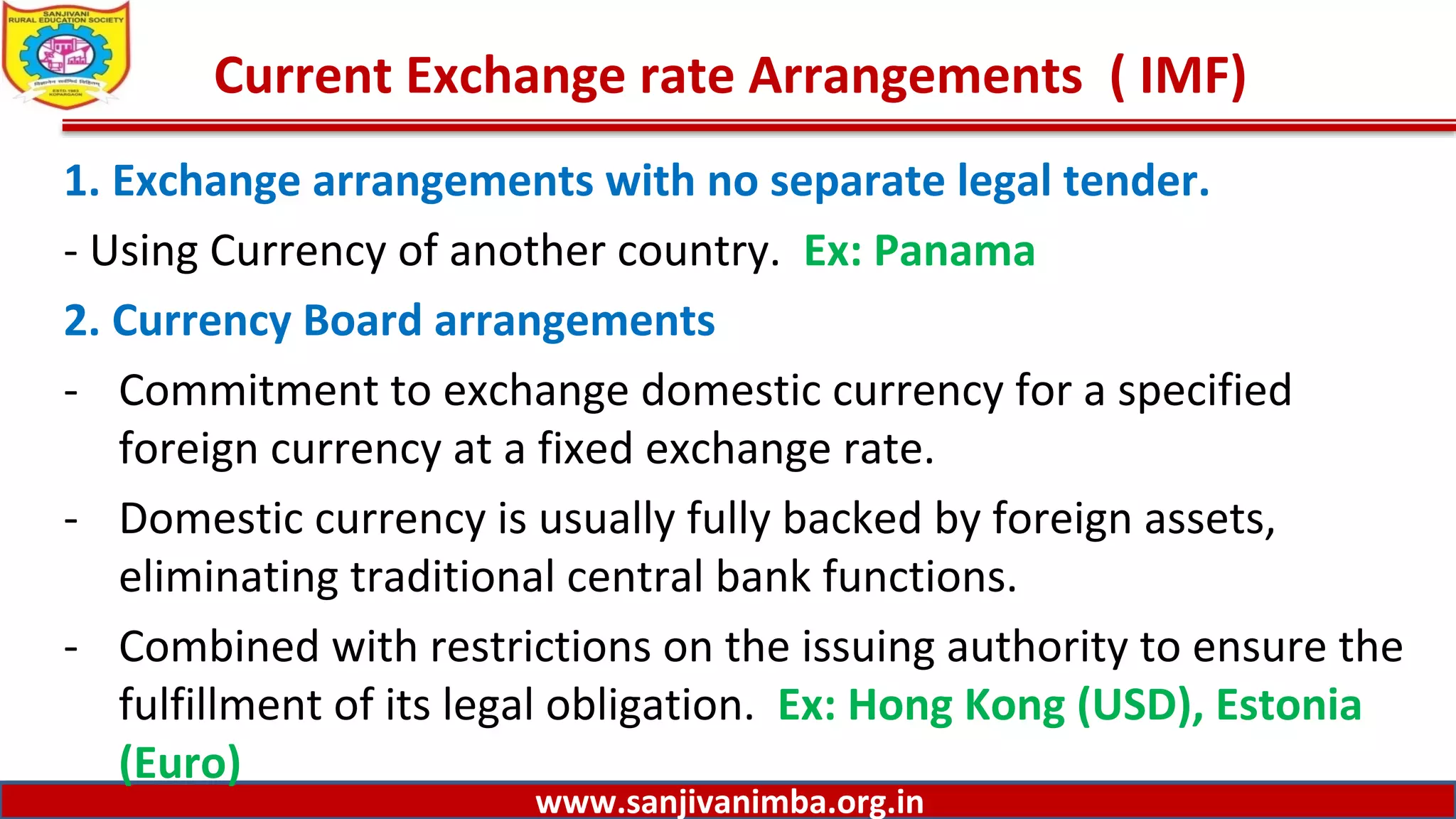
1. Exchange arrangements with no separate legal tender.
- Using Currency of another country. Ex: Panama
2. Currency Board arrangements
- Commitment to exchange domestic currency for a specified
foreign currency at a fixed exchange rate.
- Domestic currency is usually fully backed by foreign assets,
eliminating traditional central bank functions.
- Combined with restrictions on the issuing authority to ensure the
fulfillment of its legal obligation. Ex: Hong Kong (USD), Estonia
(Euro)
Current Exchange rate Arrangements ( IMF)
www.sanjivanimba.org.inwww.sanjivanimba.org.in
3. Conventional Peg:
- Country formally pegs its currency at a fixed rate to another
currency (Anchor) or a basket of currencies.
- Direct Intervention by central authorities.
- No irrevocable commitment to keep the parity, ± 1%
fluctuation allowed around central rate. Ex: Morocco, Saudi
Arabia.
www.sanjivanimba.org.inwww.sanjivanimba.org.in
4. Stabilized arrangement:
- Classification as a stabilized arrangement entails a spot
market exchange rate that remains within a margin of 2
percent for 6 months or more and is not floating.
- The required margin of stability can be met either with
respect to a single currency or a basket of currencies.
- Ex: Cambodia, Angola, and Lebanon
www.sanjivanimba.org.inwww.sanjivanimba.org.in
5. Crawling peg
- The currency is adjusted in small amounts at a fixed rate or in
response to changes in selected quantitative indicators, such
as past inflation differentials
- Ex: Bolivia and Nicaragua.
6. Crawl-like arrangement: The exchange rate must remain
within a narrow margin of 2 percent relative to a statistically
identified trend for six months or more Ex: Ethiopia, China,
and Croatia.
www.sanjivanimba.org.inwww.sanjivanimba.org.in
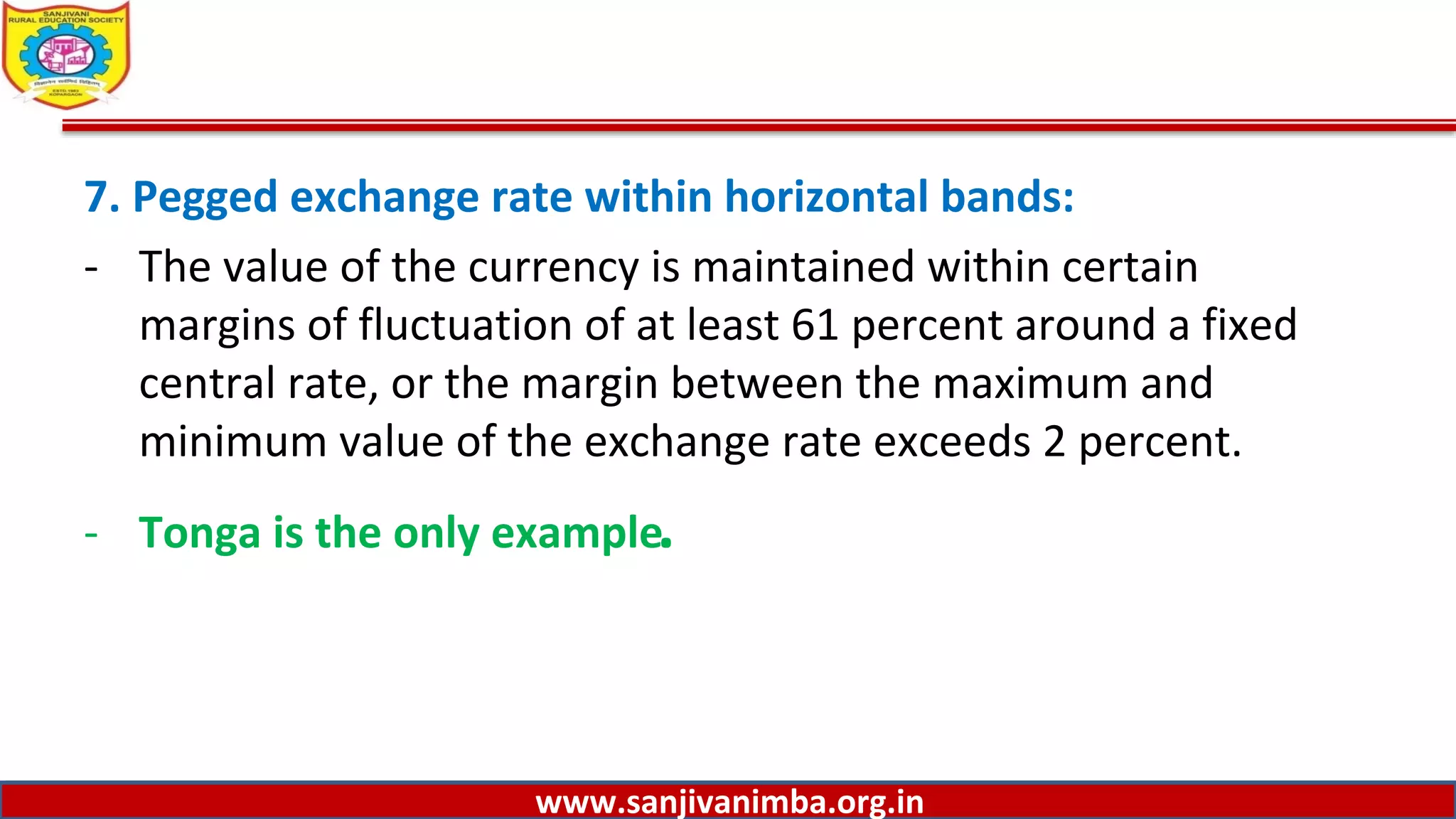
7. Pegged exchange rate within horizontal bands:
- The value of the currency is maintained within certain
margins of fluctuation of at least 61 percent around a fixed
central rate, or the margin between the maximum and
minimum value of the exchange rate exceeds 2 percent.
- Tonga is the only example.
www.sanjivanimba.org.inwww.sanjivanimba.org.in
8. Other managed arrangement:
- This category is a residual, and is used when the exchange
rate arrangement does not meet the criteria for any of the
other categories.
- Arrangements characterized by frequent shifts in policies may
fall into this category.
- Examples are Costa Rica, Switzerland, and Russia.
www.sanjivanimba.org.inwww.sanjivanimba.org.in
9. Floating: ( Managed Float)
- A floating exchange rate is largely market determined,
without an ascertainable or predictable path for the rate.
- Foreign exchange market intervention may be either direct or
indirect, and serves to moderate the rate of change and
prevent undue fluctuations in the exchange rate, but policies
targeting a specific level of the exchange rate are
incompatible with floating rate:
- Examples include Brazil, Korea, Turkey, and India.
www.sanjivanimba.org.inwww.sanjivanimba.org.in
10. Free floating:
- A floating exchange rate can be classified as free floating if
intervention occurs only exceptionally and aims to address
disorderly market conditions.
- Examples are Canada, Mexico, Japan, Israel, U.K., United States,
and euro zone.
www.sanjivanimba.org.inwww.sanjivanimba.org.in
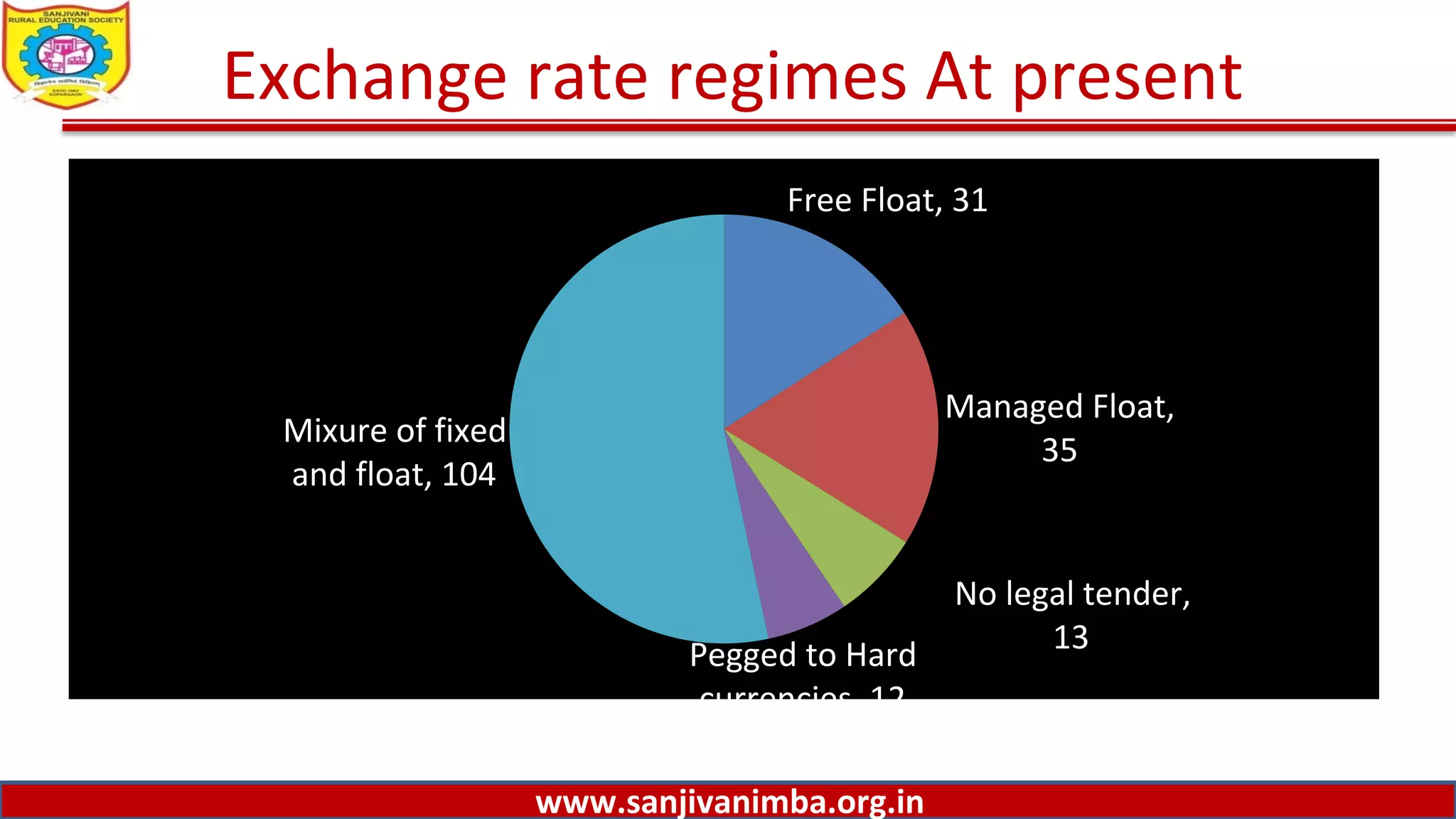
Free Float, 31
Managed Float,
35
No legal tender,
13Pegged to Hard
currencies, 12
Mixure of fixed
and float, 104
Exchange rate regimes At present
www.sanjivanimba.org.in
Thank You!!

Flexible exchange rate system