QUALITY FUNCTION 
DEPLOYMENT (QFD) 
by 
Sanower Ali Azad 
GGSIPU, NEW DELHI
QUALITY FUNCTION 
DEPLOYMENT (QFD) 
Quality Function Deployment (QFD) is 
an approach to design introduced in 
Japan in 1966 .
Why QFD? 
A lack of well defined product 
development processes in research and 
design can be the root cause for the 
ruination of a company. 
To have a successful product, we 
must understand user needs.
Why QFD? 
QFD provides a formal process to 
understand user needs and to weave these 
needs across the entire product 
development cycle including 
manufacturing.
DEFINITION OF QFD 
QFD is a very systematic and organized 
approach of taking customer needs and 
demands in the consideration when 
designing a new products and services or 
when improving existing products and 
services.
CUSTOMER DRIVEN PRODUCT DEVELOPMENT 
Design 
Requirements 
Cu 
Sto 
mer 
vo 
ice 
Process 
Parts 
Design 
Process 
Requirements Production 
Standards 
Parts 
Requirements 
Phase I: Product Planning 
Phase II: Part Deployment 
Phase III: Process Planning 
Phase IV: Production planning 
Phase I: 
Product 
Planning 
Phase II: Part 
Deployment 
Phase III: Process 
Planning 
Phase IV: 
Production 
planning
QFD BENEFITS 
CUSTOMER DRIVEN 
•Creates forces on customer 
requirements 
•Uses competitive information effectively 
•Prioritizes resources
QFD BENEFITS 
CUSTOMER DRIVEN 
•Identifies items that can be acted upon 
•Structures resident experience/ 
Information
QFD BENEFITS 
REDUCES IMPLEMENTATION TIME 
•Decreases midstream design charge 
•Limits post introduction problems 
•Avoids future development 
redundancies
QFD BENEFITS 
PROMOTES TEAMWORK 
•Consensus based 
•Creates communication at interfaces
QFD BENEFITS 
PROMOTES TEAMWORK 
•Identifies actions at interfaces 
•Creates global view out of details
QFD BENEFITS 
PROVIDES DOCUMENTATION 
• Documents rationale for design 
• Is easy to assimilate 
• Adds structure to the information
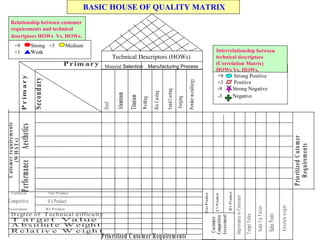
BASIC HOUSE OF QUALITY MATRIX 
Technical Descriptors (HOWs) 
Material Selection Manufacturing Process 
+9 Strong Positive 
+3 Positive 
-9 Strong Negative 
-3 Negative 
+9 Strong +3 Medium 
+1 Weak 
Interrelationship between 
technical descriptors 
(Correlation Matrix) 
HOWs Vs. HOWs. 
Relationship between customer 
requirements and technical 
descriptors HOWs Vs. HOWs.
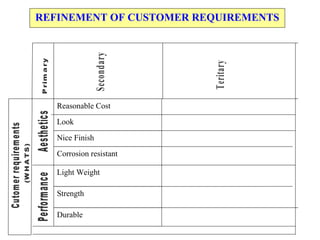
REFINEMENT OF CUSTOMER REQUIREMENTS 
Reasonable Cost 
Look 
Nice Finish 
Corrosion resistant 
Light Weight 
Strength 
Durable
REFINEMENT OF TECHNICAL DESCRIPTORS 
Steel 
Aluminum 
Titanium 
Welding 
Die Casting 
Sand Casting 
Forging 
Power Metallurgy
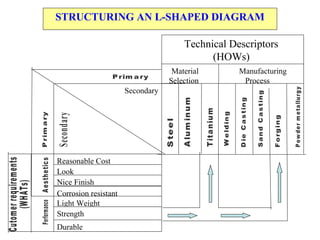
STRUCTURING AN L-SHAPED DIAGRAM 
Technical Descriptors 
(HOWs) 
Material Manufacturing 
Selection Process 
Reasonable Cost 
Look 
Nice Finish 
Corrosion resistant 
Light Weight 
Strength 
Durable 
Secondary

QUALITY FUNCTION DEPLOYMENT

  • 1.
    QUALITY FUNCTION DEPLOYMENT(QFD) by Sanower Ali Azad GGSIPU, NEW DELHI
  • 2.
    QUALITY FUNCTION DEPLOYMENT(QFD) Quality Function Deployment (QFD) is an approach to design introduced in Japan in 1966 .
  • 3.
    Why QFD? Alack of well defined product development processes in research and design can be the root cause for the ruination of a company. To have a successful product, we must understand user needs.
  • 4.
    Why QFD? QFDprovides a formal process to understand user needs and to weave these needs across the entire product development cycle including manufacturing.
  • 5.
    DEFINITION OF QFD QFD is a very systematic and organized approach of taking customer needs and demands in the consideration when designing a new products and services or when improving existing products and services.
  • 6.
    CUSTOMER DRIVEN PRODUCTDEVELOPMENT Design Requirements Cu Sto mer vo ice Process Parts Design Process Requirements Production Standards Parts Requirements Phase I: Product Planning Phase II: Part Deployment Phase III: Process Planning Phase IV: Production planning Phase I: Product Planning Phase II: Part Deployment Phase III: Process Planning Phase IV: Production planning
  • 7.
    QFD BENEFITS CUSTOMERDRIVEN •Creates forces on customer requirements •Uses competitive information effectively •Prioritizes resources
  • 8.
    QFD BENEFITS CUSTOMERDRIVEN •Identifies items that can be acted upon •Structures resident experience/ Information
  • 9.
    QFD BENEFITS REDUCESIMPLEMENTATION TIME •Decreases midstream design charge •Limits post introduction problems •Avoids future development redundancies
  • 10.
    QFD BENEFITS PROMOTESTEAMWORK •Consensus based •Creates communication at interfaces
  • 11.
    QFD BENEFITS PROMOTESTEAMWORK •Identifies actions at interfaces •Creates global view out of details
  • 12.
    QFD BENEFITS PROVIDESDOCUMENTATION • Documents rationale for design • Is easy to assimilate • Adds structure to the information
  • 13.
    BASIC HOUSE OFQUALITY MATRIX Technical Descriptors (HOWs) Material Selection Manufacturing Process +9 Strong Positive +3 Positive -9 Strong Negative -3 Negative +9 Strong +3 Medium +1 Weak Interrelationship between technical descriptors (Correlation Matrix) HOWs Vs. HOWs. Relationship between customer requirements and technical descriptors HOWs Vs. HOWs.
  • 14.
    REFINEMENT OF CUSTOMERREQUIREMENTS Reasonable Cost Look Nice Finish Corrosion resistant Light Weight Strength Durable
  • 15.
    REFINEMENT OF TECHNICALDESCRIPTORS Steel Aluminum Titanium Welding Die Casting Sand Casting Forging Power Metallurgy
  • 16.
    STRUCTURING AN L-SHAPEDDIAGRAM Technical Descriptors (HOWs) Material Manufacturing Selection Process Reasonable Cost Look Nice Finish Corrosion resistant Light Weight Strength Durable Secondary