COMPUTER AIDED
FORMULATION DEVELOPMENT :
OPTIMISATION
SUJITHA MARY
M.PHARM(2ND SEMESETER)
DEPARTMENT OF PHARMACEUTICS
ST JOSEPH COLLEGE OF PHARMACY
1
CONCEPT OF OPTIMIZATION:
• Product formulation is often considered as an art, the formulator’s experience and
creativity of converting raw materials into product
•The pharmaceutical scientist has the responsibility to choose and combine ingredients
that will result in a formulation, whose result or responses are of expected value.
•Before the advances in the research technique and availability of computes, the
formulation research was based on experience and experimenting by trial and error.
• In a pharmaceutical formulation and development various formulation trials have to be
done to obtain a good process and a suitable formulation.
2
• In the trial and error method, a lot of formulations have to be done to get a conclusion.
These can be minimized with the help of optimization technique.
• The word “optimize” is defined as:To make as PERFECT, EFFECTIVE, or
FUNCTIONAL as possible.
• The optimization techniques provide both a depth of understanding and an ability to
explore and defend ranges for formulation and processing factors.
• It is at this point that optimization can become a useful tool to quantitate a formulation
which is qualitatively determined.
• Optimization is used often in pharmacy with respect to formulation and to processing .
3
• Optimization is defined as follows:
“Choosing the best element from some set of available alternatives”.
It is the process of finding the best way of using the existing resources while taking
in to the account of all the factors that influences decisions in any experiment.
• The objective of designing quality formulation is achieved by various
Optimization techniques like DoE (Design of Experiment).
• The term FbD (Formulation by Design) & QbD (Quality by Design) indicates that
quality in the product can be built by using various techniques of DOE (Design of
Experiment).
4
Quality by Design (QbD)
• The pharmaceutical Quality by Design (QbD) is a systematic approach to development
that begins with predefined objectives and emphasizes product and process understanding
and process control, based on sound science and quality risk management.
• Quality by Design (QbD) is emerging to enhance the assurance of safe, effective drug
supply to the consumer, and also offers promise to significantly improve manufacturing
quality performance.
• The Quality of the pharmaceutical product can be evaluated by in vivo or in vitro
performance tests “QbD” assures in vitro product performance and In vitro product
performance provides assurance of in vivo product performance.
5
DOE(Design of Experiment)
• It is a mathematical tool for systematically planning and conducting scientific studies that
change experimental variables together in order to determine their effect on a given
response .
• It makes controlled changes to input variables in order to gain maximum amounts of
information on cause and effect relationships with a minimum sample size for optimizing
the formulation.
• In Optimization Method ,various types of Model used from preliminary screening of
factors to select their level and for finally study of their effect .so it’s depend upon the
formulator to choose a suitable model for study and help in minimizing the experimenting
time.
6
Define the Problem & Select the variables
Screening the factor and their level
Design the Formulation according to Model Used
Analyse the Result
Select the Check Point Formulation
Validate and Optimize the Model
(Basic Flow Chart for using DOE and optimizing the formulation)
7
Why optimization is necessary?
• Reduce the cost
• Save the time
• Safety and reduce the error
• Reproducibility
• Innovation and efficacy
8
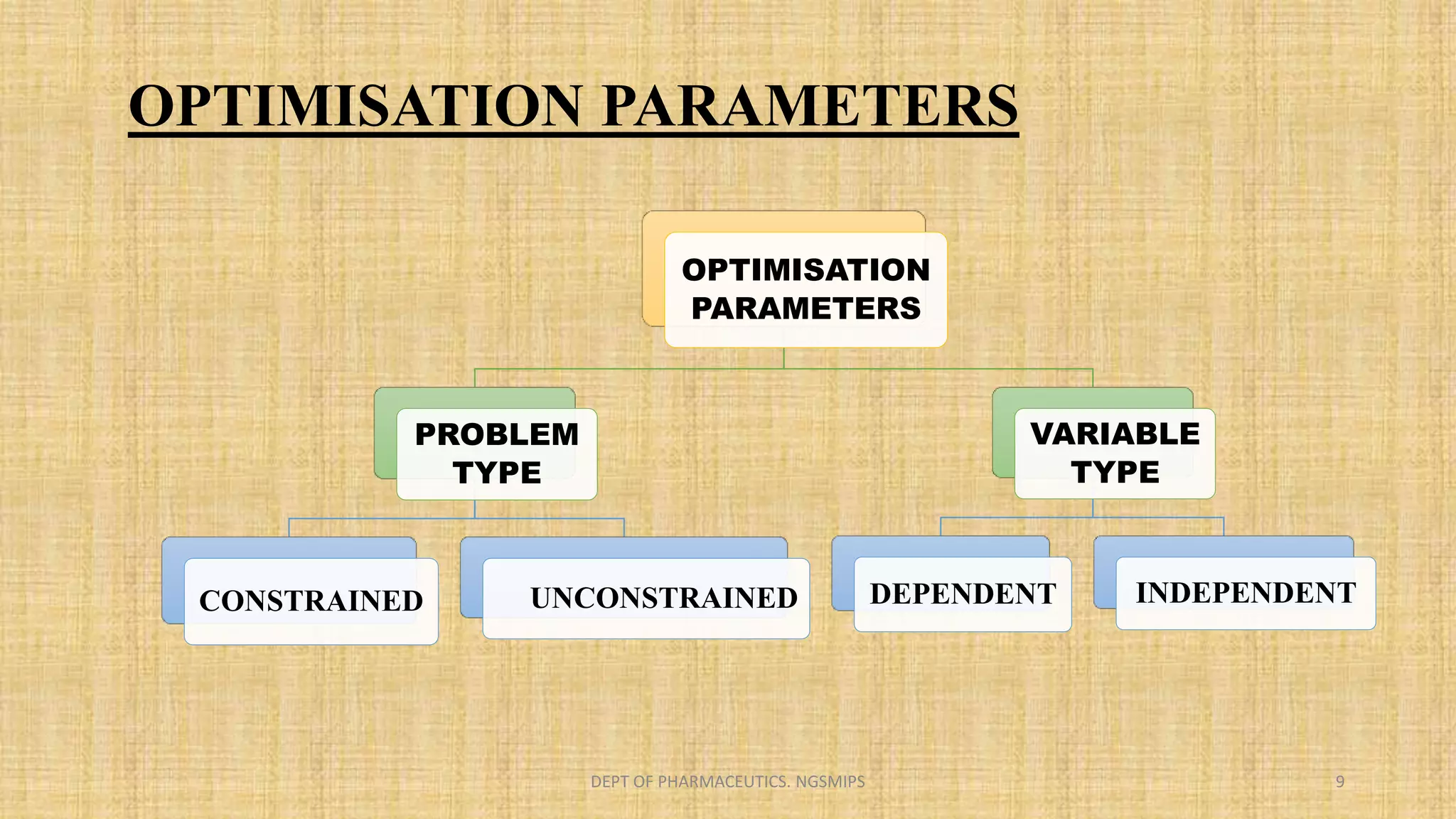
OPTIMISATION PARAMETERS
OPTIMISATION
PARAMETERS
PROBLEM
TYPE
CONSTRAINED UNCONSTRAINED
VARIABLE
TYPE
DEPENDENT INDEPENDENT
DEPT OF PHARMACEUTICS. NGSMIPS 9
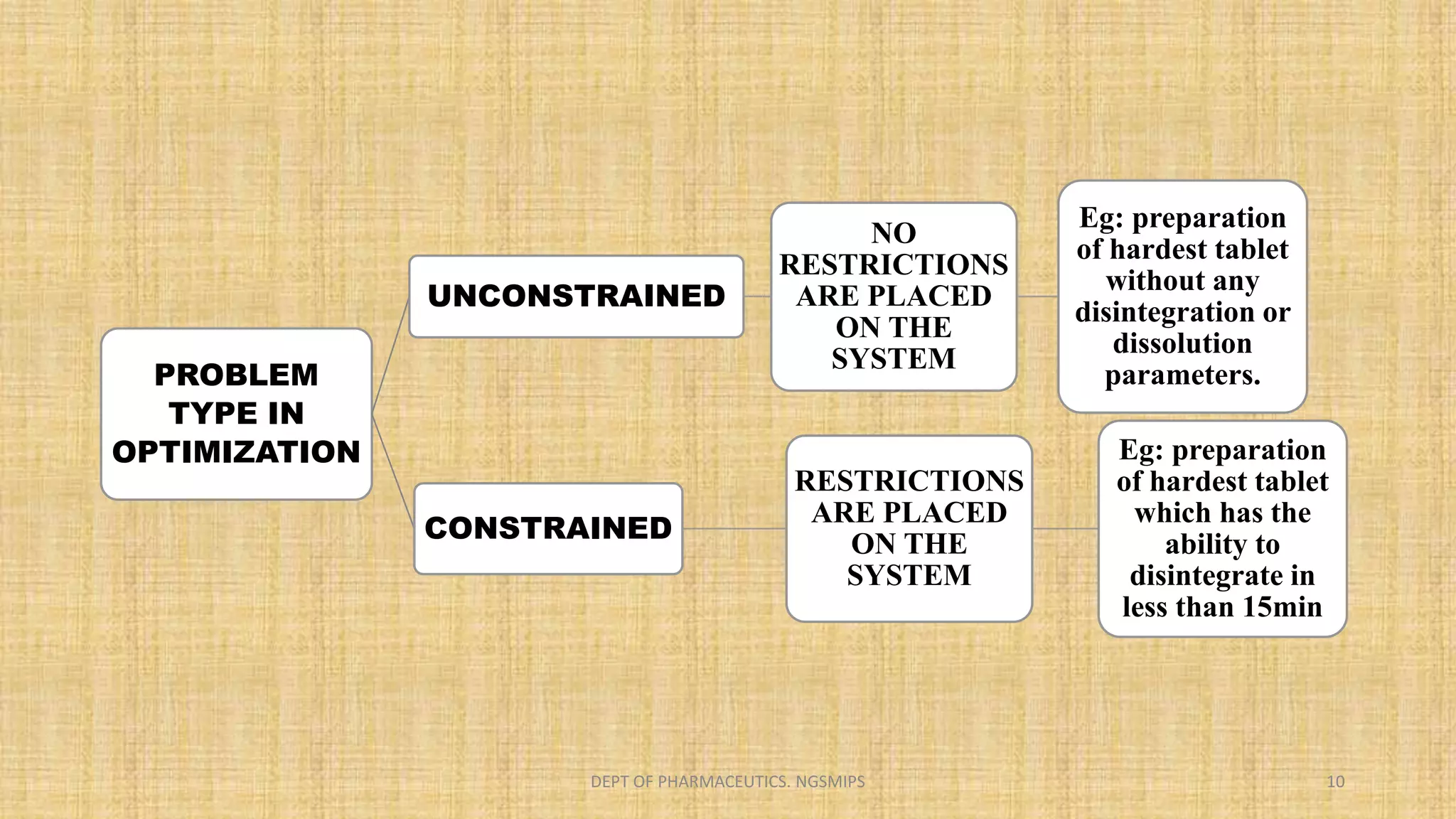
PROBLEM
TYPE IN
OPTIMIZATION
UNCONSTRAINED
NO
RESTRICTIONS
ARE PLACED
ON THE
SYSTEM
Eg: preparation
of hardest tablet
without any
disintegration or
dissolution
parameters.
CONSTRAINED
RESTRICTIONS
ARE PLACED
ON THE
SYSTEM
Eg: preparation
of hardest tablet
which has the
ability to
disintegrate in
less than 15min
DEPT OF PHARMACEUTICS. NGSMIPS 10
11
EXPERIMENTAL DESIGN
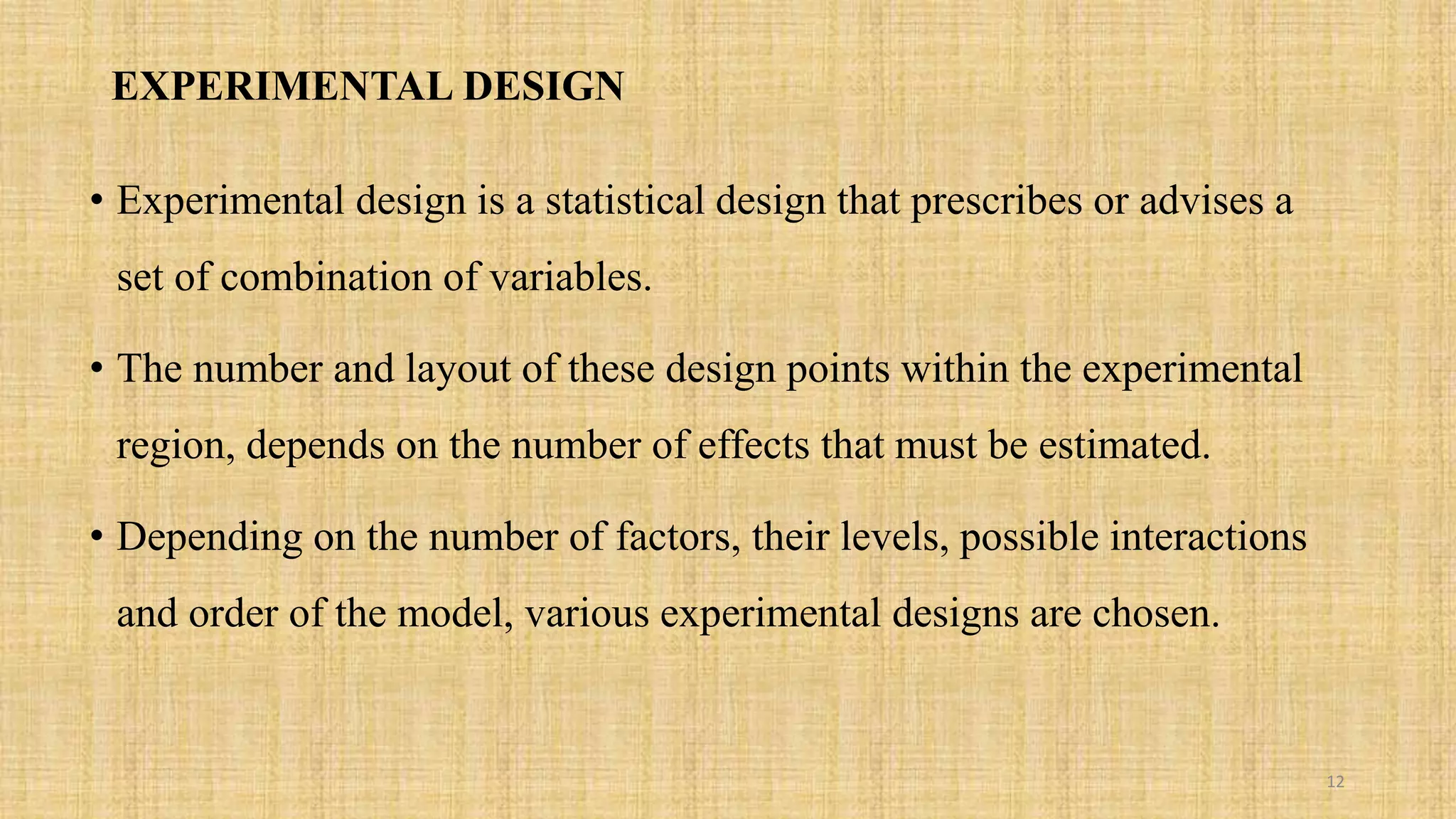
• Experimental design is a statistical design that prescribes or advises a
set of combination of variables.
• The number and layout of these design points within the experimental
region, depends on the number of effects that must be estimated.
• Depending on the number of factors, their levels, possible interactions
and order of the model, various experimental designs are chosen.
12
1. Factorial Designs
 Factorial designs (FDs) are very frequently used response surface designs.
 These are the designs of choice for simultaneous determination of the effects of
several factors & their interactions.
 Used in experiments where the effects of different factors or conditions on
experimental results are to be elucidated.
 Two types
 Full factorial- Used for small set of factors
 Fractional factorial- Used for optimizing more number of factors
DEPT OF PHARMACEUTICS. NGSMIPS 13
Full Factorial Designs
• Involves study of the effect of all factors(n) at various levels(x) including the interactions among them with
total number of experiments as Xn
• . If the number of levels is the same for each factor in the optimization study, the FDs are said to be
symmetric, whereas in cases of a different number of levels for different factors, FDs are termed
asymmetric.''
Fractional Factorial Design (FFD)
• Fractional factorial design is generally used for screening of factor.
• This design has low resolution due to less number of run.
• It is used to examine multiple factors efficiently with fewer runs than corresponding full factorial design.
DEPT OF PHARMACEUTICS. NGSMIPS 14
 Types of fractional factorial designs
 Homogenous fractional
 Mixed level fractional
 Box-Hunter
 Plackett - Burman
 Taguchi
 Latin square
15
 Homogenous fractional
 Useful when large number of factors must be screened.
 Mixed level fractional
 Useful when variety of factors need to be evaluated for main effects and higher
level interactions can be assumed to be negligible.
 Box-hunter
 Fractional designs with factors of more than two levels can be specified as
homogenous fractional or mixed level fractional.
16
 Plackett -Burman
It is a popular class of design.
 These designs are very efficient screening designs when only the main effects are of
interest.
 These are useful for detecting large main effects economically ,assuming all interactions
are negligible when compared with important main effects.
 Used to investigate n-1 variables in n experiments proposing experimental designs for more
than seven factors and especially for n*4 experiments.
17
 Taguchi
 It is similar to PBDs.
 It is a method of ensuring good performance in the development of products or processes."
 It allows estimation of main effects while minimizing variance.
 Latin square
 They are special case of fractional factorial design where there is one treatment factor of
interest and two or more blocking factors.
2. Screening Designs
It is used for identify the important factor and their level which affect the Quality of
Formulation. Screening Designs generally support only the linear responses.
18
3. Response Surface Designs
• These designs are used when we required exact image of
response, estimating interaction and even quadratic
effects. Response surface designs generally support non
linear and quadratic response and capable of detecting
curvatures .
 Two most common designs generally used in this
response surface modelling are
 Central composite designs
 Box-Behnken designs
19
Response surface representing the
relationship between the independent
variables X1 and X2 and the dependent
variable Y.
a. Central Composite Design (Box-Wilson design)
 This type contains an embedded factorial or fractional factorial design with centre
points that is augmented with the group of ‘star points’.
 The star points represent new extreme value (low & high) for each factor in the
design
 A CCD has three groups of design points:
(a) Two-level factorial or fractional factorial design points
(b) Axial points (sometimes called "star" points)
(c) Center points
20
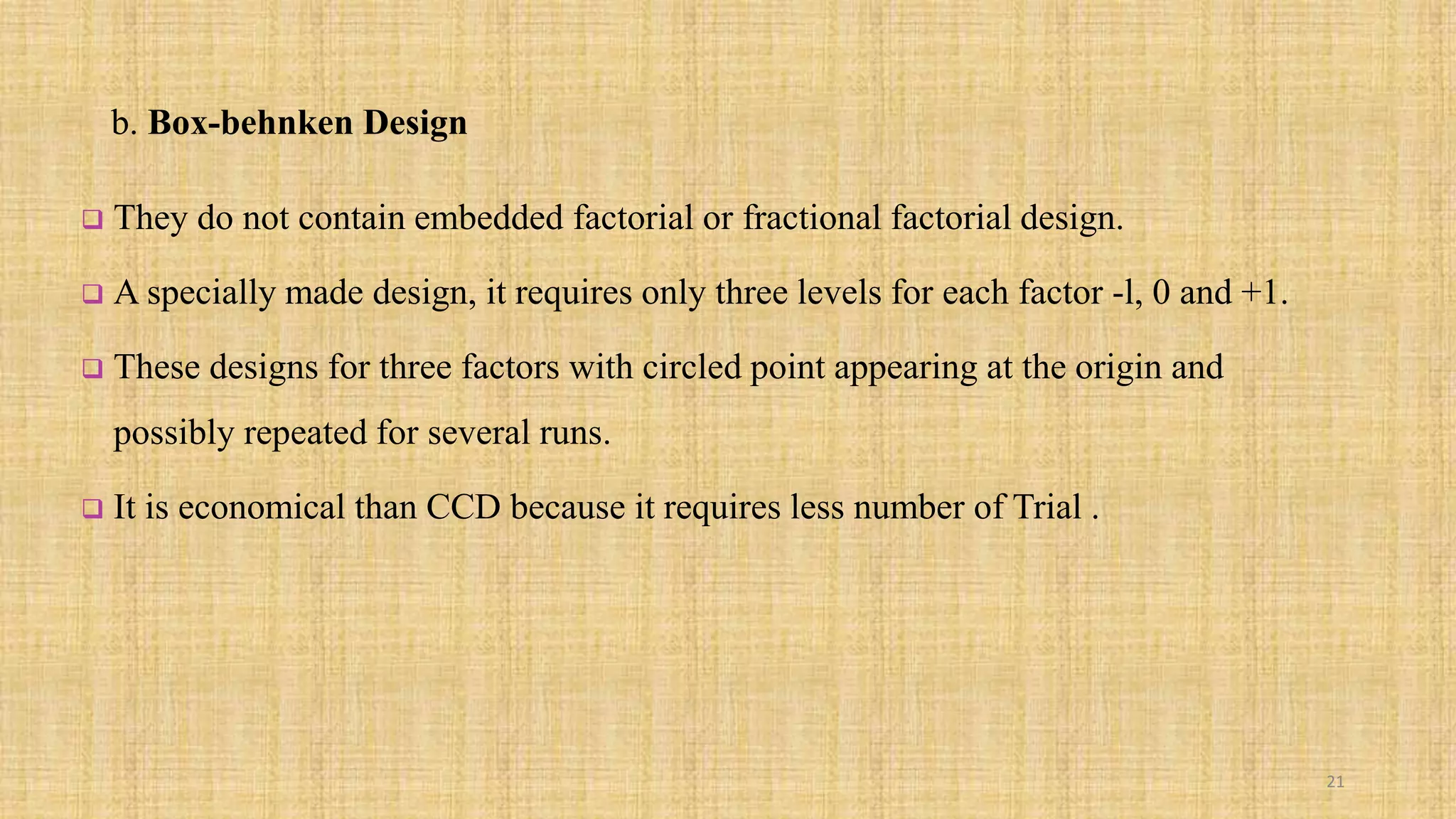
b. Box-behnken Design
 They do not contain embedded factorial or fractional factorial design.
 A specially made design, it requires only three levels for each factor -l, 0 and +1.
 These designs for three factors with circled point appearing at the origin and
possibly repeated for several runs.
 It is economical than CCD because it requires less number of Trial .
21
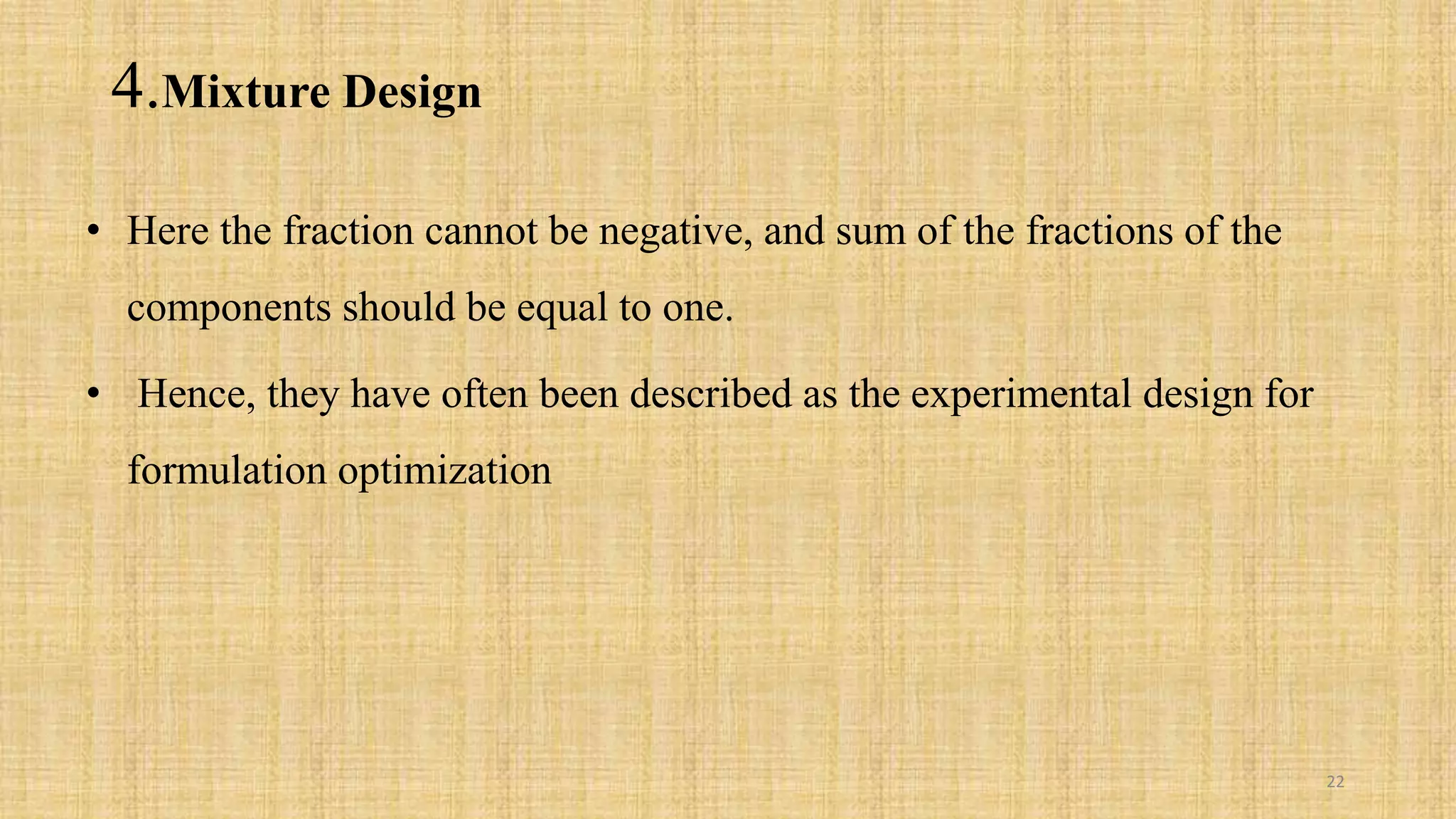
4.Mixture Design
• Here the fraction cannot be negative, and sum of the fractions of the
components should be equal to one.
• Hence, they have often been described as the experimental design for
formulation optimization
22
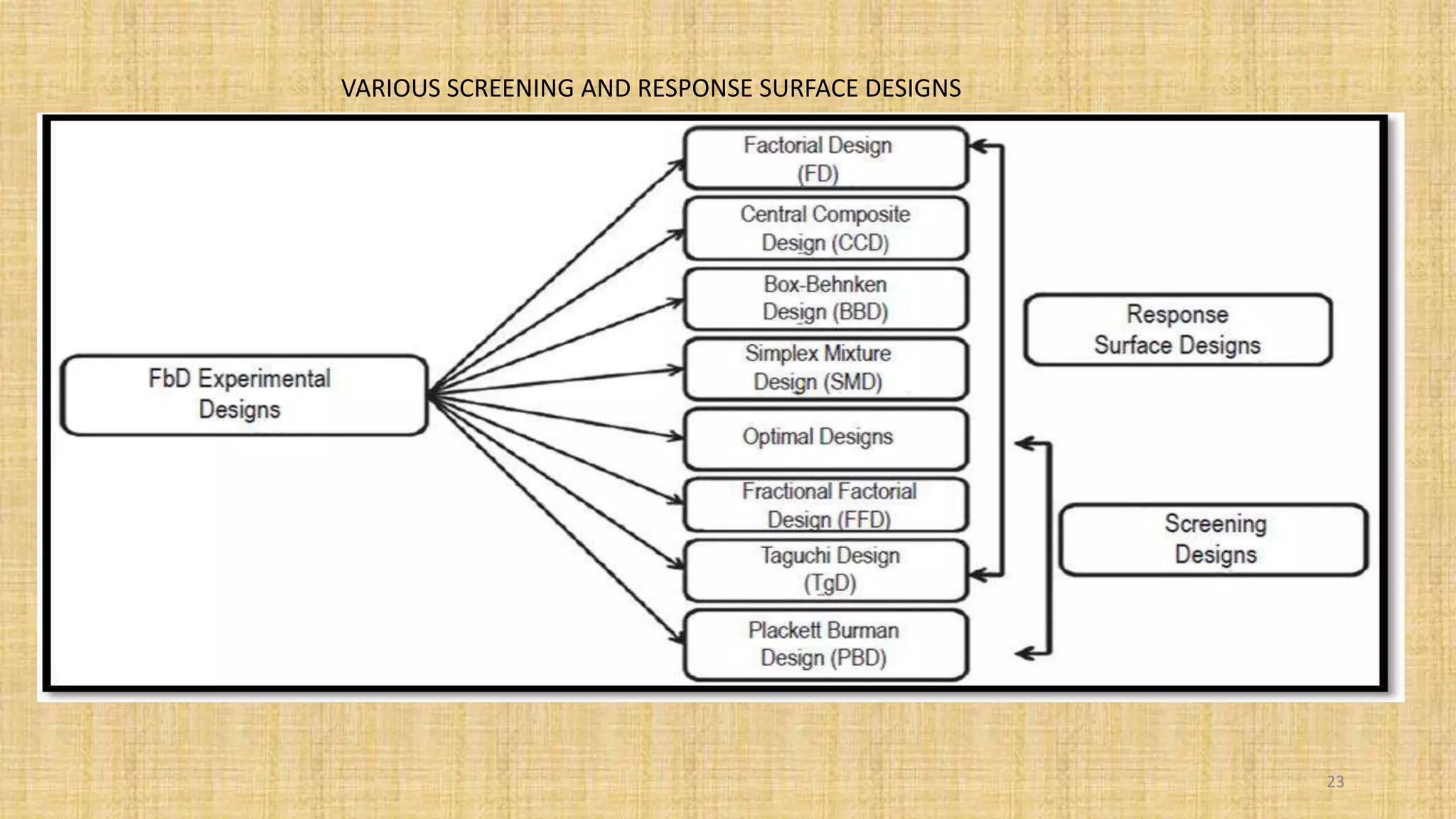
23
VARIOUS SCREENING AND RESPONSE SURFACE DESIGNS
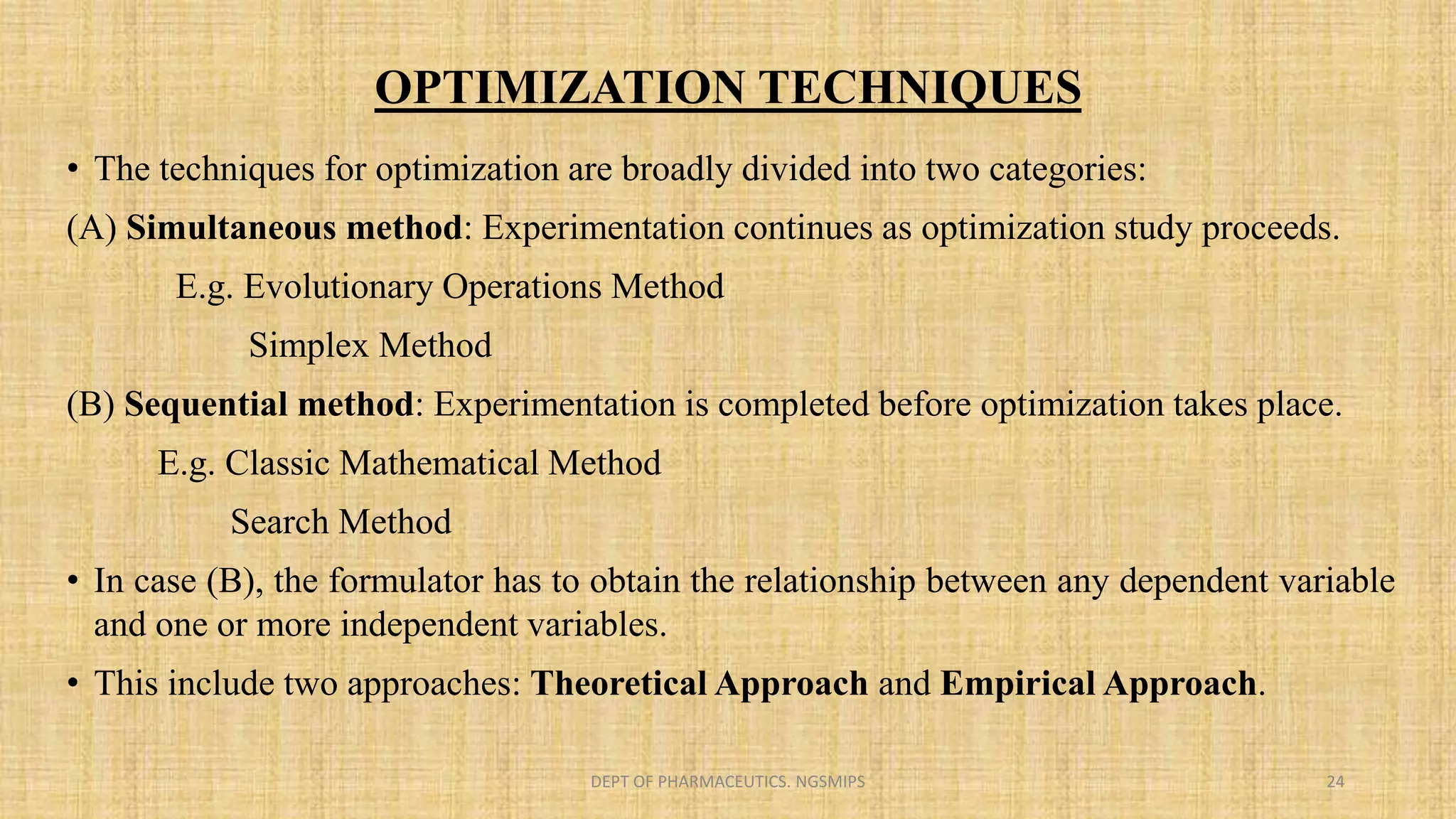
OPTIMIZATION TECHNIQUES
• The techniques for optimization are broadly divided into two categories:
(A) Simultaneous method: Experimentation continues as optimization study proceeds.
E.g. Evolutionary Operations Method
Simplex Method
(B) Sequential method: Experimentation is completed before optimization takes place.
E.g. Classic Mathematical Method
Search Method
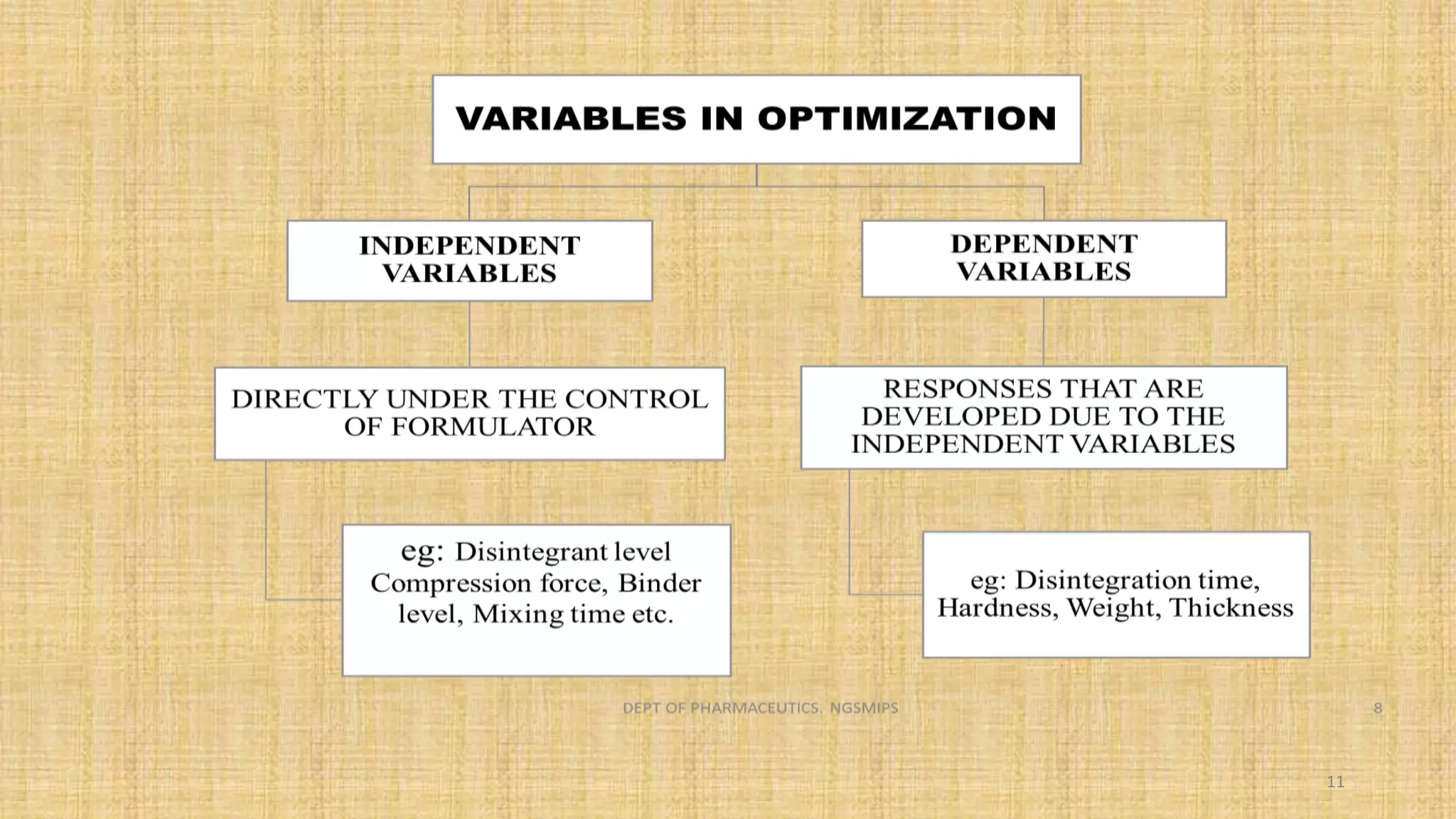
• In case (B), the formulator has to obtain the relationship between any dependent variable
and one or more independent variables.
• This include two approaches: Theoretical Approach and Empirical Approach.
DEPT OF PHARMACEUTICS. NGSMIPS 24
Evolutionary Operations (EVOP)
• It is a method of experimental optimization.
• Small changes in the formulation or process are made (i.e. repeats the experiment so
many times) and statistically analyzed whether it is improved.
• It continues until no further changes takes place i.e., it has reached optimum-the
peak
• The result of changes are statistically analyzed.
DEPT OF PHARMACEUTICS. NGSMIPS 25
A. SIMULTANEOUS METHOD
Example
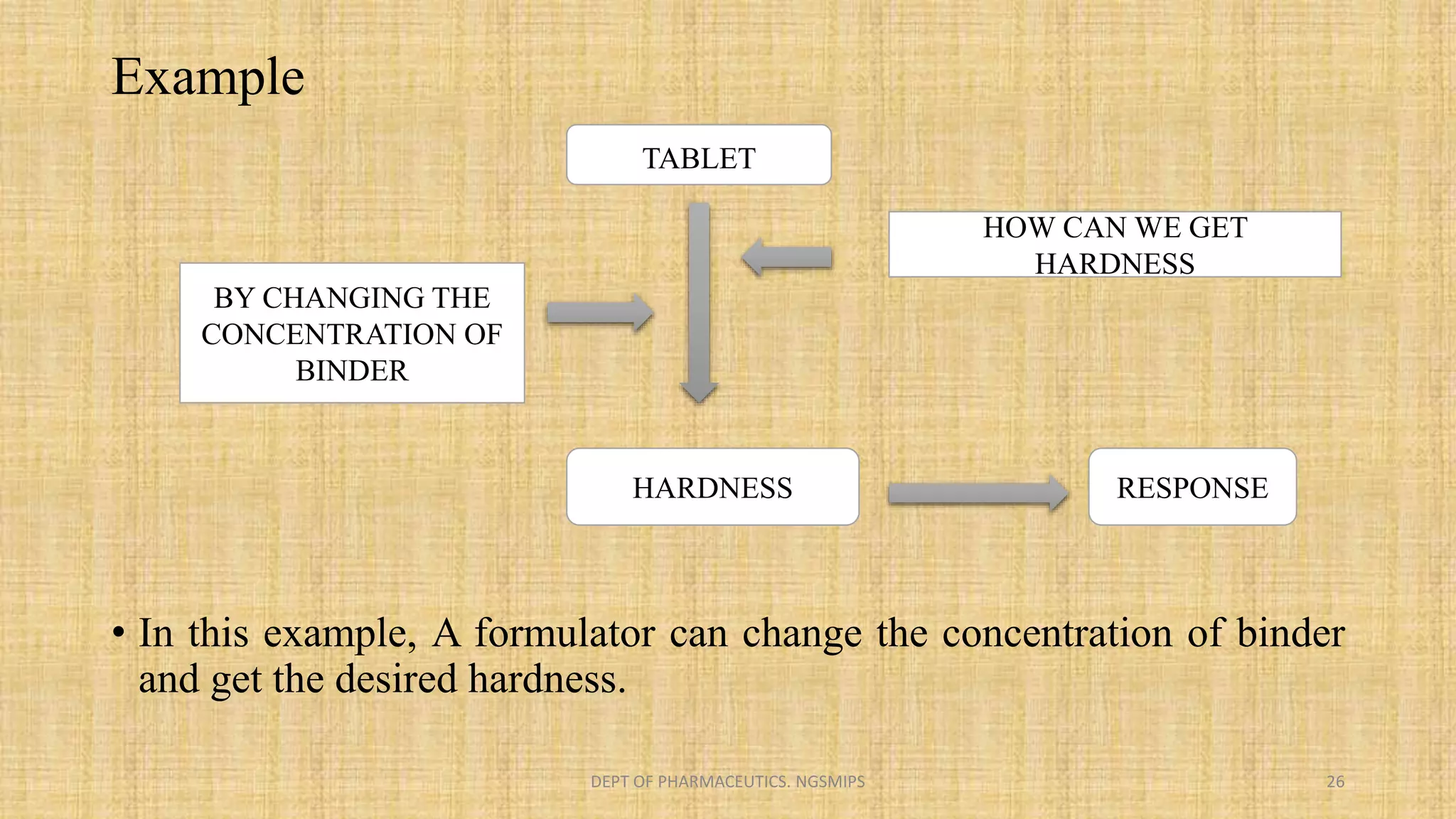
• In this example, A formulator can change the concentration of binder
and get the desired hardness.
DEPT OF PHARMACEUTICS. NGSMIPS 26
TABLET
HARDNESS RESPONSE
HOW CAN WE GET
HARDNESS
BY CHANGING THE
CONCENTRATION OF
BINDER
Simplex Method(simplex Lattice)
It is an experimental techniques & mostly used in analytical rather than formulation
& processing.
• Simplex is a geometric figure that has one more point than the number of factors.
Eg - If 2 independent variables then simplex is represented as triangle.
• The strategy is to move towards a better response by moving away from worst
response.
• Applied to optimize capsules, direct compression of tablet, liquid systems
(physical stability).
• It is also called as Downhill Simplex / Nelder-Mead Method.
DEPT OF PHARMACEUTICS. NGSMIPS 27
B. SEQUENTIAL METHOD
DEPT OF PHARMACEUTICS. NGSMIPS 28
Classic Mathematical Model
• Algebraic expression defining the dependence of a response variable on the
independent variables
• Two approaches:
 Theoretical approach- If theoretical equation is known , no experimentation is
necessary.
 Empirical or experimental approach – With single independent variable
formulator experiments at several levels.
Search Methods
• It is defined by appropriate equations.
• It do not require continuity or differentiability of function
• It is applied to pharmaceutical system.
• The response surface is searched by various methods to find the
combination of independent variables yielding an optimum.
• It takes five independent variables into account and is computer assisted.
DEPT OF PHARMACEUTICS. NGSMIPS 29
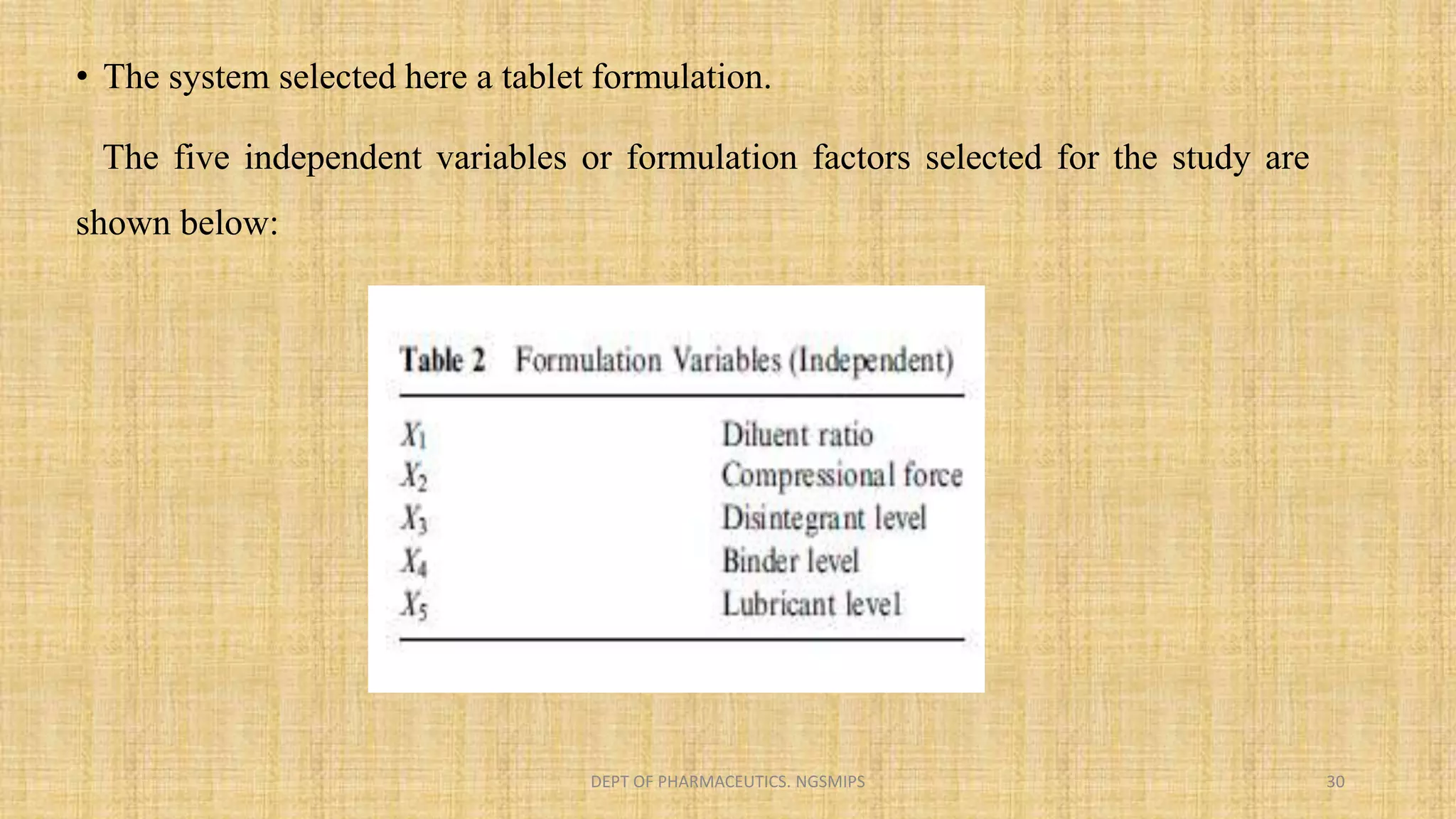
• The system selected here a tablet formulation.
The five independent variables or formulation factors selected for the study are
shown below:
DEPT OF PHARMACEUTICS. NGSMIPS 30
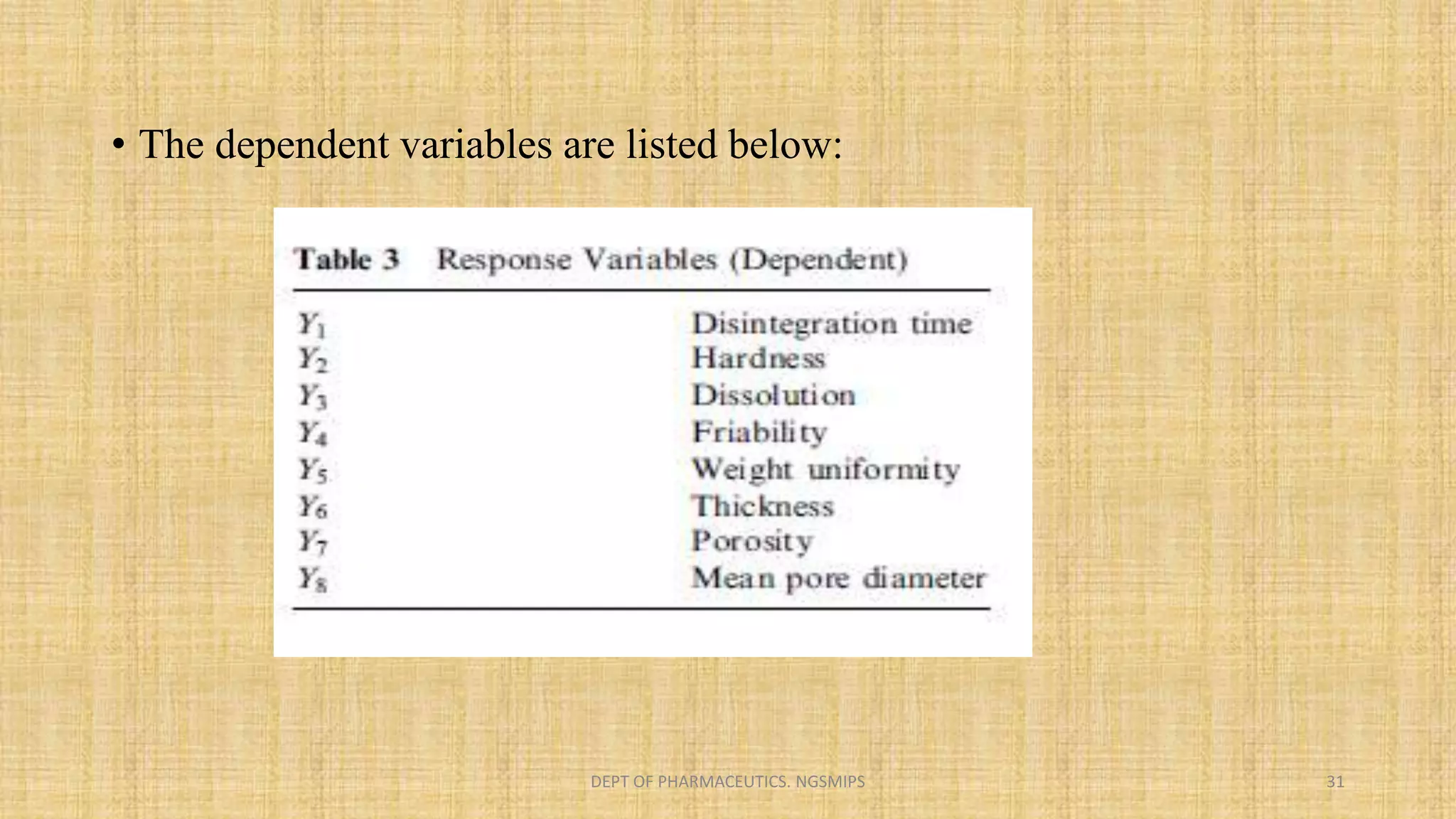
• The dependent variables are listed below:
DEPT OF PHARMACEUTICS. NGSMIPS 31
CONCLUSION
• The area of optimization is vary vast and its applications in all areas of
pharmaceutical science.
• Optimization helps in getting optimum product with desired bioavailability criteria
as well as mass production.
• Optimization techniques are help full in reducing the cost of product by
minimizing the number of experimental trials during formulation development.
32
REFERENCE
• G S Banker, CT Rhodes. Modern Pharmaceutics, Ed 4. Marcel
Dekker. New York. 2002; p: 607-24
• Djuris J.Computer aided application in pharmaceutical
technology.Wood head publishers . New delhi, 2013 ;P: 17-24
33

computer aided formulation development

  • 1.
    COMPUTER AIDED FORMULATION DEVELOPMENT: OPTIMISATION SUJITHA MARY M.PHARM(2ND SEMESETER) DEPARTMENT OF PHARMACEUTICS ST JOSEPH COLLEGE OF PHARMACY 1
  • 2.
    CONCEPT OF OPTIMIZATION: •Product formulation is often considered as an art, the formulator’s experience and creativity of converting raw materials into product •The pharmaceutical scientist has the responsibility to choose and combine ingredients that will result in a formulation, whose result or responses are of expected value. •Before the advances in the research technique and availability of computes, the formulation research was based on experience and experimenting by trial and error. • In a pharmaceutical formulation and development various formulation trials have to be done to obtain a good process and a suitable formulation. 2
  • 3.
    • In thetrial and error method, a lot of formulations have to be done to get a conclusion. These can be minimized with the help of optimization technique. • The word “optimize” is defined as:To make as PERFECT, EFFECTIVE, or FUNCTIONAL as possible. • The optimization techniques provide both a depth of understanding and an ability to explore and defend ranges for formulation and processing factors. • It is at this point that optimization can become a useful tool to quantitate a formulation which is qualitatively determined. • Optimization is used often in pharmacy with respect to formulation and to processing . 3
  • 4.
    • Optimization isdefined as follows: “Choosing the best element from some set of available alternatives”. It is the process of finding the best way of using the existing resources while taking in to the account of all the factors that influences decisions in any experiment. • The objective of designing quality formulation is achieved by various Optimization techniques like DoE (Design of Experiment). • The term FbD (Formulation by Design) & QbD (Quality by Design) indicates that quality in the product can be built by using various techniques of DOE (Design of Experiment). 4
  • 5.
    Quality by Design(QbD) • The pharmaceutical Quality by Design (QbD) is a systematic approach to development that begins with predefined objectives and emphasizes product and process understanding and process control, based on sound science and quality risk management. • Quality by Design (QbD) is emerging to enhance the assurance of safe, effective drug supply to the consumer, and also offers promise to significantly improve manufacturing quality performance. • The Quality of the pharmaceutical product can be evaluated by in vivo or in vitro performance tests “QbD” assures in vitro product performance and In vitro product performance provides assurance of in vivo product performance. 5
  • 6.
    DOE(Design of Experiment) •It is a mathematical tool for systematically planning and conducting scientific studies that change experimental variables together in order to determine their effect on a given response . • It makes controlled changes to input variables in order to gain maximum amounts of information on cause and effect relationships with a minimum sample size for optimizing the formulation. • In Optimization Method ,various types of Model used from preliminary screening of factors to select their level and for finally study of their effect .so it’s depend upon the formulator to choose a suitable model for study and help in minimizing the experimenting time. 6
  • 7.
    Define the Problem& Select the variables Screening the factor and their level Design the Formulation according to Model Used Analyse the Result Select the Check Point Formulation Validate and Optimize the Model (Basic Flow Chart for using DOE and optimizing the formulation) 7
  • 8.
    Why optimization isnecessary? • Reduce the cost • Save the time • Safety and reduce the error • Reproducibility • Innovation and efficacy 8
  • 9.
  • 10.
    PROBLEM TYPE IN OPTIMIZATION UNCONSTRAINED NO RESTRICTIONS ARE PLACED ONTHE SYSTEM Eg: preparation of hardest tablet without any disintegration or dissolution parameters. CONSTRAINED RESTRICTIONS ARE PLACED ON THE SYSTEM Eg: preparation of hardest tablet which has the ability to disintegrate in less than 15min DEPT OF PHARMACEUTICS. NGSMIPS 10
  • 11.
  • 12.
    EXPERIMENTAL DESIGN • Experimentaldesign is a statistical design that prescribes or advises a set of combination of variables. • The number and layout of these design points within the experimental region, depends on the number of effects that must be estimated. • Depending on the number of factors, their levels, possible interactions and order of the model, various experimental designs are chosen. 12
  • 13.
    1. Factorial Designs Factorial designs (FDs) are very frequently used response surface designs.  These are the designs of choice for simultaneous determination of the effects of several factors & their interactions.  Used in experiments where the effects of different factors or conditions on experimental results are to be elucidated.  Two types  Full factorial- Used for small set of factors  Fractional factorial- Used for optimizing more number of factors DEPT OF PHARMACEUTICS. NGSMIPS 13
  • 14.
    Full Factorial Designs •Involves study of the effect of all factors(n) at various levels(x) including the interactions among them with total number of experiments as Xn • . If the number of levels is the same for each factor in the optimization study, the FDs are said to be symmetric, whereas in cases of a different number of levels for different factors, FDs are termed asymmetric.'' Fractional Factorial Design (FFD) • Fractional factorial design is generally used for screening of factor. • This design has low resolution due to less number of run. • It is used to examine multiple factors efficiently with fewer runs than corresponding full factorial design. DEPT OF PHARMACEUTICS. NGSMIPS 14
  • 15.
     Types offractional factorial designs  Homogenous fractional  Mixed level fractional  Box-Hunter  Plackett - Burman  Taguchi  Latin square 15
  • 16.
     Homogenous fractional Useful when large number of factors must be screened.  Mixed level fractional  Useful when variety of factors need to be evaluated for main effects and higher level interactions can be assumed to be negligible.  Box-hunter  Fractional designs with factors of more than two levels can be specified as homogenous fractional or mixed level fractional. 16
  • 17.
     Plackett -Burman Itis a popular class of design.  These designs are very efficient screening designs when only the main effects are of interest.  These are useful for detecting large main effects economically ,assuming all interactions are negligible when compared with important main effects.  Used to investigate n-1 variables in n experiments proposing experimental designs for more than seven factors and especially for n*4 experiments. 17
  • 18.
     Taguchi  Itis similar to PBDs.  It is a method of ensuring good performance in the development of products or processes."  It allows estimation of main effects while minimizing variance.  Latin square  They are special case of fractional factorial design where there is one treatment factor of interest and two or more blocking factors. 2. Screening Designs It is used for identify the important factor and their level which affect the Quality of Formulation. Screening Designs generally support only the linear responses. 18
  • 19.
    3. Response SurfaceDesigns • These designs are used when we required exact image of response, estimating interaction and even quadratic effects. Response surface designs generally support non linear and quadratic response and capable of detecting curvatures .  Two most common designs generally used in this response surface modelling are  Central composite designs  Box-Behnken designs 19 Response surface representing the relationship between the independent variables X1 and X2 and the dependent variable Y.
  • 20.
    a. Central CompositeDesign (Box-Wilson design)  This type contains an embedded factorial or fractional factorial design with centre points that is augmented with the group of ‘star points’.  The star points represent new extreme value (low & high) for each factor in the design  A CCD has three groups of design points: (a) Two-level factorial or fractional factorial design points (b) Axial points (sometimes called "star" points) (c) Center points 20
  • 21.
    b. Box-behnken Design They do not contain embedded factorial or fractional factorial design.  A specially made design, it requires only three levels for each factor -l, 0 and +1.  These designs for three factors with circled point appearing at the origin and possibly repeated for several runs.  It is economical than CCD because it requires less number of Trial . 21
  • 22.
    4.Mixture Design • Herethe fraction cannot be negative, and sum of the fractions of the components should be equal to one. • Hence, they have often been described as the experimental design for formulation optimization 22
  • 23.
    23 VARIOUS SCREENING ANDRESPONSE SURFACE DESIGNS
  • 24.
    OPTIMIZATION TECHNIQUES • Thetechniques for optimization are broadly divided into two categories: (A) Simultaneous method: Experimentation continues as optimization study proceeds. E.g. Evolutionary Operations Method Simplex Method (B) Sequential method: Experimentation is completed before optimization takes place. E.g. Classic Mathematical Method Search Method • In case (B), the formulator has to obtain the relationship between any dependent variable and one or more independent variables. • This include two approaches: Theoretical Approach and Empirical Approach. DEPT OF PHARMACEUTICS. NGSMIPS 24
  • 25.
    Evolutionary Operations (EVOP) •It is a method of experimental optimization. • Small changes in the formulation or process are made (i.e. repeats the experiment so many times) and statistically analyzed whether it is improved. • It continues until no further changes takes place i.e., it has reached optimum-the peak • The result of changes are statistically analyzed. DEPT OF PHARMACEUTICS. NGSMIPS 25 A. SIMULTANEOUS METHOD
  • 26.
    Example • In thisexample, A formulator can change the concentration of binder and get the desired hardness. DEPT OF PHARMACEUTICS. NGSMIPS 26 TABLET HARDNESS RESPONSE HOW CAN WE GET HARDNESS BY CHANGING THE CONCENTRATION OF BINDER
  • 27.
    Simplex Method(simplex Lattice) Itis an experimental techniques & mostly used in analytical rather than formulation & processing. • Simplex is a geometric figure that has one more point than the number of factors. Eg - If 2 independent variables then simplex is represented as triangle. • The strategy is to move towards a better response by moving away from worst response. • Applied to optimize capsules, direct compression of tablet, liquid systems (physical stability). • It is also called as Downhill Simplex / Nelder-Mead Method. DEPT OF PHARMACEUTICS. NGSMIPS 27
  • 28.
    B. SEQUENTIAL METHOD DEPTOF PHARMACEUTICS. NGSMIPS 28 Classic Mathematical Model • Algebraic expression defining the dependence of a response variable on the independent variables • Two approaches:  Theoretical approach- If theoretical equation is known , no experimentation is necessary.  Empirical or experimental approach – With single independent variable formulator experiments at several levels.
  • 29.
    Search Methods • Itis defined by appropriate equations. • It do not require continuity or differentiability of function • It is applied to pharmaceutical system. • The response surface is searched by various methods to find the combination of independent variables yielding an optimum. • It takes five independent variables into account and is computer assisted. DEPT OF PHARMACEUTICS. NGSMIPS 29
  • 30.
    • The systemselected here a tablet formulation. The five independent variables or formulation factors selected for the study are shown below: DEPT OF PHARMACEUTICS. NGSMIPS 30
  • 31.
    • The dependentvariables are listed below: DEPT OF PHARMACEUTICS. NGSMIPS 31
  • 32.
    CONCLUSION • The areaof optimization is vary vast and its applications in all areas of pharmaceutical science. • Optimization helps in getting optimum product with desired bioavailability criteria as well as mass production. • Optimization techniques are help full in reducing the cost of product by minimizing the number of experimental trials during formulation development. 32
  • 33.
    REFERENCE • G SBanker, CT Rhodes. Modern Pharmaceutics, Ed 4. Marcel Dekker. New York. 2002; p: 607-24 • Djuris J.Computer aided application in pharmaceutical technology.Wood head publishers . New delhi, 2013 ;P: 17-24 33